
case_study
167 Comments Beat $889: Our B2B Organic Growth Ledger
August 28, 2026 · 9 min read · Scout7
A ledger-backed case study on B2B organic growth: how to price comment-led acquisition against paid CAC, with the arithmetic shown.
Deck: A ledger-backed case study in B2B organic growth that shows how to price comments, visits, and signups against paid CAC.
Introduction: B2B organic growth starts when the ledger gets honest
Your ads ran for weeks, the dashboard stayed busy, and the signup column stayed empty. That is the moment most B2B SaaS founders stop asking which channel is fashionable and start asking which one can actually be priced.
Here is the direct answer: to reduce SaaS customer acquisition cost, stop debating paid versus organic in theory and calculate both from your own ledger. In our case, paid spend produced zero signups to price, while a measured organic loop produced signups often enough to derive a real cost ratio.
Key takeaways:
- Zero-conversion paid spend cannot produce a usable CAC.
- Organic comments became measurable acquisition at roughly 167 per signup.
- On/off windows exposed incremental visits and signups.
- Attribution fixes mattered before any channel decision.
Customer Acquisition Cost is the total expense incurred by a business to acquire a new paying customer. It matters here because if the denominator is zero, your paid lane is not merely expensive; it is unpriced.
Organic Growth is the process of expanding a business’s reach, audience, or revenue through non-paid channels. It matters here because once non-paid activity creates repeatable signups, it becomes a budgetable system rather than vague awareness work.
This case study shows the exact arithmetic, the tracking mistakes that nearly hid it, and the founder-level method you can rerun on your own numbers. The first surprise sits in the paid ledger.
The $889.44 mistake: why paid ads stalled

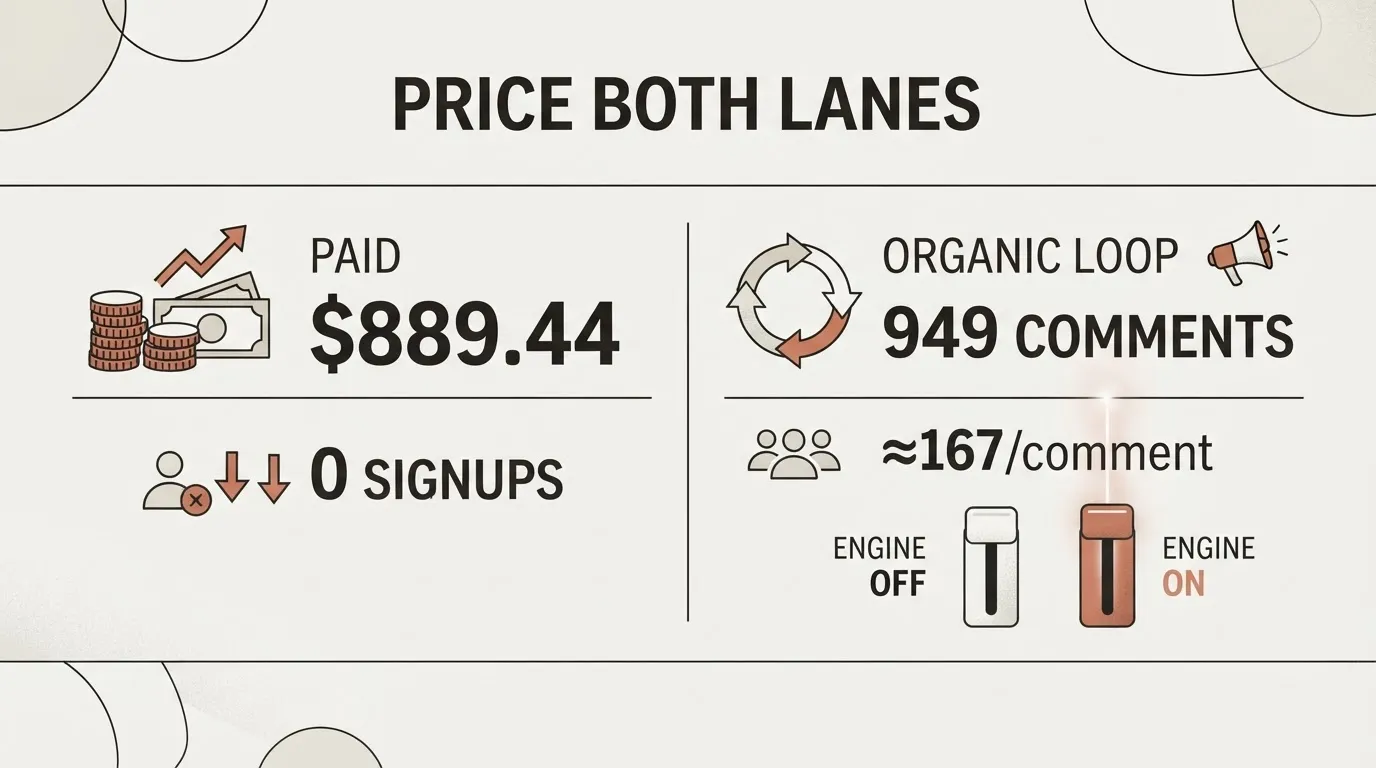
And that paid ledger was brutally simple. Across nine weeks and four platforms, our internal ledger showed $889.44 in ad spend and zero signups.
That result does not prove paid ads are dead. It proves something narrower: for this brand, in this period, the paid lane produced zero units at any price point.
- Spend: $889.44 across four platforms
- Duration: nine weeks
- Outcome: zero signups
- Conclusion: no CAC could be derived from paid
For a B2B SaaS founder, that distinction matters. Paid ads are sponsored distribution you buy upfront; useful when they convert, dangerous when they do not.
Budgets are also getting harder to defend. According to Forrester’s Budget Planning Survey 2025, more than 8 in 10 B2B marketing decision-makers (83%) expect increased investment, which raises pressure to show CAC efficiency instead of hiding dead spend inside blended reporting.
The real problem, though, was not philosophical. It was that another lane was quietly working, and bad attribution almost kept it invisible.
The organic loop: 167 comments to one signup

Once we stopped staring at ad dashboards, a different pattern appeared. The result that mattered was not reach, virality, or likes; it was a repeatable ratio from the ledger: roughly 167 comments per signup.
Based on what we saw when paid produced zero units to price across four platforms and nine weeks, while the comment engine produced measurable signups, we stopped treating organic as brand activity and started treating it as an acquisition lane.
That is the core move. Organic social media effective for B2B growth is not a slogan; it becomes true only when comments turn into visits and visits turn into signups at a rate you can observe.
- Useful unit: comments per signup
- Not useful enough alone: impressions, likes, follower growth
- Decision rule: if the ratio repeats, you can budget the work
- Operating frame: run the engine, log output, compare against paid
This is also not fringe behavior anymore. According to HubSpot’s 2026 State of Marketing Report, 4 in 10 marketers globally (40%) now use organic social media marketing, making unpaid distribution a mainstream channel rather than an experiment.
The next question is the one founders should ask immediately: what did the arithmetic actually look like?
The arithmetic, shown

Here is the plain derivation. When the organic engine was on, signups ran at 0.90 per day; when it was off, they ran at 0.33 per day.
Over a ten-day on-window, that implies about 5.7 incremental signups. Against 949 comments, that yields roughly 167 comments per signup.
Traffic showed the same pattern. Visits ran at 44.2 per day with the engine on versus 23.7 per day off.
That difference implies about 205 incremental visits, which means roughly 4.6 comments per visitor. At the paid lane’s $0.317 per visitor, each comment did about $0.068 of paid-equivalent work.
- Signups on: 0.90/day
- Signups off: 0.33/day
- Incremental signups: about 5.7 over ten days
- Comments: 949 total
- Ratio: about 167 comments per signup
- Paid-equivalent value per comment: about $0.068
The caveat is the point, not a footnote. This was a data problem first: 69% of organic arrivals carried no referrer, one Google Search campaign ran untagged and contaminated a month of “organic” numbers, and bio links were tagged on only one of three platforms.
According to Adobe’s 2026 AI and Digital Trends in B2B Journey Orchestration report, only about 4 in 10 organizations (41%) have a unified customer data foundation that can support AI at scale. Many SaaS teams still cannot see cross-channel CAC clearly enough to choose the right lane.
That is why the article exists at all. Fix the math before the workflow, and before the culture. Then you can build an engine instead of an argument.
Building your own organic growth engine

Once the arithmetic was visible, the lesson got narrower and more useful. The answer was not “post more.” It was “build a loop you can turn on, turn off, tag correctly, and price.”
That is where marketing automation matters. Marketing automation is software that systematizes recurring marketing work such as publishing, tagging, routing, and reporting so a small team can run the same loop consistently.
- Set on/off windows to isolate incremental traffic and signups
- Tag every bio link and every campaign before judging CAC
- Review a weekly ledger of comments, visits, and signups
- Automate the loop so execution stays consistent
- Re-price each cycle instead of trusting channel lore
This is also increasingly aligned with buyer behavior. According to McKinsey’s 2026 Global B2B Pulse Survey, B2B buyers now use an average of 10 channels during the purchase journey.
The same McKinsey research reports that about 7 in 10 B2B companies (71%) now offer e-commerce and that roughly one-third of revenue already flows through digital channels among those firms.
Public proof matters more in that environment. Forrester says social media is now the second most meaningful information source for B2B buyers, Gartner found about two-thirds of buyers (67%) prefer a rep-free experience, and G2 reports just over half of software buyers (51%) now start research with an AI chatbot more often than Google.
That is why Scout7 frames this as an organic marketing loop, not a posting routine. For teams exploring an autonomous marketing growth loop, an AI agent, MCP, or Claude-based workflow, the test stays the same: can you measure incremental output and price it honestly?
Price both lanes, then decide

So we return to the opening scene: a dashboard full of activity and a signup column with nothing in it. The fix is not a hotter take on paid ads. The fix is a cleaner ledger.
To answer the article’s two core questions directly: How do you reduce B2B SaaS customer acquisition costs? You reduce them by measuring incremental signups and visits by channel, then shifting effort toward the lane that produces lower-cost, repeatable acquisition on your own books. Is organic social media effective for B2B growth? Yes—when it is run as a measured loop with proper attribution, not as vague awareness work.
ROI matters because every channel consumes time or cash. ROI is the return you get from that investment, and in this case the highest-confidence return came from the lane we could actually price.
- Paid with zero signups is not “expensive”; it is unpriced
- Organic with repeatable ratios becomes budgetable acquisition
- Attribution fixes first or both lanes look random
- Weekly re-pricing beats annual channel debates
If you want to run your growth loop this week, do three things. Tag every link, define one on/off test window, and review comments, visits, and signups from a single ledger.
Then decide where budget moves next.
One final guardrail: this article was AI-assisted and edited for accuracy by Scout7, and any AI-assisted posts, carousels, videos, or articles should be disclosed clearly. Results may vary, but the method does not: price both lanes, then choose the one your own arithmetic can defend.
Frequently asked questions
Why couldn’t paid CAC be calculated in this case?
Because the paid campaigns spent $889.44 over nine weeks and produced zero signups. With no conversions in the denominator, there is no usable CAC to calculate from that lane.
What does 167 comments per signup actually mean?
It means the measured organic loop produced roughly one signup for every 167 comments logged during the on-window. In this article, that ratio came from 949 comments and about 5.7 incremental signups over ten days.
How were the incremental signups estimated?
The article compares on/off windows rather than relying on a single traffic source report. Signups ran at 0.90 per day when the engine was on versus 0.33 per day when it was off, which implies about 5.7 incremental signups over ten days.
What should a B2B team do before judging organic growth?
Fix attribution first. In this case, 69% of organic arrivals had no referrer, one Google Search campaign was untagged, and bio links were tagged on only one of three platforms, all of which could hide the real performance of the channel.
References
McKinsey & Company, The surprising economics of B2B growth: The new survival threshold—and what it takes to thrive
https://www.mckinsey.com/~/media/mckinsey/business%20functions/marketing%20and%20sales/our%20insights/the%20surprising%20economics%20of%20b2b%20growth%20the%20new%20survival%20threshold%20and%20what-it-takes-to-thrive/the-surprising-economics-of-b2b-growth-the-new-survival-threshold-and-what-it-takes-to-thrive.pdfHubSpot, Organic marketing secrets in 2026: Why paid ads aren’t the only answer
https://blog.hubspot.com/marketing/organic-marketingAdobe, 2026 AI and Digital Trends in B2B Journey Orchestration
https://business.adobe.com/resources/reports/b2b-marketing-digital-trends.htmlForrester, B2B Marketing Budgets 2026: Markets Are Volatile, But Planning Needn’t Be
https://www.forrester.com/blogs/b2b-marketing-budgets-2026-markets-are-volatile-but-planning-neednt-be/Forrester, Social Media Takes Center Stage In B2B Buying — Even In The AI Era
https://www.forrester.com/blogs/social-media-takes-center-stage-in-b2b-buying-even-in-the-ai-era/Gartner, Gartner Sales Survey Finds 67% of B2B Buyers Prefer a Rep-Free Experience
https://www.gartner.com/en/newsroom/press-releases/2026-03-09-gartner-sales-survey-finds-67-percent-of-b2b-buyers-prefer-a-rep-free-experienceG2, Your Buyers Are Using AI to Find Software. Here's What They're Trusting
https://learn.g2.com/your-buyers-are-using-ai-to-find-software.-heres-what-theyre-trustingG2, New G2 Research: AI Is Reshaping How B2B Software Deals Are Won and Lost
https://company.g2.com/news/buyer-behavior-2026