
comparison
4.3 Comments Per Follower: The Real Social Media Engagement Cost
August 28, 2026 · 9 min read · Scout7
Follower counts hide the real cost of organic growth. Compare Threads, X, and Instagram by comment tax and choose the right platform currency.
Read time: 5 minutes
Introduction
You can buy a lot of false confidence with a follower chart. The more useful social media engagement cost for a B2B SaaS founder is simpler: how many comments did it take to earn each follower, and was that effort buying audience, conversation, or both?
Most founders watch follower counts because they are visible. This piece argues for a better ledger: comments per follower, plus reply behavior, so you can compare Threads, X, and Instagram by effort instead of vibes.
Key takeaways:
- Threads won follower efficiency at 4.3 comments per follower
- Instagram won conversation quality despite higher follower cost
- X lost both tests in this measured 10-day run
- Reply-first lowered effort more than reach-first posting
That shift matters because organic growth is not paid ads. Paid ads let you spend money for distribution, while organic growth asks you to spend time, attention, and system design instead.
For a B2B SaaS founder, that means your real customer acquisition cost is not just ad spend. It also includes the labor required to earn trust in public, and comments are one clean way to price that labor.
The good news is that you can measure it. The harder part is accepting that the cheapest platform for audience may not be the best one for conversation.
Social Media Engagement Cost: Why Follower Counts Mislead

Once you stop staring at follower totals, the hidden tax appears. A rising audience can still mask weak market signal if you do not know how much commenting effort bought it.
The honest comparison is comments per follower. If Platform A needs 4 comments to gain a follower and Platform B needs 12, the second platform is charging a much steeper engagement tax.
- Followers are lagging output while comments capture current effort
- Visible interaction builds trust during B2B evaluation
- Lower comment tax saves founder time when execution bandwidth is tight
- Without effort data, platform comparisons stay distorted
According to Forrester’s January 2026 research, based on data from more than 17,000 global business buyers, social media is now the second most meaningful source of information in the purchase journey. That is why visible comments can matter more than vanity audience size.
And the supply of comments is tightening. Socialinsider’s 2026 benchmark, drawn from 70 million posts, found average comments per post fell by about one-quarter (24%) on TikTok and about one-sixth (16%) on Instagram.
So the next question is obvious: if comments are scarcer, which platform buys the result you need most efficiently?
Threads, X, and Instagram Price Attention Differently

That question is where our 10-day run stopped being abstract. We measured one brand from zero, using the same agent over ten days, and logged 840 comments to compare what each platform actually paid back.
Based on what we saw when one brand went from zero to 840 comments in ten days, reply-first moved traffic for that brand, but the payout changed sharply by platform.
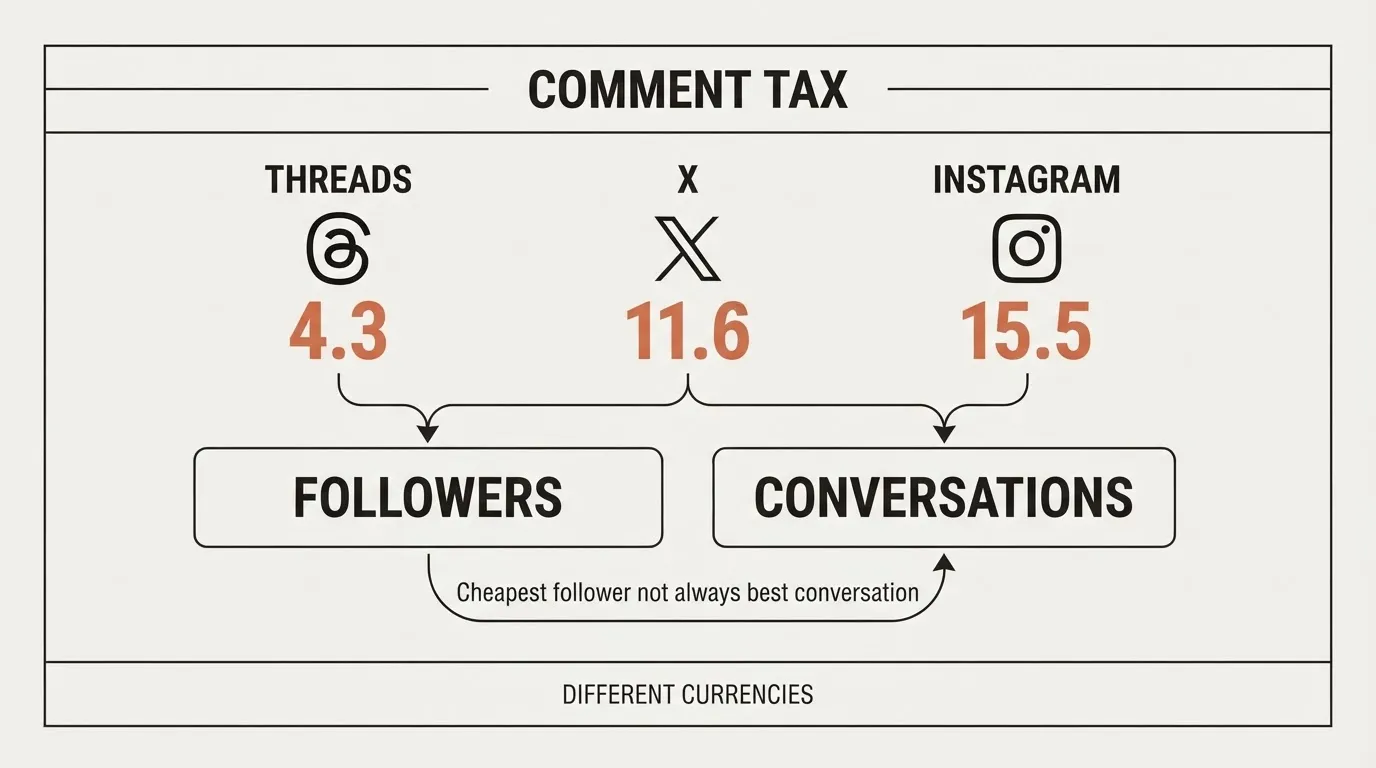
- Threads was cheapest for audience at 4.3 comments per follower
- Instagram was most expensive for followers at 15.5 comments per follower
- X underperformed on audience at 11.6 comments per follower
- Instagram showed stronger conversation with a 23.8% reply rate
- About 14.5% of Instagram post authors replied, roughly four times X’s rate
- X managed only a 3.3% author-reply rate on our biggest effort of 313 comments
That is the whole finding: there was no universal winner. Threads bought audience cheapest, Instagram bought discussion better, and X lost both games in this run.
External benchmarks support the skepticism around X. Quid’s 2026 benchmark report, built from millions of posts and billions of interactions across 18 industries, found median X engagement rebounded to three-hundredths of a percent (0.03%) in 2025 after a 0.015% low in 2024.
That tiny baseline helps explain why X’s reputation often exceeds its actual comment economics. It also fits Forrester’s 2026 buyer data, where more than half of Gen Z business buyers said five or more social sites matter in their purchase journey.
So if there is no single winner, what mechanic actually moves the numbers?
Reply-First Beats Reach-First

The clearest answer from the run was not “post more.” It was “reply more,” because the method was reply-first from day one.
We used the same agent, started from zero, and ran for ten days. Over that span, the system recorded 840 comments, and the strongest lift came from staying inside active conversations rather than broadcasting into the feed.
- Method: same agent, ten days, from zero, 840 comments
- Priority: replies first, posts second
- Measured effect: when replies stopped, traffic fell
- Why it matters: shutoff testing made the pattern measurable
That shutoff test matters because it turns a hunch into a signal. When the replies stopped, traffic dropped, which showed the motion was not just anecdotal momentum.
The broader benchmark supports that mechanism. Buffer’s March 2026 analysis of more than 52 million posts found accounts that consistently reply to comments outperform those that do not by as much as about two-fifths (42%) on Threads.
The same Buffer research also found reply-heavy accounts outperformed on LinkedIn by about 30%, which reinforces the bigger pattern: conversation often beats reach hacks.
That matters for marketing automation too. If your system can help monitor threads, draft responses, and keep your organic marketing loop moving, it reduces the manual burden of showing up consistently.
But even if reply-first works, founders still need to decide where their limited time goes next.
So Where Should SaaS Founders Spend Time?

The short answer is this: spend time where the payout matches the outcome you need this week. Do not default to the platform with the loudest reputation.
If you need audience growth, Threads was the better test in this run. If you need higher-quality discussion, Instagram earned serious consideration even though its follower cost was higher.
- Choose Threads when low-effort follower growth is the goal
- Choose Instagram when discussion quality matters more than raw audience
- Be cautious with X for B2B social media comments to followers
- Track your own ledger before declaring any universal winner
This is where ROI matters. ROI is return on investment, and in organic growth the investment is often founder time, team time, or automated execution rather than media spend.
That is also why customer acquisition cost belongs in this conversation. Even without paid ads, your acquisition cost rises when each follower or conversation demands more manual work.
For busy operators, marketing automation can lower that burden. Scout7’s approach is an autonomous marketing growth loop: scan the site, create assets, publish, measure, and run your growth loop again with an AI agent, one line connecting your agent through MCP and builder tools like Claude.
That operational gap is real. In Adobe’s global survey of nearly 800 B2B organizations, about 41% said they had a unified customer data foundation ready for AI at scale, while about 72% cited skills gaps as a major barrier to deploying agentic AI effectively.
At the same time, Social Media Examiner’s 2026 report found nearly three-quarters of marketers (73%) now use AI every day, up from about 37% in 2024. The implication is simple: automation adoption is rising, but execution still breaks when the workflow is too heavy.
So the next move is not to copy our result. It is to price your own platforms with the same ledger.
Count the Cost, Then Run Your Loop

You started with a follower count. You should end with a cost model.
The practical question is not “Which platform is best?” It is “How many comments do I need to get a follower, and is that effort buying audience or conversation?”
In our measured run, Threads beat X on follower efficiency, with 4.3 comments per follower versus 11.6 on X. But Instagram, despite its 15.5 comment tax for followers, returned stronger conversation behavior, which may be the better currency if your category needs visible discussion before trust forms.
Key takeaways:
- Measure comments per follower before judging organic performance
- Use Threads for cheaper audience tests if replies stay active
- Use Instagram for richer discussion when conversation is the goal
- Run shutoff tests to see whether replies actually move traffic
This is not a law. We measured one brand, from zero, for ten days, and reply-first moved that brand’s traffic; when we stopped replying, traffic fell by 46% over three days. Results may vary by audience, category, and execution.
That is exactly why founders should keep their own weekly ledger:
- Comments made by platform
- Replies received by platform
- Followers gained by platform
- Traffic change after shutoff periods
- Time spent by human or AI agent
If you want a clean system for that process, build it into a weekly organic marketing loop instead of treating social as random acts of posting. And if you publish with Scout7, disclose it clearly as AI-generated or Powered by Scout7 AI, so the workflow stays transparent.
Count the effort, choose the currency, and run your growth loop long enough to trust what it tells you.
Frequently asked questions
What is social media engagement cost in this article?
Here, social media engagement cost means the effort required to earn results organically, measured mainly as comments per follower. The article uses comments as a practical way to price founder time, attention, and execution across Threads, X, and Instagram.
Which platform had the lowest follower cost in the 10-day run?
Threads had the best follower efficiency in this run at 4.3 comments per follower. X came in at 11.6 comments per follower, while Instagram was highest at 15.5.
If Instagram was more expensive for followers, why would a founder still choose it?
Because it produced stronger conversation behavior in this test. The article reports a 23.8% reply rate on Instagram and says about 14.5% of Instagram post authors replied, which made it more valuable when discussion quality mattered more than raw audience growth.
What does reply-first mean, and why did it matter here?
Reply-first means prioritizing comments and replies inside active conversations before focusing on posting into the feed. In this run, when replies stopped, traffic fell, including a 46% drop over three days in the shutoff test, which suggested replies were driving the lift.
References
- Buffer — The State of Social Media Engagement in 2026: 52M+ Posts Analyzed
- Quid — 2026 Social Media Industry Benchmark Report
- Socialinsider — 2026 Social Media Benchmarks
- Forrester — Social Media Takes Center Stage In B2B Buying — Even In The AI Era
- Adobe — 2026 AI and Digital Trends in B2B Journey Orchestration
- Social Media Examiner — 2026 AI Marketing Industry Report