
how_to_playbook
4 Internal Link Audit Fixes That Make AI Crawlers See Your Site
August 29, 2026 · 10 min read · Scout7
A plain-English playbook to find orphan pages, fix broken links, and build an internal link structure AI crawlers can fully index.
Introduction
An internal link audit is the fastest way to make AI crawlers see more of your site: find orphan pages, repair broken links, remove redirect waste, and give every page a clear place in your structure. If crawlers cannot reach a page through clean paths, it is far less likely to be crawled, indexed, understood, or cited.
Key takeaways:
- Find orphan pages by comparing crawl data, sitemaps, CMS exports, and analytics
- Fix source links first before relying on redirects
- Use hub-and-cluster linking to help AI crawlers understand page relationships
- Make audits recurring because the streak is the strategy
You publish a strong page, it matches the query, and it still goes nowhere. The problem often is not the content itself. The problem is the map around it.
This matters more now because search is changing in public, not in theory. According to HubSpot’s 2026 marketing trends report, about 41% of marketers (40.6%) say updating SEO for search changes is a top 2026 trend.
That shift is why this playbook stays simple. You do not need a heroic rebuild. You need four fixes that remove dead ends and keep organic marketing on loop.
Why AI Crawlers Hate Dead Ends
 And that starts with how machines move through a site. Crawling is the process of discovering URLs by following links, while indexing is the step where a system stores and interprets those pages so they can appear in results or AI answers.
AI Search is a method of information retrieval that utilizes large language models and natural language processing to synthesize answers from multiple sources rather than providing a list of links. It interprets user intent to generate direct, contextual responses, effectively shifting search behavior from keyword-based navigation to conversational, intent-driven inquiry.
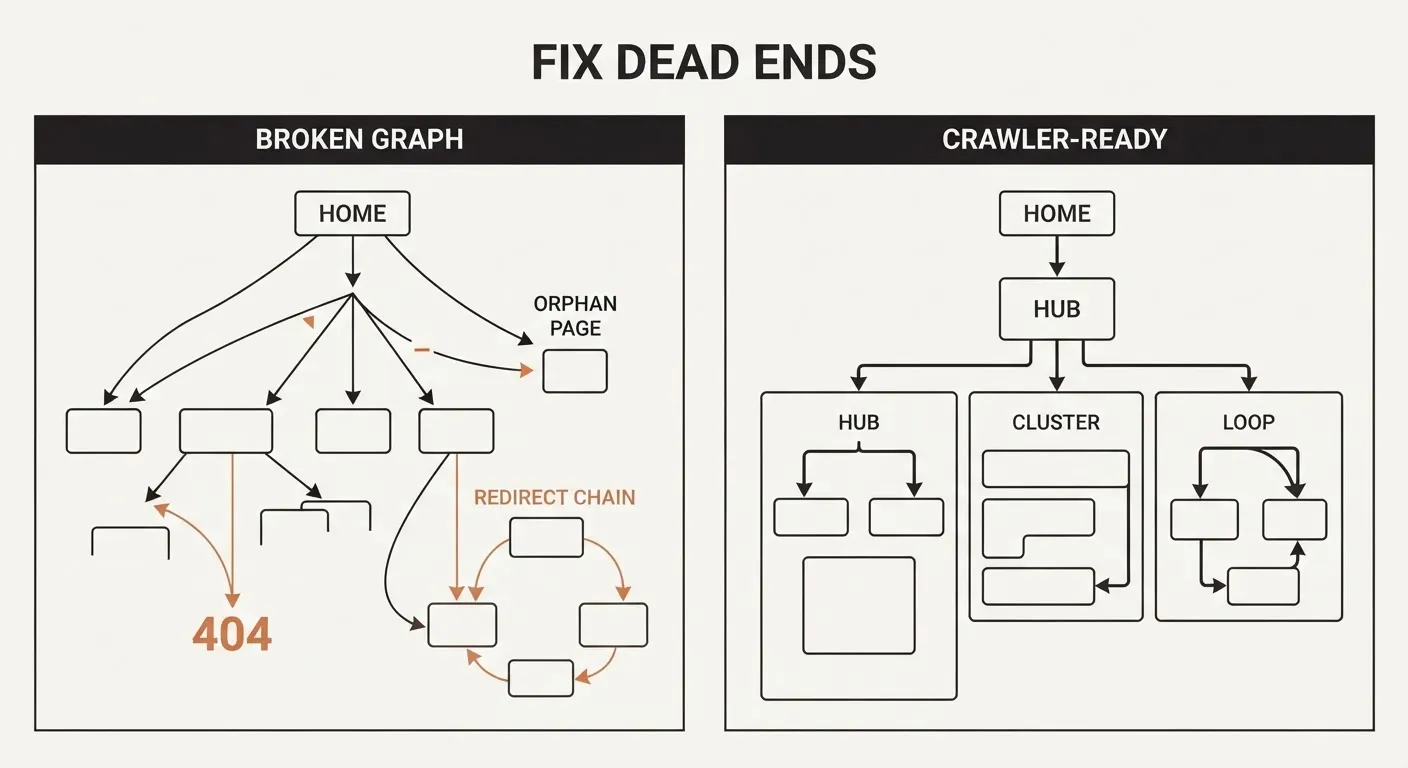
- Orphan pages disappear because pages without internal links are hard to discover reliably
- Broken architecture hides relevance even when the page itself is well written
- Internal links guide priority by showing what belongs together and what matters most
- Vector embeddings add context by representing page meaning, but models still need reachable pages to interpret
That makes AI crawler optimization an operating habit, not a niche cleanup.
If dead ends are the problem, the first fix is the one most teams never see until traffic stalls.
Step 1: The Orphan Page Purge
How do I find orphan pages on my website? Run a crawl with Screaming Frog or Ahrefs, then compare discovered URLs against your XML sitemap, CMS export, and analytics landing-page list. Any URL getting visits or listed in your systems but missing from the crawl is a likely orphan.
This is the highest-return step in an internal link audit because orphan pages are not just technical leftovers. They are often proof that publishing moved faster than planning.
- Pull four lists: crawler URLs, sitemap URLs, CMS URLs, analytics landing pages
- Flag mismatches where a page exists but no internal path reaches it
- Classify each orphan as keep, merge, redirect, or delete
- Reintegrate survivors into one pillar and at least 2-3 related cluster pages
- Update your plan so future pages launch into a hub, not into isolation
In practice, this is where the planning failure shows up. A content marketer is the person responsible for planning, creating, and distributing content that drives attention and demand, and this role now overlaps with structure maintenance because discovery depends on architecture, not just publishing.
Based on what we saw when treating crawler fixes as a practical operating loop, orphan pages were rarely just “SEO issues.” They were usually pages published without a clear home, owner, or linking plan.
A good orphan-page review usually ends with a short decision table, not a vague cleanup note.
- Keep pages that still match a live topic and business goal
- Merge thin pages into a stronger parent when intent overlaps
- Redirect retired URLs only after you update internal source links
- Delete pages with no strategic role, no traffic, and no replacement value
- Add links from the pillar, two related clusters, and any relevant navigation path
Once you restore visibility, the next leak is usually link rot.
Step 2: Hunt Broken Links and Redirect Chains
How to fix broken links for SEO? Export all internal 404s from your crawler, update the linking pages first, and then add direct redirects only where users or legacy URLs still need them. Fixing the source path is cleaner than piling on redirect rules.
A crawler that keeps hitting 404s and multi-hop redirects does not see a polished site. It sees friction, waste, and lower confidence in your navigation.
- Export all internal 404s and sort by number of linking pages
- Fix source links first on pages, nav items, and templates
- Collapse redirect chains so old URLs reach the final page in one hop
- Prioritize important pages like homepage, pillars, comparisons, and top landing pages
- Check repeating elements because one bad template can break dozens of pages
When you audit this step, work from highest impact to lowest.
- Start with templates like headers, footers, sidebars, and related-post modules
- Check nav links because one wrong URL can poison hundreds of crawl paths
- Review redirected URLs and replace old destinations with final live URLs
- Retest the repaired set with a fresh crawl instead of assuming the fixes held
- Document recurring causes so the same break does not return next sprint
Fix those paths, and the content you already have becomes easier for Google, AI search systems, and citation-focused agents to reach.
But clean paths alone are not enough. Crawlers also need a structure they can interpret.
Step 3: Build a Crawler-First Link Structure
 Once the dead ends are gone, give crawlers a graph they can read. That means one clear hub per topic, supporting cluster pages beneath it, and lateral links where pages genuinely help each other.
Why are internal links important for AI search? Because they show relationship, priority, and context. They help crawlers discover pages, help indexing systems understand topical structure, and give answer engines stronger signals about which pages deserve citation.
- Use one pillar page for each major topic with obvious supporting pages
- Link laterally by intent when pages solve related reader questions
- Write specific anchor text so the relationship is explicit
- Keep hierarchy visible with parent, sibling, and child page logic
- Make maintenance simple for builders with no time to sell
This is also where AI tools fit realistically. Writing tools can help teams produce drafts, and crawl or audit tools can help surface weak internal paths, but neither replaces the need for a human-guided internal link structure that tells crawlers what belongs together.
The practical build looks simple when you keep it consistent.
- Choose one hub for each topic you want Google and AI Search to understand
- Link every cluster page up to that hub with descriptive anchor text
- Link across sibling pages only when the reader intent clearly overlaps
- Avoid random “related” links that add clicks but no topical clarity
- Review new pages weekly so isolated posts do not pile up again
The winning move is not just more pages. It is a site graph that ranking systems and AI Search tools can understand.
Step 4: Automate the Internal Link Audit Loop
And then you protect the graph with a repeatable loop. The real fix is not a one-time cleanup. It is a monthly process that catches decay before it compounds.
Automation helps here, but humans still have to guide the logic. Set-and-forget systems can surface problems. They should not decide what stays, merges, redirects, or dies.
- Run a monthly crawl for orphans, 404s, redirect chains, and weakly linked new pages
- Add publishing checks for parent links, sibling links, and hierarchy placement
- Assign one owner for keep, merge, redirect, and delete decisions
- Track repeated failures to find broken templates or planning gaps
- Keep the loop lightweight so it actually happens every month
A simple maintenance loop works best when it is boring enough to repeat.
- Schedule one crawl day each month and keep the scope consistent
- Export the same reports every time so trends are easy to spot
- Use automation to flag issues but route decisions to one human owner
- Add a publish checklist so every new URL ships with links and hierarchy
- Close the loop fast by fixing root causes, not only symptoms
According to Content Marketing Institute’s 2025 B2B research, the teams winning now are strengthening fundamentals first.
That is the practical model for AI crawler optimization: automate detection, keep human judgment, and let the streak be the strategy.
Your Next Crawl Starts Here
 Key takeaways:
- Find orphan pages first because hidden content cannot be discovered or cited
- Repair broken links next to stop wasting crawl paths on avoidable friction
- Build hub structures so AI systems can interpret topic relationships
- Turn audits into habits with simple rules and one clear owner
The article opened with a simple image: a good page that may as well not exist because nothing cleanly leads to it. That is still the real problem.
SEO is the practice of improving the quality and quantity of website traffic from search engine results pages. It involves optimizing technical infrastructure, content relevance, and link authority to increase a site's visibility for specific queries, ultimately driving organic traffic without relying on paid advertising placements. In AI search, that technical infrastructure includes the crawl paths that determine whether your content can even be found.
So start with one crawl this week. Pull your URL lists, fix orphan pages, update broken links at the source, collapse redirect chains, and give every surviving page a home inside a hub.
Then connect that structure to your broader pages on Google, ranking, AI search, and citation so the whole discovery system becomes easier for people and models to understand. If you want organic marketing on loop, make sure the map works first. The visibility you gain next month will come from the crawl paths you clean up now.
Frequently asked questions
How do I find orphan pages on my website?
Run a crawl with a tool like Screaming Frog or Ahrefs, then compare the discovered URLs against your XML sitemap, CMS export, and analytics landing-page list. If a URL appears in those systems but not in the crawl, it is a likely orphan.
Should I fix redirects or update internal links first?
Update the internal source links first whenever you can. The article’s approach is to use redirects only where users or legacy URLs still need them, because fixing the source path is cleaner than stacking redirect rules.
Why are internal links important for AI search?
Internal links show relationship, priority, and context across your site. They help crawlers discover pages, help indexing systems understand topical structure, and give answer engines stronger signals about which pages deserve citation.
How often should I run an internal link audit?
This playbook recommends a monthly crawl that checks for orphans, 404s, redirect chains, and weakly linked new pages. The point is not a one-time cleanup but a repeatable loop that catches decay before it compounds.