
case_study
46% Down in 3 Days: The Organic Growth Loop Was Load-Bearing
August 28, 2026 · 8 min read · Scout7
A recorded Scout7 experiment showed a 46% organic traffic drop in three days after engagement stopped. Learn how to map a true organic growth loop.
Read time: 5 minutes
Introduction
Your traffic can drop fast even when content output stays steady.
In our case, the missing layer was the organic growth loop itself: when engagement stopped, discovery stopped, and that answered both questions at once — why did my organic traffic drop and what actually drives B2B organic growth.
When we looked at the numbers, the surprise was not the decline.
The surprise was that publishing volume held steady while traffic still fell, which meant Organic Traffic was responding to something other than content frequency.
That matters because many teams still confuse more output with more momentum.
But B2B Organic Growth is the process of expanding through non-paid channels by earning visibility and trust over time, and that only compounds when the system keeps feeding itself.
A Growth Loop is that closed system: one action creates the next input.
This case study is about finding the load-bearing part of that loop.
The Day We Turned Off the Engine
 And once we framed it that way, the cleanest lesson came from subtraction.
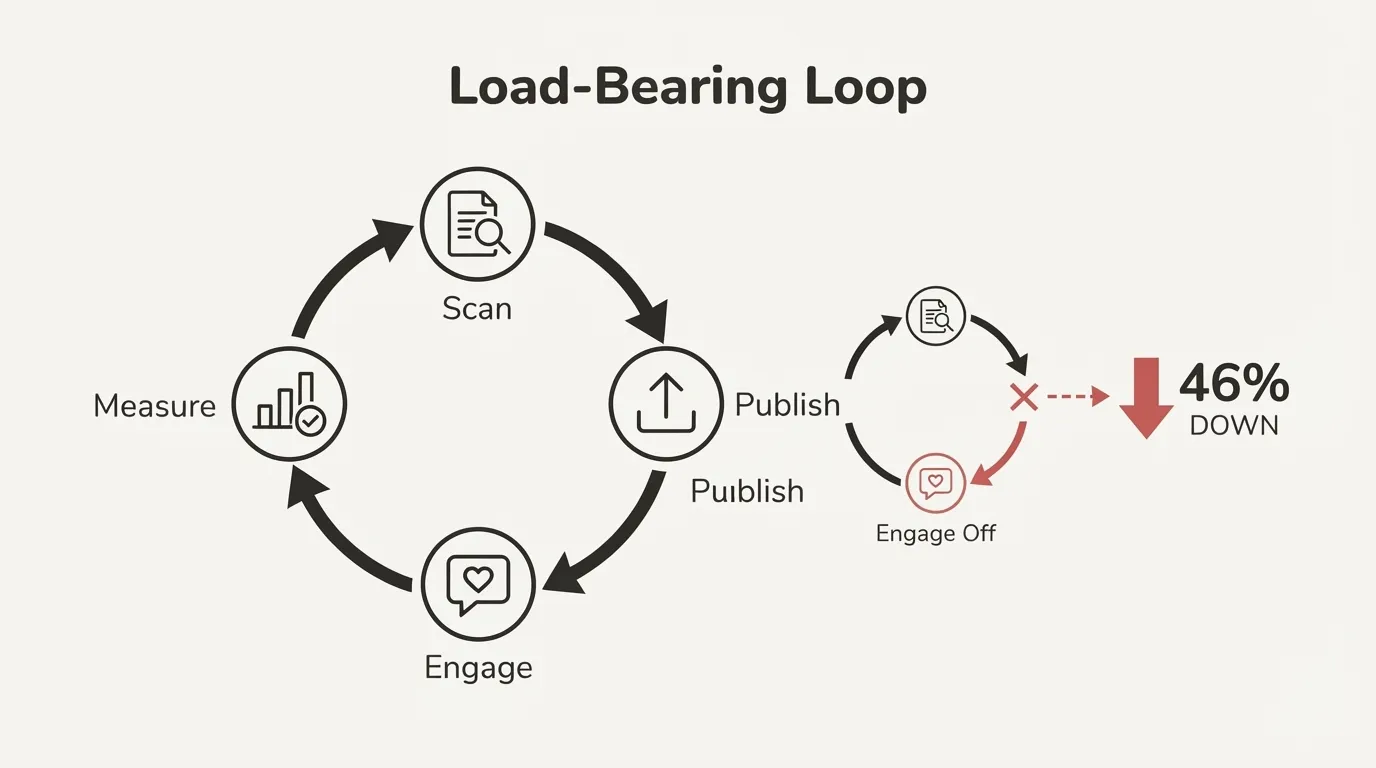
We turned ads off and saw nothing meaningful change, but when we disabled the comment engine, daily organic traffic fell from 44.2 visits a day to 23.7 — a 46% drop in three days.
This was not a content collapse.
Content volume stayed stable while traffic dropped, so the variable that changed was engagement, not publishing.
- Traffic fell 46% in three days after the comment engine stopped
- Daily organic traffic dropped from 44.2 to 23.7
- Publishing stayed steady during the same window
- The missing layer was engagement driving discovery
- The failure was measurement because we had not recorded a true no-engagement state earlier
Based on what we saw when engagement stopped and discovery stopped with content volume unchanged, we know the drop measured value rather than failure.
That is why the result felt useful, not scary.
According to Salesforce’s 2026 State of Marketing, marketers are under pressure to move from one-way output toward two-way engagement, which made our own recorded test harder to ignore.
The next question was obvious: if engagement carried discovery, why do so many teams still automate everything except that layer?
Content vs. Engagement: The Hidden Variable
 And that question points to the hidden variable most dashboards blur.
Most teams say they use marketing automation for SaaS, but in practice they automate production more than response, which means they scale output while leaving the loop open.
Our own operating ledger showed 89% of comments never got a reply.
That figure is our internal data, not an external benchmark, but it matched the broader pattern in the market.
- About 84% of marketing leaders, according to Salesforce, still run generic campaigns
- Nearly 60% of marketers, according to McKinsey, use AI multiple times weekly
- Fewer than 1 in 10 teams, also in McKinsey’s survey, capture value across end-to-end workflows
- About 80% of marketers, according to HubSpot’s State of Marketing, use AI for content creation
- About 75%, also from HubSpot, use AI for media production
The gap is not AI access. The gap is closing the loop from publishing to response to learning.
That gap explains why content volume alone rarely creates compounding Organic Growth.
So what does a real loop look like when you build it on purpose?
The Anatomy of an Organic Growth Loop
 And once we stopped treating engagement like cleanup, the system got clearer.
What worked was not posting more.
What worked was building an organic growth loop that connected scanning, publishing, engaging, and measuring into one weekly system for builders with no time to sell.
- Step 1: Scan the site and find gaps worth publishing into
- Step 2: Publish AI-generated or AI-assisted pieces with clear disclosure
- Step 3: Engage through watched threads, selective replies, and deliberate skips
- Step 4: Measure results daily so the next cycle improves
This matters because buyers do not move through one channel anymore.
According to McKinsey’s 2026 Global B2B Pulse Survey, B2B buyers use an average of 10 channels during the journey.
And according to Salesforce’s State of Marketing Report, while 83% of marketing leaders recognize the shift to personalized, two-way messaging, only 1 in 4 feel satisfied with how they use data to power it.
That is why the loop needs rules, not just effort.
The next step is translating that into something a solo founder can actually run.
Lessons for the Solo Founder
 And this is where the case study gets practical.
If you only have a few hours a week, the mistake is not automating too little.
The mistake is automating the wrong layer — publishing first, while leaving thread watching, selective replies, deliberate skips, and daily readback manual or ignored.
- Start with a recorded experiment and change one variable at a time
- Automate response rules before chasing more posting volume
- Use watched threads so important conversations do not disappear
- Skip low-value interactions by rule instead of replying to everything
- Treat results as operating data because outcomes may vary week to week
The broader market supports that caution.
According to Gartner, marketing leaders say only 16% of marketing work is AI-automated today.
According to Deloitte’s 2026 AI report, worker access to AI rose 50% in 2025, yet many organizations still struggle to move experiments into production.
And according to Forrester’s 2026 Buyer Insights, more than 60% of business buyers now use a trial to evaluate solutions, rising to 78% for purchases of $10 million or more.
That means proof beats claims.
So what, exactly, did our own proof establish?
What This Experiment Actually Proved
 The answer is simple: organic traffic dropped because the engagement loop stopped.
The experiment did not prove that content does not matter.
It proved that content volume alone was not the thing carrying discovery, and that the load-bearing layer in our system was engagement treated as infrastructure.
Key takeaways:
- Stable publishing did not prevent a 46% traffic drop
- Engagement, not output alone, drove discovery in our test
- Automate the loop first, especially response and measurement
- Run recorded experiments before blaming content strategy
That conclusion lines up with the broader market.
According to Salesforce’s 2026 State of Marketing, about 84% of marketing leaders still run generic campaigns even as buyers expect personalized, two-way engagement.
So if you want to know how to automate B2B organic growth, start by mapping the full weekly system:
- Measure the no-engagement state before changing content strategy
- Automate watched threads and reply rules instead of only scheduling posts
- Disclose AI involvement clearly with labels like AI-generated or Powered by Scout7 AI
- Respect consent and privacy with explicit opt-outs and compliant data use
- Read results back daily so one week improves the next
The opening image was a traffic chart dropping while publishing stayed flat.
The payoff is that the chart was not warning us that the system was fragile.
It was showing us what was load-bearing.
If you want to run your growth loop, begin with one clean experiment: pause engagement, measure the change, then rebuild that layer with guardrails, disclosure, and clear response logic.
A week of organic marketing on loop starts there, and what happens next may vary — but you will finally know which mechanism is doing the work.
Frequently asked questions
Why did organic traffic drop if publishing stayed steady?
In this recorded test, publishing volume stayed stable while daily organic traffic fell from 44.2 to 23.7 after the comment engine was disabled. That pointed to engagement, not output volume, as the load-bearing part of the system.
What is the organic growth loop in this article?
Here, the organic growth loop is the weekly system connecting scanning, publishing, engaging, and measuring. One step creates the input for the next, so discovery compounds only when the full loop stays active.
Did this experiment prove content does not matter?
No. The article explicitly says the experiment did not prove that content does not matter. It proved that content volume alone was not the thing carrying discovery in this case.
What should a solo founder automate first?
The article recommends automating response rules before chasing more posting volume. That includes watched threads, selective replies, deliberate skips, and daily measurement so the next cycle improves.
References
- Salesforce, “State of Marketing 2026”
- McKinsey, “From anxiety to advantage: A marketing organization that thrives with AI”
- McKinsey, “The surprising economics of B2B growth: The new survival threshold—and what it takes to thrive”
- Salesforce, “State of Marketing Report: Tenth Edition”
- Gartner, “Gartner Survey Reveals Marketing Leaders Expect AI Automation of Marketing Work to Double to 36% By 2028”
- Deloitte, “The State of AI in the Enterprise - 2026 AI report”
- Forrester, “Forrester: The State Of Business Buying, 2026”
- HubSpot, “2026 State of Marketing Report”