
first_hand_story
8,459 Followers, 0.28 Impressions Each: What a Follower Delivers in an Organic Growth Loop
August 29, 2026 · 6 min read · Scout7
8,459 followers led to 2,405 LinkedIn impressions. A hard audit of why followers are not reach, and what to track instead.
Deck: A first-hand audit of why follower count is not a LinkedIn reach strategy, and what to track instead.
Start with the arithmetic, not the applause
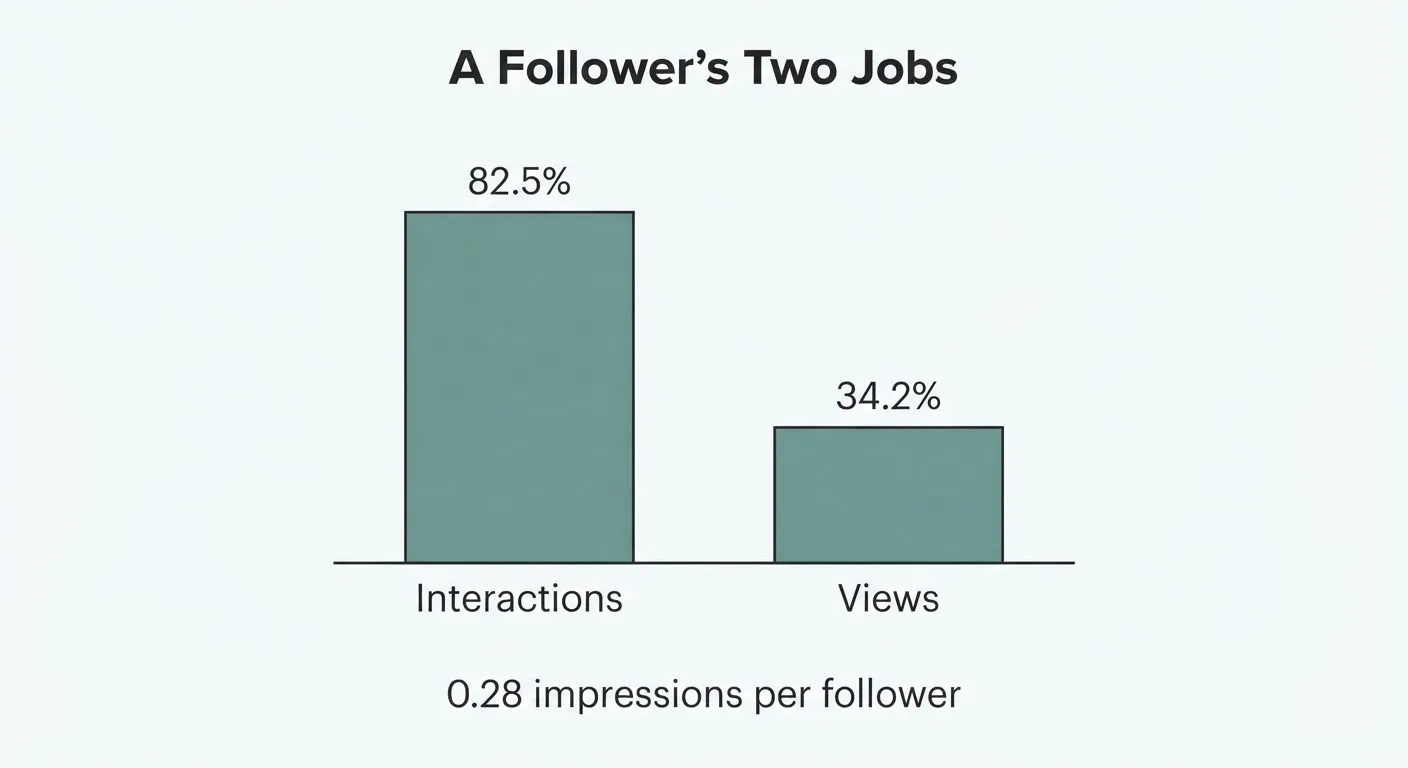
8,459 followers produced 2,405 organic LinkedIn impressions in 30 days. That works out to 0.28 impressions per follower, which means the follower count looked like distribution power while saying very little about actual visibility.
That is the useful frame for an organic growth loop: followers and reach are not the same asset. One number was being asked to do two jobs, and it covered neither cleanly.
The tension is simple.
- Follower count signals proof that people chose to stay near the page
- Impressions measure visibility across the feed, whether followers saw it or not
- Organic reach LinkedIn can stay thin even when the audience number looks healthy
- A large audience can still mean a small room if strangers are not seeing the work
The first job, then, was not to fix content. It was to separate the two scoreboards.
Divide one clean 30-day window
That separation started with one plain calculation. We took one clean 30-day window from our own LinkedIn page analytics and divided 2,405 organic impressions by 8,459 followers.
The result was 0.28 impressions per follower per month. In the same window, the page added 8 new followers. Those are the receipts, not a theory.
Based on what we saw when our own LinkedIn page with 8,459 followers generated 2,405 organic impressions and 8 new followers in 30 days, the follower total implied more distribution than it actually delivered.
A few things this audit does and does not say:
- It uses a full 30-day window, not one unusually strong post
- It proves our page arithmetic, not a universal platform rule
- It shows weak distribution per follower, even before debating content quality
- It shows slow audience movement too, with only 8 new followers added
And that left the bigger question open: if followers were not doing most of the watching, who was?
Followers clap. Strangers watch.
The second account made the split visible. On Instagram, over the same 30-day window, followers supplied 34.2% of views but 82.5% of interactions.
That is the line of the piece: they clap, they don’t watch.
- Non-followers did about two thirds of the watching
- Followers did more than four fifths of the reacting
- Reach came from strangers
- Applause came from followers
Followers are not a liability. They are also not the goal by themselves. They are a different asset than the number implies.
They clap, they don’t watch.
That changed the way I read both platforms. The same audience number that looked like distribution power was functioning more like proof, response, and social confirmation from people already in the room.
Once that split became visible, engagement rate stopped looking like a reach metric.
Engagement rate reports the room you already have

That is the real reporting mistake. Engagement rate and reach are not rival metrics; they describe different populations.
Engagement mostly reports what the people already near you did. View count reports how many people, including strangers, saw the work at all.
On our own page, the two lines move independently. The follower number went up by 8 in the window. The impression number stayed where it was. If those were one metric, that could not happen.
Why is organic reach so low on LinkedIn? For us the direct answer is that follower count does not buy distribution: 8,459 followers returned 2,405 organic impressions in 30 days, and the audience total had almost nothing to say about it.
Do followers matter for organic reach in 2026? Yes, but mainly as responders and proof rather than guaranteed reach.
So the decision was not to pick a winner between reach and engagement. It was to report both without forcing them into one metric.
Fix the Report Before the Writing: Where an Organic Growth Loop Starts
That is the copyable part of the LinkedIn reach strategy. Before changing content, change the report so you can tell what actually improved.
A simple reporting layer makes the split visible:
- Track impressions per follower per month on every page
- Track follower vs non-follower view splits wherever platforms expose them
- Track interactions separately from views, not as a proxy for them
- Stop reading follower growth as reach growth unless visibility also rises
That is why a useful organic growth loop starts with measurement. Until the split is visible, every content change is a guess.
The honest limit, and what I test next

Key takeaways:
- 0.28 impressions per follower exposed weak LinkedIn distribution
- Followers reacted more than they viewed across our two-account audit
- Reach and engagement need separate scoreboards
- A better LinkedIn reach strategy starts with reporting first
This is still one brand, two accounts, and one clean 30-day window. It is a method to copy, not a law about social media.
That limit matters because it keeps the next step honest. I do not need a bigger claim. I need another clean window, the same arithmetic, and writing aimed more clearly at strangers to see whether impressions per follower move at all.
So the next test is straightforward.
- Repeat the same 30-day audit on LinkedIn
- Check the follower vs non-follower split where available
- Write for strangers first and see whether distribution changes
- Keep applause and reach on separate lines with no winner declared
If you want to run a week of organic marketing on loop, Scout7 structures that system with clear AI disclosure. This article itself is Powered by Scout7 AI with human direction and source control. Start by auditing your own page: divide 30-day organic impressions by follower count, then compare who watched versus who reacted. That will give you a truer baseline for your next organic reach LinkedIn test.
Frequently asked questions
What does 0.28 impressions per follower actually mean?
It means 8,459 followers produced 2,405 organic LinkedIn impressions in one 30-day window. That ratio shows follower count looked like distribution power while saying very little about actual visibility.
Does this mean followers do not matter?
No. Followers are a different asset than reach, not a useless one. In this audit they looked more like proof, response, and social confirmation than guaranteed distribution.
Why separate reach from engagement in an organic growth loop?
Because they describe different populations. Engagement mostly reports what people already near you did, while impressions report how many people, including strangers, saw the work at all.
What should I track first if I want to copy this organic growth loop?
Start with one clean 30-day window and divide organic impressions by follower count. Then track follower versus non-follower view splits where the platform shows them, and keep interactions on a separate line from views.