
case_study
89% Unreplied, Traffic Still Came: Comment Marketing Strategy by the Ledger
August 28, 2026 · 9 min read · Scout7
A case study on why unreplied comments can still support B2B organic growth—and how to read engagement data without making false claims.
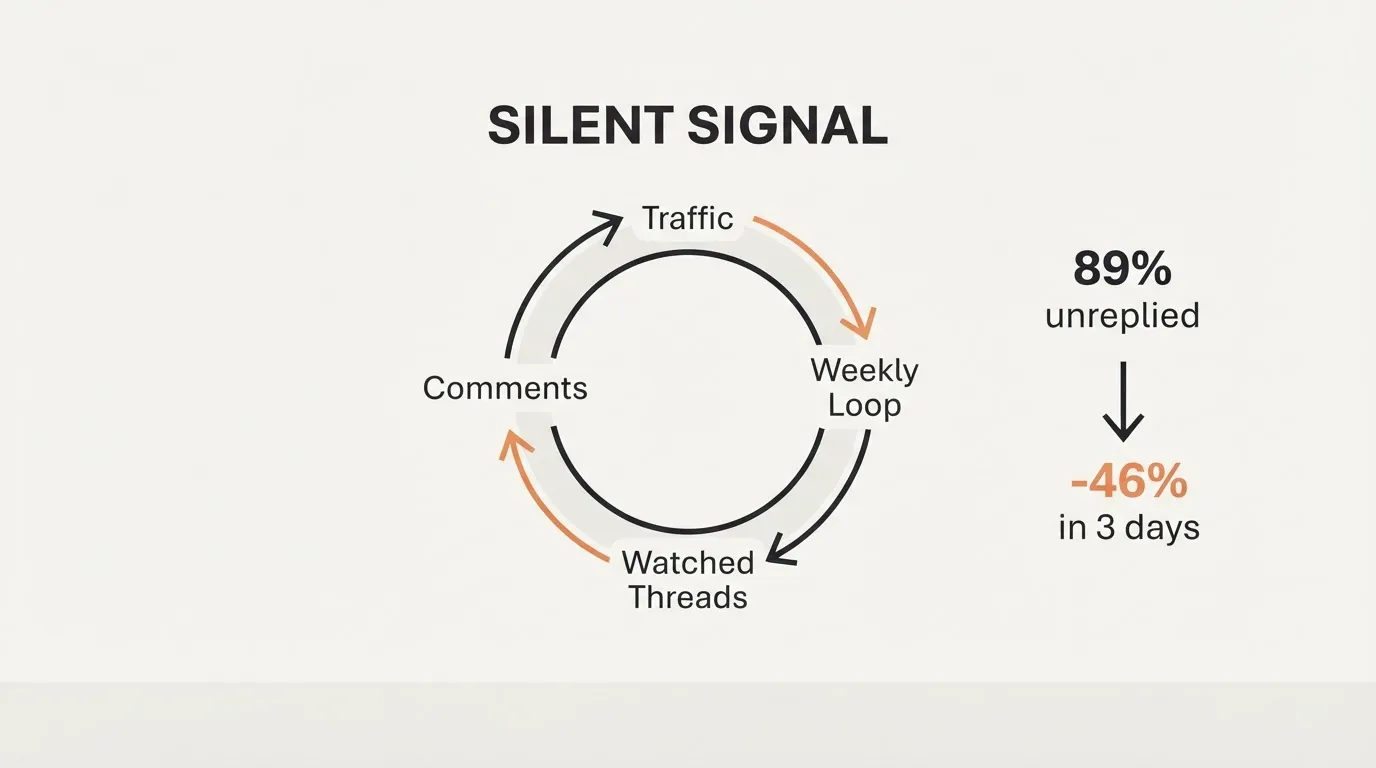
Subtitle: A Scout7 case study on reading social engagement data honestly when reply rates stay low but Organic Growth still moves.
Read time: 5 minutes
Introduction
If your team cannot reply to every comment, that does not automatically mean social is failing. In this case study, Scout7 found that most comments went unanswered (89%), yet turning the activity off still coincided with a 46% drop in organic traffic in three days, which suggests the aggregate signal mattered even when the exact mechanism stayed partly unknown.
Most advice on comment marketing strategy treats silence as a miss. This piece argues for something harder: measure the whole system honestly, admit what you cannot prove, and use social engagement data as an operational signal for B2B organic growth instead of a moral scorecard.
Key takeaways:
- 89% unreplied did not mean the activity was useless
- Turning it off coincided with a 46% organic drop
- Aggregate measurement beat fake one-comment attribution
- Deep conversations were rare and expensive to find
The 89% Gap: Why We Stopped Chasing Every Reply
 That framing matters because the painful part was simple: we were watching comments pile up, and the instinct was to chase all of them. In practice, that mandate slowed the actual work that kept the organic marketing loop running.
We say it straight: 89% of our comments were spoken into silence, and we cannot tell you which specific comments did the work. What we can say is narrower and more useful: when the activity stopped, organic traffic was down 46% in three days.
Based on what we saw when we watched threads, deliberately skipped weak conversations, capped depth, and then ran the off-switch, the mostly silent system was still load-bearing.
That honesty sits inside a broader market reality. According to Salesforce State of Marketing 2026, more than two-thirds of marketers (69%) still struggle to respond promptly, while more than four in five customers (83%) expect two-way conversations.
Silence was not proof of failure. It was part of a system we could observe, but not fully explain.
So if unreplied comments were not zero, what exactly were they doing?
Conversation Economics: Our Comment Marketing Strategy in Numbers
 The best answer is not “every comment drove traffic.” The honest answer is that comment activity appears to keep posts visible, legible, and worth checking for both people and platforms.
That matches outside evidence. Buffer’s 2026 engagement analysis found that accounts that consistently reply outperform non-repliers across six platforms, by as much as 42% on Threads and 30% on LinkedIn.
But that does not mean silence equals zero. It means replies help, while aggregate conversation may still support distribution when coverage is incomplete.
Several signals point the same way:
- Salesforce says more than four in five customers (83%) expect two-way conversations
- Sprout Social’s 2026 Pulse Survey says around a third of consumers prefer social search in many discovery moments
- The 2025 Sprout Social Index says social became the #1 source for tracking trends and culture
- Adobe Digital Trends says half of surveyed customers give social posts only two to five seconds
In that window, people often read the thread before they click. And that leads to the real constraint: not all threads deserve equal effort.
The Price of the Exceptions
 Once we accepted that, the work changed from “reply everywhere” to “find the few threads worth depth.” That search cost turned out to be the real story.
In ten days, Scout7 recorded:
- 949 writes across active threads
- 791 threads watched before deciding whether to engage
- 102 deliberate skips where we chose not to pile on
- 88 real two-way conversations that justified deeper engagement
- 3 retractions after deciding a comment should not stay live
That means it took 10.8 comments to find one conversation worth depth. The exceptions were uneven by platform too: Instagram 23.8%, Threads 21.1%, and X 11.2%, with author-reply rates of 14.5%, 8.7%, and 3.3%.
The discipline mattered. We used watched threads, recurring questions, depth caps, and a written brand profile to decide stance before any comment was written.
That operational reality fits the wider market. Salesforce found that teams satisfied with unified data are 42% more likely to respond regularly, while HubSpot’s 2026 State of Marketing says 86.4% of marketers now use AI tools. At the same time, Content Marketing Institute found that 89% of B2B marketers say they personalize, yet nearly 60% do it in only one or two channels.
The implication is clear: the bottleneck is not intent. It is selective execution.
Results: The Ledger of Organic Growth
 So what should teams measure instead of chasing a myth of perfect responsiveness? Measure the ledger.
For Scout7, the useful output was not a fairy tale about one brilliant reply. It was an observed system made of silent threads, answered threads, watched threads, skipped threads, depth caps, retractions, and traffic movement.
Here is the narrow claim we can support:
- Most comments went unanswered (89%)
- Some threads became true conversations (88)
- Stopping the activity coincided with a 46% organic drop in three days
- We cannot verify which comments caused which visits
That is the point. We refuse to split credit between replied and silent threads when the evidence does not support that split.
For lean teams, this matters because Organic Growth is the process of expanding reach, audience, or revenue through non-paid channels. If your growth loop depends on non-paid discovery, then comment streams belong in measurement even when they do not produce a neat attribution trail.
That is also where the market is heading. Gartner’s 2026 survey found that leaders expect AI-driven automation of marketing work to rise from 16% in 2026 to 36% by 2028.
If more work gets automated, engagement signals cannot stay manual leftovers. They have to become inputs.
What Builders Should Do With This
 That brings us back to the practical question builders care about: does replying to every comment matter for B2B growth? No, not in the absolute way social advice often suggests.
Replies can help, and Buffer shows they often correlate with better engagement. But Scout7’s own data shows that incomplete coverage did not make the system worthless, so long as you measured aggregate performance honestly.
Here is the better operating model for a lean team running a growth loop:
- Answer what matters instead of chasing total coverage
- Track watched threads to see where real interest clusters
- Log deliberate skips so silence becomes a decision, not neglect
- Use depth caps to avoid burning time on dead conversations
- Watch traffic shifts before inventing thread-level attribution
And here is the second question this article must answer: how should you use social engagement data for content strategy? Use it as signal, not proof.
Look for recurring objections, language patterns, proof-seeking behavior, and platform differences. Then feed those patterns back into content planning without pretending one silent comment or one reply guaranteed growth.
Conclusion
Key takeaways:
- Unreplied comments can still support distribution and discovery in aggregate
- Replying selectively is often more realistic for lean B2B teams
- Honest measurement beats invented attribution stories every time
The opening tension still holds: most social advice says every unanswered comment is a failure. Scout7’s case study says the truth is stranger and more useful.
We saw a system where 89% of comments went unreplied, yet turning the activity off coincided with a 46% drop in organic traffic in three days. We also saw that meaningful back-and-forth was rare, with only 88 real two-way conversations emerging from 949 writes. That is why the right lesson is not “never reply.” It is “stop treating reply rate as the whole story.”
For builders with no time to sell, the move is operational clarity. Measure the full ledger. Track watched threads, selective depth, skips, retractions, and total traffic movement. Keep every claim narrow, disclose when content is AI-assisted or Powered by Scout7 AI, respect privacy and consent, and never promise guaranteed results because outcomes may vary.
If you run your growth loop with limited time, audit the last ten days of comment activity and compare it to traffic before changing your team’s response policy. You may find that the quiet parts of the system are doing more work than they seem.
Frequently asked questions
Does a comment marketing strategy fail if most comments go unreplied?
Not necessarily. In this case study, 89% of comments went unanswered, yet stopping the activity still coincided with a 46% drop in organic traffic in three days. The article’s point is that incomplete reply coverage does not automatically make the system useless.
What can this comment marketing strategy actually prove?
It can support a narrow claim about correlation at the system level, not clean attribution at the comment level. Scout7 observed unanswered threads, watched threads, selective replies, and traffic movement, but could not verify which specific comments caused which visits.
Why not just reply to every comment?
Because the search for worthwhile conversations carries a real time cost. In ten days, Scout7 watched 791 threads, made 102 deliberate skips, and found only 88 two-way conversations from 949 writes. The article argues that selective depth is often more realistic than total coverage.
What should lean teams measure instead of reply rate?
Measure the full ledger: watched threads, skipped threads, depth caps, retractions, true conversations, and traffic shifts. That gives a more honest view of how comment activity supports B2B organic growth than treating reply rate as the whole story.
References
- Salesforce State of Marketing 2026
- Buffer: The State of Social Media Engagement in 2026: 52M+ Posts Analyzed
- Sprout Social: The state of social media in 2026
- Sprout Social Index 2025
- Adobe 2026 AI and Digital Trends Report
- HubSpot 2026 State of Marketing
- Content Marketing Institute: New B2B Research Finds Winning Marketing Teams Are Building Fundamentals
- Gartner Survey Reveals Marketing Leaders Expect AI Automation of Marketing Work to Double to 36% By 2028