
market_pov
Agency Client Acquisition Cost: Your Win Rate Went Up. Your Wait Doubled.
September 21, 2026 · 8 min read · Scout7
Your agency client acquisition cost is the hours you give away before anyone pays you. One survey counted them. The win rate rose and the wait doubled.
You won more pitches this year than last year. That sounds like good news.
Somebody counted what the winning actually cost. There is a name for that number. Your agency client acquisition cost is simply everything you spend to get one new client, including the hours nobody pays you for.
Over one year the share of pitches agencies won went up. Over the same year the wait before a new client made any money nearly doubled. Both things happened to the same group of agencies, in the same year.
Key takeaways:
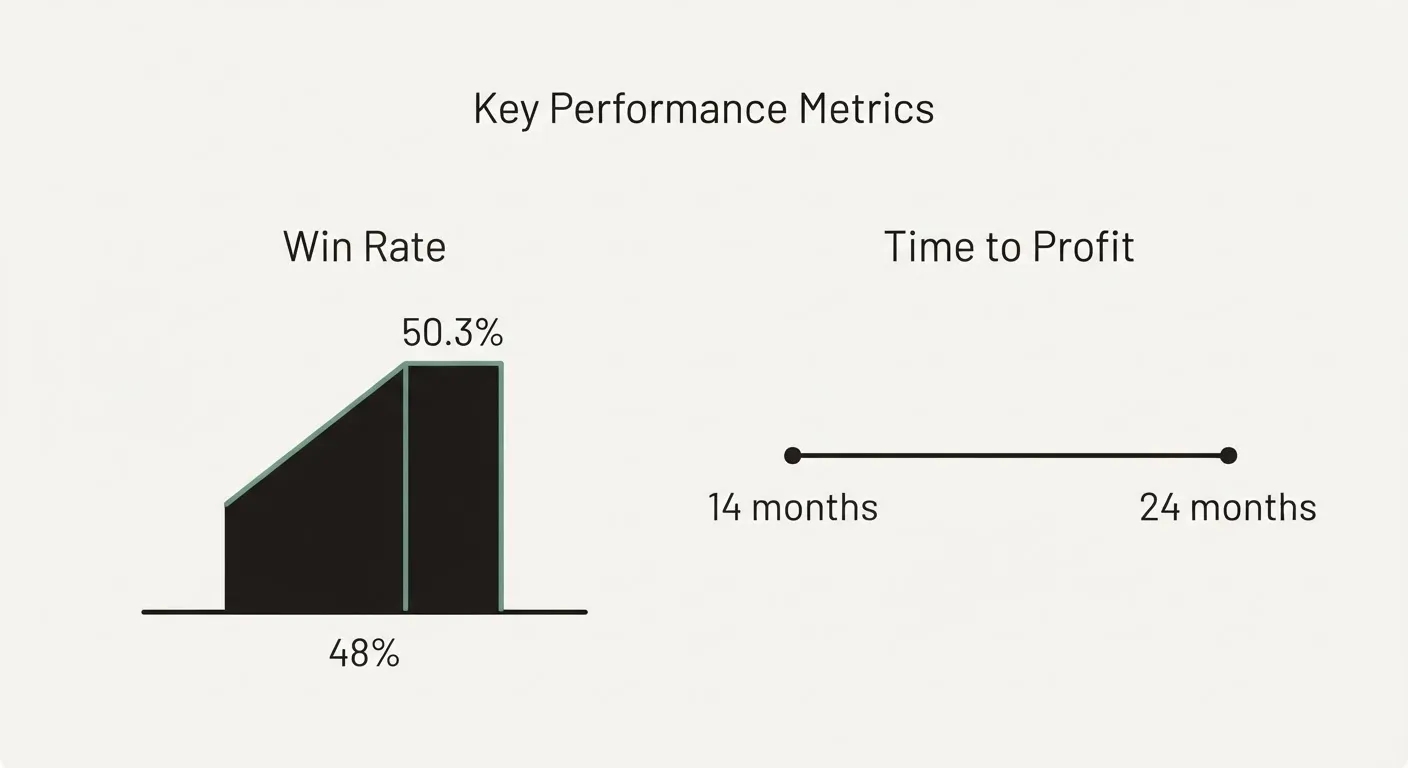
- The agency pitch win rate went up from 48 percent to 50.3 percent in one year
- Over the same year, the wait before a won client made any money went from 14 months to 24
- Unpaid pitch hours more than doubled, from 1,913 a year to 4,314 a year
- Each win was worth about a third less, about 350,000 dollars instead of about 529,000
- Agencies under 20 staff got their pitching costs back in about 7 months. Agencies of 50 to 99 staff took about 33 months
Your win rate went up. That is the bad news.
You run a small agency. Or you work on your own, making content for a handful of brands.
To win a new client you write a proposal. You build a sample. You sit on two or three calls. Nobody pays you for any of that work.
Then you judge how it went by one number. Your agency pitch win rate. That is the share of pitches you win out of the pitches you enter.
Somebody counted what that number hides. In Australia a survey called the OUCH! Factor Report asked agencies what pitching really costs them. It was run twice, one year apart.
Between those two years the win rate went up. It moved from 48 percent to 50.3 percent. Agencies got better at the thing everybody measures.
Over the same two years the wait got longer. A new client used to take 14 months before it made the agency any money. Then it took 24 months.
The number everybody watches went the right way. The business went the wrong way.
That is what this piece is about. Not how to win more. How to count what winning costs you.
Why winning more made it worse
Think about a baker. She bakes two cakes and sells one. The cake nobody buys still cost her flour and an afternoon. So the price of the cake she sells has to cover both.
A pitch works the same way. You do the work about twice for every client you get.
Now look at what changed between the two survey years. Agencies pitched 19 times a year instead of 11. Each pitch took 231 hours of work instead of 177 hours.
So the hours nobody paid for went from 1,913 a year to 4,314 a year. More than double.
And the prize got smaller. The average client won was worth about 350,000 dollars. The year before it was about 529,000 dollars. Roughly a third less.
More work. Smaller prize. That is the whole reason the wait went from 14 months to 24.
Winning more pitches was not the cure for this. It was the cause of it.
The figures come from the OUCH! Factor Report by Julia Vargiu of New Business Methodology in Sydney, reported by The Duval Partnership and by Mediaweek and B&T in September 2022.
The agency client acquisition cost that never reaches an invoice
Here is why nobody notices.
That work never goes on an invoice. No money leaves your bank account. Your accounting software shows nothing at all. The cost is hours, and the hours are yours.
Darren Woolley runs a consultancy called TrinityP3. He made this point in November 2021. Pitching costs time, not cash, because the extra hours people work are never paid. That is exactly why it stays hidden.
He adds one more thing. Those same hours would earn you more if you spent them growing a client you already have.
And getting paid nothing for this is normal. Campaign published a report called the US State of the Pitch in April 2026. It found that 90 percent of agencies are paid nothing at all for pitching. One pitch can use up to 150,000 dollars of an agency's own staff time.
Two American industry bodies, the ANA and the 4As, published ten pitch principles on 6 May 2026. They ask clients to pay agencies for pitch work, to invite fewer agencies, and to stop going silent on the ones who took part.
So the people who ask for pitches have now written down in public that this is a problem.
One more fact about the odds. The ANA and the 4As interviewed over 300 marketers and agency people in March 2023. Two thirds of clients kept the agency they already had after running a review. Half of them said the main short term gain was making that agency try harder.
If you are the outsider in one of those reviews, that is worth knowing before you spend 231 hours on it.
Small is the good end of this
Now the part nobody tells small agencies. You are already in the best group in this data.
Agencies with under 20 staff got their pitching costs back in about 7 months. They spent about 10 percent of what they won on the work of winning it.
Agencies with 20 to 29 staff won the most pitches of any size. 67 percent.
Independent agencies beat agencies owned by a bigger group. 49 percent against 40 percent.
Now look further up the ladder. Agencies with 50 to 99 staff took about 33 months to get their pitching costs back. They won the fewest pitches of anyone, 32 percent. And they spent more than half of what they won on winning it.
By type of work, Campaign Brief reported that creative agencies took about 32 months to get their pitching costs back. Digital and technology agencies took about 22 months. Media agencies took about 3 months, because their pitches cost less to make and the accounts are bigger.
So pitching is not simply good or bad. It depends on your size, and on how much you give away before anyone pays you.
And it gets worse as you grow, not better. The thing you are trying to become is worse at this than what you already are.
What this evidence cannot tell you

Be careful with all of this. Here is what these numbers cannot tell you.
The OUCH! Factor Report asked Australian agencies. It may not match your country.
The two rounds did not ask the same agencies twice. The first round had 120 agencies and marketers. The second had 94 agency leaders plus 14 people from the client side. So the change is between two different groups, not one group followed over time.
It covers the 2020 and 2021 pitch years, and it came out in 2022 and 2023. Nobody has made a fuller public count of what pitching costs. It is also not new.
Julia Vargiu sells new business training to agencies. TrinityP3 and Mercer Island Group are pitch consultancies, and they helped make the 2026 Campaign report. All of them have a reason to want this answer. That does not make the numbers wrong. It does mean you should know who counted.
The Campaign report also sits behind a paywall, so the figures here come from the parts anyone can read.
And these are big agency amounts. You will never spend 115,000 dollars on one pitch. What carries across to you is the shape of it, not the size. You do the work first. You get paid later. The gap between those two things is longer than it feels while you are in it.
What You Can Do Tomorrow

Four things. None of them needs new software.
Count the unpaid hours. Go through last month. Proposals, samples, calls, travel, the evening you spent on a deck. Add the hours up and write the number down.
Count the payback months. Multiply those hours by what an hour of your time is worth. Then work out how many months of a new client's fee it takes to cover that. Now you know your real waiting time.
Agree the money before you do the work. This is Julia Vargiu's own advice. Settle what the job pays first. If you cannot settle it, say no to the pitch.
Give your next free hour to a client you already have. That is Darren Woolley's point. Those hours return more when they go into a client who is already paying you.
Frequently asked questions
What is an agency pitch win rate? It is the share of pitches you win out of all the pitches you enter. Pitch ten times, win five, and your win rate is 50 percent.
Is a high win rate a bad sign? No. It is just not enough on its own. In the OUCH! Factor Report the win rate went up from 48 percent to 50.3 percent in the same year that the wait for profit went from 14 months to 24. A win rate does not count what winning cost you.
How long should a new client take to become profitable? There is no single right answer. In that survey, agencies under 20 staff got their pitching costs back in about 7 months. Agencies of 50 to 99 staff took about 33 months.
Should I stop pitching? No. Pitching is how plenty of small agencies meet clients they would never otherwise meet, and media agencies in the same survey got their costs back in about 3 months. The advice in the research is narrower than stopping. Agree the money first, and be willing to say no.
The Question to Answer

How many hours did you work for your last new client before they paid you anything?