
market_pov
Agency Pricing Models: Everyone Warned You About The AI Discount. Nobody Asked.
September 13, 2026 · 11 min read · Scout7
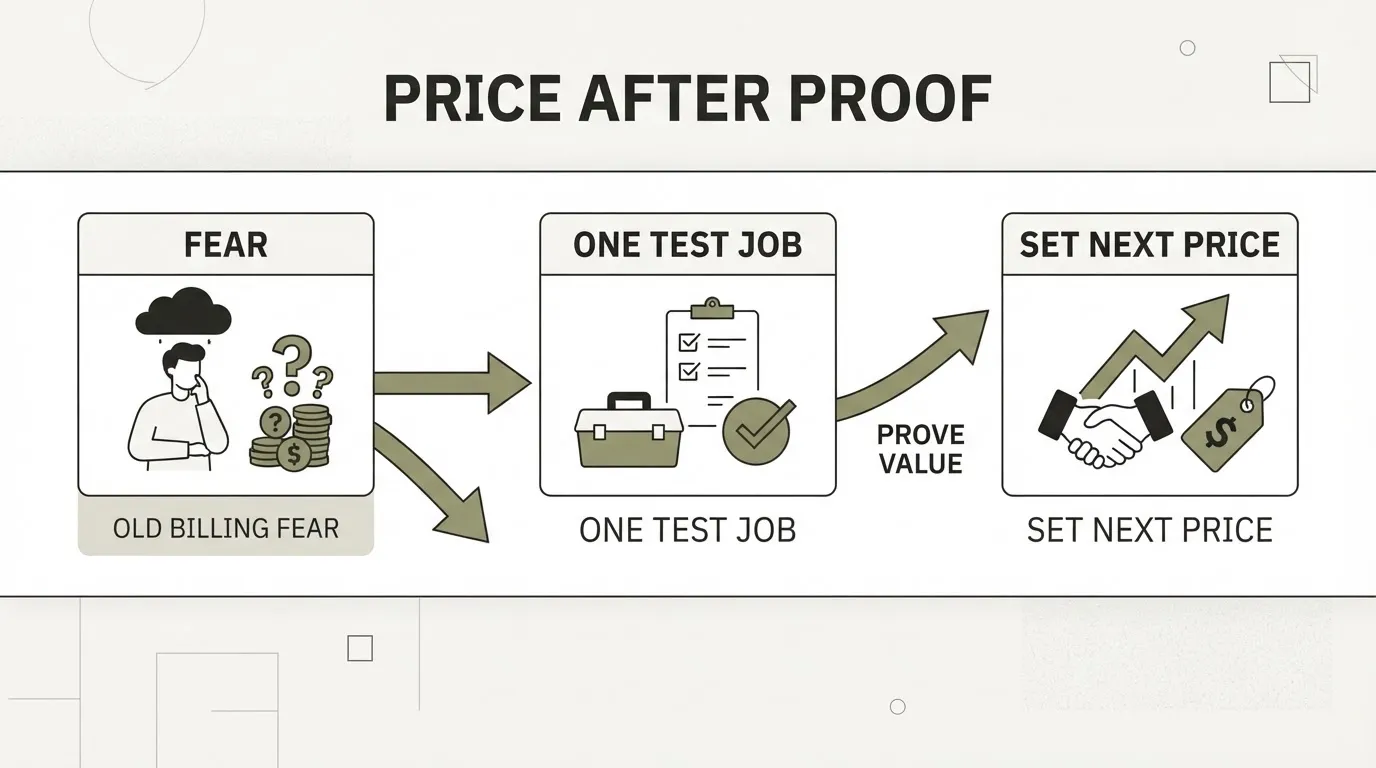
Agencies feared AI would force discounts. The better lesson: stop guessing. Do one job the new way first, then set the price.
Why agency pricing models are not your first problem
A job that used to take you a day now takes an hour.
Most small agency owners have not said that out loud to their clients. They are waiting for the question they do not want. If the client finds out the work got faster, will they ask to pay less?
Almost every article about agency pricing models tells you to pick a new model first. This one does not.
It makes one argument. You cannot set a fair price for a job you have not done the new way yet.
So stop trying to decide it in your head. Go and do one job.
The thing you have not told your clients
 You run a small agency. Maybe five clients. Maybe fifteen. Posts, articles, a schedule and a monthly report for every one of them, all done by hand across a dozen different logins.
Then the work got faster. A monthly content pack that used to eat a whole day now takes about an hour.
You have not mentioned it. Almost nobody has. The worry is simple. If they know it took an hour, they will not want to pay for a day.
There is a second worry sitting underneath that one. Your margin is the money left over after you have paid for the work. If you keep charging for hours, and the hours keep falling, that money shrinks. Your clients are just as happy. Your bank balance is not.
So you wait. You keep charging the old way, and you hope somebody somewhere works out the right answer.
A year has now gone by. We can look at what actually happened.
A year later, almost nobody asked
 In 2025 this was the loudest prediction in the agency world. Tell a client you use AI, and they will ask for money off.
A company called Productive sells software to agencies. In 2025 it asked its own customers about this. More than 180 agencies answered. About a third said a client had already asked them for a discount because of AI. Nearly half said they expected to hear it soon.
Then Productive asked again a year later. That round is called Agencies in the AI Era 2.0. It covers 174 agencies and consultancies, which are firms that advise other companies. The answers were collected between 17 and 31 March 2026.
Here is what they found, in their own words:
"Clients haven't increased the rate of asking for discounts."
The number of clients asking did not go up. The group saying "not yet, but we expect it" grew only a little.
The wave everybody braced for did not arrive. The fear did.
The part of that survey nobody quotes
 The same 2026 report did something more useful. It split the agencies into two groups.
One group had already used AI on real client work and seen it go well. The other group was still setting it up.
This is what Productive wrote about the first group:
"Among agencies reporting multiple positive AI situations, 52% are now keeping or increasing prices with improved margins (up from 47%)."
And this is what they wrote about the second group:
"Among those still working on implementation, 61% are still figuring out the right model (up from 47%)."
Read those two lines again. They point in opposite directions.
The agencies that had done the work got clearer about what to charge. More of them held their prices and kept more of the money.
The agencies still getting ready got less sure. A whole year went by, and more of them were still trying to pick a pricing model than the year before.
Waiting did not make the answer easier to find. Waiting made it harder.
That is the lesson of this whole piece. The clarity came out of doing the work. It never arrived on its own.
The same gap on the other side of the table
 This is not agencies against clients. The same split shows up among the people who hire agencies.
A chief marketing officer is the person at a client company who runs marketing. Gartner asked 402 of them about AI between August and October 2025, and published the answers on 11 May 2026.
Those bosses expect AI to do 16 percent of marketing work in 2026, and 36 percent by 2028. That 36 percent is what they expect. Nobody has measured it.
Gartner's analyst Kristina LaRocca-Cerrone described a widening gap between the marketing bosses who are still testing AI, and the ones confident enough to use it to make their brand stand apart.
Two surveys. Two completely different groups of people. The same gap, between the ones who committed and the ones still testing.
The biggest agency company on earth has one client doing it
 If this were easy, the biggest company in the business would have sorted it out by now. It has not.
WPP is a London advertising group and the largest of its kind in the world. The person who runs it is Cindy Rose.
On 23 June 2026 she told Campaign that the time-and-materials model is dead. Time and materials means you count up the hours and the costs and send a bill. She said that in a world where work is done faster and cheaper, it is not a model that lasts. She also said the market would shift quite rapidly.
Then on 6 August 2026 the same person told Digiday it is going to take time, and that she suspects it will take a few years.
Here is the number sitting under all of it. WPP has one client paying on results. One. Jaguar Land Rover.
So the biggest agency company on earth has announced the end of the old way and has moved a single client onto the new one. If they are still working it out in public, you are allowed to still be working it out too.
Where charging by the hour still works fine
 Charging by the hour is not dead, and this piece is not going to pretend it is. It fits plenty of jobs.
- It only needs a number you already have. To charge for a result, you need to know what that result is worth to the client. Most small agencies have never been told that number and have no easy way to ask. An hourly price only needs your own cost.
- The client's finance team approves it without a meeting. Lawyers and accountants have billed this way for decades, so nobody blinks at it.
- It shares the risk fairly on messy work. A brand new client. A site move. Somebody who changes their mind every week. By the hour, you get paid for the mess instead of eating it.
- WPP is keeping it too. Rose said most clients are not ready, and the company expects a mix of arrangements for several years. If the giant is keeping it, a five person agency keeping it is not weakness.
- Getting paid on results can pay you less. Rose said those deals have a limit on how much you can win and a limit on how much you can lose, because there is risk on both sides. People forget that it cuts both ways.
Where it quietly stops working
 There is one place where it quietly stops working. Repeatable work that just got much faster.
Take the monthly content pack you make for one client. The same pack every month. The client gets exactly what they always got.
Last year it took you a day. Now it takes an hour. Nothing changed for the client. The only thing that changed is your invoice.
And nobody tells you. No client complains. No email arrives. Your output goes up, your money stays flat, and it looks like you have a sales problem when what you really have is a pricing problem.
The tailor and the sewing machine
 Here is the simplest way to see it.
A tailor buys a sewing machine. Before the machine, a shirt took all day. Now it takes an hour.
So what does the tailor charge?
That cannot be answered from a chair. They do not yet know if the shirt is as good. They do not know what the machine costs to run. They do not know how many more shirts they can now take on.
They have to sew one shirt on the machine. Then they know.
That is why the agencies still deciding got more confused, not less. They were trying to put a price on work they had not done yet.
One job, then set the price
 Do not redesign your price list. Do one job.
- Pick one client and one thing you make for them every month.
- Do it the new way, from start to finish. All of it, not half of it.
- Write down the hours it really took. Not what you hoped. What it took.
- Write down what the client actually got, in plain words.
- Set the price for the next one from those two numbers.
One job. Two numbers. Then a price.
And you do not owe anyone an announcement about your tools. Nobody asks a builder which brand of drill they own. Clients buy the work.
What these numbers cannot tell you
 These numbers are worth something, but they are not proof, and it is only fair to say why.
- Productive sells software to agencies, and it surveyed its own customers. 174 agencies that already use its product. That is not a random sample of agencies anywhere.
- The 2026 round was mostly European. Europe 54 percent, Asia Pacific 21 percent, the United States 13 percent. And 61 percent of the people answering were bosses, not the people doing the work.
- The two rounds are not the same agencies twice. "Up from 47%" compares two groups a year apart. It does not follow the same firms over time.
- The Gartner 36 percent is what marketing bosses expect by 2028. Nobody has measured it.
- WPP is enormous. What is true for a company that size is not automatically true for five people in a room.
None of that makes the findings useless. It makes them strong enough to calm a fear, and not strong enough to replace what you learn from one real job.
Frequently asked questions

Should I tell my clients I use AI?
You do not need to make an announcement. Clients buy the work, not your tools. If a tool changes the quality or the scope of what they get, say so. Otherwise it is simply how you work.
Will clients start asking for a discount later?
Some might. But Productive asked its customers in 2025 and again in March 2026, and the rate of clients asking had not gone up. Cutting your prices because of a fear that has not shown up is a bad trade.
Should I switch everything to charging for results?
No. Use it where the work repeats and you can actually see the result. Even then, remember Cindy Rose's point that these deals have a limit on how much you can win and a limit on how much you can lose. They can pay you less as well as more.
What if my client will only sign off on an hourly rate?
Then charge by the hour. It is a normal way to buy services and finance teams are comfortable with it. You do not have to force a modern looking model onto work that suits the old one.
How do I work out what a result is worth to a client?
Start small. Pick one job and one result you can actually see, like the pack you deliver every month. Do not try to price the client's whole business outcome. You cannot check it, and they will not believe you.
What should I do this week if I only do one thing?
Take one repeatable job. Do it the new way from start to finish. Write down the hours and write down the result. That is the whole first step.
Sources
Every source named in this piece, with the date and the link.
- Productive, Agencies in the AI Era 2.0. 174 agencies and consultancies, surveyed 17 to 31 March 2026. https://productive.io/reports/agencies-in-the-ai-era-pulse-report/
- Productive, Agencies in the AI Era, the 2025 round, more than 180 agencies. https://productive.io/blog/agencies-in-the-ai-era/
- Gartner press release, 11 May 2026. Survey of 402 chief marketing officers, carried out August to October 2025. https://www.gartner.com/en/newsroom/press-releases/2026-05-11-gartner-survey-reveals-marketing-leaders-expect-ai-automation-of-marketing-work-to-double-to-36-percent-by-2028
- Campaign, 23 June 2026. Cindy Rose of WPP on the time-and-materials model. https://www.campaignlive.co.uk/article/wpps-cindy-rose-the-time-and-materials-model-dead/1962406
- Digiday, 6 August 2026. Cindy Rose on how long results based pay will take. https://digiday.com/media-buying/it-will-take-a-few-years-wpp-ceo-cindy-rose-says-outcome-based-pay-is-still-years-away/
Now your turn
 Has a client ever asked you to charge less because you used AI?