
market_pov
AI Content Disclosure: Everyone Told You To Label It. Somebody Measured What That Costs.
September 17, 2026 · 12 min read · Scout7
AI content disclosure lowers reader trust even when the writing does not change. Thirteen preregistered experiments, the exact scores, and the one thing that helped.
Introduction
AI content disclosure means telling your reader that an AI tool helped make the thing they are reading. Usually it is one short line at the bottom of a page.
Adding that line lowers trust. The writing above it does not change by a single word, and readers still think less of you for it.
Key takeaways:
- Saying you used AI lowers trust. Thirteen experiments found the same thing.
- Changing the wording does not help. Every version was tested.
- Being found out is worse than saying it. There are three prices, not two.
- One thing did help, and it happens long before anyone reaches the label.
Most marketing advice says the opposite. It says people respect honesty, so tell them and they will like you more. That advice is everywhere and almost nobody behind it has run a test.
Somebody did run the tests. Oliver Schilke and Martin Reimann published thirteen of them in 2025, in a journal called Organizational Behavior and Human Decision Processes. All thirteen were written up and registered before the results came in, so the researchers could not go fishing afterwards. The full paper is free to read here.
This matters right now because of two new rules, and it is worth seeing the problem in its simplest form first.
The transparency paradox

The clearest test in the paper is not about a blog post at all. It is about a man doing your tax return.
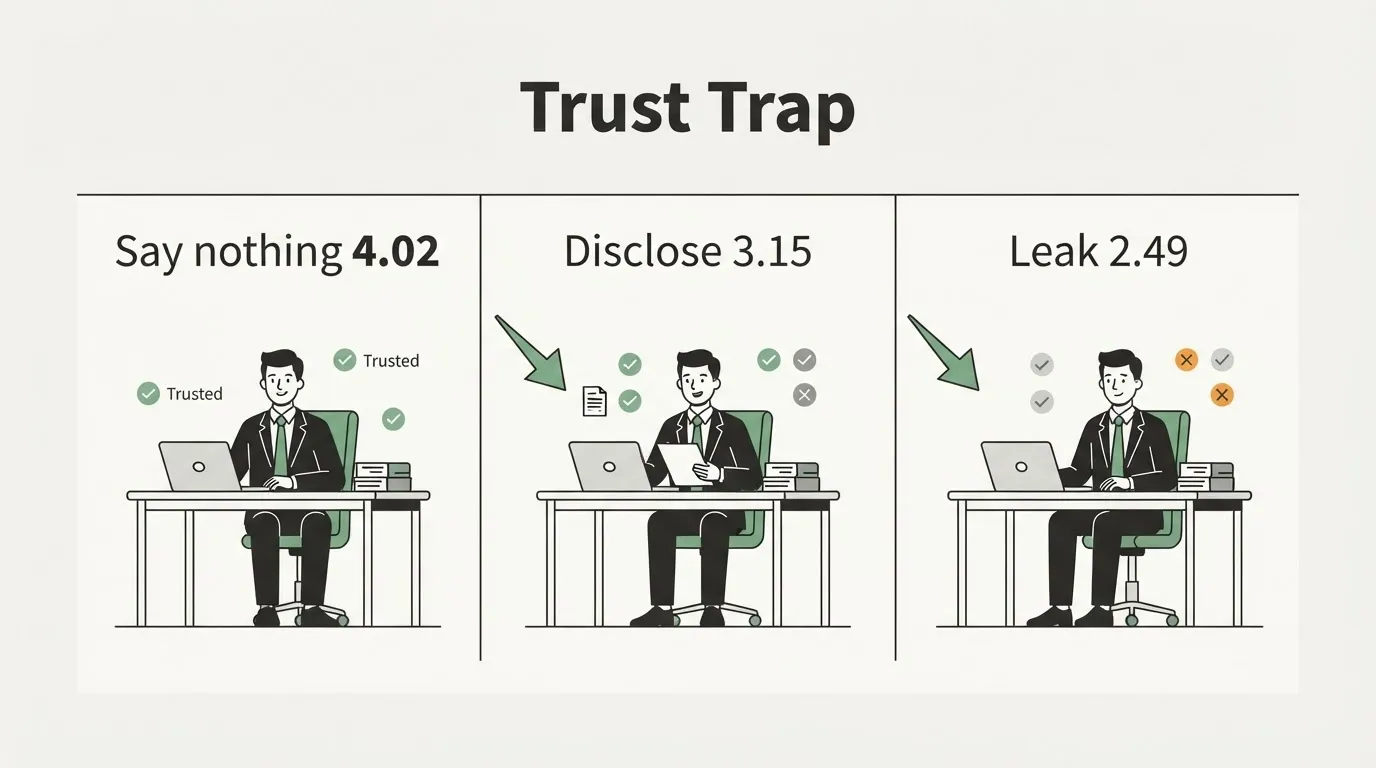
In study 13, 195 people were asked to imagine they had filed their taxes online. They were put in a chat with a tax adviser called Charles. Charles worked out what they would get back. Everyone was shown the same figure, $2,928.
Then one thing changed, and only one thing. What the person was told about how Charles did the work.
- Charles said nothing. Trust scored 4.02 out of 5.
- Charles said he used AI. Trust fell to 3.15 out of 5.
- A news leak said he used AI. Trust fell to 2.49 out of 5.
Same man. Same sums. Same refund. Three different levels of trust.
Read the middle line again. Charles lost about nine tenths of a point for one honest sentence about work nobody had complained about.
Now read the bottom line. Being found out cost him more than twice as much as admitting it.
So there are three prices here, not two. Saying nothing looks like the cheap option, and it only stays cheap for as long as nobody ever finds out.
That is the whole problem in one experiment. The rest of this piece is about why it happens, and what you can actually do about it.
The compliance squeeze: EU and California

So why is this suddenly everyone's problem? Because two rules came into force on the same day, 2 August 2026.
One is European. It is Article 50 of the EU AI Act, and it is about being open when something was made by a machine. The other is Californian, the AI Transparency Act.
The European rule can be expensive. Breaking it can cost up to 15 million euros or 3 percent of a company's worldwide turnover for the year, whichever is bigger. You can read the official summary on the European Commission's own page, the text of Article 50 itself, or a plain summary from the law firm Cooley.
Now the part the panic leaves out. The rule is narrower than it sounds.
- It mostly points at the companies that build AI tools. They have to mark what their tools produce, in a way a machine can read.
- For people who just use those tools, the duty is smaller. It is aimed mainly at deepfakes and at text on matters of public interest.
- Old work is safe. Anything made before 2 August 2026 does not have to be labelled afterwards.
- There are official icons if you want them, in a voluntary code of practice.
An ordinary blog post from a small software company is mostly not what Article 50 was written for. None of this is legal advice, and if you are unsure about your own situation you need a lawyer, not an article.
The thing that will actually reach you first is not the law. It is the platforms. Meta, Google, TikTok and YouTube each run their own AI labelling rules, with their own triggers and their own punishments, and they change them whenever they like.
So the law tells you why this landed on your desk this year. It does not tell you why the label costs you anything. For that you have to look at what readers are doing.
Why AI content disclosure costs you trust

Here is the question that decides everything you do next. What are readers actually punishing?
They are not going back and finding the writing worse. Nobody in these tests read the words differently. What they were judging is whether using AI looks like a normal and acceptable thing for a person to do.
The researchers have a word for that. They call it legitimacy. In plain terms it means the reader is judging the act, not the sentences.
That one finding rules out every fix a marketer reaches for first.
- Softer wording. Tested. The penalty held across different ways of phrasing it.
- Saying "AI-assisted" rather than "AI-written". Still penalised.
- "But they already know we use AI." Tested. It made no difference.
- "The law made us say it." Tested. Still penalised.
That last one is worth sitting with, because it is the one most people assume will save them. In study 12, people first read a news story about lawmakers. Half read that disclosure was being made compulsory. Half read that it was staying voluntary. Then they were shown a postcard designed with the help of an AI tool, and asked how much they trusted the designer.
The penalty survived both versions. Being made to say it does not buy the trust back.
So this is not simple dislike of AI, and it is not a clean punishment for hiding something either. Being open does not cure the trust problem, because being open is exactly what sets it off.
Which leaves one obvious hope. Surely this fades as everybody starts using these tools? The researchers tested that too, and that test is the most interesting thing in the paper.
The experiment they expected to fail

Everyone assumes this problem solves itself. Give it a year or two, the thinking goes, everybody will be using these tools and nobody will care any more.
The researchers thought so too. So they built a test to prove it, and they wrote down what they expected before they ran it.
It is listed in the extra material as study SM-3, and it works like this.
- First, people used an AI tool themselves to write a letter.
- Then those same people read about somebody else who said they had used one.
- The researchers expected the second group to go easy on them.
- They did not. The penalty did not move.
Their own words, from the paper:
"We had expected that the AI-disclosure effect would be alleviated in the condition in which the study participants used AI themselves prior to evaluating the other person. However, what we instead found is that the AI-disclosure effect is remarkably robust."
Read who is doing the punishing there. People who had just used AI, minutes earlier, with their own hands.
The researchers went further and checked it a second way, across all thirteen experiments at once. They looked at whether a reader who uses AI at work docks fewer marks than one who does not. The difference was too small to count.
So this is not something people will grow out of. That is worth knowing before you spend a year waiting for it to pass.
If getting used to AI does not fix it, what does?
What actually moves the number

One thing did move it. Not the label. What the reader believed before they ever got to the label.
In study 7, some people were shown a short piece from a real published article by the Boston Consulting Group's Henderson Institute, about getting value out of these tools. Other people were shown nothing. Then both groups read the same disclosure.
The group who had seen that respected people already used AI marked the writer down less.
The researchers call this collective validity. It is a heavy phrase for a simple thing. People look around to see what everyone else seems to think is normal, and then they judge you against that.
A second team found the same escape route from the other end. Hiroki Nakano and four colleagues asked 261 readers to react to writing across six different situations, and collected 990 answers. You can read their paper here. Disclosure made writers seem less trustworthy, less caring, less able and less likeable. The fall was steepest in personal writing, the kind one person sends to another.
But readers who understood AI better minded less. Some of them liked it.
A third paper, published in 2026, found the same knot tied from another side. It asked 547 people, and they said they believe disclosure matters. Then they marked disclosed writing down anyway. The researchers call it a disclosure paradox, and warn it pushes people towards saying nothing. Only the summary of that paper could be read for this piece, so it is reported at that level and nothing in it is quoted.
Put the three together and they point at the same place. The label is not the lever. The lever is what your reader already thinks about the tool.
Which means the work is upstream of the label, and it is not clever work:
- Be useful enough that the reader wants to reach the end.
- Be specific enough that only somebody who knows the job could have written it.
- Make using the tool ordinary, so that mentioning it is a note and not a confession.
None of that is a way of getting away with something. It is the only part of this the evidence says you can actually move.
Frequently asked questions
Does saying content is AI-assisted really hurt trust?
Yes. Thirteen experiments by Schilke and Reimann found that people who say they used AI are trusted less than people who say nothing. All thirteen were registered before the results came in. You can read the paper here.
The catch is that readers are not marking down the writing. They are marking down the act of using AI.
What are the fines for not labelling AI content in Europe?
For the content the rule actually covers, up to 15 million euros or 3 percent of yearly worldwide turnover, whichever is bigger. That figure is on the European Commission's page.
An ordinary company blog post is mostly not what Article 50 is aimed at. This is not legal advice, and your own case may be different.
Does writing "AI-assisted" instead of "AI-written" help?
Barely. The researchers tried different ways of phrasing the disclosure and the penalty held across them.
Wording is a weak lever because the wording is not what is being judged.
Everyone uses AI now. Will this fade by itself?
The evidence says no. In study SM-3, people who had just used an AI tool themselves still marked down somebody else who admitted using one. The researchers had expected the opposite.
Is it safer to just say nothing?
Not reliably. In the tax adviser test, trust was 4.02 out of 5 when he said nothing, 3.15 when he said it himself, and 2.49 when a leak revealed it.
So silence is the cheapest option right up until somebody else tells them, and then it is the most expensive one.
What should a small team actually do?
Spend the effort before the label, not on it. Be useful, be specific enough that only someone who knows the work could have written it, and make using the tool an ordinary thing rather than an admission.
The part we do not know yet

Before you act on any of this, here is what these studies cannot tell you.
All three of them measure strangers judging strangers. Somebody reads one letter, or one estimate, from a person they have never met and will never meet, and gives a score.
That is not the writing most people do. Most writing goes to someone who already knows you.
- We know a stranger's judgement drops when AI is disclosed.
- We do not know what happens with a reader who already trusts you.
- We do not know what happens the fifth time they see the line.
- We do not know whether it fades inside an audience that knows your work.
Nobody has run that study. It is the study this whole area needs next.
There is one last thing, and it is sitting at the bottom of the paper itself.
Schilke and Reimann added their own AI disclosure. They wrote that during the preparation of the work they used ChatGPT-4 and Dall-E to make the materials they showed people and to copyedit the manuscript, that they reviewed and edited it afterwards, and that they take full responsibility for it.
The two people who measured exactly what that sentence costs went ahead and wrote it anyway.
I have no data on what happens next, which is why I want to ask you something instead.
Where all of this came from
- Oliver Schilke and Martin Reimann, "The transparency dilemma: How AI disclosure erodes trust", Organizational Behavior and Human Decision Processes, volume 188 (2025), article 104405. Thirteen experiments, all registered in advance: https://www.sciencedirect.com/science/article/pii/S0749597825000172 . Free copy: https://www.oliverschilke.com/fileadmin/pdf/Schilke__Reimann._The_transparency_dilemma.pdf
- Hiroki Nakano, Jo Takezawa, Fabrice Matulic, Chi-Lan Yang and Koji Yatani, "Understanding Reader Perception Shifts upon Disclosure of AI Authorship". 261 readers, 990 answers: https://arxiv.org/abs/2510.24011
- "The AI penalty and disclosure paradox", Computers in Human Behavior: Artificial Humans (2026). 547 people. Only the summary was readable for this piece, so nothing here is quoted from it: https://www.sciencedirect.com/science/article/pii/S2949882126000551
- European Commission, transparency duties under Article 50 of the AI Act: https://digital-strategy.ec.europa.eu/en/faqs/transparency-obligations-under-article-50-ai-act
- The text of Article 50: https://artificialintelligenceact.eu/article/50/
- Cooley, on the rules taking effect on 2 August 2026: https://www.cooley.com/news/insight/2026/2026-08-03-eu-ai-act-transparency-obligations-take-effect-2-august-2026
- The voluntary code of practice on labelling, including the icons: https://digital-strategy.ec.europa.eu/en/policies/code-practice-ai-generated-content
When you told someone AI helped you write it, what did they say?