
guide
AI Crawler Optimization: Open the Right Doors for Training Bots
August 29, 2026 · 8 min read · Scout7
A practical guide to AI crawler optimization: audit robots.txt, structure sitemaps, and manage crawl budgets so AI bots can find and cite you.
Introduction
AI crawler optimization means making your best pages easy for AI bots to access, parse, and prioritize. If you want modern answer engines to cite you, fix technical hygiene first: robots.txt, crawlability, sitemaps, and the pages you actually want bots to spend time on.
Key takeaways:
- Audit robots.txt before publishing more content
- Structure sitemaps around your highest-value URLs
- Treat crawl budget as a visibility decision
- Monitor bot activity weekly, not once
Your site is no longer written for one audience.
It has to work for people and for bots deciding what gets summarized, trained on, and surfaced later.
For Scout7, that matters because organic marketing on loop now depends on more than output.
It depends on whether the right pages are open, readable, and easy to parse.
This guide shows the plain-English foundation.
First fix access, then improve structure, then monitor what bots actually do.
Why AI Bots Don’t See Your Site Like Google

And that starts with dropping one bad assumption: AI crawlers are not just Googlebot with a new name.
They do a different job, so they create a different visibility problem.
An AI crawler is a bot that visits websites to collect content for AI systems.
Some support training, some support retrieval, and some may later influence what answer engines cite.
- Search crawlers index for retrieval and try to rank pages in search
- AI training bots collect content for model learning and summarization
- Referrer expectations differ because many AI bots do not send classic search traffic back
- Visibility goals change from ranking pages to being parseable and citable
According to Cloudflare’s 2025 reporting, training-related crawling made up nearly 80% of AI bot activity (80%).
That is the hook: most AI bot traffic is not there to behave like search.
If you treat AI bots like a nuisance to block, you may be blocking a new discovery layer.
So the next question is more practical: what are you hiding by accident?
The Robots.txt Audit: Find the Pages You’re Hiding by Accident

Once you accept AI bots are a new audience, the first non-negotiable step is robots.txt.
That file tells crawlers what they can and cannot access.
In technical SEO, crawlability means whether bots can reach and understand your pages.
If your robots.txt file is broken, missing, or contradictory, crawlability drops before content quality even matters.
- Check that
/robots.txtresolves cleanly with a 200 status - Look for accidental disallows on docs, blog folders, or product pages
- Review outdated rules written for old campaigns or migrations
- Confirm AI bot access rules match today’s visibility goals
- Keep directives simple so intent is obvious to your team
According to Cloudflare’s AI Crawl Control guidance, unsuccessful robots.txt requests indicate crawlers are having trouble accessing directives.
Cloudflare also notes that if robots.txt returns 404 Not Found (404), site owners should create the file.
Based on the perspective behind this guide, the lesson is straightforward: AI bots are a new audience to welcome, not block, and technical hygiene is the non-negotiable foundation for being found and cited.
But access alone is not enough.
Bots also need help finding the pages that matter most.
Sitemaps for the Agentic Web
Once robots.txt works, the next job is structure.
A sitemap is the cleanest signal you can send about what exists and what deserves first pass.
A sitemap helps bots parse your site faster.
In an AI world, that matters because publishing more does not help if your best material is buried under stale, duplicate, or low-value URLs.
- Prioritize high-value URLs like docs, core product pages, and canonical explainers
- Remove stale entries so bots do not waste attention
- Consolidate duplicates across tags, archives, and parameter variations
- Keep canonicals consistent so one version carries authority
- Separate sitemap types if needed for docs, blog, or product content
A simple example: if your blog, docs, and product pages all live in one bloated sitemap, bots may keep revisiting low-value archive URLs before they reach the pages you actually want cited.
A cleaner setup is to keep priority pages in focused sitemap files and remove URLs you would not want a training bot to treat as representative.
Structure beats volume when bots need a fast, clean map of your site.
AI Crawler Optimization in an AI World: Managing Crawl Budget

And once bots can find your map, you need to decide what they should spend time on.
That is where Crawl Budget becomes a strategic filter.
Crawl Budget: Crawl budget is the number of URLs a search engine crawler, such as Googlebot, intends to index on a specific website within a given timeframe. It is determined by a site's crawl rate limit, which prevents server overload, and crawl demand, which is influenced by the site's popularity and content freshness.
For AI bot crawl budget, the practical question is simple: which pages do you want training and citation systems to see first?
- Prioritize evergreen explainers that answer recurring customer questions
- Open core product pages that define your category and value
- Include comparison and docs pages that carry high citation utility
- De-prioritize faceted search and duplicate archives
- Limit heavy endpoints that consume resources without visibility upside
According to Cloudflare’s 2026 agentic internet report, just over half of crawler requests (52%) on its network were for AI training by June 2026, up from about one in five requests (22%) in spring 2025.
And Content Marketing Institute’s 2026 B2B research says the standout teams are strengthening fundamentals first.
The better move is selective openness.
Not blanket blocking, and not unlimited access.
Monitoring Bot Activity: Who Is Actually Visiting?
That selective openness only works if you verify it.
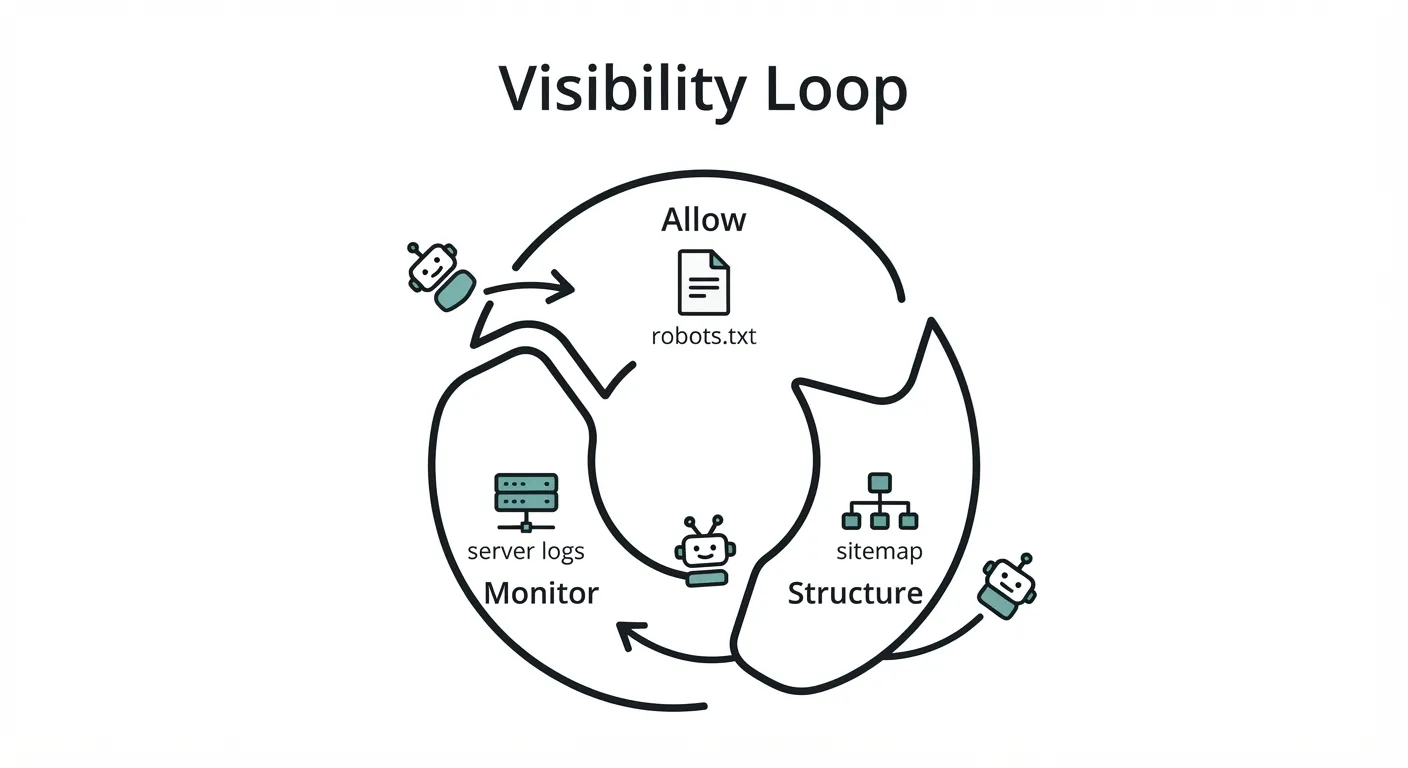
Logs turn crawler policy from guesswork into a repeatable visibility loop.
This is where technical SEO becomes operational.
You are not just setting rules; you are checking whether bots read them, request the right URLs, and skip the wrong ones.
- Watch robots.txt fetches for repeated failures or odd spikes
- Separate crawler types into search, AI training, and referrer patterns
- Track top requested paths to see where attention actually lands
- Review blocked vs allowed behavior after policy changes
- Check rendering dependencies on key pages like docs and product content
Two technical concepts matter here.
JavaScript execution is the ability of a crawler to run JavaScript before understanding page content, and many bots do this inconsistently.
Server-side rendering means the server sends usable HTML immediately, which makes important content easier for bots to read without heavy client-side execution.
A short weekly log review is usually enough to catch problems early.
For example, if an AI bot keeps requesting /robots.txt and then stops after hitting blocked JS-dependent pages, you have a visibility issue that content quality alone will not fix.
The pattern is simple: measure behavior, not assumptions.
Weekly monitoring is how the streak becomes the strategy.
Your Next Move in the Visibility Loop

If the opening image was a site publishing for humans alone, here is the payoff: that model is over.
The brands that get cited next will be the ones that welcome AI bots with clear rules, strong structure, and steady monitoring.
Key takeaways:
- Fix robots.txt first so bots can read your access rules
- Use sitemaps to spotlight value instead of making bots guess
- Manage crawl budget intentionally around pages worth citing
- Monitor logs weekly to turn one-time fixes into a loop
This is the practical shift behind AI crawler optimization.
You do not need to publish endlessly.
You need to open the right doors, point bots toward your highest-value pages, and make those pages easy to read.
Start this week with a three-step audit:
- Check
/robots.txtstatus and remove accidental disallows - Refresh your sitemap around docs, product pages, and canonical explainers
- Review logs weekly for AI bot fetches, failures, and wasted crawl paths
That is how you move from compliance to citation.
And for builders with no time to sell, it is one of the clearest ways to keep organic marketing on loop as answer engines become a bigger source of discovery.
Frequently asked questions
Should I block AI bots in robots.txt?
Not by default. This article’s recommendation is selective openness: allow access to pages you want found and cited, and review bot rules against your current visibility goals. Blanket blocking can shut off a discovery layer.
What pages should AI bots reach first?
Start with evergreen explainers, core product pages, docs, and comparison pages. These are the pages the article identifies as high-value for training, parsing, and citation utility. Low-value archives, duplicates, and faceted search pages should be de-prioritized.
Do I need a separate sitemap for AI crawlers?
Not necessarily. The article’s point is to keep sitemaps clean, focused, and aligned to your highest-value URLs. If it helps clarity, you can separate sitemap types for docs, blog, and product content.
How often should I monitor AI bot activity?
Weekly is enough for most teams, and that cadence is recommended throughout the article. A short log review can catch repeated robots.txt failures, blocked paths, or wasted crawl behavior before visibility problems compound.
References
- Cloudflare, "Crawlers, clickers, and AI bots: The state of the web" — https://blog.cloudflare.com/crawlers-click-ai-bots-training/
- Cloudflare Developers, "Track robots.txt" — https://developers.cloudflare.com/ai-crawl-control/features/track-robots-txt/
- Cloudflare, "Content Independence Day, one year on: building the business model for the agentic Internet" — https://blog.cloudflare.com/agentic-internet-bot-report/
- Content Marketing Institute, "B2B Content and Marketing Trends: Insights for 2026" — https://contentmarketinginstitute.com/b2b-research/b2b-content-marketing-trends-research