
how_to_playbook
AI Search Optimization: 5 Steps to a Page AI Will Actually Quote
September 2, 2026 · 8 min read · Scout7
AI search optimization in 5 practical steps: write answer-first sections, build self-contained passages, add schema, and link for citation.
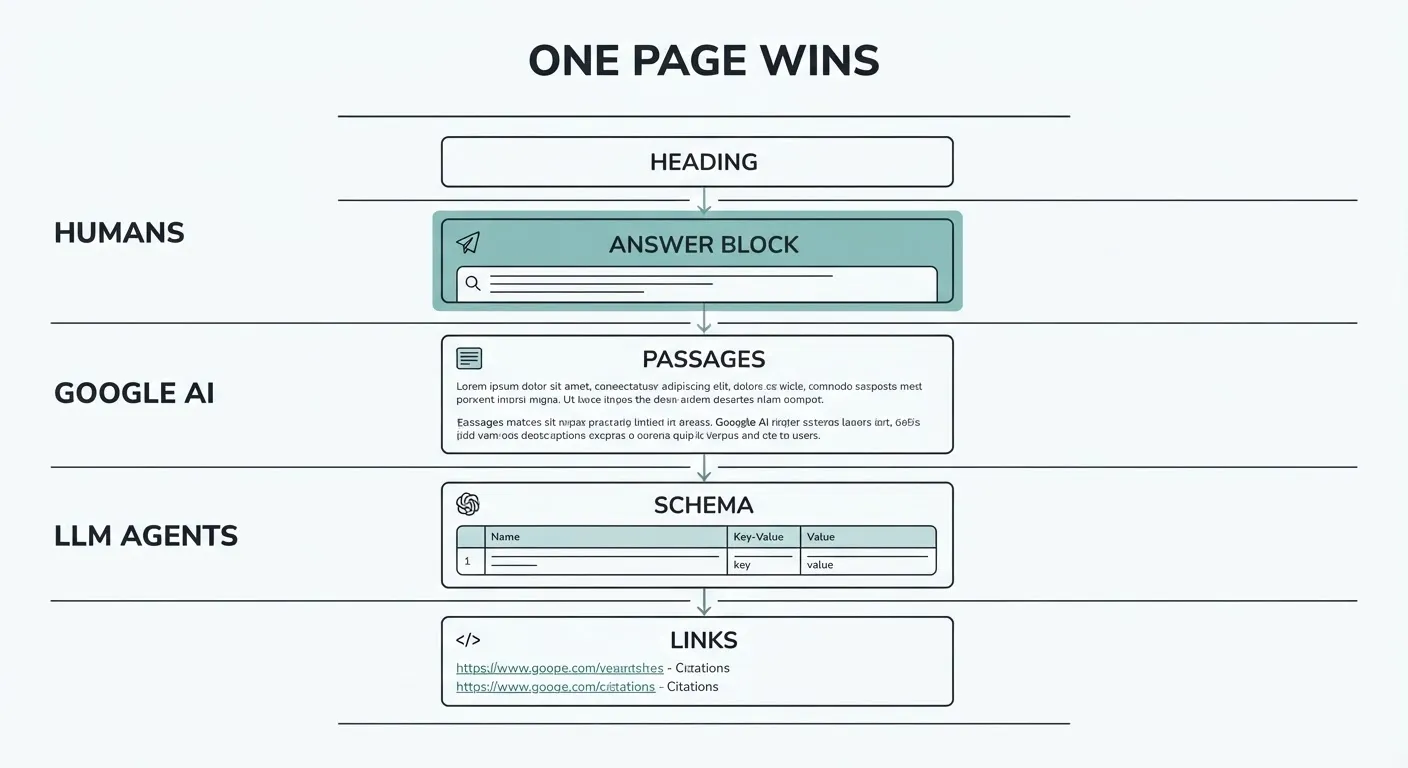
Deck: A practical build order for a page that can rank in Google, surface in AI Overviews, and earn LLM citations.
Introduction
Your page can rank on page one and still disappear when the answer gets generated above it. AI search optimization now means building for two readers at once: the human visitor and the retrieval system that may split your page into passages before a model ever sees it.
That shift is already material. According to Deloitte’s 2026 TMT Predictions, nearly 3 in 10 adults in developed countries (29%) are expected to view at least one AI-generated search summary each day by 2026.
This playbook shows the build order: heading, answer-first block, explanation, self-contained passages, schema, and internal links. The goal is simple: keep SEO for discovery, add Generative Engine Optimization for citation.
Key takeaways:
- Rank alone is no longer enough for AI-mediated visibility
- The first two lines under each heading matter most
- Passages get lifted, not whole pages
- Schema and links help models trust the page
And that leads to the first layer: the page has to say what it is before anything else can work.
Step 1: Start With a Semantic Anchor
If your H1 tries to sound clever, it often becomes harder to retrieve. A citation-ready page starts with a heading structure that names the topic, problem, and intent in plain language.
Search itself is becoming AI-mediated. Deloitte says daily usage of AI within search will be 3 times higher than standalone AI tools by 2026, which raises the cost of vague page labeling.
Use this shape:
- H1 names the topic directly: “AI Search Optimization for SaaS Docs”
- H2s mirror query intent: “What is AI search optimization?”
- H2s cover decision questions: “Does AI search change SEO strategy?”
- Headings state entities clearly: product, audience, use case, problem
Quick check:
- Read only your H1 and H2s
- Ask if a stranger can predict the answers
- If not, rewrite for clarity over style
A clear skeleton helps retrieval label sections before deeper reading begins. But structure alone is not enough; the next layer decides whether a section is actually liftable.
Step 2: Put the Answer First, Then Explain
The first two lines under a heading should answer the question completely on their own. That is the core of an effective LLM citation strategy, because retrieval often splits a page into passages before a model selects what to quote.
This is the mechanical middle position. SEO is not replaced by Generative Engine Optimization; the page just needs a second design layer for citation. Based on what we saw when thinking through how AI-mediated retrieval breaks pages into passages before models read them, the practical rule became obvious: the opening lines under each heading must stand alone.
That matters because blue-link visibility and AI visibility have started to diverge. Ahrefs found that AI Overviews correlate with a 58% lower average click-through rate for the top-ranking page, while Adobe reports that more than 3 in 4 executives and practitioners (76%) say generative AI improved content speed and volume.
Use this section pattern:
- Question heading
- Two-sentence direct answer
- Three bullets with evidence or conditions
- Short explanation for nuance
Example:
- H2: What is AI search optimization?
- Answer block: AI search optimization is the practice of structuring content so AI systems can retrieve, understand, and cite it accurately. It complements classic SEO by making each section self-contained and quotable.
- Then explain: Add examples, caveats, and supporting detail
Quick check:
- Copy the first two lines under each H2
- Paste them into a blank doc
- If they still make sense alone, the passage is liftable
Once the answer block works in isolation, the page needs supporting context so the passage feels trustworthy, not floating.
Step 3: Build Self-Contained Passages, Schema, and Context
A page becomes citable when each section can travel alone. A page becomes believable when markup, metadata, and nearby pages tell systems what the content is and how it connects.
That support layer matters because many teams have AI tools without AI workflows. McKinsey found that nearly 6 in 10 marketers use AI multiple times per week, but fewer than 1 in 10 have captured value across end-to-end workflows.
Build context with:
- Self-contained opening lines that name the subject, not “this” or “it”
- Article schema for the page’s primary content type
- FAQPage schema when the FAQ is visible on-page
- Organization or WebPage schema where it adds source context
- Internal links to proof pages, product pages, and adjacent guides
The operational case is strong. In Salesforce’s 2026 State of Marketing, teams satisfied with unified data were 42% more likely to regularly respond to customers and 60% more likely to use AI agents.
Quick check:
- Run a schema validator
- Confirm visible copy matches the schema
- Check internal links point to supporting evidence
Now the page can be understood. The next step makes sure it also answers the exact follow-up questions people and models ask.
Step 4: Add a People-Also-Ask FAQ Inside the Page
Broad pages often miss citations because they explain the topic but skip the exact question forms users type. An inline FAQ solves that by creating short, quotable answers in natural language.
That matters because content demand is rising faster than most teams can respond. Salesforce found that nearly 7 in 10 marketers (69%) still struggle to respond to customers promptly, and more than 4 in 5 (83%) say customers expect two-way conversations.
Use real question headings, then answer in one direct sentence before adding a caveat.
How to get cited in AI overviews?
To get cited in AI Overviews, write sections that answer a query fully in the first two lines, then support those lines with clear explanation, schema, and internal context. A page is easier to cite when each section can stand alone as a trustworthy passage.
Does AI search change SEO strategy?
Yes, AI Search changes SEO strategy by adding a second success condition: citation readiness. Classic ranking still matters for discovery, but ranking alone does not guarantee that generative systems will lift your page.
What questions belong in the FAQ?
Use questions that mirror natural-language search behavior and buyer follow-ups. Salesforce also found that nearly 8 in 10 marketers (78%) need more personalized content than they can produce, so one strong FAQ can do extra work across search, AI answers, and conversion paths.
Quick check:
- Read each answer aloud
- Ask whether it can be quoted without editing
- If not, tighten the first sentence
Once your page can answer direct questions cleanly, the final operating layer is measurement.
Step 5: Track Rank and Citation as Separate Outcomes
Rank still matters. It drives traffic, shapes discovery, and likely influences which sources AI systems inspect first.
But rank is no longer a proxy for citation, and pretending otherwise hides the real outcome. The right dashboard tracks where the page ranks, whether it appears in AI Overviews, and whether tools like Claude or ChatGPT cite the URL or lift a passage from it.
That measurement gap is common. Gartner found that CMOs allocate an average 15.3% of marketing budgets to AI, yet only 30% say their organizations are ready to scale AI capabilities.
Track these separately:
- Query rank in classic search
- AI Overview presence for target queries
- Citation frequency across AI tools
- Which passage gets lifted most often
- Referral changes after heading or answer-block edits
Quick check:
- Ask the same query in multiple AI tools
- Record quoted passages and linked URLs
- Compare results after page revisions
That leaves one final move: put the whole system together in the order a retrieval engine will actually process it.
AI Search Optimization: Build the Page a Retrieval System Will Read
 The practical shift is simple. Stop writing one uninterrupted essay, and start writing a page as a chain of liftable answers with visible support.
If you remember one thing, make it this: the first two lines under each heading must answer the question completely on their own. That is the build-order difference between a page that merely ranks and a page that can rank, surface in AI Overviews, and be cited by a large language model.
Key takeaways:
- Use clear headings so systems can label the page correctly
- Lead every section with a self-contained answer
- Support passages with schema and internal links
- Measure rank and citation separately
This is the payoff to the opening tension. The job is not choosing between SEO and Generative Engine Optimization. The job is keeping them together: rank for discovery, structure for citation, and let one page do both.
For your next article, audit it in ten minutes. Read only the H1 and H2s. Then read only the first two lines under each heading. Then validate your schema and test the target query in multiple AI tools. If the page fails any of those checks, you now know the exact layer to fix.
That is how builders with no time to sell can create stronger organic marketing on loop. Start with one page, make it citation-ready, and use that page as the template for the streak. The pages that stay visible next year will not just be well ranked. They will be easy to lift, easy to trust, and ready for the way search now works.
References
- Deloitte 2026 TMT Predictions
- Ahrefs: Update: AI Overviews Reduce Clicks by 58%
- Adobe: 2026 AI and Digital Trends Report: Four Key Takeaways
- McKinsey: From anxiety to advantage: A marketing organization that thrives with AI
- Salesforce: State of Marketing 2026
- Gartner: 2026 CMO Spend Survey Finds CMOs Allocate 15.3% of Marketing Budgets to AI