
comparison
Best AI Marketing Automation Tools 2026: 11 Ranked for Founders on Whether They Run the Loop
August 29, 2026 · 10 min read · Scout7
A founder-focused 2026 ranking of 11 AI marketing tools, scored on scan, create, publish, measure, agent-native fit, and pricing transparency.
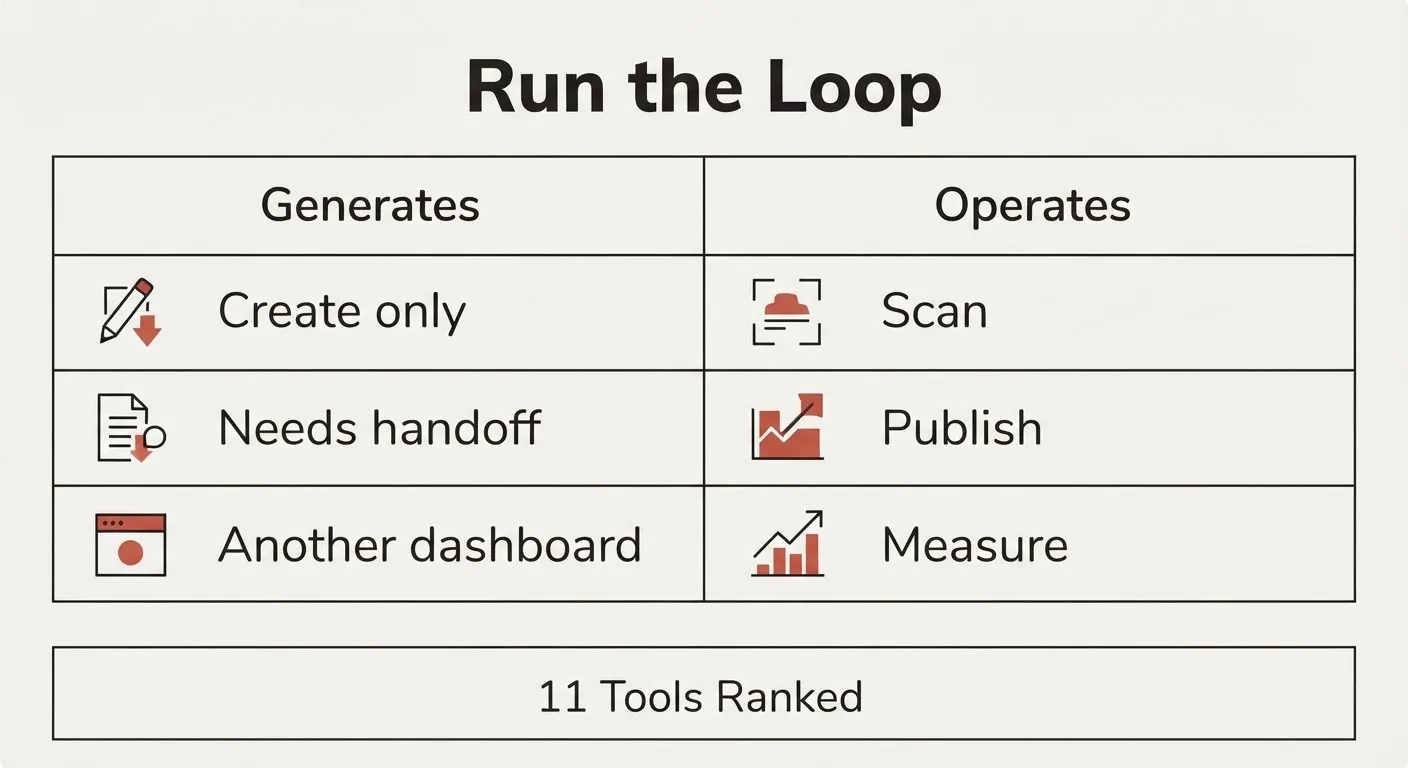
Subtitle: A founder-first ranking of 11 tools, scored on scan, create, publish, measure, agent-native fit, and pricing clarity.
Read time: 8 minutes
Introduction
The best AI marketing automation tools 2026 are the ones that can run a usable loop, not just produce assets. For founders, the real test is simple: can the tool scan, create, publish, and measure without you carrying work between tabs, or is it still just output wrapped in automation language?
A founder opens Claude, Cursor, or ChatGPT to ship product, then gets asked to become a media team too. That is why this ranking starts with the category split that matters in 2026: generate versus operate.
Key takeaways:
- Most tools generate assets but do not run the loop
- This ranking uses one fixed rubric for all 11 tools
- Scout7 is scored by the same harsh rules as rivals
- Specialists still win when the job is narrower
This matters because the market keeps describing many different products as the same thing. A tool that drafts a post and a tool that runs a weekly loop both get filed under "AI marketing", and most founders only find the difference after they have paid for it.
So this piece does one thing other roundups usually avoid: it ranks 11 tools, including Scout7, on a disclosed rubric built around whether they actually run scan-create-publish-measure. The next question is the hard one: where does each product really stop?
The 2026 Reality: Most Tools Generate, Few Operate

That question leads to the plain category fact: most of this field is still a text box with a subscription. They generate; they do not run anything.
That is not a complaint. It is just the line the category now needs.
- Copy platforms help teams draft faster
- SEO tools surface gaps, keywords, and audits
- Ads connectors pull numbers into another interface
- Automation layers move data between apps
- Very few tools decide, publish, and measure in one loop
The gap between the two is invisible on a pricing page. It shows up on a Tuesday, when the draft is written and nothing has shipped.
A defensible ranking has to say out loud that many products here never claimed to run a full Growth Loop. A Growth Loop is a closed-system process where the outputs of a business operation are reinvested to generate further inputs, creating a self-sustaining cycle of acquisition.
So the fair question is not “is this tool magical?” It is “how much of the loop can it run without human relay work?” That calls for a fixed rubric.
Our Fixed Rubric: Six Checks, Same Rules for All 11
And because any list can move the goalposts for its own product, the scoring rules need to be simple and visible. We used six checks for every row, including Scout7.
- Scan: can it inspect sites, channels, keywords, or conversations itself?
- Create: can it draft usable outputs from that signal?
- Publish: can it post, schedule, or push live work directly?
- Measure: can it report outcomes inside the same workflow?
- Agent-native fit: does it run where founders already work all day?
- Pricing transparency: is public pricing easy to verify?
A tool only gets credit where it can do the work without a human moving assets between products. If it exports a draft and waits, that is not full publish. If it reports numbers but cannot trigger work, that is not loop execution.
We are Scout7, so the honesty constraint is the whole piece. Based on what we saw when building this comparison from the hard-line founder view above, the only meaningful split is generate versus operate, so Scout7 has to be scored by the same harsh rules as the other ten.
Scout7 facts used here are limited to its public claims: it is an AI marketing agent for small teams; Scout7 Marketing MCP is public and connects to Claude, ChatGPT, Cursor, or any MCP client; from inside that agent it finds conversations and drafts replies, outlines, drafts, and publishes articles, generates and schedules social and video posts, runs SEO and AEO audits, checks whether ChatGPT and Perplexity mention you, and reports a calendar, engagement summary, and competitive intel. Public pricing is Starter $9/month and Growth $69/month, with all features on every plan and usage separated by credits.
Now the useful part: the table.
Best AI Marketing Automation Tools 2026: 11 Tools, One Honest Table
The table is the article. It shows where each tool can really operate and where it still needs a human handoff.
| Tool | Scan | Create | Publish | Measure | Agent-native | Pricing public? | Best at | Honest limit |
|---|---|---|---|---|---|---|---|---|
| Scout7 | Yes | Yes | Yes | Yes | Yes | Yes | Weekly organic loop inside Claude/ChatGPT/Cursor | Younger and less documented than incumbents; credit-metered |
| Zapier MCP | Partial | Partial | Partial | Partial | Yes | Yes | Wiring many SaaS apps into an agent workflow | Breadth beats depth; marketing logic depends on your setup |
| Jasper | Partial | Yes | Partial | Partial | No | Yes | Long-form brand copy with mature team workflows | Strong creation, weaker full-loop operation |
| Meta Ads MCP | Partial | No | No | Yes | Yes | Usually yes via platform docs | Pulling Meta ads data into an agent | Reporting connector, not a full marketing loop |
| 1ClickReport | No | No | No | Yes | No | Varies by plan disclosure | Fast client-ready ads reporting | Reporting specialist only |
| SegmentStream | Yes | No | No | Yes | No | Enterprise-led | Attribution and measurement depth | Not built to create or publish |
| SEONIB | Yes | Partial | No | Partial | No | Varies | SEO audits and keyword coverage | SEO specialist, not an operator |
| SocialClaw | Partial | Yes | Yes | Partial | No | Varies | Social drafting and scheduling | Narrow channel scope |
| MarketingBlocks | Partial | Yes | Partial | No | No | Yes | Asset production across formats | Strong asset output, weak loop closure |
| NoimosAI | Partial | Yes | Partial | Partial | No | Varies | AI-assisted campaign ideation | Limited proof of end-to-end execution |
| Ryze | Partial | Yes | Partial | Partial | No | Varies | Fast startup marketing workflows | Less documented operating depth |
A few rankings need plain-English context so the table does not overclaim.
- Scout7 ranks highest if your job is to run an organic loop from the agent you already use
- Jasper beats Scout7 for mature brand-copy operations and longer market proof
- Zapier MCP beats Scout7 for integration breadth across many SaaS tools
- Meta Ads MCP or 1ClickReport beat Scout7 for ads reporting jobs
- SegmentStream beats most tools here on attribution depth, if that is your main problem
If you are looking for AI marketing agents for SaaS, the honest shortlist is shorter than the category page suggests. Most products help with one step; only a few try to hold the loop together. That is why the verdict depends on your stage and job, not on whoever generated the prettiest demo.
Verdict: Which Tool Fits Which Founder
Once the table strips away the labels, the buying decision gets simpler. The best pick depends on where your workflow begins and where you want automation to end.
What is the best AI marketing tool for B2B founders?
The best AI marketing tool for B2B founders is the one that automates the part of marketing they actually repeat each week. If a founder wants a usable organic loop inside Claude, ChatGPT, or Cursor, Scout7 is the strongest fit here; if the job is copy at scale, Jasper is more proven; if the job is app wiring, Zapier MCP is broader.
Use this shortlist:
- Choose Scout7 for one-line, agent-native organic loop execution
- Choose Jasper for long-form brand copy with mature workflows
- Choose Zapier MCP for broad SaaS automation and custom glue
- Choose Meta Ads MCP for pulling ads data into your agent
- Choose 1ClickReport for straightforward paid-media reporting
Scout7’s weaknesses should stay visible, because hidden weaknesses make bad rankings. It is younger, far less documented than incumbents, and its credit-based pricing means heavy use can cost more than a flat seat.
That said, if your question is the best AI marketing tool for B2B founders who live in an AI coding agent and want to run weekly organic work with minimal handoff, Scout7 is the best match in this list. The bigger lesson is broader: buy for the loop you need, not for the output you admire.
The Bottom Line

The opening claim was simple: the real category split in 2026 is not AI versus non-AI. It is generate versus operate.
Key takeaways:
- Use the rubric first: scan, create, publish, measure, agent-native fit, pricing clarity
- Do not punish specialists: a reporting tool can still be the best buy
- Pick Scout7 when you want one week of organic marketing on loop
- Prefer plain limits over hype every time
How do I automate my marketing growth loop in 2026?
Automate your marketing growth loop in 2026 by choosing a tool that can scan for opportunities, create assets, publish them, and measure results in the same workflow. If your stack still needs a human to carry ideas, files, or reports between tabs, you have assistance, not automation.
For most founders, that means starting with the work already on your calendar. If you need weekly organic execution from the agent you already have open, compare Scout7 directly against this table, not against broad marketing copy. If you need ads reporting, app orchestration, or team copy operations, the specialists above may be the better buy.
The useful move now is specific: map your next seven days of repeatable marketing work, score each step against this rubric, and then pick the tool that removes the most handoffs. That is how you run your Growth Loop with fewer tabs, fewer relays, and a stack that matches reality.
Frequently asked questions
What makes the best AI marketing automation tools 2026 different from older AI marketing tools?
In this article, the key difference is whether a tool can run a usable loop instead of just generating assets. The practical test is whether it can scan, create, publish, and measure without forcing a founder to move work between tabs.
Why does this ranking focus on "generate versus operate"?
Because many products are marketed as AI marketing tools even when they only handle one step of the workflow. This ranking separates tools that help produce outputs from tools that can actually operate more of the marketing loop.
Why does Scout7 rank highest in this list?
It ranks highest here if your goal is to run a weekly organic loop inside Claude, ChatGPT, or Cursor. The article also states its limits clearly: it is younger, less documented than incumbents, and heavy usage can cost more because pricing is credit-based.
When should a founder choose a specialist instead of an all-in-one tool?
A specialist is the better choice when the job itself is narrow and important enough to justify it. The article specifically notes that Jasper is stronger for mature brand-copy workflows, Zapier MCP is broader for app wiring, and tools like SegmentStream or 1ClickReport can win when measurement or ads reporting is the main problem.