
research_paper
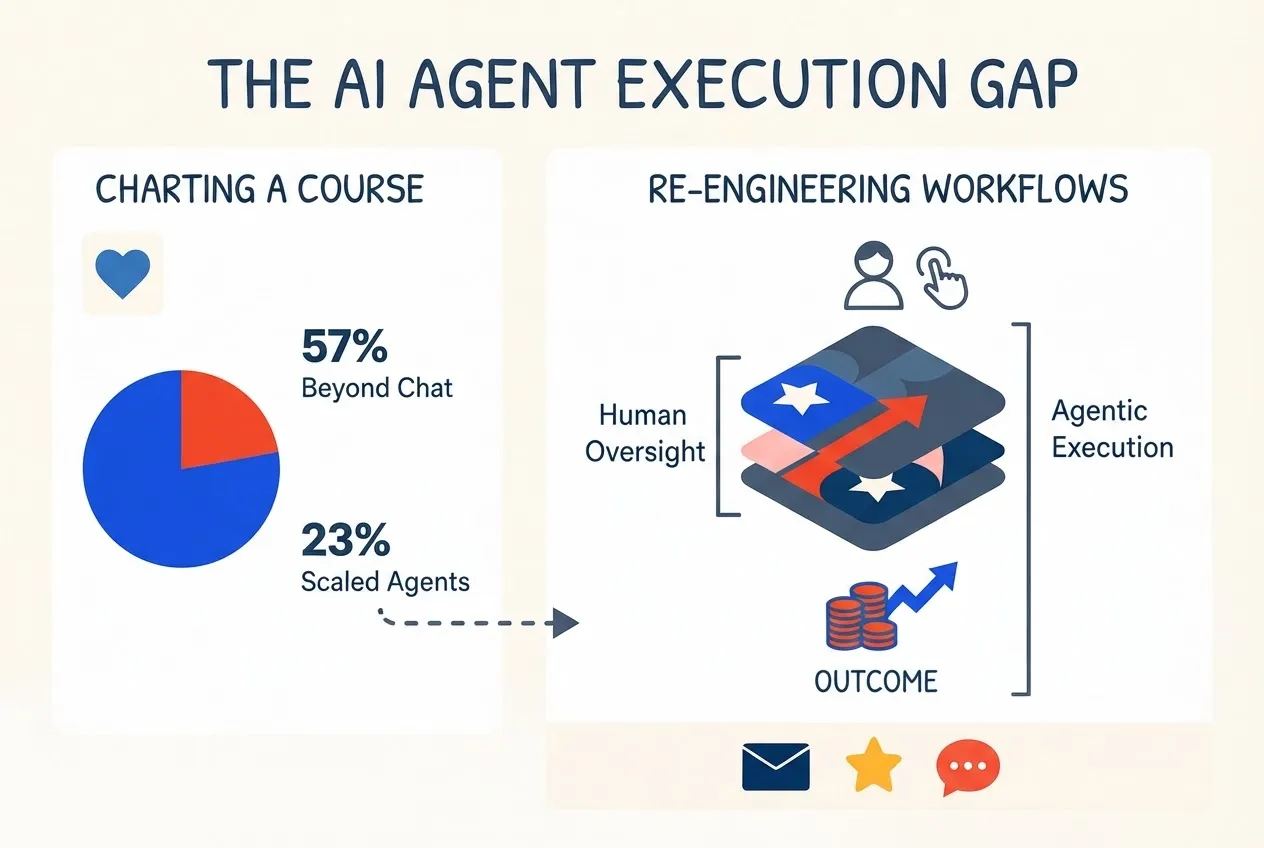
57% Have Moved Beyond Chat — So Why Have Only 23% Scaled AI Agents?
July 22, 2026 · 5 min read · Scout7
AI agents are already moving into workflows, but scaling still lags. This piece unpacks the execution gap reshaping digital campaign operations.
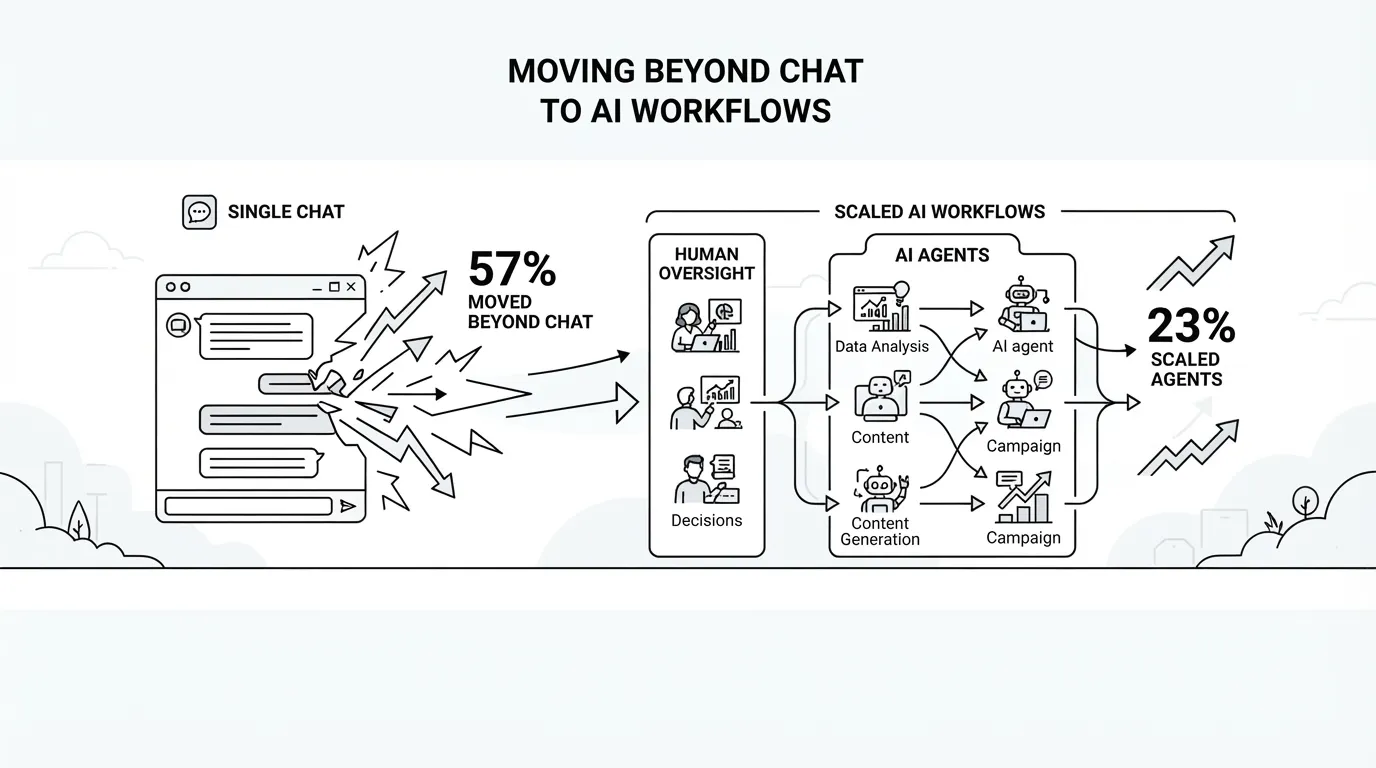
A team can now use AI to move work across a digital campaign workflow, not just answer a prompt. But the real constraint is not interest in agents. It is whether organizations can make them reliable inside real processes.
That shift is already visible in the data. According to Anthropic’s 2026 State of AI Agents Report, well over half of U.S. technical leaders (57%) use agents for multi-stage workflows, while about 1 in 6 (16%) use them across functions. Meanwhile, McKinsey’s State of AI 2025: Agents and Innovation found only about 1 in 4 organizations (23%) have scaled agentic AI beyond pilots.
That gap matters across workflow-heavy environments, including digital campaign operations, campaign optimization, and paid marketing.
The market does not need more proof that agents are interesting. It needs better operating models for where agents can be trusted.
This is the core issue. Momentum is real, but maturity is not.
The Market Moved Beyond Chat Faster Than Most Teams Realized
The common AI narrative still centers on chat. The stronger signal is that organizations are already testing agents that handle sequences, handoffs, and operational work.
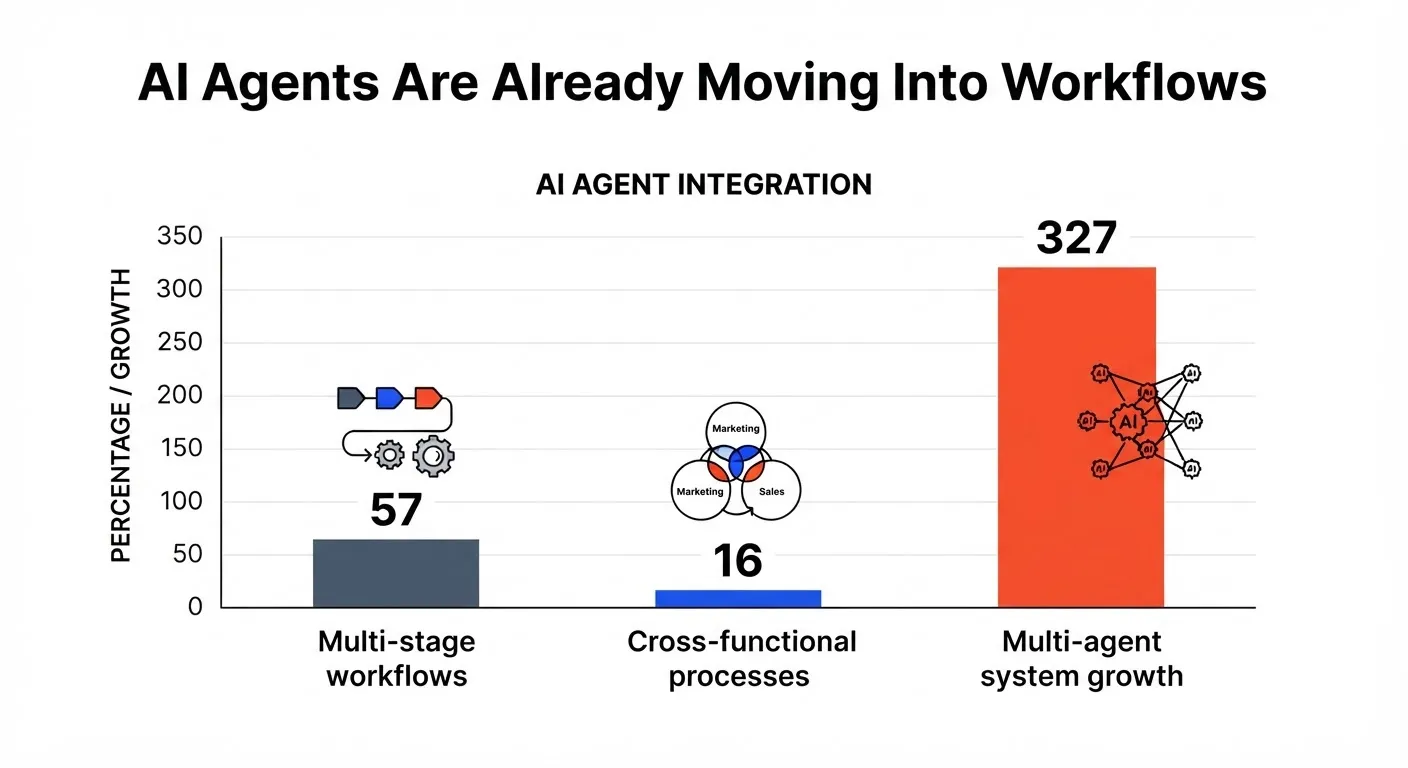
According to Anthropic, nearly 6 in 10 technical leaders (57%) already use agents for multi-stage workflows, and about 16% use them across functions. That means adoption is moving from isolated prompts toward structured execution.
Databricks’ State of AI Agents adds another clear signal. It reported a 327% increase in multi-agent systems in less than four months across its customer ecosystem.
That matters because many operational environments already run on repeatable chains of work:
- Tasks happen in sequence across research, decisions, execution, and review
- Outputs are bounded enough to define what good work should look like
- Feedback loops exist through performance, quality, or service data
- Human checkpoints remain close to the final decision in most workflows
- Speed matters when teams coordinate across tools and functions
The market has moved beyond chat. What it has not yet done is prove that those agentic systems can scale cleanly.
The Real Story Is the Execution Gap
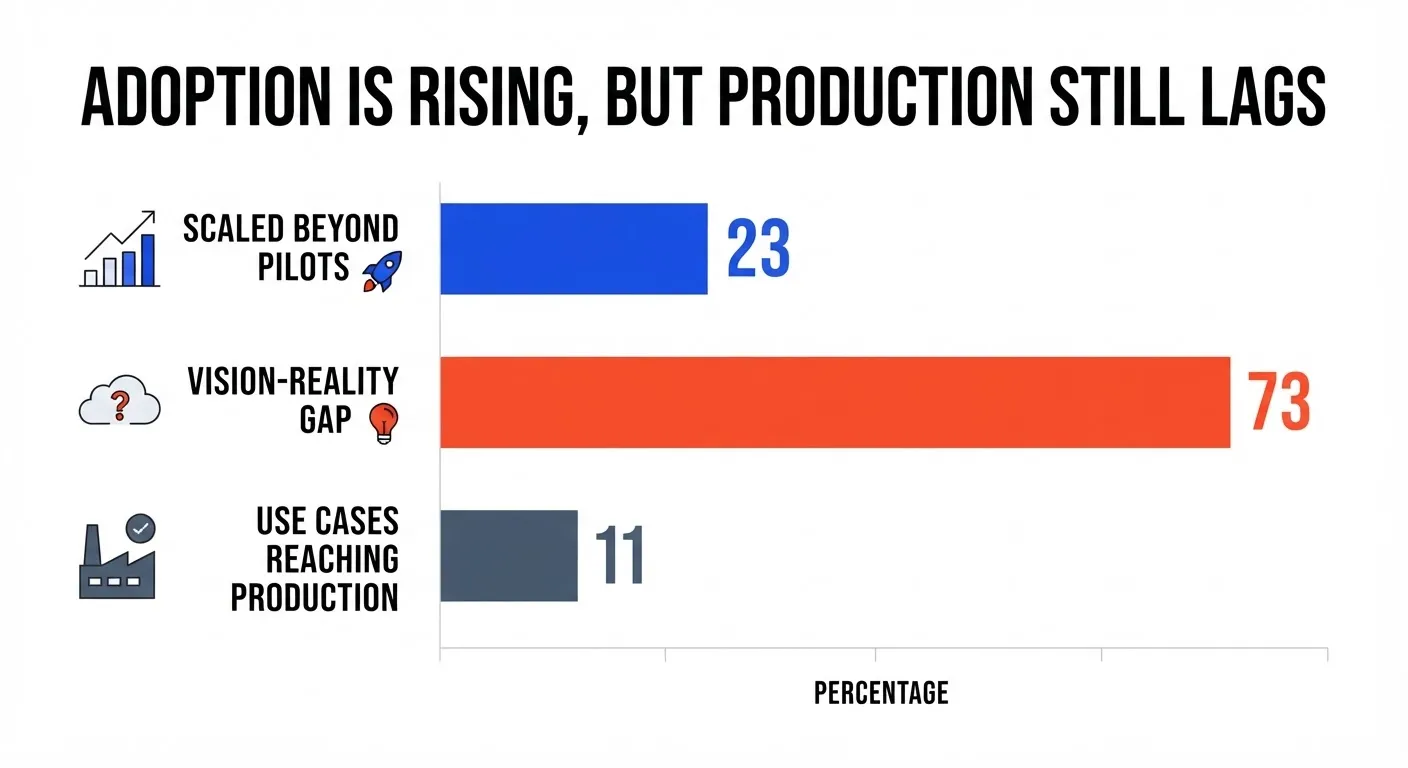
The headline numbers sound impressive until you ask how many organizations have reached production at scale. The answer is much smaller than the hype suggests.
McKinsey found that only about 1 in 4 organizations (23%) have scaled agentic AI beyond pilots, usually in just one or two functions. Camunda’s 2026 report found nearly three-quarters of organizations (73%) see a major gap between vision and reality, while only just over 1 in 10 use cases (11%) reached production in the last year.
That pattern says a lot. Organizations believe in agents, fund experiments, and talk confidently about transformation, but few have turned that interest into dependable operating systems.
A practical execution gap usually looks like this:
- Pilots stay narrow because oversight breaks once workflows cross teams
- Recommendations work but production actions still need review and controls
- Ownership stays unclear when automation spans multiple systems or functions
- Trust drops fast when outputs affect budgets, compliance, or reporting
- Integration work expands faster than the original use case promised
Adoption numbers show curiosity. Production numbers show capability.
That is why the real story is not adoption alone. It is execution discipline.
Why Scale Stalls: Not Because Agents Are Weak, But Because Systems Are
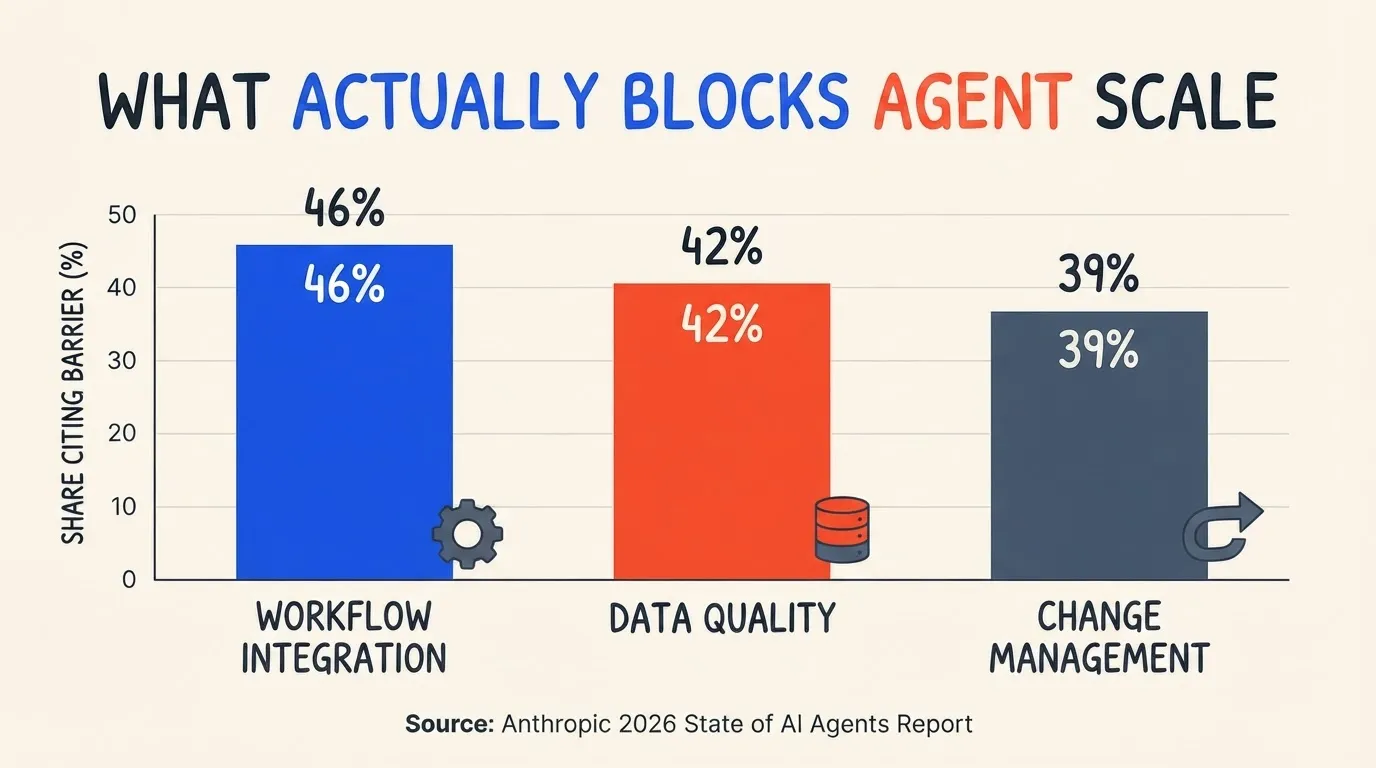
Most organizations do not stall because models cannot generate useful output. They stall because real workflows are messy, data is uneven, and control still matters.
In Anthropic’s report, leaders said the top barrier was workflow integration (46%), followed by data quality (42%) and change management (39%). Capgemini’s AI Agents report also shows that confidence falls as autonomy rises, signaling growing caution around fully autonomous systems.
These barriers show up quickly in workflow-heavy environments, including digital campaign and paid marketing operations:
- Systems stay fragmented across platforms, files, approvals, and reporting layers
- Data quality varies across sources, which weakens reliable agent action
- Approvals exist for a reason when spend, accuracy, or risk is involved
- Change management lags when teams do not trust new operating patterns
- Autonomy feels risky before visibility and escalation paths are clear
That is why the right starting point is bounded autonomy, not maximum autonomy.
Organizations scale more safely when agents support lower-risk workflow steps first, then expand only after controls, auditability, and trust are in place.
Conclusion
The lesson is not that organizations should slow down on agents. It is that they need to stop confusing workflow adoption with workflow maturity.
According to McKinsey’s research on rewiring to capture value, the biggest lever for impact is redesigning how work gets done. At the same time, Capgemini makes clear that while the economic potential is substantial, most organizations still have not fully scaled deployment.
So the practical implication is straightforward:
- Re-engineer the workflow first instead of dropping agents into broken processes
- Prepare the data foundation so agents can act on clean, connected information
- Expand autonomy gradually as controls, trust, and accountability improve
That applies broadly, including in digital campaign, campaign optimization, and paid marketing environments.
The next step is specific: pick one repeatable workflow, redesign it for an agentic model, and audit whether the underlying data can actually support it. The organizations that do both well will be better positioned for the next phase of AI adoption.
References
- Anthropic, The 2026 State of AI Agents Report
- McKinsey, The State of AI 2025: Agents and Innovation
- Databricks, State of AI Agents
- Camunda, Closing the Agentic AI Vision-Reality Gap: 2026 State of Agentic Orchestration and Automation Report
- Capgemini, AI Agents Report
- McKinsey, The State of AI: How Organizations Are Rewiring to Capture Value