
guide
Founder Content Strategy: Everyone Says Post Every Week. Nobody Says When It Ends.
September 19, 2026 · 8 min read · Scout7
Founders post for two weeks, then stop. Studies of candles, paper shapes and word games show why. People slack in the middle, and "post every week" is all middle.
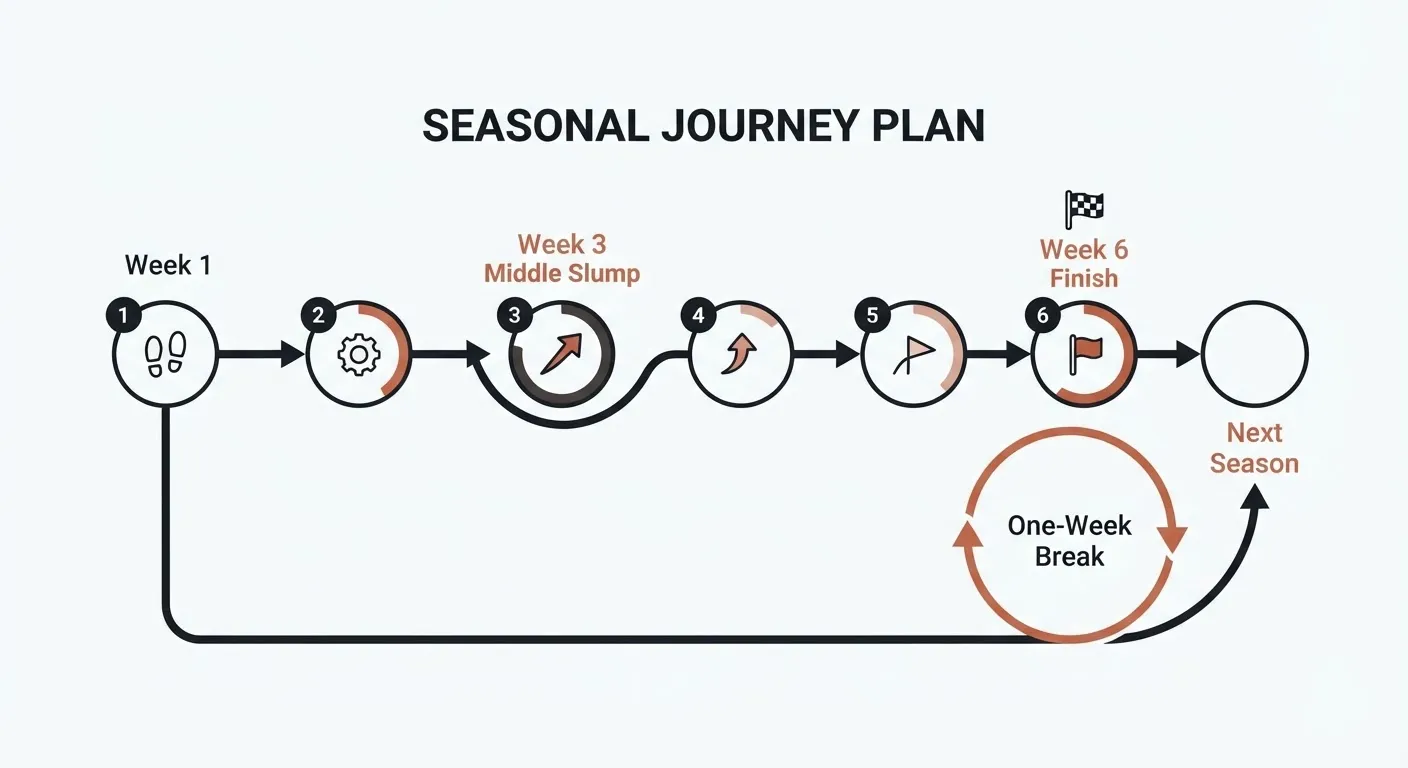
You start posting. For two weeks it goes well. Then you stop, and a month goes by.
Most founders blame themselves. They say they got lazy, or too busy. But a founder content strategy, meaning your plan for what to post, often breaks in the same place. This guide shows why, using real studies. It also gives you one change you can make this week. It costs nothing.
Key points:
- People try hard at the start of a run of tasks. They try hard again near the end. They try less in the middle.
- "Post every week" has no end. So after a few posts, you are always in the middle.
- The fix comes from the researchers themselves. Cut one long run into short runs, each with a start and an end.
- Write down the date of your next start before you begin. A finish line can turn into a place to stop.
You Did Not Quit, You Got Stuck in the Middle
Think about the last time your posting stopped. Was there a big crisis? Often there was not.
Week one felt exciting. Week two felt fine. Then in week three, one post felt less important than the others. You skipped it "just this week". Then you skipped the next one too.
A founder described this pattern on Indie Hackers in July 2025. One week people post every day. Then the updates slow down.
Research has a name for this slow stop. It is called getting stuck in the middle. It happens to people who care a lot. The next study shows that.
The Candle Study: The Middle Drops, Even For People Who Care
In 2012, two researchers looked at a festival called Hanukkah. Their names are Maferima Toure-Tillery and Ayelet Fishbach. The festival lasts eight nights. On each night, families light candles.
They asked 202 students in Israel which nights they lit the candles. The study was published in the Journal of Experimental Psychology: General.
Here is what they found:
- On night one, 76 in 100 students lit the candles.
- On night six, only 43 in 100 did.
- On night eight, the last night, it went back up to 57 in 100.
Nothing bad happened in the middle of the week. The candles were the same. The students were the same. Only the place in the week changed.
The researchers also asked how religious each student was. The most religious students lit the candles on the first and last nights. On the middle nights, they looked almost the same as everyone else.
So the drop in the middle is not about caring less. It hits people who care too.
In another part of the study, 40 students judged other people. Skipping the first night seemed worse to them than skipping the fifth night. The middle felt like it did not count, even to others.
The Paper Shapes and the Word Game

The same researchers ran another test. They gave 53 people five paper shapes to cut out with scissors. All five shapes were the same. Then judges scored how neatly each one was cut.
- Shape one scored 7.70.
- Shape three, in the middle, scored 7.13.
- Shape five, the last one, scored 7.49.
People really did cut corners on the middle shape.
A different team found the same pattern in a word game. Andrea Bonezzi, Miguel Brendl and Matteo De Angelis published it in Psychological Science in 2011. In their game, 126 students played nine rounds. They found fewer words in round five than in round two or round eight.
Their reason is simple. At the start, you count what you have done. Your second post feels big, because before it you had only one. Later, one more post feels small next to all the others.
Near the end, you start counting what is left. Now each step feels big again, because the finish is close. The middle is the place where the start and the end both feel far away.
Why 'Post Every Week' Is All Middle
Now look at the goal most founders set. "Post every week." When does it end? It does not.
A goal with no end has no finish line to run toward. You can only count from the start. So each new post feels a little smaller than the one before. After a few posts, you are in the middle. And you stay there.
This link is our own reading of the research. None of these studies tested founders or posts. But it matches what founders describe. A good start, then a slow stop, and no crisis at all.
The researchers noticed one more useful thing. Where the middle sits depends on how long you think the run is. Their example: task three is the start of a run of 50 tasks. It is the middle of a run of five. It is the end of a run of three.
So you can move the middle. You do it by changing the length of the run.
What the Consistency Advice Gets Right
The usual advice says be consistent. That means post on a regular schedule. This advice points at something real.
Buffer is a company that sells a tool for scheduling posts. It studied about 161,000 accounts on Facebook, Instagram and X. It published the results on 5 March 2026. In weeks when an account did not post, it grew more slowly than normal. Even one or two posts a week did better than none.
Buffer sells scheduling, so it has a reason to like this result. Still, the finding makes sense. People cannot see you if you are not there.
So the aim is not to post less. The aim is to stop the long gaps you did not plan. A short break that you plan is different from a month you lose.
The Fix: A Founder Content Strategy With An End
Toure-Tillery and Fishbach gave the fix in their own paper. They said long runs can be split "into shorter sequences with several beginnings and ends". That means more starts, more ends, and less middle.
For posting, it can look like this:
- Plan a run of six posts. That is six weeks, with one post a week.
- Write down what the six posts are about before you start.
- Tell your readers that post six is the last one in this run.
- After post six, take one week off. You planned it, so it is not quitting.
- Then start a new run of six.
Six is not a magic number. The study does not say six. Pick a length where you can see the end from the start. Keep it short, so post one and post six both feel close.
The Trap in the Fix, and How to Start Again

There is one risk in this fix. A finish line can turn into a place to stop.
Two researchers, On Amir and Dan Ariely, studied this in 2008. Their paper is in the Journal of Experimental Psychology: Learning, Memory, and Cognition. Small goals along the way can make people relax once they reach one. People also did not expect this. They thought the small goals would only help.
So if your run ends and nothing is planned, a week off can become a month off. That is the same stop you started with.
Three rules help:
- Write the start date of the next run on day one, before post one goes out.
- Keep the break to one week. Buffer's data says long silences cost you.
- Start the next run on a fresh day, like a Monday or the first day of a month.
The last rule comes from a study by Hengchen Dai, Katherine Milkman and Jason Riis. It is in Management Science, 2014. They looked at visits to a university gym. At the start of a new week, the chance of a visit went up by about a third. At the start of a new term, it went up by nearly half. A fresh start on the calendar makes it easier to begin.
What This Research Cannot Tell You
It is important to be clear about the limits.
- These studies used students, candles, paper shapes, word games and a gym. None of them studied founders or social media posts.
- Some groups were small. The paper shapes study had 53 people.
- In the candle study, the rise at the end was smaller than the fall. Night eight was 57 in 100. Night one was 76.
- The idea that "post every week" is all middle is our reading. Nobody has tested it.
So treat this as something to try, not a proven rule. Try one short run and see what happens.
Frequently Asked Questions

Why do I stop posting after two weeks?
Often there is no crisis. In studies of people doing a run of tasks, they try hardest at the start and at the end. They try less in the middle. "Post every week" has no end, so you reach the middle fast and stay there.
Is it bad to take a break from posting?
A long break you did not plan costs you. Buffer found that weeks with no posts grow more slowly. A short break that you plan is different, as long as the next start date is already written down.
How long should one run of posts be?
The research does not give a number. Pick a length where you can see the end from the start. Six posts, one a week, is one simple choice.
What day should I start again?
A fresh day on the calendar helps, like a Monday or the first day of a month. In one study, gym visits went up by about a third at the start of a new week.
One question for you.
The last time you stopped posting, which post number were you on?