
research_paper
Founder-Led Growth: 59 Founders Named A Channel. Only 5 Said Blog.
September 15, 2026 · 15 min read · Scout7
Founder-led growth at zero customers: 59 founders named a first-customer channel, only 5 said their own blog, 20 said a community, and 0 of 66 said ads.
Read time: 8 minutes
Start with the count, not the traffic plan
You have built something. It works. Almost nobody has paid for it yet.
So you ask the question that founder-led growth really starts with. Where do I find the first person who will?
The usual answer is to start a blog, post every week, and wait about six months. That answer is everywhere. It is also not what happened to the founders somebody actually counted.
In August 2026 a company called Lead Scorer read 70 stories written by solo founders. In each one, the founder said where their first paying customer came from. 59 of them named a channel.
Only 5 said search or their own blog.
20 said a room that somebody else had already built. A forum. A group. A place where people were already talking.
And out of all 66 founders in the main set, not one got their first customer from an advert.
Here is the part that makes it useful. Most of those rooms will not let you talk about your product at all. Someone read the rules of 49 of them. 19 ban it outright.
That sounds like a problem. It is not. It is the instruction.
This piece walks through the count, the rules, how to pick one room, and what to watch in the first two weeks. It also says plainly what the count cannot tell you, because that matters just as much.
See why the old growth advice breaks at zero customers

The advice you were given is not stupid. It is just built for somebody who already has readers.
At zero customers you have no readers. So a new page on your own site is a page nobody has a reason to visit.
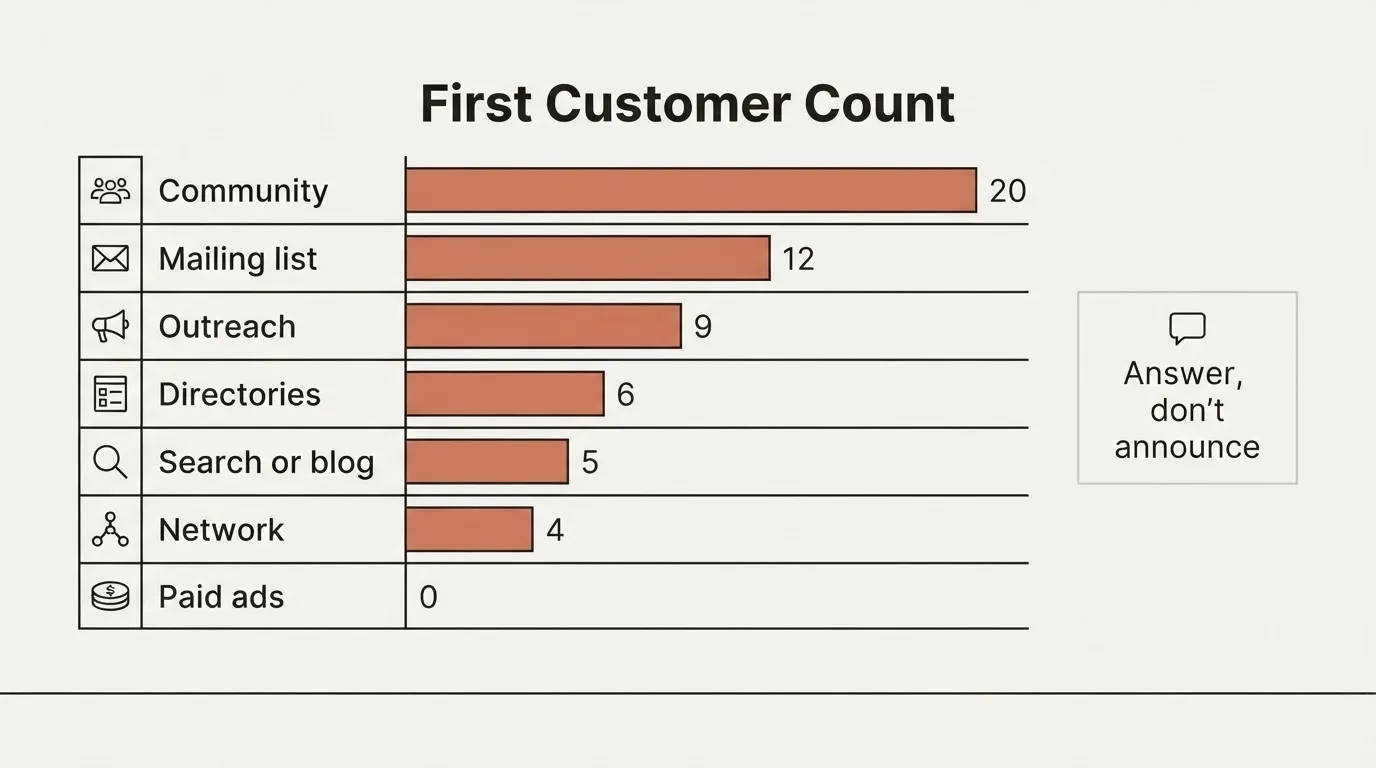
Here is what Lead Scorer found when they counted. Out of 59 solo founders who named a channel:
- A room somebody else had already built: 20
- Their own mailing list or launch post: 12
- Writing to people one at a time: 9
- Product Hunt, marketplaces and directories: 6
- Search and their own blog: 5
- People they already knew: 4
- Paid adverts: 0
Their own sentence about the adverts is worth reading twice. "Across 66 solo founders who documented getting a first paying customer between 2023 and 2026, not one of them got it from paid advertising."
Zero. Not a small number. Zero.
Look at the top and the bottom together. The biggest source was a place run by somebody else. The thing you are told to build first came fifth.
That does not mean writing is useless. The mailing list came second, at 12 of 59. But a mailing list only exists because somebody wrote for a long time before that.
So the advice is not wrong. It is aimed at the wrong week. It suits a founder in month twelve, and it keeps being handed to a founder in week one.
How did the six month rule get so certain, though? That is worth checking.
Notice that nobody measured the six-month rule

Search for how long content takes to work. You get very confident answers.
Twelve to eighteen months to make your money back. Twenty four months to make six times your money. Compounding starts to show in months five and six. Sixty to ninety days for a real return. Every post keeps pulling traffic for three and a half years.
Those numbers come from articles at ringly.io, searchlab.nl, digitalapplied.com, owlclaw.com and omnibound.ai.
Now look at what none of them say.
None of them says how many websites were measured. None says over what period. None says who was counted, or how. There is no method anywhere.
And they disagree with each other. Sixty to ninety days and twelve to eighteen months cannot both be true. Those are not small differences. One is about three months and the other is about a year and a half.
So the six month rule is a belief. People repeat it because other people repeat it. Nobody has shown the working.
That matters because a founder sits and waits on that number. They post for three months, see nothing, and decide they are bad at this. They are not. They are waiting on a clock that nobody ever built.
There is one more thing making the slow path slower. Google now shows an AI written summary at the top of many search pages. When it does, far fewer people click through to the website underneath. The drop is around 60 percent.
That is why Reddit, USA Today and Reuters have all considered blocking Google. CNBC reported on 30 July 2026 that Reddit's chief executive said these AI summaries cannot replace ordinary search links for sending traffic. Reddit is weighing whether to renew its 60 million dollar a year data deal with Google.
So the page you write today earns fewer visits than the same page would have earned two years ago.
Which brings us to the odd part.
Understand why rooms ban promotion

The rooms that produced the most first customers are mostly rooms where you are not allowed to mention your product.
A company called OneUp Today checked this properly. In July 2026 they opened 49 of the communities that founders post in most. They read the live rules of each one. Then they wrote down the exact wording.
Out of those 49:
- 19 ban self-promotion completely
- 11 allow it only if nine out of every ten things you post are not about you
- 18 decide case by case
- 1 actually welcomes it
One. Out of 49. That one is r/SideProject.
The rules are blunt. r/Entrepreneur says: "Do not use this community to sell, promote, recruit, hire, job-seek, solicit investment, or drive traffic to your profile, company, or external content." r/marketing has a "zero tolerance policy to Advertising, Self-Promotion, and Spam."
They are also getting stricter. On 14 April 2026 r/SaaS cut self-promotion to one post every 60 days. That now covers mentioning your product in a comment too. Break it repeatedly and your website address gets added to an automatic block list.
r/indiehackers lets you post about your thing once, under a label that marks it as asking for feedback rather than advertising.
Now hold the two facts next to each other. The place most likely to give you a first customer is the place most likely to remove your post.
That looks like bad luck. It is not.
Think about why the rule exists. A room with no rule fills up with adverts. Once it fills up with adverts, the people with real problems leave. Then the room is worth nothing, including to you.
The rule is what keeps the room full of people worth talking to. You want that rule. You just have to work with it instead of around it.
And working with it is simpler than it sounds.
Founder-led growth starts in one exact room

Lead Scorer put the whole thing in one sentence: "the founder does not build an audience, they go to a place where the audience already is and where people have already written down the problem."
Read that slowly. The problem is already written down. Somebody typed it out. It is sitting there.
So your job is not to get attention. Your job is to find that post and answer it.
Here is how to pick the room.
Search for the exact words a stuck person would type. Not your product category. The sentence somebody writes at eleven at night when the thing is not working. If you find real posts asking it, that is your room. If you find nothing, it is the wrong room, however big it is.
Read the rules before you post anything. They are public. Somebody has already read 49 of them for you. The first thing to learn about a room is what it will throw you out for.
Pick the small exact room over the big general one. One founder in the count tried two large platforms. They got almost nothing from either. One small, very specific community gave them all of it.
Then answer one question properly. In your own words, like a person. Say what you would say to a friend who was stuck.
That is the whole move. Answer the question. Do not announce the thing.
If somebody then asks what you use, you can tell them. They asked first. That is allowed everywhere, and it is the only moment where talking about your product is genuinely welcome.
There is a reason these rooms are worth more than they look. Semrush found that Reddit is the second most quoted website in Google's AI answers, behind only Quora. Figures from LLM Pulse were updated on 24 May 2026. Across the major AI search tools, YouTube is quoted most. Reddit is second, at about 17 in every 100 citations.
BrightEdge and Semrush give the same reason for it. People ask and answer narrow questions in those rooms that are not answered anywhere else.
Which is the same reason your first customer is there. It is where the problem gets written down.
Measure replies, not views

In the first two weeks, do not look at views.
Views feel good and tell you almost nothing at this stage. A thousand people reading your answer means very little if none of them has the problem.
Watch for one thing instead. Did the person who asked the question reply to you?
That is the signal. It means your answer matched something real that somebody actually needed. One reply from the person with the problem beats a thousand views from people without it.
A rough order, best first:
- The person who asked replies to you
- Another reader asks you a follow up question
- Somebody sends you a private message or an email afterwards
- Your answer gets a lot of views and nobody says anything
That last one is not success. It is the thing that looks like success.
If you want a sense of timing, Lead Scorer gives one: "Launch to first paying customer (n=24). Median 14 days."
Be careful with that number. It rests on only 24 of the 70 stories. It is a rough marker, not a promise and not a target. Do not judge yourself against it. It is there so you know the honest answer is closer to two weeks than to six months.
Now for the part that most articles hide at the bottom.
Name what this count cannot tell you

This count is useful. It is not a law. Here is what is wrong with it, stated plainly.
Both companies sell something. Lead Scorer sells software that helps you find people to sell to. They even say the finding flatters them. OneUp Today sells a tool for finding leads on Reddit. Both are describing a world where their own product is useful. Keep that in mind.
The sample is small. 70 stories. 66 in the main set. 59 named a channel. The 14 day figure rests on just 24. These are not numbers about all founders everywhere. They are numbers about 70 people.
It may not be your ranking. Lead Scorer says so themselves: "Platform bias. The sources over-represent micro-SaaS sold to founders and developers, which is very likely why Reddit dominates the ranking." And: "A founder selling to dental practices or freight carriers would produce a different ranking, and this dataset cannot tell you what it looks like."
So if you sell to dentists, or to trucking companies, your room is somewhere else. Probably not Reddit at all. The method still works. The specific answer does not transfer.
And the biggest problem is who is missing. Every story in this count was written by a founder who got a customer and then wrote about it.
People who tried and failed do not write that post. People who quietly gave up after four months do not write it either. Nobody publishes an article called "I posted in a community for a year and nothing happened."
So the count tells you where first customers came from, among people who got one and then told the internet. It cannot tell you how many people tried a community and got nothing. It cannot give you a success rate, because the people who failed were never in the room when the count was taken.
That is a real limit and it cuts against the finding. Read the whole thing with it in mind.
Frequently asked questions
Does this mean I should stop writing my blog?
No. The count says only 5 of 59 founders got their first paying customer from search or their own blog. It does not say writing never works. The mailing list came second at 12 of 59, and a mailing list is built by writing. The point is that writing pays you later, so it is the wrong first move when you have no customers yet.
If a community bans promotion, how does anyone get a customer there?
By answering, not announcing. People with real problems write those problems down in public. You find that post and you answer it properly. If the person then asks what you use, you can tell them, because they asked first. That is welcome in almost every room.
How do I choose which community to join?
Search for the exact sentence a stuck person would type at eleven at night. If you find real posts asking it, that is your room. If you find nothing, it is the wrong room however big it is. Then read the public rules before you post anything. Prefer the small exact community over the big general one.
Should I watch views in the first two weeks?
Mostly no. Views tell you very little when you have no customers. Watch instead for a reply from the person who asked the question. One reply from somebody with the problem is worth more than a thousand views from people without it.
Is 14 days a target I should hit?
No. That figure rests on only 24 of the 70 stories, so it is a rough marker and not a promise. Do not judge yourself against it. It is useful only as a reminder that the honest answer may be closer to two weeks than to six months.
Does this apply if I sell to dentists or trucking companies?
The method does. The specific answer probably does not. Lead Scorer says their sources over-represent small software sold to founders and developers, which is very likely why Reddit comes out on top. If you sell somewhere else, your room is somewhere else, and this count cannot tell you where.
What to do this week

None of this says stop writing.
The mailing list came second in the count, at 12 of 59. And a mailing list only exists because somebody wrote, week after week, for a long time. Writing builds the thing that pays you in month twelve.
It is just not the thing that gets you customer number one.
At zero customers the job is smaller than a content plan. It fits in an afternoon.
Pick one small community where your kind of buyer already talks. Search it for the sentence a stuck person would type. Read the rules. Find one post asking that question. Answer it properly, in plain words, as yourself.
Then watch for one reply from the person who asked.
That is it. No schedule, no backlog, no waiting six months on a number nobody ever measured.
And I would genuinely like to know whether this holds up outside a set of 70 people who wrote their story down.
Where did your first paying customer actually come from?