
market_pov
LinkedIn Algorithm 2026: Everyone Told You To Post More. Two Studies Got Opposite Answers.
September 20, 2026 · 11 min read · Scout7
Does the LinkedIn algorithm 2026 reward posting more? Buffer and Metricool studied millions of posts and found opposite answers. Here is why both are right.
You have probably read a lot about the LinkedIn algorithm 2026 and what it wants from you. Last year two companies stopped guessing and counted instead.
They asked the same question. What happens when you post more often? One of them counted two million posts. The other counted almost forty million. They got opposite answers.
Both of them counted correctly. That is the strange part, and it is what this article is about.
In short:
- One study compared different people with each other. The people who post a lot do better on every post.
- The other study compared one year with the year before. Everyone posted more, and every post did worse.
- Both are true. They asked two different questions.
The month you posted more and the numbers went down
You built something people use. They tell their friends. But you have very little time to tell anyone else about it.
So one month you pushed hard. You posted every day for three weeks. You wrote in the evenings, after the real work was done.
Then you opened your dashboard. The number of people who saw each post had gone down.
You thought the same thing everybody thinks. My writing must have got worse.
This article is about whether that is true. Two very large studies looked at it last year. They do not agree with each other.
What Buffer found about the LinkedIn algorithm 2026: posting more gets you more

Start with the good news, because it is real.
Buffer sells software for posting. So they are not a neutral judge, and it is only fair to say that out loud. But they did the work. They looked at more than two million LinkedIn posts from over 94,000 accounts.
They counted impressions. An impression just means your post showed up on one person's screen once.
Here is what they found. Everything is measured against someone who posts once a week.
- Post 2 to 5 times a week, and each post reached 1,182 more people.
- Post 6 to 10 times a week, and each post reached 5,001 more people.
- Post 11 times a week or more, and each post reached 16,946 more people.
Buffer's own words are plain. "Posting more often helps your performance on LinkedIn. Each step up in frequency delivers better per-post results."
So if you line people up next to each other, the ones who post a lot win. Every extra post seems to help them.
Hold on to that. Now look at the second study.
What Metricool found: everybody posted more and every post got less

Metricool also sells software for posting. The same warning applies to them. But they also did the work.
They looked at 39,762,999 posts from 1,059,949 accounts across ten platforms. Then they compared one year with the year before.
On LinkedIn, people posted 97 percent more. That is nearly double. And the number of people who saw each post fell 23 percent, from 1,057 down to 813.
The same thing happened elsewhere:
- On Instagram, posting went up 21 percent. The number of people reached by each post fell 31 percent, from 14,922 down to 9,689.
- On TikTok, posting went up 22 percent. Views on each video fell 17 percent, from 34,311 down to 28,483.
- On Facebook, posting went up only 4 percent. And the number of people reached by each post went up 51 percent, from 5,796 to 8,779.
Metricool's own line about LinkedIn is short. "Increased posting frequency brought increased competition."
Now here is the part that made me sit up.
Buffer says the same thing as Metricool, in a different report of their own.
In Buffer's State of Social Media Engagement 2026, which covers 52 million posts, they write: "Posting more helps you grow in aggregate, but each individual post may reach a smaller share of your audience." Aggregate just means everything added up together. They also say their study of 15.7 million posts "suggests that reach per post tends to decline at higher frequencies."
That is the opposite of what Buffer's own LinkedIn page says. Same company. Same year.
So which one is wrong?
Both are right, and here is why

Neither of them is wrong. They just answered two different questions.
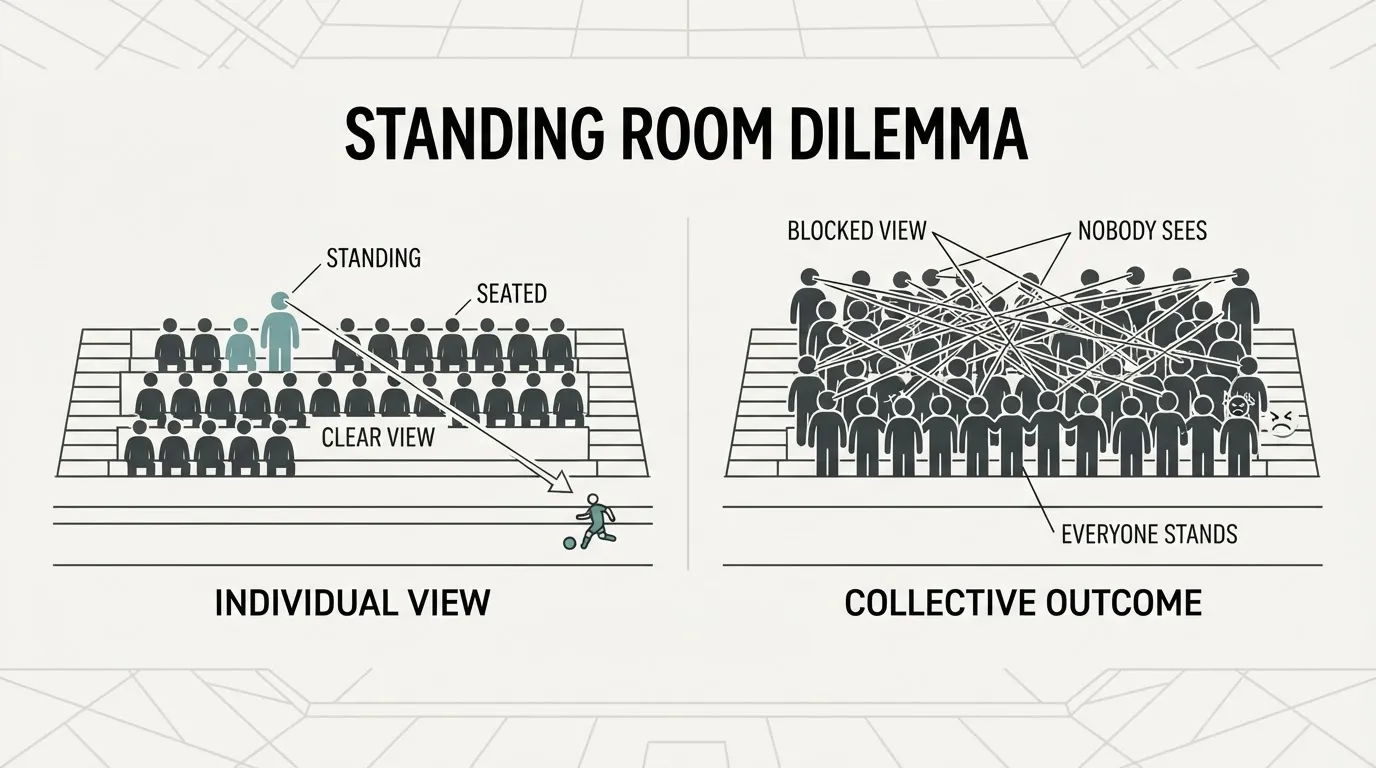
Think of a crowded cricket ground. Thousands of people are sitting in the stands. Everyone can see the game, because everyone is sitting down.
If you stand up, you see the game better than the people sitting around you. But if everybody stands up, nobody sees any better, and everyone ends up with tired legs.
Buffer looked at the person standing up while everyone else sat down. Metricool watched the entire stadium stand up at the exact same time.
- Compare people with each other, and the ones who post more do better. True.
- Compare this year with last year, and everyone who posted more got less per post. Also true.
- Posting more is not a clever trick. It is also not a punishment. It is one of those two answers, and nobody tells you which one you are looking at.
There is one question missing from almost every piece of marketing advice you will ever read. Compared to what?
More work, fewer people

Let us do the sum together, slowly.
Say you did exactly what the average Instagram account did last year.
You posted about a fifth more than the year before. So far, more work.
But each of your posts reached 31 percent fewer people. So each one did less.
Put those two together. You end the year reaching fewer people in total than when you started. More work. Fewer people.
LinkedIn was not as bad. Nearly double the posts got about one and a half times the total. So the extra work did buy something. Just much less than double.
TikTok was flat. A fifth more posts got about the same total as before.
One honest warning about all of that. These are averages of averages, so the sum is rough. It is an illustration, not a law. It describes the average account, not yours.
So should a founder just stop posting so much?
When posting more really does work

No. For a lot of people, posting more is still the right advice. It depends on how many followers you already have.
The Shield Index measured LinkedIn reach by follower size in February 2026. An account with 0 to 500 followers reaches about 94 people with a post. That is 41 percent of everyone who follows it.
An account with 100,000 to 250,000 followers reaches 9,062 people. That sounds far bigger. But it is only 6 percent of its followers.
So a founder with 300 followers is not in the crowded part at all. For them, posting more is simply good advice. Take it.
One more plain thing. This one is not a measured finding, just something worth noticing.
The accounts posting eleven times a week are mostly not doing it alone. Somebody there is paid to do it. So that figure of 16,946 is partly telling you who those accounts are. It is not telling you what would happen to you.
Crowding explains part of what changed. It does not explain all of it.
Crowding is not the only explanation

This article could be claiming too much, so here is the other side of it.
Sotrender looked at why Instagram reach fell in 2026. They found three reasons, not one.
- Crowding. In their own words, the accounts they watched "doubled their posting volume and increased weekly posting frequency by 21%, and reach fell anyway."
- Instagram changed what it counts. It started paying more attention to how long people watch a video, and to how often somebody sends a post to a friend. It pays less attention to likes than it used to.
- Instagram changed its rules. From April 2026 it cut how far reposted material travels. A repost is something you did not make yourself.
So crowding is part of the story. It is not the whole story, and this article is not saying it is.
One platform did go the other way, though.
The one place that went the other way, and why it is a test and not a move

In the same Metricool data, Facebook posting went up only 4 percent. And the number of people reached by each post went up 51 percent.
Where hardly anyone new turned up, the same work bought more. That is the pattern in one line.
Now the catch, and it matters.
PTSNV argue that this gain did not land evenly. They say Meta handed that reach to Groups and Events, not to business Pages. They point at Socialinsider, who measured 130,683 business Pages and found an average engagement rate of 0.15 percent. In plain words, on a normal business Page almost nobody liked, commented or shared anything.
So a small business Page mostly did not see that 51 percent.
A quieter room is worth a test. It is not worth moving your whole business on one number.
What to do on Monday

You do not need to buy anything. Three habits.
One. When you change how much you post, watch your total for the week. Do not watch the number on each post. Posting more is the thing that moved that number. So it cannot tell you whether posting more worked.
Two. Compare yourself to people who post as often as you do. Do not compare yourself to your own numbers from last year. Last year was a different room.
Three. When you read any piece of marketing advice, ask which of the two comparisons it came from. Advice built on the first one cannot promise you the second.
That is all of it. Add up the week, and stop reading each post as a school report.
Frequently asked questions
Does posting more often mean each post reaches fewer people?
It can. Metricool compared one year with the year before. On LinkedIn people posted 97 percent more, and the number of people reached by each post fell 23 percent. Buffer's own big report says the same thing.
Then why do the accounts that post a lot have better numbers?
Because that is a different comparison. Buffer lined accounts up next to each other. The ones posting 11 or more times a week reached 16,946 more people per post than the ones posting once a week. But those accounts mostly have somebody paid to do the posting, so they are not a fair match for a founder working alone.
Should a small account post more often?
Yes. The Shield Index found that an account with under 500 followers reaches about 41 percent of its followers with each post. A very large account reaches only about 6 percent. A small account is not in the crowded part yet, so posting more still helps it.
My numbers dropped after I posted more. Did I do something wrong?
Probably not. In the year Metricool measured, the average account on three platforms out of four did the same thing and got the same result. Watch your total for the week instead. The number on each post cannot tell you whether posting more worked, because posting more is the thing that moved it.
One question

The last time you posted more than usual, did each post do better or worse?
References
- Buffer. How Often Should You Post on LinkedIn in 2026? Data From 2 Million+ Posts. Over 2 million LinkedIn posts from 94,000+ accounts. Buffer sells posting software. https://buffer.com/resources/how-often-to-post-on-linkedin/
- Buffer. The State of Social Media Engagement in 2026. 52 million posts from over 200,000 accounts, January 2024 to December 2025. https://buffer.com/resources/state-of-social-media-engagement-2026/
- Metricool. 2026 Social Media Study. 39,762,999 posts from 1,059,949 accounts across 10 platforms, comparing 2024 with 2025. Metricool sells posting software. https://metricool.com/press-release-2026-social-media-study/ and https://metricool.com/social-media-study/
- Sotrender. Instagram Reach Is Down in 2026: What the Data Actually Says. August 2026. https://www.sotrender.com/blog/2026/08/instagram-reach-is-down-what-the-data-actually-says/
- The Shield Index. February 2026: LinkedIn reach benchmarks by follower bracket. https://theshieldindex.beehiiv.com/p/february-2026-linkedin-reach-benchmarks-by-follower-bracket
- PTSNV. Facebook reach went up last year. Your business page never saw it. Cites Socialinsider on 130,683 business Pages. https://ptsnv.com/facebook-reach-went-up-last-year-your-business-page-never-saw-it/
- NetInfluencer. Social media saturation reaches tipping point as content volume outpaces engagement, study finds. The per-platform pairs from the Metricool study. https://www.netinfluencer.com/social-media-saturation-reaches-tipping-point-as-content-volume-outpaces-engagement-study-finds/