
framework
Organic Marketing Automation: I Counted Every Job. You Can Only Buy Four.
August 31, 2026 · 12 min read · Scout7
A practical framework for solo software marketers to map 15 organic marketing jobs and automate the 4 that actually scale growth.
Read time: 4 minutes
Introduction
If you are doing organic marketing alone inside a software company, organic marketing automation should start with a job map, not a prompt. The fastest way to waste AI is to automate drafting before you define the full system, because the visible tasks get faster while the invisible ones still stall growth.
Key takeaways:
- Map all 15 organic marketing jobs first
- Automate loop work, not just drafting
- Keep judgment-heavy tasks human
- End each week with named ownership
You are not the founder in this story. You are the only marketer in a 20 to 80 person software company, covering content, social, search, email, launches, maybe events, while Slack fills with requests from founders and engineers.
That load is getting heavier. According to McKinsey’s 2026 Global B2B Pulse Survey, B2B buyers now use an average of 10 channels during the journey, so the solo marketer’s workflow keeps expanding even before new requests arrive.
The promise here is simple: by the end, you will be able to audit your organic workload, label the full set of jobs, and decide what an AI agent should handle, what should stay human, and what should stop pretending to be urgent.
And that starts with writing the work down plainly.
The 15 Jobs Most Teams Never Fully Name

Once you see the real workload, the problem stops looking like personal failure and starts looking like missing operational design. Organic work is not one job; it is a stack of separate jobs somebody has to own.
Based on what we saw when framing this for the lone marketer drowning in requests inside a software company, this fifteen-job inventory is Scout7’s own analysis.
Scout7’s own analysis: the 15 organic marketing jobs
- Site crawl and page-level audit to find technical and content issues
- Search demand research to identify real buyer questions
- Topic coverage scoring per page to spot missing depth
- Audience segmentation to separate messages by buyer type
- Article writing for durable search and citation assets
- A content site built so AI answers can cite it
- Image generation for posts, pages, and campaigns
- Video generation for channel-native output
- Slide decks and carousels for repackaging core ideas
- Multi-platform publishing across the channels that matter
- Scheduling to keep output consistent over time
- Engagement and commenting where buyers already are
- AI visibility probing to see where AI systems mention you
- Competitive intel to track gaps and market movement
- Measurement to tie activity back to attention and outcomes
Only about 4 of those 15 jobs are properly covered by typical off-the-shelf tools, in Scout7’s own analysis. That matters because the jobs without product categories are the ones that quietly never get done.
McKinsey also reports that about 71% of B2B companies now offer e-commerce, and among those firms roughly one-third of revenue comes through digital channels, which makes digital execution a core organic job rather than side work (McKinsey).
The next question is why so many of these jobs still fail even after teams add AI.
The Leverage Filter: Why 11 Jobs Fail

The usual diagnosis is “we need more automation.” The more accurate diagnosis is “we automated before anyone documented the work.”
That is why organic marketing automation often disappoints. The tooling may be fine, but the system is incomplete, so new software clusters around the same visible jobs while the unowned ones still break the loop.
According to Gartner’s 2026 CMO Spend Survey, CMOs now allocate about 15.3% of budget to AI initiatives, yet only about 3 in 10 leaders (30%) report mature or fully developed readiness to scale them. The money is moving faster than the operating model.
A second Gartner survey found leaders expect AI-driven automation to rise from 16% of marketing work in 2026 to 36% by 2028. That means the question is no longer whether AI marketing automation matters; it is whether your workflow is structured enough to absorb it.
The evidence that this is a definition problem rather than a tooling shortage is not subtle. Industry stack surveys put the average marketing team at well over a hundred tools, with B2B software teams higher still, while marketers report using only about a third of what their existing stack can already do. Most of these figures come from vendors who sell consolidation, so treat the exact numbers as directional rather than precise. The direction is consistent everywhere: a shortage of tools is not the problem.
The counter-evidence on outcomes is worth knowing and worth caveating. MIT's GenAI Divide study, built on 52 executive interviews, 153 leader surveys and 300 public deployments, reported that 95% of enterprise AI pilots produced no measurable impact on profit and loss. That figure is disputed in the industry and you should not treat it as settled. What is more durable is MIT's own diagnosis of the cause: the failure was organisational rather than technological, a gap in fitting the models into existing workflows and structures. Which is the same finding as everything above, arriving from a different direction.
The productivity gap says it most plainly. Around four in five workers report that AI makes them personally faster, while only a minority of organisations can point to a matching change in business results. Personal speed on four jobs does not move a system that has eleven jobs nobody is doing.
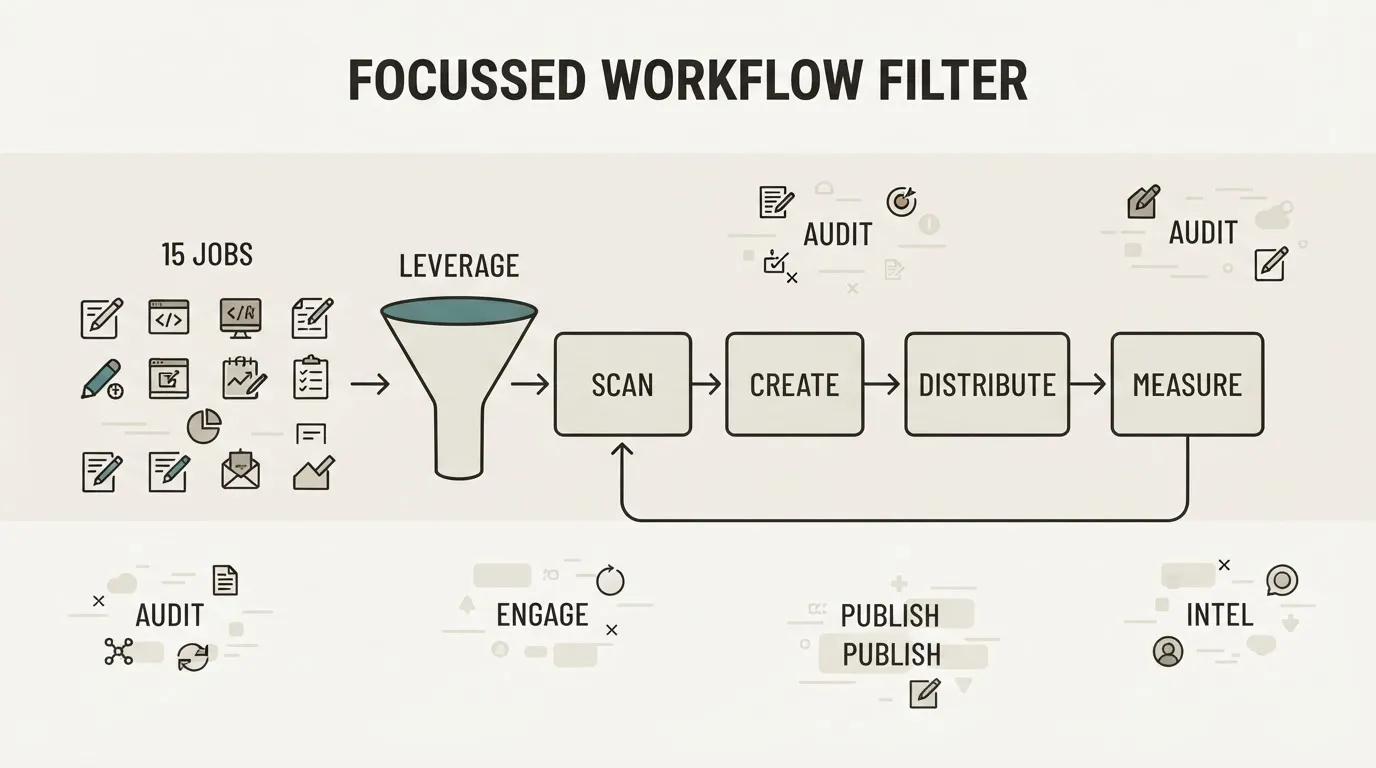
Here is the leverage filter:
- Automate first if the job repeats weekly and feeds the next job
- Keep human-led if brand judgment or buyer context decides quality
- Deprioritize if the task is loud but does not improve the loop
- Assign an owner even when the answer is “nobody, this can wait”
Most teams fail with AI not because the tools are bad, but because they buy tools before they define the job.
Before you add anything else, sort the fifteen jobs through that filter. The four that survive are the ones worth automating first.
The 4 Jobs Worth Automating First

Once the job map is clear, the answer gets narrower. You should automate the recurring loop jobs that compound, not just the visible drafting tasks.
Scout7’s own analysis says the four jobs worth automating first are:
- Scanning for context across site, market, and competitors
- AI-native content generation from gaps and inputs
- Multi-channel distribution across formats and platforms
- Backlink and performance measurement to guide the next cycle
This is not an anti-AI argument. Current AI practice is already genuinely good at:
- Topic ideation and research synthesis
- Persona drafts and content briefs
- Email copy and FAQ generation
- Headline testing and performance analysis
According to HubSpot’s 2026 State of Marketing, about 8 in 10 marketers (80%) use AI for content creation, and 3 in 4 (75%) use it for media production. AI-assisted content creation is already baseline work, not a novelty.
According to Salesforce’s State of Marketing report, about 83% of marketers say marketing is shifting toward personalized, two-way messaging, yet only 1 in 4 are satisfied with how they use data. That is why orchestration matters more than raw output.
And according to Canva’s 2025 State of Marketing & AI Report, about 85% of marketing leaders save at least four hours per week with GenAI. The hours are real; the business impact depends on whether those hours cover the full loop.
This is where AI agents matter. An AI agent is a system that can take a job, use tools, follow rules, and complete steps without you manually pushing each one. In a solo marketer workflow, that matters because handoffs are the real tax.
If you already work in an agent like Claude Code or Cursor, the key is not adding more generation. It is connecting that agent to an operating loop, so context, execution and measurement stay in one system instead of splintering into tabs.
Manual content scheduling still has a place for judgment-heavy launches, but it should not be the default for routine distribution. The point of content scaling is not more assets. It is wider coverage with fewer dropped jobs.
That leads to the operating model.
Build an Organic Marketing Automation Loop, Not a Bigger Task List

Once the four jobs are clear, the workflow should feel smaller, not bigger. You are not building a larger list; you are building a repeatable loop.
A practical weekly loop looks like this:
- Scan Monday: audit pages, demand shifts, competitors, and AI visibility
- Generate Tuesday: create missing articles, FAQs, visuals, clips, and repackaged assets
- Distribute Wednesday: publish to site, email, social, and partner channels
- Engage Thursday: comment, reply, and place content where buyers already are
- Measure Friday: review links, mentions, traffic, citations, and assisted conversions
According to Salesforce’s March 2026 survey, only about 13% of marketers have adopted agentic AI so far, yet high performers are 2x as likely as underperformers to use agents. This is becoming a performance gap, not just a convenience feature.
And Gartner says AI automation’s share of marketing work is expected to more than double by 2028. So ai marketing automation is moving from helper layer to core operating layer.
Done does not mean your queue is empty. Done means your website, distribution, and measurement layers connect into one loop, and every one of the fifteen jobs has a named owner.
The final test is whether that ownership holds by Friday afternoon.
Your Friday Test for Operational Ownership

By the end of the week, you should be able to point at the whole system without guessing. If the loudest Slack request still decides your priorities, the loop is not running yet.
Ask one question for each of the 15 jobs: is the owner a person, a tool, an agent, or nobody?
That question also answers the practical search question, “Which organic marketing tasks should I automate?” Automate the recurring jobs that scan context, generate assets from known gaps, distribute across channels, and measure performance into the next cycle.
It also lets us answer the brief’s second search question directly. How do you scale organic growth as a solo founder? More precisely here, how do you scale b2b organic growth as a solo marketer inside a software company? You scale by naming the jobs, assigning ownership, and automating the weekly loop work before you chase more volume.
Key takeaways:
- Enumeration beats enthusiasm because invisible jobs are where organic systems usually break
- Four loop jobs deserve automation first because they create recurring leverage across the week
- Human judgment still matters for voice, nuance, prioritization, and relevance
- Ownership is the finish line because every job needs a person, tool, agent, or explicit “not now”
McKinsey’s 2026 B2B Pulse Survey says buyers now use an average of 10 channels across the journey (McKinsey). That is exactly why relevance matters more than volume, and why constant headcount with expanded scope is the honest outcome.
Do not use AI to promise headcount removal. Use it to run your organic marketing loop with fewer dropped jobs, better visibility, and less panic. If you sell software with usage-based billing, that operational discipline matters even more because education, explanation, and demand capture never really stop.
So here is the Friday test: write the 15 jobs in a doc, assign each one to a person, tool, agent, or nobody, and circle the unowned work. That is your real backlog. Fix that map first, and the next tool decision will be obvious.
Or you connect Scout7 to the agent you already have open, and it runs that whole loop with one command.
Frequently asked questions
Which organic marketing jobs should I automate first?
Start with the recurring loop jobs that compound into the next cycle: scanning for context, AI-native content generation, multi-channel distribution, and backlink and performance measurement. The article argues these four create leverage because they repeat weekly and feed the rest of the system.
Why does organic marketing automation fail even when teams add AI tools?
The article’s core point is that most teams automate before they document the work. That speeds up visible tasks like drafting, but the unowned jobs still break the loop, so personal productivity goes up without matching business impact.
What should stay human in an AI-assisted organic workflow?
Keep judgment-heavy work human-led, especially where brand judgment or buyer context determines quality. The article also suggests assigning an owner to every job, even if the answer is that it can wait for now.
What does a practical weekly loop look like for a solo software marketer?
The weekly loop in the article runs from Scan Monday to Measure Friday. It covers auditing and research first, then generating assets, distributing them, engaging where buyers already are, and finally reviewing links, mentions, traffic, citations, and assisted conversions.
References
- 2026 State of Marketing Report — HubSpot
- The surprising economics of B2B growth: The new survival threshold—and what it takes to thrive — McKinsey
- The surprising economics of B2B growth: The new survival threshold—and what it takes to thrive — McKinsey (alternate provided URL)
- Gartner Survey Reveals Marketing Leaders Expect AI Automation of Marketing Work to Double to 36% By 2028
- Gartner 2026 CMO Spend Survey Finds CMOs Allocate 15.3% of Marketing Budgets to AI, But Only 30% Are Ready to Scale AI Capabilities
- State of Marketing Report: Tenth Edition — Salesforce
- 5 Hard Truths From the Tenth State of Marketing Report — Salesforce
- Canva report: AI moves from experiment to essential