
how_to_playbook
Published Is Not Proof: Automated Marketing Verification In Four Browser Checks
August 31, 2026 · 12 min read · Scout7
Published only means the request was accepted. Use this automated marketing verification loop to check whether scheduled posts actually reached anyone.
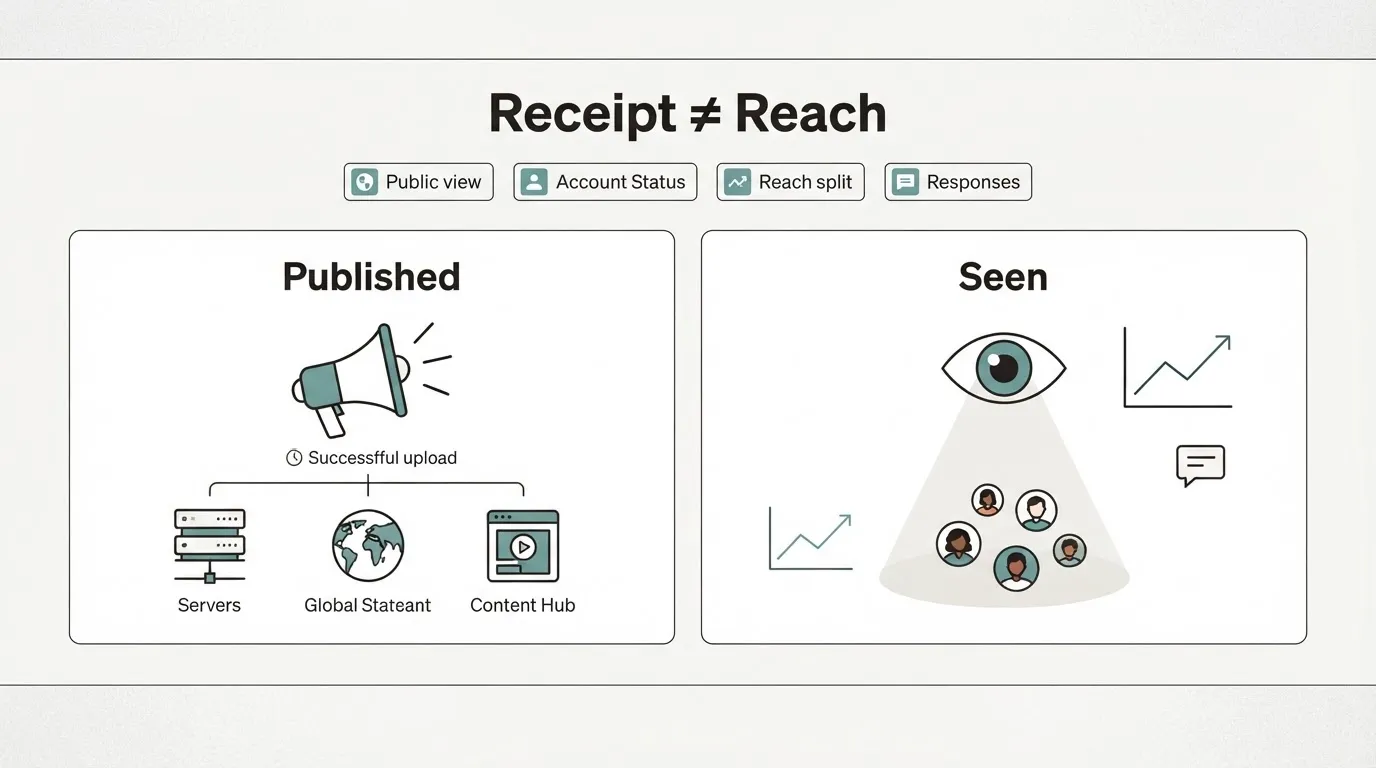
Subtitle: A browser-only 4-step playbook to verify delivery, catch silent failures, and separate broken distribution from weak content.
Published is a receipt, not proof
Your scheduler says Published.
That word proves one thing. The platform accepted the request. It does not prove that a single human being saw the post.
Those are two different claims, and the gap between them is wide enough to hide months of silence.
Closing that gap is what people mean by automated marketing verification. It sounds like something you need software for. It is not. It is four things you can go and look at yourself.
Key takeaways:
- Published confirms acceptance, not that anyone was reached
- Check after each post, not once a week
- The reach split beats engagement counts for diagnosing delivery
- Response signals tell you about performance, but only after delivery is confirmed
Picture the founder who queued a fortnight of posts so they would stop disappearing for weeks at a time. That was the right call. The dashboard is green, so it feels safe to stop looking.
That is exactly where the false reassurance sits. And working alone is the multiplier, because on a team somebody eventually asks whether they have seen the posts anywhere. On your own, nobody ever says that sentence.
What follows is four checks. Each one runs in a browser, in minutes, with nothing bought and no code written. Together they tell you whether a quiet week is a distribution problem or a writing problem, which are two very different things to go and fix.
You are worried about the wrong risk
 Almost every founder who queues posts has the same worry. Does posting through a scheduler cost me reach?
The evidence does not support it.
Buffer looked at posting through third-party tools and found it did not hurt reach or engagement on Facebook, X or LinkedIn. On Facebook and LinkedIn the scheduled posts did slightly better than native ones. Hootsuite ran a controlled test on a real business account and found scheduled posts slightly ahead as well, 8.19 percent engagement against 6.44 percent.
Both of those companies sell schedulers. So take it as a direction, not as independent proof.
The more useful part is where the belief came from. Facebook did once limit reach from third-party tools. That was in 2011, and it was fixed the same year. The worry has outlived the bug by about fifteen years.
So the risk everyone talks about is the one the evidence argues against.
Meanwhile there is a second risk. It runs on a clock, nobody discusses it, and it leaves your dashboard green the entire time it is happening.
That is the one worth your attention.
The silent-failure trap: green dashboard, invisible post
 Two ordinary things can break your distribution while every screen you own keeps reporting success.
The connection dies on a clock.
When you connect an account to a scheduler, the scheduler is handed an authentication token. Tokens expire. Across platforms the usual window is 60 to 90 days, and Meta tokens run 60 days. Most tools do not warn you before it happens.
Your post then sits at Scheduled. No error, no email, no red mark anywhere.
Sixty days is longer than most solo founders keep watching a channel. So the connection goes quiet at roughly the point you stopped looking at it.
The platform stops recommending you.
This second one is deliberate, and the platforms are reasonably open about it. They just do not use the word shadowban.
TikTok calls it content distribution prioritization, a trust-based system that weighs watch time, engagement, originality and adherence to its guidelines. Instagram calls it recommendation eligibility, and now reports it to you in plain language. LinkedIn announced algorithm changes on 20 May 2026 aimed at low-quality AI content and automation, then shipped a "Seems like AI slop" report button on 30 July 2026. Flagged posts are not removed. They are held back beyond your immediate network.
This is a reasonable thing for a platform to do, and it is worth saying so. A feed full of generic automated posts is worse for everybody. LinkedIn also scaled back its own AI writing tools over the same period, so this is not simply aimed at outsiders.
But notice what LinkedIn published and what it did not. It claims 94 percent detection accuracy for its own system. It has not published a false-positive rate.
From where you are standing, a quality filter you cannot see behaves exactly like a broken connection you cannot see. Same symptom. Same silence.
Here is the part that matters most. Neither failure is visible from inside the tool that published the post. That is not a flaw in any particular product. A dashboard can only show you what the platform's reply said, and the reply said the request was accepted. It was.
Step 1: Check from outside the tool
 Start where the scheduler cannot grade itself.
Open a private browser window, or pick up a phone that is not logged in, and go to your own public profile. Is the post there?
That is the whole check. It takes about a minute per platform.
It is the only check on this list that is genuinely independent of the tool that did the publishing, which is why it goes first. If the post is not there, nothing else matters and you already have your answer.
Do it right after the post goes out. Not on a weekly review.
The timing is not a style preference, it is arithmetic. If you post three times a week, a suppressed post and a slow week produce the same flat numbers. You will not be able to tell them apart for the better part of a month, and by then you cannot reconstruct what happened. Tie the check to the publish and the question stays answerable.
If the post is missing, stop here and reconnect the account. If it is there, carry on.
Steps 2 and 3: Account Status, then the reach split
 The post exists. Now ask a narrower question. Was it shown to anybody outside the people who already follow you?
Step 2. Read the eligibility screen.
On Instagram, open your profile, tap the menu at the top right, then Settings and activity, then More info and support, then Account Status.
It tells you in plain words whether your content is eligible to be recommended. It also reports content violations and feature restrictions. It is free, it is built in, and most people do not know it is there.
Step 3. Read the reach split, not the engagement count.
On the post itself, open View insights, then Reach. Instagram splits that audience into followers and non-followers.
The split is the tell, not the totals. An account travelling normally might sit somewhere around 40 percent non-follower reach. If that falls to almost nothing, with no notification to explain it, you are looking at a distribution problem and not a writing problem.
Be clear about what this number does and does not do. It tells you whether the post got beyond your own base. It does not tell you whether anybody who saw it cared. It is the right instrument for delivery and the wrong one for everything else.
What a broken number looks like versus a low one
 This is the part almost every guide on social media automation leaves out.
Go and read the popular ones. Mixpost, Viralpep, Simplified, Sociali all publish a version. They give you the same four points. Do not set and forget. Do not run identical copy on every platform. Keep answering your comments. Check your numbers weekly.
All four are correct. Not one of them tells you how to read the number once you have looked at it.
Here is why that gap hurts. A post that reached nobody and a post that reached people who ignored it both produce a low number. On the screen they are identical. In reality they are opposite problems with opposite fixes.
A broken number looks like this. The post is missing from your public profile, or Account Status shows a limit, or non-follower reach is close to zero. The pipe is blocked. Rewriting the caption will not help you at all.
A low number looks like this. The post is publicly visible, Account Status is clean, non-follower reach is normal, and still almost nobody replied or clicked. The pipe is fine. The writing needs work.
Same feeling, opposite diagnosis. The three checks above exist to tell them apart, and together they take about five minutes.
Only once you have confirmed delivery do you get to conclude that the content was weak.
Step 4: Audit for human response, not just presence
 Delivery is confirmed. Now performance is a fair question, and now it is worth acting on.
Look for the things a person has to choose to do:
- Replies and comment threads
- Saves and reshares
- Profile visits and link clicks
- Mentions and links from elsewhere
Then answer the comments you get. That is not politeness, it is part of the performance. Buffer looked at nearly two million posts across six platforms in 2026 and found that accounts replying to comments consistently outperform accounts that do not, by as much as 42 percent on Threads and 30 percent on LinkedIn.
If the post reached non-followers and still produced none of this, you do not have a delivery problem. You have a content problem. That is a much better problem to have, because you can see it and you can work on it.
Run your automated marketing verification loop on every post
 Published felt like proof. It was a receipt.
Here is the loop, in order:
- Step 1. Open a private window and confirm the post exists on your public profile.
- Step 2. Open Account Status and check you are still eligible to be recommended.
- Step 3. Open the post insights and compare follower against non-follower reach.
- Step 4. Look at what people actually did. Replies, saves, clicks, mentions.
Run it on the next post you publish, not next Sunday. Write down what each step showed.
At the end of it you will know whether to fix your distribution or fix your writing. Those are very different afternoons, and until now you have had no way to tell which one you were owed.
One thing does belong on the calendar. Tokens expire on a schedule, so put a reminder at day 50 to 55 and reconnect before the usual 60 day window closes. That is the one failure here you can prevent outright rather than detect.
Four checks, a few minutes, on every post you publish.
Or you connect Scout7, and it runs the whole loop for you with one command.
Frequently asked questions
Does scheduling a post reduce reach by itself?
Not based on the evidence cited here. Buffer and Hootsuite both found scheduled posts did not underperform, and in some cases did slightly better. The bigger risk in this article is silent failure, not the act of scheduling.
What is the fastest way to verify a scheduled post actually published?
Open a private browser window or use a phone that is not logged in, then check your public profile. If the post is not there, stop and reconnect the account. That is the only fully independent check on the list.
How do I tell a distribution problem from a weak post?
Look at the sequence of checks, not just the total engagement number. If the post is missing, Account Status shows a limit, or non-follower reach is near zero, the problem is distribution. If the post is visible, eligibility is clean, and non-follower reach is normal, then the writing or offer likely needs work.
How often should I run these checks?
Run them right after each post goes out, not during a weekly review. The article's point is that waiting too long makes a suppressed post and a slow week look the same. Checking at publish time keeps the diagnosis clear.
References
On whether schedulers cost you reach. Both of these companies sell scheduling tools, so read them as a direction rather than as independent proof.
- Buffer, will scheduling posts affect my engagement
- Social Status, does Hootsuite or Buffer cause lower reach and engagement
- Posterly, does posting through a scheduler hurt your reach, and what the research shows
On platforms reducing distribution without telling you.
- TechCrunch, LinkedIn adds a button to report AI-generated slop, 30 July 2026
- The Next Web, LinkedIn cracks down on AI slop. This is the source of the 94 percent figure, which is LinkedIn's own claim about its own system
- The Markup, what to do if you think you have been shadowbanned on Instagram
On connections expiring quietly.
- One Two Three Send, social media automation token expiry and when connections break silently
- Vista Social, why scheduled social media posts fail to publish
On reading the reach split and the eligibility screen.
- Inro, Instagram account health, how to check it
- Dash Social, why non-follower reach matters most on Instagram now
- Sprout Social, Instagram Insights explained
On replying to comments.
On the standard automation advice this piece is arguing with.
- Mixpost, seven automation mistakes killing your engagement
- Viralpep, ten social media automation mistakes businesses still make in 2026
- Simplified, social media automation, the complete guide for 2026
On requests that are accepted and then do nothing.