
framework
Ranked #1, Quoted by Nobody: AI Search Optimization for SEO, AEO & GEO in 2026
September 2, 2026 · 11 min read · Scout7
SEO, AEO, and GEO are not three separate jobs. Learn the shared technical foundation that makes content rank, get cited, and earn AI referrals.
Introduction
You publish one page, then three teams show up with three checklists. One says rank it. One says get it cited. One says make it discoverable in chat. That is the wrong model for AI search optimization.
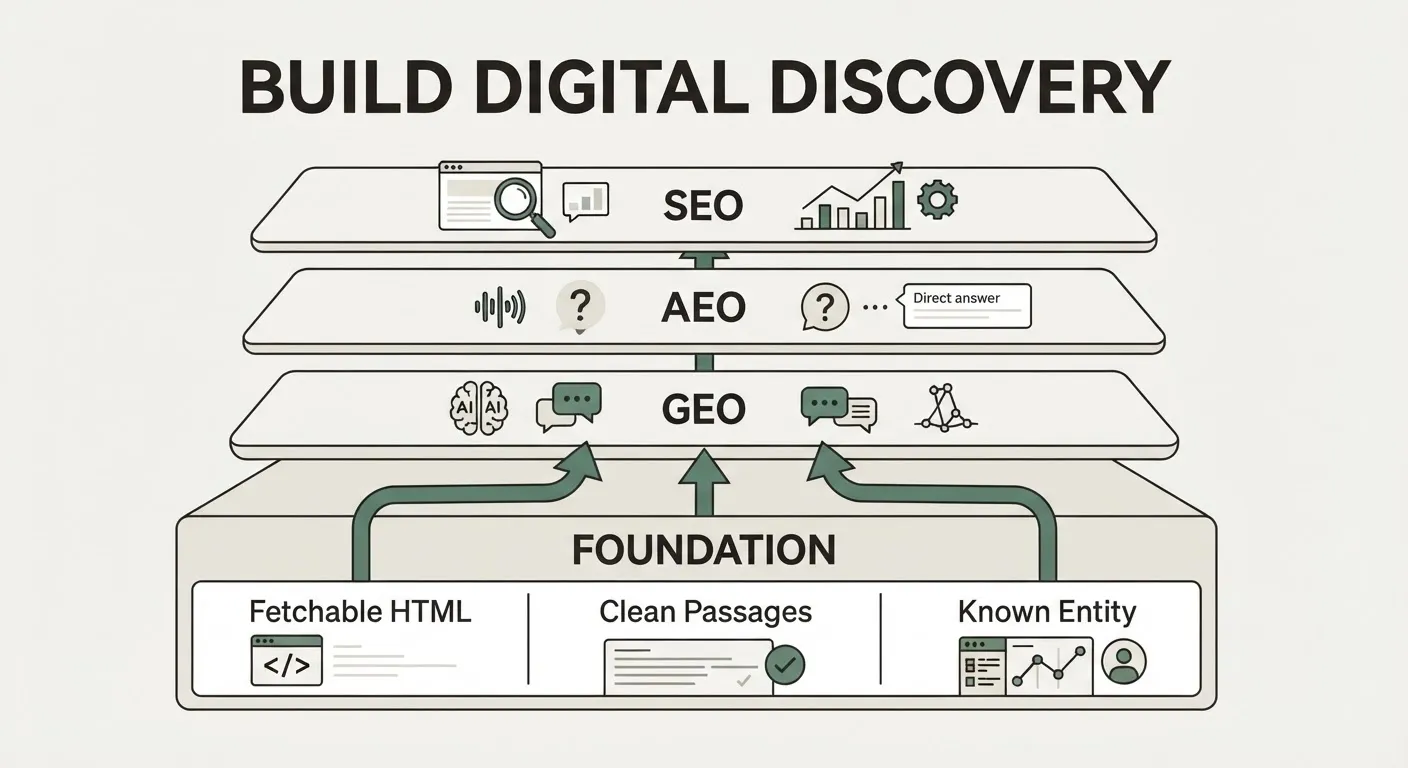
The better model is simpler: build one page machines can fetch, parse, split into clean passages, and attribute to a recognized entity. That same build can support Search Engine Optimization, Answer Engine Optimization (AEO), and Generative Engine Optimization (GEO) at once.
Key takeaways:
- SEO, AEO, and GEO share one technical foundation
- Chunking and attribution drive AI citation success
- AI referrals are measurable, but metrics remain early
- One content loop beats three disconnected programs
Most teams still treat these channels like separate crafts.
This piece argues the opposite: the real leverage sits under the channel labels, in retrieval and attribution engineering. And once you see that stack clearly, the rest of the work gets smaller.
SEO: The Layer Search Crawlers Still Depend On

Start at the bottom of the stack. If a machine cannot reliably fetch and segment your page, nothing above it works especially well.
Search Engine Optimization is still the retrieval substrate.
- SEO is not dead because indexing still seeds later discovery surfaces
- Clean HTML matters because crawlers need stable, readable structure
- Internal links matter because they expose documents and context paths
- Passage clarity matters because machines often split pages before ranking them
- Blocked or brittle pages fail early long before citation or chat discovery begins
Google itself now treats generative visibility as something publishers can measure. In June 2026, Google Search Console added generative AI performance reporting across five diagnostic dimensions: impressions, pages, countries, devices, and dates.
That update matters because it quietly confirms the premise: classic retrieval and generative discovery are connected systems, not separate planets. So if SEO is the retrieval layer, the next question is what changes when the machine stops ranking pages and starts quoting passages.
AEO: The Layer Built for Citation, Not Just Ranking
That shift is where Answer Engine Optimization (AEO) begins. AEO is the process of structuring digital content to be directly retrieved and synthesized by AI-driven search interfaces and large language models.
The output changes first.
- SEO tries to rank a page for a query and win the click
- AEO tries to supply a passage clean enough to quote or cite
- Chunk boundaries matter because retrieval systems rarely consume whole pages
- Sentence support matters because unsupported claims break citation trust
- Schema and entity cues matter because attribution needs a source, not just text
This is why AI citation is a learnable engineering discipline, not luck.
In a 2026 ACL/BioNLP evaluation on citation faithfulness, only about 3 to 4 in 10 citation pairs (27% to 41%) were actually supported at the sentence level. That is not a writing-quality story alone. It is a retrieval-and-attribution problem.
A separate 2026 ACL study on CiteGuard improved citation attribution accuracy by 10 percentage points and reached 68.1% accuracy, close to 69.2% human performance. That is strong evidence that better citation behavior can be engineered.
And a 2026 peer-reviewed chunking study compared fixed-window against semantic segmentation strategies for retrieval. Chunk size is now a measurable variable, not a publishing guess.
Based on what we saw when watching this market treat citation like a mystery, the mistake is not weak ambition. It is treating retrieval, chunking, embeddings, schema, and entity recognition as side issues instead of the actual work.
Once you see AEO as citation engineering, GEO stops looking like a buzzword and starts looking like the next output layer.
GEO: The Layer That Wins Inside AI Chat
Generative Engine Optimization (GEO) is the practice of optimizing content to improve visibility and ranking within AI-powered search engines and answer engines. Here, the goal is not only citation inside an answer box. It is discovery inside chat environments that may quote you, summarize you, or send a user through.
This layer is already real.
- AI referral traffic is measurable today even if still small
- ChatGPT is the main referral surface in current trackable traffic
- Referral intent appears high compared with many other channels
- Ranking and citation have come apart so top SERP position is not enough
- Measurement remains immature so benchmarks should stay directional
According to the 2026 Conductor AEO/GEO Benchmarks Report, AI referrals account for about 1 in 100 site visits (1.08%) across 10 industries. That is not huge, but it is no longer hypothetical.
According to Previsible’s 2026 State of AI Discovery Report, ChatGPT generated more than 9 in 10 trackable LLM referral visits (92.4%).
And Adobe reported that generative-AI referrals drove 84% more revenue per visit than other traffic sources in its 2026 analysis of U.S. retail visits. For B2B SaaS, that matters because even modest referral volume can punch above its weight if the visitor arrives with clearer intent.
So GEO is real today, but what powers it is still the same foundation underneath.
The Shared Build Behind AI Search Optimization

This is the main argument. SEO, AEO, and GEO diverge at the surface, but under the hood they depend on one machine-readable substrate.
That substrate has three parts.
- Fetchable HTML so crawlers and answer engines can access content reliably
- Clean passages so systems can split, embed, rank, and cite without losing meaning
- Recognized entity signals so claims attach to a known company, product, brand, or author
- Stable structure so headings and sections preserve context after chunking
- Clear attribution cues so machines know who said what on the page
The winning build is boring in the best way: easy to fetch, easy to split, easy to attribute.
The market keeps overcomplicating this because outputs look different.
But the infrastructure problem is the same. That is also why measurement feels messy. According to the 2026 Semrush AI Visibility Index announcement, nearly half of marketing leaders (45%) cannot accurately measure brand visibility in AI-generated answers, while only about 1 in 11 (9%) can track all relevant metrics across platforms.
If the market cannot measure the stack cleanly, many teams default to running three disconnected programs. The better move is one build, then one workflow.
The Triple-Play Workflow: One Content Loop, Three Outcomes

Once the foundation is correct, the workflow gets tighter. You do not need three versions of the same page.
You need one source page reviewed through three lenses.
- For SEO: confirm crawl access, internal links, metadata, and structural clarity
- For AEO: write direct answer blocks, stable headings, and sourceable claims
- For GEO: include brand context, product identity, and explicit entity references
- For all three: keep sections self-contained so chunks survive extraction
- For maintenance: update pages in place instead of scattering duplicate assets
This is the practical payoff for builders with no time to sell.
You publish one strong source page, then let that page serve ranking, citation, and referral outcomes across surfaces. According to the 2026 Conductor benchmark, AI referrals already represent roughly 1 in 100 visits (1.08%) across industries, which is enough to justify disciplined publishing without pretending the channel has already replaced search.
For Scout7’s worldview, this is the point: organic marketing on loop works better when the loop starts from one durable source asset. The next issue is how to measure that loop without faking certainty.
Measuring the Full Loop Without Pretending the Metrics Are Mature
The trap is simple. Teams use old SEO dashboards, fail to see AI behavior clearly, then conclude the channel does not matter.
That conclusion is too lazy.
- SEO metrics still matter for rankings, clicks, impressions, and coverage
- AEO needs citation visibility even when a citation earns no immediate click
- GEO needs referral analysis focused on sessions, engagement, and assisted intent
- Cross-platform comparisons stay noisy because tooling is still catching up
- Directional benchmarks help but should not be confused with brand-specific truth
According to the 2026 Semrush AI Visibility Index announcement, about 45% of marketing leaders cannot accurately measure AI answer visibility. That gap says a lot.
Google has also now given publishers an official visibility layer. The June 2026 Search Console generative AI reporting launch added five dimensions for AI visibility diagnostics, including pages and devices.
So the right measurement model is layered, not universal. And once teams understand that, the recurring questions get much easier to answer plainly.
FAQ: The Questions Teams Ask Once They See the Stack
What is the difference between SEO and AEO?
Search Engine Optimization focuses on helping a page rank in traditional search results. Answer Engine Optimization (AEO) focuses on helping a passage get directly retrieved, synthesized, and cited by AI-driven search interfaces and large language models.
In practice, SEO optimizes page-level retrieval and ranking. AEO optimizes passage-level extraction and attribution.
How do I optimize for generative AI discovery?
Build pages that machines can fetch, split into clean chunks, and attribute to a recognized entity. Then add direct answers, stable headings, sourceable claims, and clear brand context so generative systems can retrieve and cite you cleanly.
That is the core of Generative Engine Optimization (GEO). It is less about gaming prompts and more about retrieval-ready publishing.
Why is AI referral traffic important for B2B SaaS?
AI referral traffic matters because it signals active problem-solving intent. A user who clicks through from an AI answer or chat often arrives later in the research process and with a narrower question.
Industry data supports that direction. Previsible found in its 2026 State of AI Discovery Report that ChatGPT drove more than 9 in 10 trackable LLM referral sessions (92.4%), and Adobe reported in its 2026 traffic analysis that generative-AI referrals drove 84% more revenue per visit than other traffic sources.
Is SEO dead?
No. SEO remains the indexing and retrieval base that supports both classic search and AI discovery.
If your page is hard to crawl, render, or segment, the answer engines above it inherit that weakness.
What is the difference between AEO and GEO?
AEO is about earning citation inside answer surfaces such as AI Overviews. GEO is about being surfaced, cited, and referred from generative chat environments.
They overlap technically, but the output surface differs.
Do I need to do all three?
You need one strong foundation first. Then you tune outputs by layer instead of building three disconnected programs.
That is why the streak is the strategy: one correct build, repeated weekly, compounds faster than channel silos.
What to Teach in the Next 30 Days

If you had one month to teach this stack, do not start with hype. Start with jobs, then mechanics, then repetition.
A simple curriculum works best.
- Week 1: define SEO, AEO, and GEO as outputs, not separate teams
- Week 2: fix crawl access, rendering issues, and HTML structure
- Week 3: rewrite pages into standalone, citable passages with stable headings
- Week 4: strengthen entity clarity and track each layer with honest metrics
- Repeat weekly: publish one source page that serves all three surfaces
This is the practical version of “A week of organic marketing on loop.”
Not because every page will rank, get cited, and earn referral traffic at once. But because the same disciplined build gives you a repeatable system for all three outcomes, and that is far more durable than chasing separate checklists.
Conclusion
Key takeaways:
- One machine-readable build supports SEO, AEO, and GEO
- Citation success depends on retrieval, chunking, and attribution
- AI referrals are real now, even if measurement is still early
The opening problem was a familiar one: one page, three channels, three optimization lists. The payoff is simpler than the market makes it sound. Search Engine Optimization, Answer Engine Optimization (AEO), and Generative Engine Optimization (GEO) are different outputs, but they mostly sit on one shared technical base.
If your page is fetchable, structurally clear, chunk-friendly, and attributable to a recognized entity, you are not doing three jobs. You are doing one job correctly.
That matters for Scout7’s audience because builders with no time to sell do not need more channel sprawl. They need one repeatable publishing system that turns strong source pages into organic marketing on loop.
So in the next 30 days, audit your top pages for three things only: fetchability, passage clarity, and entity recognition. Then rebuild one page per week against that standard.
The streak is the strategy. As AI discovery matures, the teams that win will not be the ones with the longest checklist. They will be the ones with the cleanest build.
References
- The 2026 AEO / GEO Benchmarks Report
- 2026 State of AI Discovery Report by Previsible
- AI-driven traffic surges across industries with retail experiencing biggest gains
- Semrush Releases Expanded 2026 AI Visibility Index, Analyzing 126 Million AI Search Prompts
- Introducing Search Generative AI performance reports in Search Console
- VERICITE: Evaluating Sentence-Level Citation Faithfulness in Retrieval-Augmented Medical Question Answering
- CiteGuard: Faithful Citation Attribution for LLMs via Retrieval-Augmented Validation
- A Comparative Study of Chunking Strategies for Retrieval-augmented Generation