
comparison
Same Page, Two Lanes: LinkedIn Ads vs Organic ROI at $186.81 vs $0
August 28, 2026 · 8 min read · Scout7
A measured LinkedIn ledger: $186.81 in sponsored reach vs $0 organic. What persisted, what didn’t, and where to shift effort next.
Subtitle: A same-page LinkedIn ads vs organic ROI ledger showing what spiked, what persisted, and what to test next.
Introduction
If you want a plain answer on LinkedIn ads vs organic ROI, here it is: on our page, in one month, paid LinkedIn bought a bigger spike, but organic posting created the only outcomes that lasted. When we compared both lanes in the same ledger, impressions looked impressive and persistence won.
That matters because LinkedIn is not a side channel anymore. According to Dreamdata’s 2026 benchmark report, LinkedIn now takes about 41% of total B2B ad budgets for the dataset it studied, which makes bad measurement more expensive.
Key takeaways:
- Paid won reach but left no follower or signup behind
- Organic won persistence with followers and reactions
- Same page, same month makes the comparison cleaner
- Judge LinkedIn by durable signals, not dashboard spikes
So this piece stays inside one strict frame: same LinkedIn page, same month, same columns, only measured outcomes.
We are not borrowing broad buyer-journey theory to force a conclusion, and we are not pretending unmeasured influence is measured proof. The question is simpler than that: what did each lane leave behind after the impressions were gone?
The $186.81 lesson in LinkedIn ads vs organic ROI
 And that is where the surprise starts. The problem was not that paid reach cost money; the problem was that it vanished without adding anything durable.
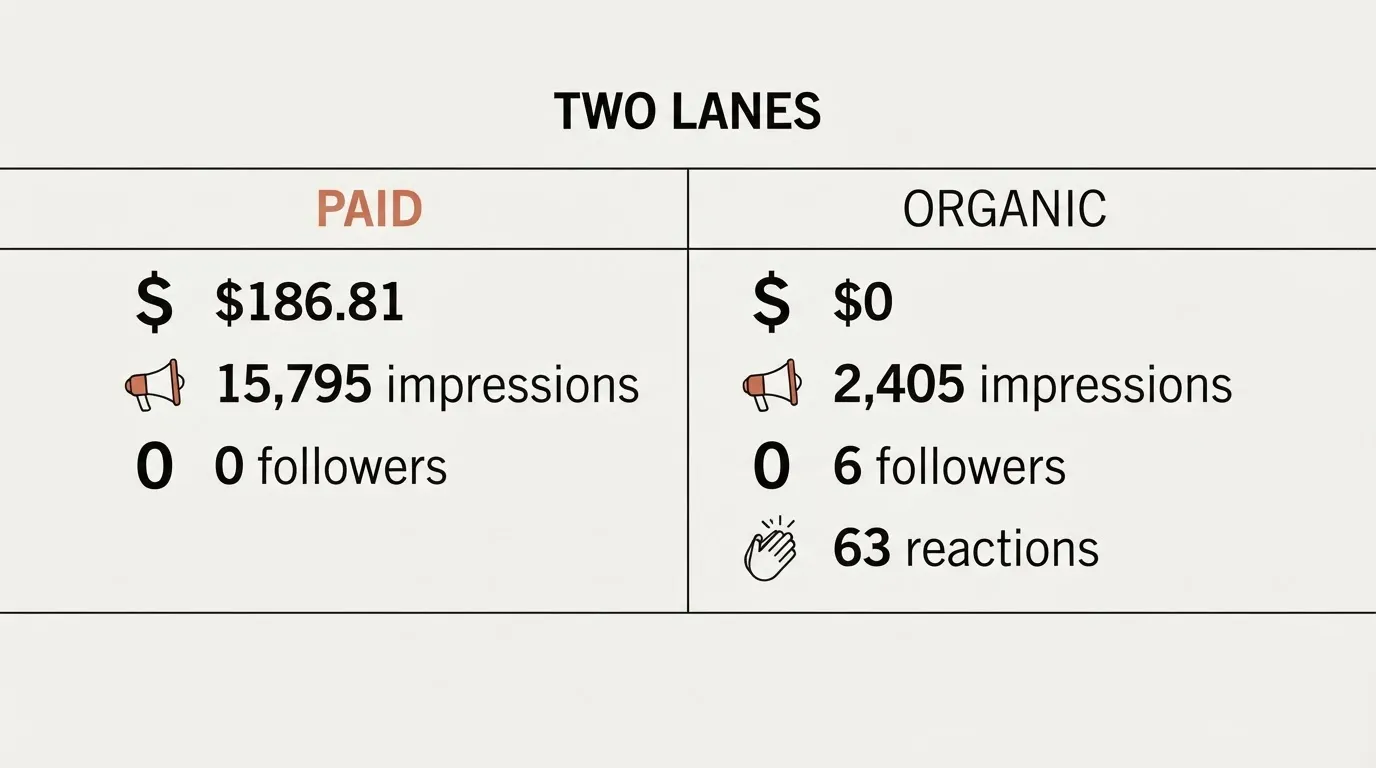
On our page, $186.81 bought 15,795 sponsored impressions across a short burst, while free organic posting generated 2,405 impressions in the month. But the sponsored lane produced zero followers, and the organic lane produced six followers, based on our own recorded results and the same-page comparison framed alongside Dreamdata’s 2026 LinkedIn budget context.
- Paid spike: 15,795 sponsored impressions
- Paid residue: 0 followers, 0 reposts, 0 signups
- Organic reach: 2,405 free impressions
- Organic residue: 6 followers
That is the vanity-metric trap in one line. The bigger number on the dashboard was real, but it was not the better growth lane.
If impressions disappear without leaving a persistent asset, you rented visibility rather than built momentum.
And once that hook lands, the fair comparison becomes obvious: put both lanes into the same columns.
The two-lane ledger: same page, same month, same columns
 Once we forced both lanes into one ledger, the decision got less emotional. Reach stayed in the table, but it stopped being the headline.
Based on what we saw when we tracked our own LinkedIn page for the same month, we compared both lanes using only our measured numbers, as recorded.
The paid lane was simple: $186.81 delivered 15,795 impressions in roughly four days, with 0 followers, 0 reposts, and 0 signups. The free lane was also simple: 2,405 impressions across the month produced 6 followers and 63 reactions.
- Reach winner: paid, by about 6.6-to-1
- Follower winner: organic, by 6-to-0
- Engagement winner: organic, with 63 reactions
- Persistence winner: organic, because anything remained at all
That scale gap is real. According to Oktopost’s 2026 LinkedIn benchmark report, median organic reach per LinkedIn company page post is 927 impressions, with the 75th percentile at 1,734 and the 90th percentile at 3,635. So the sponsored campaign did buy meaningfully above-typical visibility.
But the same Oktopost benchmark also reports a median organic engagement rate of 5.10%, with the top decile reaching 21.63%. That is the right context for a B2B organic LinkedIn strategy: organic is not automatically huge, but it can produce signals that compound.
And that points to a harder issue than ad spend.
The deeper cut: your audience may not see you
 That harder issue was honestly a little embarrassing. Our page had 8,459 followers, yet organic impressions for the month totaled only 2,405.
That works out to about 0.28 organic impressions per follower for the month. In other words, before asking whether paid should do more, we had to ask whether our own audience was seeing us at all.
- Follower base: 8,459
- Monthly organic impressions: 2,405
- Impressions per follower: 0.28
- Thirty-day follower gain: 8 total, with 6 from organic posting
So we say this exactly as scoped: on our page, in this month, $186.81 of sponsored reach produced nothing that persisted—no follower, no repost, no signup—while the free posts produced all six followers the page gained organically.
That does not mean paid reach is useless. According to Gartner’s 2026 survey, about 70% of B2B buyers prefer a completely digital self-service experience, so digital reach matters.
But the same Gartner survey found about 69% still want sales reps to validate AI-generated insights, and Edelman’s 2026 brand report says earned media is the most powerful way to build trust globally. Reach can open the door; trust still needs something more durable than self-asserted visibility.
And that is why the verdict is not “never pay.” It is “measure what remains.”
Verdict: build for persistence, then test the next lane
 From there, the conclusion sharpened. Paid is not bad because it is paid; it is weak when it buys attention that leaves no trace.
So is organic LinkedIn better than paid for B2B? In this ledger, yes. On this page, under these conditions, organic created the only followers and engagement that persisted after the viewing window closed.
- Organic was not bigger in raw impressions
- Organic was better in durable outcomes
- Paid may still fit narrow tests or distribution goals
- The metric that matters is what persists
That aligns with a broader execution problem. According to Salesforce’s 2026 State of Marketing, about 84% of marketers still admit they run generic campaigns even though 75% have adopted AI. And according to Forrester’s 2026 State of Business Buying, about 94% of business buyers used AI during the buying process.
For builders with no time to sell, the default should be a consistent organic marketing loop, not random bursts. This article was AI-assisted by Scout7, and results may vary.
And the honest gap matters most: we never ran our comment engine on LinkedIn. That lane moved traffic elsewhere, but here it is still untested, so that is our next experiment—not a claim we get for free.
What this ledger says
 The clearest decisions often come from the plainest table. Same page, same month, same columns.
If you came here asking, “Is organic LinkedIn better than paid for B2B?” the extractable answer is yes—when your measure is persistent outcomes, not rented impressions. In this ledger, organic delivered the only followers and engagement that lasted.
If you also came here asking, “How many touchpoints are in the B2B SaaS buyer journey?” the broader market answer from Dreamdata’s 2026 benchmark report is 88 touchpoints across 4 channels on average. But that is not the frame this article uses to decide the winner, because our argument stays inside measured same-page outcomes.
Key takeaways:
- Paid bought scale but no durable asset on this page
- Organic left residue in followers and reactions
- A weak delivery baseline can hide behind paid reach
- Next step: run your growth loop weekly and test comments honestly
So return to the opening image: one LinkedIn page, two lanes, one bigger spike. The spike looked better until the month ended.
What remained was the signal. Organic posting left behind followers, reactions, and a small but real trust trail; paid reach left a screenshot.
That is the practical lesson for any B2B team comparing lanes under time pressure. Keep paid for specific tests if you want, but run your growth loop around persistence: followers gained, engagement earned, reposts triggered, signups recorded, and trust signals that outlive the campaign window.
The next move is specific. Pull your last 30 days into one persistence ledger, compare every lane by what remained after impressions disappeared, and then test one new lane with the same columns. If you are using AI assistance, disclose it clearly and keep the measurement honest.
Frequently asked questions
Did paid LinkedIn outperform organic in this test?
Paid won on raw reach in this same-page, same-month comparison. The sponsored campaign delivered 15,795 impressions, while organic posting generated 2,405. But organic produced the only durable outcomes: 6 followers and 63 reactions.
What does “persistence” mean in this article?
Here, persistence means what remained after the impression spike faded. The article uses followers, reactions, reposts, and signups as the practical residue to compare both lanes. By that standard, paid reach left no lasting asset in this test.
Does this mean LinkedIn ads never work for B2B?
No. The article does not argue that paid is useless; it argues that paid is weak when it buys attention that leaves no trace. The stated verdict is to measure what remains and keep paid for specific tests or distribution goals.
Why compare both lanes on the same page and in the same month?
That setup keeps the comparison tighter and less theoretical. Instead of pulling in broad buyer-journey assumptions, the article looks at one LinkedIn page, one month, and the same outcome columns for both lanes. That makes the ledger cleaner and the conclusion more grounded.
References
- Dreamdata — Announcing LinkedIn Ads Benchmarks Report 2026
- Oktopost — LinkedIn Benchmark Report
- Gartner — Survey Finds 69% of B2B Buyers Turn to Sales Reps to Validate AI-Generated Insights
- Edelman — 2026 Trust Barometer Special Report: Brands
- Salesforce — State of Marketing 2026
- Forrester — State of Business Buying 2026