
market_pov
Social Proof Strategy: Everyone Told You To Show Your Flaws. Nobody Told You Where.
September 23, 2026 · 9 min read · Scout7
A page of only perfect reviews can sell less than one with a small honest complaint. But the flaw has to come second. What the studies say, in plain words.
You run the whole business on your own. You built the product. You answer the support emails. And somewhere on your website there is a small box of kind words from customers. People call this social proof. It just means what other people say about you. How you pick and order those words is your social proof strategy.
You picked those words yourself. You chose the nicest ones. Maybe there was one you left out. A customer who said something like "setup took me an hour, but then it just worked."
This piece is about that one review. It looks at what the studies say about perfect praise. It looks at the popular advice to "show your flaws". And it shows the one detail that advice leaves out. Where the flaw goes.
What you will take away:
- A page of only perfect reviews can sell less than a page with one small complaint.
- Your first five real reviews do most of the work.
- A small flaw helps only after the good news. Put it first and it hurts.
- Writing, buying or hiding reviews is now a legal risk in the US.
The Box of Kind Words
Most founders do the same thing. They collect a few happy messages. They copy the best lines onto the home page. Anything mixed stays in the inbox.
There are whole guides for this. Senja, Shoutjar and Curator publish them. Most of those companies sell testimonial software. They all teach the same thing. Collect kind quotes. Put them in one block on the page. None of them says what to do with the mixed one.
It feels safe. Why show a buyer anything less than perfect?
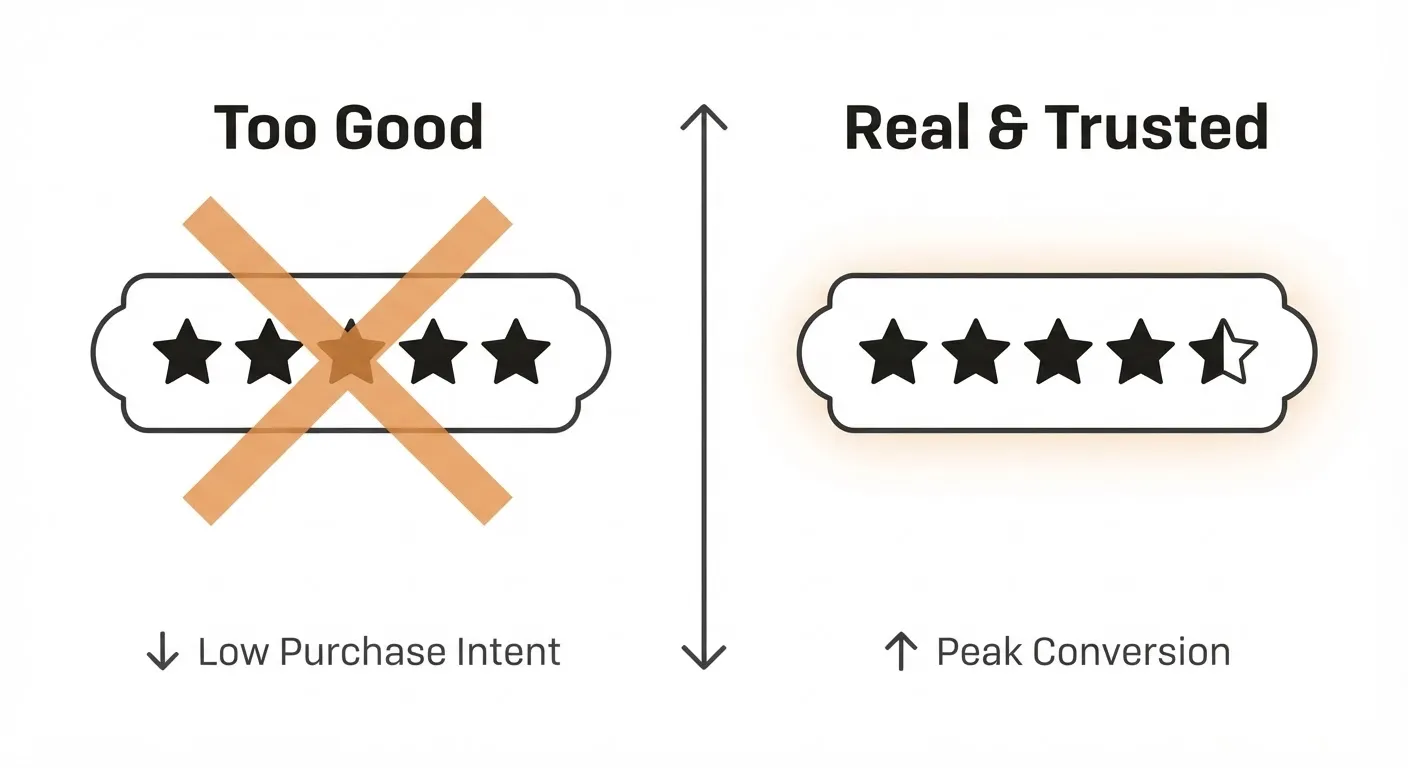
Here is the problem. A buyer sees a wall where every quote is glowing. It starts to look too good to be true. So they trust it a little less.
Buyers also go looking for the bad side. PowerReviews is a company that sells review software. In 2014 it found that 82 percent of shoppers look for negative reviews on purpose. They want to know the worst before they pay.
So the mixed review you hid is the very thing a buyer is looking for.
Jeff Bezos faced this in the early days of Amazon. A publisher was angry that bad book reviews stayed up. Bezos kept them. In his book Invent and Wander he explains why. His point was simple. Amazon makes money by helping people decide, not just by selling.
Four And A Half Stars Sold Better Than Five
In 2017 the Spiegel Research Center at Northwestern University studied online shops. It worked with PowerReviews. It looked at how star ratings changed what people bought.
More stars helped. But only up to a point.
People were most likely to buy when the average rating was between 4.2 and 4.7 stars. Above that, buying went down as the rating got close to a perfect 5.0. The report says that "in no category was the optimal rating 5.0." In plain words, no kind of product sold best at a perfect score.
Think of a restaurant with a thousand reviews and a perfect 5.0. Many people would wonder how that is possible. A 4.6 feels real. Somebody had a slow evening. Somebody wanted more salt. That is normal life.
The research paper behind this is by Maslowska, Malthouse and Bernritter. It is in the International Journal of Advertising, 2017. Its title is "Too Good to be True".
Your First Five Reviews Do Most Of The Work
This part is good news for a one person company. You do not need hundreds of reviews.
The same Spiegel report followed a gift shop for one year. It covered about 1,800 products and 7.8 million visitors. A product with five reviews was 270 percent more likely to be bought than one with none. That is close to four times.
Almost all of that gain came in the first ten reviews. Most of it came in the first five. After that, each new review added very little.
Reviews mattered more when the price was higher. Showing reviews lifted sales by 190 percent on cheaper items. On pricier items the lift was 380 percent. When you spend more, you want more proof.
The report also found something about who writes the review. Reviews from checked, real buyers were trusted more than anonymous ones.
So the usual advice is right. Collect reviews and show them. And the first five are within reach of anyone.
Show Your Flaws? Only If It Comes Second
In 2026 you will often read this advice. "Be real. Show your flaws. People love it." There is real research behind it. But the research came with conditions. The conditions usually get left out.
The hiking boots. In 2012 three researchers ran four studies. Their names are Ein-Gar, Shiv and Tormala. In one study, people read about a pair of hiking boots. Some read only good points. Others read the same good points and then one small minus. The boots came in only two colours.
The people who saw the small minus liked the boots more. But only in two cases.
- The minus came after the good points. When it came first, the lift went away.
- People were reading quickly. When people read slowly and carefully, the minus was just a minus.
The study is in the Journal of Consumer Research, volume 38, 2012.
The spilled coffee. In 1966 Elliot Aronson and two colleagues played students a recording of a quiz show. One player got 92 percent of the answers right. Then he spilled coffee on himself. Students liked him more after the spill.
Another player got only 30 percent right. He spilled the same coffee. Students liked him less.
The same mistake helped the strong player. It hurt the weak one. So a flaw only helps once you already look good.
Size matters too. Martin Eisend looked at many studies of ads that admit a downside. He published this in 2006. The benefit depended on how much bad news there was. It also depended on how important the flawed thing was. A small flaw on a small thing can help. A big flaw on the main thing does not.
Never Write, Buy Or Hide Reviews
There is one thing never to do. Never write reviews yourself. Never pay for good ones. Never bury the bad ones under fake good ones.
In the US this now breaks a federal rule. The Federal Trade Commission is the US agency that protects shoppers. Its rule on reviews started on 21 October 2024. Fines can reach $53,088 for each break of the rule.
2026 is the first year of real cases. The law firm DLA Piper summed them up in July 2026.
- TruHeight, April 2026. Staff wrote reviews while pretending to be customers. Free products were offered for five star reviews. The order was for $4 million. $750,000 was paid.
- Premium Home Service, May 2026. The FTC says staff, relatives and search firms posted fake five star reviews. The aim was to push down real one star reviews. That case is still going.
The rule also covers reviews written by AI. Do not use AI to write or change what a customer said.
This is not legal advice. If you sell in the US, check with a lawyer.
Your Social Proof Strategy For This Week
Here is a plain plan.
- Ask for real reviews. Write to your last ten happy customers. Ask for two or three honest sentences. Aim for your first five.
- Use their exact words. Do not polish them.
- Put the strongest ones first. Let the visitor see that the product works.
- Add back one small honest complaint. Place it after the praise. Pick one about something small, like setup time. Not one about the main job the product does.
- Never lead with a flaw. Not in the first line of the page. Not in the first review.
- Never write, buy or hide reviews.
What This Evidence Cannot Tell You
Here is what these studies do not prove.
- The Spiegel data comes from online shops. Most items were everyday goods and gifts. None of it was software.
- It is from 2017. Buyers may have changed since then.
- It was made together with PowerReviews, a company that sells review software.
- The hiking boot and coffee studies were run with students in a lab.
- None of it was measured on the page of a one person software company.
So take the shape, not the exact numbers. Perfect can look too good. The first few reviews matter most. A small flaw helps only when it comes second.
Sources
- Spiegel Research Center, How Online Reviews Influence Sales, 2017
- Maslowska, Malthouse and Bernritter, Too Good to be True, International Journal of Advertising 36(1), 2017
- Askalidis and Malthouse, The Value of Online Customer Reviews, RecSys 2016
- Ein-Gar, Shiv and Tormala, When Blemishing Leads to Blossoming, Journal of Consumer Research 38(5), 2012
- Aronson, Willerman and Floyd, The effect of a pratfall on increasing interpersonal attractiveness, Psychonomic Science, 1966
- Eisend, Two-sided advertising: A meta-analysis, International Journal of Research in Marketing, 2006
- FTC, final rule on fake reviews and testimonials, August 2024
- DLA Piper, FTC's 2026 enforcement approach to fake reviews, July 2026
- Jeff Bezos, Invent and Wander, 2020
Frequently Asked Questions
Are five star reviews bad?
No. Five star reviews are great. The trouble is a page where every single one is perfect. That can look too good to be true.
Should I show a one star review on my home page?
Probably not. The studies are about a small minus on a small thing. A one star review is usually about the main thing going wrong.
Where should the mixed review go?
After the praise. Never first.
How many reviews do I need?
The Spiegel data says most of the gain comes from the first five.
Can I tidy up a customer's words?
Keep their words as they wrote them. And never let AI write or change a review.
One Question For You
We would like to learn from you. Most founders have a comment they chose not to show. We do not know how common that is. We do not know what those comments say.
So here is our question.
What did a customer once say about your product that you chose not to put on your page?