
research_paper
Stop Blaming The Hour. Attention Residue Is Why Your Post Came Out Thin.
September 12, 2026 · 13 min read · Scout7
The 23 minute interruption number came from a 2006 interview and never measured focus at all. Attention residue is the real problem, and one minute fixes it.
Introduction
Here is the short version.
You are a founder. Your product works. Customers are arriving. You do the marketing yourself, in the gaps between customer problems.
On Thursday you finally got a clear hour to write. What you wrote was thin. You blamed the hour.
The hour was probably fine. Something happened ten minutes before it started.
Researchers have a name for it. They call it attention residue. It means a bit of the last job stays stuck in your head and spoils the next one.
This article does two things. First it shows you where the famous 23 minute number really came from. It is not where people say. Then it gives you the fix. The fix takes one minute and you need a pen.
You Finally Got An Hour. The Post Was Thin.

Stay with that hour for a moment.
You were answering a customer message. You did not finish it. You told yourself you would come back to it later.
Then you opened a blank page to write your post.
The page is open. You are still thinking about the customer. That message is sitting in the back of your mind the whole time. You write four sentences. You delete two. You know the post is thin while you are still writing it.
At the end of the hour you think the same thing you always think. I need more time.
You probably do not need more time. Here is why.
The Number Everybody Repeats

You have read this line many times.
It takes 23 minutes and 15 seconds to recover your focus after an interruption.
It is in blog posts. It is in talks. It is in advice threads. People write it as if it came out of a laboratory. It gets repeated so often that nobody stops to check it.
The number is real. A real researcher really did say it.
But it does not mean what people say it means. And it did not come from where people say it came from.
Where That Number Actually Came From

It came from an interview.
On 8 June 2006, a magazine called Gallup Business Journal published a conversation with Gloria Mark. She is a researcher at the University of California, Irvine, and she studies how people work. You can still read it here: Too Many Interruptions at Work?
An interview is a chat. A researcher answers questions and a reporter writes down what they said.
A study is a different thing. A study says who was watched and how many of them there were. It says what was measured. It says what came out of it. Other researchers can then go and check the whole thing.
The 23 minute number is from the chat. It is not from a study.
In that chat, Mark describes watching 36 people at work for three days. That is real work and it is useful. It is just not the same as a paper that tested how long focus takes to come back.
What It Actually Measured

Here is what Mark actually said in that interview. These are her own words.
The good news is that most interrupted work was resumed on the same day -- 81.9 percent -- and it was resumed, on average, in 23 minutes and 15 seconds.
Read it again slowly. She says the work was picked up again after 23 minutes and 15 seconds. She does not say anybody recovered anything.
Then, in the same interview, she says this.
There are about two intervening tasks before you go back to your original task.
So here is the real picture.
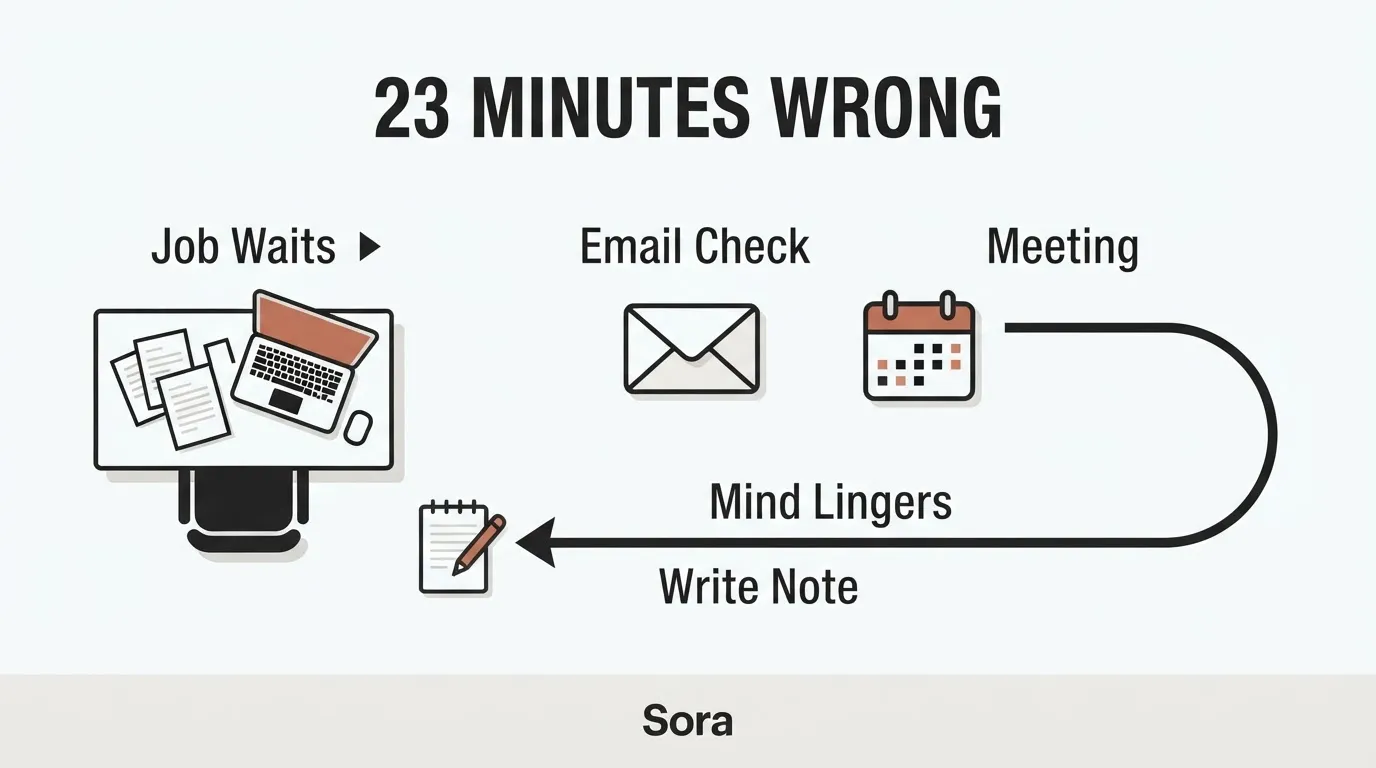
You stop a job halfway. Two other jobs land on you. You do those two jobs. Then you come back to the first one. The clock between putting it down and picking it up again says 23 minutes and 15 seconds.
That is how long the job sat on your desk while you were busy somewhere else.
So the number counts the jobs waiting on your desk. It does not tell you anything about your brain.
Every article that says "23 minutes to get your focus back" has changed what she meant.
The Published Number Is Different, And It Is Too Spread Out To Use

The same team did publish a proper paper. Gloria Mark, Victor Gonzalez and Justin Harris, in 2005, at a conference called CHI. They watched 24 office workers. The paper is here: No Task Left Behind?
Their published number is 25 minutes 26 seconds. Not 23 minutes and 15 seconds. So the famous number is not even the one in the paper.
The paper also gives the spread. The spread tells you how far apart people were from each other. Think of the heights of children in one class. The average might be 130 centimetres. But some children are 115 and some are 150.
The spread here is 54 minutes 48 seconds. That is bigger than the average itself.
So some people came back in two minutes. Some came back two hours later. An average with a spread that wide cannot tell you anything about your own Tuesday.
Two more things from the same paper. People did about two other pieces of work before coming back to the first one. And 57 out of every 100 pieces of work were interrupted before they were finished.
Attention Residue: The Thing That Was Actually Measured, And Nobody Quotes It

Now here is the part almost nobody repeats. It is far more useful than the number.
In 2009, Sophie Leroy, a researcher at the University of Washington, measured something and gave it a name. She called it attention residue.
Residue means the bit that is left behind. Like the soap left in a glass after you wash it.
Here is what she found. When you leave a job unfinished, part of your mind stays on that job. So you do the next job worse.
Not slower. Worse. You notice less. You decide worse.
This is Sophie Leroy in her own words, from the University of Washington, on 16 January 2018.
It's like Windows staying open in our brains, and it makes it hard to focus on the intervening work.
Anyone who has left ten tabs open on a computer knows that feeling.
And this is the important bit. It is normal. It happens to everybody. It is not you being lazy, and it is not you being bad at concentrating. It is how a normal brain works when a job is left open.
You can read the plain English write up here: Task interrupted? A plan for returning helps you move on
The Advice You Have Been Given Is Good, And Here Is Why It Works

You have probably been told to block out time. Put an hour in the calendar, close everything else, and write.
That advice is good. There is real evidence behind it.
In 2001, three researchers called Rubinstein, Meyer and Evans ran four experiments. People swapped between tasks, like solving sums and sorting shapes. Every time somebody swapped, they lost time. The harder the tasks were, the more time they lost.
The American Psychological Association wrote this work up. They say swapping causes small mental blocks. Those blocks can cost as much as 40 out of every 100 minutes of useful time. You can read it here: Multitasking: Switching costs
Be careful with that 40. It is the researcher's own estimate, quoted by the Association. It is not a measurement of your afternoon.
Still, the point holds. Fewer swaps means less waste. If your day is cut into small pieces, putting all the writing in one block really does help.
And Here Is Exactly Where It Stops Helping

Here is the surprise.
A blocked out hour fixes how often you swap. It does nothing about residue.
Residue starts at the moment you walk away from the unfinished job. That moment is before your hour. It is outside the block completely.
So you can guard the hour perfectly. Phone off. Door shut. Calendar clear. And you still sit down carrying the customer problem you left open ten minutes earlier.
So the advice is fixing the wrong part of the day.
One more honest note. Nobody has run a proper test on time blocking itself. The evidence for it is borrowed from the swapping experiments above. It is sensible advice. It has just never been tested on its own.
One Minute, Before You Walk Away

So what actually works.
In 2018, Sophie Leroy and Theresa Glomb published a paper in a journal called Organization Science. They ran four studies. One followed 202 working people. Two more were done in a room, with 66 people and with 44 people. The paper is here: Tasks Interrupted
They tried one thing. Before somebody switched away from a job, that person spent about one minute writing a short note about it.
Three lines. That is all it was.
- Where I pick this up again
- What is still left to do
- What I am putting off until later
The people who wrote the note remembered more afterwards. They also made better decisions on the next job.
The note is not a to do list and it is not a diary. It tells your own head that the job is safe. Then your head can let go of it.
Here is what one looks like. Say you are leaving a customer message half answered.
- Pick up at: reply to Anita about the missing invoice
- Left to do: check the payment date, then write her two lines back
- Not today: her refund question, that is Friday
One minute. A pen and a piece of paper. Then you start the writing hour.
What This Does Not Prove

Be careful with all of this.
Nobody in any of these studies was writing marketing posts. They were office workers and students, doing office jobs and tasks in a room. So we do not know that the note makes your posts better. We know it made those people do better on the next task.
The groups were small. The 2005 paper watched 24 people. The 2006 interview describes 36 people.
The 40 out of 100 figure is an estimate, not a measurement.
And the 23 minute number is not made up. A real researcher said it, and she was describing something real. What went wrong is what other people turned it into.
One last thing, and it is not comforting. Gloria Mark kept measuring. She now finds that a person looks at one screen for about 47 seconds before moving to another one. In 2004 it was about two and a half minutes. She says so here: Speaking of Psychology
So the pressure is going one way, and it is not the helpful way.
Frequently Asked Questions

Is the 23 minute number a lie?
No. The number is real. It was just misread. Look at the 2006 Gallup Business Journal interview. The number describes how long a job sat waiting. It never described how long a brain takes to settle.
What is attention residue in one sentence?
When you leave a job unfinished, part of your mind stays on it, so you do the next job worse. Sophie Leroy measured this and named it in 2009.
What exactly do I write in the note?
Three short lines on paper. Where you will pick the job up again. What is still left to do. What you are putting off until later. That is the plan tested by Leroy and Glomb in 2018.
Does it work if somebody interrupts me, rather than me choosing to stop?
That is exactly the case they tested. The people in the study were interrupted. The note gives you a clean way back in. That matters even more when the break was not your idea.
Do I need an app for this?
No. A pen and a piece of paper. The thing that helps is writing it down, not the tool you write it with.
How long before I know if it worked?
You will feel it on the very next task. That is the whole point. The note is meant to help the job you do next, not the one you left.
Where All Of This Came From

Every claim above comes from one of these. Nothing else was used.
- Gallup Business Journal, 8 June 2006. The interview where the 23 minutes and 15 seconds line appears. Too Many Interruptions at Work?
- Gloria Mark, Victor Gonzalez and Justin Harris, CHI 2005. The published study of 24 office workers, with the 25 minutes 26 seconds figure and the 54 minutes 48 seconds spread. No Task Left Behind?
- Sophie Leroy, 2009, in the journal Organizational Behavior and Human Decision Processes. The paper that named attention residue.
- Sophie Leroy and Theresa Glomb, 2018, in the journal Organization Science, volume 29, pages 380 to 397. The four studies of the one minute note. Tasks Interrupted
- University of Washington News, 16 January 2018. The plain English write up of that paper, and the quote from Sophie Leroy. Task interrupted? A plan for returning helps you move on
- American Psychological Association, on the 2001 experiments by Rubinstein, Meyer and Evans. Where the 40 out of 100 minutes estimate comes from. Multitasking: Switching costs
- American Psychological Association podcast, February 2023. Gloria Mark on the 47 seconds figure. Speaking of Psychology
One more note on checking. In 2023 somebody searched Mark's most quoted paper for the number 23. The paper is called The Cost of Interrupted Work. The number is not in it. That was a blog post and not a study, so treat it as a pointer. Anyone can repeat the search themselves. The check
What To Do This Week

One thing. Not a system, not a new habit, one thing.
Before you walk away from a job, write the three lines. Where you pick it up. What is left. What can wait.
Then start your writing hour.
That is the whole change. It costs one minute. And it happens before the hour, not during it.
One Question

There is something we do not know, and we would like to.
The last time you sat down to write something for your business, what were you doing in the ten minutes before that?