
market_pov
Why AI Can't See Your Best Content: AI Crawler Optimization
August 31, 2026 · 9 min read · Scout7
AI crawlers read raw HTML, not your polished frontend. Learn how to audit React sites so AI bots can actually see and cite your content.
Introduction
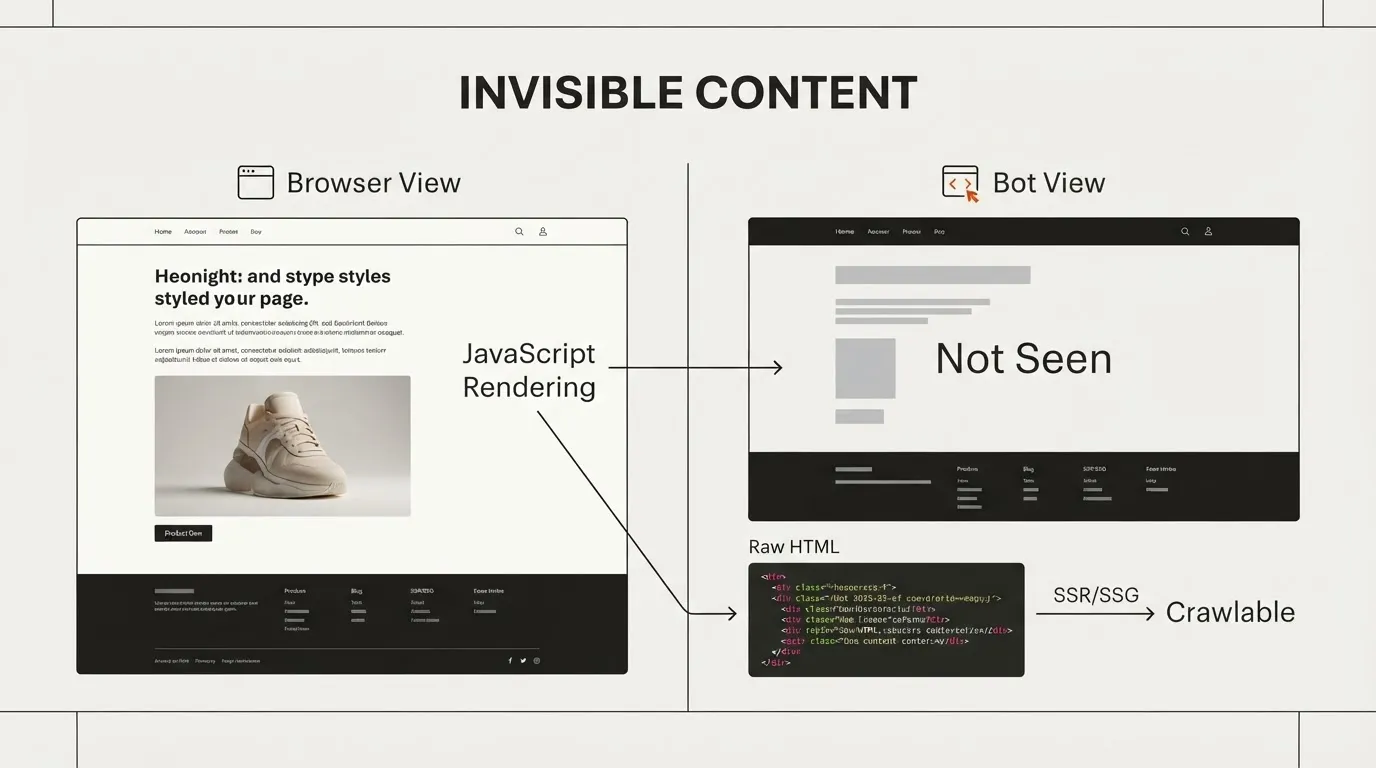
Your site can look flawless in a browser and still fail AI crawler optimization. If your product copy, links, or proof points only appear after JavaScript runs, many AI systems may not see them in the raw HTML they fetch first.
This is not just a React problem. It affects any client-side-rendered or JavaScript-heavy setup, including React, Vue, Angular, and CMS themes that depend on scripts to load key content.
That risk is no longer theoretical. Google’s own Understand JavaScript SEO Basics says crawling, rendering, and indexing happen in separate steps, and the 2026 JavaScript links can make your pages invisible to AI search experiment showed major AI crawlers discovered zero pages linked only through JavaScript.
Key takeaways:
- Raw HTML decides whether AI bots can read core content
- JS-only links fail discovery for many AI crawlers
- Server-rendered or pre-rendered pages help on key templates
- View source first before trusting what the browser shows
For lean teams, this changes the job. SEO, or Search Engine Optimization, used to focus on rankings and user experience.
Now SEO for AI search also depends on whether a machine can extract meaning from the source layer on first fetch.
That applies across JavaScript-rendered sites in general, with React crawlability being one common example rather than the whole category.
And that leads to the real problem.
The Invisible Web
 A modern site can be visible to people and invisible to bots at the same time. That happens when the important layer lives in the rendered DOM, not in raw HTML.
Google says in its 2026 JavaScript SEO documentation that crawling, rendering, and indexing are separate stages. If article text is missing from source, Google may need an extra render pass before it can even see the page properly.
Based on the plain-English reality small teams face, the issue is simple: lean marketers and founders were taught to judge pages by what loads in the browser, while AI bots often judge them by what exists before scripts run.
- Raw HTML is the first gate for machine-readable discovery
- Human-ready pages are not enough when bots need extractable source content
- Client-side navigation can hide links from crawlers completely
- React crawlability drops fast when routes depend on JavaScript alone
The clearest signal comes from a 41-day Search Engine Land test on a 1,062-page site. Googlebot found only about 2 in 100 pages (2%) linked only through JavaScript, while GPTBot, ClaudeBot, Bingbot, PerplexityBot, Meta’s crawler, and Amazon’s crawler found none.
That is not an edge case. The 2025 HTTP Archive Web Almanac analyzed 17.2 million websites and 244 TB of data, which makes this a web-wide architecture issue, not a niche frontend mistake.
So the next question is not technical vanity. It is business risk.
The Cost of Being Unreadable
 If AI systems cannot read your source pages, they cannot cite you accurately. That weakens visibility first, then trust.
Forrester’s 2026 B2B predictions found that nearly 1 in 5 buyers (19%) felt less confident in purchase decisions because AI-provided information was inaccurate or unreliable. If your best page is unreadable, you lose the chance to be the trustworthy source those buyers verify.
- Unreadable pages create weak answers in AI-assisted discovery
- Weak answers lower confidence during shortlist and evaluation stages
- Missing source visibility costs revenue when buyers cannot confirm claims
- AI trust is now a pipeline issue not just a content issue
The stakes get bigger in complex B2B sales. Forrester’s 2026 buyer research says the typical purchase now involves 13 internal stakeholders and 9 external influencers.
That means more people asking tools for summaries, comparisons, and proof. It also means more chances for weak source pages to derail the deal.
Forrester also warned in its 2026 predictions release that B2B firms could lose more than $10 billion in enterprise value from unguided generative AI use. If your go-to-market content is invisible or misread, this stops being a frontend bug and becomes a commercial risk.
That changes how teams should think about optimization.
From Visual SEO to Semantic SEO
 The old playbook optimized what users saw. The new one also has to optimize what machines can parse.
That is the shift behind AI crawler optimization. A polished interface still matters, but citation depends on whether headings, links, value props, and metadata exist in source code in a clear semantic structure.
In AI search, presentation helps humans trust you, but source structure helps machines find you.
- Ranking is not the whole game when citations drive discovery
- Semantic HTML beats presentation tricks for machine extraction
- Source-layer copy matters more than post-render decoration
- This discipline is learnable for builders with no time to sell
The timing matters too. McKinsey’s 2026 Global Marketer Survey found that while nearly 6 in 10 marketers use AI multiple times each week, fewer than 1 in 10 capture value across full workflows.
At the same time, Adobe’s 2026 AI and Digital Trends report found more than three-quarters of teams (76%) saw moderate-to-significant gains in content ideation and production speed.
Teams are producing more content faster. But if the source layer is unreadable, scale just produces more invisible assets.
So the practical question becomes: what should a React team do this week?
Build for the Machine First With AI Crawler Optimization
 The fix is technical, but it does not need to be heavy. For React crawlability, the rule is simple: make the important content exist before JavaScript runs.
Start with a raw-HTML audit. Use View Source, not Inspect Element, because Inspect shows the post-JavaScript DOM, which bots may never receive.
- Check homepage source for headline, subhead, and primary CTA
- Check product pages for core value props in raw HTML
- Check pricing pages for plan names, limits, and FAQs
- Check docs and comparison pages for crawlable body copy and links
- Check navigation for plain
<a>links visible without scripts
Then choose the leanest delivery method for each page type.
- Use SSR for frequently changing pages that need immediate HTML output
- Use SSG for stable pages like docs, comparison, and feature pages
- Keep HTML links in navs, footers, and in-content modules
- Add noscript fallbacks when critical content depends on JS interactions
- Fetch with JS disabled and confirm the page still makes sense
If a bot loads your page without JavaScript, your value proposition should still survive. That is the baseline for SEO for AI search.
And once you know the rule, the audit itself is fast.
Your Next Crawl Test
 The fastest way to find AI visibility risk is to test one week, up close. Do not start with your whole site.
Start with the pages most likely to shape discovery and buying. For Scout7’s audience, that means the pages that should power organic marketing on loop, not just look good in screenshots.
Why can't AI bots see my website content?
AI bots often miss website content because they fetch raw HTML first, and many do not execute JavaScript reliably enough to see client-rendered text, links, or navigation. If your key content only appears after scripts run, the machine may never read or cite it.
How to make React sites crawlable for AI?
Make React sites crawlable by serving critical pages as SSR or SSG, keeping important copy in raw HTML, using standard HTML links, and adding fallbacks where JavaScript controls visibility. Then test pages with JavaScript disabled and verify that the core message still appears in source.
- Audit four pages first: homepage, top product page, docs hub, pricing
- Compare source to screen: what humans see versus what bots fetch
- Fix source before styling: machine readability comes first
- Repeat every release: new components can re-hide old content
If you want a practical threshold, ask one question: could a dumb fetch request understand what you sell?
If the answer is no, your best page may already be missing from AI discovery.
Conclusion
Key takeaways:
- AI visibility starts in raw HTML, not the polished browser view
- JS-only navigation breaks discovery for many AI and search crawlers
- SSR, SSG, and HTML fallbacks are the practical React crawlability fix
- The streak is the strategy once machines can read your pages consistently
The opening claim was blunt for a reason: a site can look finished and still be invisible where new discovery begins. That is the new constraint behind AI crawler optimization.
The good news is that the fix is learnable. You do not need a giant platform rewrite to improve SEO for AI search.
You need a disciplined audit of the source layer, a clear decision on which pages should use SSR or SSG, and a hard rule that key links and value props must survive without JavaScript. For builders with no time to sell, that is an engineering habit worth building.
This week, open View Source on your homepage, product page, docs hub, and pricing page. If the message is missing there, fix that first.
Because in the next wave of discovery, the winners will not just have better content. They will have content machines can read on first fetch—and that is how organic marketing stays on loop.
Frequently asked questions
Do AI crawlers really read raw HTML before rendered content?
Yes—this article’s core point is that many AI systems fetch raw HTML first, not the polished frontend users see in the browser. If your key copy, links, or proof points only appear after JavaScript runs, those systems may miss them entirely.
Is this only a React problem?
No. The article explicitly says this affects any client-side-rendered or JavaScript-heavy setup, including React, Vue, Angular, and CMS themes that rely on scripts to load important content. React crawlability is just one common example.
What is the fastest way to audit a page for AI visibility?
Start with View Source, not Inspect Element, because Inspect shows the post-JavaScript DOM. Then compare the raw HTML to what appears on screen and check whether the headline, value props, primary links, and key page copy are present without scripts.
What should we fix first if our content is hidden from AI bots?
Fix the pages that drive discovery and buying first: homepage, top product page, docs hub, and pricing. The article recommends using SSR or SSG where needed, keeping important links as plain HTML <a> links, and making sure the page still makes sense with JavaScript disabled.
References
- Google Search Central, "Understand JavaScript SEO basics"
- Search Engine Land, "JavaScript links can make your pages invisible to AI search"
- HTTP Archive, "The 2025 Web Almanac"
- Forrester, "Forrester’s 2026 B2B Marketing, Sales, And Product Predictions"
- Forrester, "Forrester’s 2026 Buyer Insights: GenAI Is Upending B2B Buying"
- McKinsey, "From anxiety to advantage: A marketing organization that thrives with AI"
- Adobe, "2026 AI and Digital Trends Report: Four key takeaways"