
blog
Why More AI Automation Creates Less Growth in Marketing Orchestration
August 28, 2026 · 8 min read · Scout7
Most teams automate tasks, not systems. Learn the difference between marketing automation and orchestration, and how to build an organic growth loop.
Subtitle: Most teams automate tasks, not systems. Here is how marketing orchestration builds an organic growth loop that learns.
Read time: 5 minutes
Introduction: Why marketing orchestration matters now
Marketing orchestration is the difference between automating a task and running a system that learns. Most teams do not have too little AI. They have too many disconnected automations, which means research, publishing, and measurement never become one organic growth loop.
You can see the pattern in one ordinary week: one tool drafts a post, another schedules it, a spreadsheet tracks clicks, and a person has to remember what the last campaign taught the next one.
Key takeaways:
- Marketing automation handles tasks; orchestration connects the full loop
- Broken handoffs create content debt and weak feedback
- Unified data gives AI the context to improve weekly
- Organic growth loops compound when strategy and execution share state
That quiet failure is common. According to McKinsey, nearly 6 in 10 marketers (almost 60%) use AI multiple times per week, yet fewer than 1 in 10 (under 10%) capture value across end-to-end workflows.
The gap is the point of this piece. If you want sustainable growth, you need more than marketing automation. You need marketing orchestration.
The Automation Trap: Scaling the wrong things

And once you see that gap, the real problem comes into focus. Teams are not scaling a system. They are scaling isolated outputs.
According to McKinsey, nearly 6 in 10 marketers (almost 60%) use AI weekly, but fewer than 1 in 10 (under 10%) capture end-to-end workflow value.
According to Deloitte, only about 1 in 4 organizations (25%) moved at least 40% of AI pilots into production.
According to Gartner, marketing leaders say only about one-sixth of marketing work (16%) is AI-automated today.
That happens because loops break at handoffs:
- Research to brief loses audience context and positioning
- Brief to creation drops channel rules and prior winners
- Creation to publishing loses timing, approvals, and asset lineage
- Publishing to measurement breaks attribution and response signals
- Measurement to planning never updates next week’s strategy
When those handoffs stay disconnected, the human becomes the glue. Data and strategy break together, so fixing one tool never fixes the loop.
Orchestration vs. automation: What is the difference?

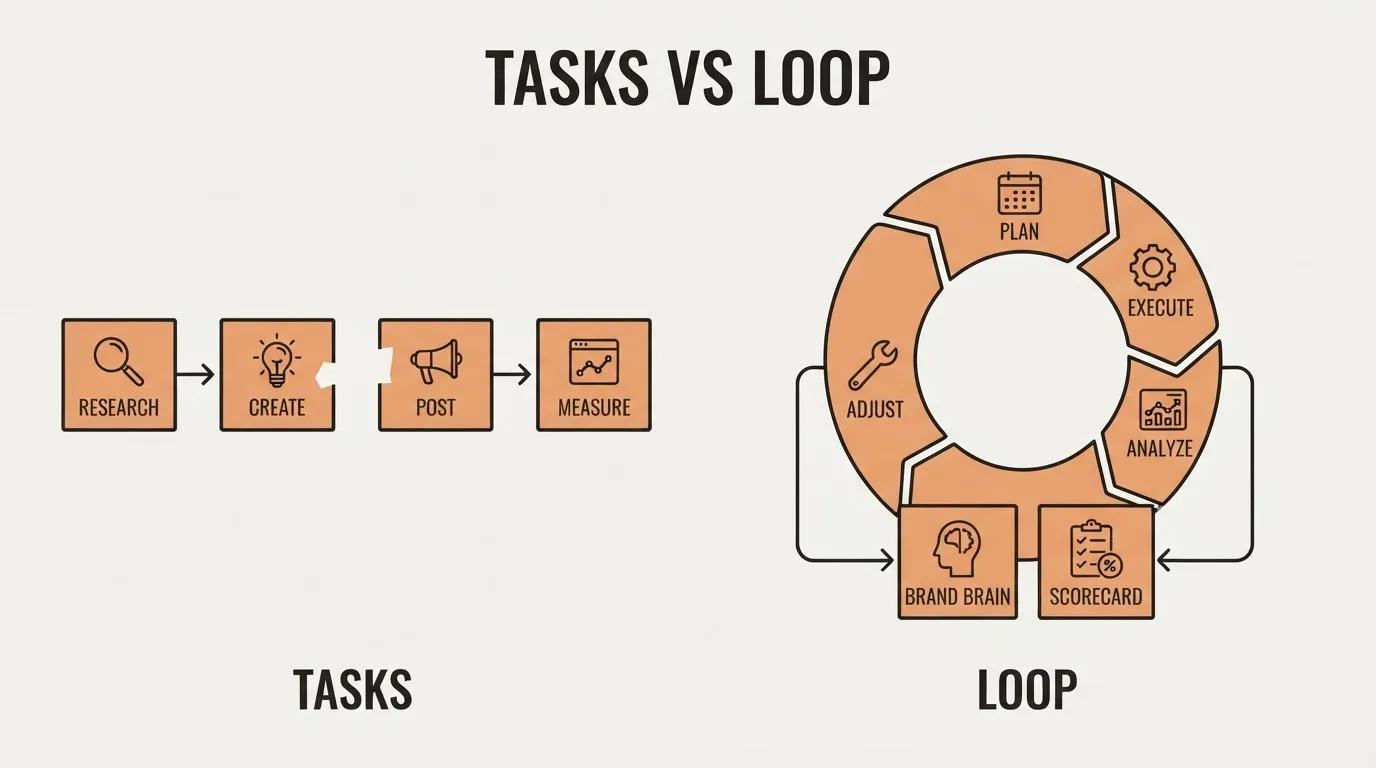
So what is the difference between marketing automation and orchestration? Marketing automation completes a task. Marketing orchestration coordinates a stateful system, where each step can see prior context, current goals, and performance feedback.
That difference sounds abstract until you map the loop.
- Marketing automation drafts one post, rewrites one email, or schedules one asset
- Marketing orchestration connects research, creation, publishing, and measurement into one responsive cycle
- An organic content loop turns each campaign’s output into the next campaign’s input
- An Organic Growth Loop is a self-reinforcing system where the output of a marketing activity generates further reach or engagement without the use of paid advertising. These cycles occur when content performance creates data or visibility that informs subsequent content, effectively lowering the cost of acquisition while increasing sustainable audience compounding.
According to Adobe, more than 8 in 10 teams missed an opportunity last quarter because they could not respond in time, while only about 1 in 14 (7%) embedded AI in ways that produced measurable business results.
According to Salesforce, more than 8 in 10 marketers (84%) still run generic campaigns, and about 7 in 10 (69%) struggle to respond promptly.
Automation finishes work. Orchestration decides what the next work should be.
That is why Scout7 talks about “A week of organic marketing on loop.” The point is not one generated asset. The point is a loop that can run, remember, and adapt.
Why unified data is the engine of orchestration

And that leads to the real cause. Loops rarely fail at writing. They fail because the system cannot see enough context to act.
This is where a marketing control plane matters. A marketing control plane is the shared operating layer that connects your brand brain, workflow state, publishing actions, and unified marketing analytics so the loop can coordinate itself.
It also explains why content infrastructure matters. Content infrastructure is the connected system of briefs, assets, metadata, channels, and performance signals that makes content reusable instead of disposable.
In our own operating loop, the break never came from asking an agent to write. It came when research lived in one place, website context in another, publishing in a third, and performance in a dashboard that never shaped the next brief.
Based on what we saw while running our own brand on a weekly agent loop, the failure mode was always the same: when tools could not share state, a person had to carry context between them.
The research supports that lived pattern:
- According to Salesforce, marketers satisfied with unified data are 42% more likely to respond regularly
- The same Salesforce research says they are 60% more likely to use AI agents
- According to Salesforce, about 7 in 10 marketers (69%) struggle to respond because they cannot access needed context
- The same source says only about half (56%) have complete access to sales data
- According to Gartner, CMOs spend 15.3% of budget on AI, but only 30% report mature or fully developed readiness
Without unified marketing analytics, AI repeats. With unified data, AI can update the loop.
Three steps to build your own growth loop

So how do you build an organic growth loop? Design the handoffs first, then the prompts.
Step 1: Connect context
- Build one brand brain from website, positioning, audience, and top-performing assets
- Store channel rules, ICP language, and current offers in one place
- Define your marketing control plane as the source of shared state
Step 2: Run the weekly cycle
- Start with research on gaps, themes, and search intent
- Turn insights into blogs, posts, carousels, and videos inside one system
- Publish with visible status, asset lineage, and channel-specific variants
- This is your organic content loop in motion
Step 3: Close the scorecard
- Use a weekly scorecard to track output quality and response
- Feed winners, losses, and audience signals into the next brief
- Make unified marketing analytics part of planning, not a separate report
For a small marketing team or a b2b founder, this matters because time disappears in handoffs. For leaders focused on ROI, the key metric is not how much content shipped. It is whether the next cycle gets smarter.
What a connected loop changes

Now the payoff comes back to the opening image. The goal is no longer a founder babysitting drafts, schedulers, and spreadsheets.
A connected loop changes what marketing automation is for:
- You stop measuring output and start measuring learning velocity
- You audit handoffs first before adding another model or workflow
- You build continuity across research, creation, publishing, and reporting
- You reduce generic campaigns because the system can see what happened last week
- You make weekly compounding possible because the loop retains memory
That is the practical difference between automation and orchestration. One produces more activity. The other produces an organic growth loop that improves itself.
If you want to run your loop instead of stitching one together by hand, Scout7 is built for that operating model. Onboard. Connect. Ask. Run your organic growth loop from Claude Code, Codex or Cursor.
The teams that grow from AI will not be the ones with the most tools. They will be the ones that finally connect strategy, data, and execution into one system.
Frequently asked questions
What is the difference between marketing automation and marketing orchestration?
Marketing automation handles a task, like drafting a post, rewriting an email, or scheduling an asset. Marketing orchestration connects research, creation, publishing, and measurement into one stateful system that can use prior context and performance feedback.
Why does more AI automation sometimes create less growth?
The article argues that growth slows when teams automate isolated outputs instead of the full loop. When handoffs break between research, creation, publishing, and measurement, a person has to carry context manually and the system never learns from prior campaigns.
Why is unified data so important for orchestration?
Unified data gives AI the context it needs to improve the next cycle instead of repeating the last one. The article notes that marketers satisfied with unified data are more likely to respond regularly and more likely to use AI agents.
How can a small team start building an organic growth loop?
Start by connecting context first, not prompts. Build one brand brain, define a shared marketing control plane, run a weekly cycle across research through publishing, and use a scorecard so wins and losses shape the next brief.
References
- McKinsey — From anxiety to advantage: A marketing organization that thrives with AI
- Salesforce — State of Marketing 2026
- Adobe — The search for impact in an era of speed
- Deloitte — State of AI report 2026
- Gartner — 2026 CMO Spend Survey finds CMOs allocate 15.3% of marketing budgets to AI, but only 30% are ready to scale AI capabilities
- Gartner — Survey reveals marketing leaders expect AI automation of marketing work to double to 36% by 2028