
blog
Why More AI Content Still Doesn't Grow Without a Marketing Control Plane
August 28, 2026 · 8 min read · Scout7
Most AI marketing fails because teams automate drafts, not the loop. Learn what a marketing control plane is and how orchestration fixes it.
Why the marketing control plane matters first
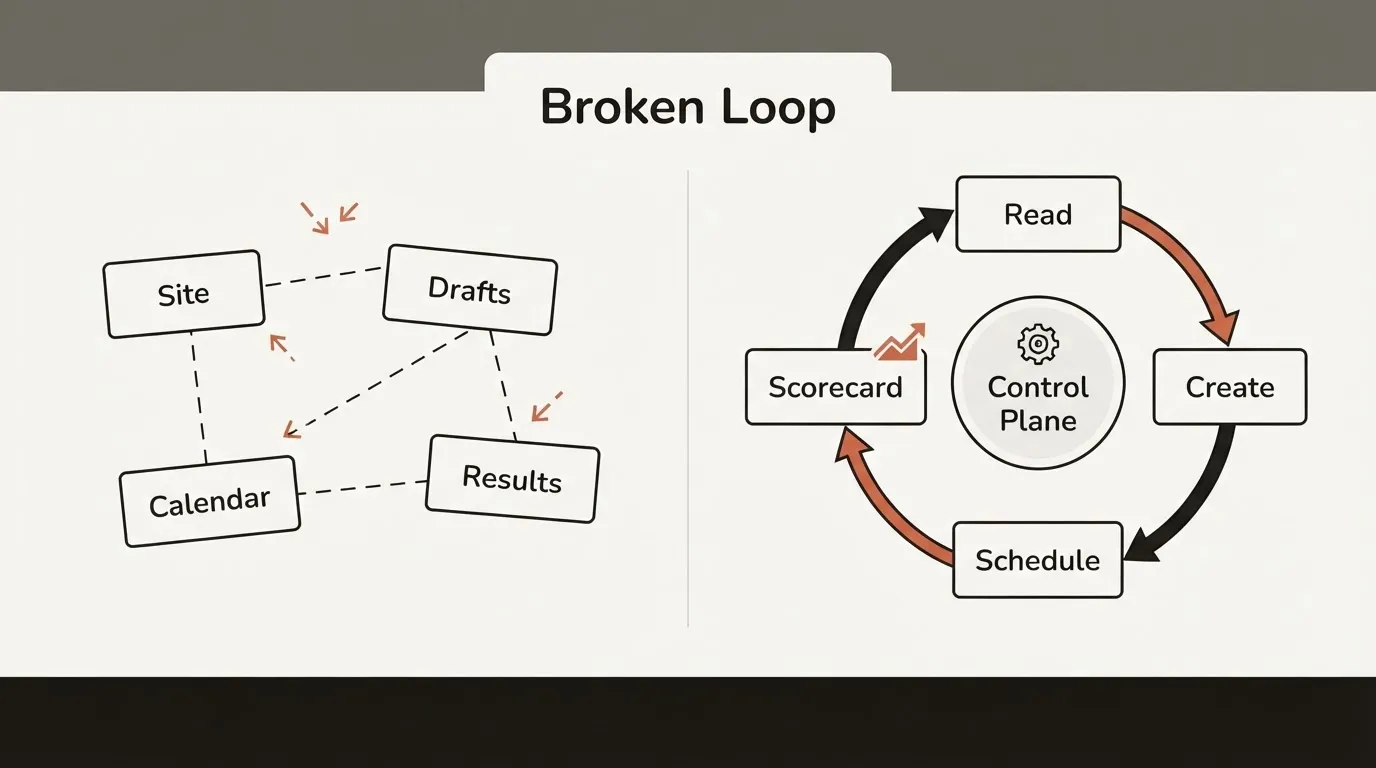
A marketing control plane is the missing layer between AI output and real growth. It coordinates site context, calendar timing, and result signals so your team can run an organic marketing loop instead of pushing drafts between disconnected tools.
Key takeaways:
- More AI output usually creates more fragments, not more growth
- A marketing control plane coordinates site, calendar, and results together
- AI marketing orchestration fixes handoffs between planning, publishing, and measurement
- An organic marketing loop gets smarter every week from performance feedback
Picture the common setup: one tool writes a blog, another drafts social posts, someone copies ideas into a calendar, and someone else checks analytics later. The stack looks busy, but growth still feels random.
That pattern now shows up clearly in the data. According to Adobe, 8 in 10 marketers (80%) use AI for content, yet only about 1 in 14 (7%) have embedded it in ways that deliver measurable business results.
Why more AI output creates more noise
 And that gap points to the real problem: teams often automate production before they design the system that should coordinate the work.
Most teams use AI as a drafting layer. The real bottleneck sits elsewhere:
- Ideas do not move cleanly from plan to publish to feedback
- Approvals live in separate tools from scheduling and analytics
- Performance signals arrive too late to change the next action
- Humans become couriers carrying context between tabs
The usage numbers are high because access is no longer the issue. HubSpot says 8 in 10 marketers (80%) use AI for content creation and 3 in 4 (75%) use it for media production.
But workflow payoff stays low. McKinsey found nearly 6 in 10 marketers (almost 60%) use AI multiple times per week, while fewer than 1 in 10 (under 10%) have begun capturing value across end-to-end workflows.
Adobe also reports that more than 8 in 10 teams missed an opportunity in the previous quarter because they could not respond in time. So the failure is not weak prompts. It is a broken loop.
What is a marketing control plane?
 So if the issue is structural, the next question is architectural. A marketing control plane is the layer that sees the whole system and decides what should happen next.
By Scout7’s canonical definition, a Marketing Control Plane is a centralized software architecture that integrates disparate marketing automation tools, data streams, and content generation engines into a single operational interface. It functions as the command layer for managing cross-channel campaigns, enabling users to synchronize strategy, execution, and performance analytics from one unified dashboard rather than managing fragmented point solutions.
In practice, that means the control plane sees three moving parts together:
- Site context from your website, messaging, and product pages
- Calendar timing across channels, sequences, and publishing windows
- Result signals from the scorecard, so performance updates the next cycle
This is the core difference between asset production and AI marketing orchestration. Gartner found leaders expect AI-driven automation to rise from about 1 in 6 tasks (16%) in 2026 to more than 1 in 3 (36%) by 2028.
Yet Gartner also shows teams are spending before they have the process, data, and governance to scale. Based on what we saw from a founder-technical, mechanism-first view, teams bought generators without designing the loop, so people kept acting as couriers between tabs instead of letting one system run the work.
That is why content infrastructure matters. Without a control plane, your infrastructure produces assets; with one, it runs the loop.
Why integration is now the growth lever
 And once you see the loop, the bottleneck becomes obvious. The hard part is not asking AI to write; it is giving the system the connected context to choose, schedule, and improve the next move.
This is where unified marketing analytics matters. If content data, channel timing, and revenue signals live in different places, the system cannot learn.
The integration problem is now well documented:
- Nearly two-thirds of teams (65.7%) cite data integration as their biggest stack challenge, per MarTech
- More than 6 in 10 teams (62.1%) use more tools than two years ago, per MarTech
- More than two-thirds (69%) struggle to respond promptly to customers, per Salesforce
- Only 58% have complete service data access, 56% sales data, and 51% commerce data, per Salesforce
When systems cannot see site behavior, timing, and outcomes together, automation becomes handoff management.
That is why integration failure, not prompt quality, breaks AI marketing. A marketing control plane removes those handoffs by sitting above fragmented tools and coordinating them into one operating layer.
How does an organic marketing loop work each week?
 Once the orchestration layer exists, the weekly motion gets simpler. An organic growth loop is a connected cycle where each step feeds the next one, so planning, publishing, and measurement keep improving together.
A practical organic content loop looks like this:
- Read the site first to pull product context, positioning, and content gaps
- Choose the next topics from what the site needs, not random prompts
- Create channel-ready assets that reflect the same brand brain
- Schedule them on the calendar with sequence, timing, and channel intent
- Score results weekly so the next plan learns from actual performance
That is the difference between marketing automation and isolated AI output. Marketing automation matters here because it connects actions across systems, while the organic marketing loop makes those actions cumulative.
Without that loop, generic campaigns persist. Salesforce found more than 8 in 10 marketers (84%) still run generic campaigns despite broad AI adoption.
For a small marketing team or a busy b2b founder, this is the real unlock: onboard the site, connect your agent, run your loop, then use the scorecard to improve next week instead of guessing.
What to fix first if AI marketing feels busy but not useful
 So the fix is not to add another writing tool. Fix the loop architecture first, then let AI operate inside it.
Start with three decisions:
- Define the control plane that sees site context, calendar timing, and results together
- Connect your agent to planning, creation, scheduling, and scorecarding in one system
- Measure loop quality instead of counting output volume alone
- Use unified marketing analytics to decide what the next week should do
This is how AI marketing orchestration becomes useful. The question is not how many assets your stack can produce; it is whether each cycle improves your ROI.
If you want “A week of organic marketing on loop,” the path is straightforward: onboard the website, connect your agent, and let one system coordinate the work. More output is easy. A loop that learns is what grows.
Conclusion
Key takeaways:
- Growth stalls when AI speeds up output but not coordination
- A marketing control plane must see site, calendar, and results together
- The organic marketing loop turns weekly performance into the next action
- Integration quality matters more than another drafting tool
Go back to the opening image of marketers copying work between tabs. That is what most failed AI programs actually look like in production: not a model problem, but a system problem.
The teams that pull ahead will not be the ones with the most generators. They will be the ones with the best content infrastructure, the clearest unified marketing analytics, and one control layer that can run an organic content loop from research to scorecard.
If your current stack feels active but not compounding, stop asking how to make more. Ask what coordinates the loop. Decide what will read the site, manage the calendar, and absorb result signals into the next cycle.
That is the shift from fragmented automation to an organic growth loop. And it is the shift Scout7 is built for: Onboard. Connect. Ask. If you want to run your organic growth loop from Claude Code, Codex or Cursor, start by mapping the control plane your team actually needs.
Frequently asked questions
What is a marketing control plane?
A marketing control plane is the layer that connects AI output to real growth. In this article, it means one system that sees site context, calendar timing, and result signals together so teams can coordinate planning, publishing, and measurement.
Why doesn't more AI content automatically create growth?
Because most teams automate drafting before they fix the system around it. When planning, approvals, scheduling, and analytics live in separate tools, AI speeds up output but not the loop that improves performance.
How is a marketing control plane different from a writing tool?
A writing tool helps produce assets. A marketing control plane sits above fragmented tools and coordinates what should happen next across the site, the calendar, and the scorecard.
What does an organic marketing loop look like each week?
The article describes a simple weekly cycle: read the site, choose the next topics, create channel-ready assets, schedule them on the calendar, and score results weekly. The key is that performance from one cycle informs the next one.
References
- Adobe — The Search for Impact in an Era of Speed
- HubSpot — State of Marketing
- McKinsey — From anxiety to advantage: A marketing organization that thrives with AI
- Gartner — Survey Reveals Marketing Leaders Expect AI Automation of Marketing Work to Double to 36% By 2028
- Gartner — 2026 CMO Spend Survey Finds CMOs Allocate 15.3% of Marketing Budgets to AI, But Only 30% Are Ready to Scale AI Capabilities
- MarTech — These are the challenges and barriers impacting your martech stack
- MarTech — State of the Stack 2025: Homegrown martech surges as AI accelerates development
- Salesforce — State of Marketing 2026