
research_paper
You Hear The Song. They Hear Knocking. The Curse Of Knowledge In Your Launch Post
September 24, 2026 · 9 min read · Scout7
In 1990, people tapped 120 songs and guessed half would be named. Listeners named 3. How the curse of knowledge hides what is unclear in your launch post.
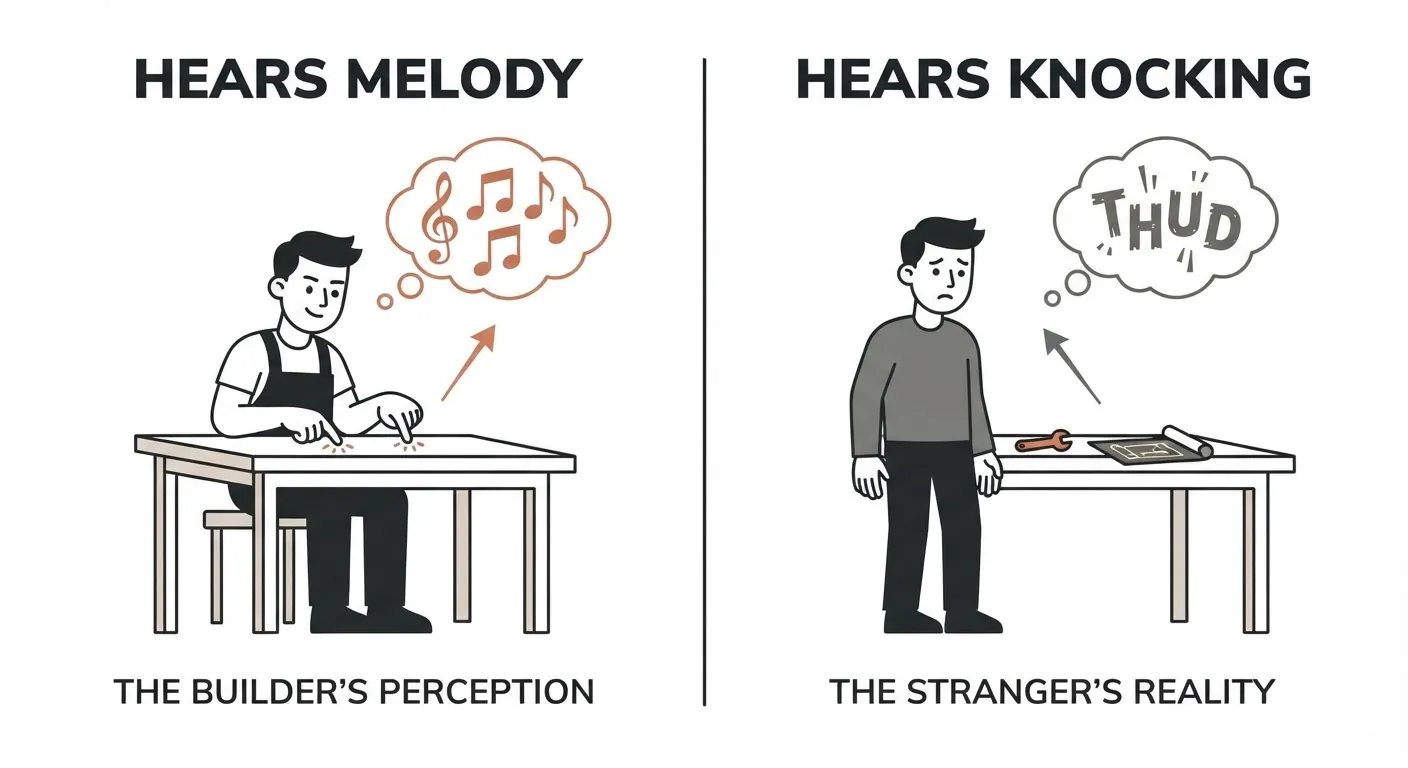
In 1990, people tapped 120 famous songs on a table. They guessed half would be named. Listeners named 3.
Your launch post has the same problem. Researchers call it the curse of knowledge. This piece shows why, and gives you a ten minute test to catch it before launch day.
Why is the person who built it the worst one to check the launch post?
The person who built it is the worst person to check the launch post.
That sounds wrong. You know every line of the code. You know why each part is there. Nobody knows the project better than you.
That is exactly the problem.
What happens the day after you launch?

It is midnight before launch day. You read your one line tagline again. Then again. Five times.
It looks clear every time.
The next day you post it. A few people look. Some click. A day later it is quiet again. Months of work, and almost nobody says what you hoped they would say.
Nobody tells you why they left. They just leave.
And you are not the only one posting. One company that sells launch tools counted launches on Product Hunt. Between 24 May and 25 July 2026 it counted 44,744. That is about 750 a day (PH Launch Kit). A visitor gives each one a few seconds.
So here is the question this piece answers. If you know your project best, why are you the worst one to check it?
What you will know by the end
Most launch guides say the same thing. Product Hunt checklists say it. Show HN guides say it. Write clearly. Avoid jargon. Jargon means words only insiders use.
That advice is right. But it leaves out one detail. Without it, you cannot follow the advice on your own. We will get to it.
By the end you will know:
- why you cannot hear the problem in your own post
- what happened when researchers paid people to stop making this mistake
- a ten minute test to run before launch day
- the one rule about who you test on that most guides miss
It starts with a table and a song.
Is the curse of knowledge only a lab game?

In 1990 a student at Stanford University ran a simple game. Her name was Elizabeth Newton.
She sat two people at a table. One was the tapper. One was the listener.
The tapper got a list of well known songs. Songs like Happy Birthday. They tapped the rhythm of each song on the table with their knuckles. No humming. No words. Just knocking.
The listener tried to name the song.
Before the game, the tappers made a guess. They thought the listener would name about half of the songs.
Then the game ran. The tappers tapped 120 songs. The listeners named 3.
That is 3 out of 120. Not half. About 1 in 40.
Why was the guess so far off? When the tapper knocks, they hear the tune in their head. They hear the words too. The listener hears none of that. The listener hears a knock, then another knock.
Chip and Dan Heath told this story in Harvard Business Review in December 2006. They used the name researchers gave it in 1989. The curse of knowledge. Once you know something, it is very hard to imagine not knowing it.
But that was a game with songs. Real messages are different, right?
Does this happen with real messages, or only in a lab game?
Think of a joke you once sent by text. Your friend wrote back, asking if you were angry. You heard your own voice when you typed it. They did not.
Researchers have measured this with real messages.
In 2002, Boaz Keysar and Anne Henly asked people to say sentences that could mean two things. Speakers thought listeners understood them 72 percent of the time. Listeners really understood 61 percent of the time (Psychological Science, 2002).
In 2005, Justin Kruger and his team looked at email. Was a message a joke, or serious? Writers expected about 89 percent of readers to get it right. About half did (Journal of Personality and Social Psychology, 2005).
Half is about what you get from tossing a coin.
These people were not bad writers. They were ordinary people who knew what they meant. That was enough to fool them.
And a visitor gives you far less time than a friend does.
How long does a stranger give your launch post?
A friend reads your whole message. A stranger does not.
Jakob Nielsen studied how long people stay on web pages. He wrote it up in September 2011. The first ten seconds decide if a visitor stays or goes. A page has about ten seconds to say what it offers.
That study is old. The web has only got busier since.
Now picture your launch day. Hundreds of other launches go up the same day. A visitor reads your one line. They do not know your project. They cannot ask you a question. If the line does not land in those few seconds, they move on.
This is where the tapping comes back. Your tagline is the tapping. You hear the whole project in it. The visitor hears knocking.
So the usual advice is to write more clearly. Sometimes that is right.
When does technical detail actually help?
Technical detail is not the enemy.
Some readers already know your world. Think of other developers reading a Show HN post on Hacker News. They want to know what you built, how it works and why. Plain technical detail helps them. That is the common advice in guides for that site. It comes from what posters report, not from a study.
Reading your post again also helps. It catches typos. It catches a broken link. It catches a sentence that runs on too long.
So what is the problem?
Detail helps the reader who already knows your world. It loses the one who does not. And when you check your own post, you always read it as the first kind of reader. You cannot tell which reader you wrote for.
So can you train yourself to read like a stranger? Researchers tested that.
Why being careful does not fix it
Most people think the answer is effort. Slow down. Take a breath. Read it like a beginner would.
It does not work.
In 1989 three researchers who study money ran a test. They were Colin Camerer, George Loewenstein and Martin Weber. People who knew a fact had to guess what people without the fact would do. They were paid money to guess right. They could even trade on their guesses in a small market.
Money helped. The mistake got about half as big. But it did not go away (Journal of Political Economy, 1989).
A close cousin of this mistake is hindsight. That is the feeling that you knew it all along. In the 1970s Baruch Fischhoff studied it. He told people about the mistake before they started. They still made it (review in Psychological Science, 2025).
So this is the detail the usual advice leaves out. Knowing about the mistake does not remove it. Being careful does not remove it. Being paid does not remove it.
When you reread your own post, the song is already playing. You cannot switch it off.
So the check has to come from somebody else.
The ten second test you can run this week
Here is the answer to the question at the start. Only someone who has never seen your project can check it. You cannot switch off what you know, even when you try.
So borrow someone who does not know. It takes ten minutes.
- Write your one line tagline and your short launch post.
- Find one person who has never seen your project.
- Show them the post for about ten seconds.
- Take it away.
- Ask two questions. What does it do? Who is it for?
- Write down their exact words. Do not explain. Do not correct them.
- If their words do not match what you meant, change the post.
- Test the new version on a new person.
Step 8 is the rule most guides miss. Each person works only once. After one read, they know what your project does. Now they hear the song too.
Showing a page for a few seconds and asking what people remember is not new. Designers call it a five second test. Nielsen Norman Group and Lyssna both describe it. The research above is why it is worth doing before every launch.
What these studies cannot tell you
This evidence has limits. You should know them.
- Most of these were small studies in a lab. Many used students.
- Newton's study was a PhD paper. Most people know it from the Heath brothers' retelling.
- In 2014, Rachel Ryskin and Sarah Brown-Schmidt repeated one version of this research in seven experiments. The effect was real, but less than half the size first reported (PLOS ONE, 2014).
- None of these studies measured a launch page or a README.
- The ten second finding is from 2011.
- The Product Hunt count comes from a company that sells launch tools. It says its own numbers are rough.
So treat this as a reason to test. It is not a promise of more users.
Frequently asked questions
Can I use a friend?
Yes, if they have never seen the project. A friend who heard you talk about it for weeks already knows the song.
Can an AI read it for me?
It can catch typos and long sentences. But it is not a person scrolling past on launch day. No study here tested it. Use it as a first pass, not as the test.
How many people should I test?
Start with three new people. Three is a starting point, not a rule from a study.
Does this work for a README?
Yes. A README is the front page of a code project on GitHub. Run the same test on its first paragraph.
What if they get it wrong?
That is what the test is for. Their words show you what your post really says. Change it, then try a new person.
One question for you
What is one word in your launch post that somebody asked you to explain?