
guide
Reporting or Running? The 4-Question Marketing MCP Test
August 29, 2026 · 9 min read · Scout7
Use this 4-question test to tell a reporting marketing MCP from an autonomous marketing agent before you buy the wrong tool.
Introduction
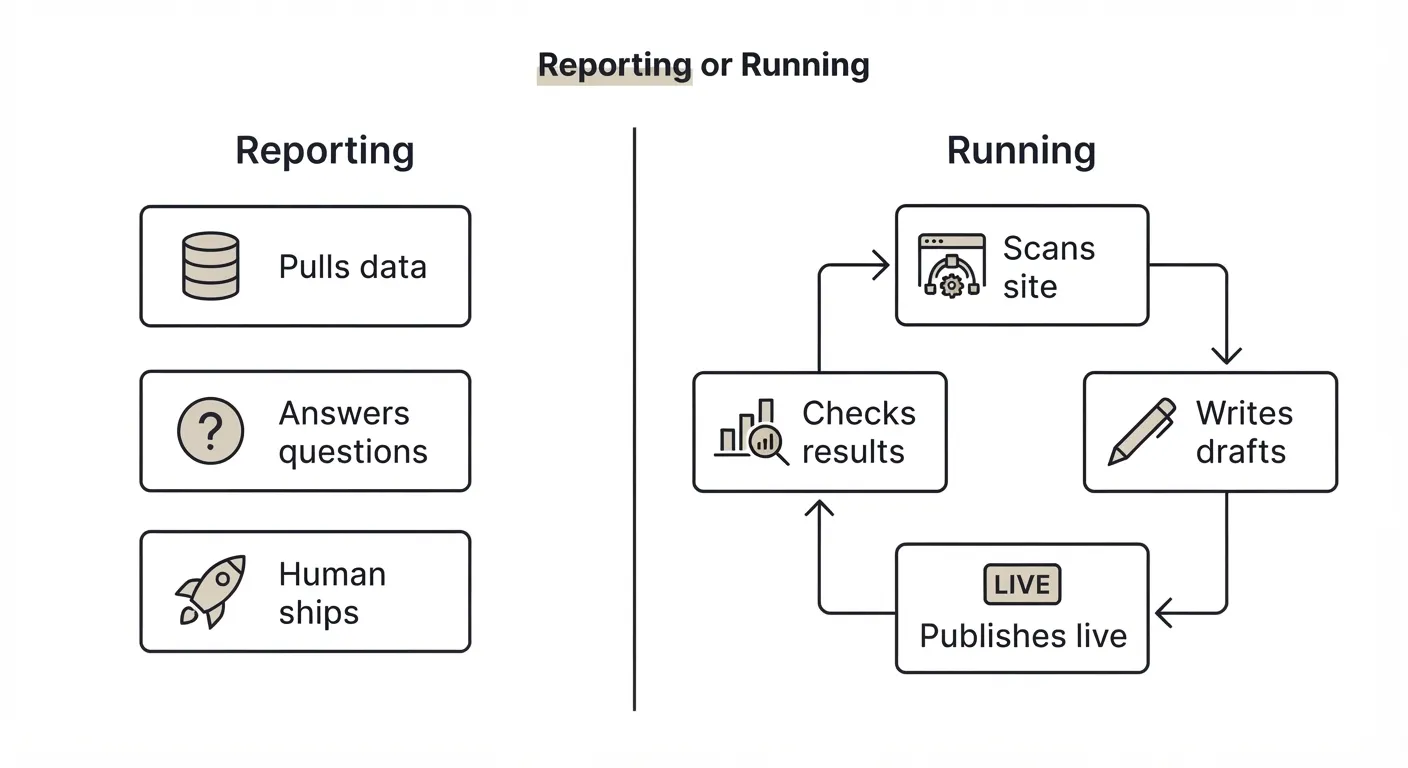
A founder opens a demo expecting a system that will run next week’s organic marketing loop. What they get instead is a clean dashboard, better answers from GA4, and one more tab to check. That is the core difference between a marketing MCP and an execution system: one helps you see the work, the other helps you ship it.
That confusion is everywhere right now. In our own 2026-08-28 review of twenty first-page results across three buyer queries in this category, none of the twenty centered the agent actually running the marketing loop; every result framed MCP as a connector for reporting and ads.¹
Key takeaways:
- Reporting connectors automate visibility, not execution
- A true agent writes, publishes, and maintains state
- The 4-question test exposes where the work really lives
- Post-publish review matters more than API success
If your bottleneck is unclear numbers, a reporting connector may be the right buy. But if your strategy already exists and the work still does not ship, you need something else.
The Reporting Trap: Connected Is Not the Same as Automated
That gap matters because a connected system can still leave your calendar full. A reporting-first MCP, or Model Context Protocol, is an open standard that enables secure, standardized connections between AI assistants and external data sources or tools.
In practice, most products sold as marketing MCPs do something narrower and useful:
- They connect data sources like GA4, Meta, Google Ads, or a warehouse
- They answer performance questions faster than manual reporting
- They improve visibility into attribution, spend, and channel health
- They do not remove production work from your week
That is not a criticism. It is a framing problem.
Look at what is actually on the shelf. 1ClickReport and SegmentStream sit squarely in the reporting shape — they pull campaign, attribution and channel data into one place so you can interrogate it. Meta Ads MCP does the same job inside one ad account, and does it well. Zapier MCP is the closest thing to an exception: it can genuinely take actions across your stack, but the marketing loop itself — what to write, when it ships, what happens to the result — is still yours to define and supervise.
None of that is a criticism, and it is worth saying plainly: if what is missing from your week is visibility rather than output, a reporting connector is the right buy. The gap is not quality. It is that the category's language promises execution while most of the products deliver analysis — and execution is the half almost nobody is building.
So the honest distinction is simple: reporting connectors automate the looking, not the doing. The next question is what “doing” actually looks like.
The Execution Shift: What a Real Growth Loop Looks Like
 That “doing” starts where reports stop. An autonomous marketing agent is not just connected software; it is a system that performs the repetitive steps between strategy and published output inside an AI agentic marketing workflow.
A real Growth Loop is a closed-system process where the outputs of a business operation are reinvested to generate further inputs, creating a self-sustaining cycle of acquisition. In B2B content automation, that means the system scans, drafts, adapts, publishes, measures, and repeats.
What stays human:
- Strategy: which audience matters and why
- Claims: what the brand is willing to say publicly
- Taste: what feels on-brand and worth posting
- Final approval: the last yes before anything goes live
What the agent should own:
- Scanning the category for topics and gaps
- Drafting assets from the brief
- Generating visuals and channel variants
- Publishing on schedule across platforms
- Reading results back into the next cycle
That is why the loop matters more than the protocol. Two products may both support MCP and still solve completely different problems.
The Founder's Checklist: 4 Questions to Ask Before You Integrate a marketing MCP
So before you connect anything, ask four blunt questions and screenshot the answers. This is the fastest way to tell a reporting connector from a system that can run your growth loop.
1. Does it write?
If it only retrieves data, you still own content production. That may be fine for analytics, but it is not B2B content automation.
2. Does it publish — a live URL, not an export?
Drafts in a doc, folder, or queue are not distribution. Running means it can create the live artifact.
3. What does it need permission to do?
Read scopes and write scopes are different products. A system with only read access is usually a reporting product.
4. Where does the work live when you close the chat?
If state only lives in a transcript, the loop is fragile. Real marketing automation needs durable state, scheduling, and memory.
These questions also expose fit by bottleneck:
- Choose visibility tools for attribution and performance questions
- Choose execution tools when work keeps slipping off the calendar
- Avoid overlap if you do not need autonomous publishing
And once a product says it publishes, a harder question appears: what happens when it publishes something wrong?
What Stays Human When the Agent Publishes
The narrow truth is the one most buyers miss: an agent that can publish is an agent that can publish something wrong. That is why “human in the loop” is too vague to be useful here.
We gate our own output on exactly this, so the failure modes are not hypothetical to us. Narration that silently fails to bake over one clip of a finished video. A caption truncated at a platform's character limit, severing the URL so the published link resolves to a 404. In both cases every API call in the chain returns success — which is precisely why a success flag cannot be the thing you trust.
The rule that follows is operational, not philosophical:
- API success is not proof the output is correct
- The live artifact is the truth after publishing
- Approval is a real gate before publication, not a decorative setting
- Verification happens after publish by opening the post, watching the video, and clicking every link
Scout7’s default is the right one: strategy, claims, taste, and final approval stay with the human; the agent handles the mechanical middle. That matters in agency marketing operations too, where teams need throughput without giving up judgment.
The buying implication is simple. Judge an execution product by what it does when it is wrong, not only when it works.
Verdict: When to Choose Reporting vs. Running
 That brings the buying decision back to your actual bottleneck. The wrong purchase usually starts with the wrong diagnosis.
Choose reporting when your problem is visibility:
- You cannot trust attribution across channels
- You need clearer spend analysis on paid ads
- You lack channel visibility into what already happened
- You are trying to understand customer acquisition cost before changing execution
Choose running when your problem is capacity:
- Your strategy already exists but content does not ship
- Your team misses schedules for posts and repurposing
- Organic growth matters, but repetitive production keeps dying on the to-do list
- You need an autonomous marketing agent to run the mechanical middle each week
This is where customer acquisition cost matters. CAC is the cost to acquire a customer, and if your organic system never ships, paid acquisition often carries more of the load than it should.
So no, a marketing MCP and an AI marketing agent are not the same thing. One reports on the work. The other runs the organic marketing loop.
Your Next Move
The opening mistake was buying a connector and expecting a marketer. The fix is not cynicism; it is sharper vocabulary.
Key takeaways:
- Reporting helps you see performance, attribution, and spend
- Running helps you ship drafts, distribution, and measurement loops
- Post-publish verification is mandatory for any publishing agent
- MCP support alone does not prove execution capability
If you are evaluating tools now, use the four-question test on every demo. Ask whether it writes, whether it publishes to a live URL, what permissions it needs, and where the work lives after the chat closes.
If the product can publish, insist on live-artifact review. Ask to see the actual published post, the final URL, and the approval gate. That standard comes from shipping failures, not theory, and it is the one check most category pages still skip.
The practical choice is straightforward. Buy reporting when you lack visibility. Buy running when you lack time to execute. And if you want one week of organic marketing on loop, start by matching the tool to next week’s bottleneck without giving up your judgment.
For deeper context, connect this test back to Scout7’s pages on autonomous marketing growth loop, AI agent, MCP, and Claude. Then bring the four screenshots into your next integration call and make the vendor answer them plainly.
Frequently asked questions
Is a marketing MCP the same thing as an autonomous marketing agent?
No. In this article, a marketing MCP usually refers to a reporting connector that helps you see data across tools. An autonomous marketing agent goes further by drafting, publishing, measuring, and carrying the work forward.
What is the fastest way to tell whether a tool reports or runs?
Use the four-question test: does it write, does it publish to a live URL, what permissions does it need, and where does the work live when the chat closes. Those questions reveal whether the product only improves visibility or actually executes the loop.
If a tool supports MCP, does that mean it can execute marketing work?
No. The article makes the point that protocol support alone does not prove execution capability. Two products may both support MCP and still solve completely different problems.
What should stay human if the agent can publish?
Strategy, claims, taste, and final approval should stay with the human. The article also argues that verification has to happen after publish by opening the live post, watching the video, and clicking every link.
References
- Our own category read, 2026-08-28: twenty first-page results across three buyer queries in this category, none of which centered the agent actually running the marketing loop. Counted by hand; no public URL.