



How to price a B2B product or service
Price your B2B product or service when you do all the selling: work out your floor price, collect 20 real prices, check the value to the buyer, quote the same day in three options, and change the price only after 20 quotes.
ByDinesh BypillaReviewed byMurali SidLast checked 16 min read
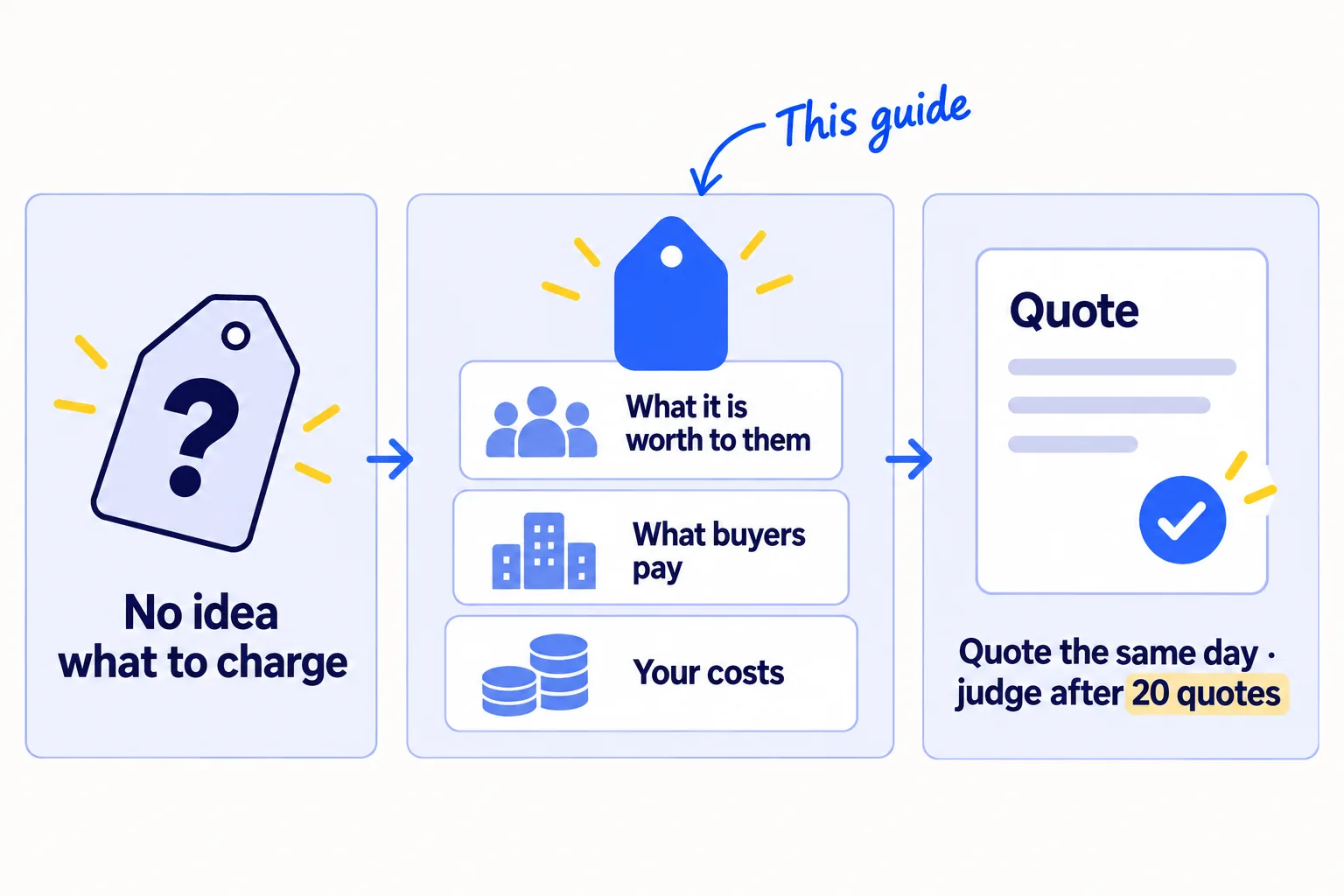
Your first one or two clients paid a price you made up on the spot, and now you have to quote new clients you have never met. Here is how to price a B2B product or service in one afternoon: three sums, one quote you send the same day, and a rule for when to change the price. If you guess instead, most founders guess low, and a low first price is hard to raise later.
Do these three things
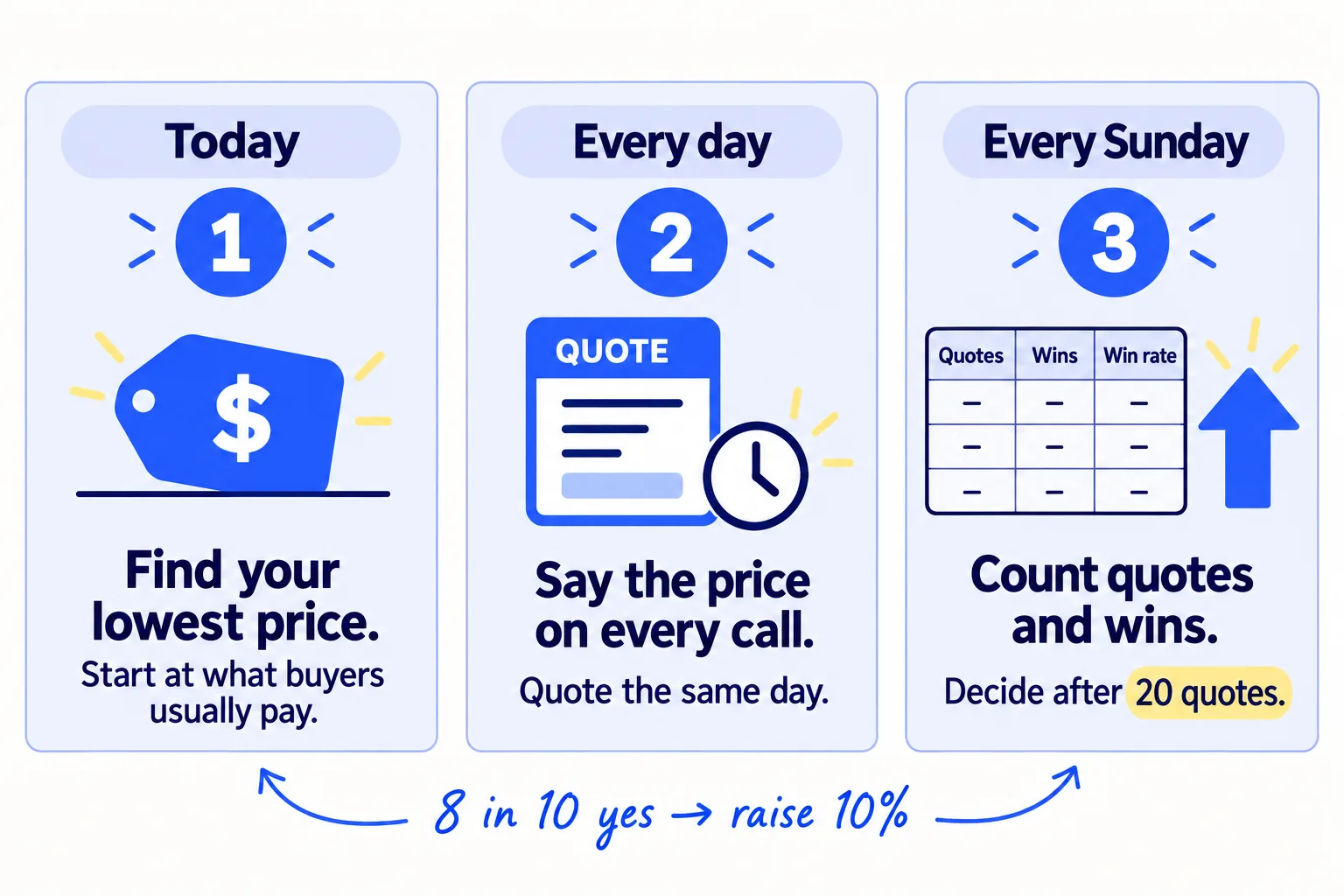
About 3 hours today, then about 20 minutes a quote. Keep up your daily outreach so the quotes keep coming, and judge the price after 20 quotes, never after one lost deal.
Show the three actions in fullHide the full list
- Today: work out the lowest price that still pays you, from your real costs. Then set your price at or above what buyers usually pay, and never below that floor.
- Every day: say your price on every sales callsoon, send every quotesoon the same day with a 30-day limit, and write down whether the buyer said yes, no or "too much".
- Every Sunday: count quotes and wins. After 20 quotes, raise your pricesoon 10% if 8 in 10 said yes. If fewer than 2 in 10 did, fix the offer before you cut the price.
Get help doing these
ChatGPT or Claude reads this guide and works through it with you.
1. Work out the lowest price that still pays you
Your floor price is the lowest price at which a sale still pays all its costs and your own pay. Work it out first, from real bills, so you never quote below it in a hurry on a call.
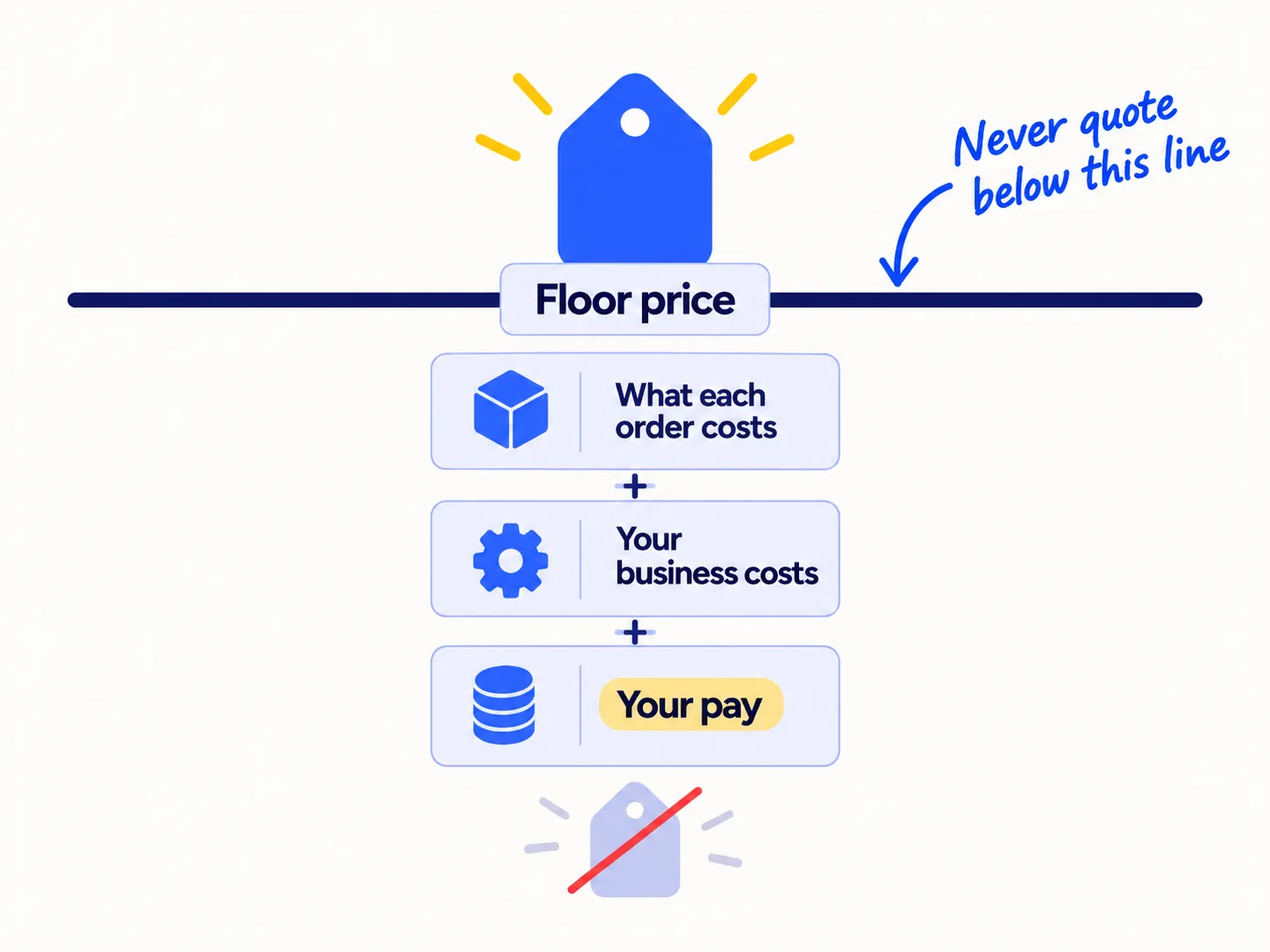
Open a Google Sheet and list every cost, with a real number from a bill, an invoice or your bank account. Do not guess. Then use the sum that fits what you sell.
- If you make or wholesale a product: add up everything one typical order costs you: materials, setup, printing or making, packing and delivery. Divide by the number of units. Then divide by 0.7. That leaves 30% of the price for your fixed costs and your pay. If you sell through a distributorsoon, ask what margin it needs first. Your price to the distributor must still be above your floor.
- If you sell a service, such as consulting or IT: add the pay you need for a year to your yearly business costs (software, insurance, travel, your accountant). Divide by 1,000. That is your floor per hour. Use 1,000 hours, about 20 a week, because selling, admin and gaps between jobs take the rest of your time. Most independent consultants bill about 1,000 to 1,400 hours a year.
- If you sell software through sales calls: each extra customer costs you little, so your floor is the cost of the setup, training and support hours in the first year. Set the real price from what it is worth (step 3). The SaaS pricing guide covers plans and trials.
Then do one more sum: your monthly fixed costs, including your pay, divided by the profit on one order or one project. That is how many sales you need each month. It tells you how much outreach and marketing money the price has to carry, and later how much you can spend to win each client (CAC and paybacksoon).
What one typical order or project costs me: $[X]
Units in it (boxes, hours, seats): [N]
Cost per unit: $[X ÷ N]
Floor per unit (product: cost ÷ 0.7; service: yearly pay + costs ÷ 1,000): $[floor]
My fixed costs a month, including my pay: $[F]
Profit on one typical order: $[P]
Sales I need a month: [F ÷ P]
- Tool: Google Sheets. Free.
- Time: 1 hour.
- You will have: one floor number per unit, and the number of sales you need a month.
- It worked if: every line has a number you could show on a bill or invoice, and your current price is above the floor. If it is below, you lose money on every sale; fix the price before you send another quote.
- Common mistake: leaving out your own pay, or the hours you spend on calls, samples and changes. A price that only covers materials pays for the work and nothing for you.
See it done: Carvelian's floor price
Carvelian Packaging is a made-up maker of custom printed boxes for small food and drink brands. One founder sells through calls, samples and quotes.
One typical order: 1,000 printed boxes
| Line | Amount |
|---|---|
| Setup and printing plates | $300 |
| Board, printing, cutting, packing, delivery | $1,700 ($1.70 a box) |
| Cost per box | $2.00 |
| Floor per box ($2.00 ÷ 0.7) | $2.86 |
| Price today | $3.00 a box ($3,000) |
| Profit on one order | $1,000 |
| Fixed costs a month, including his pay | $5,000 |
| Orders needed a month | 5 |
Why it works: It uses real costs from the last order, so the founder knows the lowest price he can say on a call.
2. Collect 20 prices your buyers pay today
Find out what your buyers pay now for the same job, from 20 real prices. This is your market range: the low price, the typical price and the high price.
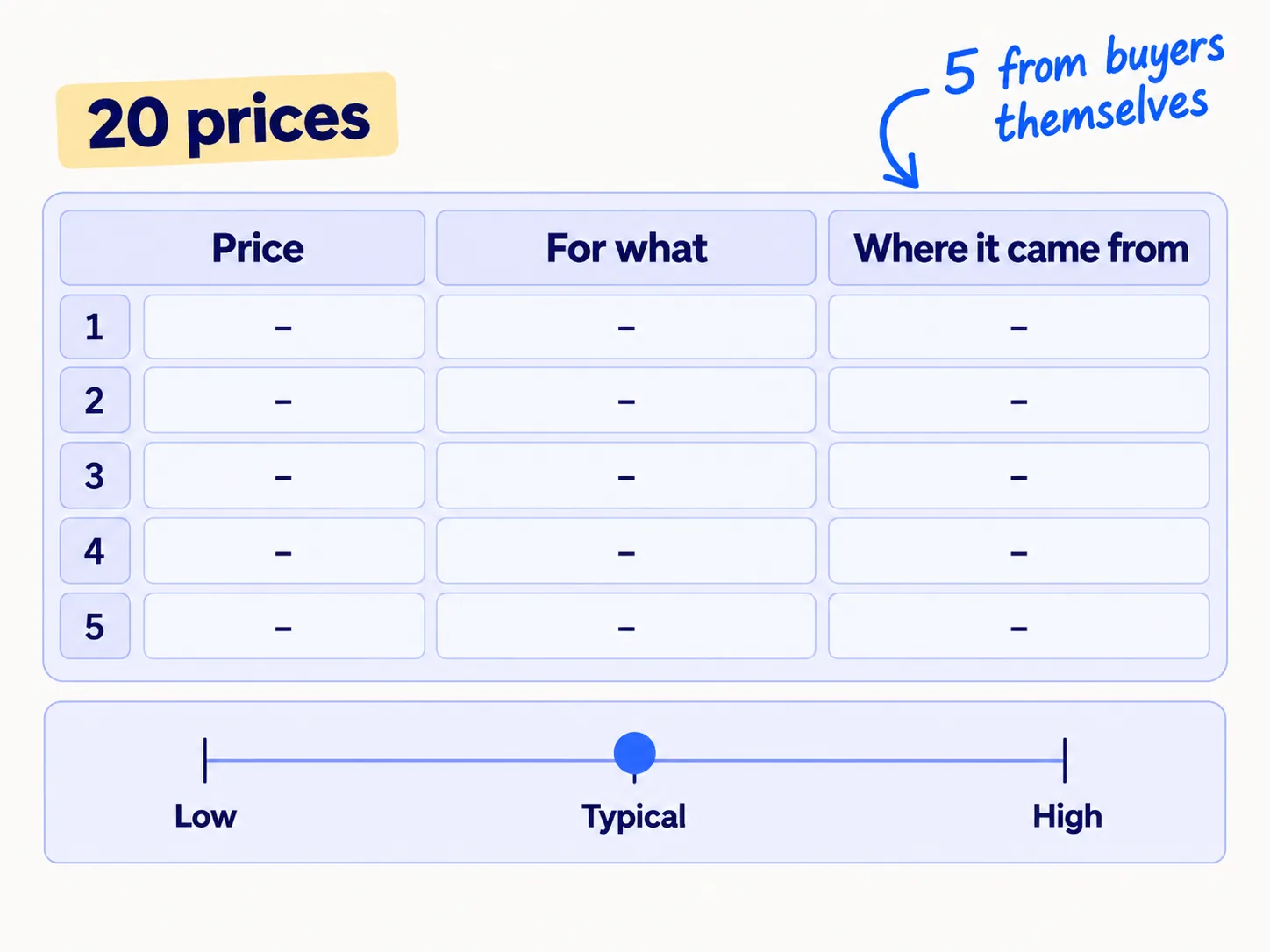
Get prices from three places:
- Buyers. At the end of every call, ask: "What did you pay last time for this, and for how much?" Buyers tell you more than you expect, because the question is about them. This is a normal customer interview question. Aim for at least 5 of your 20 prices from buyers.
- Competitors' websites. Many small suppliers show a "from" price, a price list or an online price calculator. Note the price for the same amount and the same job as yours. Your competitor analysis sheet can hold them.
- AI answers, as a lead only. Ask ChatGPT or Claudesoon: "What does [the job] usually cost for a [kind of company] of [size]?" Your buyers may be reading the same answersoon. In G2's March 2026 survey, 51% of software buyers said they now start their research in an AI chatbot more often than in Google. Check every number the AI gives you against a real price before you write it down.
Price | For what (amount, job) | Where it came from (buyer / website / calculator) | Date
Low: $[ ] · Typical (the middle price): $[ ] · High: $[ ]
- Tool: Google Sheets, and ChatGPT or Claude (free plans are enough).
- Time: 2 hours for the websites, then one question at the end of every call you already have.
- You will have: 20 prices, each with its source, and a low, typical and high price.
- It worked if: you have 20 prices for the same job as yours, and at least 5 came from buyers.
- Common mistake: comparing yourself only with big firms' list prices, or only with the cheapest seller online. Your buyers compare you with what they paid last time, so those prices count most.
3. Work out what your product or service is worth to the buyer
Ask buyers what the problem costs them each year, and turn their answers into one number: the value of your product or service to them in its first year. Your price should be no more than a third of it.
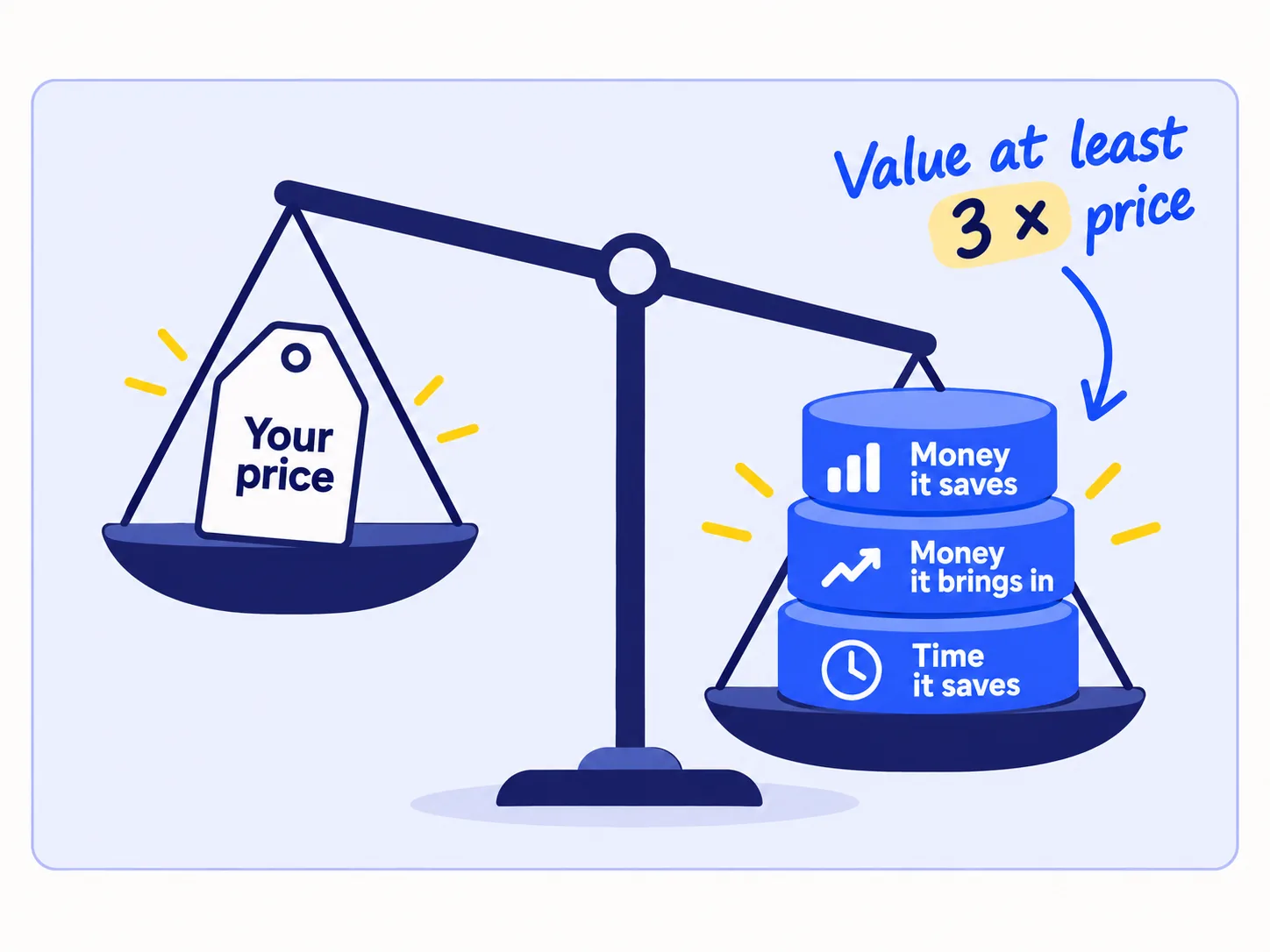
Ask 5 buyers, or your first clients, these questions. Use their numbers, not yours.
What does this problem cost you today, in money or in hours a month?
What do you use or pay for instead right now?
If it were fixed, what would you sell more of, or stop paying for?
How many times a year does this come up?
Add it up for one year: money saved, plus money brought in, plus hours saved times what an hour costs them. Then divide by your price. If the value is at least 3 times your price, you can defend it, and the value sentence becomes part of your value proposition. If it is less than 3 times, you are selling to the wrong buyer or selling too little, or the problem is not painful enough to pay for. Check your ideal customer profile before you change the price.
- Tool: your phone and a Google Sheet.
- Time: the last 5 minutes of 5 calls you already have, then 30 minutes to add it up.
- You will have: one value number for your main kind of buyer, in their own words.
- It worked if: at least 3 of the 5 buyers gave you a number, and the value is at least 3 times your price.
- Common mistake: writing the value yourself. A buyer believes their own numbers, and a price based on your guess falls apart on the first call.
See it done: What a printed box is worth to one buyer
A small hot-sauce brand, 1,000 gift sets a year
| What changes | A year |
|---|---|
| Shops pay $9 more for a gift set in a printed box | $9,000 |
| No more stickers and hand-packing, $0.80 a set | $800 |
| Value in the first year | $9,800 |
| 1,000 boxes at $3.00 | $3,000 |
| Value ÷ price | 3.3 |
Why it works: The buyer gave every number, so the value is hers, and the box price is about a third of it.
4. Set your B2B price and write it as three options
Pick your starting price with three rules, then write it as three options in one quote template and put a starting price on your website.
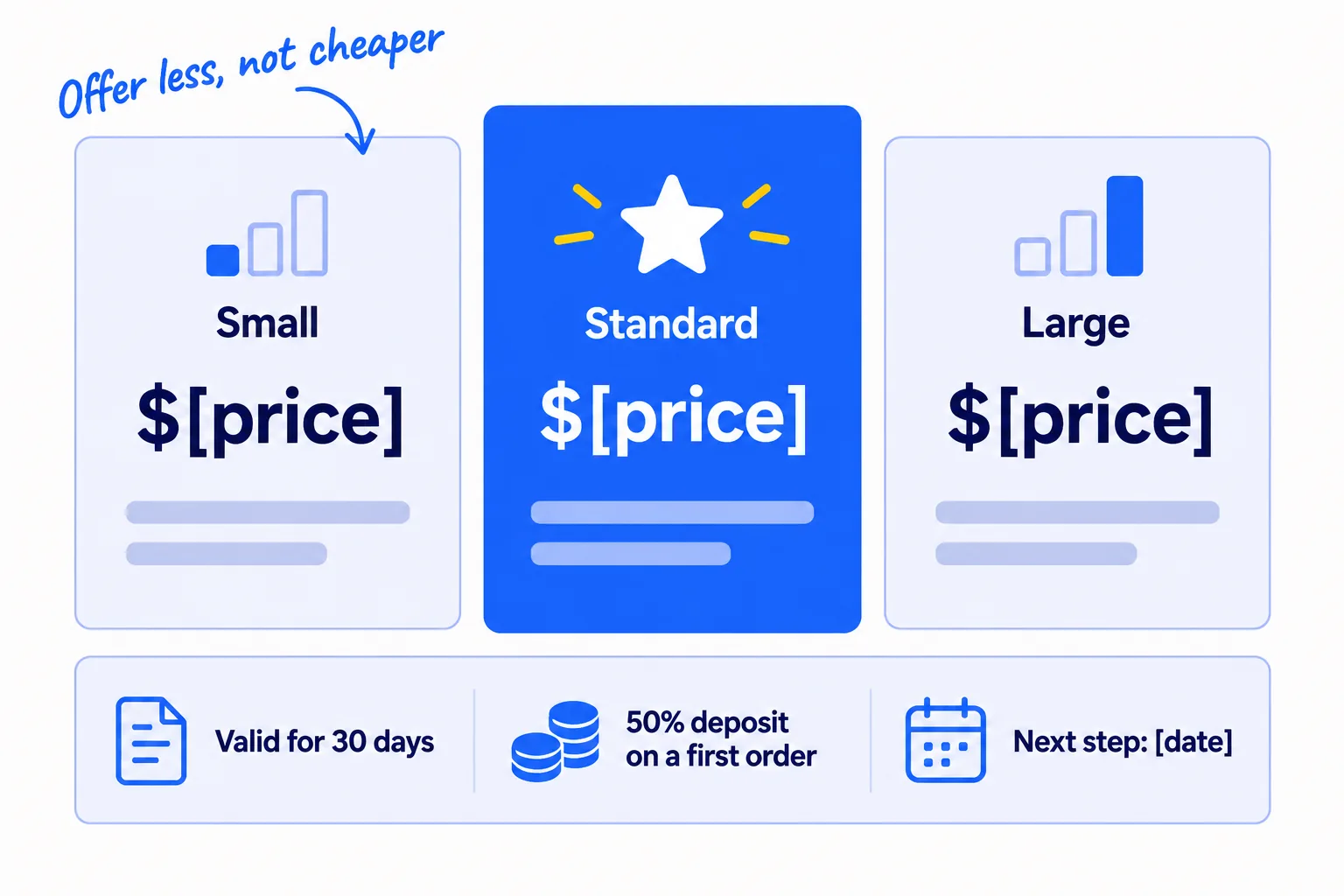
The three rules for your starting price:
- Never below your floor from step 1.
- At or above the typical price from step 2. Go under typical only if you sell less for it: a smaller amount, fewer changes, a longer wait.
- No more than a third of the value from step 3.
Pick a price between rule 2 and rule 3. If you have two happy clients and a result you can show, pick the top of that gap. If you have nothing to show yet, pick the typical price and add proof as you get it: a case studysoon, testimonialssoon or, for a service firm, reviews on Clutchsoon.
Then write three options. The middle one is the price you want most buyers to take. The small one gives a buyer who says "too much" a way to say yes without a discount.
- If you make or wholesale a product: three amounts with a price per unit for each, such as 500, 1,000 and 2,500 units. Check each one against its own floor, because setup costs weigh more on a small order.
- If you sell a service: three fixed-price packages, such as a check, a project and a monthly retainer. Buyers compare a fixed price more easily than an hourly rate, and you keep the gain when you work fast.
- If you sell software through sales calls: three plans by number of users or sites, with a yearly contract, and setup as a separate line.
Subject: [Their company]: [what you will do], [amount]Hi [first name],Thanks for the call. Here is what we talked about: [their problem, in their words].Option 1, [small]: [what is in it], $[price]
Option 2, [standard]: [what is in it], $[price]  ← what I would pick for you, because [one reason from the call]
Option 3, [large]: [what is in it], $[price]Payment: 50% when you say yes, the rest on delivery. [For repeat clients: within 30 days of the invoice.]
This price is good for 30 days, until [date].Next step: reply "Option 2" and I will send the invoice and book [the start / the print date].[Your name], [company], [phone]
Put a 30-day limit on every quote, and check your costs again before each new one. Costs can move fast: in the US, import tariffs changed several times in 2026, starting with the Supreme Court's ruling on 20 February 2026 that struck down one set of them.
Ask for a deposit on every first order. A new client has no history with you, and a deposit also shows they are serious. If your buyers are in the UK: a bill announced in May 2026 would limit payment terms between businesses to 60 days. It is not law yet, so write your own terms into every quote.
Then put a starting price on your website, next to your headlinesoon: "From $[X]" or "Orders from [N] units at $[X] each". It lets the right buyers contact you and puts off the wrong ones. In TrustRadius' 2025 survey of 2,058 technology buyers, 49% said missing prices were the one thing they would most like vendors to change. The pricing page guidesoon shows how to lay it out, and your homepagesoon should show the "from" price near the top. For big buyers who send a formal RFPsoon, use the same three prices in their form.
If your first clients paid a friends' price: keep it for their next order, and tell them now when it will change: "From [date], the price for new orders is $[X]." Give them at least 30 days. The price rise guidesoon has the message.
- Tool: Google Docs for the quote template, and your site editor.
- Time: 1 hour for the template, 30 minutes for the website.
- You will have: a starting price, three options, a quote template, and a "from" price live on your site.
- It worked if: each option is above its own floor, and a stranger can find your starting price on your website in 5 seconds.
- Common mistake: giving a discount on the one option you have. Offer the small option instead. A discount teaches buyers that your first price is not your real price.
See it done: Carvelian's three options
Custom printed boxes, three amounts
| Option | Boxes | Price a box | Order total | Floor a box |
|---|---|---|---|---|
| Small | 500 | $3.90 | $1,950 | $3.29 |
| Standard | 1,000 | $3.20 | $3,200 | $2.86 |
| Large | 2,500 | $2.70 | $6,750 | $2.60 |
The typical price from his 20 prices was $3.10 a box, and a third of the value was $3.27. So Standard goes from $3.00 to $3.20.
Why it works: Each option clears its own floor, and the middle one sits between the typical price and a third of the value.
5. Say your price on every call and send every quote the same day
Say a price range on the first call with every buyer, then send the written quote the same day. A buyer who hears the price first in a long proposal a week later is the one who goes quiet.
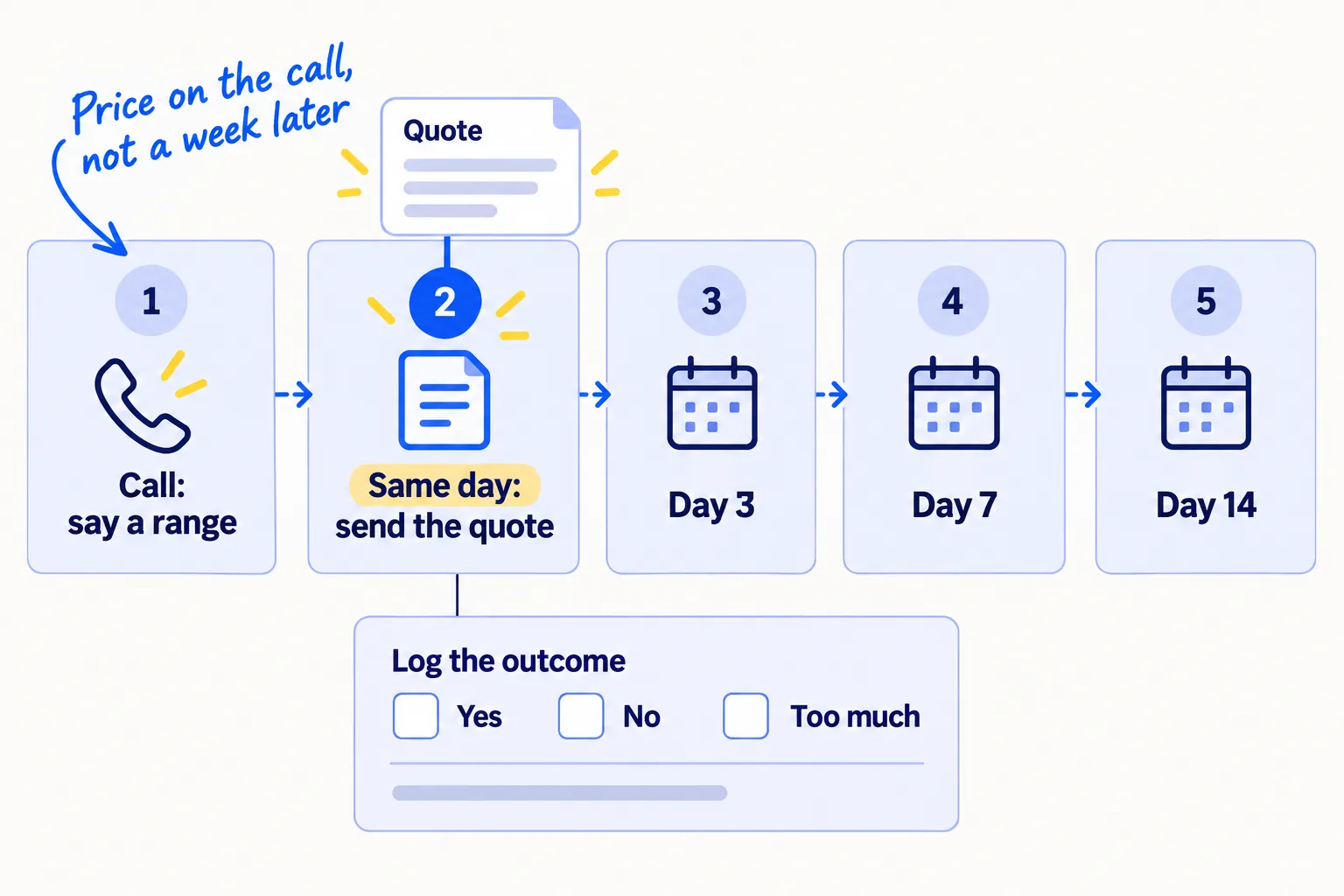
On the discovery callsoon, once you know what they need, say the range out loud: "Most orders like yours are between $[low] and $[high]. Does that fit what you had in mind?" If they say no, you have saved a week. If they say yes, the quote holds no surprise.
Send the quote from step 4 the same day. AI makes that possible: paste your call notes and the template into ChatGPT or Claude and ask for a first draft. Check every number and every promise yourself, then send it. That takes about 20 minutes.
Follow upsoon on day 3, day 7 and day 14 in the same email thread, and log every quote. When a buyer says "too much", ask one question before you answer: "Too much compared with what?" Their answer tells you whether to offer the small option or to explain the value from step 3.
Quotes only come from conversations. Keep up your daily outreach: 100 personal messagessoon a day by email or LinkedInsoon to people on your lead listsoon, plus introductions from referral partnerssoon and meetings at trade showssoon. Book every call you can. At a few calls a day, 20 quotes come in weeks, not months. If your deals need a demosoon or a sales decksoon, say the range there too.
Date | Company | Buyer | Option quoted | Price | Range said on the call? (yes / no) | Follow-ups sent | Result (won / lost / no answer) | Reason, in their words
- Tool: Gmail, ChatGPT or Claude for the first draft, and your Google Sheet. A CRMsoon can wait until the sheet gets slow.
- Time: about 20 minutes a quote, plus 5 minutes a day for follow-ups.
- You will have: every quote sent within 24 hours of the call, each with a result and a reason in the log.
- It worked if: every quote went out within 24 hours, and every one has a result by day 14.
- Common mistake: hiding the price until a long proposal, then waiting for the buyer to reply. Say the range on the call, and follow up 3 times. Big companies with many people in the decision take longer, and enterprise dealssoon need the range said to each of them.
See it done: Carvelian's quote
To: Priya, founder of a small hot-sauce brand
Subject: Pepperwick: printed gift-set boxes, 3 options
Hi Priya,
Thanks for the call. Here is what we talked about: your gift sets go out in plain boxes with stickers, and two shops asked for something that looks ready for a shelf.
Option 1: 500 printed boxes, $3.90 each, $1,950 Option 2: 1,000 printed boxes, $3.20 each, $3,200. This is what I would pick for you, because it covers the 1,000 gift sets you plan for the year. Option 3: 2,500 printed boxes, $2.70 each, $6,750
Payment: 50% when you say yes, the rest on delivery. This price is good for 30 days, until 26 October.
Next step: reply "Option 2" and I will send the invoice and book your print date.
Dan, Carvelian Packaging, [phone]
Why it works: It repeats her problem in her words, gives three options with one picked for her, and ends with one easy next step.
6. Count quotes and wins every Sunday and change the price after 20 quotes
Every Sunday, count your quotes, wins and losses, with the reason for each. Change the price only after 20 quotes, using the rules below. One lost deal tells you nothing.
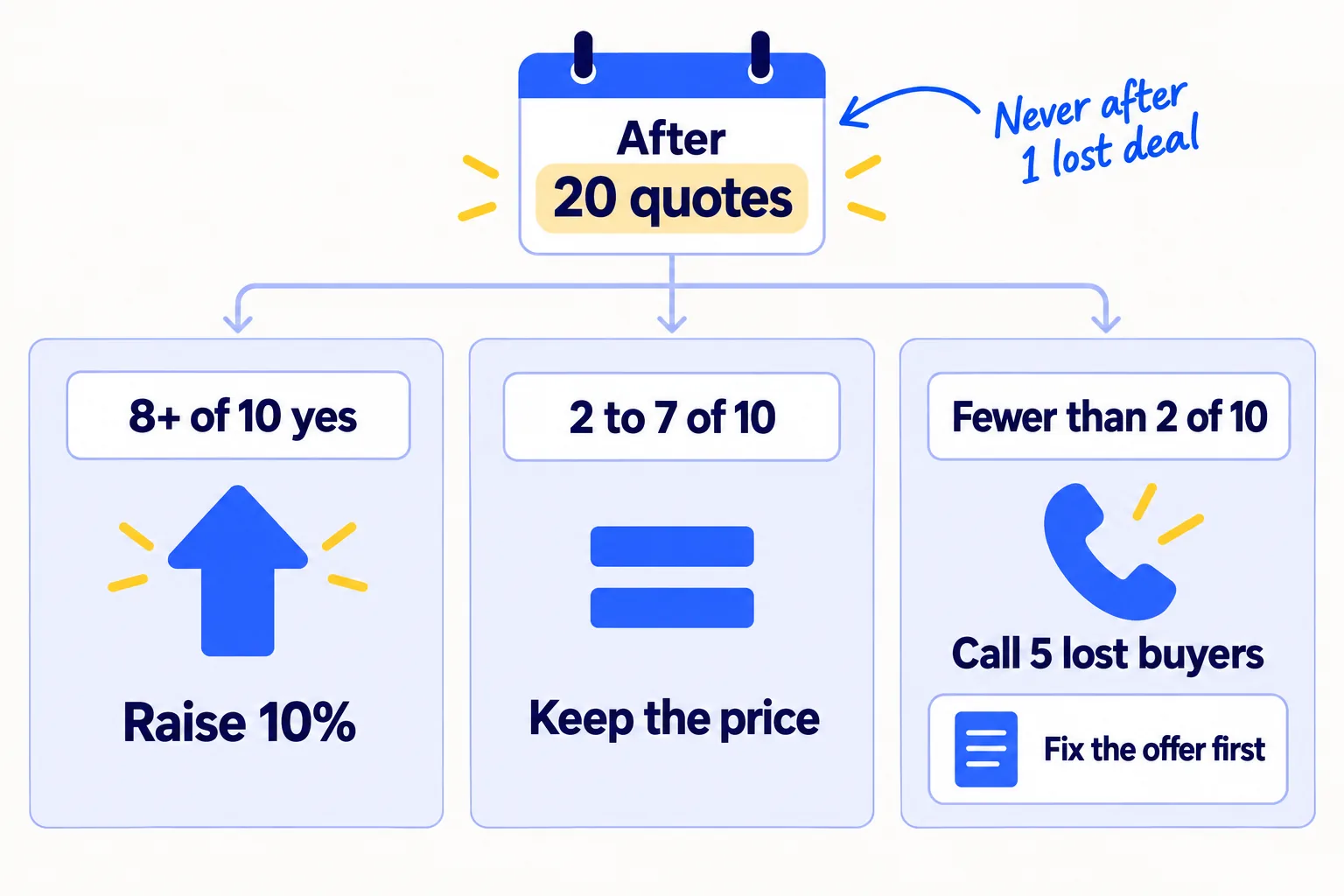
Count a quote as lost if there is still no answer after the day-14 follow-up, and keep those buyers in touch with an occasional useful emailsoon. Then, after every 20 quotes, divide wins by quotes and use these rules:
- 8 or more in 10 said yes, and nobody said "too much": your price is too low. Raise it 10% for the next 20 quotes. Existing clients keep their price until you tell them, with 30 days' notice.
- 2 to 7 in 10 said yes: keep the price. Put your time into getting more calls with the right buyers.
- Fewer than 2 in 10 said yes: do not cut the price yet. Call 5 buyers who said no and ask: "What did you choose instead, and what did it cost?" If most chose something cheaper and smaller, add a smaller option. If most chose to wait or do nothing, the problem is the offer or the buyer, not the price. Go back to why nobody is buying. Cut the price only if 3 of the 5 name a lower price for the same thing, and never below your floor.
Week | Quotes sent | Won | Lost | No answer after day 14 | Said "too much" | Won ÷ quotes (after 20) | Decision
Add these columns to the sheet you already keep for your channels, so you can see which channel brought each dealsoon and at what price. Once a month, look at price, wins and orders together in your monthly reviewsoon.
- Tool: Google Sheets.
- Time: 20 minutes each Sunday, plus about an hour for 5 calls when rule 3 applies.
- You will have: one row a week, and a written price decision after every 20 quotes.
- It worked if: every quote has a result and a reason, and each price change points to one of the three rules.
- Common mistake: cutting the price after one or two lost deals, or raising it for clients who already agreed a price without telling them first.
See it done: Carvelian after 20 quotes
The first 20 quotes at $3.20 a box
| Quotes sent | Won | Lost | No answer after day 14 | Said "too much" | Won ÷ quotes |
|---|---|---|---|---|---|
| 20 | 3 | 5 | 12 | 1 | 3 in 20 |
The decision: 3 in 20 is fewer than 2 in 10, so the founder calls 5 lost buyers. Four say 1,000 boxes is too many for a first run. So he adds a 300-box option at $4.60 a box, above its $3.86 floor, and keeps Standard at $3.20.
Why it works: Only 1 lost buyer named the price, so the founder changes the offer and keeps the price.
Your B2B pricing checklist for your next 20 quotes
0 of 16 done
Work through this list with an AI assistant
It drafts the work and keeps track of what is done.
Frequently asked questions
- Should I put prices on my B2B website?
Yes, a starting price: "from $1,500" or "orders from 500 units at $3.90 each". It lets the right buyers contact you and saves you calls with the wrong ones. If every job is custom, show a typical range from your last few jobs. Keep the exact quote for after the call. The pricing page guidesoon shows the layout.
- Should I charge by the hour or a fixed price?
Work out your hourly floor first, then quote a fixed price for a clear piece of work. Buyers compare fixed prices more easily, and you keep the gain when you work fast. Charge by the hour only when nobody can say how big the job is. Then give an estimate and a cap. A proposalsoon should say what is in the price and what is not.
- Why do buyers go quiet after I send a quote?
Usually because they heard the price for the first time in the quote, or the quote had no next step. Say a range on the first call, send the quote the same day, end it with one easy next step, and follow up on day 3, 7 and 14. If they still go quiet, ask one short question: "Should I close this for now?"
- Should I give my first clients a discount?
Offer less, not cheaper: a smaller amount or a shorter first project at your real price. If you already gave a friends' price, keep it for the next order and tell them the date it changes. A discount with no end date becomes your price. It is also what those clients will tell others you charge.
- How do I price my product for distributors?
Ask the distributor what margin it needs and what the final price to its customers will be. Your price to the distributor must still be above your floor. If it is not, you need a lower cost, a bigger order or a different distributor. Work this out before your first distributorsoon call, not during it.
Sources
- 1.New G2 Research: Half of B2B Software Buyers Now Start Their Research With AI Chatbots — G2, via PR Newswire, 15 April 2026
- 2.Bridging the Trust Gap: TrustRadius Releases Its Ninth Annual Buyer Research Report — TrustRadius, via PR Newswire, 8 April 2025
- 3.Supreme Court Strikes Down IEEPA Tariffs: What Importers Need to Know Now — Holland & Knight, February 2026
- 4.Supreme Court Rules Against Tariffs Imposed Under the International Emergency Economic Powers Act (IEEPA) — Congressional Research Service, checked 26 September 2026
- 5.US Trade Court Strikes Down Section 122 Tariffs, but Ruling's Fate Is Uncertain and Practical Impact Is Limited — Skadden, May 2026
- 6.UK government ploughs ahead with late payments Bill — ICAEW, May 2026
- 7.Average billable hours for consultants — Everhour, checked 26 September 2026
Next article to read
Related guides
- How to design a pricing pageComing soon
- How to raise prices without losing customersComing soon
- How to sell to enterprise clientsComing soon
- How to run a discovery callComing soon
Guides that link here
- How much to spend on marketing as a B2B companyB2B
- How to get clients for a consulting business without referralsB2B
- How to get customers online for free
- How to get your first B2B clientsB2B
- Why no one is buying your product, and how to fix it
- How to create an ideal customer profile
- How to do a competitor analysis
- How to do customer interviews
- How to price a SaaS productSaaS
- How to validate a business idea without spending money
Cite this page
Dinesh Bypilla (2026). How to price a B2B product or service. Scout7 Academy. https://scout7.ai/academy/marketing-plan/how-to-price-a-b2b-product-or-service
Written by Dinesh Bypilla, Agentic systems engineer at Scout7. Reviewed by Murali Sid. Last checked 26 September 2026.
Quote any part of this guide with a link back to this page. © 2026 Scout7.
Markdown version of this page: https://scout7.ai/academy/marketing-plan/how-to-price-a-b2b-product-or-service.md