



How to choose marketing channels for an agency
Choose marketing channels for your agency: ask your clients where they looked, test 3 places for 4 weeks at full volume next to your outreach, then double the one with the most calls per 10 hours.
ByDinesh BypillaReviewed byMurali SidLast checked 20 min read
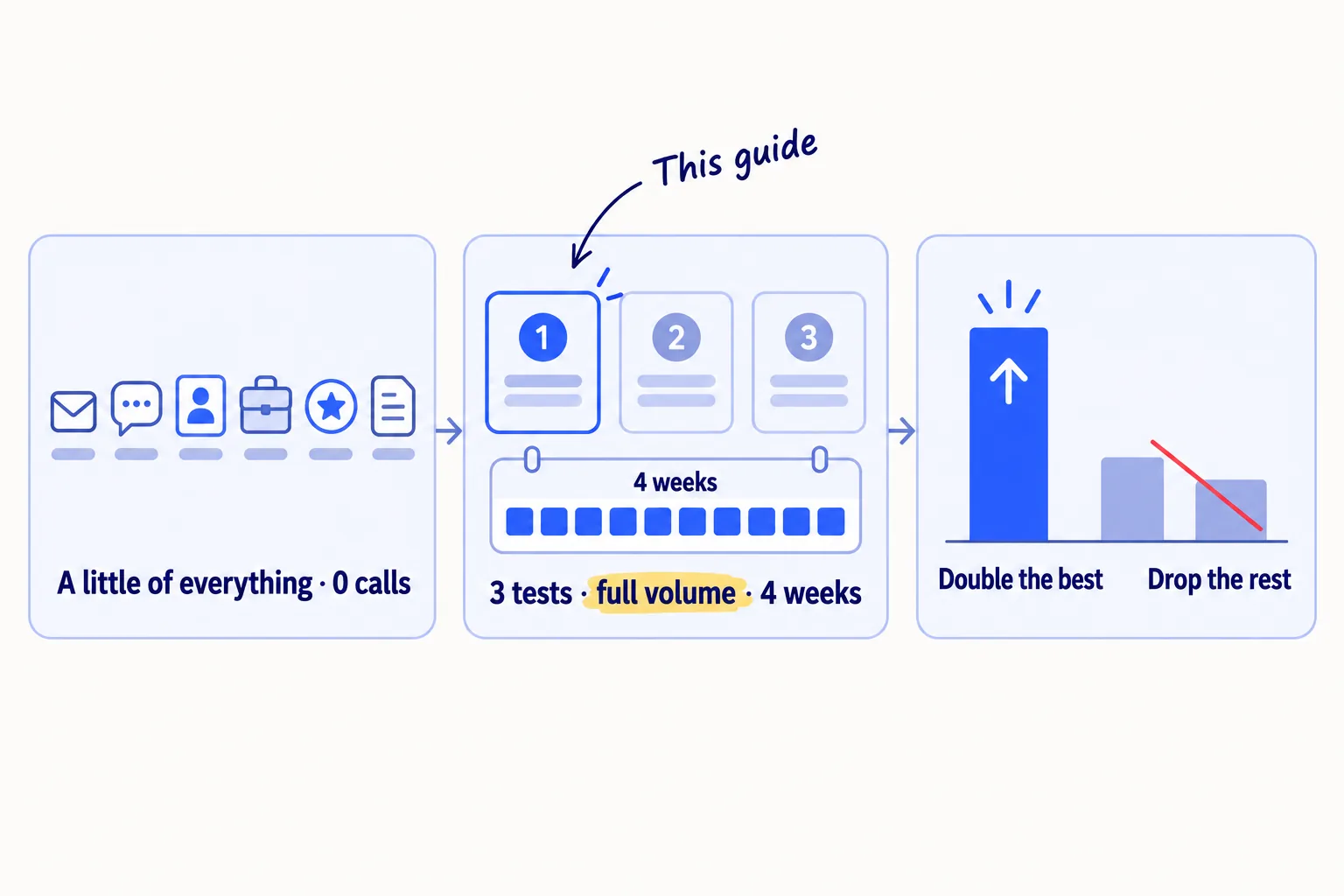
You have one or two clients, and you have tried a bit of cold email, some LinkedIn posts, maybe an Upwork profile, but you cannot say where the next client will come from. Here is how to choose marketing channels for an agency: ask your clients where they looked, test three places at full volume for 4 weeks next to your daily outreach, then put your hours into what brings calls. If you keep doing a little of each, every channel will look like it failed. None of them got enough work to show a result, and in 2026 inboxes are full of agencies saying the same thing.
Do these three things
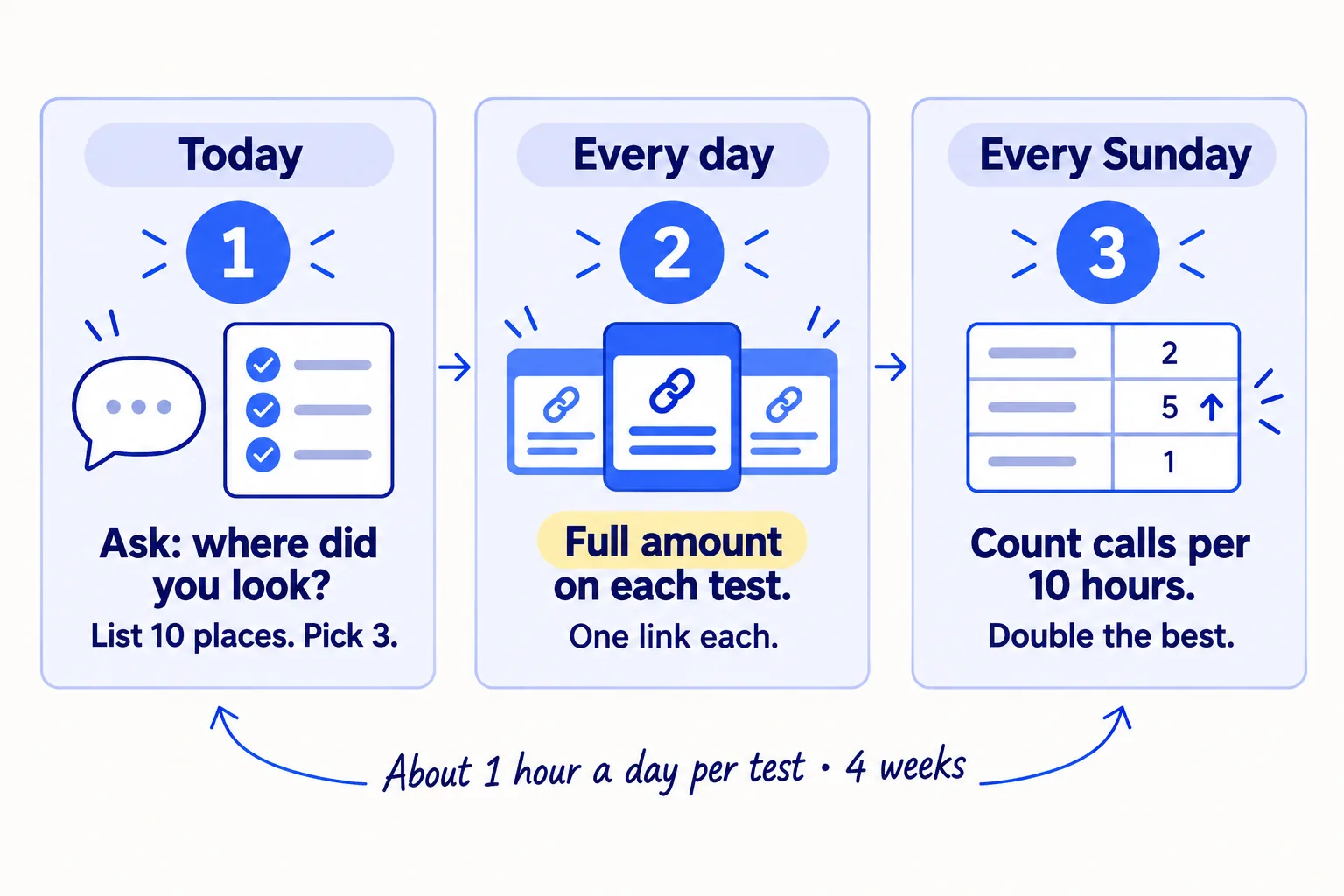
About 1 hour a day for each test, on top of your daily outreach and client work. Judge most tests after 4 weeks at full volume, and search pages at month 3.
Show the three actions in fullHide the full list
- Today: ask each of your clients where they looked for help before they hired you. Then list 10 exact places where your kind of clientsoon already looks for help, and pick 3 to test next to your daily outreachsoon.
- Every day: do each test at its full amount, such as 20 answers across 5 communitiessoon or 2 LinkedIn postssoon, next to 100 personal messages. Give each test its own tracking linksoon.
- Every Sunday: for each channel, count calls with your kind of clientsoon for every 10 hours you spent. When a test reaches its full amount, double the best one and drop any that brought fewer than 3 calls.
Get help doing these
ChatGPT or Claude reads this guide and works through it with you.
1. Ask your clients where they looked, then list 10 places your clients look for help
The best marketing channel for your agency is the place your next client is already looking for help, so start by asking the clients you have. Then write down 10 exact places, each with a number that proves your kind of client is there. A place is something you can open in a browser, like one Slack group, one subreddit or one search phrase. "Social media" is not a place.
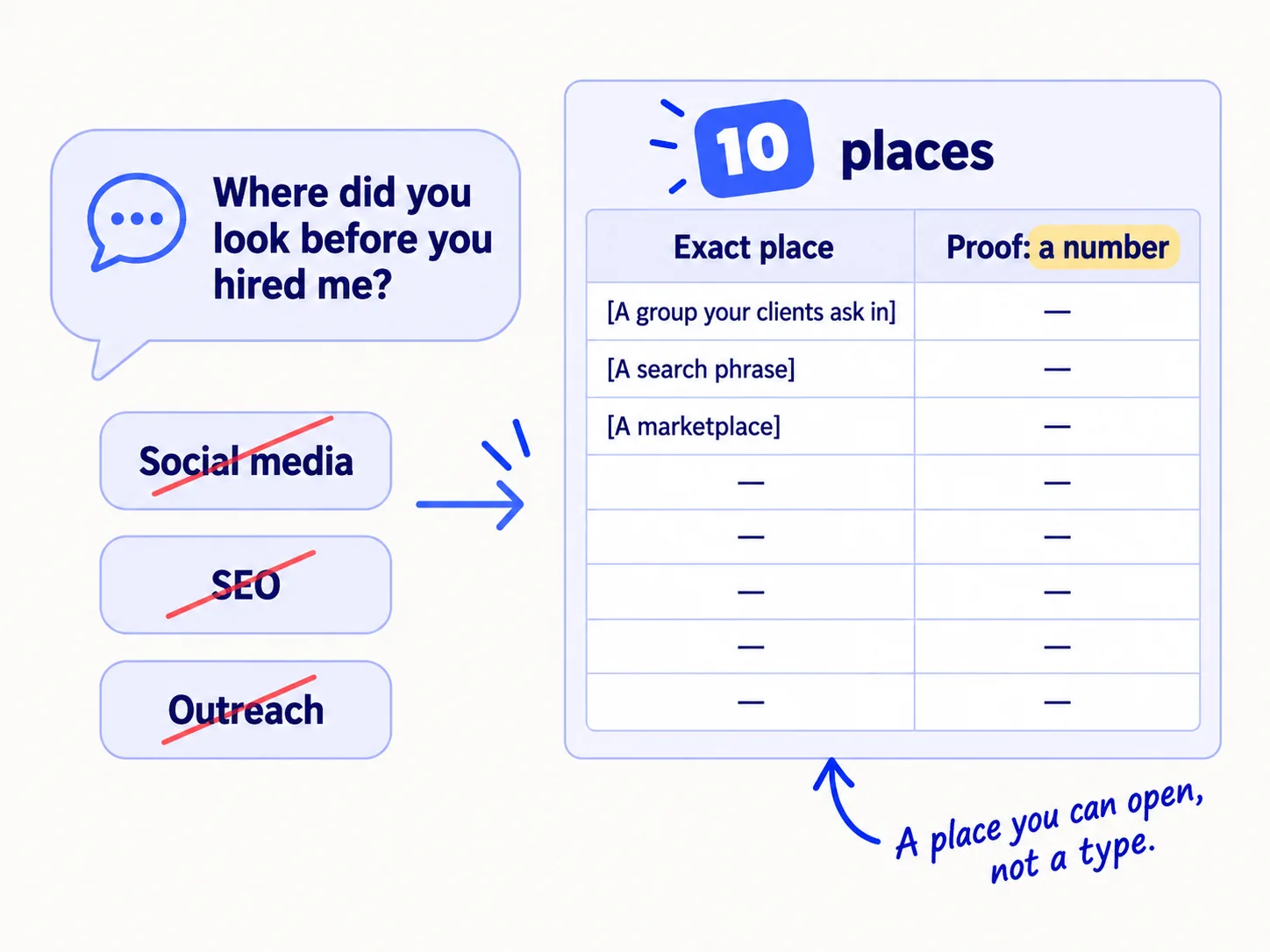
First, message each client and ask one question. Add the same question to the end of every discovery call from now on. Their answers go on the list first.
Quick question for my notes: before you hired me, where did you look for help with your marketing? Who did you ask, what did you search, and what else did you try?
Then fill the rest of the 10 rows from these kinds of places, one exact place per row. Your step 1 sentence from How to market your marketing agency says who your kind of client is. If you do not have it yet, write it first.
- Introductions: your clients, and partners who sell something else to the same clientssoon. Promethean Research's August 2026 survey of 91 agency leaders found that client referrals and growing current accounts were rated the most effective ways to win work, and that the top-scoring tactics all run on relationships, not reach.
- One-to-one messages: email and LinkedIn messages to owners who fit, the channel you run every day. Proof is the number of names you can find in an hour with a free lead listsoon.
- Communities: Slack groups, subredditssoon, Facebook groupssoon and forums where your kind of client asks for marketing help. Search each one for their problem, and count the posts from the last 30 days.
- Posts from your own LinkedIn profile, written for owners, not for other marketers. Proof is how many of your connections are your kind of client.
- Freelance marketplaces: Upworksoon and others. Search the jobs for your service and your kind of client, and count those posted in the last 7 days.
- Agency directories: a free profile on Clutchsoon.
- Search and AI answers: Promethean found that prospects now use AI tools to research and shortlist agencies. Ask ChatGPT "who can help [your kind of client] with [your result]?" and note who it names; that is how brands get mentioned by ChatGPTsoon today. Then check the phrase in Google's suggestions and a free keyword toolsoon for monthly searches.
- People who already reach your clients: a podcastsoon, a newsletter, or an eventsoon your kind of client goes to.
- Paid: ads, sponsorships and paid listings. They go on the list now and wait for step 6.
Exact place | Kind | Proof your clients are there (a number) | First call expected in | Full amount a day | Decision
- Tool: Google Sheets, the search box on each site, Google and LinkedIn search. All free.
- Time: 1 hour, plus waiting for your clients' replies.
- You will have: 10 rows, each with an exact place and a number.
- It worked if: every row is a place you could open in a browser today, with a number next to it: posts in the last 30 days, jobs in the last 7 days, monthly searches, or names you can list.
- Common mistake: copying a list of "19 marketing channels". Those lists are written for businesses choosing channels for their own customers, with a team and a budget. They are not about how a one-person agency finds clients.
See it done: What Quillfox's two clients said
Quillfox is a made-up one-person agency. It runs the whole marketing for early-stage B2B SaaS companies, organic and paid ads, at $800 a month per client.
Jess, who runs Quillfox, asked both SaaS clients the question.
Where the clients looked
| Client | Where they looked first | How they found Quillfox |
|---|---|---|
| Client 1, a 4-person SaaS | Asked in a Slack group for early SaaS founders: "anyone know a marketer for a tiny B2B SaaS?" | Another founder in the group named Jess |
| Client 2, a 9-person SaaS | Searched LinkedIn for "SaaS marketing" | Had seen Jess's comment on a founder's post the week before |
Why it works: Both answers name an exact place, so they go on the list first, with proof already attached.
2. Pick 3 channels to test with three yes-or-no questions
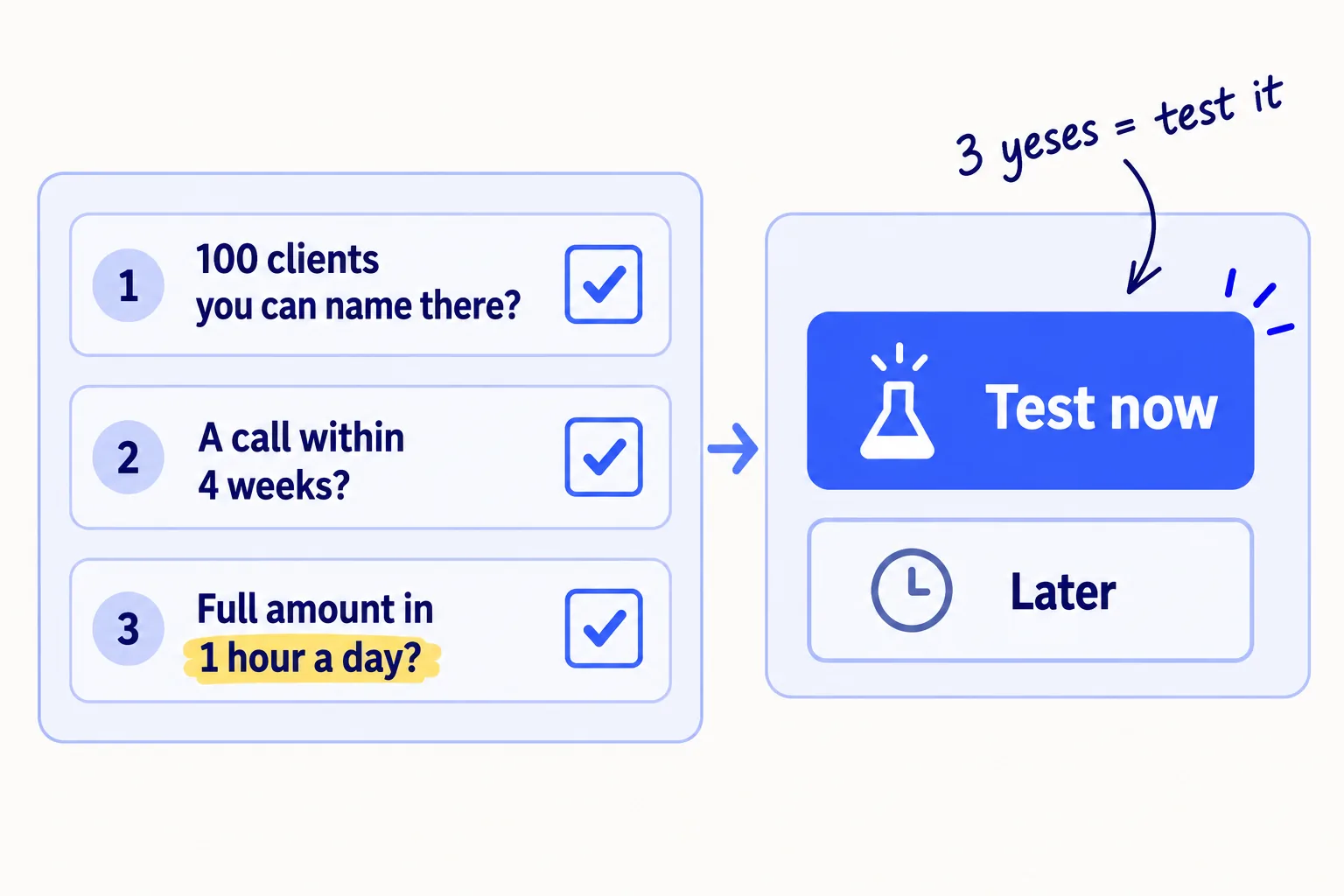
Ask three yes-or-no questions about each place, and test the ones that get three yeses. Keep your daily outreach and your introductions going while you test. They are your base, and most agencies still win most new clients through people.
First, count your hours. Write down how many hours a day you really have for your own marketing next to client work. Take away about 2 hours for your 100 daily messages. Each test needs about 1 hour a day, so what is left is how many channels you can test at once. With 5 hours, you test 3. More tests at once means you find your best channel sooner. If client work leaves you less, find more hours in your week before you cut the number of tests.
Then ask the three questions about every row:
- Can you point to your kind of client there? Yes if you can name 100 of them, or find 10 posts from them asking for help in the last 30 days, or 10 jobs posted in the last 7 days.
- Could it bring a call within 4 weeks at its full amount? Communities, messages, partners, marketplaces and posts usually can. Search pages and directory profiles usually cannot.
- Can you do its full amount in about 1 hour a day, for under $150 in total? The full amounts are in step 3.
Then decide:
- No to question 1: cross it out. The other two do not matter if your clients are not there.
- Three yeses: test it now. If more rows pass than you have hours for, take the ones with the biggest numbers.
- Yes to 1 and 3, no to 2: start it now only if it is search pages or a free directory profile, and judge it at month 3soon.
- It needs more than $150: it waits for step 6.
Testing a few channels side by side, instead of one after another, comes from the Bullseye method in the 2015 book Traction. You learn from all of them in the same 4 weeks.
- Tool: your sheet from step 1.
- Time: 30 minutes.
- You will have: 3 channels to test, your base channels to keep, and a "later" list.
- It worked if: each test has three yeses and an exact place.
- Common mistake: picking the place you enjoy instead of the place your clients are. General marketing tips get likes from other marketers. In Promethean's survey, social media content was rated 2.0 out of 5, one of the lowest scores, even though 41% of agency leaders spend time on it.
See it done: Quillfox's scored list
Jess has about 5 hours a day for her own marketing next to client work. Her 100 daily messages take 2, so she has room for 3 tests.
The channel list, scored
| Place | Clients you can name there? | A call within 4 weeks? | Full amount in 1 hour a day, under $150? | Decision |
|---|---|---|---|---|
| Personal messages to SaaS founders | Yes: 400 names found | Yes | Takes 2 hours a day | Keep: base channel |
| Introductions from clients and 2 dev studios | Yes | Yes | Yes | Keep: base channel |
| 5 SaaS founder communities, starting with the Slack group | Yes: 14 posts asking for marketing help in 30 days | Yes | Yes | Test now |
| 2 LinkedIn posts a day from Jess's profile | Yes: 1 client came from LinkedIn | Yes | Yes | Test now |
| Upwork jobs for SaaS marketing | Yes: 22 jobs in the last 7 days | Yes | Yes, with a $150 cap on Connects | Test now |
| Free Clutch profile | Yes | No | Yes | Set up once, judge at month 3 |
| Podcasts for early SaaS founders | Yes | Yes | No hours left | Later |
| Pages on her site for SaaS marketing questions | Yes | No | No hours left | Later |
| Sponsoring a SaaS founders' newsletter | Yes | Yes | Needs more than $150 | Later: step 6 |
| Posts on X | No: her followers are other marketers | Crossed out |
Why it works: Every test has proof that SaaS founders are there, and Jess has the hours to run each one at full volume.
3. Set a fair test for each channel: a daily amount, a pass mark and a stop line
Before you start, write down for each test how much you will do every day, when you will judge it, and what counts as a pass. If you set the pass mark after the test, you will talk yourself into keeping what you enjoyed.
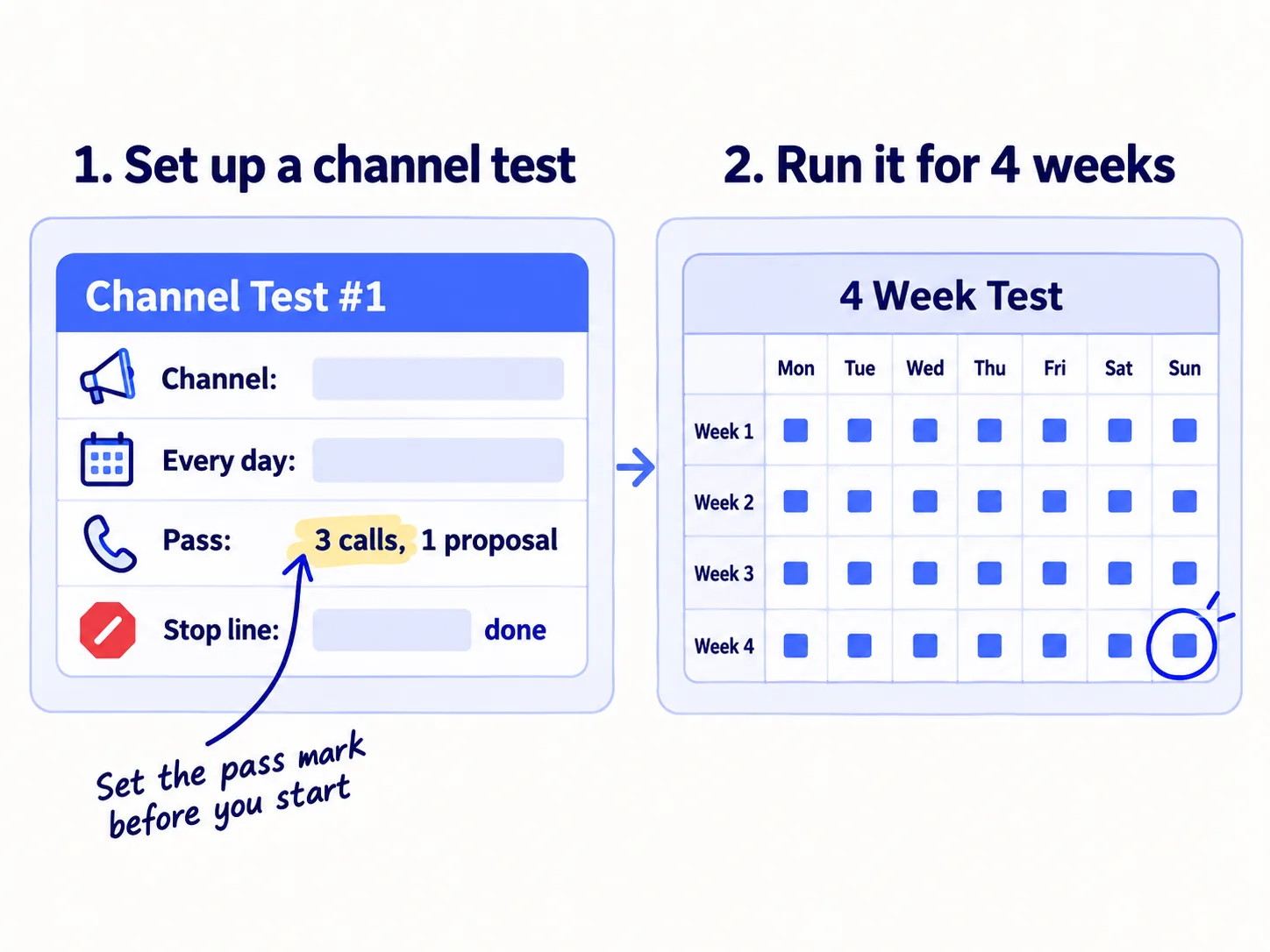
Use this table for the full amount. Less than this, and a zero tells you nothing.
| If the channel is… | a fair test is… | and you judge it after… |
|---|---|---|
| one-to-one messagessoon to your kind of client | 100 a day, each with one true line about the person, plus follow-upssoon | 2,800 messages (4 weeks) |
| answers in communities where your clients ask for help | 20 a day, across at least 5 places | 560 answers (4 weeks) |
| posts from your own LinkedIn profilesoon | 2 a day | 56 posts (4 weeks) |
| messages to partnerssoon who serve the same clients | 20 a day | 560 messages (4 weeks) |
| proposals on Upwork | 3 a day, on jobs posted in the last 24 hours | 84 proposals (4 weeks) |
| pitches to podcastssoon and newsletters your clients follow | 10 a day | 280 pitches (4 weeks) |
| a free Clutch profile | set up once, then a review requestsoon to every client | month 3 |
| pages on your sitesoon that answer your clients' questions | 1 a day | month 3 |
Use one pass mark for every 4-week test: at least 3 calls with your kind of client from this channel, and at least 1 proposalsoon sent. Put the stop date in your calendar.
Let AI do the drafting, so the amounts fit in an hour. For community answers, ChatGPT or Claude can find the questions and list the points to cover. You write the answer in your own words, from what you know, about 3 minutes each. For posts, AI turns a note about a real fix you made into a draft, and you add the numbers and the one line only you know, about 25 minutes a post. For Upwork, AI drafts the first two lines from the job post, and you check them against the client's words, about 15 minutes a proposal. This is how ChatGPT helps with marketingsoon: it drafts, you add what is true.
Know the limits before you start, and spread the volume instead of cutting it:
- Communities: read each place's rules on self-promotion first. 20 answers spread over 5 places keeps you inside each one's rules; 20 in one place in a day looks like spam. No link unless someone asks.
- LinkedIn: LinkedIn limits how many connection invitations you can send, and when you hit the limit you wait a week before you can send more. So message people on LinkedInsoon who have already accepted, and send the rest of your 100 by email.
- Email: Gmail requires every sender to have SPF or DKIM set up and a spam rate below 0.3%, and since November 2025 it rejects more mail that breaks these rules. If you email more than about 50 strangers a day, set up a second domain and warm it upsoon first.
- Upwork: each proposal costs Connects, and the job shows how many next to "Submit a Proposal". Connects cost $0.15 each. The free Basic plan gives 10 a month, which will not cover a fair test. Freelancer Plus is $19.99 a month with 100 Connects, and you can buy more. Set a cap before you start, such as $150, and stop when it is spent. Upwork also takes a service fee of 0% to 15% of what you earn, shown before you submit.
Channel: [exact place]Every day: [full amount, from the table]Time a day: [about 1 hour]Link: [its own link, from step 4]Pass: at least 3 calls with my kind of client, and at least 1 proposal sentStop line: [the full amount, and the date it will be done]Money cap: [$0, or up to $150]
- Tool: Google Sheets and your calendar.
- Time: 20 minutes.
- You will have: one card for each test, and a stop date in your calendar.
- It worked if: a friend could read each card and know exactly what to do every day and when it ends.
- Common mistake: stopping early. Agency owners on Reddit this year report "35–40 cold emails a day and getting nowhere", or three months of email with almost nothing back. That is a test at a third of the amount, run for too long. The other mistake is changing three things halfway through. Change nothing until the stop line.
See it done: Quillfox's three test cards
Tests for the next 4 weeks
| Test | Every day | Time a day | Pass mark | Stop line | Money cap |
|---|---|---|---|---|---|
| 5 SaaS founder communities | 20 answers, 4 in each place | 1 hour | 3 calls, 1 proposal | 560 answers | $0 |
| LinkedIn posts from Jess's profile | 2 posts about a real fix for a SaaS client | 1 hour | 3 calls, 1 proposal | 56 posts | $0 |
| Upwork jobs for SaaS marketing | 3 proposals on jobs from the last 24 hours | 45 minutes | 3 calls, 1 proposal | 84 proposals | $150 of Connects |
Why it works: Each card says the amount for every day and what counts as a pass, so the Sunday decision is already made.
4. Give each channel its own link and ask every call how they heard about you
Give every place its own tracking link, and ask every person who books a call where they heard about you. Then judge each channel by calls with your kind of client, not by likes, views or upvotes.
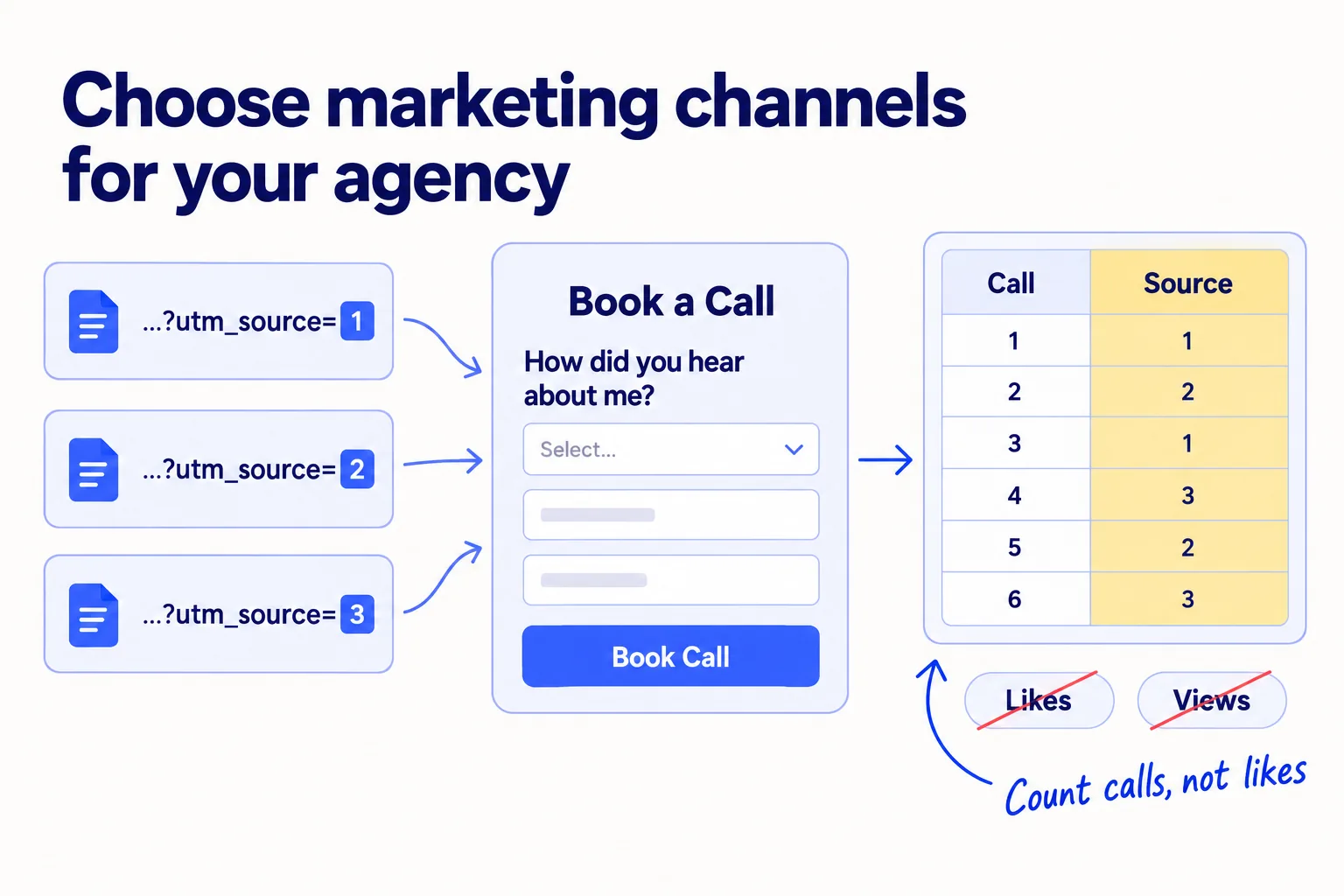
A tracking link is your normal link with a few words added at the end, called UTM parameters, which tell your analytics where a visitor came from. Make one for each place, and use it in every profile, post, answer and proposal there:
youragency.com/?utm_source=[exact place, such as saas-founders-slack]&utm_medium=[kind, such as community]&utm_campaign=channel-test
Many people will not click. They read your answer, then look you up on LinkedIn a week later. So add a required question to your booking form, "How did you hear about me?", with each test as an option, and ask it again at the start of every call. This is called self-reported attribution. Log every call in one sheet with its source, and move it along your pipeline: call, proposal, client.
- Tool: your booking form, your analytics, and Google Sheets.
- Time: 30 minutes, once.
- You will have: a link for every place, and a source on every call.
- It worked if: at least 9 of every 10 calls this week have a source.
- Common mistake: counting likes, profile views or Upwork invitations to interview. They are easy to count, and they tell you nothing about who will pay you. Once you have more than a few calls a week, track which channel brought each dealsoon from first call to signed client.
5. Every Sunday, count calls per 10 hours, then double, fix or drop each channel
Every Sunday, write down for each channel the hours you spent, the calls, the proposals and the new clients. When a test reaches its stop line, use the rules below to double, keep, fix or drop it.
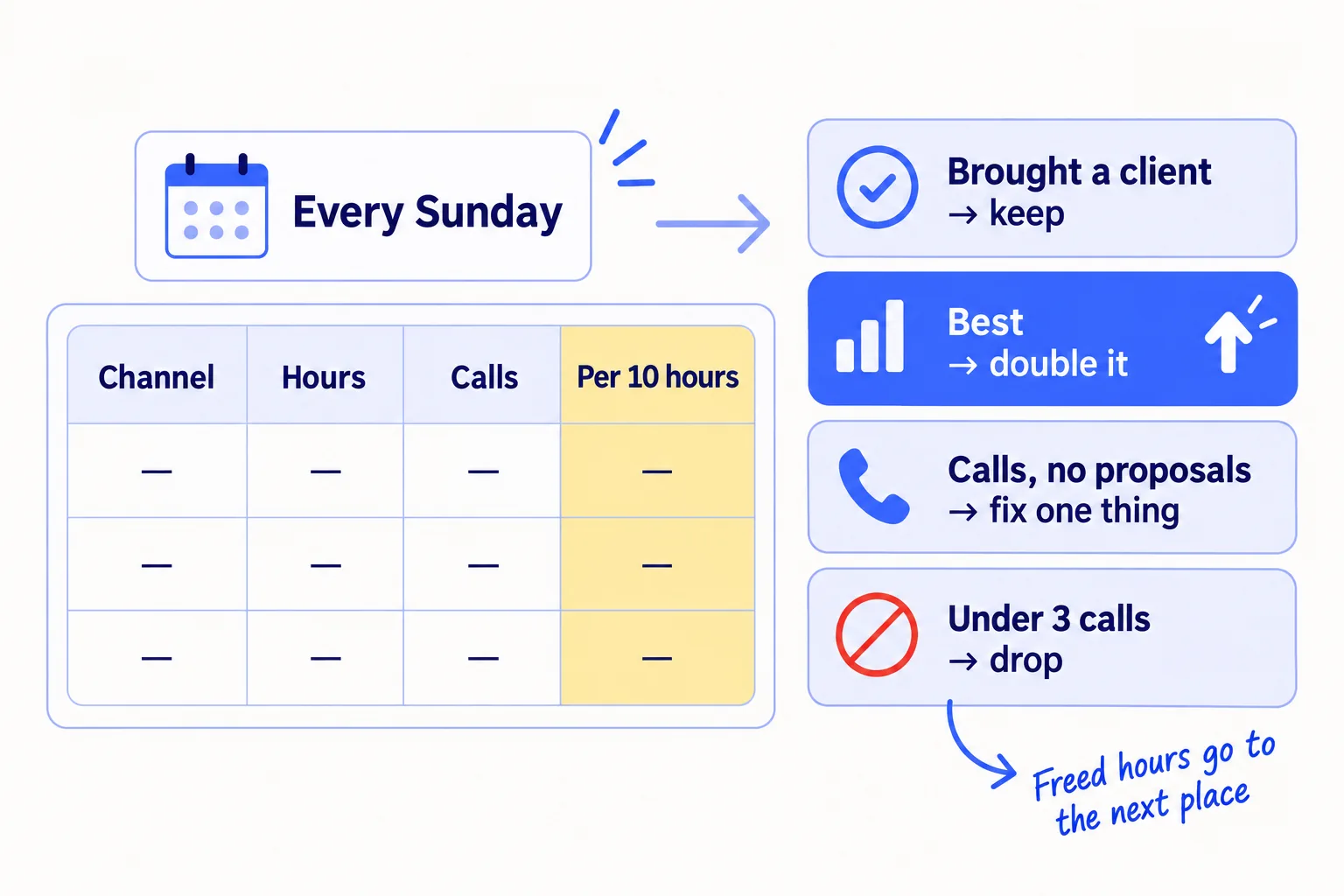
To compare channels fairly, work out one number for each: calls with your kind of client, per 10 hours. Divide the calls by the hours you spent, and multiply by 10. A channel that gave you 5 calls for 28 hours scores 1.8.
Channel | Hours spent | Amount done | Calls | Proposals sent | New clients | New monthly revenue | Calls per 10 hours
At each stop line, decide:
- It brought a new client: keep it, whatever its number. A client matters more than anything else on the sheet.
- It passed and has the best number of your tests: double it. Double the daily amount for 2 weeks, spread over more places if a platform limits you. If calls go up, keep the new amount. If they do not, go back to the old amount and give the extra hour to the next place on your list.
- It passed, but it is not the best: keep it at the same amount.
- It brought calls, but no proposals: you reached the wrong people, or offered the wrong thing. Change one thing, such as the place or your offersoon, and run it for 2 more weeks. If this happens on every channel, fix your offer and your price, not the channels.
- Fewer than 3 calls after the full amount: drop it. Write one line on why, so you do not try it again next month.
- Search pages and your Clutch profile: keep going and judge them at month 3.
The same week you drop a channel, give its hour to the best test or start the next place on your list with a new test card. Once a month, do a marketing reviewsoon: add the places your newest clients say they looked.
- Tool: Google Sheets.
- Time: 20 minutes every Sunday, and 1 hour at each stop line.
- You will have: a written decision for every channel.
- It worked if: after each stop line, every hour of next week belongs to a channel that passed or to a new test with a stop line.
- Common mistake: keeping a channel that brought nothing "in case it works later", or dropping one before it reached its full amount. Both leave you guessing next month.
See it done: Quillfox at the stop line
The Sunday sheet after 4 weeks
| Channel | Hours spent | Amount done | Calls | Proposals | New clients | Calls per 10 hours |
|---|---|---|---|---|---|---|
| Personal messages (base) | 56 | 2,800 messages | 60 | 12 | 1 | 10.7 |
| SaaS founder communities | 28 | 560 answers | 5 | 2 | 1 | 1.8 |
| LinkedIn posts | 28 | 56 posts | 3 | 1 | 0 | 1.1 |
| Upwork | 21 | 84 proposals | 2 | 0 | 0 | 1.0 |
The decision: Jess keeps 100 messages a day, because they still bring more than 1 call per 50 messages. The communities passed, brought a client at $800 a month and have the best number of the three tests, so she doubles them to 40 answers a day across 10 places. The LinkedIn posts passed, so she keeps them at 2 a day. Upwork brought 2 calls and no proposals for $150 of Connects, so she drops it and uses those 45 minutes to start podcast pitches, the next place on her list.
Why it works: Jess compares channels by calls per 10 hours, and keeps the one that brought a client, not the one with the most likes.
6. Pay for a channel only after its free version brought a client
Spend money on a channel only after its free version has brought you at least one client, and cap the spend at what one client pays you in a month. Before that, you do not know what a client from that channel is worth, so you cannot tell whether the money was well spent.
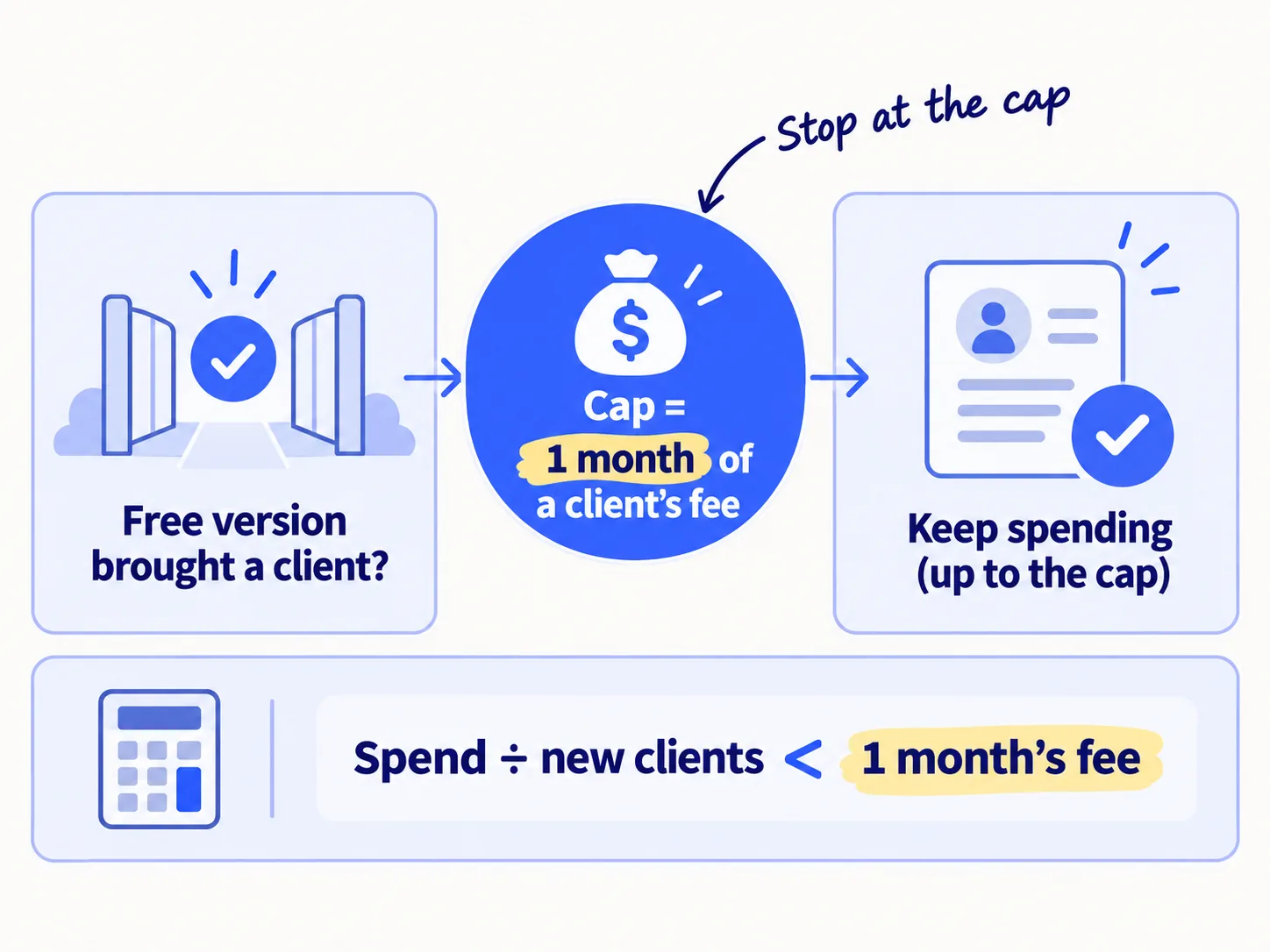
Paid versions of a channel include Upwork Connects beyond your test cap, paid tiers on Clutch, a sponsored spot in a newsletter or podcast your clients follow, and ads. Use this rule:
Cap = [your average monthly fee per client]Keep it if: [money spent] ÷ [new clients from it] is less than [one month's fee]
For example, at $800 a month per client, a paid test is capped at $800. It passes if it brings at least one client for that money. That is your cost to win a client, and it pays back in the first month.
Leave ads for your own agency until at least 5 clients have come from outreach and introductions, and you know which message books calls. Before that, ads pay to send strangers to an offer you have not tested. When you get there, LinkedIn adssoon reach owners by job title, and how much to spend on adssoon helps you set the number.
- Tool: the platform's own billing, with a cap you set before you start.
- Time: 1 hour to set up, then 10 minutes each Sunday to add it to the sheet.
- You will have: a cost per new client for each paid channel, from real spending.
- It worked if: the cost per new client is below one month of that client's fee.
- Common mistake: buying Connects, a sponsored listing or ads before the free version brought a single call. The rest of your spending belongs in your agency's marketing budget.
Where Scout7 helps
Scout7 speeds up step 1 and two of the daily tests.
Step 1. Scout7's Join Conversations searches social platforms for live discussions about a problem, so the threads it finds show where your kind of client talks. That fills in the proof column for your community rows. Audience research reads public social conversations in your clients' category and gives their pain points in their own words. For search and AI rows, keyword intelligence shows monthly searches, difficulty, and who leads on Google and in AI answers for each phrase, and AI question coverage shows which questions buyers ask AI assistants and who is cited today.
The community test. Join Conversations drafts a reply in your voice for a thread you pick. You read the thread yourself and approve or rewrite the reply. Nothing is posted without your approval.
The LinkedIn test. Scout7 proposes post ideas, makes image posts and LinkedIn carousels in your voice, and schedules them to your LinkedIn profile. You edit and approve each one before it goes live.
Step 6. When you reach a paid test, Scout7 plans, builds, launches and monitors Google, Meta, LinkedIn and Reddit campaigns in the Scout7 app, not over MCP yet. You approve every creative, every change and the spend.
Client work. Scout7 gives each client brand its own workspace, with its own brand profile, connections and calendar, so client brand voices stay separatesoon and you get hours back for these tests. Its Organic Loop plans, creates and schedules a content cycle for a client, and you approve the output.
Your agency channel-testing checklist for the next 4 weeks
0 of 13 done
Work through this list with an AI assistant
It drafts the work and keeps track of what is done.
Frequently asked questions
- What is the best marketing channel for a new agency?
The one your clients already use, and for most new agencies that is people: introductions from clientssoon and partners, plus one-to-one messages. In Promethean Research's 2026 survey, relationship tactics scored highest. Keep those as your base, and test three more places next to them. Your best extra channel is the one with the most calls per 10 hours after its full amount.
- Should a new agency use Upwork or cold email?
Test both, if your kind of client posts jobs there. They are not either-or. Cold email is your base at 100 messages a day. Upwork is one test: 3 proposals a day on fresh jobs, with a cap on Connects. After 84 proposals, compare calls per 10 hours. Upwork is one of several places to find clients onlinesoon; judge it by calls, like the rest.
- Does posting on LinkedIn get agency clients?
It can, if you write for owners, not other marketers. Posts about a real fix you made for your kind of client lead to calls; general marketing tips lead to likes from other marketers. Test it at 2 posts a day from your own profile for 56 posts, and count calls, not likes. Fix your profilesoon first, because every reader checks it.
- How many marketing channels should an agency use?
As many as your hours can run at full volume. Your daily outreach and introductions come first. Each extra test needs about 1 hour a day, so divide the hours you have left by 1. With 5 hours a day for marketing, that is 3 tests. Keep every channel that passes, and start the next one as soon as you free an hour.
- What if none of my channels bring clients?
Look at how they failed. If every channel brought calls but no proposals or clients, the problem is your nichesoon or your offer, not the channels. If none brought calls at the full amount, go back to who you serve and what you promise. If owners ask for proof you do not have yet, win clients without case studiessoon first.
Sources
- 1.How Marketing Agencies Get Clients: Every Channel Ranked — Promethean Research, 2 August 2026, checked 26 September 2026
- 2.Email sender guidelines FAQ — Google Workspace Admin Help, checked 26 September 2026
- 3.Email sender guidelines — Google Workspace Admin Help, checked 26 September 2026
- 4.Invitation limit reached — LinkedIn Help, checked 26 September 2026
- 5.Understanding and using Connects — Upwork Help, checked 26 September 2026
- 6.What's the difference between Freelancer Basic and Freelancer Plus? — Upwork Help, checked 26 September 2026
- 7.Learn about the Freelancer Service Fee — Upwork Help, checked 26 September 2026
- 8.How Do I Get My Company Listed on Clutch? — Clutch Help Center, checked 26 September 2026
- 9.Strategize, Test, Measure: The Bullseye Framework — Brian Balfour, on Traction by Gabriel Weinberg and Justin Mares, 2 September 2014
Next article to read
How to set a marketing budget for your agencyAgencyOnce you pick your channels, this shows how much time and money to give each one.Read it nextRelated guides
- How to market your marketing agencyAgencyMarket your marketing agency when it is just you: an 8-week routine next to client work, with who to pick, what to send, what to put on your site and LinkedIn, and what to count every Friday.
- How to get agency clients on LinkedInAgencyComing soon
- How to get clients on UpworkAgencyComing soon
- How to write a cold email for a marketing agencyAgencyComing soon
Guides that link here
Cite this page
Dinesh Bypilla (2026). How to choose marketing channels for an agency. Scout7 Academy. https://scout7.ai/academy/marketing-plan/how-to-choose-marketing-channels-for-an-agency
Written by Dinesh Bypilla, Agentic systems engineer at Scout7. Reviewed by Murali Sid. Last checked 26 September 2026.
Quote any part of this guide with a link back to this page. © 2026 Scout7.
Markdown version of this page: https://scout7.ai/academy/marketing-plan/how-to-choose-marketing-channels-for-an-agency.md