



How much to spend on marketing as a SaaS startup
Set your SaaS startup's first marketing budget when you have almost no revenue: 5 to 6 hours a day, under $100 a month for tools and $0 for ads until 10 people have paid, with the maths that shows when ads can pay and a Sunday sheet.
ByDinesh BypillaReviewed byMurali SidLast checked 16 min read
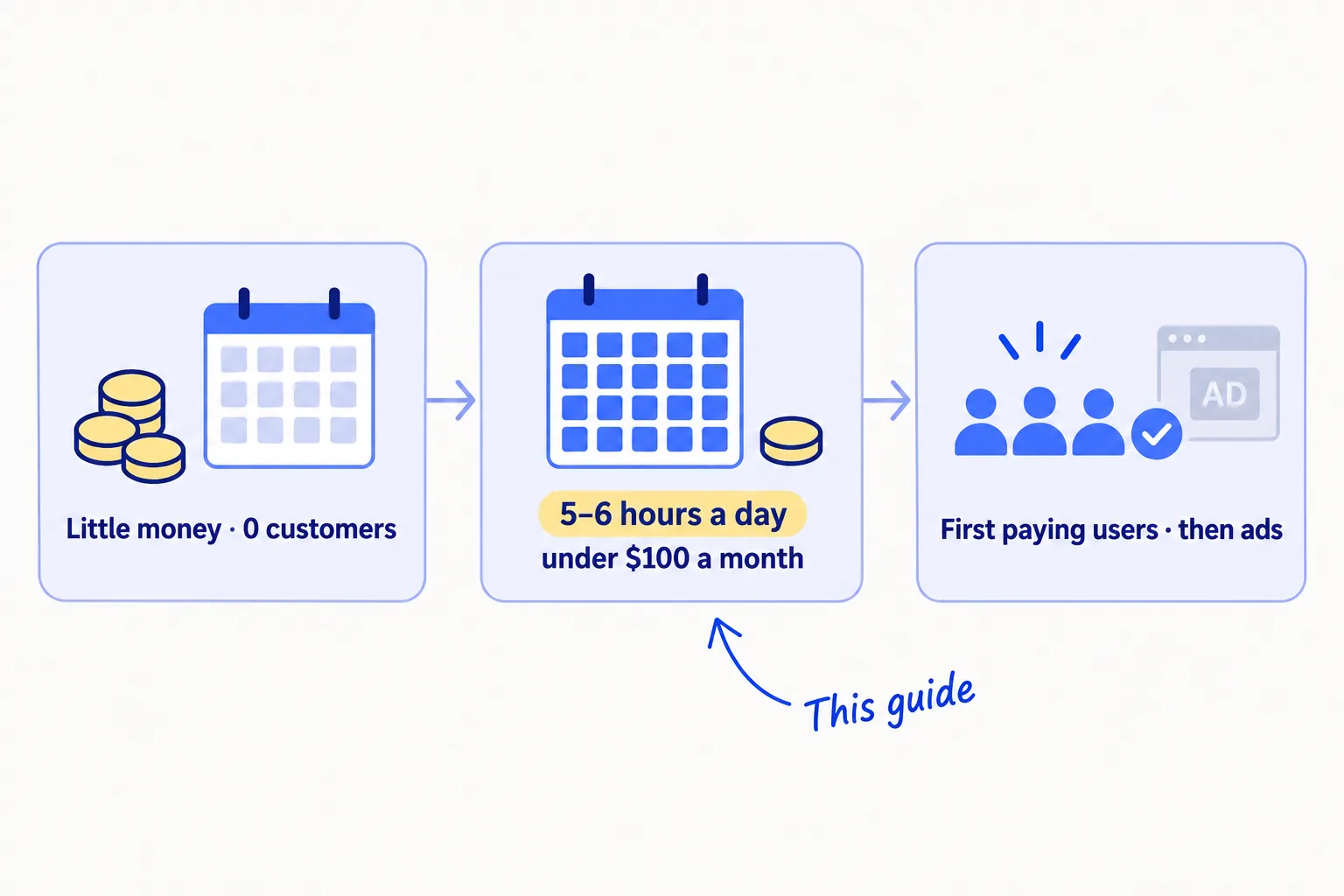
You have a SaaS product, a little money and almost no revenue, and every article on how much to spend on marketing as a SaaS startup gives you a percentage of revenue you do not have. So you either spend nothing and wait, or put your savings into ads that bring clicks and no paying users. At your size, the budget that works is mostly your own hours, plus a small, fixed amount of money that you only raise once people pay you.
Do these three things
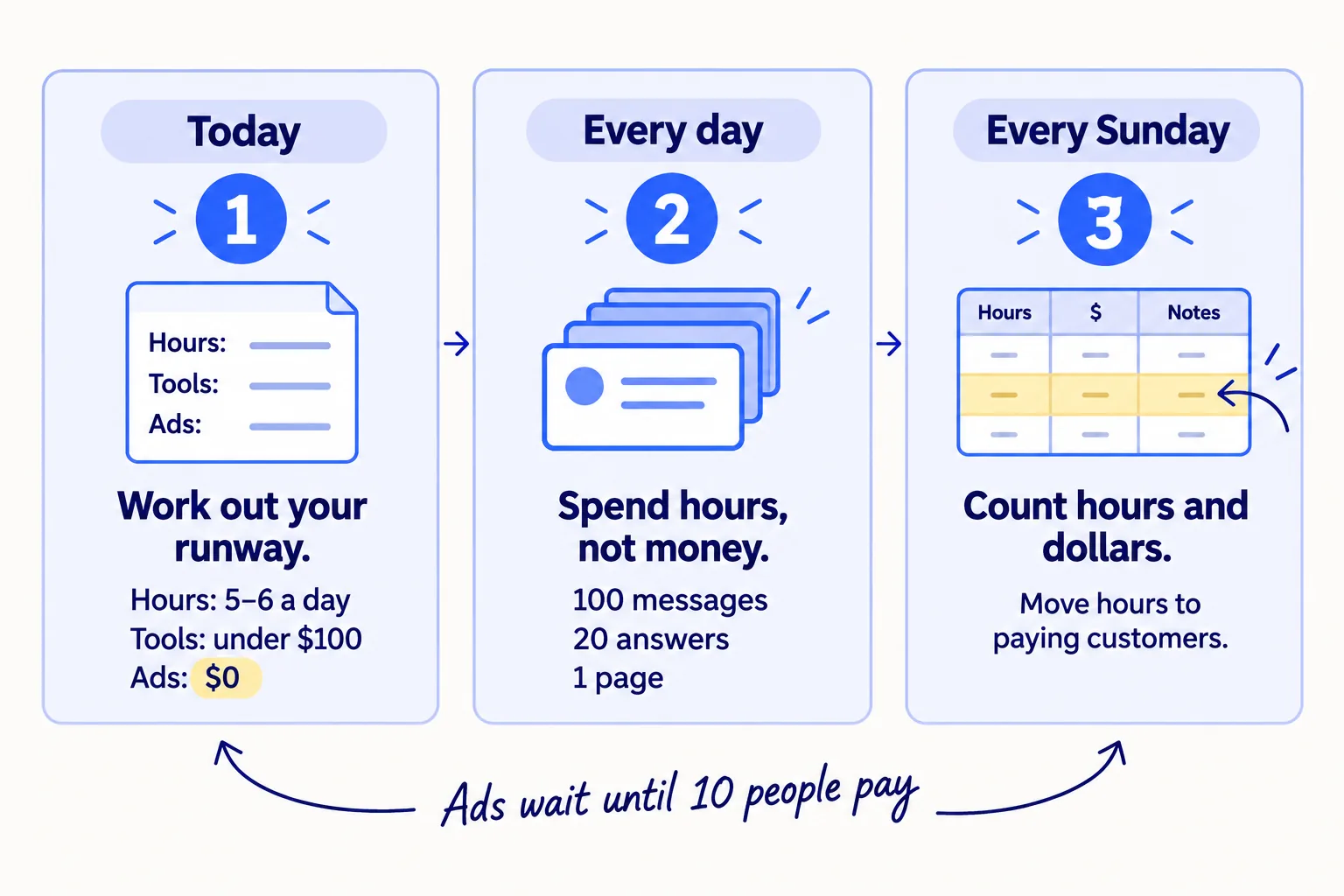
The money is small on purpose. About 5 to 6 hours a day for 4 weeks, then judge it by paying customers, not by what you spent.
Show the three actions in fullHide the full list
- Today: work out your runway and write your budget: 5 to 6 hours a day, up to $100 a month for tools, and $0 for adssoon until 10 people have paid you.
- Every day: spend the hours, not the money. Send 100 personal messagessoon, give 20 answers where your buyers ask for helpsoon and publish 1 page that answers a real searchsoon. AI drafts each one; you add what only you know.
- Every Sunday: write down every hour and dollar next to signups and paying customerssoon. Move next week's hours to what brought paying customers, and cancel any tool you did not use.
Get help doing these
ChatGPT or Claude reads this guide and works through it with you.
1. Work out your runway before you set a marketing budget
Your marketing money comes out of your runway, not your revenue, so work that out first. Runway is the number of months you can keep going: the cash you have, divided by what you spend each month.
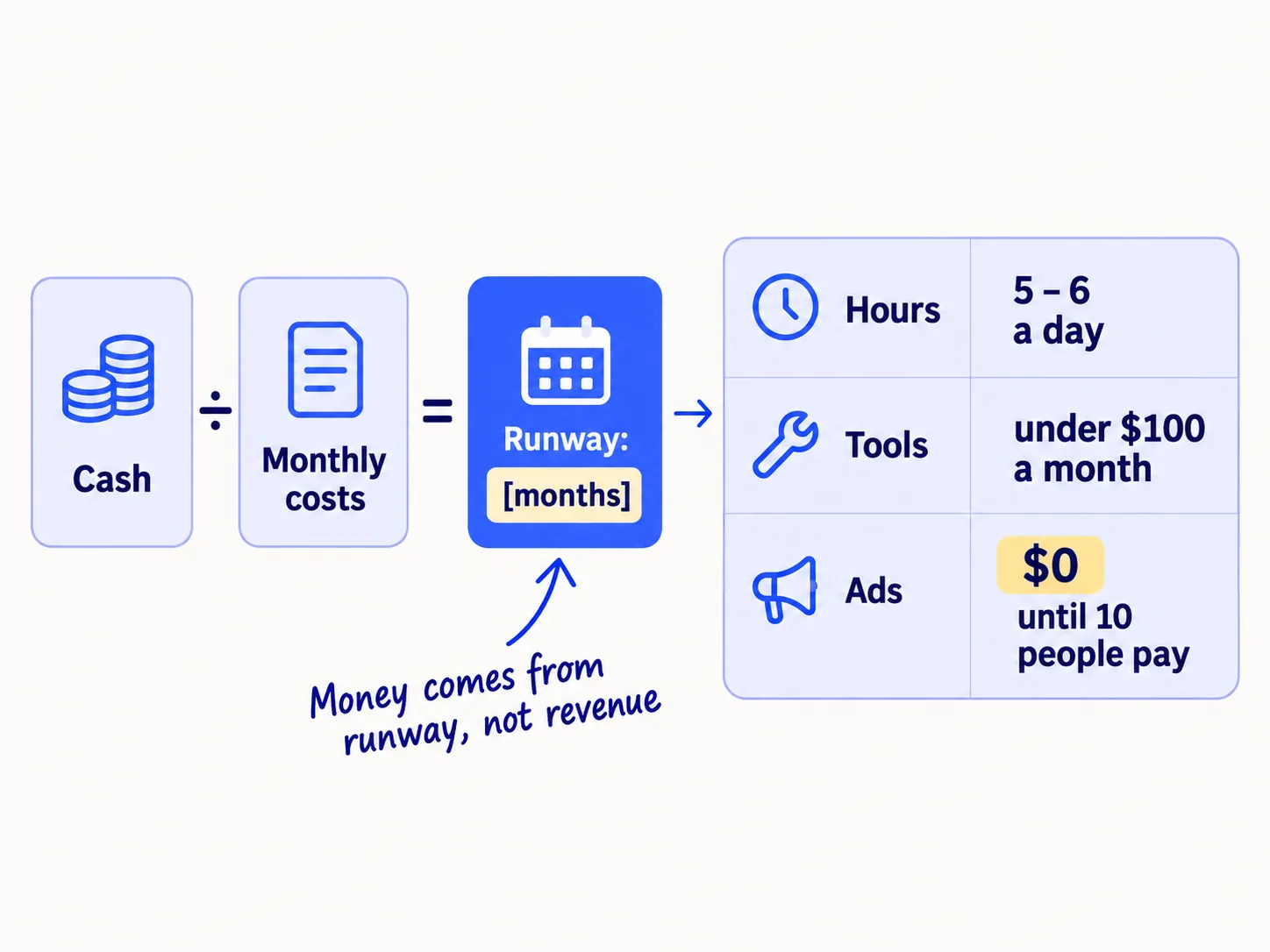
Open a Google Sheet and write three numbers. First, the cash you can use for the business. Second, everything you spend each month: hosting, tools and, if the business pays them, your own living costs. Third, runway: cash divided by monthly costs.
The usual advice is a percentage of revenue. The median private SaaS company spends 8% of its annual recurring revenue on marketing, according to SaaS Capital's 2026 survey of more than 1,000 companies. If your MRR is $40, 8% is about $38 a year. That rule is for companies that already have revenue. Until you do, set your budget in three lines:
- Hours: 5 to 6 a day, every day. This is most of your budget (step 2).
- Tools: up to $100 a month. If your runway is under 6 months, keep it to $30 and put every spare hour into step 2.
- Ads and people: $0 on ads until 10 people have paid you (step 5), and $0 on an agency or freelancersoon until one channel has passed a test you ran yourself. Until then, you cannot tell good work from bad.
A long runway buys you more months of step 2, not a bigger ad budget. What gets you your first customers is the number of people you reach and talk to.
Cash for the business: $[amount]Monthly costs (hosting, tools, your living costs if the business pays them): $[amount]Runway: [cash ÷ monthly costs] monthsHours: 5–6 a day, every day, for 4 weeksTools: up to $[100, or 30 if runway is under 6 months] a monthAds: $0 until 10 people have paidAgencies and freelancers: $0 until one channel has passed a test
- Tool: Google Sheets.
- Time: 30 minutes.
- You will have: your runway in months, and a budget with a line for hours, tools and ads.
- It worked if: each line has a number, and you could read the sheet to a co-founder in one minute.
- Common mistake: taking "spend 20–40% of revenue" or "$1,000–$5,000 a month" from a budget article and spending savings on ads "to get started". Those numbers are for companies that already have revenue or funding.
See it done: Bugmoth's first budget
Bugmoth is a made-up bug-reporting tool for small web teams. It costs $19 a month per team, with a 14-day trial.
Bugmoth's budget
| Line | Number |
|---|---|
| Cash for the business | $15,000 |
| Monthly costs | $1,250 |
| Runway | 12 months |
| Hours | 5–6 a day, every day, for 4 weeks |
| Tools | up to $100 a month |
| Ads | $0 until 10 teams have paid |
| Agencies and freelancers | $0 until one channel has passed a test |
Why it works: The money lines are small and fixed, and the hours line carries the budget.
2. Set your marketing budget in hours: 5 to 6 a day, every day
Most of your marketing budget is time: put 5 to 6 hours a day in your calendar, every day for 4 weeks, and decide now what they buy. They buy 100 personal messages, 20 answers and 1 page a day, the routine in How to market a SaaS product.
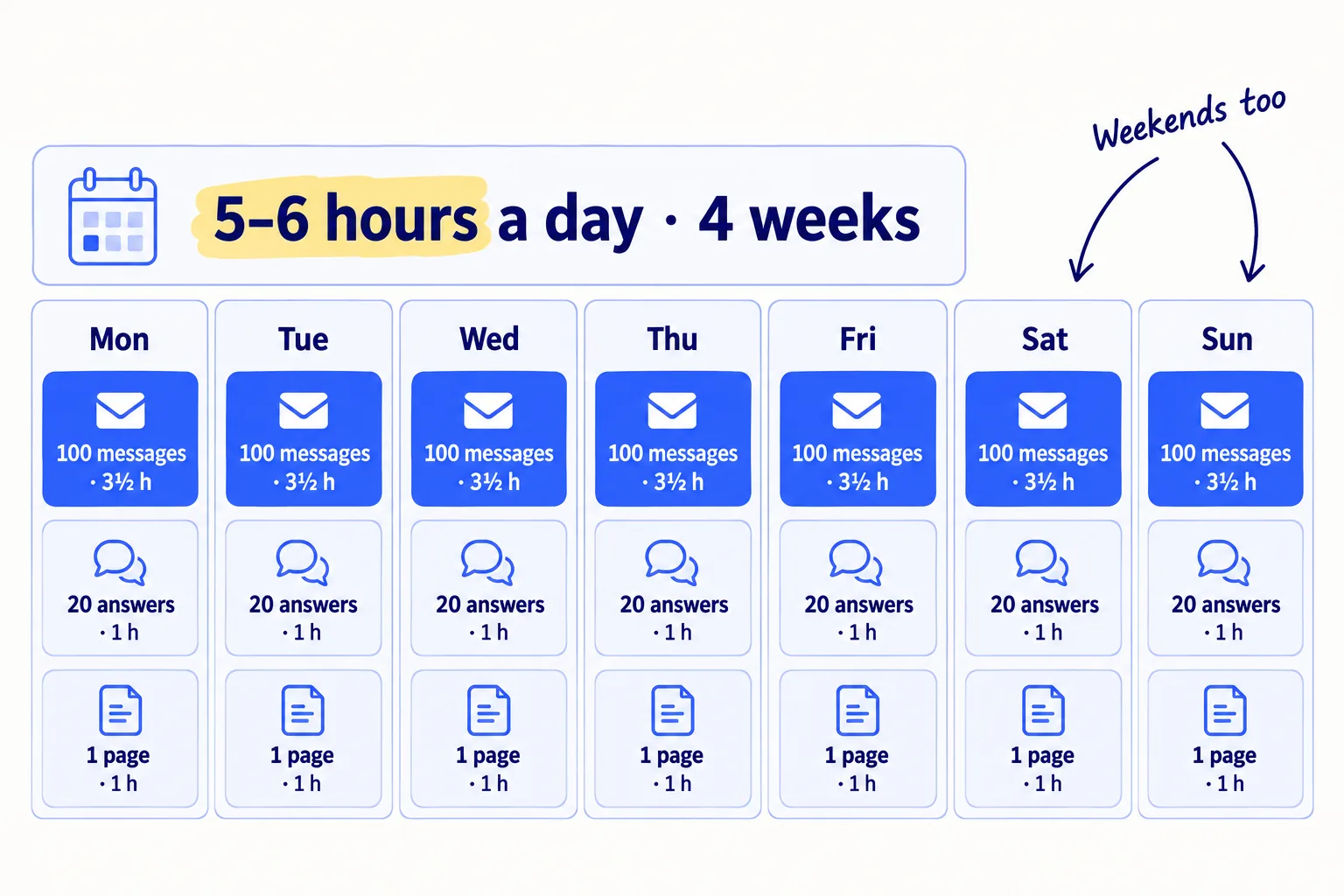
Here is where the hours go, and why the numbers are possible with AI drafting:
| Work | Each day | Time with AI |
|---|---|---|
| Find new namessoon for tomorrow's messages | 100 | 45 minutes |
| Personal messages asking for a 15-minute chat | 100, plus follow-upssoon | about 2 hours: AI drafts, you add one true line about the person |
| The chats those messages book | about 3 | 45 minutes |
| Answers in 5 communitiessoon | 20 | 1 hour, 3 minutes each, in your own words |
| A page that answers a real search | 1 | 1 hour: AI drafts, you add a screenshot, a number or a step you tested |
Put these blocks in Google Calendar before you start, on every day, weekends included. If 5 hours a day is not possible, find the hours before you cut the numbers: cut product work first. Where a platform limits you, spread the work instead of doing less. LinkedIn limits how many invitations you can send in a week, so message people you are already connected tosoon there and email the rest. If you email more than about 50 strangers a day, set up a second domainsoon and warm it up first.
Your hours cost you nothing in cash, but they are not free. An hour spent on a new feature nobody asked for is an hour of marketing budget gone. Two founders who wrote on Indie Hackers in July and August 2026 about launching to zero paying customers said the same thing: they spent the time building, not getting the product in front of buyers.
- Tool: Google Calendar, and ChatGPT or Claudesoon to draft.
- Time: 20 minutes to block the calendar, then 5 to 6 hours a day.
- You will have: 28 days of blocks in your calendar, and a count of what you did each day.
- It worked if: on at least 25 of the 28 days you hit all three numbers: 100 messages, 20 answers, 1 page. By the end of week 4, that is about 2,800 messages.
- Common mistake: spending the marketing hours on the product "because it is not ready". If people can sign up, it is ready enough to message 100 people a day about it. A technical founder often needs this rule most.
3. Spend under $100 a month on tools that save you hours
Keep your tool budget under $100 a month, and pay only for a tool that saves you at least 1 hour a week. Free tools cover most of the job at your size.
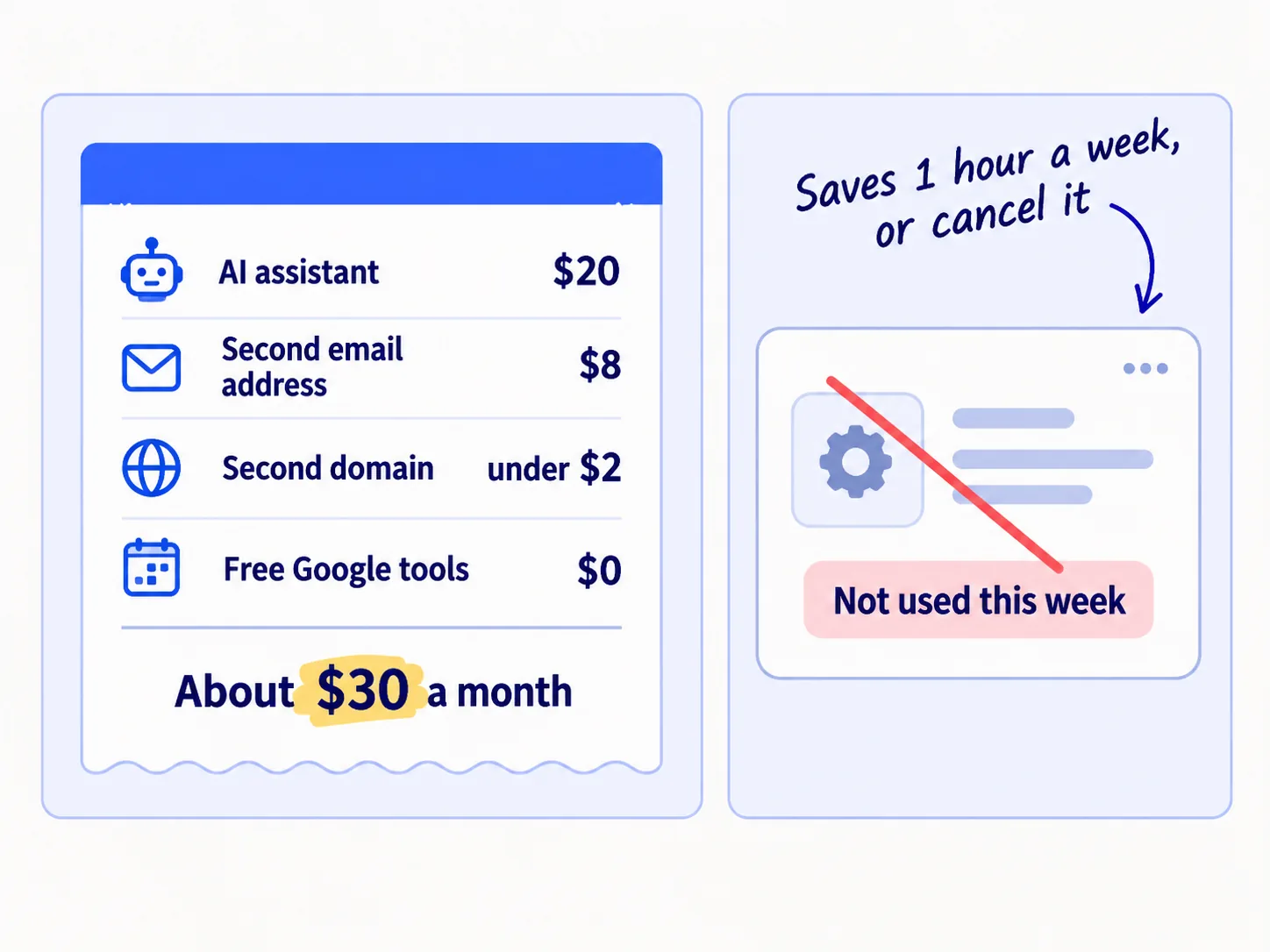
Open your bank statement and list every tool you pay for. Cancel anything you did not open in the last 7 days. Then keep only these, one per job:
| Job | Tool | Cost |
|---|---|---|
| Draft messages, answers and pages | ChatGPT Plus or Claude Pro | $20 a month each; both have free plans to start, and ChatGPT Go is $8 a month in the US |
| A second address for cold email, if you send more than about 50 a day | Google Workspace Business Starter | $7 a month on the annual plan, $8.40 on the Flexible plan |
| A second domain for that address | Cloudflare Registrar, which sells domains at cost | under $2 a month |
| Your list, your Sunday sheet and your calendar | Google Sheets and Google Calendar | free |
| See which searches find you | Google Search Consolesoon | free |
| See where visitors come from | Google Analytics 4, with UTM linkssoon | free |
That is about $30 a month. Leave the other $70 unspent. It is there for one tool that saves you an hour a week, once you know which job takes too long.
- Tool: your bank statement and Google Sheets.
- Time: 30 minutes.
- You will have: a list of every tool you pay for, with a total under $100 a month.
- It worked if: every paid tool on the list was used this week.
- Common mistake: paying for a large SEO suite, an email marketing platform or a CRMsoon at 300 visits a month. A free keyword tool, your own inbox and a sheet do the same job until you outgrow them.
See it done: Bugmoth's tool list
Bugmoth's tools, per month
| Tool | Cost | Saves |
|---|---|---|
| ChatGPT Plus | $20 | drafts 100 messages and 1 page a day |
| Google Workspace address on a second domain | $8.40 | keeps the main email safe at 100 messages a day |
| Second domain | under $2 | the address above |
| Google Sheets, Calendar, Search Console, Analytics | $0 | |
| Total | about $30 |
They cancel a paid keyword tool they opened twice in a month.
Why it works: Each tool saves hours on the daily work, and everything else is free.
4. Work out the most you can pay for one signup
Before you spend a dollar on ads, work out the most one signup is worth to you, and what a signup costs from ads today. If the second number is bigger, ads lose money, and you keep your money in step 2.
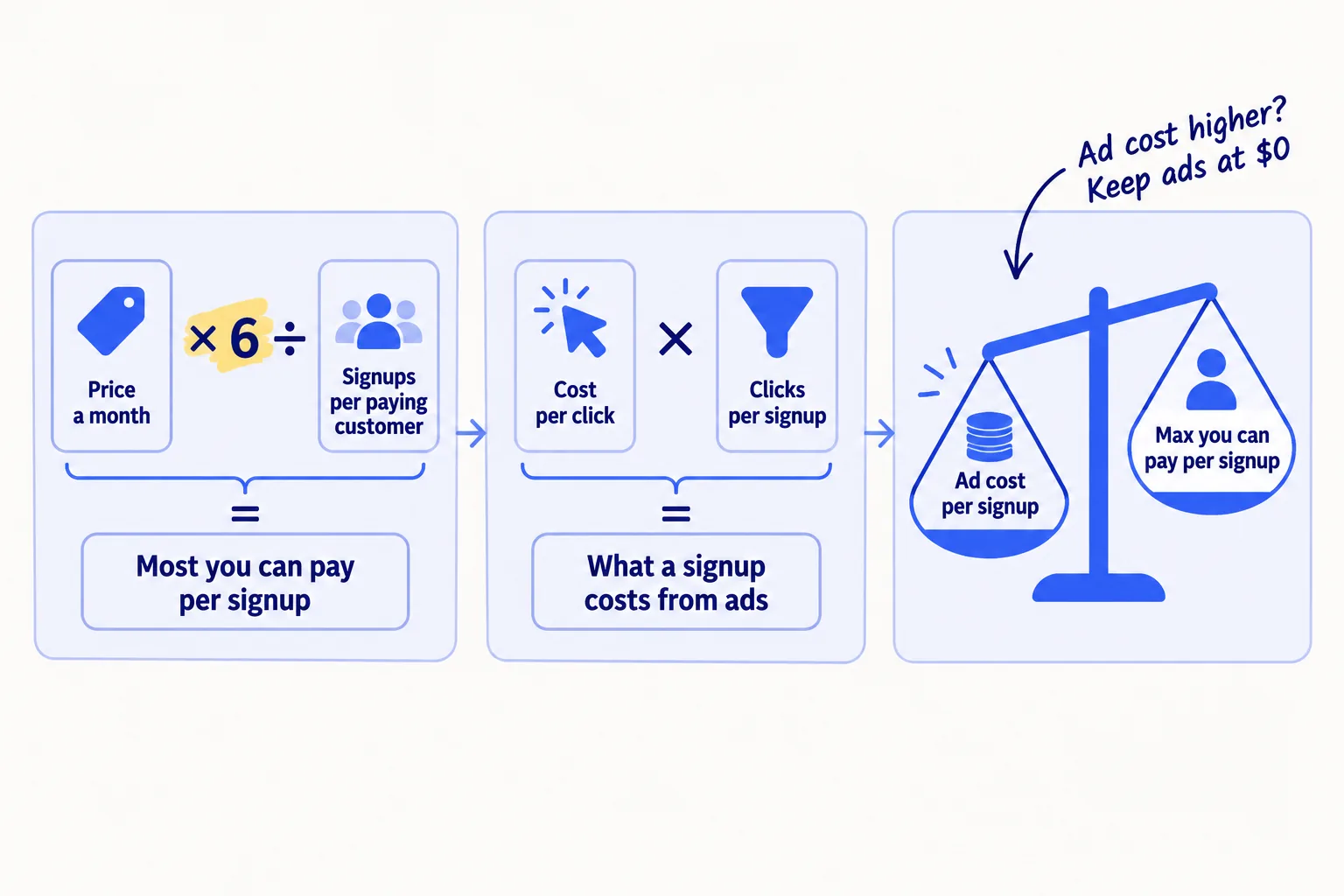
Use the same sum as in How to choose marketing channels for a SaaS startup:
[Price a month] × [months a customer stays] ÷ [signups it takes to get one paying customer] = the most you can pay per signup
With one or two customers, you do not know yet how long customers stay. Use 6 months until you do, and keep them longersoon once you know. The best quarter of SaaS companies earn back what they spend to win a customer in 6 months or less, according to the 2026 Aleph and Benchmarkit report of 342 companies. The median takes 16 months, and on runway like yours you cannot wait that long. This is your payback period, and How to calculate CAC and payback periodsoon has the full version.
Then work out what a signup costs from paid search:
$5.42 a click × [100 ÷ your signups per 100 visits] = what one signup costs from paid search
$5.42 is the average cost per click for search ads across all industries, from LocaliQ's 2026 report of Google and Microsoft Ads (April 2025 to March 2026). Your own conversion rate comes from your analytics: signups divided by visits, times 100.
If "what a signup costs" is higher than "the most you can pay", ads lose money at your price and your conversion rate. Raise the conversion rate first by fixing your homepagesoon, or check your price. A low price makes paid ads very hard.
- Tool: Google Sheets and your analytics.
- Time: 15 minutes.
- You will have: two numbers: the most you can pay per signup, and what a signup costs from ads.
- It worked if: you can say in one sentence whether an ad can pay for itself at your price today.
- Common mistake: judging ads by cost per click or by visits. A cheap click that never signs up is still money gone.
See it done: Bugmoth's ad maths
Can an ad pay for itself?
| Number | Sum | Result |
|---|---|---|
| Signups per paying team | 25 signups, 2 paying teams | about 12 |
| Most they can pay per signup | $19 × 6 ÷ 12 | about $9.50 |
| Signups per 100 visits | about 25 from 900 visits | about 3 |
| What a signup costs from paid search | $5.42 × 33 clicks | about $180 |
A signup from ads would cost about 19 times what it is worth. So the ad line stays at $0, and the money stays in step 2.
Why it works: Seeing the two numbers side by side shows why the ad line stays at $0.
5. Keep ads at $0 until 10 people have paid, then test with a cap
Spend nothing on paid adssoon until at least 10 people have paid you. Then run one 2-week test with a spending cap, and stop it yourself on day 14.
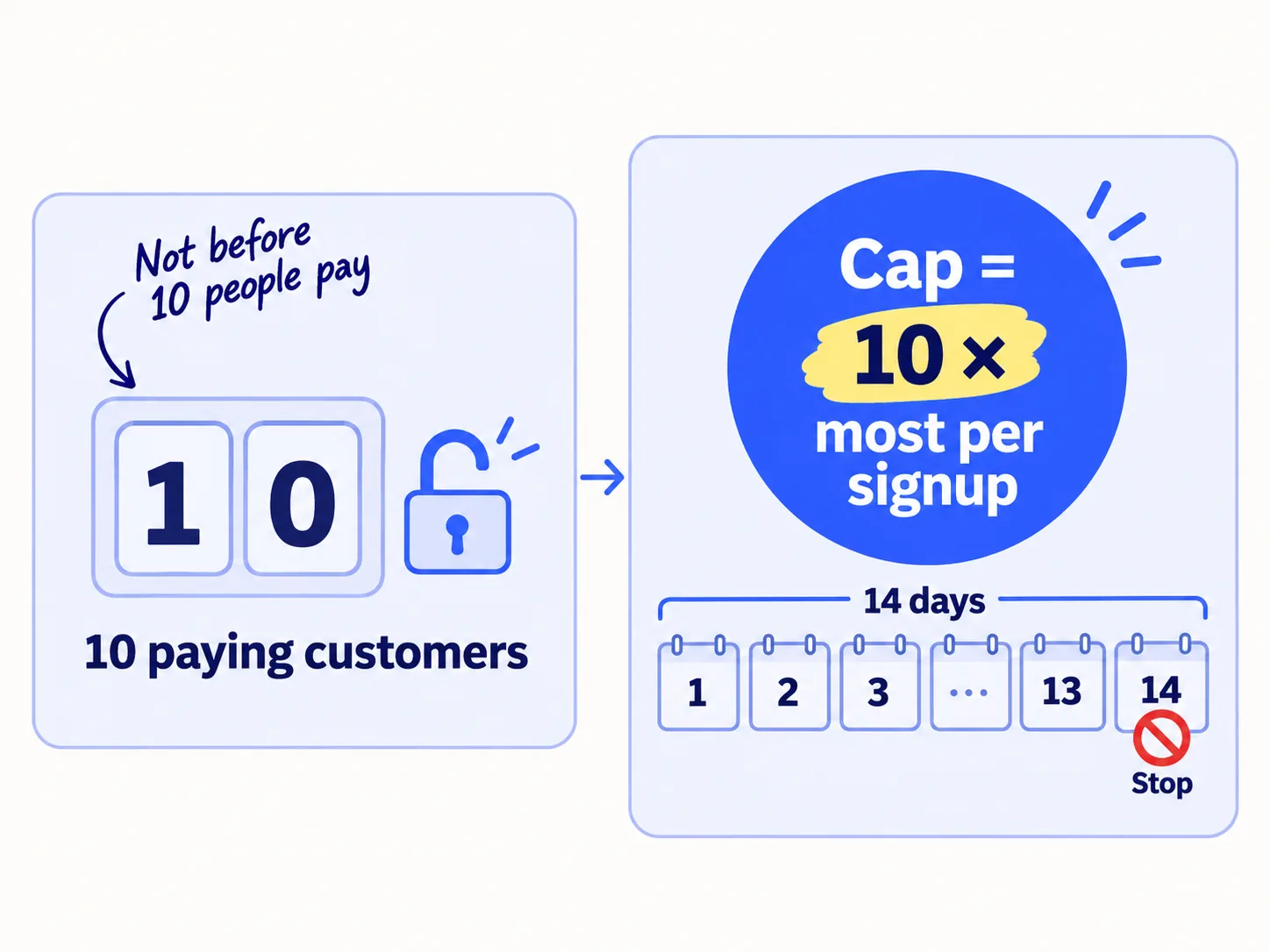
With 10 paying customers, you know which sentence, which kind of team and which place brought them. Before that, an ad sends strangers to a message you have not tested. When you reach 10:
- Redo step 4 with your real numbers: your real signups per paying customer and, once you have them, your real months.
- Set a test cap of 10 times the most you can pay per signup.
- In Google Ads, make a Search campaign using only the exact phrases that already bring you signups from your pages, such as "[competitor] alternative". Set the daily budget to your cap divided by 14. Google Ads for SaaSsoon has the setup.
- Stop it yourself on day 14. Google lets a campaign spend up to 2 times its daily budget on one day, and up to 30.4 times it in a month, so the budget alone does not stop at your cap.
Know the minimums and the credits before you start. LinkedIn Adssoon needs at least $10 a day, which is $140 for a 14-day test; if your cap is lower, test Google instead. Google often offers new advertisers ad credit, shown on the Promotions page of your account. You must spend a set amount first, usually within 60 days. The check can then take up to 35 days, and the credit must be used within 60 days. Your cap is what you pay. If an offer asks you to spend more than your cap to get the credit, skip the offer.
- Tool: Google Ads.
- Time: 2 hours to set up, then 15 minutes a day to check which searches your ads showed for.
- You will have: a real cost per signup and per paying customer from paid search.
- It worked if: the cost per signup is at or below your number from step 4, and those signups use the product about as often as signups from your other channels.
- Common mistake: broad phrases, and treating a credit offer as free money. The credit only comes after you spend a set amount, which can push you past your cap.
6. Every Sunday, count every hour and dollar, and move them
Every Sunday, write one row: the hours you spent, the dollars you spent, signups, paying customers and MRR, with where each came from. Then move next week's hours to what brought paying customers.
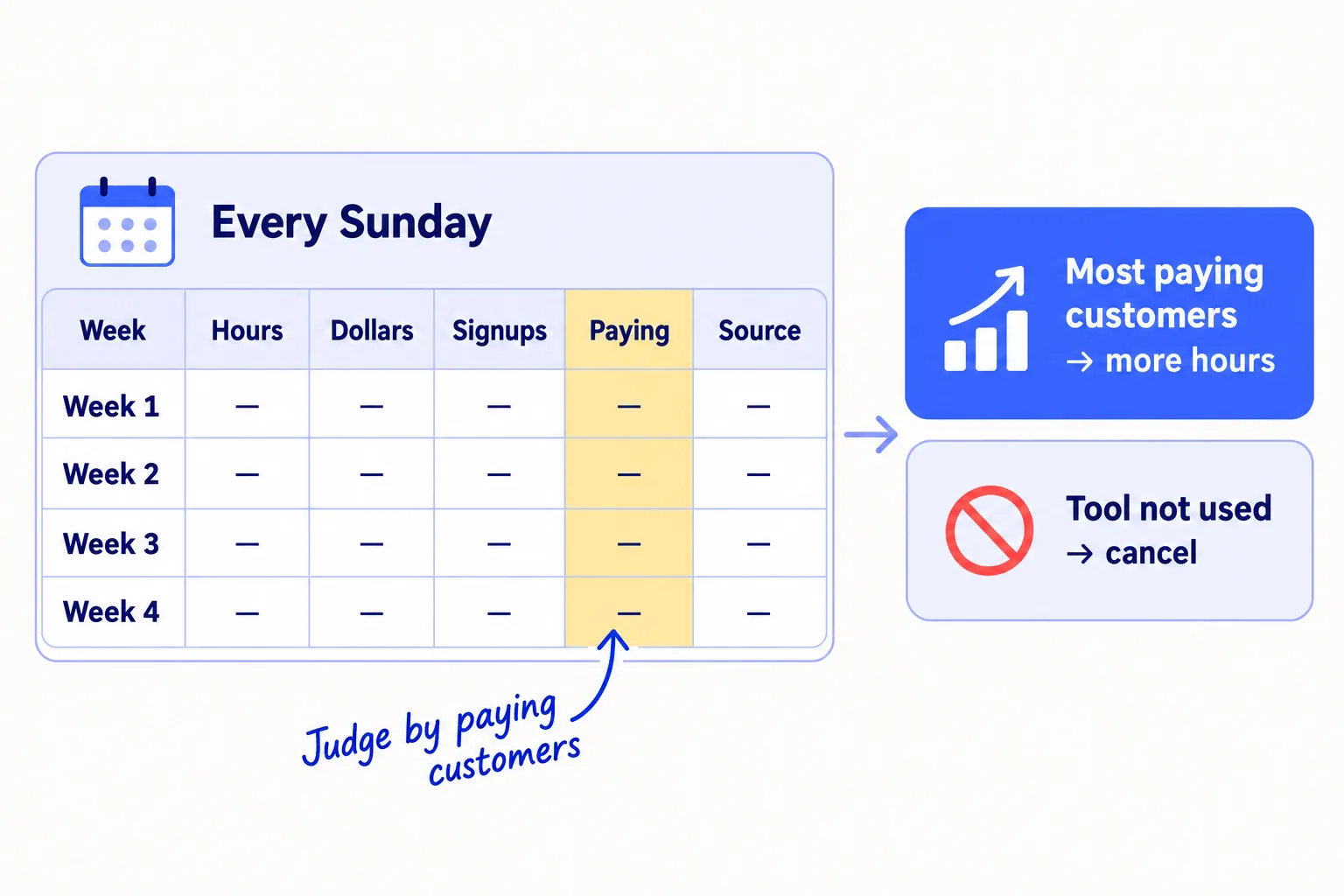
To know where each signup came from, ask "Where did you hear about us?" on your signup form. This is self-reported attribution, and at your size it beats any tool. Then fill in the sheet:
Week | Hours | Dollars spent | Signups | New paying customers | MRR | Where the paying customers came from
Then decide, using these rules:
- Hours: after 2,800 messages (4 weeks), give next week's hours to the place that brought the most paying customers. Stop anything that brought 0 chats and 0 signups. Search is the exception: judge it at month 3soon.
- Tools: cancel any tool you did not use this week.
- Money: raise spending only on a channel where the cost per paying customer is at or below 6 months of your price.
- Benchmarks: once you have steady revenue, compare with other companies. SaaS Capital's 2026 survey found a median of 8% of annual revenue on marketing, and companies with investors spend about twice as much on marketing as bootstrapped ones. Gartner's 2026 survey found 7.8% of revenue, mostly at very large companies.
If people sign up but few pay, the problem is not your budget. Fix the first minutes in your productsoon before you spend more to bring people in. If nobody pays after 2,800 messages, work out why no one is buying before you spend anything. Once a month, step back for a marketing reviewsoon.
- Tool: Google Sheets.
- Time: 20 minutes every Sunday.
- You will have: one row a week, and a cost and a source for every paying customer.
- It worked if: you can name where every paying customer came from and what they cost in hours and dollars.
- Common mistake: judging after one week, or by how much you spent. The question is how many paying customers each hour and dollar brought.
See it done: Bugmoth's Sunday sheet after 4 weeks
Weeks 1 to 4
| Week | Dollars spent | Signups | New paying teams | MRR |
|---|---|---|---|---|
| 1 | $30 (tools for the month) | 10 | 0 | $38 |
| 2 | $0 | 21 | 0 | $38 |
| 3 | $0 | 18 | 2 | $76 |
| 4 | $0 | 20 | 3 | $133 |
The decision: 4 of the 5 new paying teams came from personal messages, so the founders keep all their hours there. $30 and 4 weeks of hours brought 5 paying teams. They have 7 of the 10 paying teams they need before they test ads, so the ad line stays at $0.
Why it works: It counts paying teams, not money spent, so the decision is clear.
When one place clearly brings paying customers, choose the next channel for your spare hours.
Where Scout7 helps
Scout7 speeds up two of the six steps: 2 and 5.
Step 2. Two of the three daily jobs take the most hours. For the 20 answers, Join Conversations searches social platforms for live discussions about your problem, groups them by the kind of reply that fits, and drafts a reply in your voice for each thread. You judge which threads are worth joining and approve or rewrite each reply. Nothing is posted without your approval. For the page a day, keyword intelligence gives each term's monthly searches, difficulty and who leads on Google and in AI answers, and AI question coverage shows the questions buyers ask AI assistants in your category and who gets cited now.
Step 5. When you reach the capped test, Scout7 drafts the campaign with its audience and a daily budget, builds it and launches it to your connected Google, Meta, LinkedIn or Reddit ad account. You set the number you are willing to spend and approve every creative and the spend. Every twelve hours it reviews each campaign and proposes what to cut or where more budget would earn more; you approve or reject each change. This runs in the Scout7 app, not over MCP yet.
Your SaaS marketing budget checklist for the next 4 weeks
0 of 10 done
Work through this list with an AI assistant
It drafts the work and keeps track of what is done.
Frequently asked questions
- How much should a SaaS startup spend on marketing?
With almost no revenue, spend 5 to 6 hours a day, up to $100 a month on tools, and $0 on ads until 10 people have paid you. Most of your budget is time: 100 personal messages, 20 answers and 1 page a day, which is how you get your first users. Raise the money only where a paying customer costs under 6 months of your price.
- What percentage of revenue should a SaaS company spend on marketing?
SaaS Capital's 2026 survey of more than 1,000 private SaaS companies found a median of 8% of annual recurring revenue, and companies with investors spend about twice as much as bootstrapped ones. Those numbers are for companies with steady revenue. Below that, set your budget in hours and a fixed tool amount, and use the percentage once you have revenue to take it from.
- Should I spend my savings on ads to get my first customers?
No. Work out the most you can pay per signup first. At a price like $19 a month, it is often under $10, while a signup from paid search can cost well over $100 at an average of $5.42 a click. Spend the savings on runway: more months of personal messages and answers. Test adssoon once 10 people have paid.
- Should I pay an agency or freelancer to do my marketing?
Not before one channel has passed a test you ran yourself. Until then, you cannot judge their work, and you pay for their learning. Once a channel brings paying customers and you have no hours left to do more of it, hand over that one channel. Hire carefullysoon: a small, fixed scope and a clear result to check.
- How much should I spend on marketing before product-market fit?
Almost no money, and a lot of hours. Before product-market fit, your marketing is how you find out whether people will pay. Personal messages and chats tell you that fastest, and they cost time, not cash. If nobody will talk to you after 2,800 messages, check the problem is real before you spend anything.
Sources
- 1.2026 Spending Benchmarks for Private B2B SaaS Companies — SaaS Capital, survey March 2026, checked 26 September 2026
- 2.Gartner 2026 CMO Spend Survey — Gartner, 11 May 2026
- 3.CAC payback period benchmarks for SaaS (2026) — Aleph and Benchmarkit, 1 June 2026
- 4.Search Advertising Benchmarks for Every Industry (2026 data) — LocaliQ, April 2025 to March 2026 data, checked 26 September 2026
- 5.How much should a small business spend on marketing in 2026? — Mercury, checked 26 September 2026
- 6.Why daily costs might exceed your average daily budget — Google Ads Help, checked 26 September 2026
- 7.About Google Ads promotional offers — Google Ads Help, checked 26 September 2026
- 8.Campaign and ad set budgets — LinkedIn Marketing Solutions Help, checked 26 September 2026
- 9.Google Workspace pricing — Google, checked 26 September 2026
- 10.ChatGPT pricing — OpenAI, checked 26 September 2026
- 11.Plans and pricing — Anthropic, checked 26 September 2026
- 12.Cloudflare Registrar — Cloudflare, checked 26 September 2026
- 13.I built a SaaS that got 0 paying customers at launch. Distribution was the real problem all along. — Indie Hackers, 5 July 2026
Next article to read
How to price a SaaS productSaaSAfter you set a budget, this helps you set a price that can pay for it.Read it nextRelated guides
- How much to spend on adsComing soon
- How to calculate CAC and payback periodComing soon
- How to choose marketing channels for a SaaS startupSaaSChoose marketing channels for a SaaS startup: list 10 places your buyers already look, test 3 for 4 weeks with a pass mark, then double down on what brings active users and drop the rest.
- How to market a SaaS productSaaSMarket a new SaaS product with no budget: a 4-week routine for one founder, with the messages to send, where to answer questions, and the numbers to check every Sunday.
Guides that link here
Cite this page
Dinesh Bypilla (2026). How much to spend on marketing as a SaaS startup. Scout7 Academy. https://scout7.ai/academy/marketing-plan/how-much-to-spend-on-marketing-as-a-saas-startup
Written by Dinesh Bypilla, Agentic systems engineer at Scout7. Reviewed by Murali Sid. Last checked 26 September 2026.
Quote any part of this guide with a link back to this page. © 2026 Scout7.
Markdown version of this page: https://scout7.ai/academy/marketing-plan/how-much-to-spend-on-marketing-as-a-saas-startup.md