



How to market your B2B business
Market your B2B business when you do all the selling: a 12-week routine for one founder, with who to contact, what to send, what to fix on your website, and what to count every Friday.
ByDinesh BypillaReviewed byMurali SidLast checked 15 min read
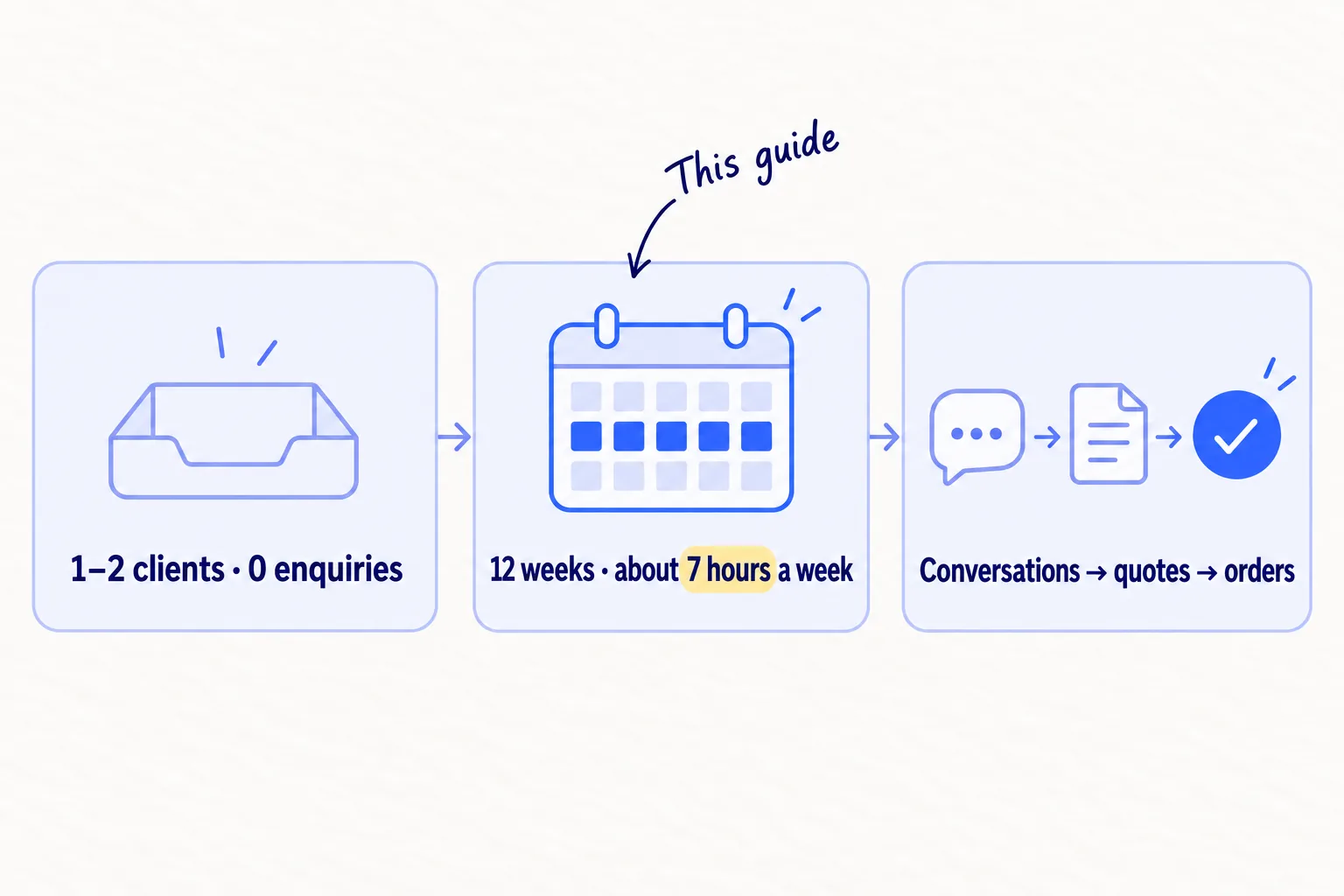
Your first one or two clients came from people you already knew, and now that list has run out. Here is how to market your B2B business when you do all the selling yourself: one routine, about 7 hours a week, for 12 weeks. If you wait for your website or a few LinkedIn posts to bring enquiries, expect almost nothing, because most buyers choose a favourite supplier before they contact anyone.
Do these three things
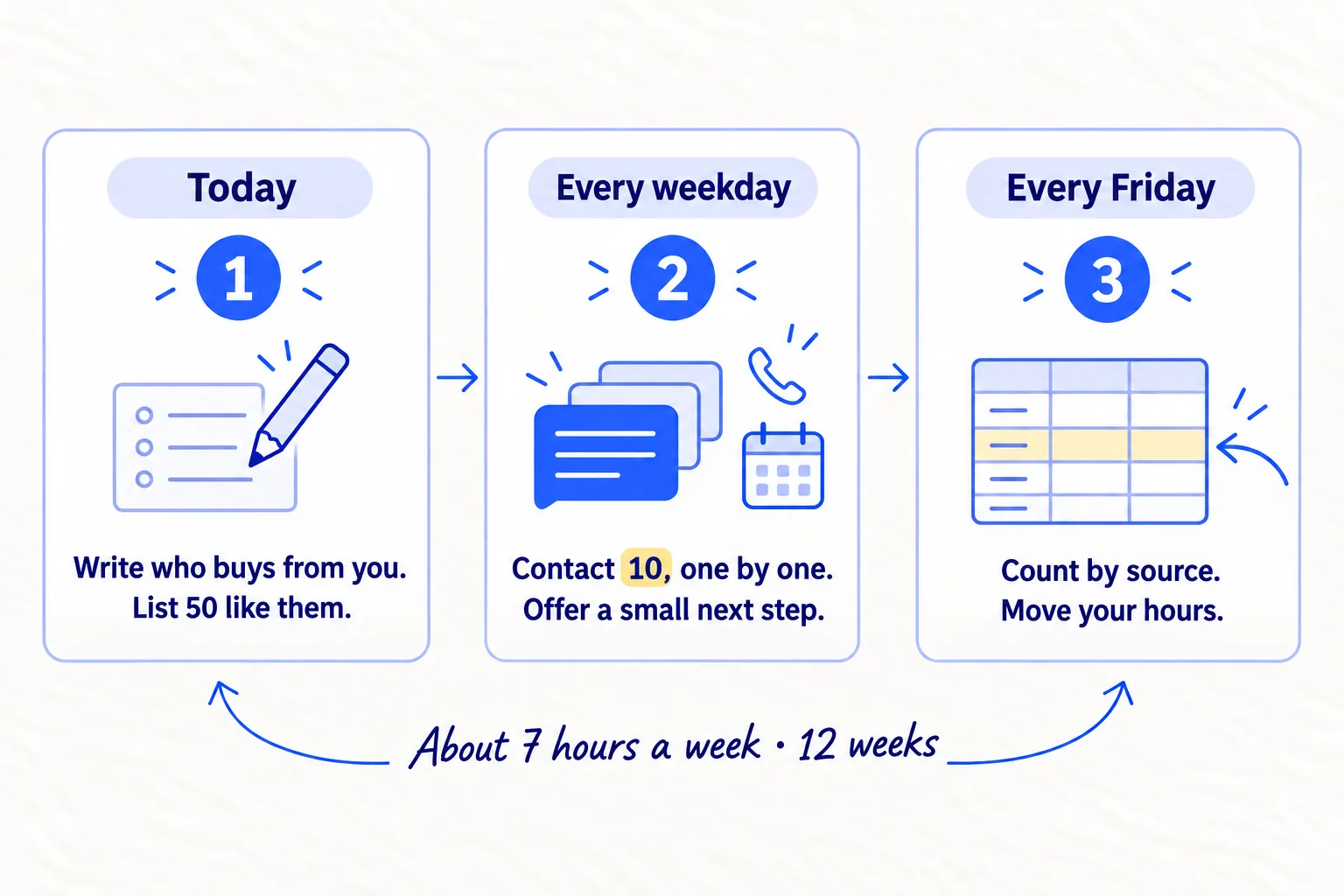
About 7 hours a week, after a first week of setup. Judge replies after 4 weeks and orders after 12.
Show the three actions in fullHide the full list
- Today: write one sentence that says who buys from you, using your first two clients. Then start a list of 50 companies like them, each with the name of the person who buys.
- Every weekday: contact 10 of them one by one, by email, phone or LinkedIn. Offer one small next step: a sample, a quick check or a 15-minute call. Follow up 3 times, because many replies come from the follow-ups.
- Every Friday: count this week's conversations, quotes and orders by where each one came from. Give next week's hours to the place that brought the most.
Get help doing these
ChatGPT or Claude reads this guide and works through it with you.
1. Ask your first clients why they bought, then write who you sell to
Call your first two clients, ask them four questions, and use their answers to write one sentence about who buys from you. Every other step uses this sentence, so do it first.
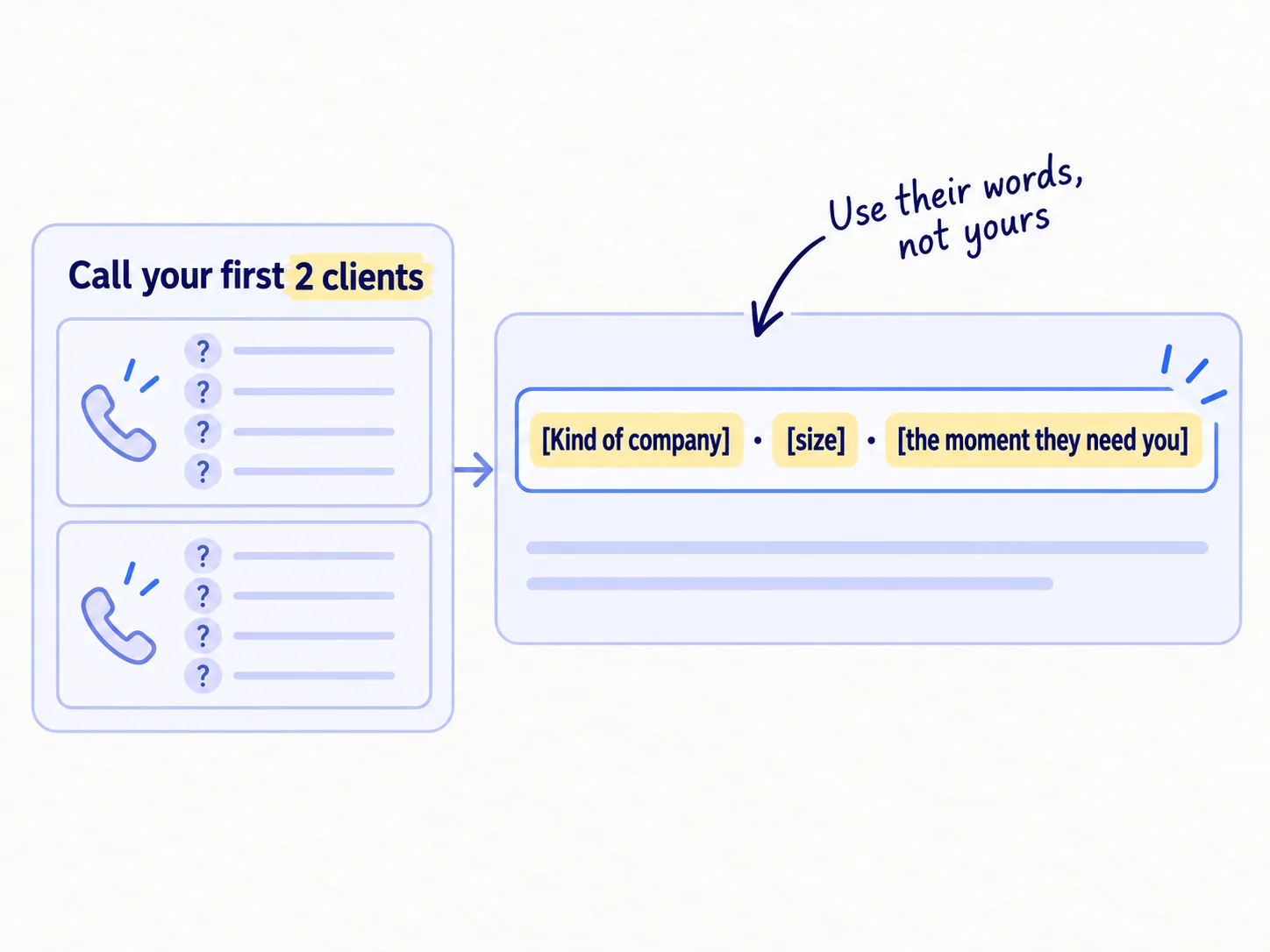
Your first clients know why they chose you better than you do. Ask each one these questions on a 20-minute call. Write down their exact words.
What made you look for a new [supplier / partner / tool] when you did?
What else did you look at, and why did you pick us?
What almost stopped you from buying?
Who else do you know with the same problem?
Then fill in this line, using their words:
[Your company] is for [kind of company] of [size] who [the moment they need you], and today they [what they do instead].
- Tool: your phone and a Google Doc.
- Time: two 20-minute calls, then 30 minutes to write.
- You will have: one sentence, and a page of your clients' own words.
- It worked if: both clients read the sentence and say "yes, that's us", and you can name 20 more companies that fit it.
- Common mistake: writing "small businesses" or "any company that needs [what you sell]". That is too wide to find anyone by name. Name the kind of company and the moment it needs you.
See it done: Carvelian's sentence
Carvelian Packaging is a made-up maker of custom printed boxes for small food and drink brands. One founder sells through calls, samples and quotes.
It started 5 months ago. It has 2 clients, both from the founder's old contacts, with an average order of about $3,000. The website has brought no enquiries yet.
The sentence: Carvelian Packaging is for small food and drink brands that have just got into shops or cafés and want their own printed box, and today they use plain boxes with stickers because big print firms want huge minimum orders.
Why it works: It names the kind of company and the moment it needs a box, so the founder can find 50 of them by name.
For more on choosing who to sell to, see How to create an ideal customer profile. For running the calls, see How to do customer interviews.
2. Tell everyone you already know what you sell, and ask for one introduction
Write a list of 50 people who know you, and send each one a personal note that says what you sell and asks for one introduction. Founders in B2B forums in 2026 give the same answer again and again: the first clients came from people they knew, and from the people those people knew.
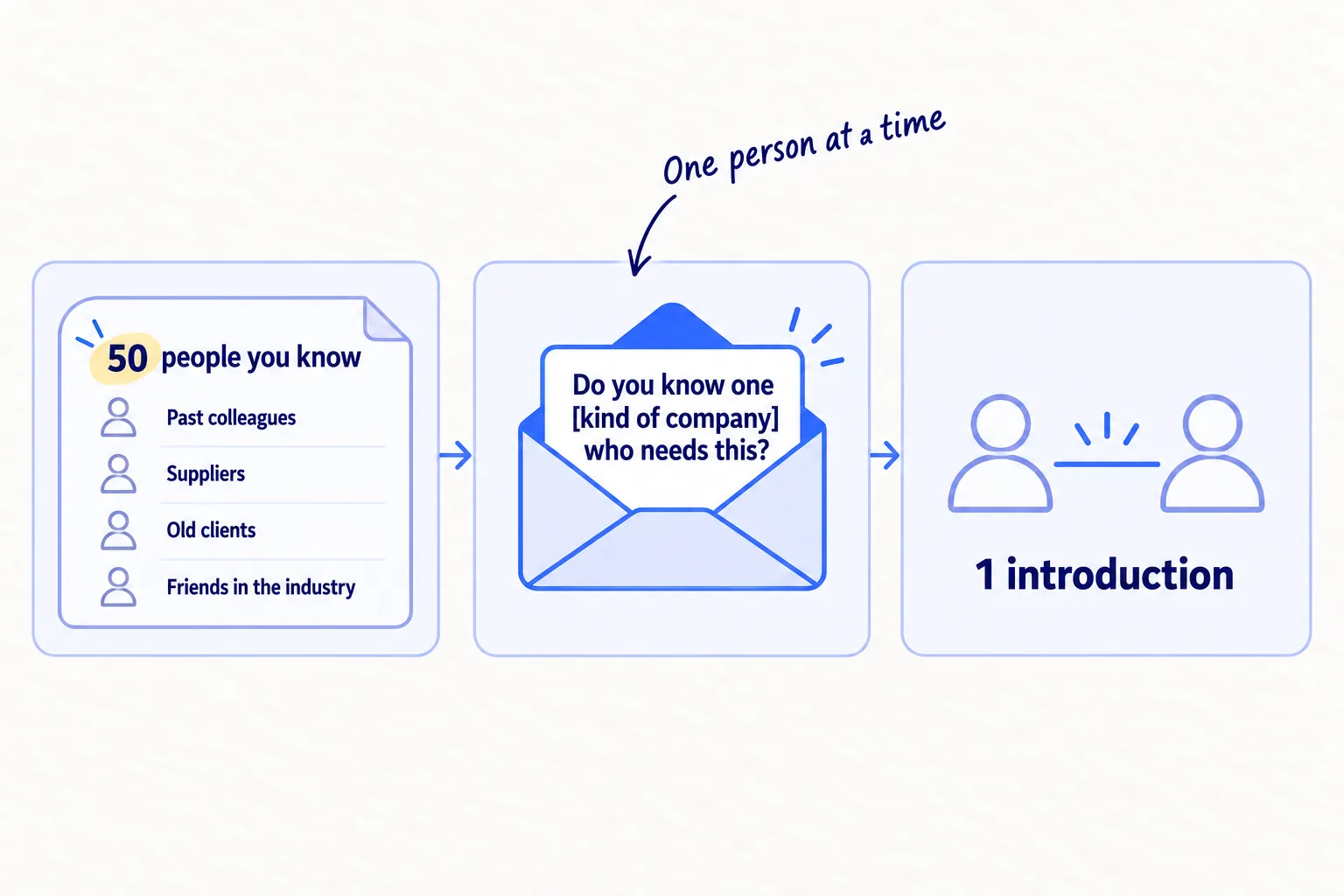
Put these people in a Google Sheet: past colleagues, suppliers you worked with, people at old clients, and friends who work in your buyers' industry. Then send 10 notes a day until you have asked all 50. Send each one by hand, from your own email or as a LinkedIn message to someone you are already connected to.
If you left a job with a non-solicitation clause, read it before you contact that employer's clients.
Subject: a quick favourHi [first name],[One line about how you know each other.]I've started [your company]. We [what you do] for [who you sell to, from step 1].Do you know one [kind of company or job title] who might need this in the next few months? A name is enough, and I'll say you sent me.[Your name]
- Tool: Google Sheets, Gmail or LinkedIn messages.
- Time: 1 hour to write the list, then 30 minutes a day for the first week.
- You will have: 50 people asked, and a list of names they gave you.
- It worked if: you get at least 3 introductions or conversations from the 50. Contact each introduction within 2 days, and mention who sent you.
- Common mistake: posting "We're open for business!" on LinkedIn instead of asking people one by one. The other mistake is a vague ask like "let me know if you hear of anyone". Ask for one name, of one kind of company.
When the same kind of business keeps sending you clients, turn it into a regular deal. See How to set up referral partnershipssoon. For the full first-clients routine, see How to get your first B2B clients.
3. Build a list of 50 companies that fit your sentence, with a named buyer
Make a sheet of 50 companies that match your step 1 sentence, and write down the person at each one who buys what you sell. You cannot contact a company. You can only contact a person.
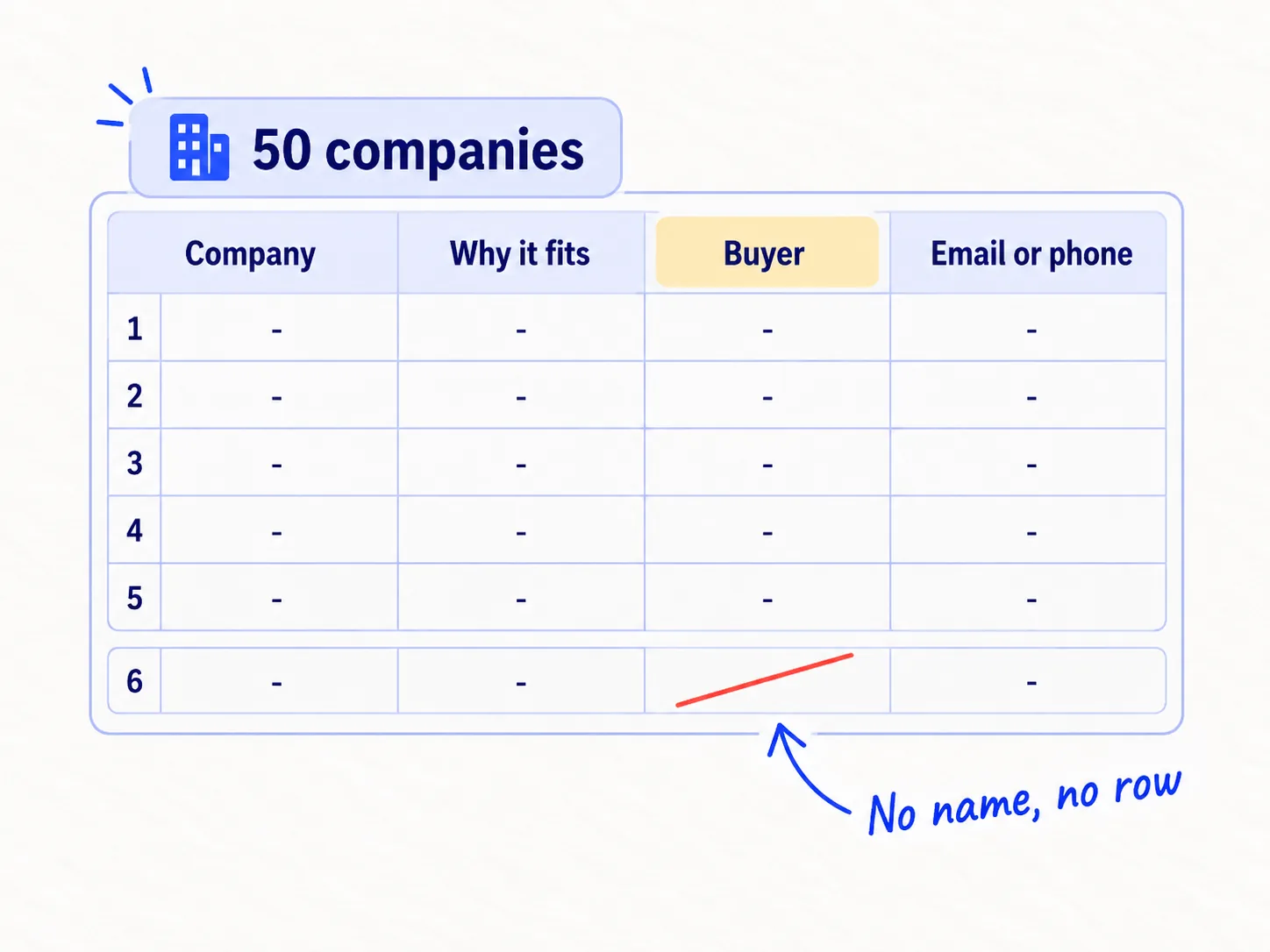
Look where your buyers already show themselves:
- If you make or wholesale a product: the shops, cafés and websites that sell your buyers' goods, and the member lists of their trade associations.
- If you sell a service or sales-led software: LinkedIn search for the job title in your sentence, and Google for the kind of company plus your city or region.
For each company, find the person who orders what you sell: the founder in a small firm, or the operations, buying or IT lead in a bigger one. Their company's "About" or "Team" page often names them. To find a work email, use Hunter's free plan. It gives 50 credits a month, and a search only uses a credit when it finds an email.
Company | Website | Why it fits (one fact) | Buyer name | Role | Email or phone | Date contacted | Reply | Next step | Source
- Tool: Google Sheets, LinkedIn search, and Hunter (free plan).
- Time: about 3 hours for 50 rows. After that, add 10 rows a day as you use them up.
- You will have: 50 rows, each with a named person and one reason they fit.
- It worked if: every row has a person's name and a way to reach them, and at least 40 of the 50 fit your sentence exactly.
- Common mistake: buying a list of 5,000 contacts. You cannot write a personal line to 5,000 people, and bulk mail from a new list lands in spam.
See How to create a B2B lead list for freesoon and How to find a decision maker's email addresssoon.
4. Contact 10 companies every weekday and offer one small next step
Every weekday, contact 10 people on your list, one by one, and offer something small and useful instead of asking for a meeting. Then follow up 3 times.
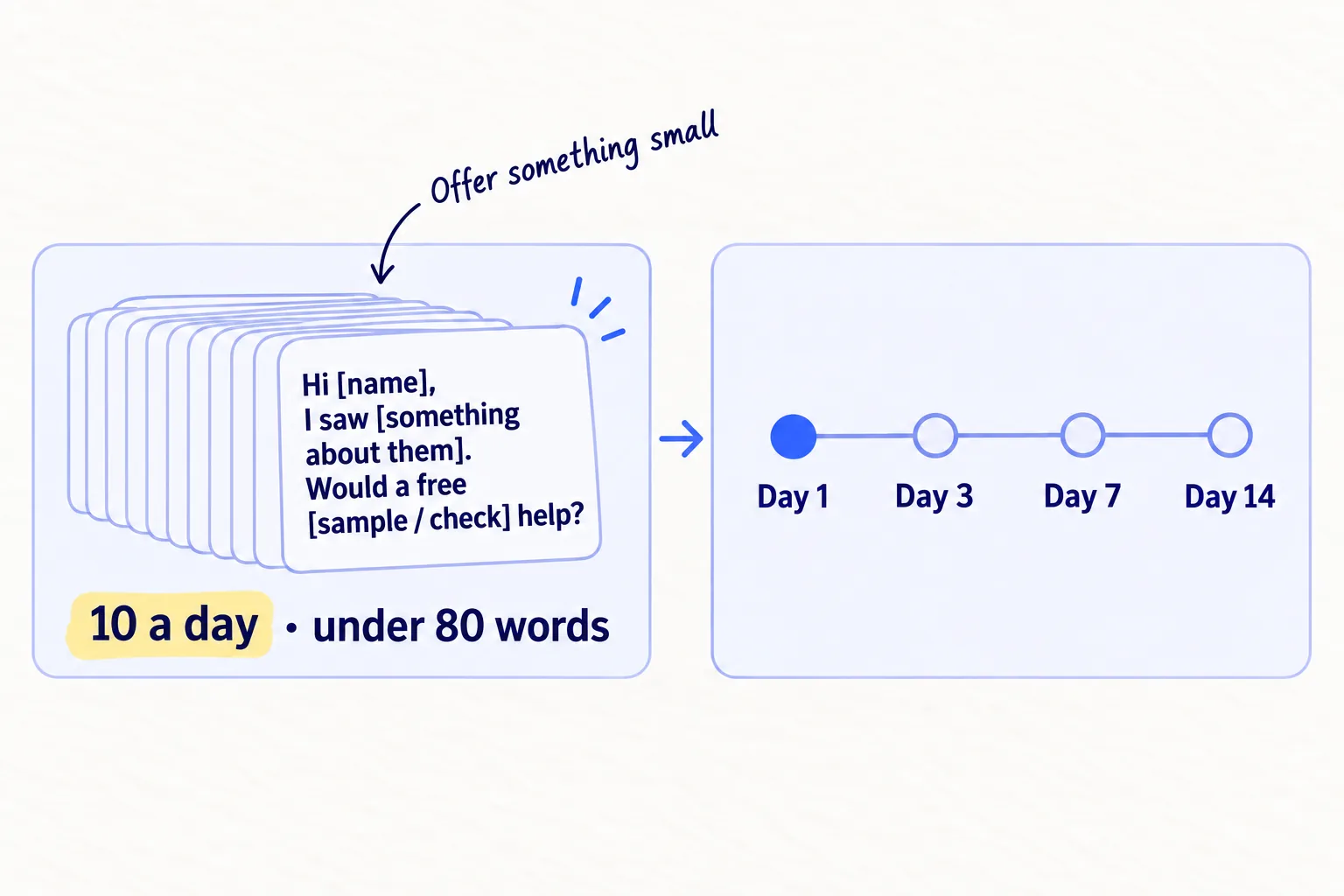
A small next step is easy to say yes to. "Book a demo" asks a stranger for 30 minutes. "Can I post you a free sample?" or "Want me to check your current setup?" asks for almost nothing. Pick the one that fits what you sell.
Send email from your business address (you@yourcompany.com), one at a time. Gmail requires every sender to have SPF or DKIM, two settings that prove an email really comes from your domain. Ask your email host to confirm both are on. Since November 2025, Gmail has been rejecting more mail that breaks its rules, so bulk email from a new tool or a new domain lands in spam.
For the smallest companies, phone instead. Ask "Who orders your [what you sell]?", then ask that person for 2 minutes. On LinkedIn, message people you are already connected to. A free account lets you add a note to only a few connection requests each month.
Subject: [their company] + [what you make or fix]Hi [first name],[One true line about them: something they launched, sell or said.]I [what you do] for [who you sell to]. [One line of proof: a client like them and the result.]Would [a free sample / a quick check of X / a 15-minute call] help? I can do it [this week / next week].[Your name], [company], [phone]
Day 3: Hi [first name], bringing this back up. Happy to [the small next step] this week if it helps.Day 7: [One short, useful tip about their situation.] The offer of [the small next step] still stands.Day 14: I'll stop here. If [the problem] comes up later, my number is [phone].
Keep the first message under 80 words. In Instantly's 2026 benchmark of cold email sent in 2025, the best first emails were under 80 words, and 42% of all replies came from follow-ups, not the first email. When someone says yes, send the sample or book the call, and follow How to run a discovery callsoon.
- Tool: Gmail from your business address, your phone, and Cal.com (free for one person) for booking calls. Log everything in your step 3 sheet.
- Time: 1 hour a weekday: 10 new messages, plus the follow-ups that are due.
- You will have: 50 companies contacted a week, and 200 after 4 weeks.
- It worked if: you get at least 2 conversations (a call, a meeting or a sample request) for every 50 companies, after all follow-ups. If you get fewer than 1, change the offer or the list before you contact more.
- Common mistake: a long first email about your company, or no follow-ups. The other mistake is sending hundreds of copies of the same email from a bulk tool.
See it done: Carvelian's first message
To: Priya, founder of a small hot-sauce brand
Subject: Pepperwick + your gift-set box
Hi Priya,
I saw Pepperwick's 3-bottle gift set in Hollis Market last week. The new labels look great.
I make custom printed boxes for small food and drink brands, in short runs.
Would a free printed sample box for the gift set help? I can post one next week.
Dan, Carvelian Packaging, [phone]
Why it works: The first line is about her brand, and it offers a free sample instead of asking for a meeting.
For subject lines and more follow-ups, see How to write a cold emailsoon and How to follow up on a cold emailsoon. For phoning, see How to cold call past the gatekeepersoon.
5. Make your website ready for the buyers who check you
Rewrite the top of your homepage so a buyer who checks you can see what you sell, who it is for and what to do next. Then check that Google and ChatGPT can read your site.
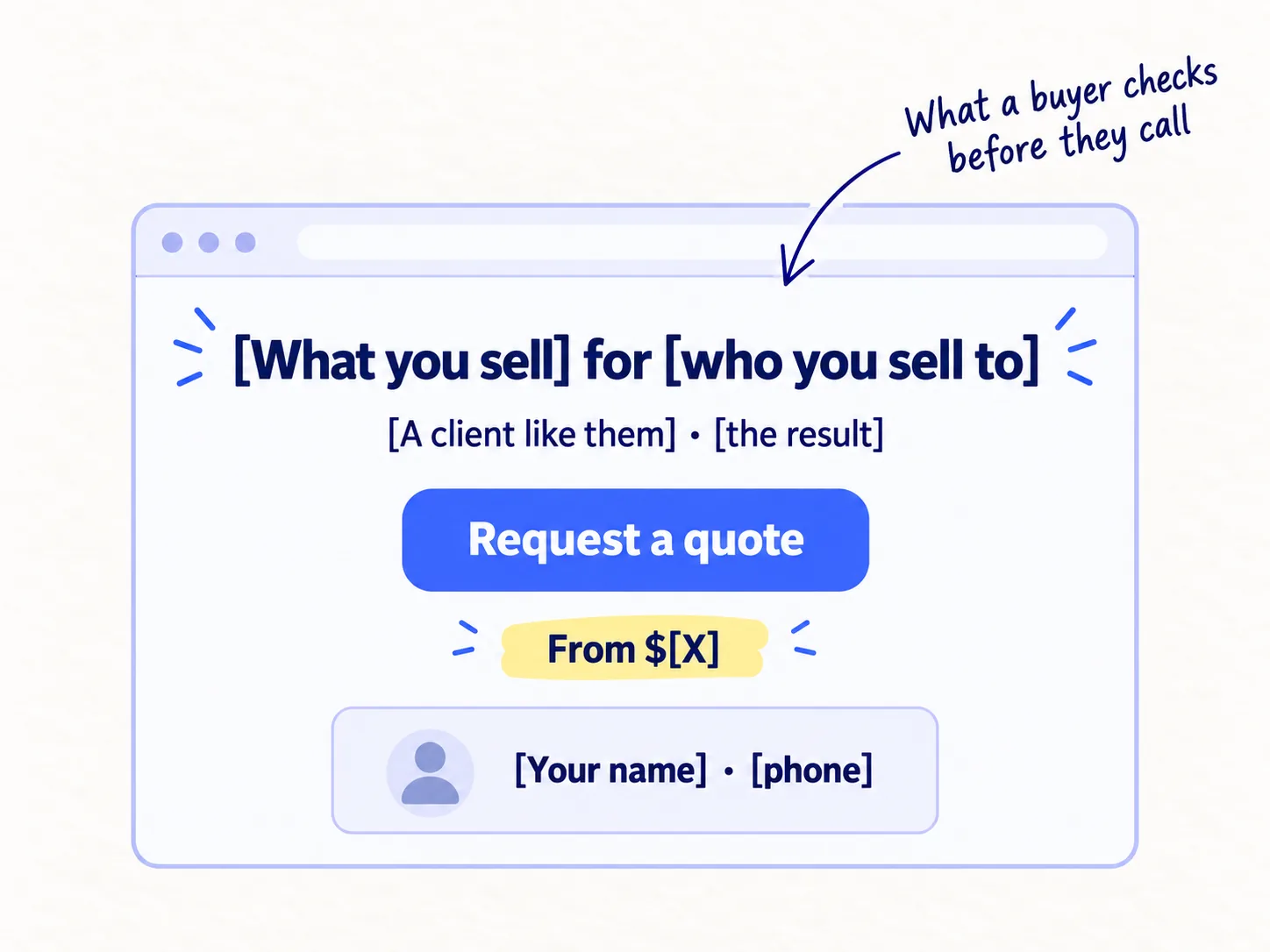
Expect every buyer you contact in step 4 to check your website before they reply. In 6sense's 2025 survey of nearly 4,000 business buyers, 94% of buying groups had ranked their preferred suppliers before first contact, and buyers started 79% of the conversations themselves. Those were large purchases, but the lesson holds for yours: your website has to answer a buyer's questions without you in the room.
Headline: [What you sell] for [who you sell to, from step 1].Under it: [A client like them] [the result you got them, with a number].One button: [Request a quote / Request a sample / Book a 15-minute call]A starting point: From $[X] / Orders from [N] units / Typical project [range]Your name, photo and phone number.
Then do the setup once:
- 1
Add your site to Google Search Console
Open Search Console, click "+ Add property", choose Domain, and verify it by adding the record Google gives you to your domain's DNS settings. It is free.
- 2
Check your robots.txt
Open yoursite.com/robots.txt, the file that tells crawlers what they may read. If you see "User-agent: OAI-SearchBot" or "User-agent: *" followed by "Disallow: /", remove those lines. OpenAI says sites that block OAI-SearchBot are not shown in ChatGPT search answers.
- 3
Skip special AI files for now
Google says you need no extra files or special markup to appear in AI Overviews or AI Mode. Your pages only need to be indexed.
- Tool: your site editor and Google Search Console.
- Time: about 3 hours.
- You will have: a homepage a buyer can act on, and a site Google and ChatGPT can read.
- It worked if: you show the page to 5 people for 5 seconds, and at least 4 can say what you sell and who it is for. In Search Console, URL Inspection shows "URL is on Google" within 1 to 2 weeks. Once a month, ask ChatGPT "Who are good [your category] suppliers for [your buyer]?" and write down who it names.
- Common mistake: a headline like "Innovative solutions for forward-thinking businesses", and a "Contact us" form as the only next step. A buyer cannot tell what you sell or what happens after they write.
See it done: Carvelian's homepage headline
Before
Innovative packaging solutions for forward-thinking brands
After
Custom printed boxes for small food and drink brands. Get a free sample box before you order.
Why it works: The new headline says what they make, who it is for and the first step, so a buyer who checks them knows what to ask for.
For the rest of the page, see How to get more leads from a B2B websitesoon. For being named in AI answers, see How to get your company recommended by ChatGPT as a suppliersoon.
6. Post one proof or lesson a week on LinkedIn from your own profile
Once a week, post on LinkedIn from your own profile about a problem you solved for a client. The post does not need to bring clients by itself. It gives the people you message in step 4 a reason to trust you when they look you up.
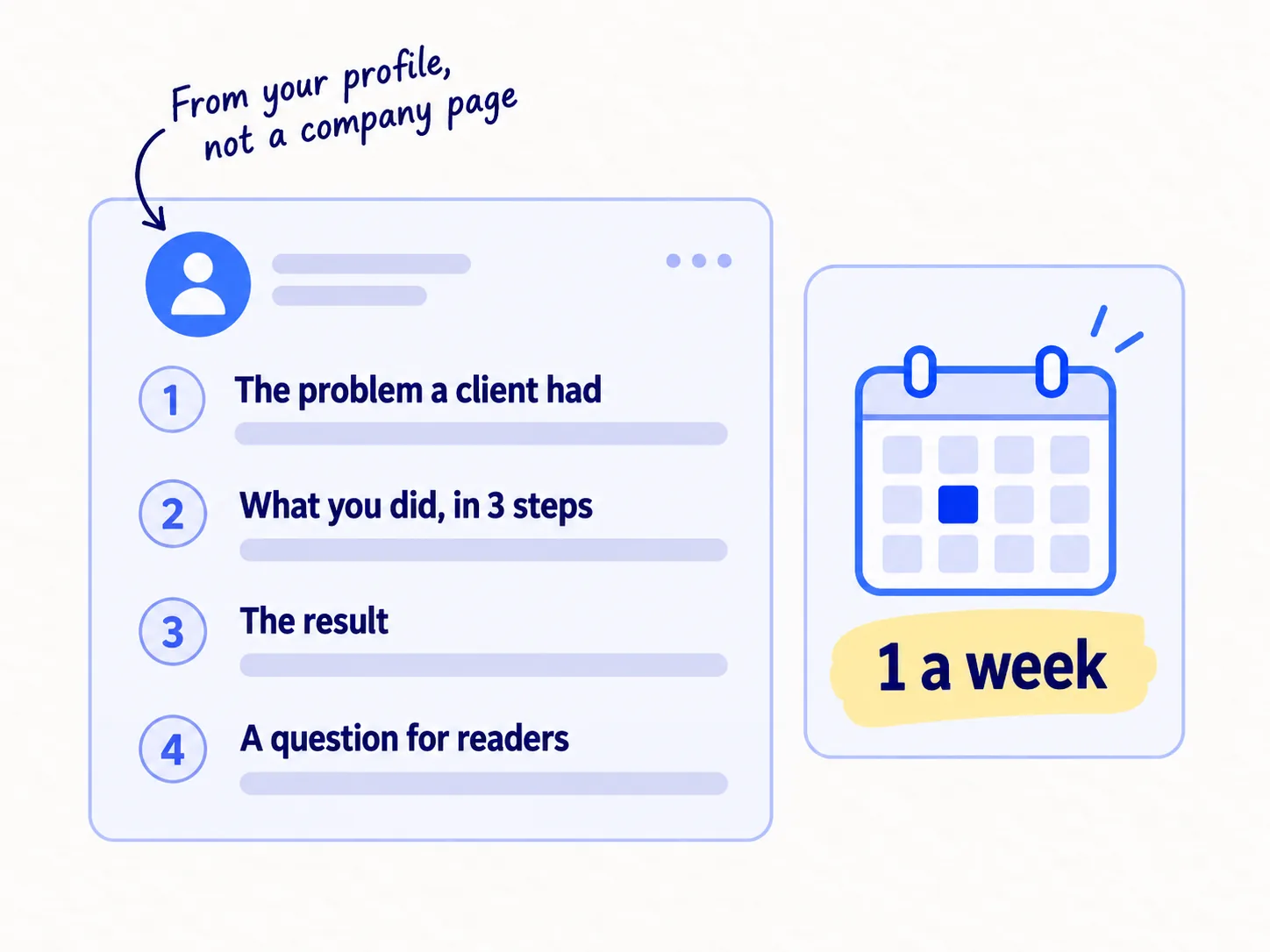
Write about one real job, with your client's permission, not general tips. If they do not want to be named, describe them instead: "a 12-person coffee roaster".
[The problem a client had, in their words.][What you did, in 3 short lines.][The result, with a number if you have one.][A question for people with the same problem.]
- Tool: LinkedIn, from your personal profile.
- Time: 45 minutes a week.
- You will have: 12 posts after 12 weeks, and a profile that shows your work to anyone who checks you.
- It worked if: by week 12, at least 2 conversations started from a post, or the person mentioned one.
- Common mistake: posting from a company page with a handful of followers, or judging posts by likes. Count the conversations they start.
For ideas, see LinkedIn post ideas for B2B companiessoon and How to grow on LinkedIn as a foundersoon. For writing up a client result, see How to write a case studysoon.
7. Count your numbers every Friday and move your hours
Every Friday, fill in one row in a sheet: how many companies you contacted, the replies, conversations, quotes and orders, and where each conversation came from. After 4 weeks, stop what brought nothing and give its hours to what worked.
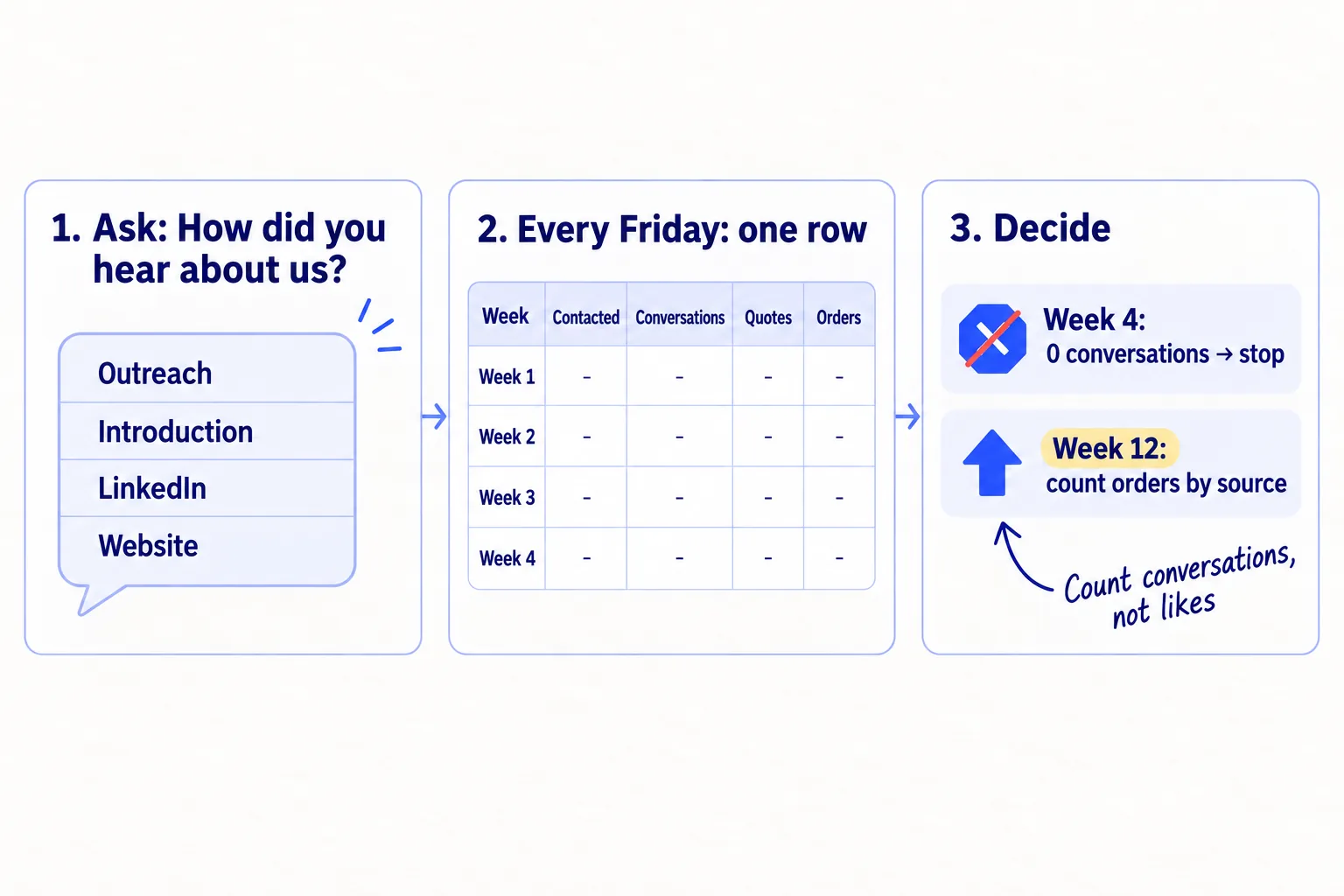
Add "How did you hear about us?" to your quote form, and ask it at the start of every first call. Without it, you are guessing.
Week | Contacted | Replies | Conversations: outreach | Conversations: introductions | Conversations: LinkedIn | Conversations: website | Samples or quotes sent | Orders | Order value
At the end of week 4, look at each source. If one brought 0 conversations, stop it and move its hours to the one that brought the most. If outreach brought fewer than 1 conversation per 50 companies, change the offer or the list, not the channel. At week 12, count orders by source, and do more of what brought them.
Leave paid ads until at least 5 orders have come from outreach and you know which message gets replies. Before that, ads pay to send strangers to a message you have not tested.
- Tool: Google Sheets.
- Time: 20 minutes each Friday.
- You will have: one row per week, and a clear answer on where your conversations and orders come from.
- It worked if: you can name where every conversation and every order came from.
- Common mistake: judging after one week, or counting followers and likes instead of conversations and orders.
See it done: Carvelian after 4 weeks
The Friday sheet, weeks 1 to 4
| Week | Contacted | Replies | Conversations: outreach | Conversations: introductions | Conversations: LinkedIn | Samples or quotes sent | Orders |
|---|---|---|---|---|---|---|---|
| 1 | 50 | 3 | 2 | 2 | 0 | 1 | 0 |
| 2 | 50 | 4 | 2 | 1 | 0 | 1 | 0 |
| 3 | 50 | 5 | 3 | 1 | 0 | 2 | 0 |
| 4 | 50 | 4 | 2 | 0 | 1 | 1 | 1 |
The decision: outreach brought 9 conversations from 200 companies, so the founder keeps 10 a day. Introductions brought 4 conversations and the first new order, about $3,000, so he asks both clients again and writes to 50 more old contacts. LinkedIn brought 1, so he keeps one post a week and adds no more. He judges orders at week 12.
Why it works: The founder moves hours by counting conversations and orders, not likes or visits.
For a fuller way to track sources, see How to track which channel brought each dealsoon. For choosing what to add next, see How to choose marketing channels for a B2B company.
Where Scout7 helps
Scout7 speeds up parts of steps 1 and 5.
Step 1. Scout7's brand intelligence reads your website and builds a brand profile: what you sell, your value proposition and who you sell to. Compare it with your step 1 sentence. If they do not match, your website does not say it clearly yet. Scout7's audience research reads public social conversations in your category and builds audience segments with pain points and quotes in buyers' own words. It does not replace the calls with your clients.
Step 5. Scout7 builds your competitor set and reports which competitors are winning the Google and AI answers you want, and by how much. That turns the monthly "who does ChatGPT name?" check into a list you can act on.
Your B2B marketing checklist for the next 12 weeks
0 of 16 done
Work through this list with an AI assistant
It drafts the work and keeps track of what is done.
Frequently asked questions
- How long does it take to get B2B clients?
At 10 companies a day, your first conversations should come in week 1 or 2, and your first samples or quotes by week 3 or 4. Orders take longer, because buyers compare suppliers and wait for a budget or a reorder date. Judge orders at week 12. If you have contacted 400 companies and had no conversations, go back to step 1.
- Should I pay for LinkedIn or Google ads now?
Not yet. Wait until at least 5 orders have come from outreach and you know which message gets replies. Before that, ads send strangers to a message you have not tested, and a small budget runs out before you learn anything. When you are ready, see How to run LinkedIn ads for B2Bsoon.
- Are trade shows worth it for a small B2B business?
Go to one as a visitor before you pay for a stand. Get the exhibitor list first, email 10 people you want to meet, and book times with them. Follow up with everyone within 2 days. Pay for a stand only once you know which offer wins orders. See How to get meetings from a trade showsoon.
- My clients will not let me use their name. How do I show proof?
Describe the client instead of naming them: "a 12-person coffee roaster" or "a regional accounting firm". Give the problem, what you did and the result with a number. Ask the client to approve the text before you use it. An unnamed result with a real number still shows a buyer you have done this before.
- Should I put prices on my B2B website?
Show a starting point, such as "from $1,500" or "orders from 500 units". Buyers check you before they call, and a starting point lets the right ones contact you. If every job is custom, show a typical range from your last few jobs. Keep the full quote for the call.
Sources
- 1.The Timeline for Influencing B2B Buyers Is Shrinking: Insights From 6sense's 2025 Buyer Experience Report — 6sense, 12 November 2025
- 2.The B2B Buyer Experience Report for 2025 — 6sense, checked 24 September 2026
- 3.Cold Email Benchmark Report 2026 — Instantly, updated 12 January 2026
- 4.Email sender guidelines — Google Workspace Admin Help, checked 24 September 2026
- 5.Email sender guidelines FAQ — Google Workspace Admin Help, checked 24 September 2026
- 6.Overview of OpenAI crawlers — OpenAI, checked 24 September 2026
- 7.AI features and your website — Google Search Central, updated 10 December 2025
- 8.Add a website property to Search Console — Google Search Console Help, checked 24 September 2026
- 9.URL Inspection tool — Google Search Console Help, checked 24 September 2026
- 10.Personalize invitations to connect — LinkedIn Help, checked 24 September 2026
- 11.Pricing — Hunter, checked 24 September 2026
- 12.Pricing — Cal.com, checked 24 September 2026
- 13.Ask HN: How did you land your first projects as a solo engineer/consultant? — Hacker News, April 2026
Next article to read
How to get your first B2B clientsB2BOnce you know who to sell to, this shows how to win your first paying clients.Read it nextRelated guides
- How to choose marketing channels for a B2B companyB2BChoose marketing channels for your B2B company in 6 weeks: ask five buyers where they look, test two channels next to your outreach, and keep the one with the most conversations per hour.
- How to create an ideal customer profileCreate an ideal customer profile when you have one or two customers: list everyone who paid, tried or talked to you, write 2 or 3 one-sentence guesses, test them with 100 messages a day, and keep the one that gets the most chats after 1,500 messages.
- How to create a B2B lead list for freeComing soon
- How to run a discovery callComing soon
Guides that link here
Cite this page
Dinesh Bypilla (2026). How to market your B2B business. Scout7 Academy. https://scout7.ai/academy/marketing-plan/how-to-market-your-b2b-business
Written by Dinesh Bypilla, Agentic systems engineer at Scout7. Reviewed by Murali Sid. Last checked 24 September 2026.
Quote any part of this guide with a link back to this page. © 2026 Scout7.
Markdown version of this page: https://scout7.ai/academy/marketing-plan/how-to-market-your-b2b-business.md