



How to price digital marketing services
Price your digital marketing services when it is just you: work out your lowest price per hour, turn it into one monthly package with three options, send a price after every call, and change it by counting wins every Sunday.
ByDinesh BypillaReviewed byMurali SidLast checked 16 min read
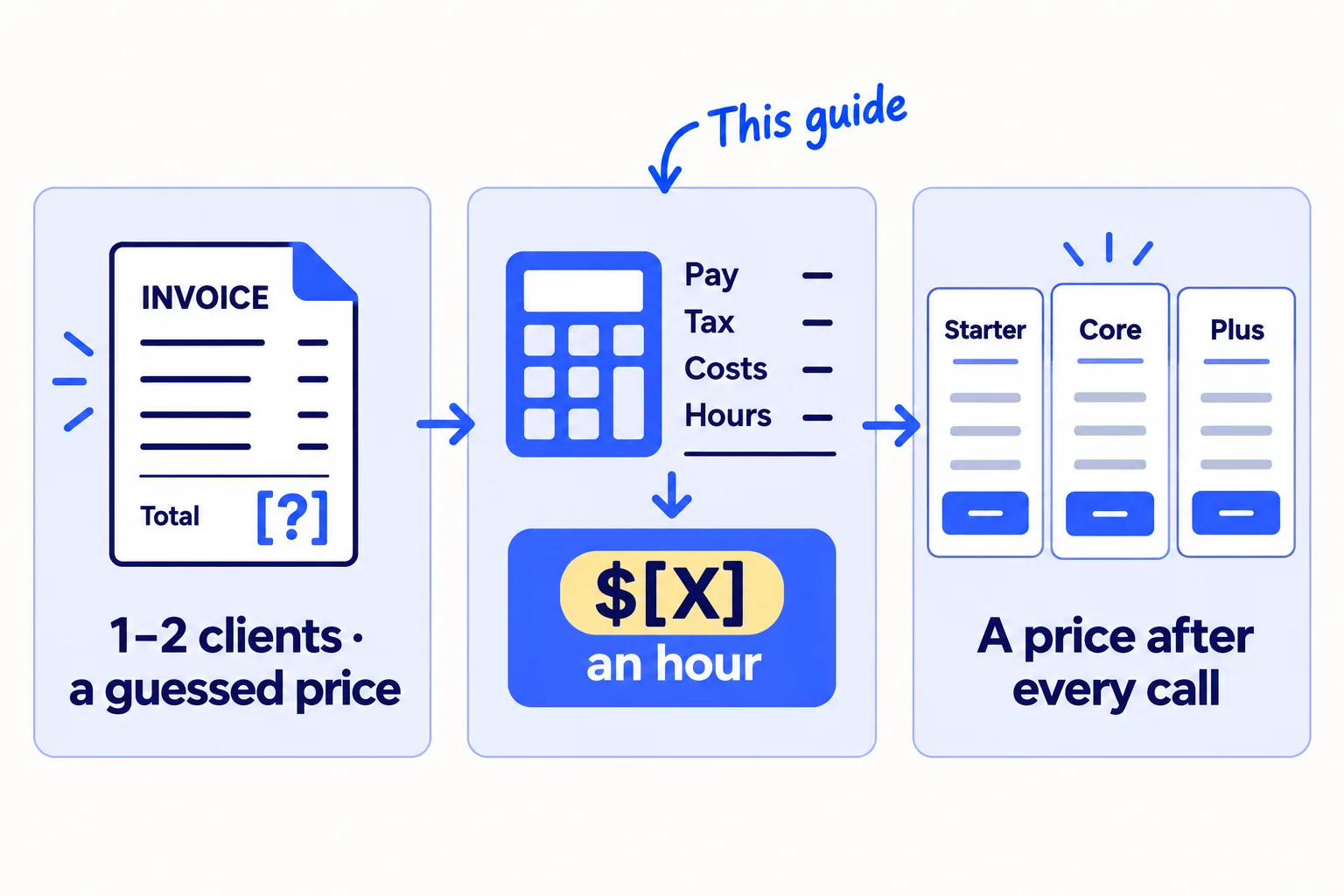
You have one or two clients on a price you guessed, and you do not know if it pays you. Here is how to price digital marketing services when it is just you: work out the lowest price that covers your pay, then turn it into one monthly package and test it on every call. If you copy a range from an agency blog, such as "$1,000 to $20,000 a month", you will either lose deals you could have won or work more hours than anyone pays you for.
Do these three things
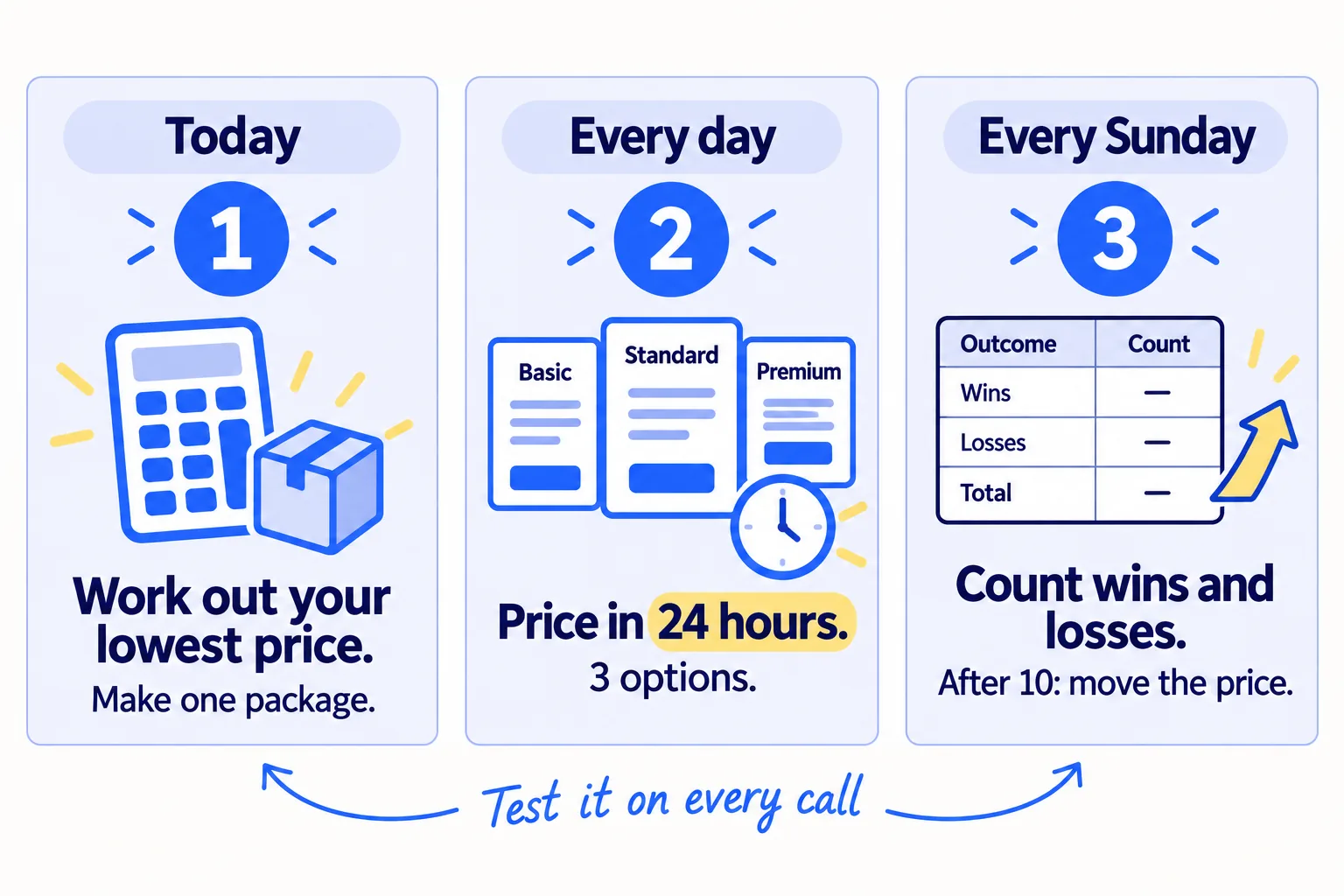
About 3 hours today to set the price, then 20 minutes after each call and 20 minutes each Sunday. Judge the price after every 10 proposals, not after one no.
Show the three actions in fullHide the full list
- Today: work out your lowest price per hour from the pay, tax and costs you need and the client hours you can sell. Turn it into one monthly packagesoon with a fixed list of work.
- Every day: send a written pricesoon with three options within 24 hours of every call. Keep booking calls with 100 personal messagessoon a day.
- Every Sunday: count proposals won and lost, and why. After every 10, raisesoon the next price by 20% if you won more than half. If most said no to the price, cut the work, never the rate.
Get help doing these
ChatGPT or Claude reads this guide and works through it with you.
1. Work out the lowest price you can charge per hour
Your lowest price per hour is the money you need each month, divided by the client hours you can really sell. Below it, you work for less than you need. Work it out before you quote anyone, because every other number in this guide starts from it.
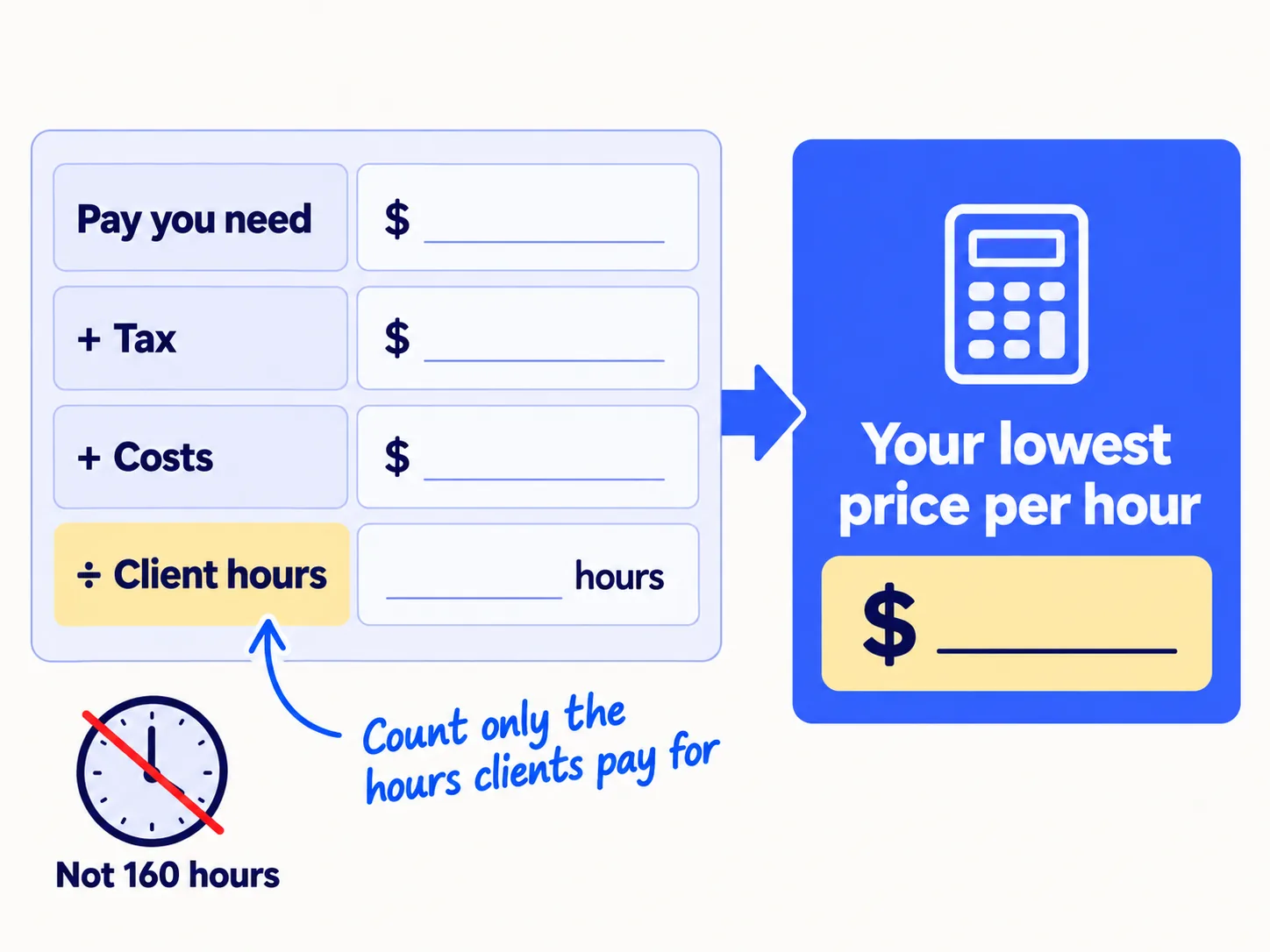
Fill in five numbers in a Google Sheet:
Pay you need each month, after tax: $[ ]
Tax share you set aside: [ ]%
Pay before tax: line 1 ÷ (1 − line 2) = $[ ]
Business costs each month (tools, software, accountant, insurance): $[ ]
Client hours you can sell each month: [ ]
Lowest price per hour = (line 3 + line 4) ÷ line 5 = $[ ]
- Costs. Include every tool you pay for each month and your own marketing budget, the money you spend finding clients.
- Tax. In the US, you pay self-employment tax of 15.3% on your profit (12.4% for Social Security and 2.9% for Medicare), on top of income tax. Ask an accountant for your full share once, and use it here. Outside the US, ask about your own country's rules.
- Client hours. Do not use 160 hours a month. When it is just you, part of every week goes on finding clients, sales callssoon, invoices and learning. Plan your week so those hours are set aside first. Look at last month and count only the hours you spent on work a client paid for. If you have no clients yet, start with 24 hours a week, about 96 a month.
- Current clients. Divide what each client pays by the hours you really spent on them last month. That is what you earn per hour today. If it is below your lowest price, step 3 says what to do.
AI can help with the sums. Paste your five numbers into ChatGPT or Claudesoon and ask it to check the maths. The numbers themselves must be yours.
- Tool: Google Sheets. Free.
- Time: 45 minutes, plus one question to an accountant.
- You will have: one number, your lowest price per hour, and what each current client pays you per hour.
- It worked if: the number covers your pay, your tax and your costs, and you can say which current client pays you less than it.
- Common mistake: dividing by 40 hours a week, or leaving out tax. Both make the number look lower than it is, and you find out when the tax bill comes. The other mistake is keeping the hourly rate you charged as a freelancersoon, when you now also pay for your own tools, sales and admin.
See it done: Quillfox's lowest price per hour
Quillfox is a made-up one-person agency. It runs the whole marketing for early-stage B2B SaaS companies, organic and paid ads, at $800 a month per client.
Lowest price per hour
| Line | Number |
|---|---|
| Pay needed each month, after tax | $4,500 |
| Tax share (from the accountant) | 25% |
| Pay before tax: $4,500 ÷ 0.75 | $6,000 |
| Business costs each month | $400 |
| Client hours to sell each month | 96 |
| Lowest price per hour: $6,400 ÷ 96 | $67 |
| Each current client: $800 ÷ 16 hours | $50 an hour, below the lowest |
Why it works: It counts only the hours a client pays for, so the number shows the $800 clients pay less than it costs to serve them.
2. Write one monthly package and price it from its hours
Price your services as one monthly package: a fixed list of work for your one kind of client, priced from the hours it takes you. List every piece of work, time each one, then use this sum: hours × your lowest price per hour ÷ 0.65.
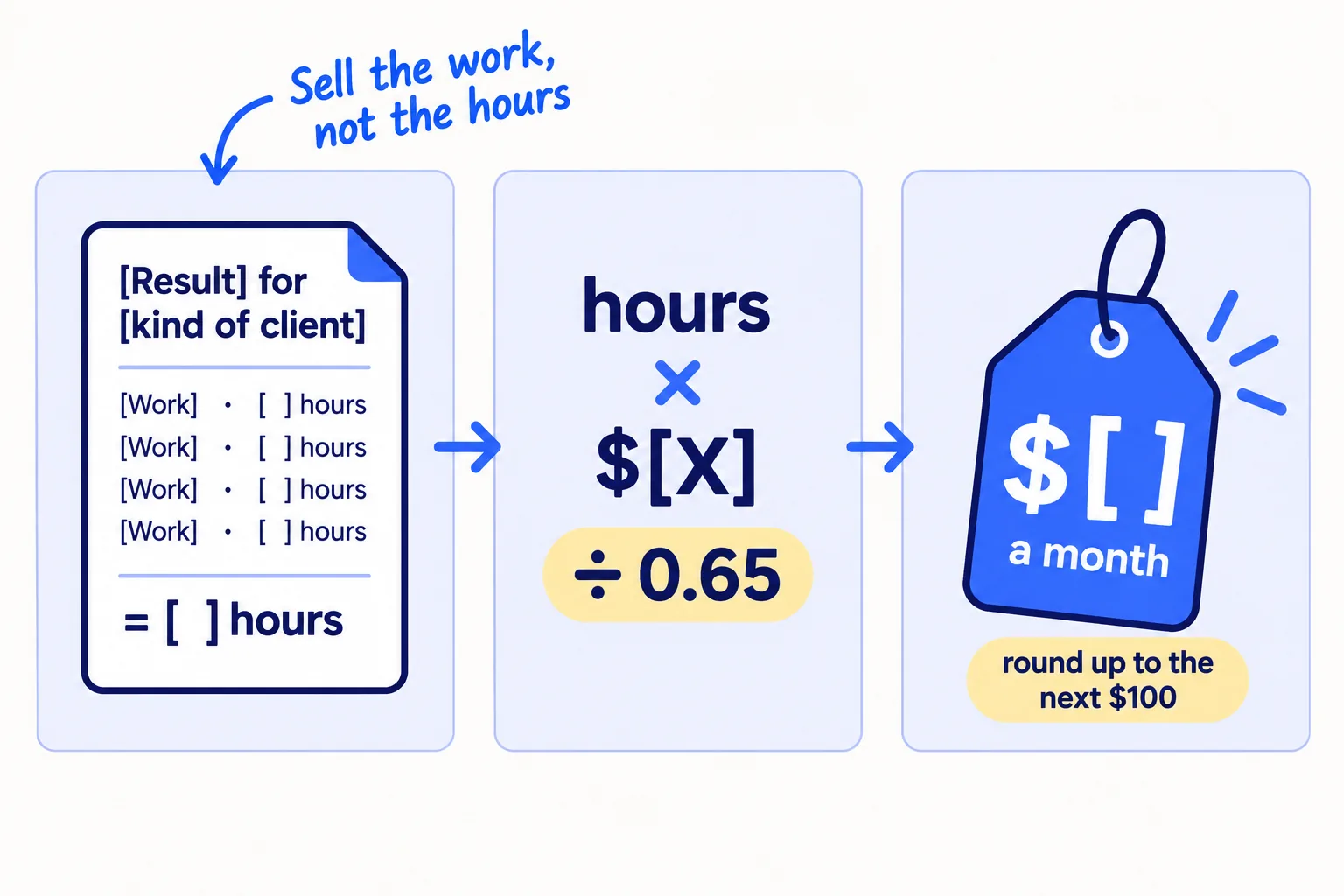
The package is for the one kind of clientsoon you chose, and it names the result you get them, from your value proposition. Then write down every piece of work you will do each month, and the hours each takes you with AI draftingsoon: postssoon, articlessoon, ad changes, the monthly reportsoon, one call. Time the next piece you make for a real client instead of guessing. If you pay someone else for part of the work, such as white-label SEOsoon, add what you pay them to the cost before you divide by 0.65. Price new services, such as AI visibility worksoon, the same way. If you only sell social media, see how to price social media managementsoon.
Why 0.65: dividing by 0.65 adds a 35% margin, money the business keeps on top of your pay for slow months, unpaid work and new tools. It is the average project margin agencies reported in Promethean Research's 2026 survey of 119 agency leaders. Round up to the next $100.
Sell the work and the result, never the hours. AI makes the work faster, and clients know it. In Productive's March 2026 survey of 174 agencies, 27% had already been asked to cut prices because of AI, and about half expected to be asked soon. If your price is hours, every hour AI saves comes off your bill. If your price is a list of work and a result, it stays the same.
[Package name]: [the result] for [kind of client].Each month you get:
[Work 1, with a number: e.g. 8 posts]
[Work 2]
[Work 3]
A one-page report and a 30-minute call
Not included: [the 2–3 things clients most often ask for, which cost extra].$[price] a month, billed at the start of each month.
The "Not included" line matters as much as the list. It is the start of your scope of worksoon, and it stops a $2,000 package turning into $4,000 of work.
- Tool: Google Docs, and your Google Sheet for the hours.
- Time: 1 hour.
- You will have: one package with a fixed list of work, its hours and its monthly price.
- It worked if: the price is at least hours × your lowest price ÷ 0.65, and a client could read the list and know exactly what arrives each month.
- Common mistake: a menu of 12 services, each with its own price, or a price per hour. Both push the client to buy less, and neither says what result they get.
See it done: Quillfox's Core package
Core: steady trial signups from LinkedIn and Google, for early-stage B2B SaaS
| Work each month | Hours |
|---|---|
| 12 LinkedIn posts for the founder | 6 |
| 2 articles that answer a buyer's search | 6 |
| 1 comparison page | 3 |
| Search Console and signup check, 1-page report | 3 |
| Monthly 30-minute call, with preparation | 2 |
| Total | 20 |
| 20 hours × $67 ÷ 0.65 = $2,062, rounded up | $2,100 a month |
Why it works: Each line of work has its hours, so the price comes from what the work costs to deliver, not from another agency's range.
3. Offer three options and show your starting price
Offer every client three options, from less work to more, with your package in the middle, and show the lowest price on your website. Price each option with the same sum from step 2, so every option pays you.
![Three price cards: Starter with less work, Core in the middle marked as the main option, and Plus with more work. Above them, a website line reads 'From $[X] a month'.](/academy/illustrations/how-to-price-digital-marketing-services/step-3-offer-three-options-and-show-your-starting.webp)
- Starter: the same result, less work. Take out the pieces the client could do without for now.
- Core: your package from step 2.
- Plus: more work, such as more pages, a second channel, or managing adssoon (step 4).
The options must differ in work, not only in price. When a client says "too expensive", point them to Starter instead of cutting Core's price.
Then put the Starter price on your site and your LinkedIn profilesoon: "From $[Starter] a month". A business owner who sees a price and still books a call can afford you. Leave the full three options for the proposalsoon. For how to lay out a pricing pagesoon later, keep it to the same three.
Bill each month at the start of the month, before you do the work. For SEO, ask for at least 3 months, because search takes months to show resultssoon, and a client who leaves at month 1soon has paid for nothing.
Clients on a price below yours. Work out the hours their price pays for: their price × 0.65 ÷ your lowest price per hour. Until their renewal, do only that much work each month. At renewal, give 30 days' notice and move them to Starter or Core. See how to raise prices on current clientssoon without losing them.
If you sell website projects: price the site as a project, then offer Starter as the monthly work after launch, in the same proposal. See how to turn website projects into monthly retainerssoon.
- Tool: Google Docs, your site editor and LinkedIn.
- Time: 1 hour.
- You will have: three priced options, and "From $[X] a month" on your site and profile.
- It worked if: all three options are above hours × your lowest price ÷ 0.65, and a stranger can find your starting price in under 10 seconds.
- Common mistake: hiding the price until the proposal, so you spend calls with owners who can never afford you. The other mistake is three options where only the price changes.
See it done: Quillfox's three options
Three options, all at $67 an hour ÷ 0.65
| Option | Work each month | Hours | Price |
|---|---|---|---|
| Starter | 8 LinkedIn posts, 1 article, 1-page report | 12 | $1,300 a month |
| Core | The package from step 2 | 20 | $2,100 a month |
| Plus | Core, plus LinkedIn ads management (ad spend paid by the client) | 30 | $3,100 a month |
Her two clients at $800 a month buy about 8 hours each ($800 × 0.65 ÷ $67). She fits their work into 8 hours until renewal, then offers them Starter.
Why it works: Starter takes work out instead of cutting the rate, so a client who says 'too much' still has a yes that pays her.
4. Charge for ad management separately from the ad spend
Your fee pays for your work, and the client pays the ad platform directly for the ads. Never put the ad budgetsoon on your invoice: it makes your price look much bigger, and if the platform bills you, you carry their spend on your card.
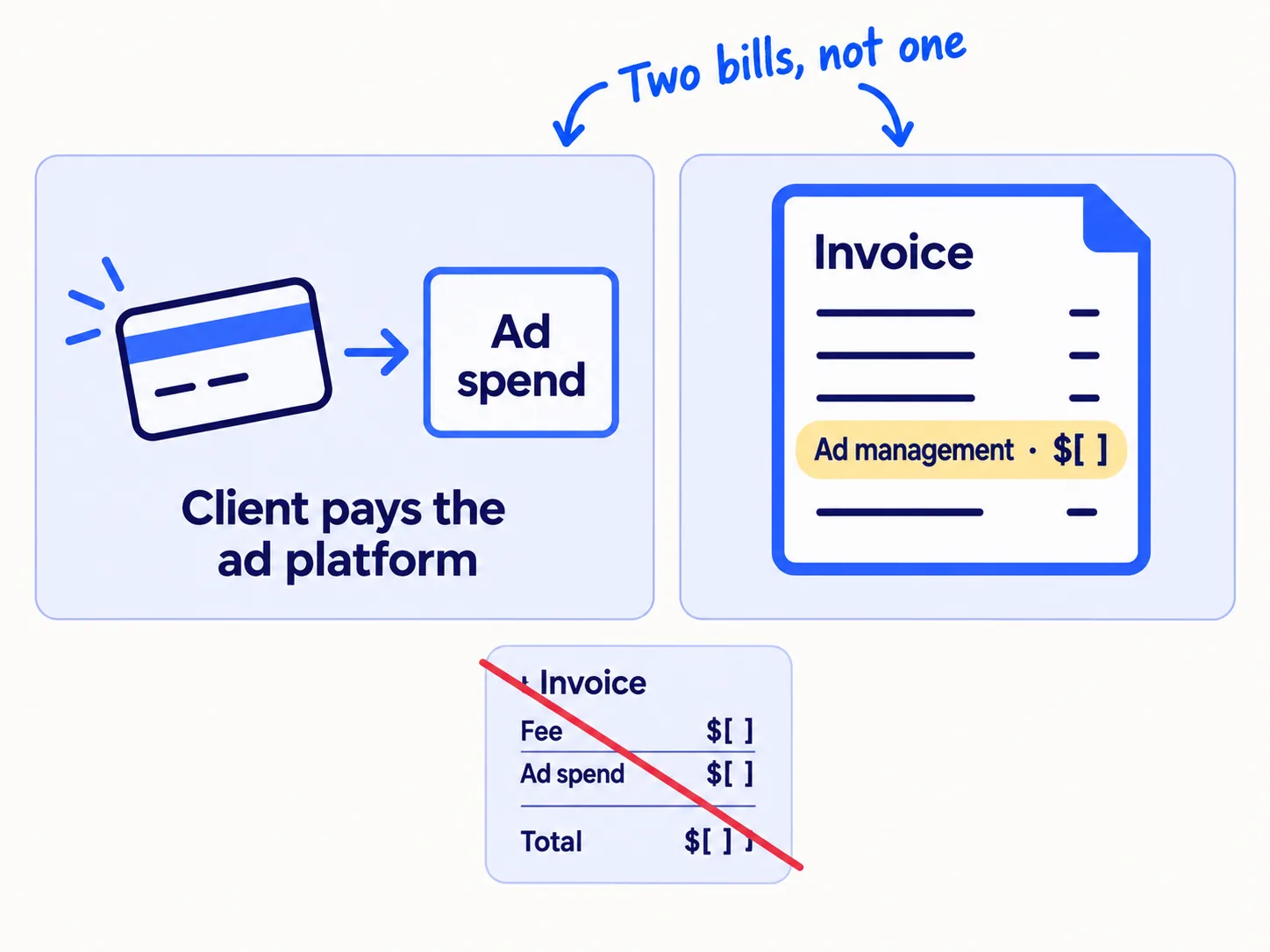
Charge a flat monthly fee for managing ads, priced from its hours like any other work, whether it is Google Adssoon, Meta or LinkedIn adssoon. A flat fee stays the same whether the client spends more or less, so your advice on how much to spend stays honest. If a client asks for a percentage, the agencies that publish their prices in 2026 mostly charge 10% to 20% of monthly ad spend, with a minimum fee. Use your flat fee as that minimum.
Get access without paying for the ads:
- 1
Google Ads
Create a Google Ads manager account for your agency. It lets you see and run many client accounts from one place. Link each client's Google Ads account to it. The client keeps their own account and can still sign in to it, and their own card pays Google.
- 2
Meta (Facebook and Instagram)
Send the client your business portfolio ID. They open Settings in Meta Business Suite, click Partners under Users, then Add, then "Give a partner access to your assets", and enter your ID. Ask for partial access, with only the task for managing ads. Only someone with full control of their business portfolio can do this.
- Tool: a Google Ads manager account and Meta Business Suite, using the client's own ad accounts.
- Time: 30 minutes per client.
- You will have: access to each client's ad accounts, and a fee that is only your work.
- It worked if: no ad spend goes through your bank account, and the client pays the platform directly.
- Common mistake: running a client's ads on your own ad account and card. When they leave, the history and the account stay with you, and an unpaid bill is yours.
5. Send your price within 24 hours of every call
Give every business that books a call a written price with your three options within 24 hours. A price only gets tested when people see it, so the number of proposals you send decides how fast you learn if it is right.
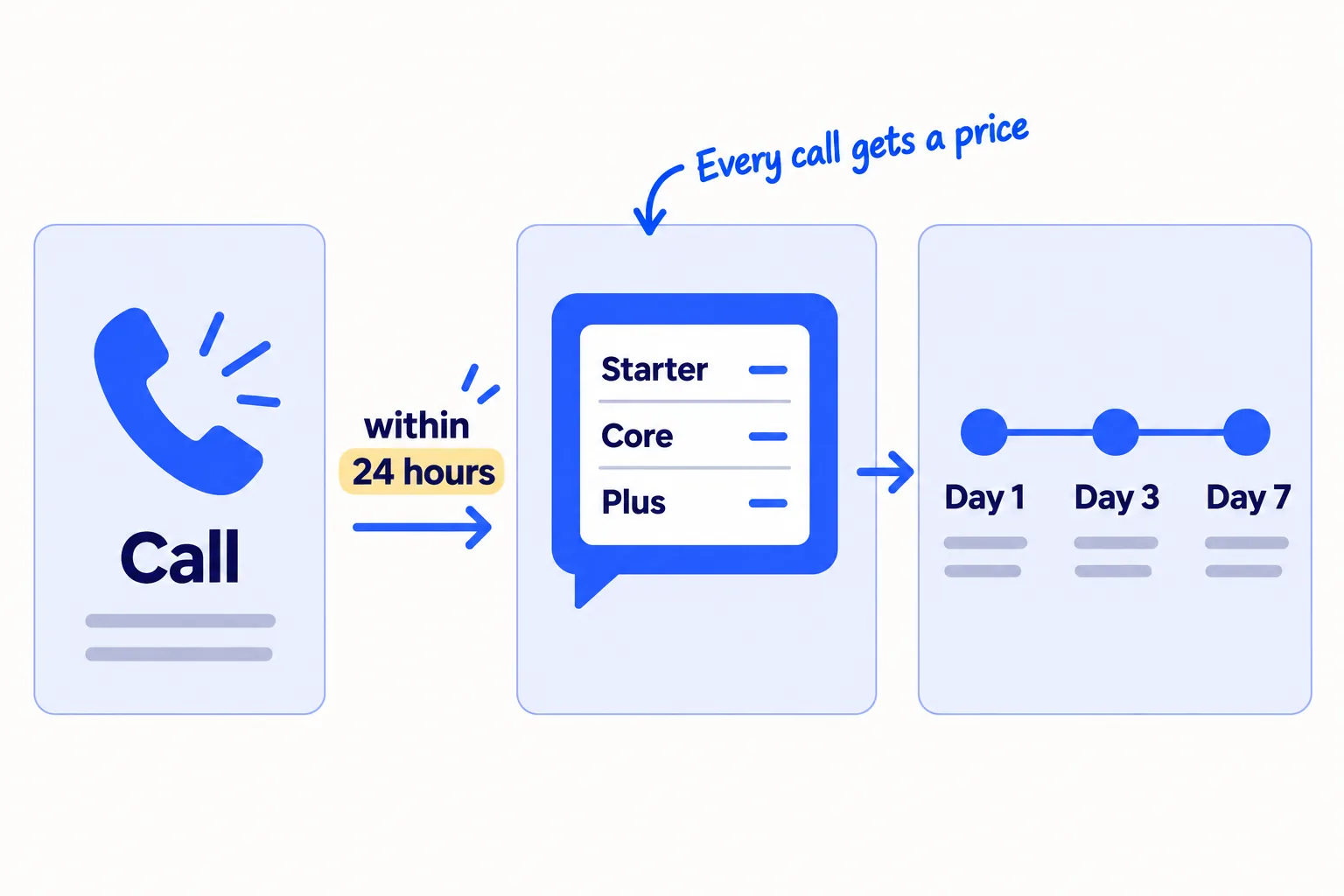
On the discovery callsoon, say your price out loud before you hang up: "For a company like yours, I'd start with Core, which is $[X] a month." An owner who hears it and still wants the proposal is a real lead. Then ChatGPT or Claude drafts the price email from your call notes and the template below, and you check the numbers and the first line. That is about 20 minutes a proposal.
Subject: [their company]: three optionsHi [first name],Thanks for the call. You said [their problem, in their words], and you want [the result] by [date].Here are three ways I can help, each billed monthly, at the start of the month:Starter, $[ ] a month: [2–3 lines of work]
Core, $[ ] a month: [3–4 lines of work]. This is what I'd pick for you, because [one reason from the call].
Plus, $[ ] a month: [Core, plus 1–2 lines]Ad spend, if any, is paid by you directly to the platform.If one fits, reply with its name and I'll send the agreement today.[Your name]
If they do not reply, follow up on day 3 and day 7 in the same thread (what to saysoon). If they say yes, send the agreement and the scope the same day, then onboard themsoon.
Calls come from volume. Keep sending 100 personal messagessoon a day to businesses that fit, on email and LinkedInsoon, with AI drafting and you adding one true line about each one, as in how to market your marketing agency. Ask each client for a testimonialsoon and one introduction too. More calls mean more proposals, and more proposals mean you learn your price in weeks, not months.
- Tool: Google Docs, Gmail, and ChatGPT or Claude to draft. Log every proposal in your sheet, or in a CRMsoon once the sheet gets slow.
- Time: 20 minutes a proposal, plus 2 minutes for each follow-up.
- You will have: a written price for every call, with its date, in your sheet.
- It worked if: every call this week has a written price, sent within 24 hours, and every silent one has its day 3 and day 7 follow-up.
- Common mistake: a custom price for each lead, sent a week later. The other mistake is offering a discount before anyone asked for one.
See it done: Quillfox's price email
To: Priya, founder of a 6-person SaaS company
Subject: Loomtally: three options
Hi Priya,
Thanks for the call. You said most visitors leave your homepage without starting a trial, and you want 30 trials a month by January.
Here are three ways I can help, each billed monthly, at the start of the month:
Starter, $1,300 a month: 8 LinkedIn posts for you, 1 article, a 1-page report. Core, $2,100 a month: 12 LinkedIn posts, 2 articles, 1 comparison page, a report and a call. This is what I'd pick for you, because buyers compare you with two bigger tools before they try you. Plus, $3,100 a month: Core, plus running your LinkedIn ads. Ad spend is paid by you directly to LinkedIn.
If one fits, reply with its name and I'll send the agreement today.
Jess
Why it works: It repeats the founder's own problem, names the option she recommends and why, and asks for one word back.
6. Count wins and losses every Sunday and change your price
Every Sunday, count your proposals and why each one was won or lost, then change your price by a rule. One no tells you nothing about price. Ten proposals start to.
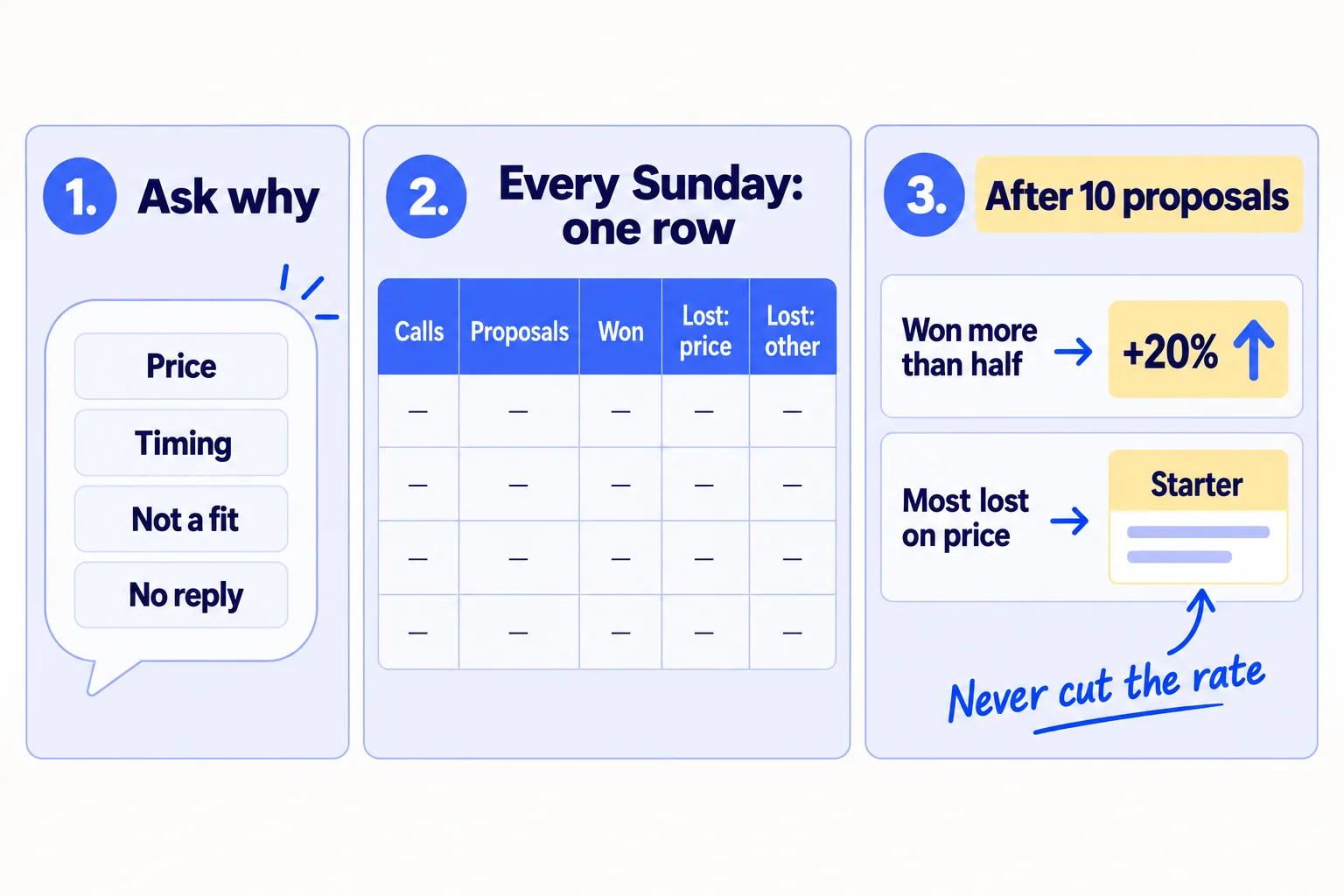
When someone says no, ask one question: "Was it the price, the timing, or something else?" Write the answer down. Ask every call "How did you hear about me?" too, so you know where each client came fromsoon. Then fill in one row each Sunday:
Week | Messages sent | Calls | Proposals sent | Won | Lost: price | Lost: other reason | No reply yet | New monthly revenue
After every 10 proposals, use this rule:
- You won more than half: your price is too low. Raise all three options by 20% for the next 10 proposals.
- You lost most of them, and most said "price": offer Starter first, or take work out of Core. Do not lower your price per hour.
- You had too few calls to send 10 proposals in a month: the price is not the problem yet. Add a channel or send more messages.
- You lost most of them for other reasons, or they did not reply: the price is not the problem. Change who you send messages to or what the package promises, before you touch the price.
- Never go below hours × your lowest price ÷ 0.65.
Once a month, as part of your monthly reviewsoon, add up your hours per client from your sheet. If a client took more hours than their option has, either do less next month or move them up an option. A client who always takes more work than they pay for is what scope creepsoon looks like in numbers.
- Tool: Google Sheets.
- Time: 20 minutes each Sunday.
- You will have: one row per week, and a reason for every lost proposal.
- It worked if: after 10 proposals you can say whether price, timing or fit lost you the most deals, and your next price follows the rule.
- Common mistake: cutting your price after one or two no's, or raising it after one yes. Wait for 10, then move by the rule.
See it done: Quillfox after 4 weeks
The Sunday sheet, weeks 1 to 4
| Week | Messages sent | Calls | Proposals sent | Won | Lost: price | Lost: other | No reply yet |
|---|---|---|---|---|---|---|---|
| 1 | 700 | 3 | 3 | 0 | 1 | 0 | 2 |
| 2 | 700 | 5 | 4 | 1 | 0 | 1 | 2 |
| 3 | 700 | 4 | 4 | 0 | 1 | 1 | 2 |
| 4 | 700 | 4 | 3 | 1 | 0 | 1 | 1 |
The decision: 14 proposals, 2 won (one Core, one Starter), 2 lost on price, 3 on timing and 7 with no reply. She won fewer than half, so no raise. Price lost only 2, so she keeps $2,100 for Core, and sends the day 3 and day 7 follow-ups to the 7 who went quiet.
Why it works: Only 2 of 12 losses were about price, so she keeps the price and fixes the follow-ups instead.
When your price holds and your weeks are full, it is time to raise pricessoon again or hire your first contractorsoon. To see what you can spend to win each client, work out your cost to win a clientsoon.
Your agency pricing checklist for this month
0 of 13 done
Work through this list with an AI assistant
It drafts the work and keeps track of what is done.
Frequently asked questions
- How much should I charge my first marketing client?
At least your lowest price per hour × the hours the work takes ÷ 0.65. That number comes from your own pay, tax, costs and hours, so it is right for you. A range from a blog is not. If the client cannot pay it, offer less work for less money. Do not do the same work for a lower price. See how to get your first client.
- Should I charge hourly or a monthly retainer?
A monthly retainer, with a fixed list of work. Hourly pricing shrinks as AIsoon makes you faster: in March 2026, 27% of agencies in Productive's survey had been asked to cut prices because of AI. Use hours only to set your price, never to show the client. For one-off work, such as a website, charge a project fee, then turn it into monthly worksoon.
- Should I charge a percentage of ad spend?
Start with a flat monthly fee for managing ads, priced from its hours, and keep the ad budgetsoon off your invoice. A flat fee stays the same when the client spends more, so your advice on spend stays honest. If a client wants a percentage, agencies that publish prices in 2026 mostly charge 10% to 20% of spend. Use your flat fee as the minimum.
- Should I lower my price because I use AI?
No. Price the work and the result, not the time it takes. In Productive's 2025 survey, almost one in three agencies was asked for an "AI discount", and only 13% lowered prices. If a client asks, offer Starter, which is less work for less money, and keep your price per hour. Show them the result in your monthly reportsoon, not the hours.
- Should I charge per lead or only on results?
Not for your first clients. Leads and sales also depend on the client's product, website and sales calls, which you do not control, and you need a steady monthly income to plan. If a client wants it, add a bonus for a result you both can count, such as trials or booked calls, on top of your monthly fee. Once you have case studiessoon, you can ask for more.
Sources
- 1.2026 State of Digital Services: Digital Agency Industry Research — Promethean Research, checked 26 September 2026
- 2.How to Calculate a Retainer Fee — Promethean Research, checked 26 September 2026
- 3.Agencies in the AI Era 2.0 — Productive, March 2026, checked 26 September 2026
- 4.Agencies in the AI Era: Between Hype and Reality (2025) — Productive, 2025, checked 26 September 2026
- 5.Self-employment tax (Social Security and Medicare taxes) — Internal Revenue Service, checked 26 September 2026
- 6.Topic no. 554, Self-employment tax — Internal Revenue Service, checked 26 September 2026
- 7.PPC Management Pricing: How Much Do Google Ads Management Services Cost in 2026? — OuterBox, 2026, checked 26 September 2026
- 8.Google Ads Management Pricing in 2026 — ALM Corp, 2026, checked 26 September 2026
- 9.About Google Ads manager accounts — Google Ads Help, checked 26 September 2026
- 10.Manage Ads account billing setup from your manager account — Google Ads Help, checked 26 September 2026
- 11.Give a partner access to business assets in your business portfolio — Meta Business Help Center, checked 26 September 2026
- 12.How much should I charge for this monthly service package? — Reddit, r/SocialMediaManagers, 2026
- 13.If your retainer margin is below 25%, you have a discovery problem — Reddit, r/agency, 2026
Next article to read
Related guides
- How to price social media managementAgencyComing soon
- How to raise agency pricesAgencyComing soon
- How to write a scope of work that stops scope creepAgencyComing soon
- How to turn website projects into monthly retainersAgencyComing soon
Guides that link here
- How to market your marketing agencyAgency
- How to set a marketing budget for your agencyAgency
- How to get your first client as a marketing agencyAgency
- How to get customers online for free
- Why no one is buying your product, and how to fix it
- How to choose marketing channels for an agencyAgency
- How to do a competitor analysis
- How to validate a business idea without spending money
Cite this page
Dinesh Bypilla (2026). How to price digital marketing services. Scout7 Academy. https://scout7.ai/academy/marketing-plan/how-to-price-digital-marketing-services
Written by Dinesh Bypilla, Agentic systems engineer at Scout7. Reviewed by Murali Sid. Last checked 26 September 2026.
Quote any part of this guide with a link back to this page. © 2026 Scout7.
Markdown version of this page: https://scout7.ai/academy/marketing-plan/how-to-price-digital-marketing-services.md