



How to create an ideal customer profile
Create an ideal customer profile when you have one or two customers: list everyone who paid, tried or talked to you, write 2 or 3 one-sentence guesses, test them with 100 messages a day, and keep the one that gets the most chats after 1,500 messages.
ByDinesh BypillaReviewed byMurali SidLast checked 17 min read
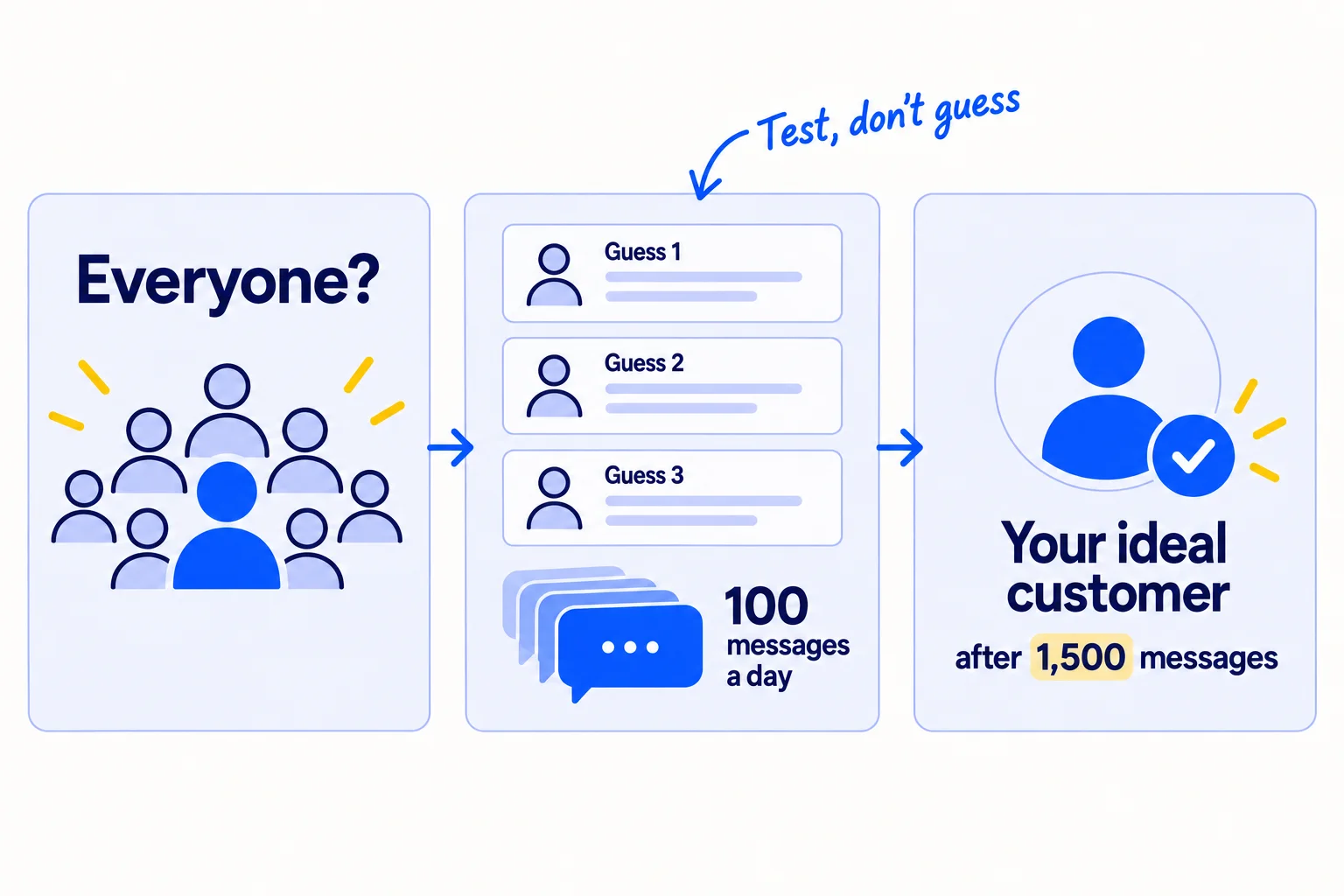
You have a product and one or two customers, and every piece of advice starts with "define your ideal customer profile" first. Most templates for how to create an ideal customer profile ask for a sales team, a CRM and a hundred customers you do not have, so you guess, and your messages, your homepage and your postssoon all speak to nobody in particular. That is one of the most common reasons no one is buying. Here you write two or three short guesses about who your best customer is, test them on real people at volume, and keep the one that gets the most yeses.
Do these three things
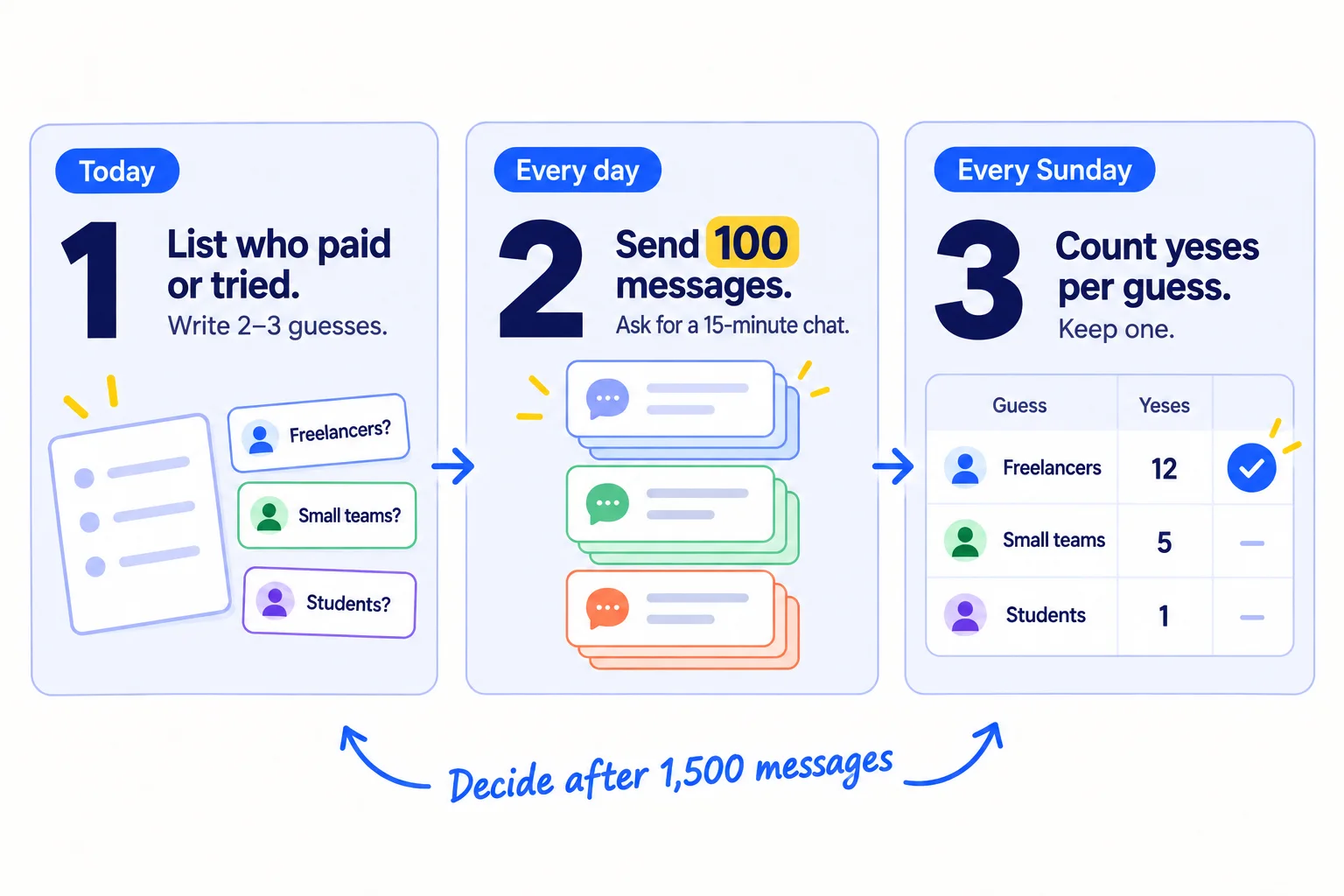
About 2 hours today, then about 4 hours a day. Most founders can pick one ideal customer after about 15 days.
Show the three actions in fullHide the full list
- Today: list everyone who has paid, tried or talked to you, and write 2 or 3 one-sentence guesses of your ideal customer: who they are, their size, the moment the problem hurts, what they use today, and who it is not for.
- Every day: send 100 personal messagessoon to people who fit, split across your guesses, and ask for a 15-minute chat about what made them look for a fix. AI drafts each one; you add one true line about the person.
- Every Sunday: count chats and yeses for each guess. After 1,500 messages, keep the guess with the most, and rewrite its sentence in your buyers' own words.
Get help doing these
ChatGPT or Claude reads this guide and works through it with you.
1. List everyone who has paid, tried or talked to you
Your ideal customer profile starts with the people who already said yes, even if there are only two. Put every customer, trial user, reply and warm lead in one sheet, then mark the two you would most like ten more of.
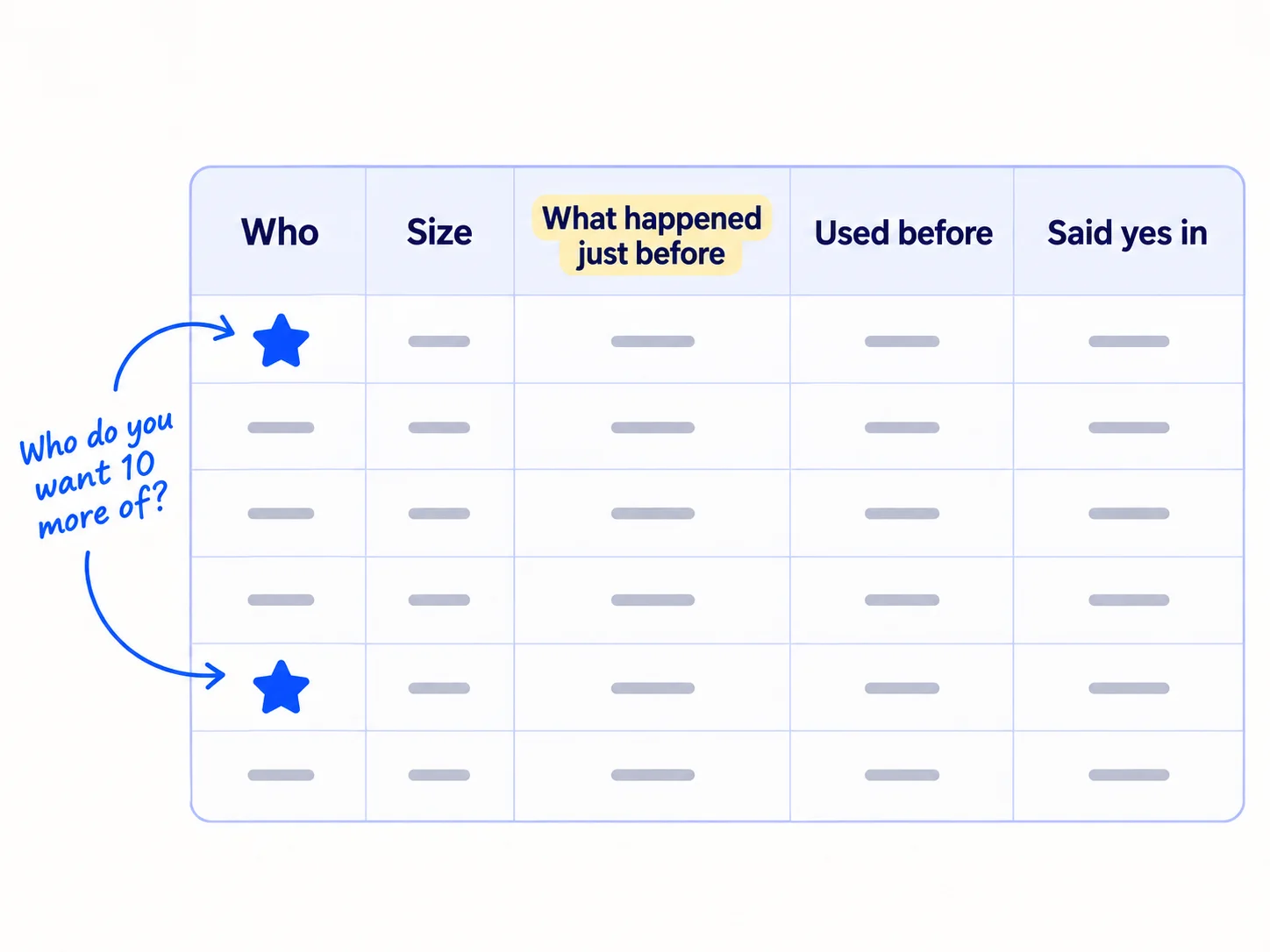
With so few customers, one row can mislead you. So count everyone who showed real interest: people who paid, started a free trialsoon, replied to a message, asked what you charge after reading your pricing pagesoon, or booked a call. If you already have users, ask them for feedbacksoon with the same columns in mind. The column that matters most is "what happened just before". One founder on Hacker News had one pilot customer and could not find a second, in June 2026. The best reply told them to write down what caused the first customer's pain, because "your ICP becomes 'companies that match the trigger,' which is often not the same as 'companies in that vertical.'"
Name | Paid, trial, reply or chat | Kind of business (or person) | Size | What happened just before they needed you | What they used before | How they found you | Days from first contact to yes | What they pay | Want 10 more? (yes/no)
If you have call notes or emails, paste them into ChatGPT or Claudesoon and ask it to fill these columns. Check every cell yourself: it will guess where the notes are silent. Then mark your best two rows: the ones that paid fastest, use you most, and were easiest to work with.
- Tool: Google Sheets and ChatGPT or Claude. Both free to start.
- Time: 45 minutes.
- You will have: a sheet with one row per person, every column filled, and your best 2 marked.
- It worked if: you have at least 5 rows. With fewer, add everyone who replied, asked a price or visited your pricing page and wrote to you.
- Common mistake: starting from your own background ("I was a designer, so designers") or from friends who bought to be kind. Friends and former colleagues are polite, and polite is not the same as buying. Mark the rows by what people did, not by who you like.
See it done: Carvelian's customer sheet
Carvelian Packaging is a made-up maker of custom printed boxes for small food and drink brands. One founder sells through calls, samples and quotes.
It has 2 clients from the founder's old contacts, an average order of about $3,000, and no enquiries from the website.
| Who | Stage | Size | What happened just before | Used before | Want 10 more? |
|---|---|---|---|---|---|
| Coffee roaster | Client, $3,400 | 6 staff | Won a listing in 40 grocery stores | Stock boxes with a sticker | Yes |
| Hot sauce maker | Client, $2,600 | 4 staff | Moving from markets into shops | Stock boxes with a sticker | Yes |
| Meal kit brand | Asked price | 12 staff | New subscription box | A big printer, too slow | Maybe |
| Bakery | Chat | 3 staff | Holiday gift boxes | Plain white boxes | No, order too small |
Why it works: Both clients bought right after the same event, a new shop listing, and that is the pattern to test.
2. Write your ideal customer profile as two or three one-sentence guesses
Write one sentence per guess: who the customer is, how big, the moment the problem hurts, what they use today, and who you are not for. Start from your two best rows, and add one or two near neighbours, so you have something to compare.
![A sentence card with five slots: '[Who]', '[Size]', '[The moment it hurts]', '[What they use today]' and 'Not for: […]'. Beside it, four ticks: 'Hurts now', 'Can pay', 'Can find by name', 'Gather somewhere'.](/academy/illustrations/how-to-create-an-ideal-customer-profile/step-2-write-your-ideal-customer-profile-as-two-or-t.webp)
An ideal customer profile, or ICP, describes the kind of business, or kind of person, that gets the most from what you sell and pays for it. A buyer persona is different: it describes the one person inside that business who decides. For now, write the ICP. You will learn the decision-maker in your chats in step 4.
[Your business] is for [kind of business or person] with [size], who [the moment the problem hurts], and today they [what they use or do instead]. They can pay [your price].Not for: [who you will turn down, and why].
Keep each guess narrow. Lenny Rachitsky's advice, from studying how Gusto, Gong and Snyk started, is to pick three very specific traits, such as size, the tool they use, or where they are, rather than a broad market. Your second and third guesses change one thing: the same moment in a different kind of business, or the same business at a different size. Never write more than three. Each extra guess cuts the messages each one gets in step 4.
Then check each guess with four questions. Cut or change any guess that fails one:
- Does it hurt now? Something just happened that makes them look for a fix this month.
- Can they pay your price? Check it against your price, not your hopes.
- Can you find them by name? You will test this in step 3.
- Do they gather somewhere? A forum, a subreddit, a trade showsoon, a Facebook groupsoon.
The "Not for" line matters as much as the rest. A founder who writes it stops saying yes to work that costs more to win than it pays, which is what customer acquisition costsoon measures, and a stranger reading your site can tell straight away whether it is for them.
If you run a D2C store: your customer is a person, not a company. Write the moment in their life ("just moved to a hard-water city", "a new baby and no time") instead of a company size. In Shopify admin, open Customers, then Segments, then Create segment, and filter by
number_of_ordersoramount_spentto see who bought twicesoon and where they live.
If you run an agency: your ideal customer profile is your nichesoon: one kind of client with one problem you fix. It decides who you message for your first client. "Small businesses that need marketing" is not a guess. "B2B software companies of 2 to 15 people where the founder still writes every post" is.
If you run a SaaS: name the tool they use today and the team size. It is the fastest way to find them, and it tells you which alternatives pagessoon to write later.
- Tool: a Google Doc.
- Time: 45 minutes.
- You will have: 2 or 3 sentences and one "Not for" list.
- It worked if: you show each sentence to a friend, and they can name 3 real businesses (or people) that fit it.
- Common mistake: "small businesses", "founders" or "women 25 to 45". Nobody can find those by name, and nobody reading them thinks "that's me".
See it done: Carvelian's first guess
Before
Custom boxes for food and drink brands.
After
Carvelian is for food and drink brands with 2 to 20 staff who have just won their first shop or grocery listing and need shelf-ready printed boxes in 4 to 6 weeks. Today they use plain stock boxes with a sticker. Not for: orders under $1,000, cafés, one-off gift boxes.
Its other two guesses: food brands that sell subscription boxes online, and local bakeries that want holiday gift boxes.
Why it works: It names the moment the boxes are needed, which is when a brand is ready to pay.
3. Find 100 real names for each guess
Before you test a guess, prove you can reach it: find 100 real businesses or people for each one, by name, with a way to contact them. A guess you cannot fill is a guess you cannot sell to.
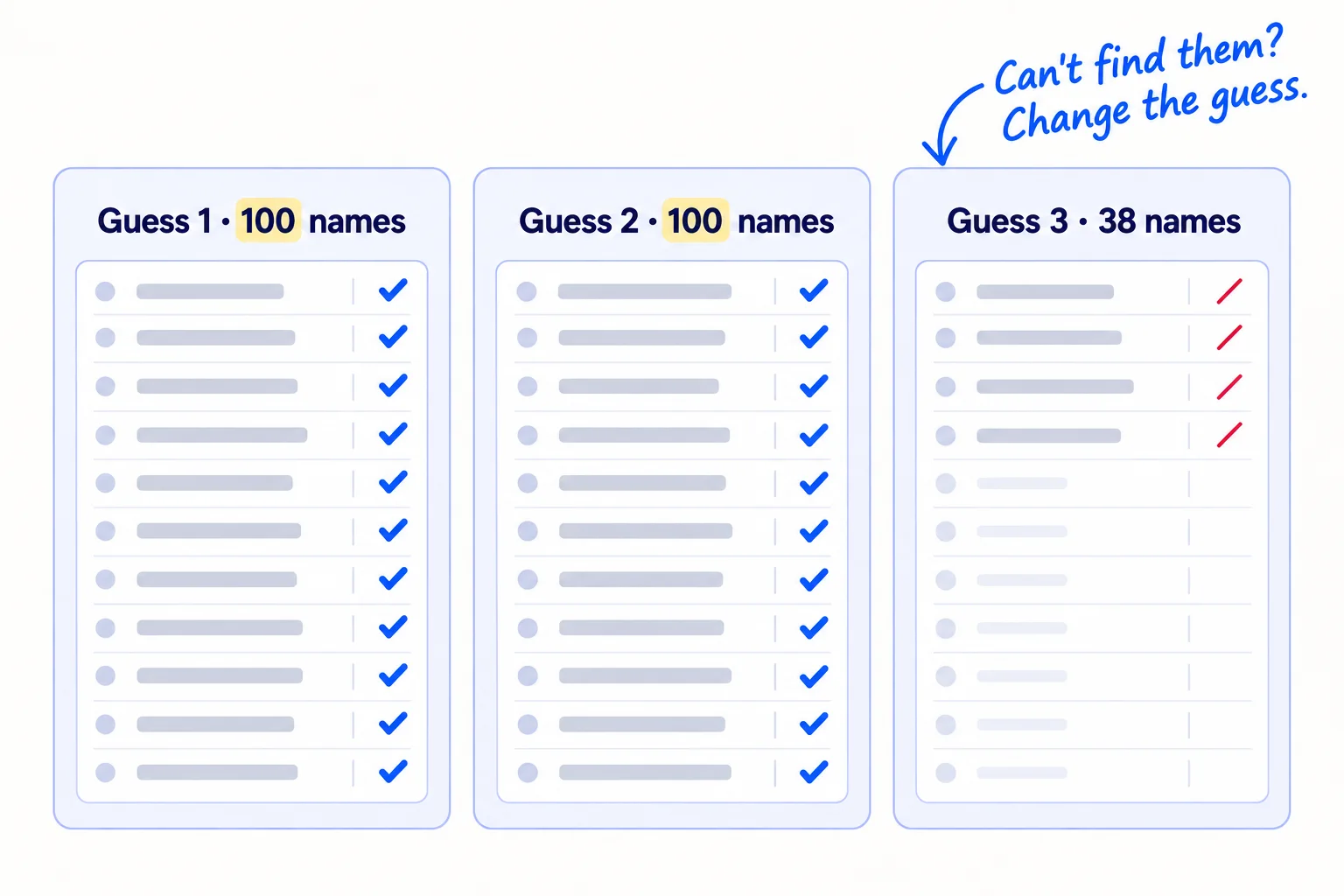
Build a lead listsoon in the same sheet, with one extra column for the guess each name belongs to. Search where each guess actually shows up. A local business shows up on Google Maps. A software team shows up on LinkedIn, GitHub or in the reviews of a competitor. A shop brand shows up on the stockist page of the stores it sells insoon. Give ChatGPT or Claude one guess at a time and ask for 30 businesses that fit, with where it found each one. Open each one yourself and keep only the real ones.
Then find the person. For a business, that is usually the owner or the person who would sign: find their emailsoon from the company site or LinkedIn.
LinkedIn limits how much a free account can search. When your searches look like prospecting, it shows a "commercial use limit", resets it on the 1st of each month, and will not tell you how many you have left. So do not do all your searching there. Spread it across Google, Google Maps, stockist pages, trade lists and online communities where your buyers talksoon.
Step 4 uses 100 names a day, so after the first 300, add 100 new names every day, split across the guesses that are still in the test.
- Tool: Google Sheets, Google, Google Maps, LinkedIn, and ChatGPT or Claude.
- Time: about 2 hours for the first 300 names, then 45 minutes a day.
- You will have: 300 rows, each with a name, a business, a way to reach them, and a guess number.
- It worked if: you fill 100 names for a guess in about an hour. If a guess stops below 50 after an hour, widen it by one trait (a bigger size range, or a nearby region) or swap it for another near neighbour.
- Common mistake: a guess that no search tool can find, such as "brands that care about quality". Every trait in the sentence should be something you can see from outside: a size, a shop listing, a tool, a place, a job title.
4. Message 100 people a day and ask what made them look for a fix
Send 100 personal messages every day, split evenly across your guesses, and ask each person for a 15-minute chat about the problem, not for a sale. How each guess answers is your test.
![A stack of message cards labelled '100 a day', split into three piles marked 'Guess 1', 'Guess 2' and 'Guess 3'. The front card reads 'Hi [name], I saw [one true thing]. Could I ask 4 questions?' An arrow leads to a 15-minute chat with the question 'What happened just before?'](/academy/illustrations/how-to-create-an-ideal-customer-profile/step-4-message-100-people-a-day-and-ask-what-made-th.webp)
100 a day is the point. At a pass mark of 2 chats per 100 messages, 10 a day would give each guess one chat a fortnight, and you would still be guessing in three months. 100 a day gives you about 2 chats a day, and after 1,500 messages, about 15 days, each guess has had 500 tries.
Let AI do the drafting. Paste 10 names at a time into ChatGPT or Claude, each with one real fact about the person, plus the template below. Read each draft, make the first line true and about them, then send it. That is about a minute a message. Log the guess, the date and any reply in your sheet.
Send each message one at a time from your own work email, or to your LinkedIn connections. Gmail requires every sender to have SPF or DKIM, two settings that prove an email comes from your domain, and wants spam reports below 0.3%. At 100 a day, set up a second domainsoon for these messages and warm it up first, so your main email stays safe. In the US, the CAN-SPAM Act covers business email too: every message needs your postal address and a way to say no, and you must honour a "no" within 10 business days. The UK and EU have their own, stricter rules, so check them before you write to buyers there. On LinkedIn, hitting the invitation limit usually blocks invitations for a week, so message people you are already connected tosoon and send the rest by email.
Subject: [the moment it hurts, in 3–5 words]Hi [first name],[One true line about them: something they launched, won, wrote or said.]I run [your business]. I'm trying to learn how [kind of business] handle [the problem] when [the moment it hurts].Could I ask you 4 questions on a 15-minute call this week? No pitch.[Your name]
[Your business, postal address]
Not for you? Reply "no" and I won't write again.
Follow upsoon twice with everyone who has not replied, 3 days apart, with one new line each time. Stop the moment someone says no.
On the call, ask these four customer interview questions, and write down the answers in their exact words:
- What happened just before you started looking for a fix?
- What do you use or do today?
- What did it cost you last time it went wrong?
- If this were fixed, what would it be worth to you?
Their words matter more than their yes. The phrase they use for the problem becomes your value proposition and the first line of your next messages.
If you run a D2C store: email every past buyer these questions, with a one-question survey after checkout: "What made you buy today?" Fairing's free plan covers stores with up to 200 orders. Send your 100 a day as one-to-one replies to people who have posted about the problem, spread across several places, and follow each place's rules on self-promotion. On Reddit, read the rules firstsoon. The same chats are how your first sales from strangers start.
- Tool: Gmail or LinkedIn, ChatGPT or Claude to draft, and your Google Sheet. A CRMsoon can wait.
- Time: about 1 hour 40 minutes a day for messages, 45 minutes for new names (step 3), and about 1 hour for chats.
- You will have: 700 messages a week, each tagged with its guess, and notes from every chat.
- It worked if: you get at least 2 chats per 100 messages across all guesses. If you get fewer than 1 per 100 after 300 messages, rewrite the first linesoon so it is more about them, then send the next 100.
- Common mistake: deciding after 20 messages, or pitching on the call. You are testing who has the problem, so let them talk. Offer to show what you sell only at the end, and only if they ask. The discovery callsoon comes later.
See it done: Carvelian's message to a guess 1 brand
Subject: boxes for your new stockists
Hi Priya,
Congratulations on getting your kombucha into 30 new grocery stores. I saw the post last week.
I run Carvelian Packaging. I'm trying to learn how small drinks brands handle shelf-ready boxes when a big listing lands.
Could I ask you 4 questions on a 15-minute call this week? No pitch.
Dan Carvelian Packaging, [postal address] Not for you? Reply "no" and I won't write again.
Why it works: The first line is the event that makes boxes urgent, so she can see why they wrote to her.
5. Count results by guess every Sunday and keep one ideal customer profile
Every Sunday, fill in one row per guess. After 1,500 messages, keep the guess with the most chats and yeses per 100 messages, drop the rest, and rewrite its sentence in your buyers' own words.
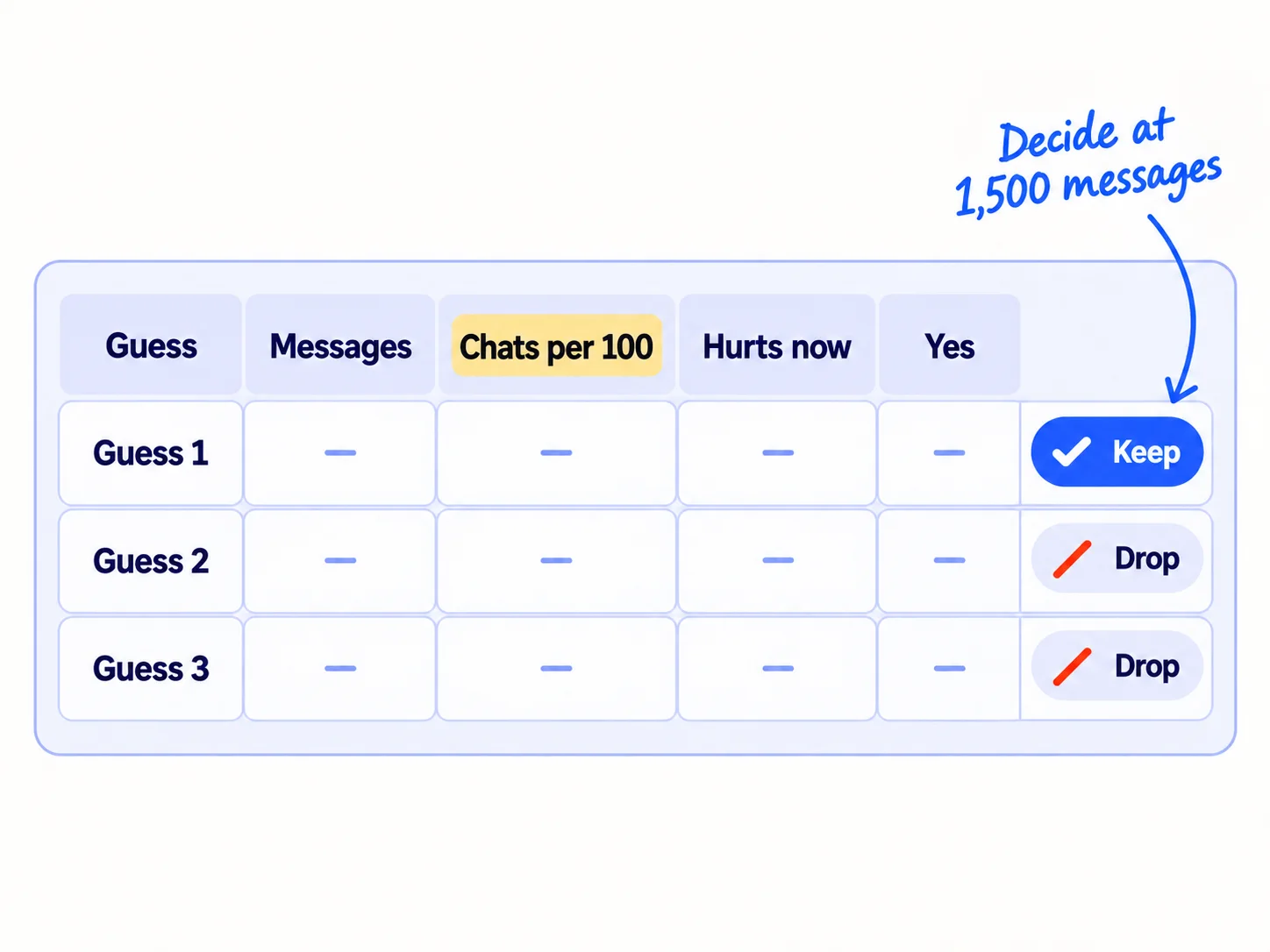
Guess | Messages sent | Replies | Chats | Said "this hurts now" | Asked for a price, trial or sample | Paid | Price they paid
The decision rule after 1,500 messages, 500 per guess:
- Keep the guess with the most chats per 100 messages. If two are close, keep the one with more people asking for a price, a trialsoon or a sample.
- Drop any guess below 1 chat per 100 messages.
- Run one more round if no guess reaches 2 chats per 100: write a new neighbour of your best guess and test it for another 500 messages. If three rounds find nothing, check the problem is real before you market it.
Then rewrite the winning sentence with the words people used on the calls, and add to the "Not for" list anyone who wasted a call. Put the sentence at the top of a one-page doc. Everything else now starts from it: your homepage headlinesoon, your listsoon, the channels you choose and your positioning. It also helps AI tools: in G2's March 2026 survey of 1,076 software buyers, 51% said they now start their research in an AI chatbot rather than Google. A buyer tells the chatbot who they are and what just happened, and a site that says the same words gives ChatGPT something to matchsoon when it recommends a business.
Ask every customer who fits the sentence for one introduction to someone with the same problem. The Hacker News reply in step 1 gave the same advice. Later you can turn it into a referral programsoon.
Once a month, check the sentence against your newest customers, and rewrite it after every 10 new ones.
- Tool: Google Sheets.
- Time: 30 minutes each Sunday.
- You will have: one sentence, one "Not for" list, and the numbers that chose them.
- It worked if: at least 7 of your next 10 new customers fit the sentence. If fewer do, the sentence describes who you hoped for, not who buys: rewrite it from the rows in step 1.
- Common mistake: keeping all three guesses "to be safe". Then every message, page and post is still written for three kinds of buyer, and none of them hears it as theirs.
See it done: Carvelian after 1,500 messages
The Sunday sheet, after 15 days
| Guess | Messages sent | Chats | Chats per 100 | Asked for a sample or quote |
|---|---|---|---|---|
| 1: shop listing just won | 500 | 21 | 4.2 | 8 |
| 2: online subscription boxes | 500 | 10 | 2.0 | 2 |
| 3: bakery gift boxes | 500 | 4 | 0.8 | 1 |
The decision: Carvelian keeps guess 1, drops guess 3 (under 1 chat per 100, and orders under $1,000), and moves all 100 messages a day to brands that just won a listing. On the calls, founders said "our first big stockist", so that phrase goes into the sentence and the headline.
Why it works: Guess 1 got twice the chats of guess 2 and the only price requests, so it wins on what people did, not on what felt likely.
Where Scout7 helps
Scout7 speeds up steps 2, 3 and 5. It does not message anyone or run the chats: steps 1 and 4 stay yours.
Steps 2 and 5. Scout7's audience research reads public social conversations in your category and builds audience segments with pain points and quotes in buyers' own words. Use them to write your first guesses and to check the words in your final sentence. It does not replace the chats in step 4.
Step 3. Join Conversations searches social platforms for live discussions about your problem. That shows you where each guess talks, so you know where to look for names.
Step 5. Scout7 keeps your brand profile, including who you sell to, as facts you can edit. Put your final sentence there, and every later Scout7 job, from articles to posts, is written for that customer.
Your ideal customer profile checklist for the next 15 days
0 of 13 done
Work through this list with an AI assistant
It drafts the work and keeps track of what is done.
Frequently asked questions
- What is the difference between an ideal customer profile and a buyer persona?
An ideal customer profile describes the kind of business, or kind of person, that gets the most from what you sell. A buyer persona describes the one person inside that business who decides: their job, worries and how they like to be contacted. Write the ICP first. You learn the persona from your chats, and HubSpot's free Make My Persona tool can hold it.
- What should an ideal customer profile include for a B2B company?
Five things, in one sentence: the kind of business, its size, the moment the problem hurts, what it uses today, and whether it can pay your price. Add a "Not for" line. Leave out anything you cannot see from outside, like "values quality", because you cannot build a listsoon from it. The template is in step 2.
- How do I create an ideal customer profile with no customers?
Use everyone who showed real interest: people who replied, asked your price, started a trial or booked a call. If there is nobody yet, write 3 guesses from the problem you solve, find 100 names for each, and let 1,500 messages choose between them. The same test finds your first clients and your first SaaS users.
- Can I have more than one ideal customer profile?
Later, yes. Now, keep one. With one or two customers, each extra profile splits your messages, your homepage and your posts, and none of them reads as written for the buyer. Test up to 3 guesses for 1,500 messages, then keep one. Add a second only when at least 10 customers fit the first and you have hours to spare.
- How often should I update my ideal customer profile?
Check it once a month against your newest customers, and rewrite it after every 10 new ones. If fewer than 7 of your last 10 customers fit the sentence, it describes who you hoped for, not who buys. Go back to your customer sheet and start again from step 1. Once you have more customers, a monthly marketing reviewsoon is a good place to do it.
Sources
- 1.Ask HN: I'm lost. How can I define ICP (Ideal Customer Profile)? — Hacker News, 18 June 2026
- 2.Ask HN: One month, zero paying customers – keep it or kill it? (comment) — Hacker News, 13 September 2026
- 3.How to identify your ideal customer profile (ICP) — Lenny's Newsletter, 29 August 2023
- 4.Getting your ideal customer profile (ICP) right — Diljit, 23 August 2026
- 5.What is an ideal customer profile? — Unusual Ventures, checked 27 September 2026
- 6.Ideal Customer Profile Template — HubSpot, checked 27 September 2026
- 7.Creating customer segments — Shopify Help Center, checked 27 September 2026
- 8.Fairing Post Purchase Surveys: pricing — Shopify App Store, checked 27 September 2026
- 9.Commercial use limit — LinkedIn Help, checked 27 September 2026
- 10.Invitation limit reached — LinkedIn Help, checked 27 September 2026
- 11.Email sender guidelines — Google Workspace Admin Help, checked 27 September 2026
- 12.CAN-SPAM Act: A Compliance Guide for Business — Federal Trade Commission, checked 27 September 2026
- 13.New G2 Research: Half of B2B Software Buyers Now Start Their Research With AI Chatbots — G2, via PR Newswire, survey March 2026, checked 27 September 2026
Next article to read
How to do customer interviewsOnce you have a first guess at your buyer, this shows how to check it with real people.Read it nextRelated guides
- How to write a value propositionWrite a value proposition from your buyers' own words: copy 30 phrases, write 3 one-sentence versions, test them in 100 personal messages a day, and put the winner on your homepage after 900 messages.
- How to do a competitor analysisDo a competitor analysis in 5 days with free tools: list 10 alternatives your buyers use, read 100 complaints about the top 5 in their own words, put the gap you can fix in your headline, and check them for 45 minutes every Sunday.
- How to create a B2B lead list for freeComing soon
- How to find online communities where your buyers talkComing soon
Guides that link here
- How to market a SaaS productSaaS
- How to market your B2B businessB2B
- How to write a value proposition
- How to do customer interviews
- How to do a competitor analysis
- How to validate a business idea without spending money
- How to fix a SaaS launch that got zero signupsSaaS
- How to get beta users for your startupSaaS
- How to get clients for a consulting business without referralsB2B
- How to get customers online for free
- How to get people to try your product
- How to get traffic to a new website for free
- How to get your first 100 SaaS usersSaaS
- How to get your first B2B clientsB2B
- How to get your first client as a marketing agencyAgency
- How to get your first sale on EtsyD2C
- How to get your first sales on ShopifyD2C
- Why no one is buying your product, and how to fix it
- How to launch on Product HuntSaaS
- How much to spend on marketing as a B2B companyB2B
- How to choose marketing channels for an agencyAgency
- How to choose marketing channels for an ecommerce brandD2C
- How to fit marketing into your week as a solo founder
- How to market a D2C brandD2C
- How to market your product as a technical founderSaaS
- How to price a B2B product or serviceB2B
- How to price a productD2C
- How to price a SaaS productSaaS
- How to price digital marketing servicesAgency
Cite this page
Dinesh Bypilla (2026). How to create an ideal customer profile. Scout7 Academy. https://scout7.ai/academy/marketing-plan/how-to-create-an-ideal-customer-profile
Written by Dinesh Bypilla, Agentic systems engineer at Scout7. Reviewed by Murali Sid. Last checked 27 September 2026.
Quote any part of this guide with a link back to this page. © 2026 Scout7.
Markdown version of this page: https://scout7.ai/academy/marketing-plan/how-to-create-an-ideal-customer-profile.md