



How to write a value proposition
Write a value proposition from your buyers' own words: copy 30 phrases, write 3 one-sentence versions, test them in 100 personal messages a day, and put the winner on your homepage after 900 messages.
ByDinesh BypillaReviewed byMurali SidLast checked 18 min read
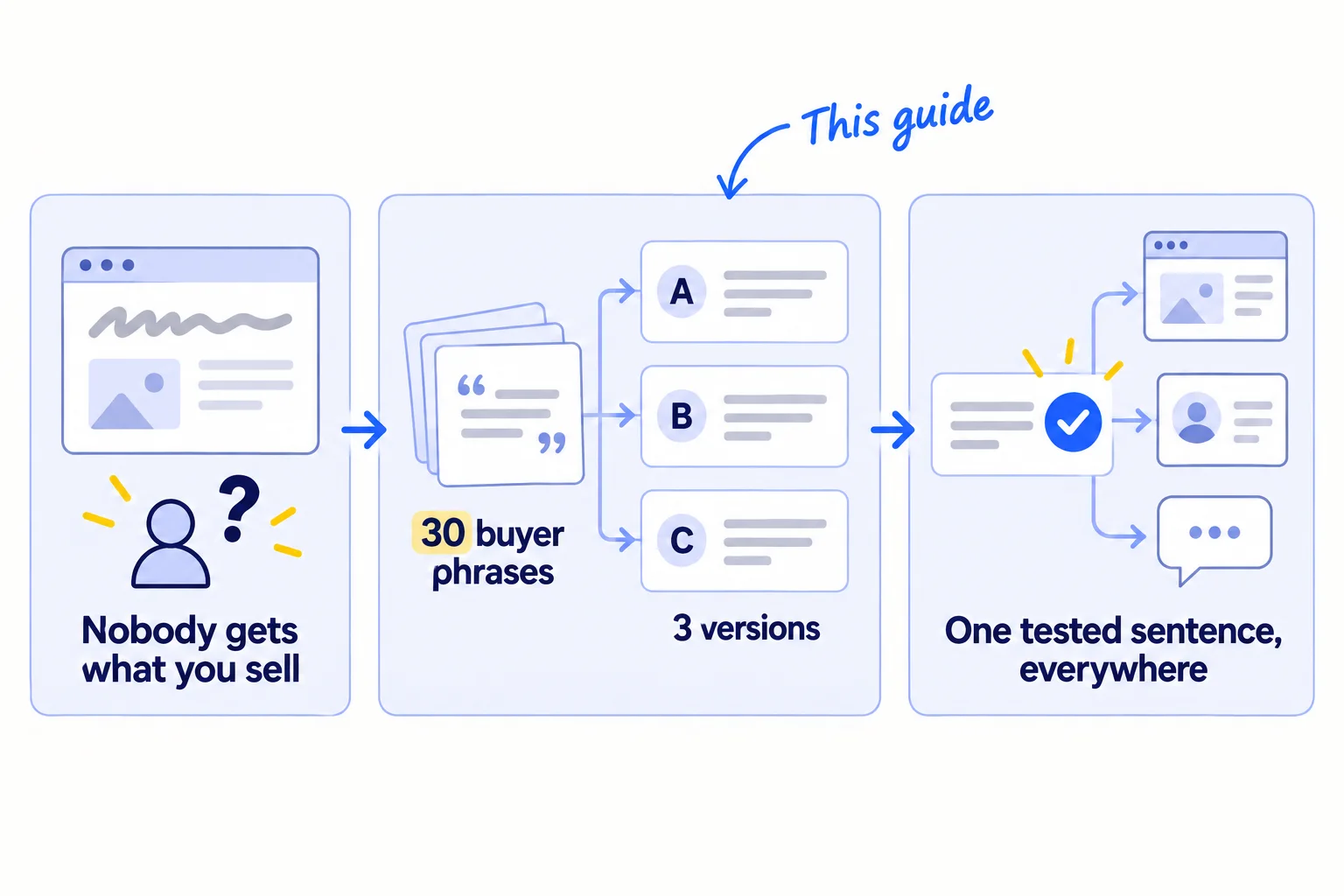
People visit your site or read your message and still cannot say what you sell or why it is for them. Here is how to write a value proposition: one sentence that says who it is for, what they get, and why you instead of what they do now, built from your buyers' own words and tested on real people. Most founders ask ChatGPT for one, get "the all-in-one platform that streamlines…", and never find out that it loses them every visitor.
Do these three things
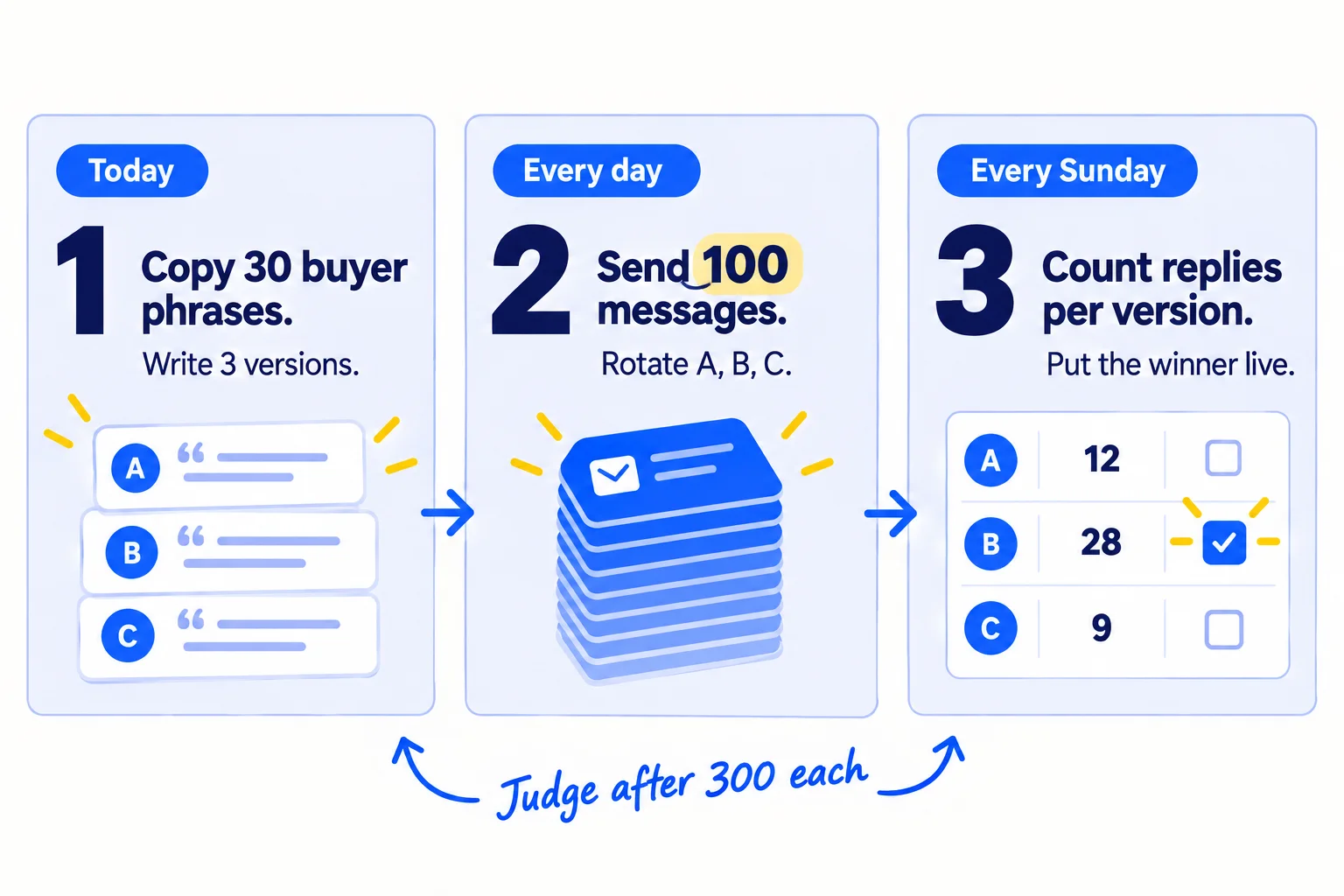
About 3 hours today, then about 3 hours a day. You pick a winner after 900 messages, 300 per version: about 9 days at 100 a day.
Show the three actions in fullHide the full list
- Today: copy 30 phrases your buyers use about the problem, then write 3 versions of your value proposition, each one sentence under 15 words: who it is for, what they get, and why you instead of what they do now.
- Every day: send 100 personal messagessoon, each opening with one of the 3 versions in turn, and write down which version every reply came from.
- Every Sunday: count replies for each version. After 300 messages each, put the winner on your homepagesoon and in every bio, and replace the weakest with a new version.
Get help doing these
ChatGPT or Claude reads this guide and works through it with you.
1. Copy 30 phrases your buyers already use about the problem
Before you write a word, copy 30 phrases real buyers have used about the problem, word for word, into one sheet. Your value proposition should sound like them, not like you or like ChatGPT.
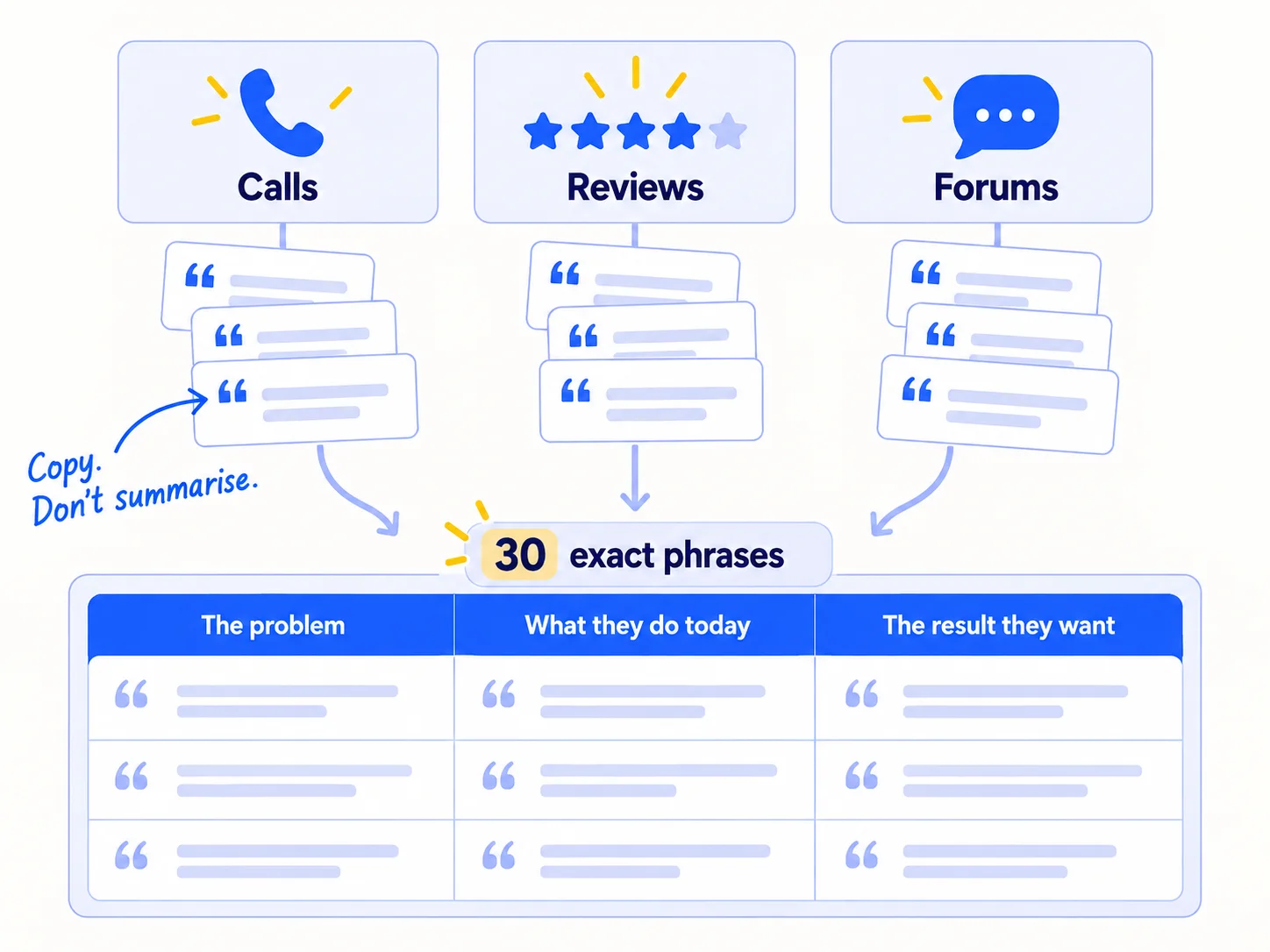
Make a sheet with three columns: the problem, what they do today instead, and the result they want. Then fill it from these places, in this order:
- What buyers already told you. Your emails, DMs and call notes with anyone who bought, tried or said no. If you have spoken to fewer than 5 buyers, book customer interviews as well; they give the best phrases.
- Reviews of what they use now. Read the 3-star and 2-star reviews of the tools, products or firms your buyers use today. People who half-liked something say exactly what was missing. Copywriters call this review mining.
- Forum questions. Search the places your buyers ask for helpsoon for the problem, sorted by New. Read what they asked, not the answers.
Copy the words exactly, with a link or a name next to each. Do not tidy them up. "The minimum order was more boxes than we sell in a year" is useful. "Minimum order quantities are a pain point" is not. You can paste your rows into ChatGPT or Claude and ask it to sort them into the three columns and group the ones that say the same thing. Do not ask it what your customers want: it will invent the same pains it gives everyone.
If you run a SaaS: read the 3-star reviews on G2 or Capterra of the tools your buyers compare you with.
If you run a B2B business: ask your 2 clients "What were you doing before us, and what annoyed you about it?" Then read the Google reviews of the firms you compete with.
If you run a D2C store: read the 3-star reviews of the best-selling products like yours on Amazon, and the comments under creators' videos about the problem.
If you run an agency: pick one kind of clientsoon first. Then read what those business owners post about marketing, and the job ads they write for marketers.
- Tool: Google Sheets. ChatGPT or Claude to sort the rows. All free to start.
- Time: 1 hour 30 minutes.
- You will have: a sheet with 30 exact phrases, each with where it came from.
- It worked if: all 30 are real quotes, and at least 3 ideas were said by 3 or more different people. Those repeated ideas go into your sentence.
- Common mistake: writing the phrases yourself from memory, or letting AI fill the sheet. Then the sentence sounds like every other page, because it was written from the same guesses.
See it done: 5 of Carvelian's 30 phrases
Carvelian Packaging is a made-up maker of custom printed boxes for small food and drink brands. One founder sells through calls, samples and quotes.
The phrase sheet (5 of 30 rows)
| Column | Exact phrase | Where it came from |
|---|---|---|
| The problem | "The minimum order was more boxes than we sell in a year" | A food makers' forum |
| The problem | "We're in 6 cafés and still putting stickers on brown boxes" | Call with a client |
| What they do today | "Plain kraft boxes and a label printer" | 3-star review of a box supplier |
| The result they want | "A box that looks like we're a real brand" | Call with a client |
| The result they want | "Something a shop will put on the front shelf" | A food makers' forum |
Why it works: Every phrase is a buyer's own words, and the same idea turns up from different people.
2. Write your value proposition statement three ways, in one sentence each
A value proposition statement is one sentence that says who it is for, what they get, and why you instead of what they do now. Write one long version for yourself, then 3 short versions to test.
![A long sentence card with four blanks: 'For [who] who [the moment it hurts], [what you sell] gives [the result]. Unlike [what they do today], it [the one thing only you do].' Arrows lead to three short cards: 'A: lead with the result', 'B: lead with the pain', 'C: lead with the difference'. Label: 'Under 15 words each'.](/academy/illustrations/how-to-write-a-value-proposition/step-2-write-your-value-proposition-statement-three.webp)
First, the long sentence. This is your positioning in one line, and it is for you, not for your homepage. Start with the last blank: what would your buyer do if you did not exist? That is what you really compete with, and it is often a spreadsheet, a plain box, a freelancer or doing nothing. Then ask what you have that it does not, and what that gets the buyer. Take the "who" from your ideal customer profile.
For [who, from your customer profile] who [the moment the problem hurts, in their words], [what you sell] gives them [the result they want, in their words].Unlike [what they do today], it [the one thing only you do].
Then, 3 short versions. Each one is a single sentence, or two very short ones, under 15 words. Each must name who it is for and what they get. Make them differ in one way only, what they lead with:
- A leads with the result they want.
- B leads with the pain of what they do today.
- C leads with the difference from the alternative.
Here are 30 phrases my buyers used, in three columns: the problem, what they do today, and the result they want. [paste the sheet]Here is my long sentence: [paste it]Write 10 versions of a value proposition, each under 15 words. Use only words and ideas from the phrases. Each must say who it is for and what they get. Do not use: all-in-one, AI-powered, seamless, streamline, powerful, innovative, solution, platform, leading, next-generation.
Pick the 3 you would be happy to see on your homepage: one A, one B and one C. Change any word a buyer would not say. If your price is a reason to choose you, say so with the real number, and only once your pricing is settled.
This matters. In March 2026, one founder changed a headline from what the product does to what it is built on. Signups went from 32 a week to 0 on the same traffic, and changing it back brought 8 signups that night (Indie Hackers).
If you run an agency: the result is your client's result, such as "more booked demos", not your service, such as "SEO and content". Name the kind of client in every version.
If you run a D2C store: the "who" can be the moment of need ("for hair that frizzes by noon"), and the "unlike" is what they buy now. Put the result on your product pagesoon too, once it wins.
- Tool: a Google Doc, and ChatGPT or Claude.
- Time: 45 minutes.
- You will have: 1 long sentence and 3 short versions, marked A, B and C.
- It worked if: each short version is under 15 words, names who it is for, and uses at least 2 phrases from your sheet.
- Common mistake: describing what it is made of or built on. The other mistake is writing for everyone. If a version could be about any business in your field, it is not finished.
See it done: Carvelian's three versions
Versions to test
| Version | The sentence |
|---|---|
| A · the result | Your own printed box for your food brand, even on a small first order. |
| B · the pain | Stop putting stickers on plain boxes. Get your own printed box, in short runs. |
| C · the difference | Printed boxes for small food brands, without a big print firm's minimum order. |
Why it works: All three name the buyer and use their words: 'stickers', 'plain boxes', 'minimum order'.
3. Show each version to 10 people for 5 seconds
Show each version to 10 people who fit your buyer and have never seen your product, for 5 seconds each. Keep a version only if at least 8 of the 10 can say what you sell and who it is for.
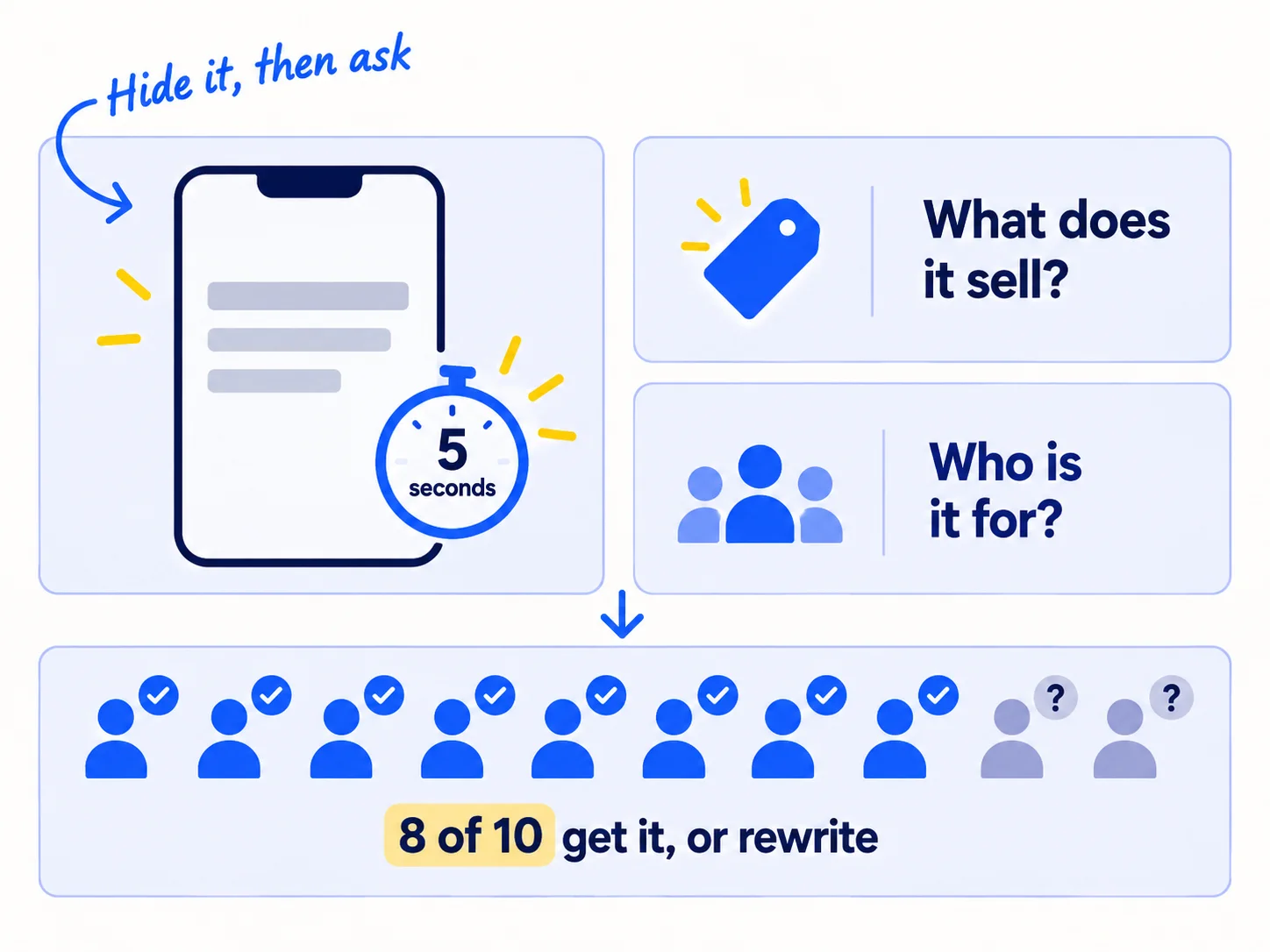
This is a five-second test. It checks the one thing a visitor decides first: is this for me? In April 2026, one founder put 96 landing pages through an AI review and found that 80% had headlines that did not say the benefit in the first 5 seconds (Indie Hackers). Most of the rest failed on who it was for.
Put each version on your phone, one per screen. Show it for 5 seconds, then hide it and ask two questions. Write the answers word for word.
[Show the sentence for 5 seconds, then hide it.]
What does it sell?
Who is it for?
[Write down exactly what they said. Do not explain anything until both answers are written.]
Find the 30 people where your buyers already are: a feedback thread in one of your communities, people at a local business meetup, friends of friends who fit your buyer. Your cofounder, your family and people who have seen your product do not count. They already know the answer.
- Tool: your phone and your sheet. No paid tool.
- Time: 45 minutes for 30 people.
- You will have: 30 written answers, 10 per version.
- It worked if: at least 8 of 10 name both what you sell and who it is for. If a version scores under 8, rewrite it with the words people used when they got it wrong, and test it on 10 new people.
- Common mistake: asking "Do you like it?" People are kind, and a liked sentence can still be unclear. Ask what it sells.
4. Send 100 messages a day that open with a different version
Every day, send 100 personal messages to people who fit your buyer. Put one of your 3 versions near the top of each, taking turns, A then B then C, and write down which version each reply came from. Replies from real buyers are your test.
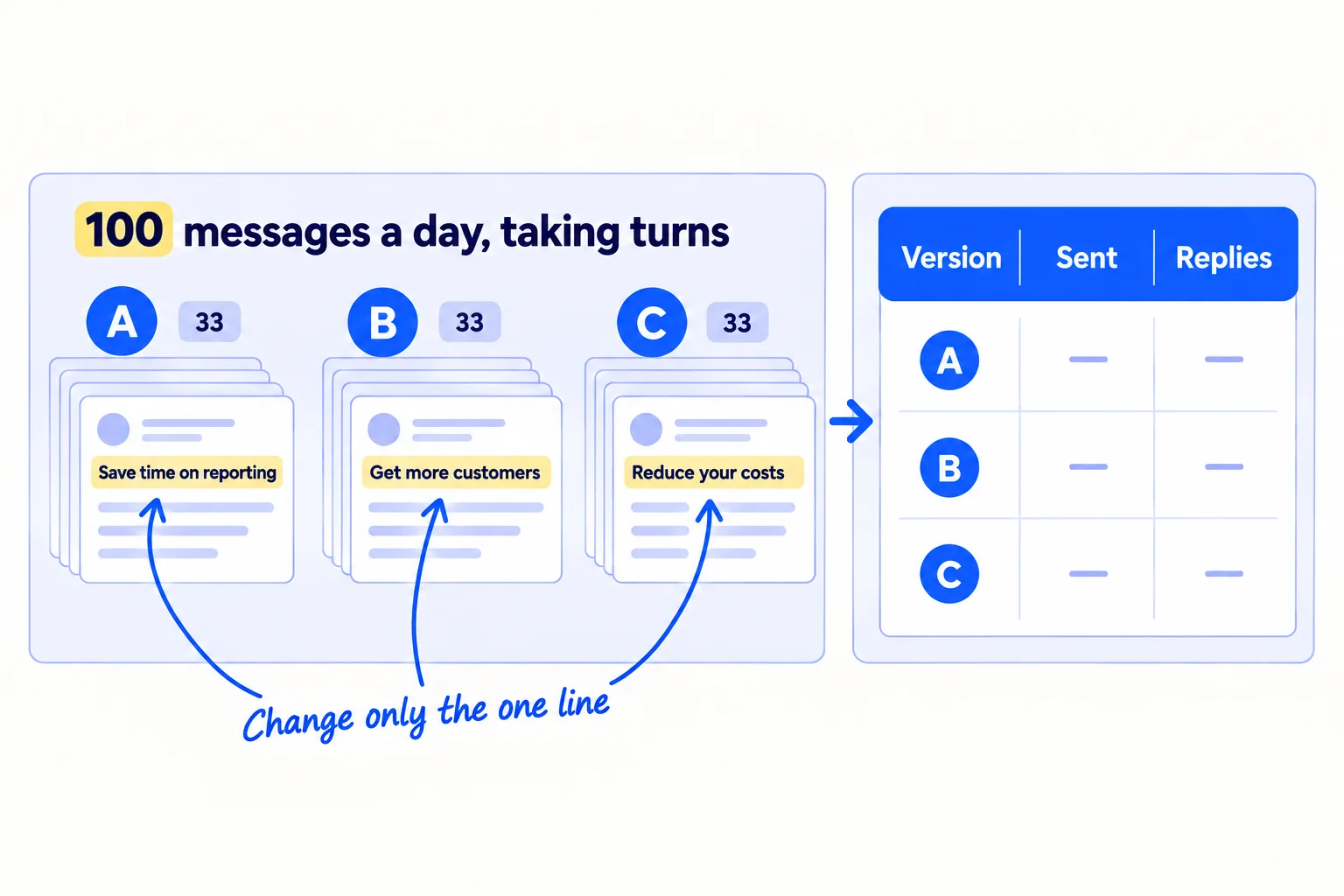
You probably get too few visits to test on your website. An A/B testsoon needs around 200 signups or sales per version before it tells you anything (Web Tonic), and at 300 visits a month that takes years. Messages are faster. At 100 a day, each version reaches 300 buyers in 9 days.
Keep every message the same except the version line. The first line is one true thing about the person. The second is your version. The end is one easy question. Let AI draft: paste 10 names at a time into ChatGPT or Claude, each with one thing you found about them, plus the template below and today's version. Read each draft, make the first line true, and send it yourself. That is about a minute a message.
Subject: [the problem, in their words, 3 to 5 words]Hi [first name],[One true line about them: something they made, sold, wrote or posted.][Version A, B or C, word for word.]Is that a problem for you right now? If it is, I'd like to ask you 3 questions on a 15-minute call.[Your name]
[Your company, postal address]
Not for you? Reply "no" and I won't write again.
Keep the list full. 100 a day uses up names fast, so add 100 new ones every day. Build the list for freesoon from the same places you found your phrases, and find each buyer's emailsoon.
Stay inside the rules while you send 100 a day. Gmail requires every sender to have SPF or DKIM, two settings that prove the email really comes from your domain, and wants your spam reports below 0.3%. If you email more than about 50 strangers a day, set up a second domainsoon and warm it up first. In the US, the CAN-SPAM Act covers business email too: every message needs your postal address and a way to say no, and you must honour a "no" within 10 business days. The UK and EU have stricter rules on emailing people, so check them before you write to buyers there. LinkedIn limits connection invitations, and a block usually lasts a week, so message people you are already connected tosoon there and send the rest by email. If any platform warns you, stop there for the day and move the rest of the 100 to another place.
Follow upsoon with everyone who has not replied, twice more, 3 days apart. Keep their version in the follow-ups. Stop the moment someone says no.
If you run a D2C store: send the messages as DMs to people who posted about the problem on Instagramsoon, TikTok and Redditsoon, with your product link instead of the call. Count replies and clicks.
If you run a B2B business or an agency: send to the named decision-maker at each company, by email. The call is a discovery callsoon, not a pitch.
- Tool: Gmail or LinkedIn (DMs for D2C), ChatGPT or Claude to draft, and your sheet with a "Version" column.
- Time: about 2 hours a day for the messages, and 45 minutes to find 100 new names.
- You will have: 900 messages sent and logged after 9 days, 300 for each version.
- It worked if: your best version gets at least 3 replies per 100 messages. Instantly's 2026 report put the average cold email reply rate at 3.43%, from emails sent in 2025, so 3 in 100 is a fair pass mark. If all three versions get fewer than 2 replies per 100 after 900 messages, the words are not the problem. You are writing to the wrong people: go back to who you sell to.
- Common mistake: changing more than the version line, so you cannot tell what made the difference. The other mistake is sending the same text to everyone. Each message still starts with a true line about the person.
See it done: Carvelian's message with version B
To: Priya, co-founder of a small granola brand now sold in cafés
Subject: stickers on plain boxes
Hi Priya,
I saw your granola is now in 4 cafés in town. The new flavour looks great.
Stop putting stickers on plain boxes. Get your own printed box, in short runs.
Is that a problem for you right now? If it is, I'd like to ask you 3 questions on a 15-minute call.
Dan Carvelian Packaging, [postal address] Not for you? Reply "no" and I won't write again.
Why it works: Only the second line changes between versions, so the replies show which sentence works.
5. Every Sunday, count replies by version and put the winner everywhere
Every Sunday, count the replies for each version. When each has reached 300 messages, pick the winner, put it everywhere a stranger meets you, and start a new round with a new version in place of the weakest.
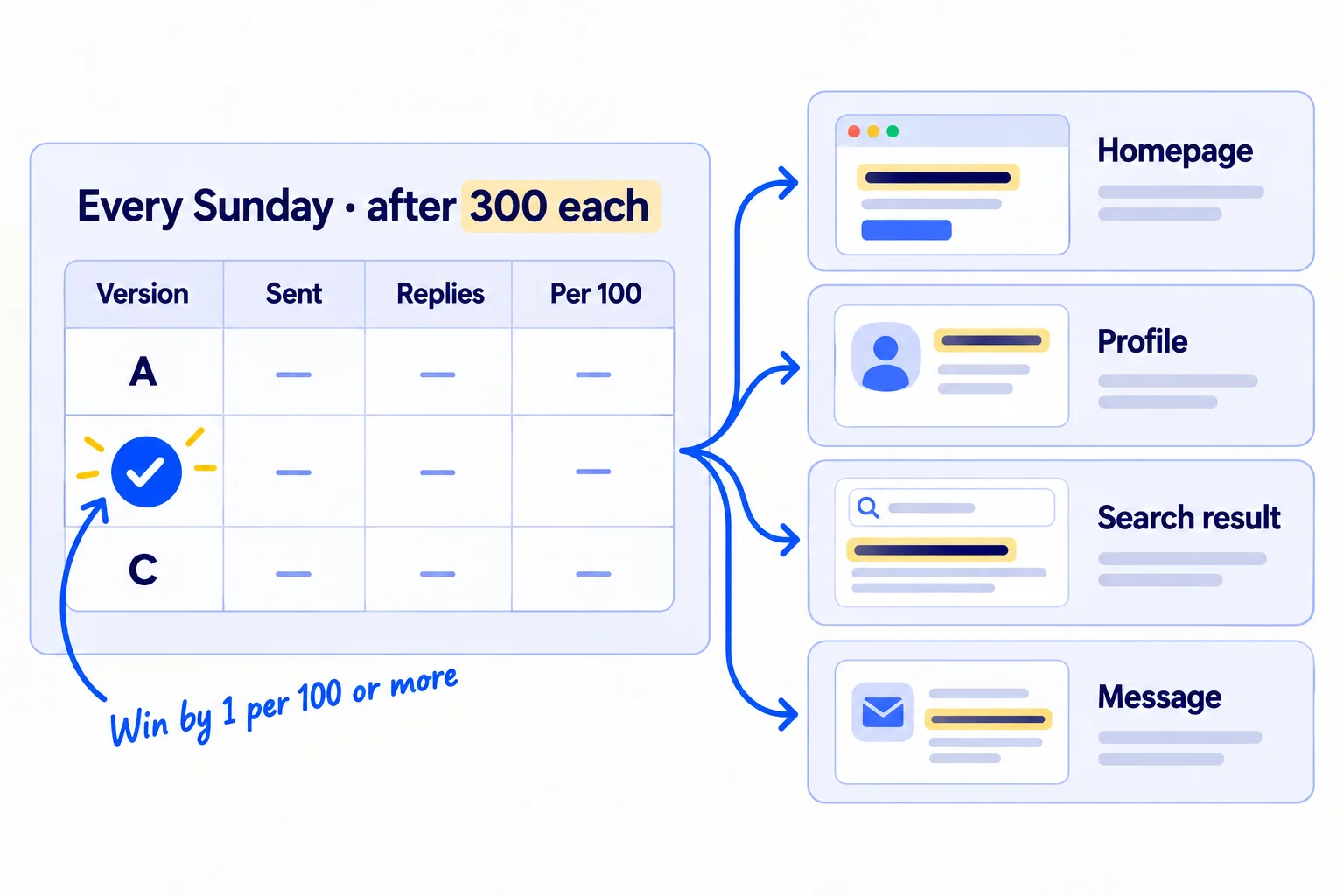
Pick the winner by this rule. After 300 messages each, the winner has the most replies per 100, and is at least 1 per 100 ahead of the next one. If the top two are closer than that, keep both, replace only the third, and send 600 more before you decide.
Version | The sentence | Messages sent | Replies | Replies per 100 | Calls booked
A | … | … | … | … | …
B | … | … | … | … | …
C | … | … | … | … | …
Put the winner everywhere, in the same words. Change these in one sitting:
- Your homepage headline, with your long sentence's "unlike" part as the line under it. Put your main call to action right below, above the fold. Then write the rest of the homepagesoon under it.
- Your page title and meta description, the lines Google can show in results. Google says it uses the meta description when it describes the page better than the page's own text.
- Your LinkedIn headline: click Me, then View Profile, then the Edit icon in your intro. Change the Headline field and click Save. Do the same in every social bio.
- The first line of every message from now on, and the first slide of your sales decksoon or proposalsoon.
Then ask ChatGPT: "What does [your website] do, and who is it for?" More and more buyers meet you there first. In G2's March 2026 survey of 1,076 software buyers, 51% said they now start their research in an AI chatbot more often than in Google, up from 29% a year earlier. If the answer does not match your sentence, find the pages that still say something else, and change them. Ask again a month later, and write down what it sayssoon. Pages that all say the same thing are the first step to getting your brand mentioned by ChatGPTsoon.
Start the next round. Write a new version to replace the weakest, from the phrases you heard in this week's replies and calls. Test it on 10 people for 5 seconds, then run another 900 messages. Your value proposition should keep getting sharper as you hear more buyers.
If you run a SaaS: also put the winner on your signup page. If people now understand the page but still do not sign up, fix the rest of your sitesoon.
If you run a D2C store: put it in the first line of your product page and in your store's title and meta description. In Shopify, go to Online Store, then Preferences, and fill in "Social sharing image and SEO". Keep the title to 60 characters and the description to about 160, then click Save. If shoppers visit but do not buy, fix the storesoon next.
If you run a B2B business: put it on the cover of every quote, and make your site bring in enquiriessoon.
If you run an agency: change your LinkedIn profilesoon first, because clients check it before your site.
- Tool: Google Sheets, your site editor, and LinkedIn.
- Time: 20 minutes each Sunday, plus 1 hour once to change everything.
- You will have: one tested sentence, live everywhere a stranger meets you, and a new version in test.
- It worked if: the winner leads by at least 1 reply per 100; 8 of 10 new people still get the live homepage in 5 seconds; and over the next 200 visits your signups or orders per 100 visits are no lower than before.
- Common mistake: picking a winner after 30 messages, or changing the homepage every day. 30 messages is 1 reply either way. Wait for 300 each.
See it done: Carvelian's Sunday sheet after 900 messages
Round 1, 300 messages per version
| Version | Messages sent | Replies | Replies per 100 | Calls booked |
|---|---|---|---|---|
| A · the result | 300 | 8 | 2.7 | 3 |
| B · the pain | 300 | 14 | 4.7 | 6 |
| C · the difference | 300 | 9 | 3.0 | 4 |
The decision: B goes on the homepage, the LinkedIn headline and the quote cover. A, the weakest, is replaced by a new version built from "a box that looks like we're a real brand", which three café owners said on calls this week.
Why it works: B is ahead of the next version by more than 1 reply per 100, so it wins.
Once your sentence has won, use it to write your landing pagessoon, your ad creativessoon and your case studiessoon. If nobody buys even when they understand you, read why no one is buying.
Where Scout7 helps
Scout7 speeds up steps 1 and 5.
Step 1. Scout7's audience research reads public social conversations about your category and builds audience segments, with pain points and quotes in buyers' own words. That gives you a head start on your 30 phrases. It reads public conversation only. It does not run interviews, so the calls and reviews in step 1 still matter.
Step 5. When Scout7 reads your website, it builds a brand profile that includes the value proposition it finds there. If the profile says something different from your winning sentence, your site is still saying the old thing. You can correct the profile, and the posts and articles Scout7 drafts later read from it. Nothing is published without your approval.
Your value proposition checklist for the next 2 weeks
0 of 11 done
Work through this list with an AI assistant
It drafts the work and keeps track of what is done.
Frequently asked questions
- What is the difference between a value proposition, a tagline and a positioning statement?
Your value proposition is the promise a buyer reads: who it is for, what they get, why you. A positioning statement is the long, internal version, like the long sentence in step 2; it guides your choices but rarely goes on the page. A tagline is a short, memorable phrase for a brand. You need the value proposition first; a tagline can wait.
- Do I need a value proposition canvas?
Not to start. The canvas from Strategyzer is a free worksheet that lists your buyer's jobs, pains and gains next to what your product relieves and creates. It can help you sort your 30 phrases. But a filled-in canvas is still a guess. Strategyzer itself says fit "is a claim until customers confirm it". The replies in step 4 are that confirmation.
- Can ChatGPT write my value proposition?
It can draft versions, and it saves time. But if you only give it your product, it writes the same sentence it gives everyone, full of words like "seamless" and "all-in-one". Give it your 30 buyer phrases and your long sentence, tell it which words to avoid, and use it to draftsoon. Then test what it writes on real people.
- How long should a value proposition be?
Under 15 words for the version people see first, such as your homepage headline or bio. Add one supporting line of 20 to 30 words under it on your homepage. The long sentence in step 2 can be as long as it needs, because only you read it. If you cannot get the short version under 15 words, you are probably speaking to more than one kind of buyer.
- What if I sell to more than one kind of customer?
Pick the kind you can name the most real people for, and write for them first. One sentence cannot promise different results to different buyers. Once that one wins, write a separate version for the second kind and use it on its own page and in its own messages. Your ideal customer profile decides who goes first.
Sources
- 1.I went from 32 signups a week to 0 with one headline change — Indie Hackers, 18 March 2026
- 2.I roasted 96 landing pages with AI this week. Here is what I'm changing. — Indie Hackers, 14 April 2026
- 3.New G2 Research: Half of B2B Software Buyers Now Start Their Research With AI Chatbots — G2, via PR Newswire, 15 April 2026
- 4.Cold Email Benchmark Report 2026 — Instantly, checked 27 September 2026
- 5.22 Value Proposition Examples and How to Write One — Web Tonic, updated 4 September 2026
- 6.Value Proposition: How To Write One and Examples — Shopify, updated 13 April 2026
- 7.A Quickstart Guide to Positioning — April Dunford, 2021, checked 27 September 2026
- 8.How to Find Your Message Using Review Mining — Copyhackers, checked 27 September 2026
- 9.Write an Inspiring Value Proposition, with Free Template — Asana, updated 5 January 2026
- 10.The Value Proposition Canvas — Strategyzer, checked 27 September 2026
- 11.Control your snippets in search results — Google Search Central, updated 20 April 2026
- 12.Adding keywords to your online store — Shopify Help Center, checked 27 September 2026
- 13.Edit your headline — LinkedIn Help, checked 27 September 2026
- 14.Invitation limit reached — LinkedIn Help, checked 27 September 2026
- 15.Email sender guidelines — Google Workspace Admin Help, checked 27 September 2026
- 16.CAN-SPAM Act: A Compliance Guide for Business — Federal Trade Commission, checked 27 September 2026
Next article to read
Related guides
- How to create an ideal customer profileCreate an ideal customer profile when you have one or two customers: list everyone who paid, tried or talked to you, write 2 or 3 one-sentence guesses, test them with 100 messages a day, and keep the one that gets the most chats after 1,500 messages.
- How to do a competitor analysisDo a competitor analysis in 5 days with free tools: list 10 alternatives your buyers use, read 100 complaints about the top 5 in their own words, put the gap you can fix in your headline, and check them for 45 minutes every Sunday.
- How to write a landing page that convertsComing soon
- How to do customer interviewsDo customer interviews when you have almost no customers: 7 questions about the last time the problem happened, 100 messages a day to book 20-minute calls, a notes sheet in their exact words, and a Sunday count that puts those words into your marketing.
Guides that link here
- How to create an ideal customer profile
- How to do customer interviews
- How to do a competitor analysis
- Why no one is buying your product, and how to fix it
- How to fix a SaaS launch that got zero signupsSaaS
- How to get beta users for your startupSaaS
- How to get clients for a consulting business without referralsB2B
- How to get customers online for free
- How to get people to try your product
- How to get your first 100 SaaS usersSaaS
- How to get your first B2B clientsB2B
- How to get your first client as a marketing agencyAgency
- How to launch on Product HuntSaaS
- How to market a SaaS productSaaS
- How to market your product as a technical founderSaaS
- How to price a B2B product or serviceB2B
- How to price a productD2C
- How to price a SaaS productSaaS
- How to price digital marketing servicesAgency
- How to validate a business idea without spending money
Cite this page
Dinesh Bypilla (2026). How to write a value proposition. Scout7 Academy. https://scout7.ai/academy/marketing-plan/how-to-write-a-value-proposition
Written by Dinesh Bypilla, Agentic systems engineer at Scout7. Reviewed by Murali Sid. Last checked 27 September 2026.
Quote any part of this guide with a link back to this page. © 2026 Scout7.
Markdown version of this page: https://scout7.ai/academy/marketing-plan/how-to-write-a-value-proposition.md