



How to do customer interviews
Do customer interviews when you have almost no customers: 7 questions about the last time the problem happened, 100 messages a day to book 20-minute calls, a notes sheet in their exact words, and a Sunday count that puts those words into your marketing.
ByDinesh BypillaReviewed byMurali SidLast checked 17 min read
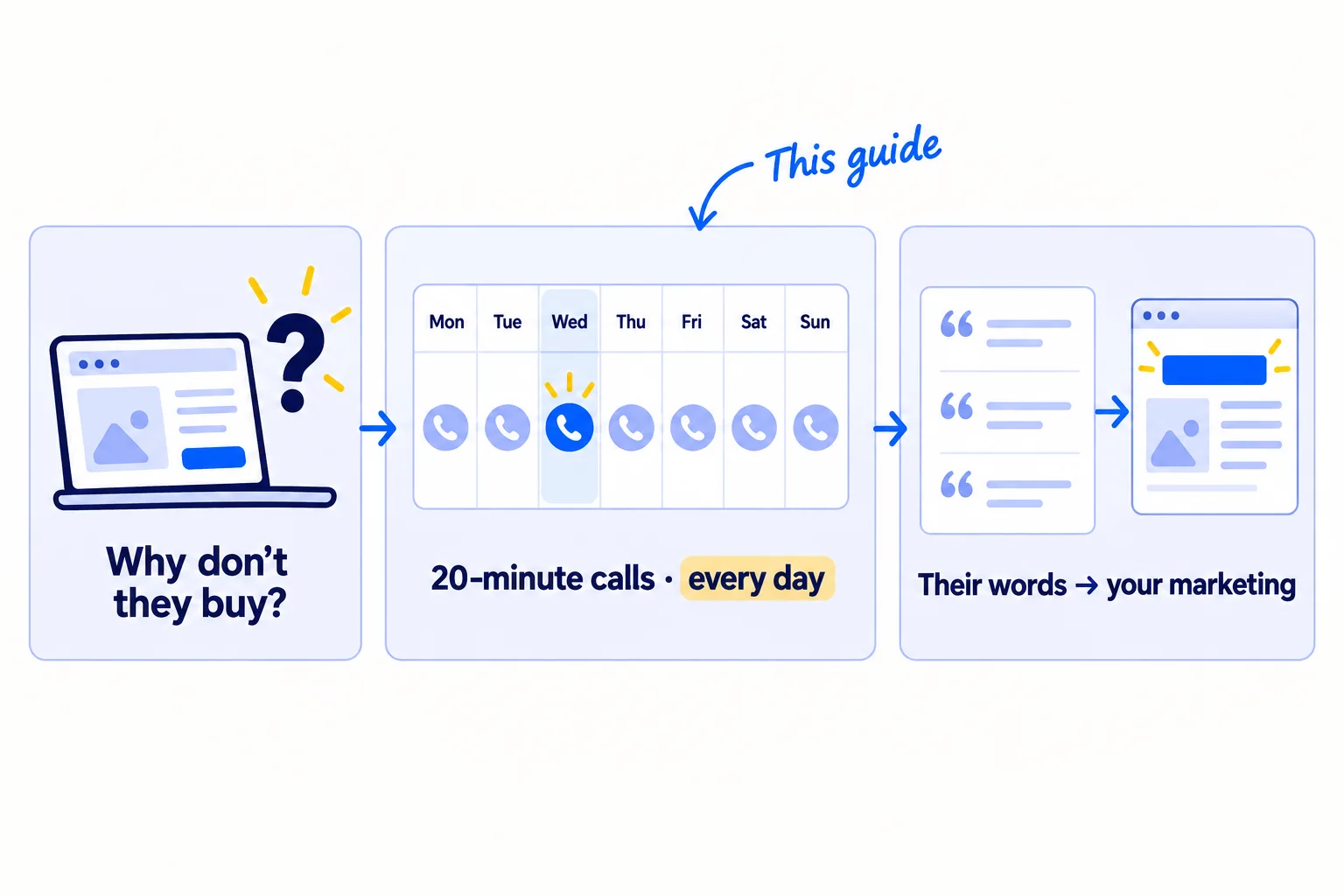
You built the product, a few people signed up or bought, and you do not know why the rest did not. Here is how to do customer interviews when you have almost no customers: short calls about the last time your buyer had the problem, booked at a volume that gives you 20 conversations in about a week. Without them, you guess what to say on your websitesoon and in your messages, and most guesses are wrong.
Do these three things
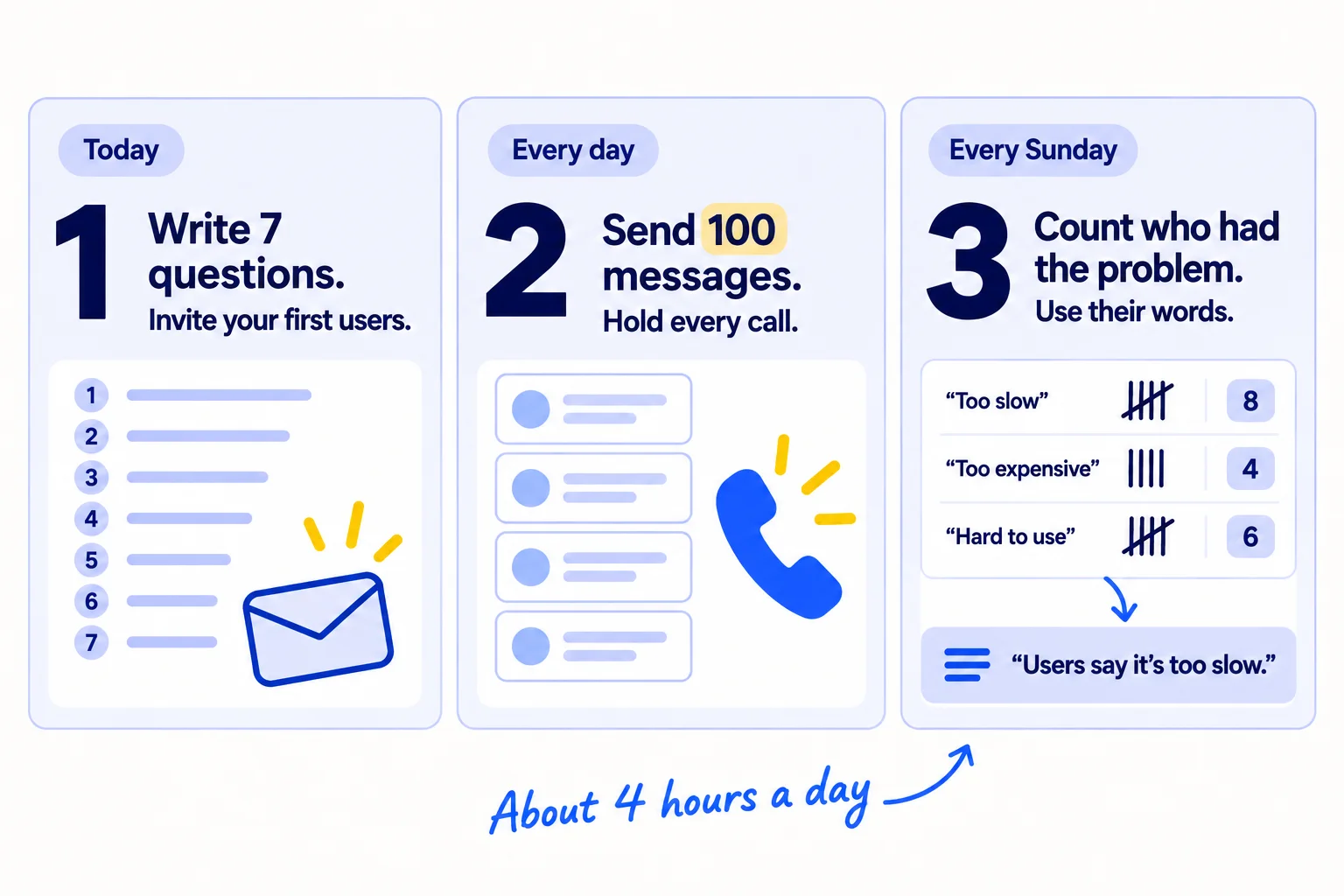
About 4 hours a day. Expect about 3 interviews from every 100 messages, and judge who you are talking to after 20 interviews, about 700 messages.
Show the three actions in fullHide the full list
- Today: write 7 customer interview questions about the last time your buyer had the problem, and invite everyone who already signed up or boughtsoon to a 20-minute call.
- Every day: send 100 personal messagessoon asking for a 20-minute interview, hold every call you book, and write down the person's exact words within 10 minutes.
- Every Sunday: count how many people had the problem in the last 30 days, and put the words 3 or more of them used into your homepage headlinesoon and the first line of your messages.
Get help doing these
ChatGPT or Claude reads this guide and works through it with you.
1. Write down who to interview and the three things you need to learn
Write one sentence that says who you will interview, and three things you need to learn from them. Then list 100 people who fit, starting with anyone who has already used, bought or cancelled.
![A sentence card reading '[Kind of buyer] · [size] · [the moment it hurts]' with three numbered boxes under it: '1. How often it happens', '2. What it costs them', '3. What they use now'. An arrow leads to a list labelled '100 names · first users first'.](/academy/illustrations/how-to-do-customer-interviews/step-1-write-down-who-to-interview-and-the-three-thi.webp)
The sentence is the short form of your ideal customer profile. If you have one already, use it. The three things to learn are the same for almost every business:
- How often the problem happens to them, and when it last did.
- What it costs them in time, money or stress.
- What they use or pay for now, including doing nothing.
Then fill a Google Sheet with 100 names, in this order:
- People who already signed up, bought or paid you. They are the easiest yes and teach you the most. Anyone who cancelledsoon or signed up and never came backsoon goes near the top.
- People you know who fit the sentence: past colleagues, old clients, friends at companies like your buyer. This is warm outreach.
- Strangers who fit, found on LinkedIn, Google and in online communities where your buyers talksoon. People who posted about the problem in the last few months are the best of these. Build the rest with a free lead listsoon.
Give ChatGPT or Claudesoon your sentence and ask it for kinds of companies or people who fit, and where they gather online. Check each name yourself before it goes in the sheet.
- Tool: Google Sheets, and ChatGPT or Claude. Free to start.
- Time: 1 hour 30 minutes.
- You will have: the sentence, the three things to learn, and a sheet of 100 names with a way to reach each one.
- It worked if: all 100 rows have a real name, and at least 20 of them have already used your product, bought from you or know you.
- Common mistake: interviewing friends and family who do not have the problem. They are kind, and kind answers teach you nothing. If you cannot find 20 people who have the problem, check the problem is real before you go further.
2. Write your customer interview questions about the last time the problem happened
Write 7 questions that ask about something that already happened, never about the future or your product. People are polite about ideas, but they remember what they did last Tuesday.
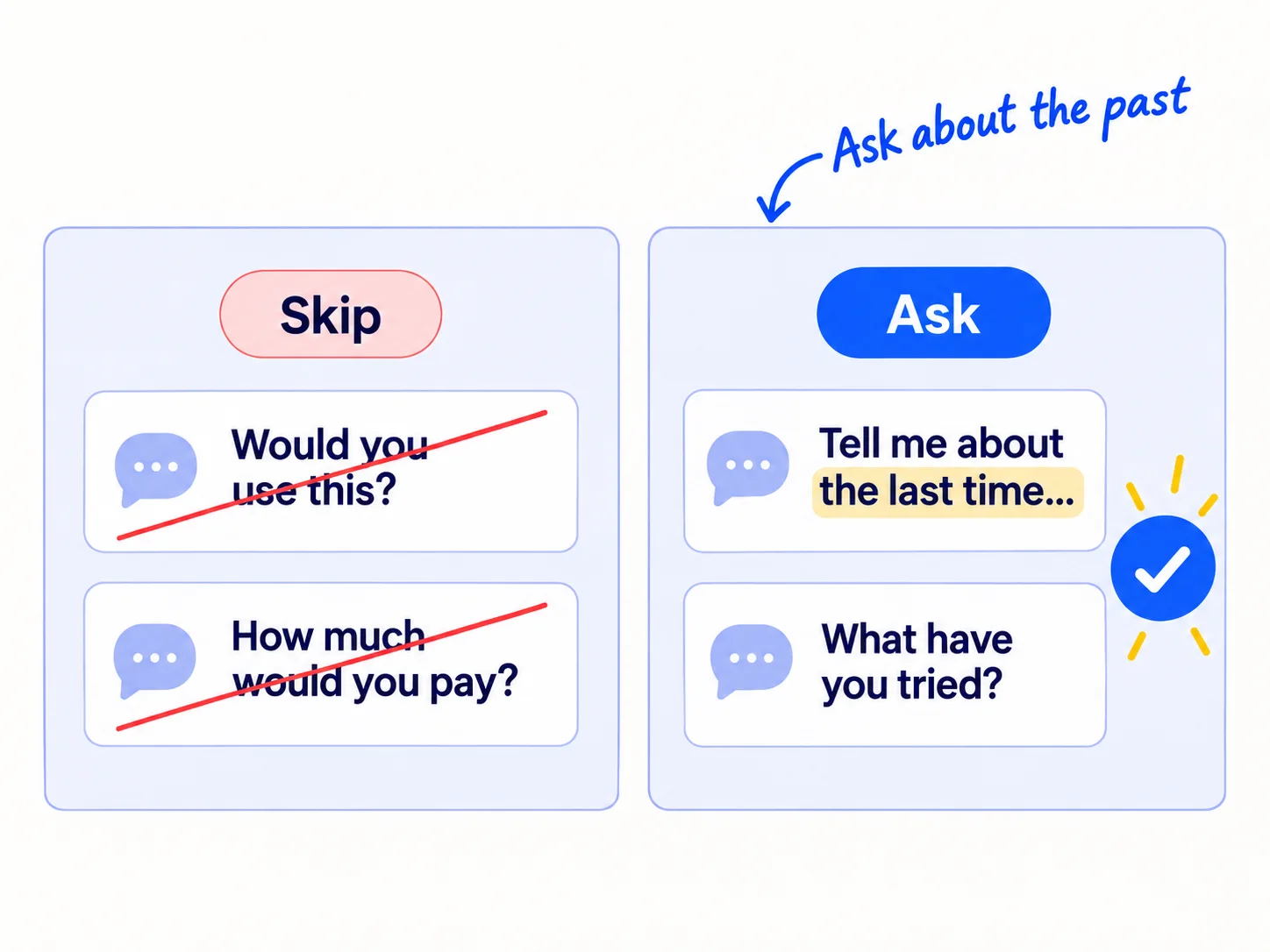
The first five come from Eric Migicovsky's Y Combinator talk "How to Talk to Users". The last two find the words and places you will use in your marketing. Copy them and put your buyer's task in the brackets:
Opening: "Thanks for your time. I'm not selling anything today. I'm trying to understand how people like you deal with [the problem]. Is it OK if I record this so I can take notes? It's only for me."
What's the hardest part about [doing this task]?
Tell me about the last time that happened. When was it, and what did you do?
Why was that hard?
What, if anything, have you done to try to solve it? What do you use or pay for now?
What don't you love about the things you've tried?
When you looked for a fix, where did you look, and what did you type into Google or ask ChatGPT?
What did the last time cost you, in time or money?
Closing: "This really helped. [Next step: "Can I set up a trial for you now?" / "Can I send you a sample?" / "Could we look at your last order together next week?"] And who else should I talk to about this?"
After each answer, ask "Why?" or "What happened next?" once or twice before you move on. These follow-ups find the real cost.
- Tool: a Google Doc.
- Time: 30 minutes.
- You will have: one page with the opening, 7 questions and the closing.
- It worked if: none of the 7 questions names your product, and none starts with "Would you" or "Do you think".
- Common mistake: asking "Would you use this?" or "How much would you pay?". People say yes to be nice, then never buy. Ask what they paid last time instead. That is also the question the pricing guides use in every chat.
3. Send 100 messages a day to get customer interviews
Send 100 personal messages every day, each asking for a 20-minute call about the problem, with a link to pick a time. Expect about 3 interviews from every 100 messages, so 100 a day gives you about 20 interviews in the first week.
![A tall stack of message cards labelled '100 messages a day'. The front card reads 'Hi [name], could I ask you 7 questions about [the problem]? 20 minutes.' An arrow leads to a booking page with time slots.](/academy/illustrations/how-to-do-customer-interviews/step-3-send-100-messages-a-day-to-get-customer-inter.webp)
First, make a booking page so nobody has to email back and forth. In Google Calendar, click "Create", then "Appointment schedule", set 20-minute slots with 10 minutes free after each, click "Next", then "Save". A basic booking page is free with a Google account.
Then work down your list: first users and buyers first, then people you know, then strangers. 100 a day empties a list fast, so add 100 new names every day. Search LinkedIn or Google for people who fit your sentence, and find their work emailsoon.
Let AI do the drafting. Paste 10 names at a time into ChatGPT or Claude, each with one thing you know about the person, plus the template below. Ask for one message per person. Read each draft, make the first line true and about them, and send it. That is about a minute a message.
Subject: [the problem, in 3–5 words]Hi [first name],[One true line about them: they signed up, bought, posted about the problem, or you worked together.]I'm trying to learn how [kind of buyer] deal with [the problem] today. Could I ask you 7 questions on a 20-minute call? I won't try to sell you anything.Pick any time that suits you: [booking link][Your name]
[Your company, postal address]
Not for you? Reply "no" and I won't write again.
Stay inside each platform's rules, and spread the 100 across them instead of sending fewer:
- LinkedIn restricts your invitations for about a week if you hit its limit, and it does not say what the limit is. Message people you are already connected to, and send the rest by emailsoon.
- Email. Since February 2024, Gmail requires every sender to have SPF or DKIM, two settings that prove the email comes from you, and a spam complaint rate below 0.3%. If you email more than about 50 strangers a day, set up a second domain and warm it upsoon so your main email stays safe.
- The law. In the US, the CAN-SPAM Act covers business email too: add your postal address and a way to say no, and honour a "no" within 10 business days.
- Communities. Some let you post one "looking to talk to [kind of buyer]" request. Read each place's rules on self-promotion first, and never paste the same post in many places. This matters most on Redditsoon and in Facebook groupssoon.
Follow upsoon with everyone who has not replied, twice more, 3 days apart, with one new line each time. Stop the moment someone says no.
If you run a D2C store: email every past buyer who is not a friend, and people who reviewed or posted about products like yours. Offer a $25 gift card or a free product for 20 minutes. In 2025, research panels most often paid shoppers $80 an hour for calls like this.
If you run a B2B company or an agency: do not offer cash. You cannot match what research panels pay managers, and it attracts the wrong people. Offer to send a one-page summary of how 20 of their peers handle the same problem. Some of these calls turn into your first clients.
- Tool: Gmail or LinkedIn, Google Calendar's appointment schedule, ChatGPT or Claude to draft, and your Google Sheet to log every message.
- Time: about 1 hour 45 minutes a day for 100 messages, plus 45 minutes to find 100 new names. With the calls and notes, the whole routine is about 4 hours a day, so plan your week around it.
- You will have: 700 messages sent and logged in the first week, and about 20 interviews booked.
- It worked if: at least 3 interviews are booked from every 100 messages. Below 2, rewrite the first linesoon so it is more about them, then send the next 100.
- Common mistake: asking for "feedback on my product" or offering a demo. That reads as a sales pitch, and people ignore it. Ask about their problem. The other mistake is stopping at 50 messages because nobody replied yet.
See it done: Bugmoth's interview request to a signup
Bugmoth is a made-up bug-reporting tool for small web teams. It costs $19 a month per team, with a 14-day trial.
To: Priya, owner of a 3-person web studio, signed up 3 weeks ago and never added a site
Subject: client bug reports
Hi Priya,
You signed up for Bugmoth 3 weeks ago. Thank you. I noticed you never added a site, and that is fine. I would like to understand why.
I'm trying to learn how small studios deal with bug reports from clients today. Could I ask you 7 questions on a 20-minute call? I won't try to sell you anything.
Pick any time that suits you: [booking link]
Sam Bugmoth, [postal address] Not for you? Reply "no" and I won't write again.
Why it works: It names something true about her and asks about her problem, not the product.
4. Run each customer interview in 20 minutes without pitching
Hold every call you book, ask your 7 questions in order, and let them talk for at least 15 of the 20 minutes. Say nothing about your product until the last 5 minutes, and only if they ask.
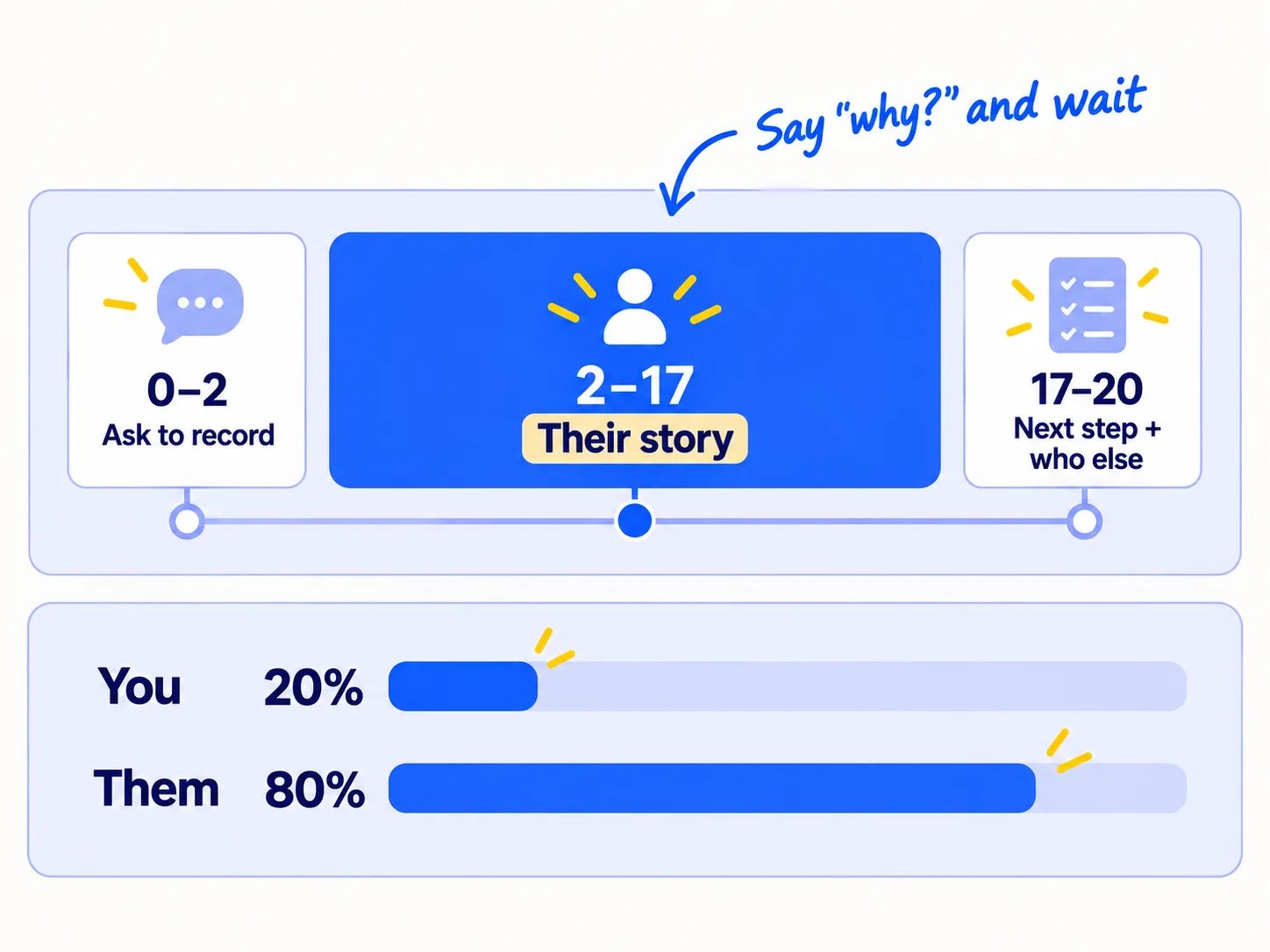
Start. Read your opening line. Ask if you may record, and record only if they say yes. Some US states, such as California and Florida, need everyone on the call to agree, so ask every time. Say what the recording is for, and delete it once your notes are done.
Middle. Ask the questions in order. When they finish an answer, wait three seconds before you speak. People often add the most useful part to fill the silence. Ask "Why?" and "What happened next?" and write down numbers: how long, how often, how much. If they start to describe a feature they want, ask "When did you last need that? What did you do instead?"
End. Ask for one real next step, then for names. A next step is something that costs them a little time or money, which is how you tell real interest from politeness. Thank them, and send the promised summary or gift the same day.
If you run a SaaS: the next step is "Can I set up your trial with you now?". People who start on a call with you are more likely to become paying customerssoon. If they ask to see it first, give a short demosoon in the last 5 minutes.
If you run a B2B company: add two questions: "Who else would decide on this?" and "What did you pay last time, and for how much?". If they want to buy, the call has become a discovery callsoon. Book a second call for that.
If you run an agency: ask about the last time they hired outside help for marketing: who, what it cost, and what went wrong. Their answer tells you which clients to picksoon and what to promise, which matters most when you have no case studies yetsoon.
- Tool: Google Meet or a phone call. A free Google account allows one-to-one Meet calls of up to 24 hours. For a transcript, Otter's free plan covers up to 30 minutes per call and 300 minutes a month, about 15 calls. At 3 calls a day you will need Otter Pro ($16.99 a month) or to take notes by hand.
- Time: 20 minutes a call, about 1 hour a day at 3 calls.
- You will have: about 3 interviews a day, each with one story about the last time the problem happened.
- It worked if: they talked for at least 15 of the 20 minutes, and you have one dated story with a cost in it, such as "Last Thursday, 2 hours".
- Common mistake: pitching or defending your product when they criticise the way things are done today. Once you pitch, they stop telling you the truth and start being polite.
5. Write up each interview within 10 minutes, in their exact words
Within 10 minutes of each call, fill in one row of your notes sheet. Write what they said in their own words, not your summary of it.
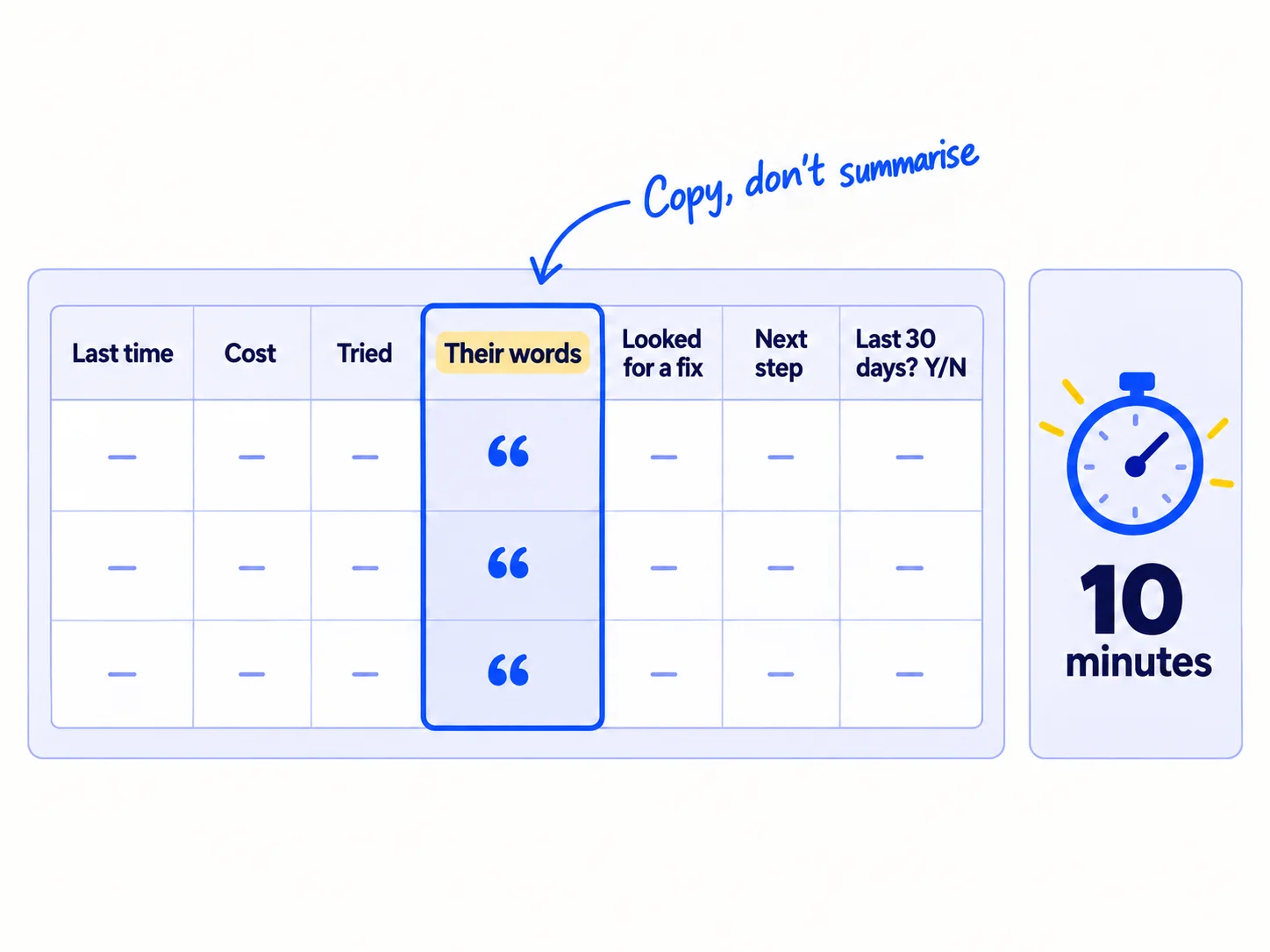
Date | Name and role | Where you found them | Last time it happened | What it cost | What they tried or pay for now | Their words (3 quotes, word for word) | Where they looked for a fix and what they typed | Next step agreed | Had the problem in the last 30 days? (Y/N)
If you recorded the call, paste the transcript into ChatGPT or Claude and ask it to pull out the three strongest quotes about the problem, word for word, and every number mentioned. Check each quote against the transcript before it goes in the sheet. AI summaries often tidy up the very words you need.
This sheet is also where your CRMsoon starts. Keep one row per person, so you can follow up on each next step. A row with a big cost and a happy ending later becomes a case studysoon.
- Tool: Google Sheets, and ChatGPT or Claude for transcripts.
- Time: 10 minutes an interview, about 30 minutes a day.
- You will have: one row per interview, about 20 rows after the first week.
- It worked if: every row has 3 quotes word for word, a Y or N in the last column, and a next step or the word "none".
- Common mistake: writing "found reporting painful" instead of what they said: "I spend Friday afternoons guessing what 'the button is broken' means." The second one can go on your homepage. The first one cannot.
See it done: One row from Bugmoth's notes sheet
Interview 7
| Field | What Sam wrote |
|---|---|
| Name and role | Priya, owner, 3-person web studio |
| Last time it happened | Last Thursday |
| What it cost | 2 hours on a call to find one bug |
| What they tried | A Google Form; clients ignore it |
| Their words | "The site is broken, is all I get." · "I spend Friday afternoons guessing." · "I'd pay to never ask for a screenshot again." |
| Where they looked | Typed "how to get clients to report bugs" into Google |
| Next step | Set up trial on the call, with 1 client site |
| Last 30 days? | Y |
Why it works: The quotes are word for word and the cost has a number, so Sam can use both.
6. Every Sunday, count what you heard and put their words into your marketing
Every Sunday, count three things in your notes sheet, then copy the words 3 or more people used into your headline, your messages and your pages. This is how customer interviews turn into marketing.
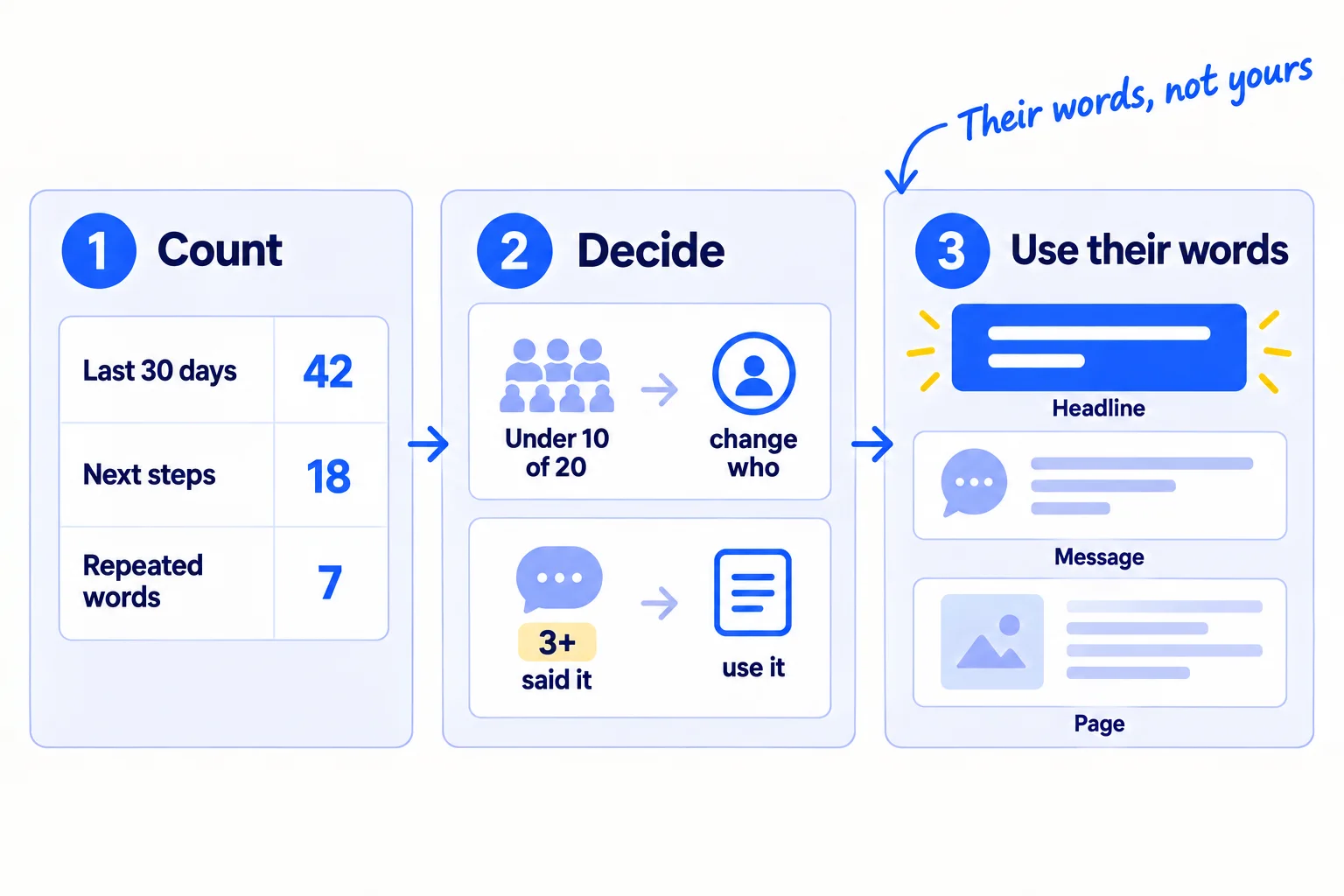
Count:
- How many people had the problem in the last 30 days (the Y column).
- How many agreed to a next step.
- Which words or phrases 3 or more people used. Highlight them in the sheet.
Decide, after your first 20 interviews (about 700 messages):
- Fewer than 10 of 20 had the problem in the last 30 days: you are calling the wrong people, which is a common reason no one is buying. Rewrite your sentence from step 1 around the people who said Y, and message more like them.
- 10 or more had it, but 0 agreed to a next step: the problem is real but not urgent enough to act on. Ask more about cost (question 7) and look for the people who lose the most.
- 10 or more had it and 3 or more agreed to a next step: keep going at 100 messages a day, and put their words to work.
Use their words:
- Your headline. Turn the phrase most people used into your value proposition and your homepage headlinesoon. If you sell products, use it in your product descriptionssoon.
- Your first message line. Open next week's 700 messages with the problem in their words. Count interviews booked per 100 before and after.
- Your pages. What people typed into Google (column 8) is a list of keywordssoon. Write one page for eachsoon, and use the questions they asked as its headings.
- Your competitor list. What they tried or pay for now (column 6) is your real competition, including spreadsheets and doing nothing. What they pay is also your first guide to price.
- AI answers. What they asked ChatGPT shows which questions you want to be named insoon.
- Your proof. When someone who became a customer says something strong, ask if you may quote them. That is your first testimonialsoon.
Later, when you are ready for adssoon, the same words go into them. Keep interviewing after the first 20. New people, new kinds of buyer and new prices all change the answers. Once a month, carry the counts into your monthly marketing reviewsoon.
- Tool: Google Sheets, and your site editor.
- Time: 45 minutes each Sunday.
- You will have: three counts, a decision, and a new headline and first message line in your buyers' words.
- It worked if: after 20 interviews, at least 10 people had the problem in the last 30 days and at least 3 agreed to a next step. After you switch to their words, interviews booked per 100 messages stay the same or go up.
- Common mistake: changing the product or the message after one loud interview. Wait until 3 or more people say the same thing.
See it done: Bugmoth's first message line, before and after 20 interviews
Before the interviews
I'm building a visual bug-reporting tool for web agencies.
After 20 interviews
Do your clients still email you 'the site is broken' with no screenshot?
Why it works: The new line uses the exact words 6 of 20 studio owners said, so buyers see their own problem.
Where Scout7 helps
Scout7 helps with the words in steps 2 and 6. It does not run interviews. The calls are still yours.
Step 2. Scout7's audience research reads public social conversations in your category and builds audience segments with pain points and quotes in buyers' own words. Read them before you write your questions, so you know which phrases to listen for.
Step 6. Put the phrases 3 or more of your interviews used next to Scout7's quotes from public conversations. A phrase that shows up in both places is the safest one to put in your headline.
Your customer interview checklist for the first 20 interviews
0 of 12 done
Work through this list with an AI assistant
It drafts the work and keeps track of what is done.
Frequently asked questions
- How many customer interviews should I do?
Do 20 before you change your message or your product, and keep going after that. At 100 messages a day and about 3 interviews per 100, 20 takes about a week. Stop adding new questions when interviews stop telling you anything new, but keep booking calls: every call is also a chance at a customer, and at product-market fit.
- How long should a customer interview be?
20 minutes. That is long enough for one full story about the last time the problem happened, and short enough that busy people say yes. Most guides suggest 30 to 45 minutes, which suits paid research panels. If the person wants to keep talking, let them.
- Should I pay people for customer interviews?
Shoppers, yes, a little: a $25 gift card or a free product for 20 minutes is fair. In 2025, research panels most often paid shoppers $80 an hour. Business buyers, no: offer a one-page summary of how their peers handle the problem. People who talk only for money often do not have the problem.
- Can AI do customer interviews for me?
No. AI "synthetic users" answer with what sounds likely, not with what a real buyer did last week. Nielsen Norman Group, a user research firm, says they cannot replace real research. Use AI to draft your messages, transcribe calls and pull out quotes. The answers must come from real people.
- What is the difference between a customer interview and a sales call?
In a customer interview you learn about their problem and do not sell. In a sales callsoon you check if they can buy and agree the next step. Keep them apart. If someone wants to buy during an interview, finish your questions, then book a second call for the sale.
Sources
- 1.Eric Migicovsky's five questions you can ask in every user interview (from Y Combinator's 'How to Talk to Users', 2019) — Startup Archive, checked 27 September 2026
- 2.The Mom Test — Rob Fitzpatrick, checked 27 September 2026
- 3.Planning to do a SaaS start-up? Don't forget the 20 interview rule — SaaStr, checked 27 September 2026
- 4.Start with 200 customer interviews — Ash Rust, 6 November 2025
- 5.Synthetic Users: If, When, and How to Use AI-Generated 'Research' — Nielsen Norman Group, 21 June 2024, checked 27 September 2026
- 6.The UX Research Incentives Report — User Interviews, updated 4 January 2025
- 7.Otter pricing — Otter.ai, checked 27 September 2026
- 8.Create a booking page with appointment schedules — Google Calendar Help, checked 27 September 2026
- 9.Learn what requirements you need to use Google Meet — Google Meet Help, checked 27 September 2026
- 10.Email sender guidelines — Google Workspace Admin Help, checked 27 September 2026
- 11.Invitation limit reached — LinkedIn Help, checked 27 September 2026
- 12.CAN-SPAM Act: A Compliance Guide for Business — Federal Trade Commission, checked 27 September 2026
- 13.Two-Party Consent States for Recording (2026 Guide) — Recording Law, checked 27 September 2026
Next article to read
How to write a value propositionAfter the interviews, this turns what buyers said into one clear promise.Read it nextRelated guides
- How to create an ideal customer profileCreate an ideal customer profile when you have one or two customers: list everyone who paid, tried or talked to you, write 2 or 3 one-sentence guesses, test them with 100 messages a day, and keep the one that gets the most chats after 1,500 messages.
- How to get feedback from your first usersComing soon
- How to validate a business idea without spending moneyValidate a business idea without spending money: set a pass mark, message 100 people a day about the problem, ask everyone who has it to pay through a free one-page offer, and decide after 2,800 messages.
- How to run a discovery callComing soon
Guides that link here
- How to create an ideal customer profile
- How to write a value proposition
- How to validate a business idea without spending money
- Why no one is buying your product, and how to fix it
- How to fix a SaaS launch that got zero signupsSaaS
- How to get beta users for your startupSaaS
- How to get people to try your product
- How to get traffic to a new website for free
- How to get your first 100 SaaS usersSaaS
- How to get your first B2B clientsB2B
- How to get your first sale on EtsyD2C
- How to get your first sales on ShopifyD2C
- How to launch on Product HuntSaaS
- How much to spend on marketing as a B2B companyB2B
- How much to spend on marketing as a SaaS startupSaaS
- How to choose marketing channels for a B2B companyB2B
- How to do a competitor analysis
- How to fit marketing into your week as a solo founder
- How to market a D2C brandD2C
- How to market a SaaS productSaaS
- How to market your B2B businessB2B
- How to market your product as a technical founderSaaS
- How to price a B2B product or serviceB2B
- How to price a productD2C
- How to price a SaaS productSaaS
Cite this page
Dinesh Bypilla (2026). How to do customer interviews. Scout7 Academy. https://scout7.ai/academy/marketing-plan/how-to-do-customer-interviews
Written by Dinesh Bypilla, Agentic systems engineer at Scout7. Reviewed by Murali Sid. Last checked 27 September 2026.
Quote any part of this guide with a link back to this page. © 2026 Scout7.
Markdown version of this page: https://scout7.ai/academy/marketing-plan/how-to-do-customer-interviews.md