



How much to spend on marketing as a B2B company
Set a marketing budget for your B2B company from what one client is worth: pay at most a third of a client's first-year profit, cap it at what you could lose over 12 weeks, spend your hours before your cash, and check the cost of every order each Sunday.
ByDinesh BypillaReviewed byMurali SidLast checked 16 min read
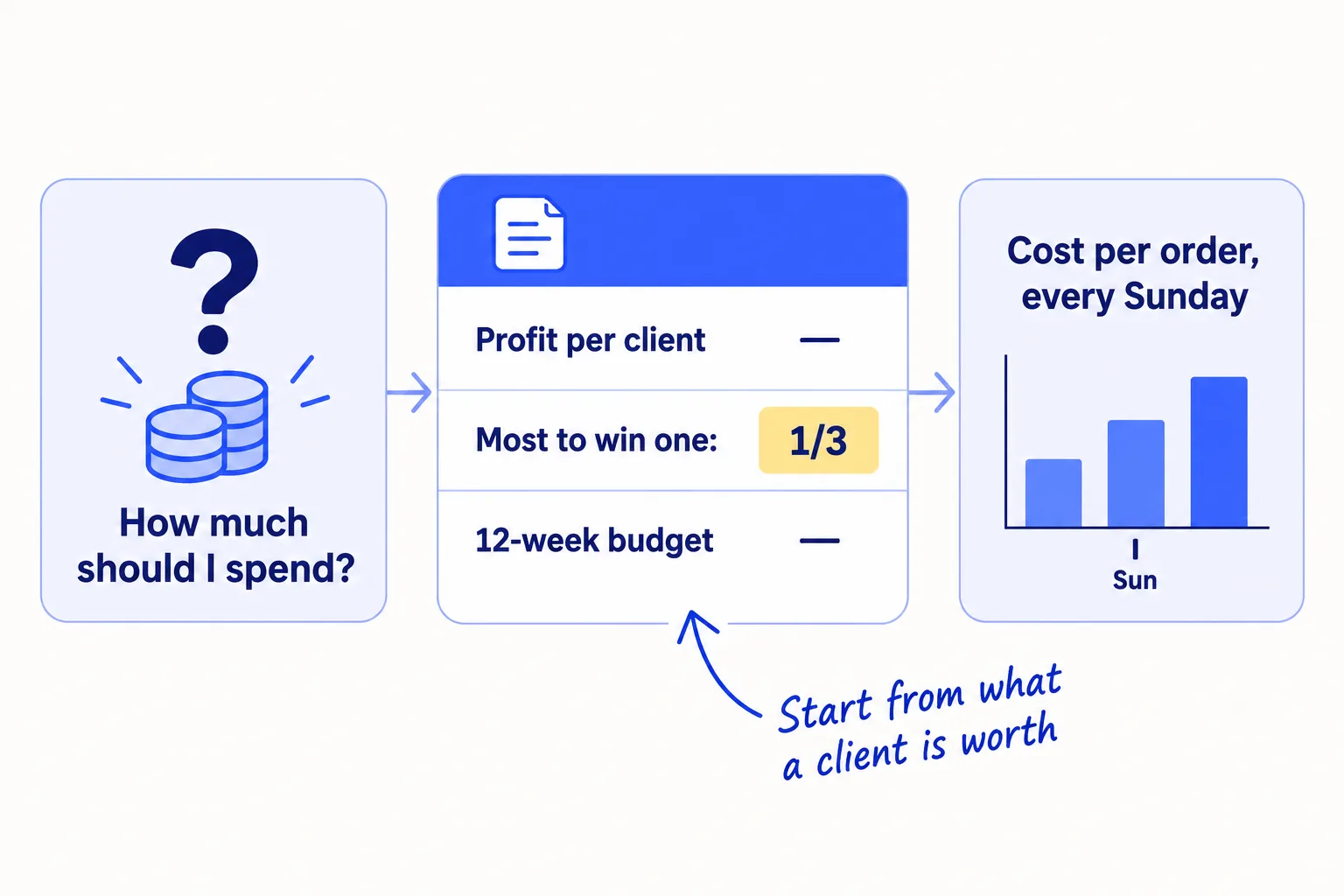
You have one or two clients, a little cash, and every article says to spend 7 to 10% of revenue, which for you is almost nothing. Here is how much to spend on marketing as a B2B company at your size: set your B2B marketing budget from what one new client is worthsoon to you, cap it at what you could lose, and spend your hours before your cash. If you skip this, the usual result is a trade show stand or a month of LinkedIn adssoon that uses up the money and brings no orders.
Do these three things
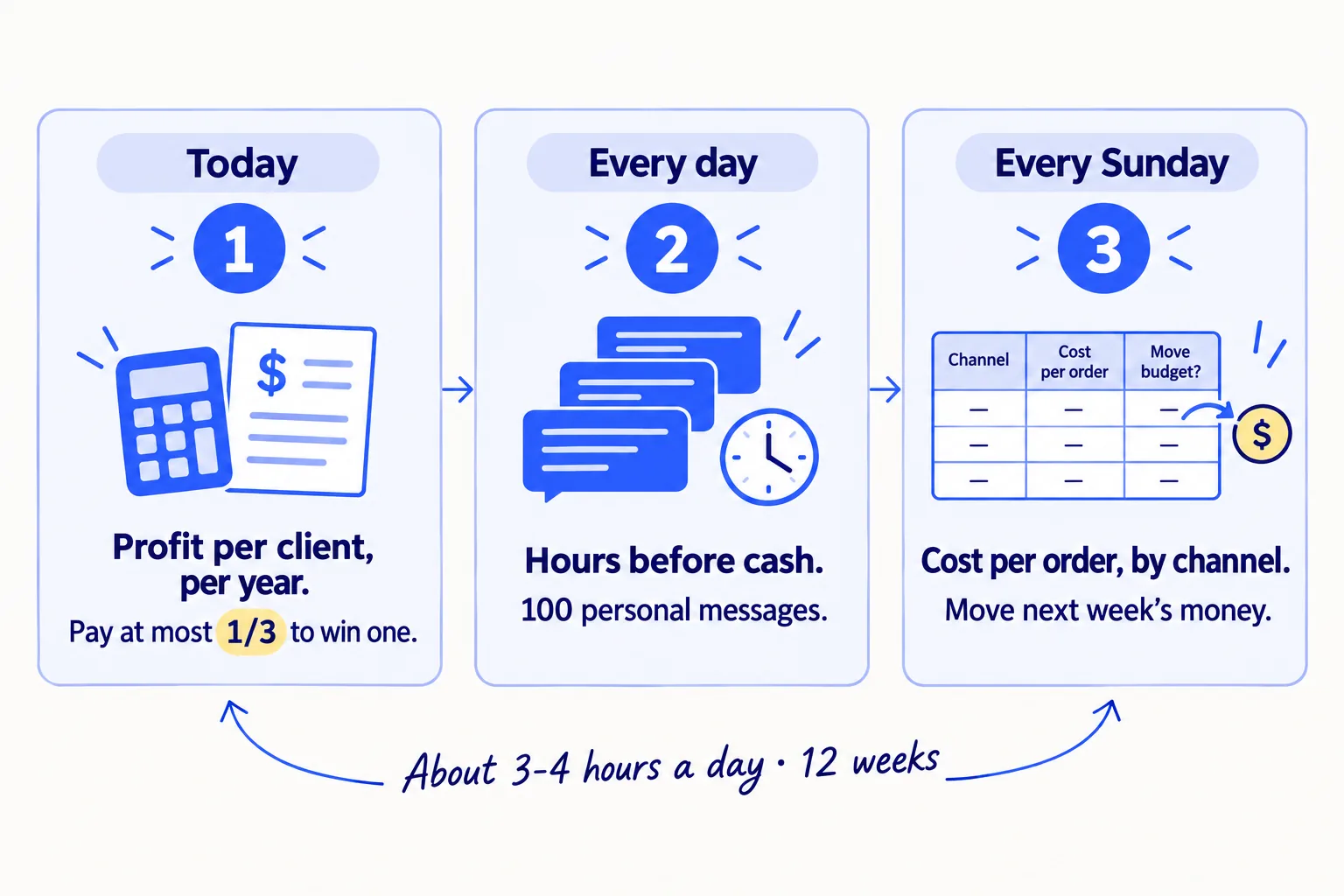
About 30 minutes today, then 3 to 4 hours a day and 30 minutes each Sunday, for 12 weeks. Judge each channel after 8,400 messages, not after one week.
Show the three actions in fullHide the full list
- Today: work out the profit one new client brings you in a year, using your real prices and costs. Pay at most a third of it to win one client, and set a 12-week cash budget you could lose without missing a bill.
- Every day: spend your hours before your cash. Send 100 personal messagessoon to named buyers. AI drafts each one; you add one true line about the person. Write every dollar and hour against the channel it went to.
- Every Sunday: work out what each conversation and each order cost, by where it came fromsoon. Put next week's money where an order costs less than your limit, and stop what brought nothing after its full test.
Get help doing these
ChatGPT or Claude reads this guide and works through it with you.
1. Work out what one new client is worth to you in a year
Before you pick a budget, write down the profit one new client brings you in their first year, because that number tells you the most you can pay to win one. Four numbers do it, and all four come from your own invoices.
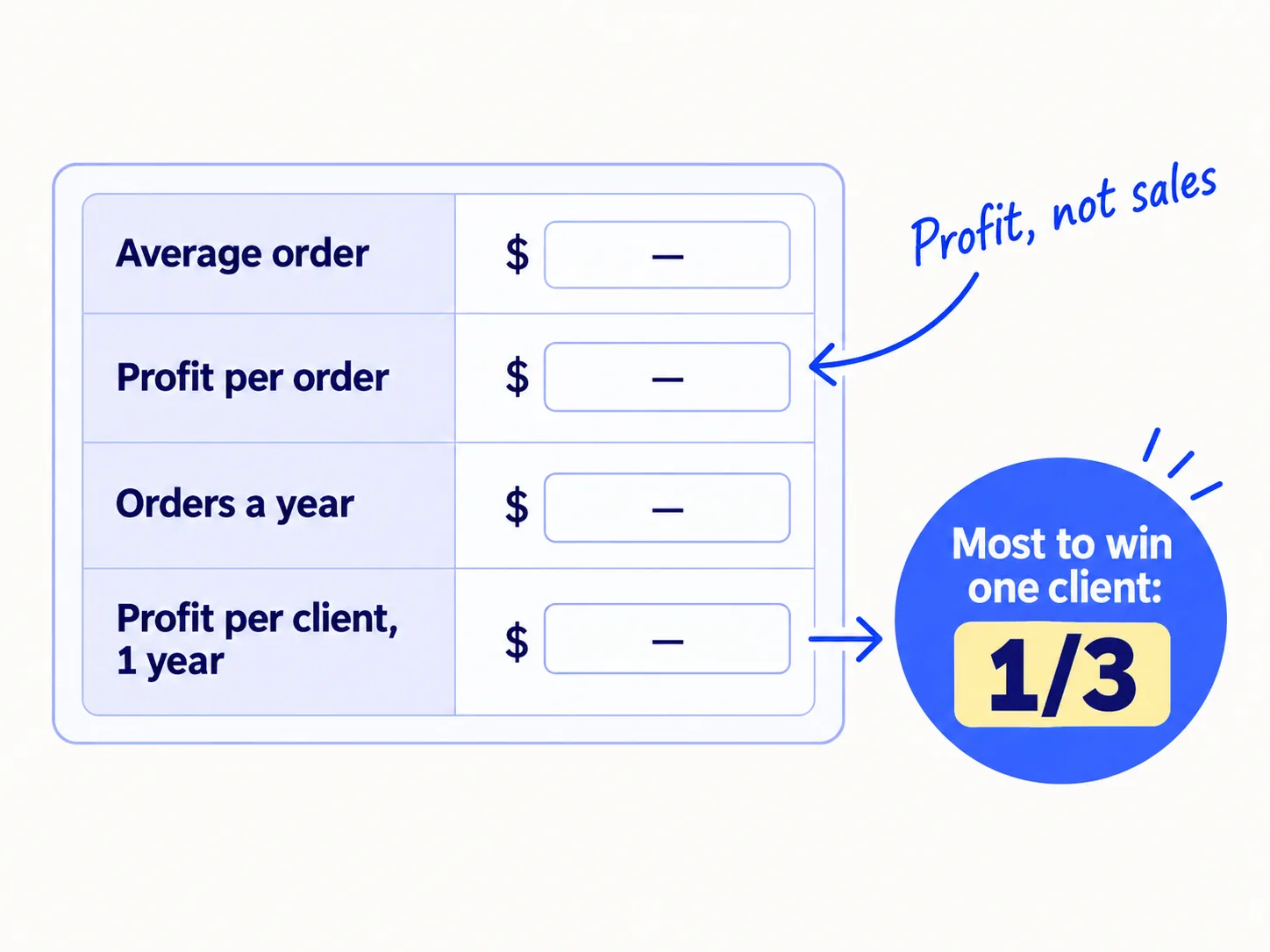
Open your last invoices and fill in this sheet. Profit per order means the price minus what it costs you to make or deliver that order: materials, printing, freelancers, shipping. It does not take off rent or your own pay.
Average order: $[total of your orders ÷ number of orders]Profit per order: $[average order − what it costs you to deliver it]Orders per client in a year: [ask your clients how often they will reorder; if you do not know, write 1]Profit per client in their first year: $[profit per order × orders a year]The most I will pay to win one new client: $[profit per client ÷ 3]
The last line is your limit. It is what you can pay, in cash, to win one new client and still keep two thirds of the profit. This limit is your target customer acquisition cost, and the lifetime value of a client is the first-year profit, plus the years after. Use one year only for now, because at your size you cannot yet know how long clients stay. How fast the money comes back is your payback period. If a client might reorder, ask them on your next call: it is one of the best customer interview questions you can ask.
- Tool: Google Sheets and your last invoices.
- Time: 30 minutes.
- You will have: four numbers and one limit, in dollars.
- It worked if: every number comes from a real invoice, quote or supplier bill. If you had to guess one, write "guess" next to it and check it with your next client.
- Common mistake: using the order value instead of the profit. At a $3,000 order and $1,000 profit, paying $1,500 to win a one-off order loses you $500.
See it done: What one new Carvelian client is worth
Carvelian Packaging is a made-up maker of custom printed boxes for small food and drink brands. One founder sells through calls, samples and quotes.
One new client, first year
| Line | Number |
|---|---|
| Average order | $3,000 |
| Profit per order | $1,000 |
| Orders per client in a year | 3 |
| Profit per client, first year | $3,000 |
| Most he will pay to win one client | $1,000 |
Why it works: The limit comes from the founder's own invoices, so he knows what is too much before he spends anything.
2. Set a 12-week marketing budget from that number, not from a percentage of revenue
Set your cash budget for the next 12 weeks as the smaller of two numbers: your limit times the new clients you want, and the cash you could lose without missing a bill. A percentage of revenue gives a small company a number too small to test anything.
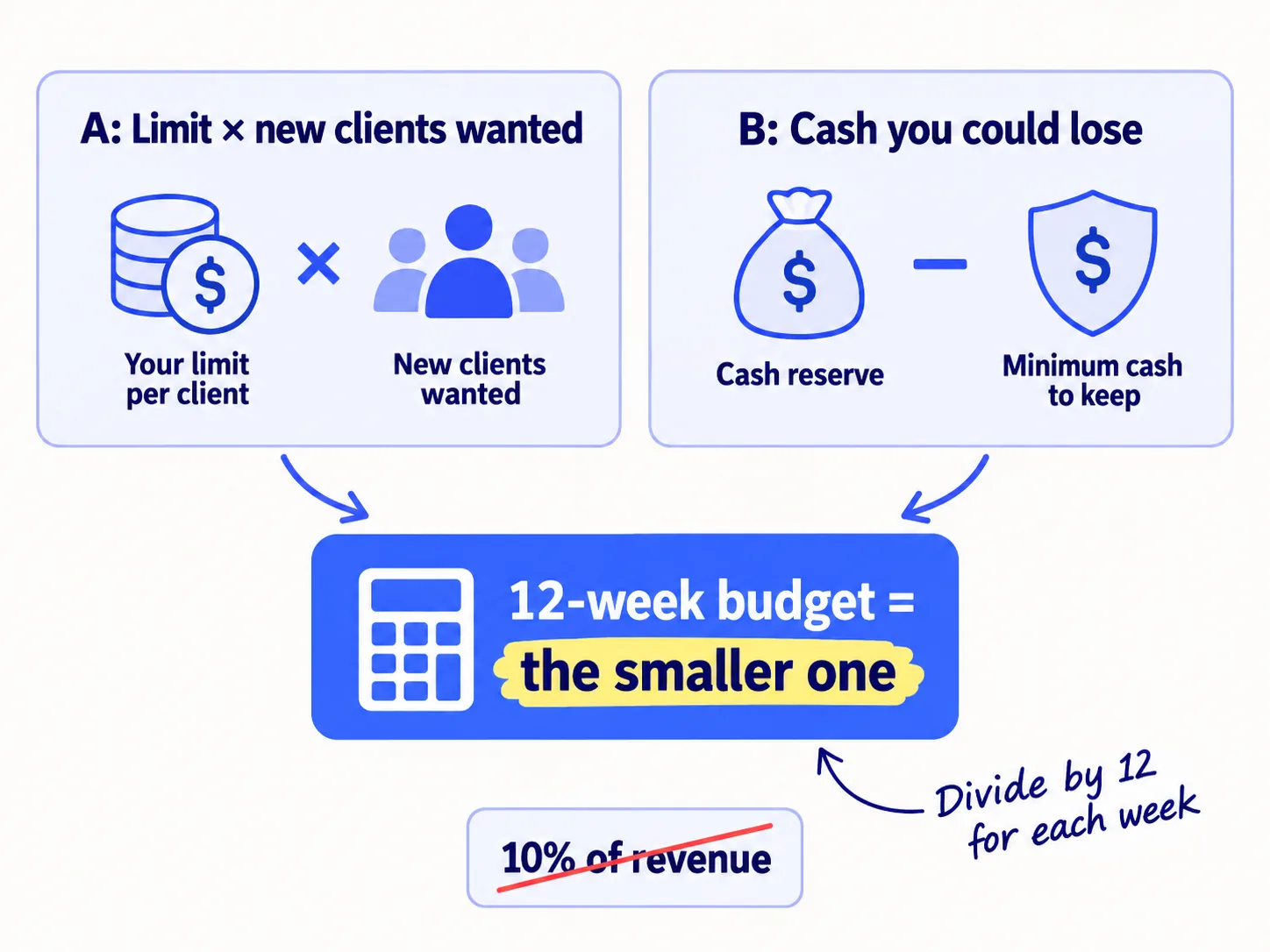
The percentages come from big companies. Gartner's 2026 CMO Spend Survey found marketing budgets at 7.8% of revenue, from 401 marketing leaders, most of them at companies with more than $1 billion in revenue. The CMO Survey's spring 2026 report puts B2B product companies at 7.0% of revenue and B2B services companies at 10.1%. At $18,000 of revenue a year, 10% is about $415 for 12 weeks. That buys one trade show visit and almost nothing else.
The blogs that say "startups spend 30 to 50%" or "$5,000 a month" assume someone gave you money. Work it out from your own numbers instead:
A. My limit × the new clients I want in 12 weeks: $[limit] × [number] = $[A]B. The cash I could lose in 12 weeks and still pay every bill for the next 3 months: $[B]My 12-week budget, the smaller of A and B: $[budget]Each week: $[budget ÷ 12]
- If B is $0: your budget is $0 cash for now. Everything in step 3 works without money, the free version of each channel comes first anyway, and there are more free ways to get customers.
- If you have 12 months of steady revenue: compare your budget with 7 to 10% of revenue. If you are below it and every order costs less than your limit, spend more. If you are above it, keep going only while your cost per order stays under the limit.
A marketer, an agency or a fractional CMOsoon comes out of this same budget. At a few hundred dollars a week, you cannot pay one yet, and you should not hire one until you know which message wins orders.
- Tool: Google Sheets and your bank balance.
- Time: 20 minutes.
- You will have: one 12-week number, and a weekly amount.
- It worked if: you could lose the whole budget and still pay every bill for the next 3 months.
- Common mistake: copying 10% of revenue, which is too little to test anything, or a blog's monthly budget, which can put the business at risk.
See it done: Carvelian's 12-week budget
Three ways to set it
| Way to set it | 12-week budget |
|---|---|
| 10% of this year's revenue ($18,000) | about $415 |
| A: $1,000 limit × 3 new clients | $3,000 |
| B: cash he could lose without missing a bill | $1,500 |
| His budget: the smaller of A and B | $1,500, about $125 a week |
Why it works: The limit says he could spend $3,000, but he can only afford to lose $1,500, so the smaller number wins.
3. Budget your hours first: 100 personal messages a day
Give your hours a daily number before you spend a dollar: 100 personal messages a day to named buyers. At your size your hours are your biggest marketing spend, and they bring more orders than cash does, so plan them into your week like a bill. Most founders send 10, hear nothing and decide to buy ads. With AI drafting, 100 is possible.
![A clock labelled '3–4 hours a day' next to a tall stack of message cards labelled '100 personal messages a day'. The top card reads 'Hi [name], I saw [something about you]. Would a free [sample / check] help?'. Three icons, an envelope, a profile card and a phone, are labelled 'Spread across 3'. A handwritten note reads 'AI drafts, you add one true line'.](/academy/illustrations/how-much-to-spend-on-marketing-as-a-b2b-company/step-3-budget-your-hours-first-100-personal-messages.webp)
Here is how 100 a day fits in 3 to 4 hours:
- Keep the list full. 100 messages a day needs about 3,000 names a month. Add 100 names a day that fit who buys from you to your lead listsoon, each with the person who buyssoon. Hunter's free plan gives 50 credits a month; find the rest on company websites and LinkedIn.
- Let AI draft, then add one true line. Give ChatGPT or Claudesoon your template and the person's company page. It drafts the message in seconds. You add one true line about them. About 1 minute each.
- Spread the volume over three channels. Send email, LinkedIn messagessoon and phone callssoon. LinkedIn limits how many connection requests you can send each week, so put the rest into email and calls instead of sending fewer.
- Protect your email. If you will email more than about 50 strangers a day, set up a second domain and warm it upsoon first, so your main address stays out of spam. That costs $7 a month for a Google Workspace mailbox on an annual plan, plus the domain.
- Follow up. Everyone who does not reply gets up to 3 follow-upssoon. Every yes becomes a discovery callsoon or a sample.
Log every message and your hours in one sheet. You will need the hours in step 6, because a channel that eats 20 hours a week is not free. For what to write and the full routine, use How to market your B2B business and how to get your first B2B clients.
Date | Channel (email / LinkedIn / phone / other) | Messages sent | Follow-ups sent | Replies | Conversations booked | Hours | Cash spent
- Tool: Gmail, LinkedIn, your phone, ChatGPT or Claude, Hunter (free plan) and Google Sheets.
- Time: 3 to 4 hours a day, every day, for 12 weeks.
- You will have: 700 personal messages a week, with every hour logged by channel.
- It worked if: you get at least 2 conversations for every 50 people you contact, after all follow-ups. Below 1 in 50, change the offer or the list before you send more, and before you spend on anything else.
- Common mistake: paying for ads or a list of 5,000 contacts to avoid writing to people. The other mistake is sending one text to everyone: each message is still one-to-one.
4. Split the money: tools, tests with a stop line, and a reserve
Put every dollar of your 12-week budget into one of three buckets before you spend any of it: tools, tests, and a reserve. Each dollar gets a channel and a stop line, so you cannot spend it all in week 1.
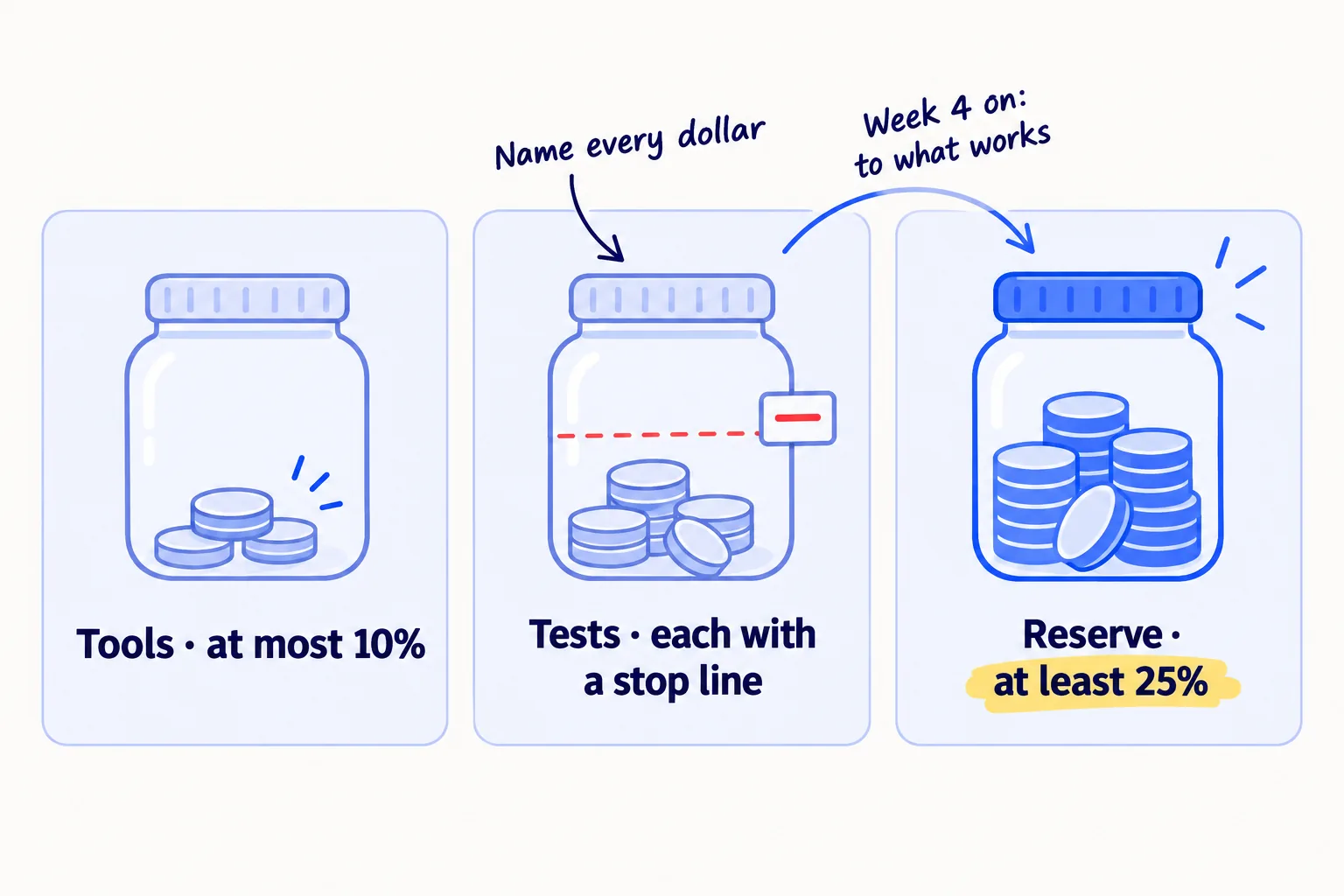
Tools (at most 10%): [only what lets you send more, such as a second email domain] $[X]Test 1: [channel], [what you buy, how many], stop if [number] by week [N]: $[X]Test 2: [channel], [what you buy, how many], stop if [number] by week [N]: $[X]Reserve (at least 25%): for the channel with the lowest cost per conversation from week 4: $[X]
Pick your tests from How to choose marketing channels for a B2B company, which gives each channel a weekly amount and a stop line. What the tests buy depends on what you sell:
- If you make or wholesale a product: free samples and postage for the buyers who say yes, and visits to trade showssoon as a visitor, with meetings booked before the day. Samples for a distributorsoon come from the same bucket.
- If you sell a service, such as consulting or IT: a free first check or audit costs you hours, not cash. Spend the cash on networking eventssoon your buyers go to, and on lunches with referral partnerssoon. A basic Clutch profilesoon is free, and a case studysoon from your first client costs only hours. More in getting consulting clients without referrals.
- If you sell software through sales calls: the free trial or pilot costs you hours. Spend the cash on one event and on the tools that let you send more messages.
Leave out anything that runs for a year: a yearly software plan, a sponsored listing or a stand. You cannot stop them at week 4.
- Tool: Google Sheets.
- Time: 30 minutes.
- You will have: your budget in three buckets, with a channel and a stop line next to every dollar.
- It worked if: tools are 10% or less, the reserve is 25% or more, and the reserve is still untouched at the end of week 4.
- Common mistake: spending the whole budget in the first week on the biggest single thing: a stand, a yearly plan or a month of ads.
See it done: Carvelian's $1,500 split
12 weeks, $1,500
| Bucket | What | Stop line | Cash |
|---|---|---|---|
| Tools | Second email domain and one mailbox | None | $40 |
| Test 1 | 40 free printed sample boxes, with postage, at $15 each | 0 quote requests from the first 20 samples | $600 |
| Test 2 | 2 regional food and drink shows, as a visitor | 0 sample or quote requests from the first show | $480 |
| Reserve | For the test with the lowest cost per conversation | Not before week 4 | $380 |
Why it works: Most of the cash buys samples and show visits that his outreach can use, and a quarter waits for the channel that wins.
5. Pay for ads or a trade show stand only after the free version works
Pay for ads, a stand or a sponsored listing only after your free channels have brought at least 5 orders, and only when the orders you can expect cover the cost. Before that, you pay to show strangers a message you have not tested.
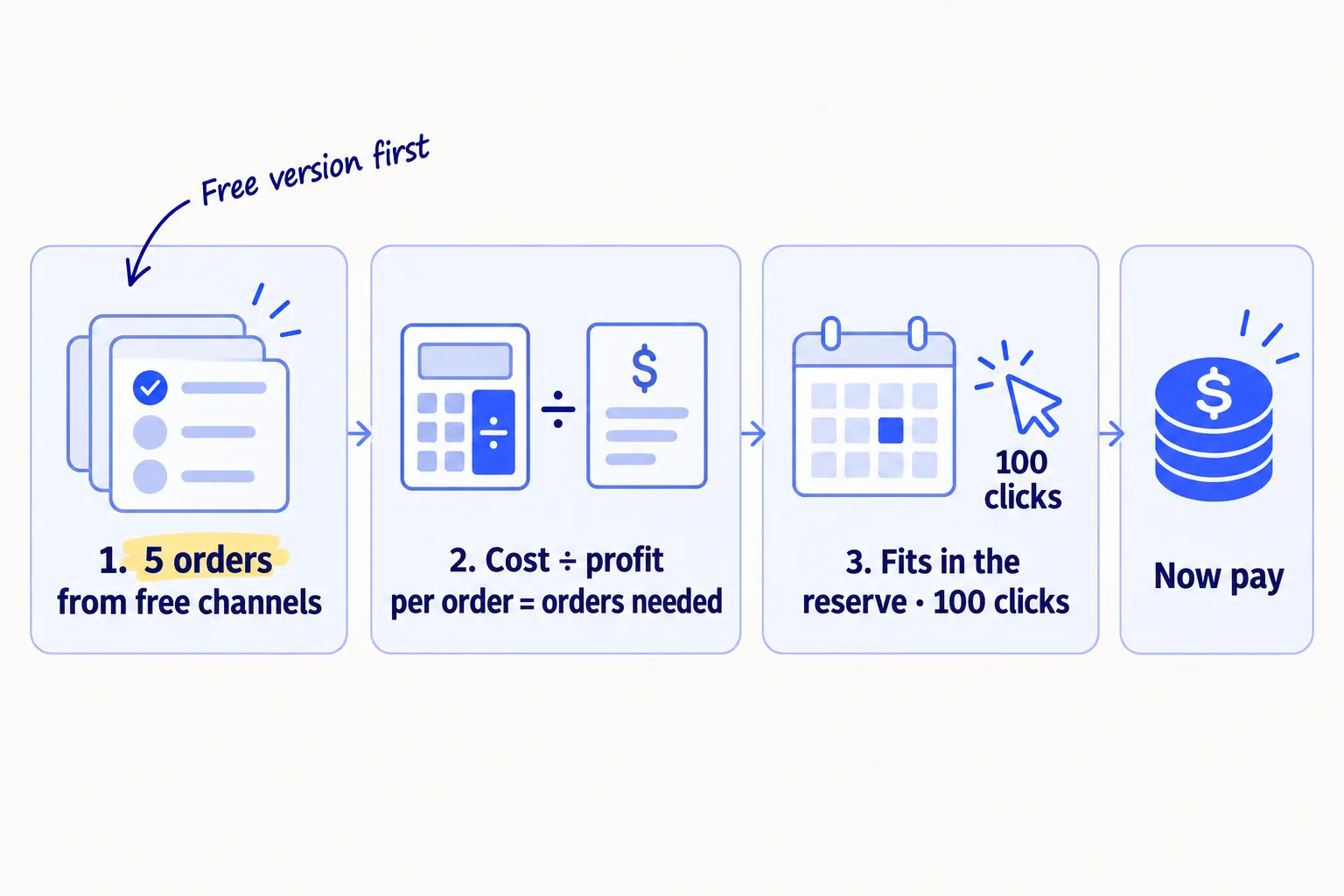
Run every paid option through this card before you pay. The first two gates are the same rules as in the channels guide.
Paid option: [LinkedIn ads / Google Ads / a stand at [show] / a sponsored listing]Cost: $[X]Gate 1. Orders from free channels so far: [number]. Pass at 5 or more.Gate 2. Orders needed: $[cost] ÷ $[profit per order] = [number]. Did the free version of this channel bring at least that many conversations? [yes / no]Gate 3. Does it fit in my reserve, and does it buy at least 100 clicks (for ads)? [yes / no]Decision: [pay / wait]
The ad platforms set their own minimums, so check them before you pick a test size:
| Platform | The rule | What it means for a small test |
|---|---|---|
| LinkedIn ads | At least $10 a day, or $100 over the life of a new campaign. Clicks cost about $5 to $12 in 2026 benchmark reports, more for senior job titles. | 100 clicks costs about $500 to $1,200. Less than that, and you learn almost nothing. |
| Google Ads | No minimum. A campaign can spend up to 2 times its daily budget on one day, and at most 30.4 times it in a month. | A $10 daily budget can cost up to $304 in a month. Budget for the monthly number. |
When an ad test passes all three gates, use the words that won replies in your outreach in the ad creativesoon, and set it up with conversion trackingsoon first, so you can count what it brings. Then follow How to run LinkedIn ads for B2Bsoon or the guide to Google Adssoon, and size it with how much to spend on adssoon. Retargetingsoon only shows ads to people who already visited your site, so it waits until your site has steady visits.
- Tool: a calculator, your Sunday sheet, and LinkedIn Campaign Manager or Google Ads when you are ready.
- Time: 15 minutes for each paid option.
- You will have: a gate card for each paid option, with a pay or wait decision.
- It worked if: everything you pay for passed all three gates, and has its orders-needed number written next to it.
- Common mistake: buying a stand or $2,000 of ads "to get the word out" before any free channel has brought orders. A stand at $4,000 with $1,000 profit per order needs 4 orders from one show.
6. Every Sunday, count what each conversation and order cost, and move the money
Every Sunday, add up the cash, hours, conversations and orders for each channel, and divide. Cost per conversation tells you where to put next week's money. Cost per order tells you if it is working.
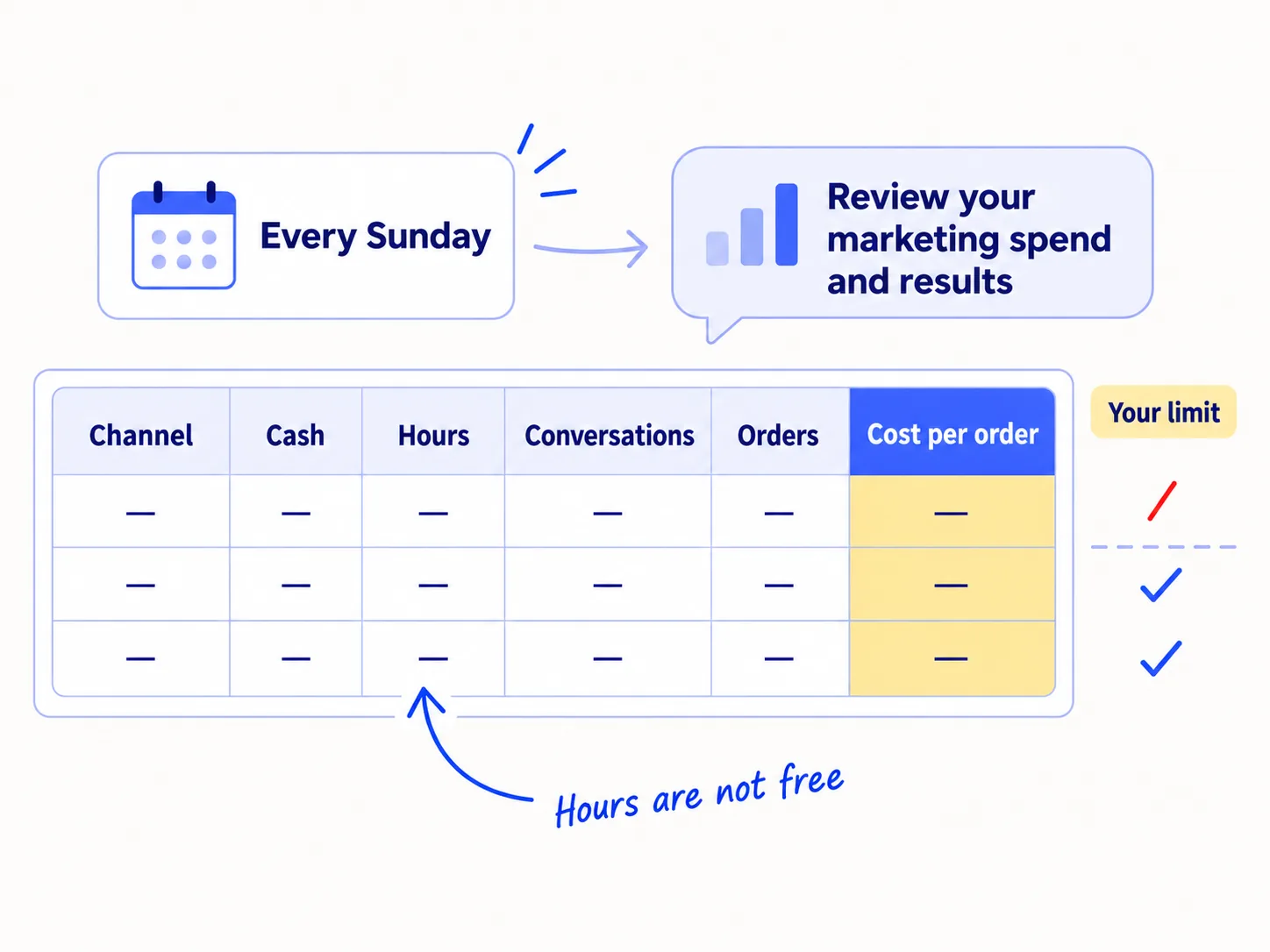
Ask every new conversation "How did you hear about us?" and write the answer down. This is self-reported attribution, and at your size it is more reliable than any tool. Tag links you share with UTM parameterssoon so website enquiriessoon show their source too.
Week | Channel | Cash spent | Hours | Conversations | Samples or quotes | Orders | Cash per conversation | Cash per order
Then use these rules:
- Every Sunday, from week 4: give next week's reserve money to the channel with the lowest cash per conversation.
- When a test reaches its stop line with nothing: stop it, and move what is left to the reserve.
- When a channel's cash per order is under your limit: keep it, and give it more of the next 12-week budget.
- When it is over your limit: fix the offer first, then stop it if the next 12 weeks are also over.
- After 8,400 messages (12 weeks at 100 a day): set your next 12-week budget in step 2 again, with your new numbers. Once a month, step back for a full marketing reviewsoon.
Orders are slow in B2B. A buyer who asks for a sample or a proposalsoon this week may order in 6 weeks, so judge conversations weekly and orders at week 12. Searchsoon takes months, so judge it at month 3 or later. Keep slow leads warm with a monthly email: see nurturing B2B leads by emailsoon. When the sheet gets too big, move to a CRMsoon.
- Tool: Google Sheets.
- Time: 30 minutes each Sunday.
- You will have: one row per channel per week, and a cash cost per conversation and per order for each channel.
- It worked if: you can name the channel and the cost behind every order.
- Common mistake: judging after one week, or leaving hours out, so the channel that eats your week looks free.
See it done: Carvelian after 12 weeks
Weeks 1 to 12, by channel
| Channel | Cash | Hours | Conversations | Orders | Cash per order |
|---|---|---|---|---|---|
| Outreach, with free sample boxes | $1,015 | 294 | 340 | 3 | $338 |
| 2 trade show visits | $480 | 24 | 14 | 1 | $480 |
The decision: samples had the lowest cost per conversation, so the $380 reserve went into 25 more sample boxes in week 7. Both channels cost less than $1,000 per order, and 4 orders brought $4,000 of profit. So his next 12-week budget is $3,000: more samples, and a visit to two more shows. Ads wait until he has 5 orders.
Why it works: Both channels won orders under his $1,000 limit, so he keeps them, and he waits on ads because he has 4 orders, not 5.
Where Scout7 helps
Scout7 helps once an ad test passes the gates in step 5.
Step 5. In the Scout7 app, you connect your Google, Meta, LinkedIn or Reddit ad account. Scout7 talks through the campaign with you, researches the targeting, and drafts campaigns with an audience, an estimated reach and a daily budget. You set the objective and the amount you are willing to spend, and you approve every creative and every dollar before anything launches. Once it is live, Scout7 reports spend, clicks and click rate for each campaign, and every 12 hours it proposes what to stop and where more budget would earn more. You approve or reject each change. Campaigns run in the Scout7 app today, not from a chat with ChatGPT or Claude.
Your B2B marketing budget checklist for the next 12 weeks
0 of 12 done
Work through this list with an AI assistant
It drafts the work and keeps track of what is done.
Frequently asked questions
- What percentage of revenue should a B2B company spend on marketing?
Large B2B companies spend about 7 to 10%: in the CMO Survey's spring 2026 report, 7.0% for product companies and 10.1% for services. With one or two clients, that percentage gives you too little to test anything. Set your budget from what a client is worth and what you could lose instead. Compare with 7 to 10% once you have 12 months of steady revenue.
- How much should a B2B startup spend on marketing before it has any revenue?
Spend hours, not cash, until the free version of a channel brings conversations. With no clients yet, use the profit you expect from one order, 1 order a year, and the cash you could lose. For many founders that is a few hundred dollars for samples, one event and a second email domain. The hours matter more: 100 personal messages a day.
- Should I spend my marketing budget on an agency or a freelancer?
Not while your budget is a few hundred dollars a week. An agency or freelancer still needs you to know which message wins orders, and you find that faster yourself, with 100 messages a day. When you do hire, read how to hire a marketing agency without getting burnedsoon.
- Is $1,000 a month enough for LinkedIn ads?
It can be for one test, if your free channels have already brought 5 orders. At about $5 to $12 a click, $1,000 buys roughly 80 to 200 clicks, enough to see if one message brings conversations. Test one audience and one offer. Stop if the cost per conversation is well above what your outreach costs.
- Does my own time count as marketing spend?
Yes. Write your hours next to each channel every Sunday. A channel that costs $0 but takes 20 hours a week is not free, and a $500 event that brings 14 conversations in 24 hours may be cheaper. Compare channels by cash and hours per conversation, not by cash alone.
Sources
- 1.Gartner 2026 CMO Spend Survey Finds CMOs Allocate 15.3% of Marketing Budgets to AI, but Only 30% Are Ready to Scale AI Capabilities — Gartner, 11 May 2026, checked 26 September 2026
- 2.The CMO Survey: Highlights and Insights Report, Spring 2026 — The CMO Survey (Duke University, Deloitte, American Marketing Association), 2026, checked 26 September 2026
- 3.The CMO Survey: Firm and Industry Breakout Report, 2026 — The CMO Survey, 2026, checked 26 September 2026
- 4.Campaign and ad set budgets — LinkedIn Help, checked 26 September 2026
- 5.About average daily budgets — Google Ads Help, checked 26 September 2026
- 6.About overdelivery and your average daily budget — Google Ads Help, checked 26 September 2026
- 7.LinkedIn Ads Cost in 2026: Complete CPC Pricing Guide — Stackmatix, 2026, checked 26 September 2026
- 8.Compare Flexible Pricing Plan Options — Google Workspace, checked 26 September 2026
- 9.Pricing — Hunter, checked 26 September 2026
Next article to read
How to price a B2B product or serviceB2BAfter you set a budget, this helps you set a price that can pay for it.Read it nextRelated guides
- How to calculate CAC and payback periodComing soon
- How to run LinkedIn ads for B2BComing soon
- How to choose marketing channels for a B2B companyB2BChoose marketing channels for your B2B company in 6 weeks: ask five buyers where they look, test two channels next to your outreach, and keep the one with the most conversations per hour.
- How much to spend on adsComing soon
Guides that link here
Cite this page
Dinesh Bypilla (2026). How much to spend on marketing as a B2B company. Scout7 Academy. https://scout7.ai/academy/marketing-plan/how-much-to-spend-on-marketing-as-a-b2b-company
Written by Dinesh Bypilla, Agentic systems engineer at Scout7. Reviewed by Murali Sid. Last checked 26 September 2026.
Quote any part of this guide with a link back to this page. © 2026 Scout7.
Markdown version of this page: https://scout7.ai/academy/marketing-plan/how-much-to-spend-on-marketing-as-a-b2b-company.md