



How to choose marketing channels for an ecommerce brand
Choose marketing channels for your ecommerce brand: check whether shoppers already search for what you sell, test 3 channels at full volume for 4 weeks, and keep what brings orders from strangers.
ByDinesh BypillaReviewed byMurali SidLast checked 21 min read
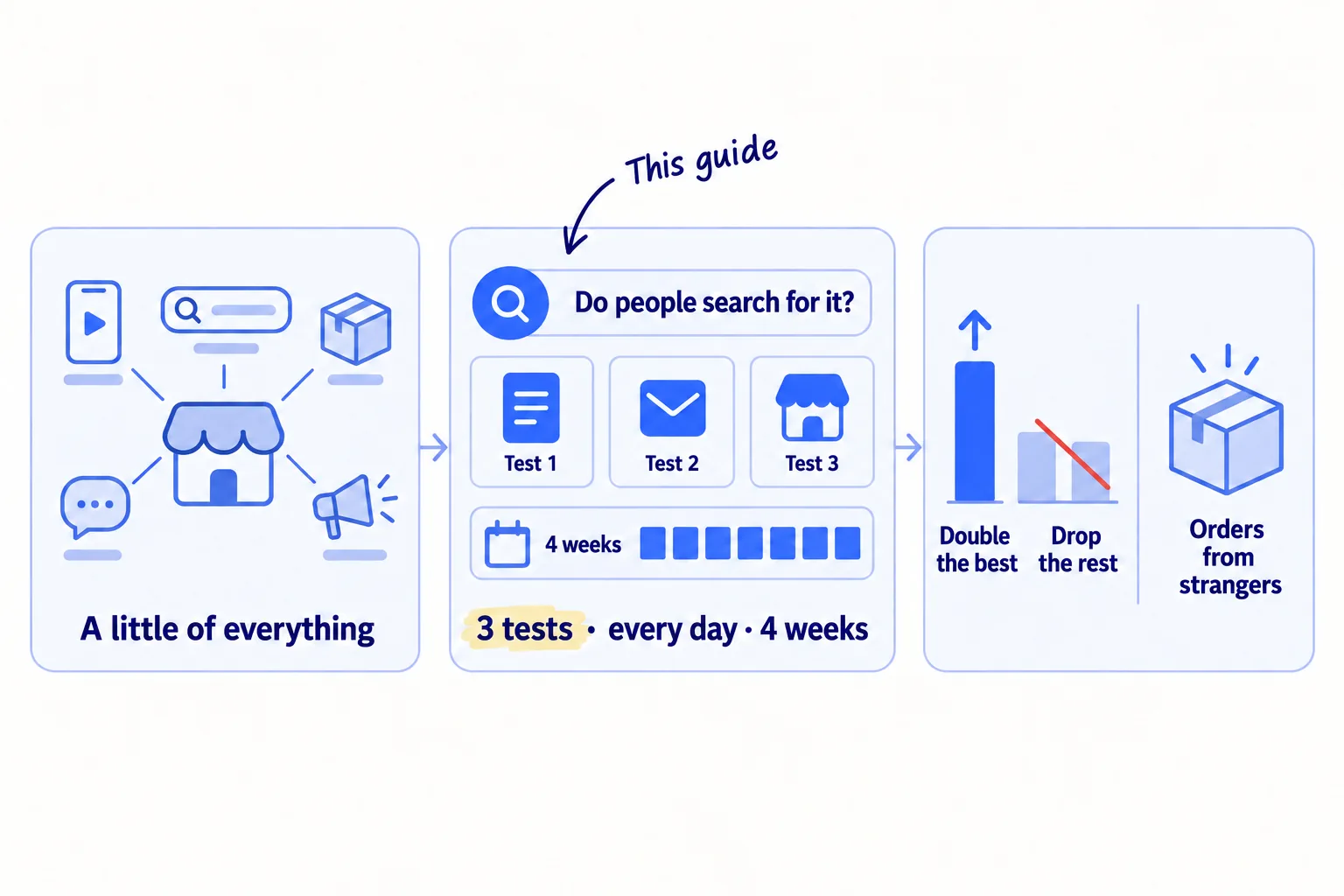
Your store is live and a few orders came in, but you have tried a bit of Instagram, a few creators and a little Meta money, and you cannot tell which one to keep. Here is how to choose marketing channels for an ecommerce brand: check whether shoppers already search for what you sell, test 3 channels at full volume for 4 weeks, and keep what brings orders from people who do not know you. If you keep doing a little of everything, every channel looks like it failed, because none got enough work to show a result.
Do these three things
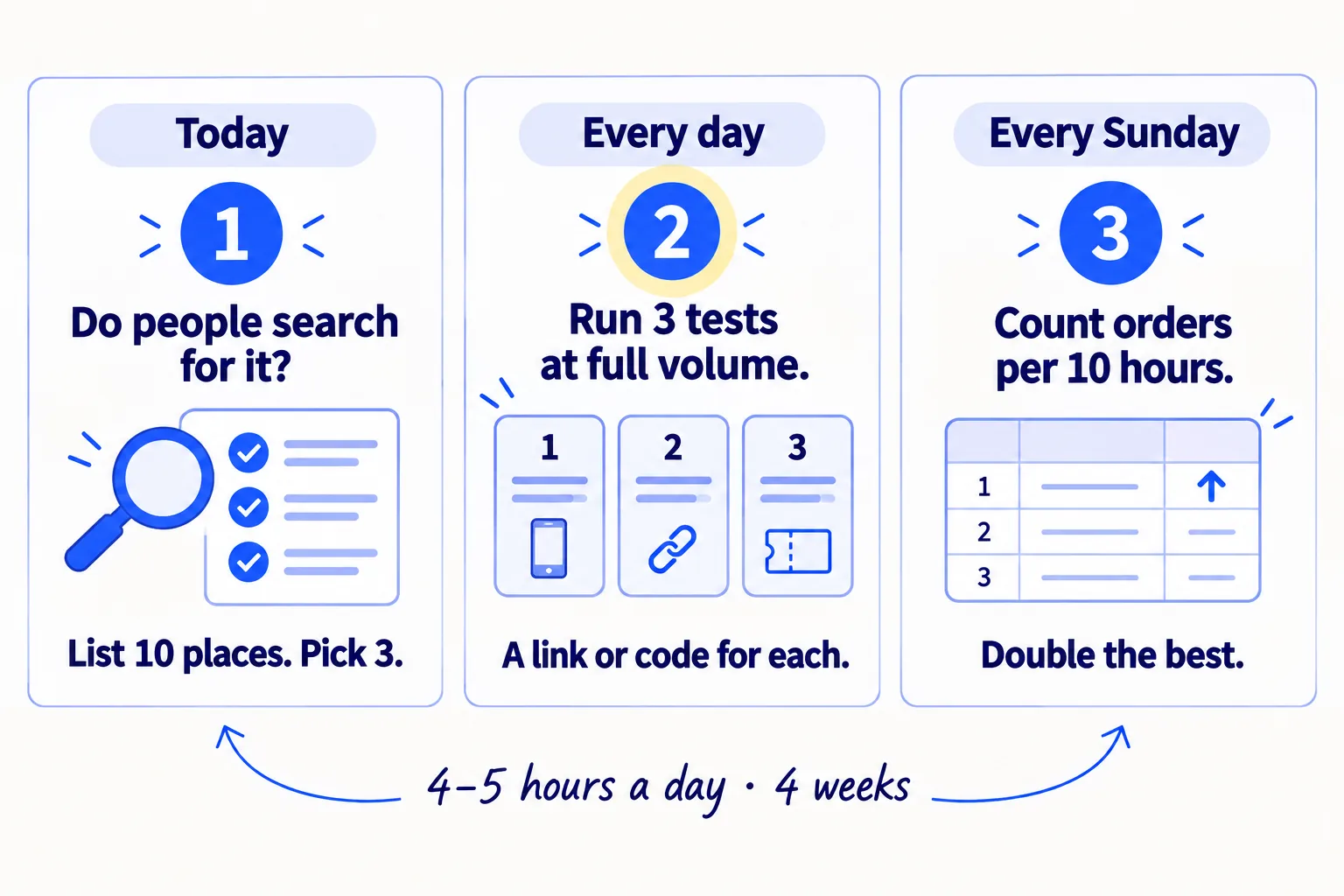
About 4 to 5 hours a day for the 3 tests, every day, for 4 weeks, plus free samples and postage. Judge search pages at month 3, and add paid ads last.
Show the three actions in fullHide the full list
- Today: check whether shoppers already search for what you sellsoon. Then list 10 exact places your buyers already look, each with a number that proves they are there, and pick 3 to test.
- Every day: run your 3 tests at full volume for 4 weeks: for example 2 short videossoon a day on each video app, 100 messages to small creatorssoon, or 20 answers in communitiessoon. Give each place its own linksoon or discount code.
- Every Sunday: count the orders from strangers that each channel brought, and the orders per 10 hours of work. At week 4, double the best one, fix or drop the rest, and start the next place on your list.
Get help doing these
ChatGPT or Claude reads this guide and works through it with you.
1. Check whether shoppers already search for what you sell
Type five phrases for your product into Google and Amazon, and look up how many people search for each one. The answer tells you which half of your channel list comes first: places where people search, or places where people have to see your product before they want it.
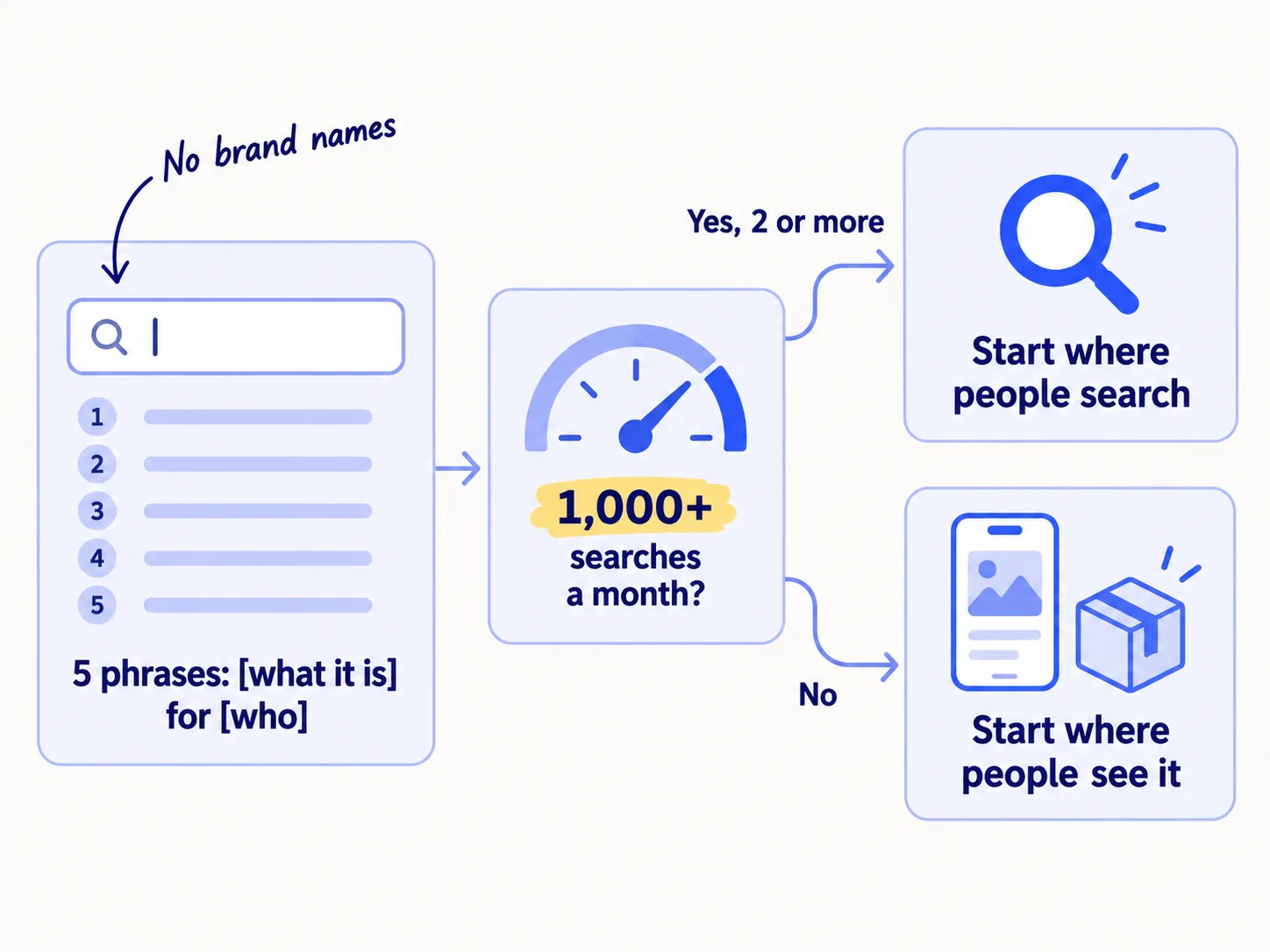
Write five phrases a shopper would type when they need your product, without your brand name. Use "[what it is] for [who or what problem]", the same way you name your productssoon. Type each one into Google and into Amazon's search box, and write down the suggestions that appear as you type. Then put each phrase into the free Ahrefs Keyword Generatorsoon. It shows monthly search volume for Google and for Amazon, with up to 100 ideas for free.
Phrase | Google suggestions (yes or no) | Google searches a month | Amazon suggestions (yes or no) | Amazon searches a month
Then decide, using this rule:
- 2 or more phrases get at least 1,000 searches a month: people search for it. Put search places first on your list: your products in Google's free listingssoon and AI chats, pages on your storesoon that answer those searches, and a marketplacesoon if the Amazon numbers are bigger than the Google ones.
- Fewer than 2: people have to see it first. Put short videossoon, creators and TikTok Shopsoon first. Search still goes on the list, but it waits.
Most products are a bit of both. The rule only sets the order. If you sell on Etsy, type the same phrases into Etsy's search box as well.
- Tool: Google, the Amazon search box, and the Ahrefs Keyword Generator (free).
- Time: 45 minutes.
- You will have: 5 phrases, each with a number, and one label for your product: "people search for it" or "people have to see it first".
- It worked if: every phrase has a monthly number or "no suggestions" written next to it, and the label follows the rule.
- Common mistake: searching your brand name, or one wide word like "shampoo" or "candles". Nobody new types your brand, and a wide word is too crowded to tell you anything.
2. List 10 places your buyers already look, with a number for each
Write down 10 exact places where people who fit your buyer already look at, talk about or buy products like yours, with a number next to each that proves they are there. A place is something you can open in a browser, like one subreddit or one search phrase. "Social media" is not a place.
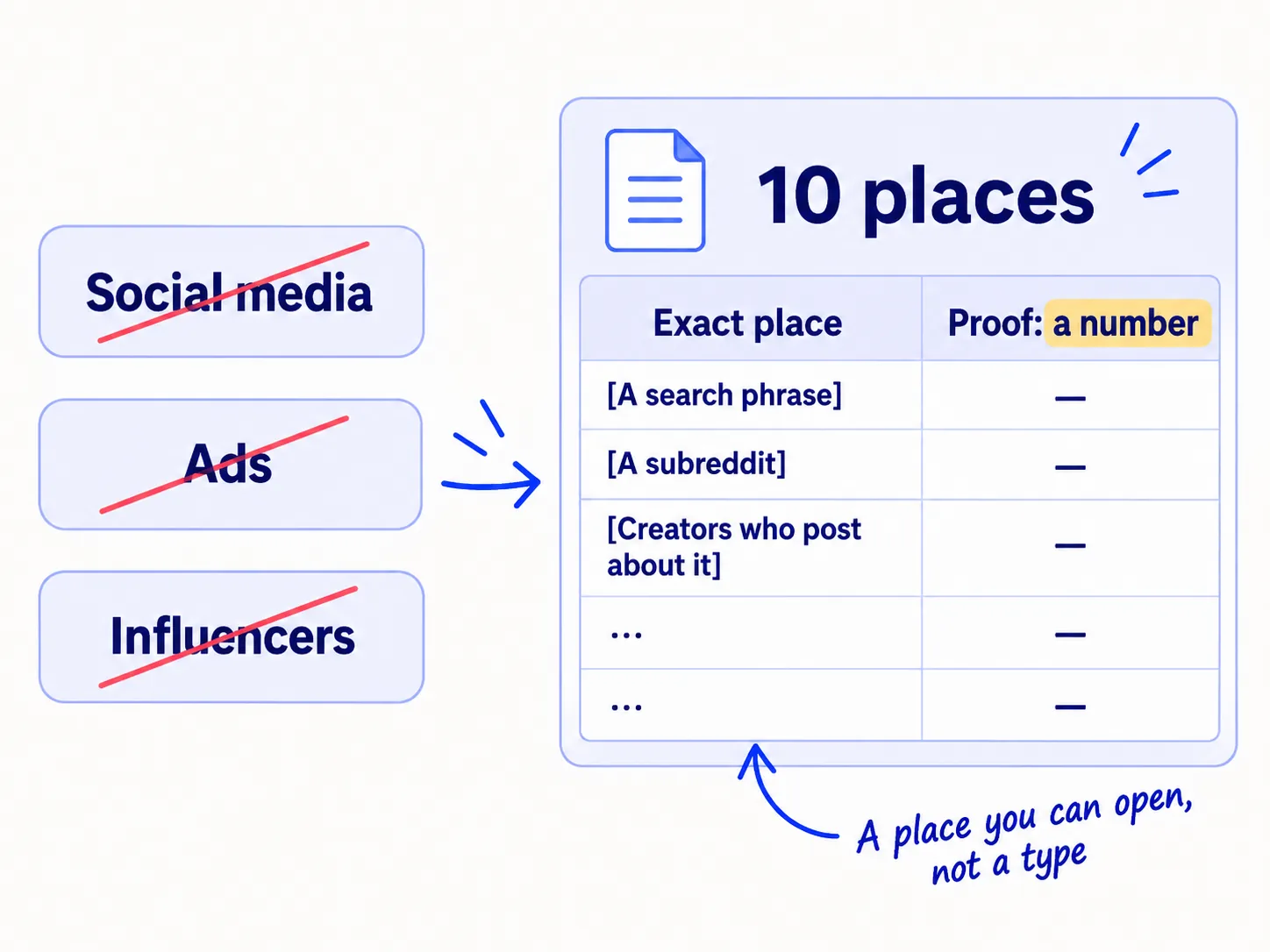
Start with your buyers. Email or message every person who has ordered, and ask two questions. From today, add the first question to every thank-you email you send. This is self-reported attribution, and it catches what links miss.
How did you first hear about us?
Where do you usually find products like this: TikTok, Instagram, Google, Amazon, a friend, somewhere else?
Then fill the rest of the list, one exact place per row, from these kinds of place:
- Video apps: TikTok, Instagram Reelssoon and YouTube Shortssoon. Proof: search your step 1 phrases in the app and count the videos about them from the last 30 days.
- Creators: micro-influencerssoon with 1,000 to 20,000 followers who post about your kind of product. Proof: how many you can name.
- TikTok Shop: you sell inside TikToksoon, and affiliate creatorssoon earn a commission for each sale. Proof: videos with a shop link for products like yours.
- Google and AI chats: your products in Google's free listingssoon and in ChatGPTsoon, and pages on your store that answer a search. Proof: the numbers from step 1.
- Marketplaces: Amazonsoon or Etsy. Proof: the Amazon numbers from step 1, or listings like yours with reviews.
- Communities: one subreddit or one Facebook group where your buyers talksoon and ask for advice on your kind of product. Proof: posts asking for a recommendation in the last 30 days.
- Shops, press and gift guides: a local shopsoon that sells products like yours, a journalistsoon who writes about them, or a gift guidesoon that lists them. Proof: shops, writers or guides you can name.
- Paid ads: Metasoon, Google Shoppingsoon or TikTok. They go on the list now and wait for step 6.
Exact place | Kind | Proof buyers are there (a number) | Search or see (from step 1) | Could bring an order in 4 weeks? | Full daily amount possible? | An order leaves money after fees? | Decision
- Tool: Google Sheets, your email, and the search box on each site.
- Time: 1 hour 30 minutes, plus waiting for your buyers' replies.
- You will have: 10 rows, each with an exact place and a number.
- It worked if: every row names one place you could open today, and has a number: videos or posts in the last 30 days, monthly searches, or creators you can name.
- Common mistake: copying a list of "15 ecommerce marketing channels". Those lists are written for stores with a team and an ad budget, and most of them start with paid ads.
3. Pick 3 ecommerce marketing channels to test, at full volume
Ask four yes-or-no questions about each place, and test the 3 that get four yeses. Keep anything that already brings orders running next to them.
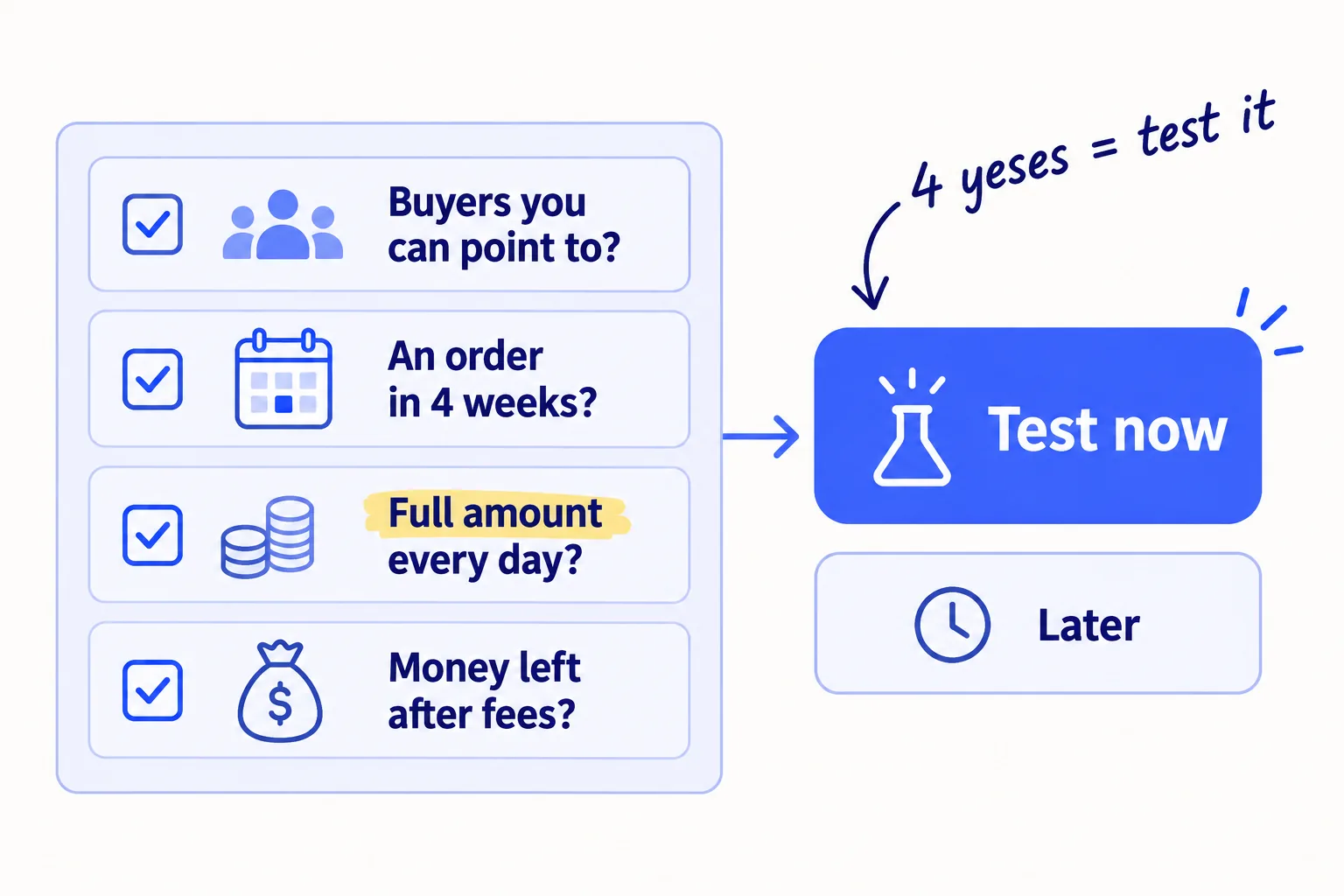
Ask these about every row:
- Can you point to buyers there? Yes if the proof number is real: 20 creators you can name, 10 posts from the last 30 days, or a phrase with searches.
- Could it bring an order from a stranger within 4 weeks? Videos, creators, TikTok Shop, communities and a marketplace listing can. Pages for Google usually cannot, so judge them at month 3.
- Can you do the full daily amount below, every day, for 4 weeks?
- Does an order there leave you money after fees? Take your price, then subtract your product cost, shipping, the platform's fee and any creator commission. If nothing is left, the channel waits until you fix your price or your costs.
Use these amounts. Less than this, and a zero tells you nothing.
| If the channel is… | the full daily amount is… | and you judge it… |
|---|---|---|
| short videos | 2 a day on each video app, in portrait (9:16). Post the same video to TikTok and Instagram Reels | after 56 videos on each app |
| creator messages | 100 a day, across Instagram messages, TikTok messages and email. Send the product to those who say yes and fit, up to your weekly sample cap | after 2,800 messages |
| TikTok Shop affiliates | invitations to 100 new creators a day, with free samples turned on | at week 4 |
| communities | 20 answers a day, across at least 5 places | after 560 answers |
| pages for Google and AI chats | 1 page a day that answers one of your step 1 phrases | at month 3 |
| a marketplace listing | every product listed in week 1, then a reply to every question the same day | at week 4 |
Use one pass mark for every 4-week test: at least 3 orders from people you do not know, traced to this channel.
How the volume is possible. AI does the first draft. Give ChatGPT or Claude your who-it-is-for sentence, then ask for 14 video scripts for the week, 25 creator messages at a time, or a first draft of each answer. You add the one true line: what the creator posted, what the person asked. Film a week of videos in one batch of about 2 hours. Each creator message then takes about a minute. Use AI to draftsoon, never to post for you.
Where a platform limits you, spread the volume. TikTok Shop lets you send up to 1,000 target collaboration invitations in 24 hours, in sends of 50 creators, so 100 a day fits easily. Instagram and TikTok do not publish their message limits. If either shows a warning, stop messaging there for the day and send the rest by email, to the business address in the creator's bio. In communities, read each place's rules first and answer without a link unless someone asks. Reddit and Facebook groupssoon remove posts that break their self-promotion rulessoon. On Instagram, use no more than 5 hashtags: Instagram has capped every post and Reel at 5 since December 2025. If you see the Trial toggle before you share a Reel, turn it on, so Instagram shows it to people who do not follow you first.
Set a sample cap before you start. Decide how many free products you can send a week, and send only to creators who said yes and who post about your kind of product. Tell every creator to say the product was a gift: the FTC expects creators to say clearly when a product was free. Ask before you reuse their video as UGCsoon on your store.
Hi [first name], I loved your video on [something specific they posted].We make [what it is] for [who]. Could I send you one to try? It's free, and there's no need to post.If you do post about it, please say it was a gift. Here's a code for your followers: [CODE] for [X]% off.[Your name], [your store]
If you sell on a marketplace, do the fee maths first. Amazon charges $0.99 per item sold on its Individual plan, or $39.99 a month on the Professional plan, plus a referral fee and any fulfilment fee. Etsy charges $0.20 per listing, a 6.5% transaction fee and about 3% plus $0.25 for US card payments, and a 12% or 15% fee on any sale that comes from its Offsite Ads. TikTok Shop charges a 6% referral fee on most US sales, plus the commission you offer creators. Put those into question 4.
Channel: [exact place]Every day: [the full amount, from the table]Hours a day: [hours]Link or code: [from step 4]Pass: at least 3 orders from strangers in 4 weeksStop date: [the Sunday of week 4]
- Tool: your sheet from step 2, and ChatGPT or Claude to draft.
- Time: 30 minutes to pick. The tests themselves take about 4 to 5 hours a day for the 3 together.
- You will have: 3 test cards, each with a daily amount, a pass mark and a stop date, and a "later" list.
- It worked if: each test has four yeses and an exact place, and its daily amount matches the table.
- Common mistake: picking the place you enjoy, or the biggest platform, instead of the place with proof. The other mistake is signing up for a paid marketplace plan before the fee maths.
See it done: Ferns & Rinse's scored list
Ferns & Rinse is a made-up plant-based haircare brand with its own Shopify store. It sells one shampoo and one conditioner at $28 each, or both for $49.
Four weeks into their D2C routine, creators brought 4 of their 6 orders from strangers. So creator messages stay, and three new places get tested.
The channel list, scored
| Place | Proof buyers are there | Order in 4 weeks? | Full amount every day? | Money left after fees? | Decision |
|---|---|---|---|---|---|
| Messages to curly-hair creators | 4 of 6 orders from strangers came from creator codes | Yes | Yes: 100 a day | Yes | Keep: already works |
| Short videos on TikTok and Instagram Reels | 40 creators posted curly-hair routines in the last 30 days | Yes | Yes: 2 a day | Yes | Test now |
| TikTok Shop, with free samples for creators | 25 videos with a shop link for a curly-hair product in the last 30 days | Yes | Yes: 100 invitations a day | Yes, after the 6% fee | Test now |
| Two curly-hair subreddits and three Facebook groups | 30 posts asking for a shampoo in the last 30 days | Yes | Yes: 20 answers a day | Yes | Test now |
| Pages for Google and AI chats | 1 of 5 phrases over 1,000 searches a month, so videos come first | No: month 3 | Yes: 1 a day | Yes | Next on the list |
| Amazon | Amazon searches lower than Google's | No: needs reviews first | Yes | Unsure | Later |
| Local salons | 6 salons they can name | Unsure | No hours left | Yes | Later |
| Meta ads | $150 brought 1 sale | Yes | Needs money | Unsure | Later: step 6 |
| No posts about curly hair products found | Crossed out |
Why it works: Every test has proof that people with dry, curly hair are there, and each one can run at its full daily amount.
4. Give every channel its own link or code, so each order has a source
Give every place its own tracking link, give every creator their own discount code, and ask every buyer how they heard about you. Then you can count orders by channel, not just visits.
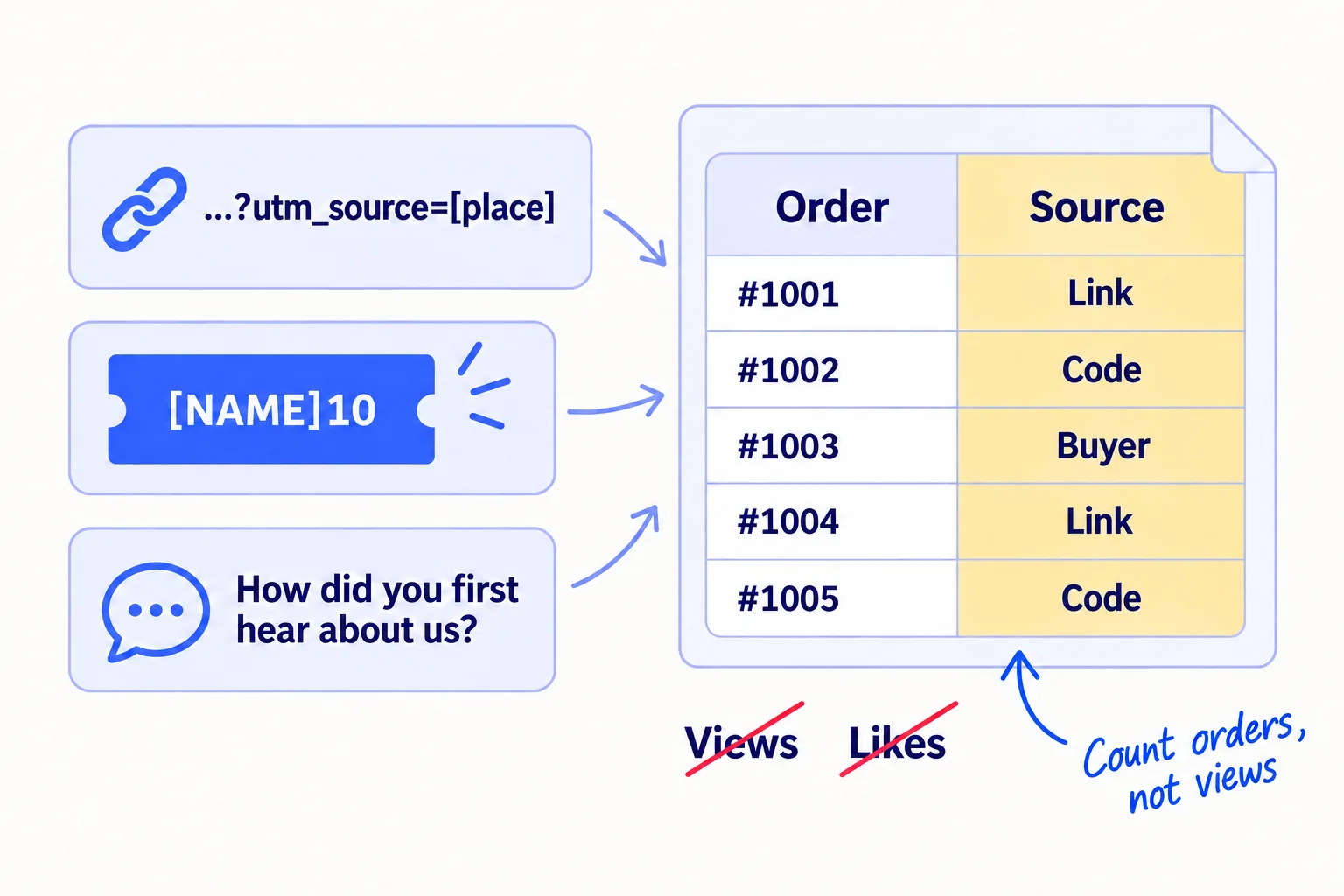
Use all three, because each one misses some orders:
- A tracking link for each place. A UTM link is your normal link with a few words at the end that say where the visitor came from. Put it in every bio, post and answer for that place.
- A discount code for each creator. Make it in your Shopify admin under Discounts, with the creator's name in it. People who watch a video often type your store name later instead of clicking, and the code still shows who sent them.
- One question to every buyer. Keep asking "How did you first hear about us?" in your thank-you email. If you would rather have it on the order page, apps such as Grapevine do it for $25 a month, with a 14-day free trial.
yourstore.com/products/[product]?utm_source=[exact place, such as tiktok]&utm_medium=[kind, such as video]&utm_campaign=channel-test
Shopify shows the links in Analytics › Reports: open the Category filter and choose Marketing. "Sessions by referrer" shows where visits came from, and the UTM campaign reports group visits and sales by your links. A UTM link records the visit, not the whole path to the order, which is why the code and the question matter. Orders on TikTok Shop, Amazon or Etsy are counted in that platform's own seller centre. Before step 6, also set up conversion trackingsoon, so ad platforms can see your orders.
- Tool: your Shopify admin and a Google Sheet. An app only if you want the question on the order page.
- Time: 45 minutes, once, then 1 minute per new creator code.
- You will have: a link for every place, a code for every creator, and the question in every thank-you email.
- It worked if: at least 9 of every 10 orders this week have a source, from a link, a code or an answer.
- Common mistake: judging a channel by views, likes or followers, or using one link everywhere. Then every order says "Instagram" and you cannot tell a creator from your own post.
5. Count orders by channel every Sunday, then double down, fix or drop
Every Sunday, write down for each channel the hours you spent, the samples you sent, the visits, and the orders from strangers. At week 4, after the full volume, use the rules below to double down, keep, fix or drop each one.
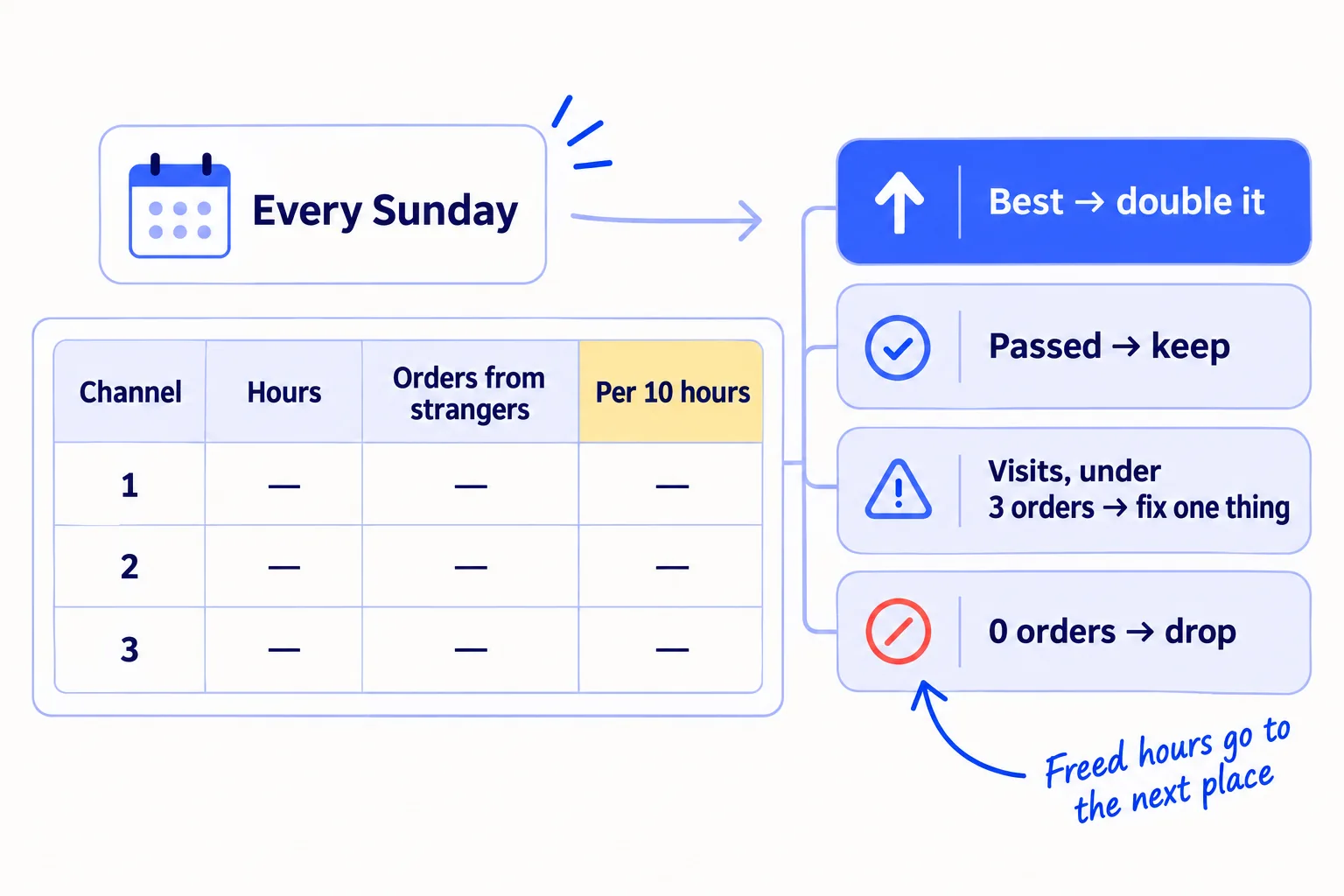
To compare channels fairly, work out one number for each: orders from strangers per 10 hours. Divide the orders by the hours you spent, and multiply by 10. A channel with 6 orders for 20 hours scores 3. A channel with 4 orders for 50 hours scores 0.8.
Week | Channel | Hours | Samples sent | Visits | Orders from strangers | Orders per 10 hours
At week 4, decide:
- It passed and has the best number: double its daily amount for 2 weeks. If orders go up, keep the new amount and try doubling again. If they do not, go back to the old amount and give the extra hours to the next place on your list.
- It passed, but it is not the best: keep it at the same amount.
- It brought visits, but fewer than 3 orders: change one thing, such as the first 2 seconds of the video, which creators you pick, or the product pagesoon you send people to. Run it 2 more weeks. If it is the same, drop it.
- It brought 0 orders after the full volume: drop it. Write one line on why, so you do not try it again next month.
- Pages for Google and AI chats: keep publishing and judge them at month 3, because SEO takes monthssoon to show results.
- Every channel brought visits and almost no orders: the problem is your store, not the channels. Stop adding channels and fix the storesoon first.
The same week you drop a channel, start the next place on your list with a new test card, or give its hours to the best one. Once a month, add the places your newest buyers named in their answers to your list, and run a short monthly reviewsoon.
- Tool: Google Sheets and your Shopify reports.
- Time: 20 minutes every Sunday, and 1 hour at week 4.
- You will have: a written decision for every channel.
- It worked if: after week 4, every hour of next week belongs to a channel that passed or to a new test with a stop date.
- Common mistake: keeping a channel that brought nothing "in case it works later", or dropping one after a week, before its full volume.
See it done: Ferns & Rinse at week 4
The Sunday sheet, weeks 1 to 4
| Channel | Hours | Samples sent | Visits | Orders from strangers | Orders per 10 hours |
|---|---|---|---|---|---|
| Creator messages (2,800 sent) | 56 | 32 | 420 | 9 | 1.6 |
| Short videos (56 on each app) | 49 | 0 | 610 | 4 | 0.8 |
| TikTok Shop affiliates | 21 | 28 | Sold in the app | 6 | 2.9 |
| Two subreddits and three groups (560 answers) | 28 | 0 | 90 | 1 | 0.4 |
The decision: TikTok Shop has the best number, so the founders double the invitations and the samples for 2 weeks. Creator messages and videos passed, so they stay. The communities brought visits and 1 order, so for 2 more weeks the founders swap the three Facebook groups for three other subreddits, and change nothing else.
Why it works: They compare channels by orders from strangers per 10 hours, not by views or likes.
6. Add paid ads last: Google Shopping or Meta, once strangers buy
Turn on paid ads only when your store already sells to strangers, and run them as one 14-day test with a cap and a stop rule. Before that, ads pay to send strangers to a page that does not yet sell, and Meta's system cannot learn: an ad set needs about 50 purchases in 7 days to leave its learning phase.
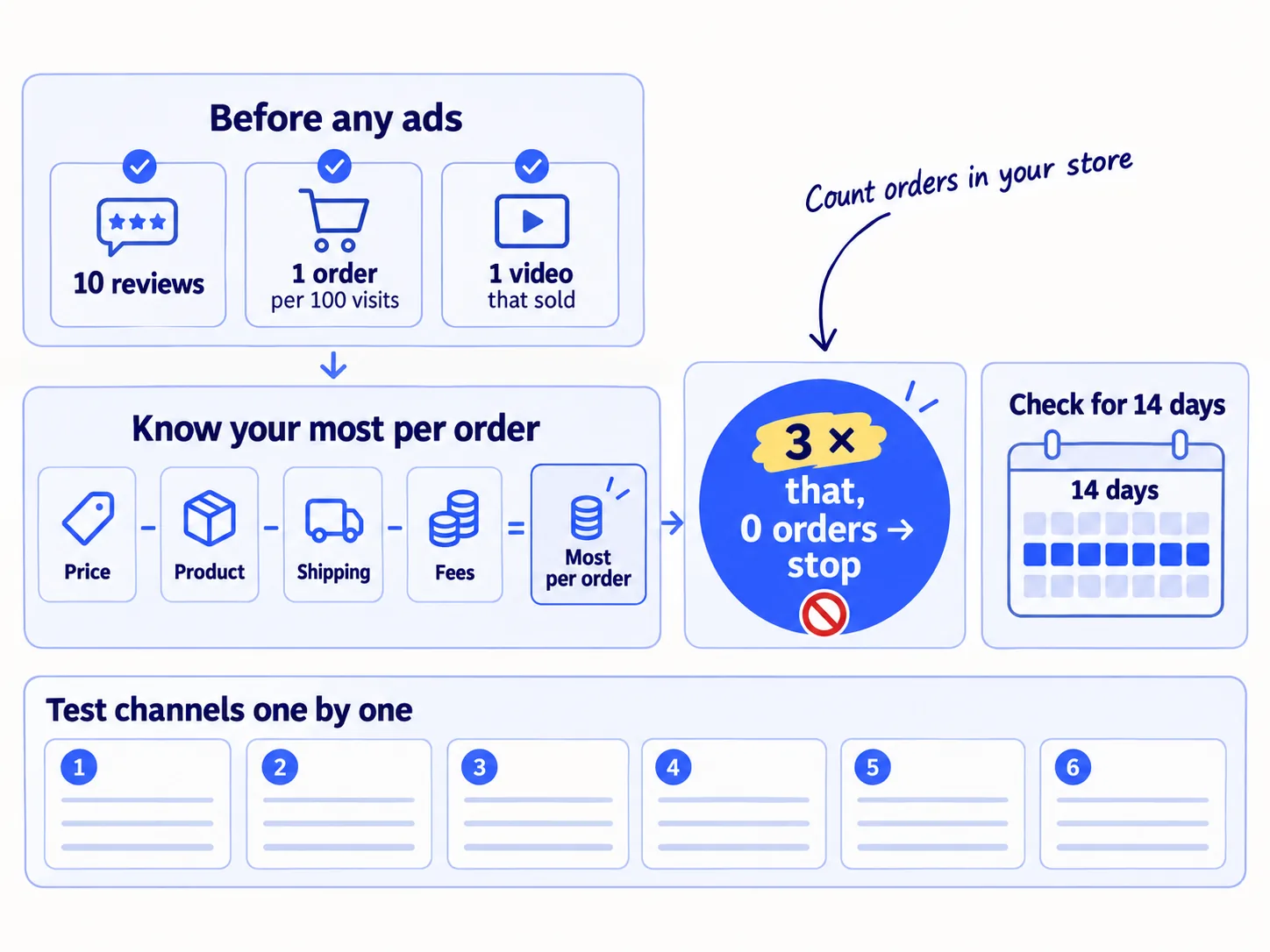
Turn ads on only when all three are true, the same rule as in How to market a D2C brand:
- You have at least 10 reviewssoon.
- You get at least 1 order for every 100 visits from people who do not know you.
- One video, yours or a creator's, brought orders or got shares without being paid for.
Then work out the most you can pay for one order, and when to stop an ad. This is your break-even ROASsoon written as dollars, where ROAS is the sales you get back for each dollar of ads.
[Price] − [product cost] − [shipping] − [payment and platform fees] = the most you can pay per orderStop any ad that has spent 3 × that number with no order.Test cap = 10 × that number, and never more than the money you put aside for adsDaily budget = the cap ÷ 14, for a 14-day test
Start where step 1 pointed:
- People search for it: run Google Shoppingsoon from the Merchant Center feed you already have for free listings. Google can spend up to twice your daily budget on one day, so check spend every day and stop the campaign yourself on day 14.
- People have to see it first: run Meta adssoon with the video that already sold as your ad creativesoon, with purchases as the goalsoon, not traffic. At a small budget the ad set will likely say "Learning limited". Judge it by cost per ordersoon, counted in Shopify, not by that label.
- You would rather pay only for results: if your store can use them, Shopify's Shop Campaigns bill you only when a new customer buys, at a most-per-customer amount you set: your customer acquisition cost.
If your buyers talk on Reddit, Reddit's ads now connect to Shopify directly, since May 2026. Test one paid channel at a time, so you know which one worked, and keep the test inside your marketing budget.
- Tool: Google Ads, Meta Ads Manager, or Shop Campaigns in your Shopify admin.
- Time: 2 hours to set up, then 15 minutes a day to check spend and orders.
- You will have: a real cost per order for one paid channel, from 14 days of spending.
- It worked if: your cost per order is at or below the most you can pay. If it is above, stop, and put the money into samples and creator messages instead.
- Common mistake: boosting a post or choosing a traffic goal. A new skincare brand on r/FacebookAds, with $400 a month, got purchases from Sales campaigns and none from Traffic campaigns.
Where Scout7 helps
Scout7 speeds up steps 2, 3 and 6.
Step 2. Scout7's audience research reads public social conversations in your category and gives you shoppers' problems in their own words, which become your search phrases and community rows. Join Conversations finds live threads about your problem, which fills in the proof column. Keyword intelligence shows monthly searches, difficulty, and who leads on Google and in AI answers for each phrase. AI question coverage shows which questions shoppers ask AI assistants and who gets named. Your competitor set shows which competitors win those answers.
Step 3. Scout7 makes portrait (9:16) videos from a script, with captions. You choose the cast and voice, direct each scene and approve the cut. It schedules approved posts to Instagram, Facebook and Threads; you download the video for TikTok. Nothing goes live until you approve it.
Step 6. When you pass the gate, Scout7 plans, builds, launches and monitors Google and Meta campaigns in the Scout7 app, not over MCP yet. Every twelve hours it reviews each campaign and proposes what to cut or where more budget would earn more. You approve every creative, every change and the spend.
Your ecommerce channel checklist for the next 4 weeks
0 of 12 done
Work through this list with an AI assistant
It drafts the work and keeps track of what is done.
Frequently asked questions
- What are the best marketing channels for a new ecommerce store?
The best channel is the place your buyers already look, and it depends on whether people search for your product. If they do, start with Google's free listingssoon, pages that answer those searches, and perhaps a marketplace. If they do not, start with short videos, small creators and TikTok Shop. Test 3 at full volume for 4 weeks and keep what brings orders from strangers.
- Should I start with Meta ads, TikTok or Google?
Start with none of them paid. First test short videos, creators and free listings, which cost time and samples. Turn on ads when you have 10 reviews, 1 order per 100 visits from strangers, and one video that sold. Then use Google Shopping if people search for your product, and Metasoon with that video if they do not, with a capped test budgetsoon.
- Should I sell on Amazon, Etsy or TikTok Shop as well as my own store?
Add one when your step 1 check shows shoppers search there, and when an order still leaves you money after its fees. Amazonsoon suits products people already search for. Etsy suits handmade and gift products. TikTok Shopsoon suits products that sell when someone sees them used. Test one marketplace at a time, as one of your 3 tests.
- How many marketing channels should a small ecommerce brand use?
Three tests at a time, next to anything that already brings orders. One or two people can run 3 tests at full volume in about 4 to 5 hours a day. Keep every channel that passes, drop the rest at week 4, and start the next place on your list in the hours you free.
- How long should I test a marketing channel before giving up?
Four weeks at the full daily amount for videos, creators, TikTok Shop, communities and a marketplace listing: that is 56 videos on each app, 2,800 creator messages or 560 answers. Judge pages for Google at month 3. Stopping earlier, or after doing less, tells you nothing either way.
Sources
- 1.Selling on ChatGPT — Shopify Help Center, checked 26 September 2026
- 2.Free listings for products — Google Merchant Center Help, checked 26 September 2026
- 3.Free Keyword Generator — Ahrefs, checked 26 September 2026
- 4.Marketing reports — Shopify Help Center, checked 26 September 2026
- 5.Grapevine Surveys pricing — Grapevine, checked 26 September 2026
- 6.About target collaborations in Seller Center — TikTok Shop, checked 26 September 2026
- 7.How to set up and manage samples — TikTok Shop Seller University, checked 26 September 2026
- 8.TikTok Shop fees explained (2026) — Printify, 2026, checked 26 September 2026
- 9.Amazon's Individual selling plan vs Professional selling plan — Amazon, checked 26 September 2026
- 10.Etsy Fees Explained: Every Fee You're Paying in 2026 — Marmalead, 2026, checked 26 September 2026
- 11.Instagram implements new limits on hashtag use — Social Media Today, December 2025
- 12.Trial reels: try content with non-followers first — Instagram for Creators, checked 26 September 2026
- 13.Disclosures 101 for social media influencers — Federal Trade Commission, checked 24 September 2026
- 14.About the learning phase — Meta Business Help Center, checked 26 September 2026
- 15.About average daily budgets — Google Ads Help, checked 24 September 2026
- 16.Shop Campaigns — Shopify, checked 26 September 2026
- 17.Reddit's advertising integration with Shopify is now available to all merchants — Shopifreaks, 2026
- 18.New DTC skincare brand, $400/mo budget: getting purchases on Sales campaigns but zero on Traffic — r/FacebookAds, 2026
Next article to read
How much to spend on marketing as an ecommerce brandD2COnce you pick your channels, this shows how much time and money to give each one.Read it nextRelated guides
- How to market a D2C brandD2CMarket your D2C brand when your first orders came from friends: an 8-week routine for your product page, first reviews, free product for small creators, short videos, free Google and ChatGPT listings, and a Friday count that tells you when to turn ads back on.
- How to sell on TikTok ShopD2CComing soon
- How to run Meta ads for a Shopify storeD2CComing soon
- How to do SEO for a Shopify storeD2CComing soon
Guides that link here
Cite this page
Dinesh Bypilla (2026). How to choose marketing channels for an ecommerce brand. Scout7 Academy. https://scout7.ai/academy/marketing-plan/how-to-choose-marketing-channels-for-an-ecommerce-brand
Written by Dinesh Bypilla, Agentic systems engineer at Scout7. Reviewed by Murali Sid. Last checked 26 September 2026.
Quote any part of this guide with a link back to this page. © 2026 Scout7.
Markdown version of this page: https://scout7.ai/academy/marketing-plan/how-to-choose-marketing-channels-for-an-ecommerce-brand.md