



How to price a product
Price your product for a new store: add up what one order really costs, keep product and packaging at 30% of the price or less, ask 100 people a day what they would pay for 7 days, and check the money left on each order every Sunday.
ByDinesh BypillaReviewed byMurali SidLast checked 17 min read
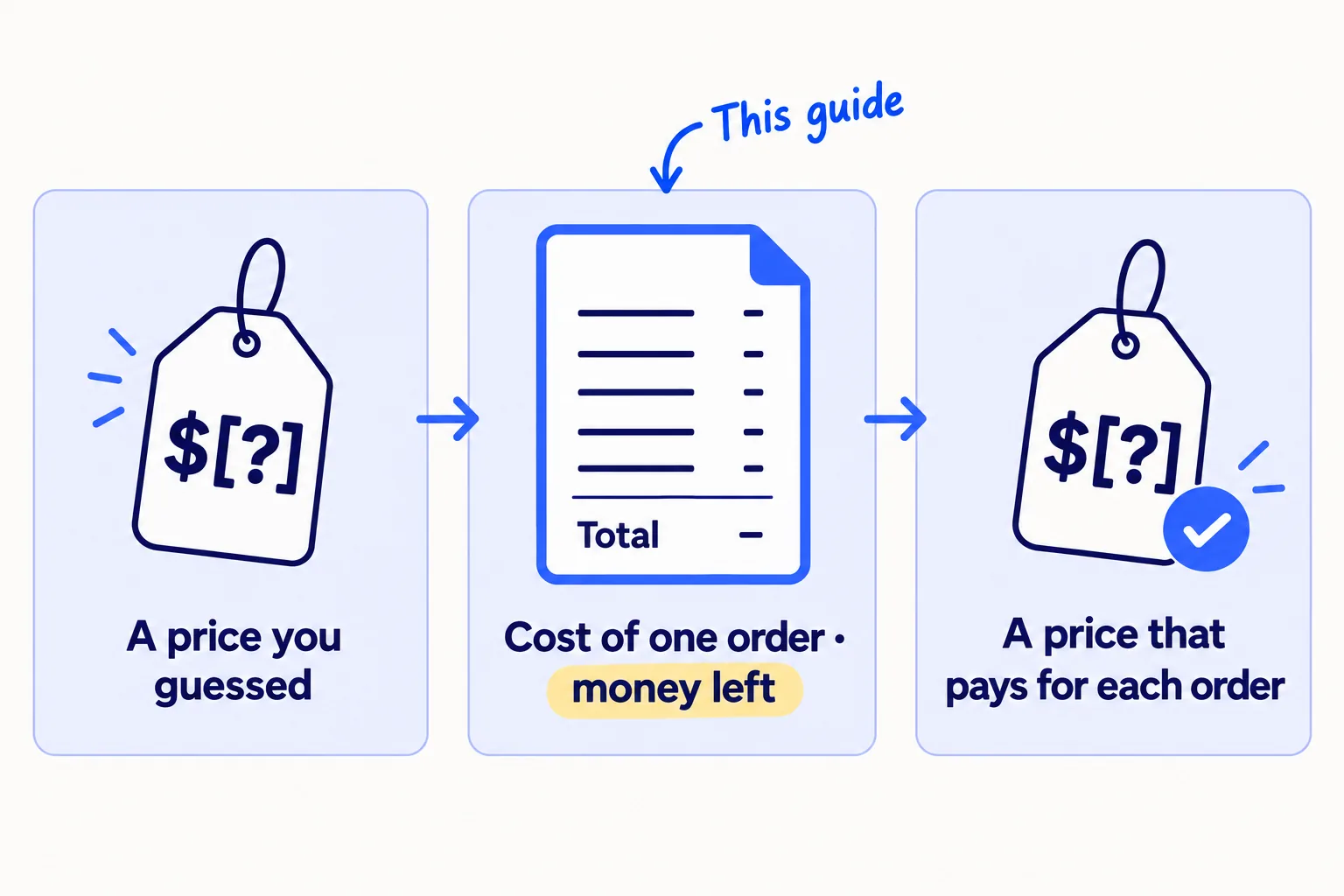
You set a price by looking at a few other brands, and the first orders came from friends. Here is how to price a product for your store: add up what one order really costs, ask hundreds of real buyers what they would pay, and check the money left on each order every Sunday. If you skip this, you can sell more and lose more, because shipping, fees and free samples eat a price that only looked right.
Do these three things
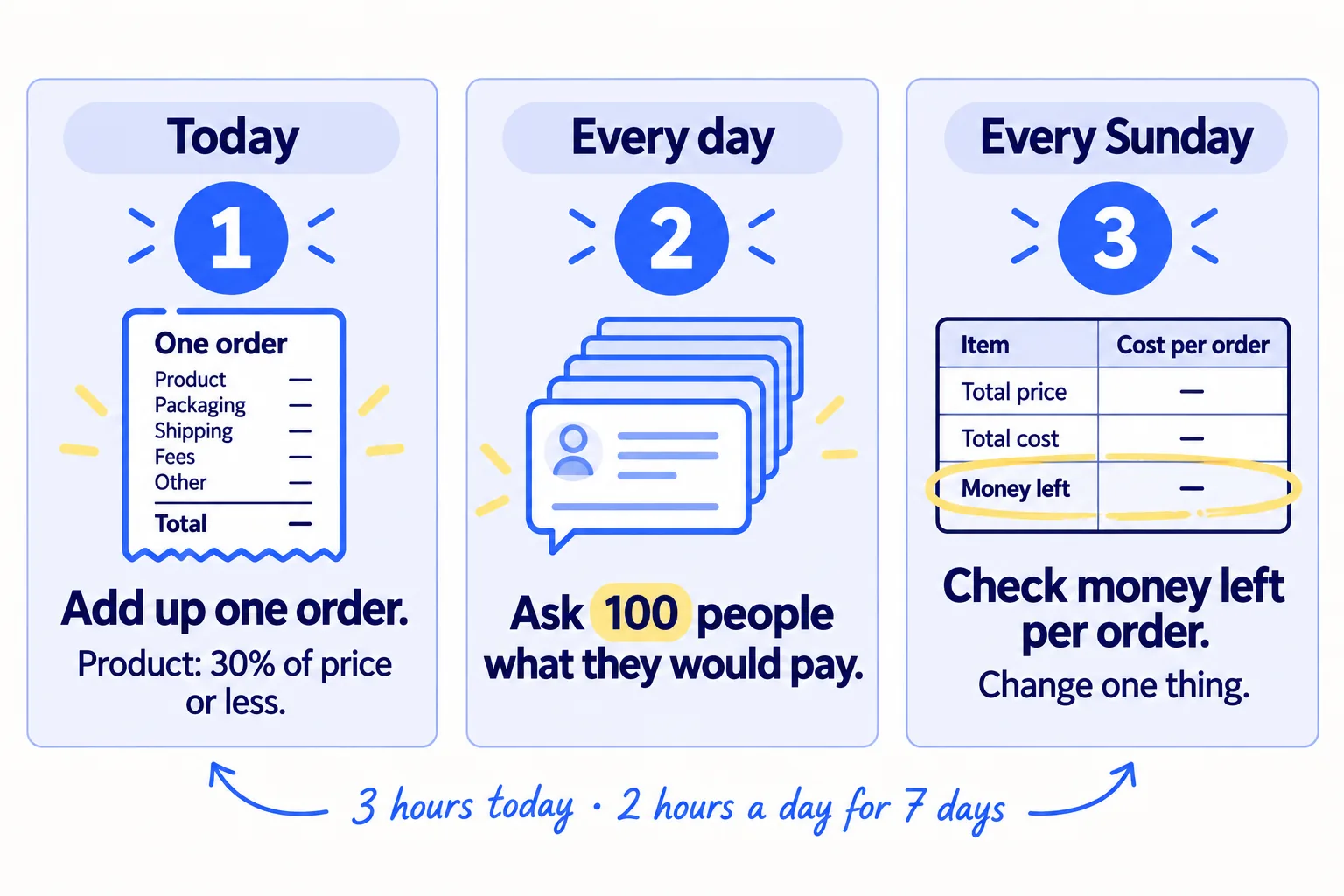
About 3 hours today, then about 2 hours a day for 7 days. Set your price after 700 asks, then check it every Sunday.
Show the three actions in fullHide the full list
- Today: add up what one order really costs yousoon, from the product to the shipping label. Set a price where the product and its packaging cost no more than 30% of it.
- Every day: ask 100 people who fit your buyer what they would pay, with your price and link in the message. AI drafts each one; you add one true line about the person.
- Every Sunday: work out the money left on each order and count what people said about your price. Change one thing at a time: the price, the bundlesoon or the shipping line.
Get help doing these
ChatGPT or Claude reads this guide and works through it with you.
1. Work out what one order really costs you
Add up every cost of one order, not one bottle or one shirt: the product delivered to you, the box, the shipping label, the payment fee and a little for free samples and returns. Do it for each product and each bundlesoon you sell. This number is the floor under every other step.
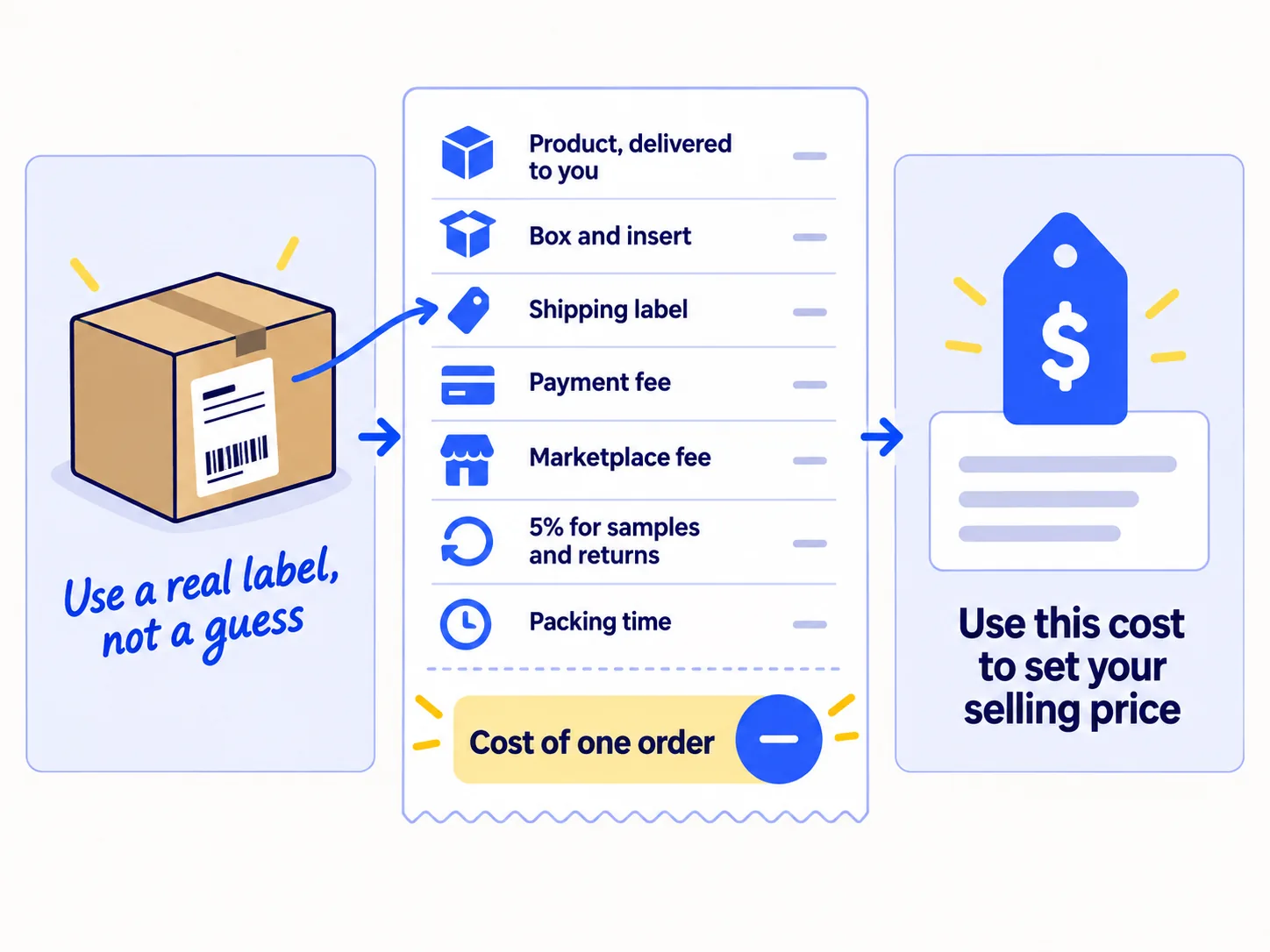
Take every number from a real place: an invoice, a label you bought, a fee page. Guesses are why the numbers never add up later.
Product | Price the customer pays (with shipping) | Product, delivered to you | Box and insert | Shipping label | Payment fee | Marketplace fee | 5% for samples and returns | Packing time | Cost of one order | Money left
- Product, delivered to you: the factory price, plus freight and import duty, divided by the units you received. Take the duty from your latest invoice or your customs broker. US duties have changed several times since 2025: duty-free entry for small parcels ended for every country on 29 August 2025, and in February 2026 the Supreme Court struck down one set of tariffs. An old quote is probably wrong.
- Shipping label: pack a real order, weigh it and buy or price one label. USPS changed its Ground Advantage prices on 12 July 2026 and ended the cheaper 4-ounce and 8-ounce steps for commercial rates, so light parcels can cost more than last year.
- Payment fee: on Shopify's Basic plan in the US, Shopify Payments takes 2.9% + 30¢ of each online card order. Check the rate on your own plan.
- Marketplace fee: if you also sell on Amazonsoon or TikTok Shopsoon, add a row for each, with the fee from that platform's own seller fee page.
- 5% for samples and returns: the products you give to creatorssoon, breakages and refunds. Set aside 5% of the product price until you have real numbers.
Let ChatGPT or Claudesoon build the sheet's formulas. Paste in your invoice numbers yourself and check each total with a calculator once.
- Tool: Google Sheets, your supplier invoices, and one real shipping label.
- Time: 1 hour.
- You will have: the cost of one order and the money left, for each product and each bundle.
- It worked if: every cell has a number from an invoice, a label or a fee page, and you can say the money left on your best-selling order without looking.
- Common mistake: counting only the factory price. The label and the payment fee together can cost more than the product. The other mistake is using last year's duty or postage.
See it done: Ferns & Rinse's cost of one order
Ferns & Rinse is a made-up plant-based haircare brand with its own Shopify store. It sells one shampoo and one conditioner at $28 each, or both for $49.
Store live for 2 months. About 400 visits a month and 9 orders, most from friends and family. $150 of Meta ads brought 1 sale. They charge $5 shipping on every order.
The cost of one order
| Order | Customer pays | Product | Box and insert | Label | Payment fee | 5% set aside | Cost of one order | Money left |
|---|---|---|---|---|---|---|---|---|
| One bottle | $33.00 | $6.00 | $1.20 | $7.80 | $1.26 | $1.40 | $17.66 | $15.34 (46%) |
| Both bottles | $54.00 | $12.00 | $1.20 | $8.90 | $1.87 | $2.45 | $26.42 | $27.58 (51%) |
Why it works: Every line comes from an invoice or a real label, so the money left is true, and the founders can see the pair earns almost twice as much per order.
2. Set your lowest price and your target price with two rules
Check your price against two rules. First, the product and its packaging cost no more than 30% of the price. Second, at least 40% of what the customer pays is left after every cost from step 1. That 40% is what pays for getting each customersoon: ads, creator codes and free samples.
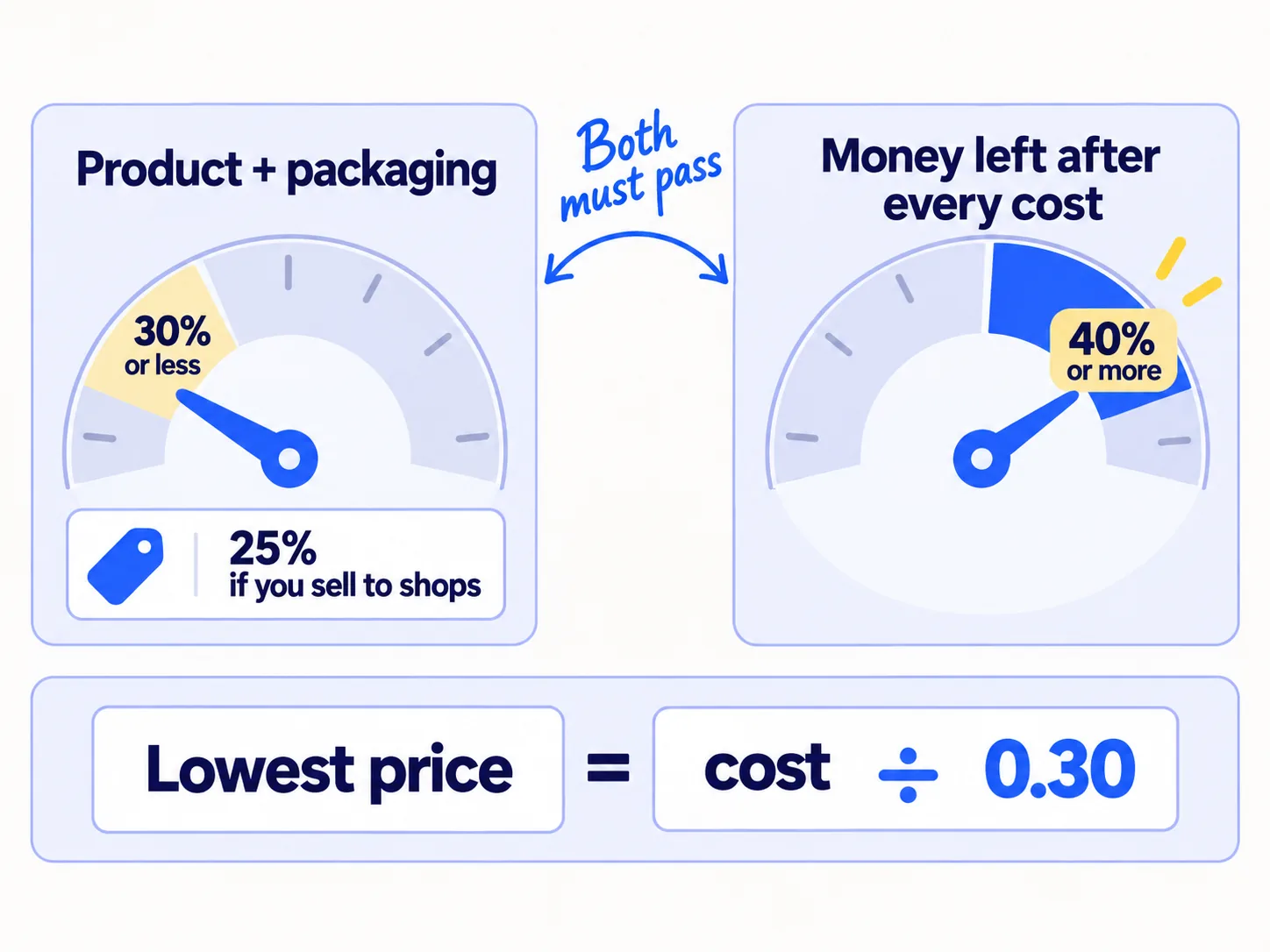
Rule 1: product and packaging, 30% of the price or less. Public beauty brands kept about 69% of their sales after product costs in their 2025 annual reports (e.l.f. Beauty 71%, Olaplex 69%, Beauty Health 65%). So their product costs were about 30% of sales. Food brands keep less, about 40%, so if you sell food or drink, your price must rest more on step 3 and step 4.
To find the lowest price that passes, divide the product and packaging cost by 0.30. That is the selling-price formula every pricing page gives: cost ÷ (1 − the share you want to keep).
If you plan to sell to shops later: use 25%, not 30%. Shops usually pay half your retail price and double it on the shelf. This is called keystone pricingsoon. At 25%, you still keep half of what the shop pays you. Set the retail price for the shelf now, because raising it later annoys the buyers you already have.
Rule 2: at least 40% left after every cost. This is often called contribution margin: the money an order leaves after all its own costs. Then work out your break-even ROASsoon, the most you can spend on ads for each dollar of sales before you lose money:
Money left share = money left ÷ what the customer pays
Break-even ROAS = 1 ÷ money left shareExample: $15 left on a $33 order = 45% left. Break-even ROAS = 1 ÷ 0.45 = 2.2. Every $1 of ads must bring back at least $2.20 in orders.
Decide with these rules:
-
Rule 1 fails: raise the price, find a cheaper box or supplier, or sell the product only in a bundlesoon.
-
Rule 1 passes, rule 2 fails: shipping and fees are too big a share. Make the bigger order the easy choice, or charge the shipping (step 5).
-
Both pass: keep your price, and take it to step 3.
-
Tool: your step 1 sheet.
-
Time: 30 minutes.
-
You will have: a lowest price, a target price, and your break-even ROAS, written at the top of the sheet.
-
It worked if: both rules pass at the price you will charge, or you have written which of the three fixes you will make.
-
Common mistake: a "50% markup" from a blog. A 50% markup means the product costs two-thirds of the price, which leaves nothing to pay for your marketing. The other mistake is pricing below cost to win the first orders. Your first buyers then set a price you cannot keep.
3. Write down 20 competitor prices, per ounce and with shipping
List 20 products your buyers could buy instead of yours, with the price per ounce (or per item, or per use) and the shipping. Shoppers compare the total, and a bigger bottle can hide a higher price.
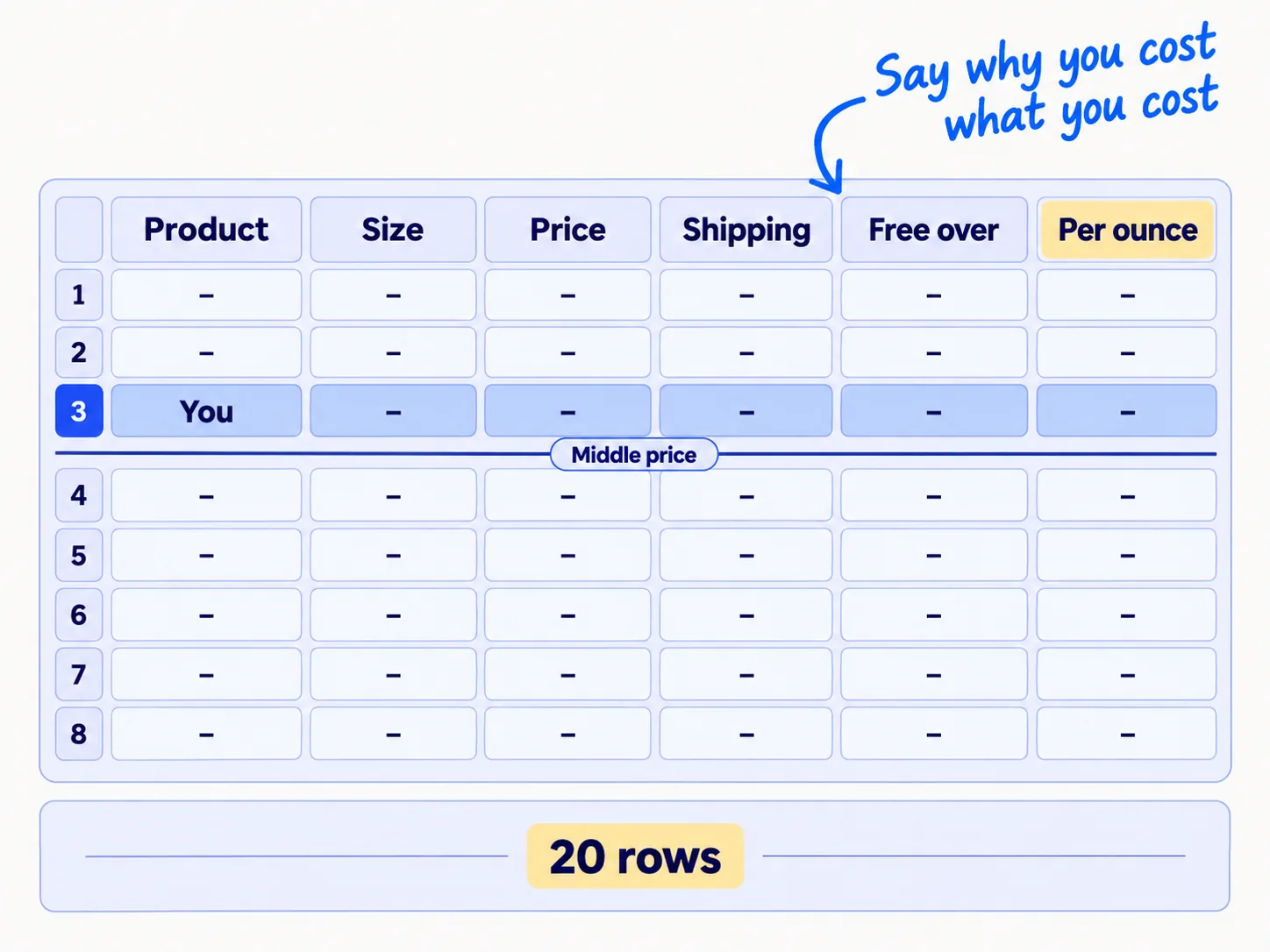
Look in the places your buyers shop: the Google Shoppingsoon tab, Amazon, TikTok Shop and the brands' own stores. Ask ChatGPT or Claude for 30 products like yours, then open each one yourself and write down today's price. AI lists are a start, and their prices are often out of date. This is the price part of a competitor analysis.
Product | Where sold | Size | Price | Shipping | Free shipping over | Price per ounce | Bundle price | Number of reviews
Sort by price per ounce, and find where you sit. This is your price positioning:
-
Above the top 5: keep the price only if the first screen of your product page says why, in your buyers' words: what it does that the cheaper ones do not. Rewrite it with your value proposition and the product descriptionsoon.
-
In the middle 10: fine. Most buyers will judge you on reviewssoon and the page, not the price.
-
Below the middle: go back to step 2 and check both rules still pass. Cheap is only a choice if the numbers work.
-
Tool: Google Sheets, Google Shopping, Amazon, and ChatGPT or Claude to find names.
-
Time: 1 hour 30 minutes.
-
You will have: 20 rows and one sentence: where you sit and why.
-
It worked if: all 20 rows have a price per ounce and a shipping cost you checked today.
-
Common mistake: comparing sticker prices only, or copying the cheapest brand. The brands with the most reviews can charge more because buyers already trust them. Until you have social proof, match the middle and win on the page.
4. Ask 100 people a day what they would pay
Every day for 7 days, send 100 personal messages to people who fit your buyer. Each message shows your price and link and asks what they would pay. A price is right when strangers pay it. Asking is the cheapest way to test demand before you change anything, and asking 700 people shows you in a week what 9 orders never will.
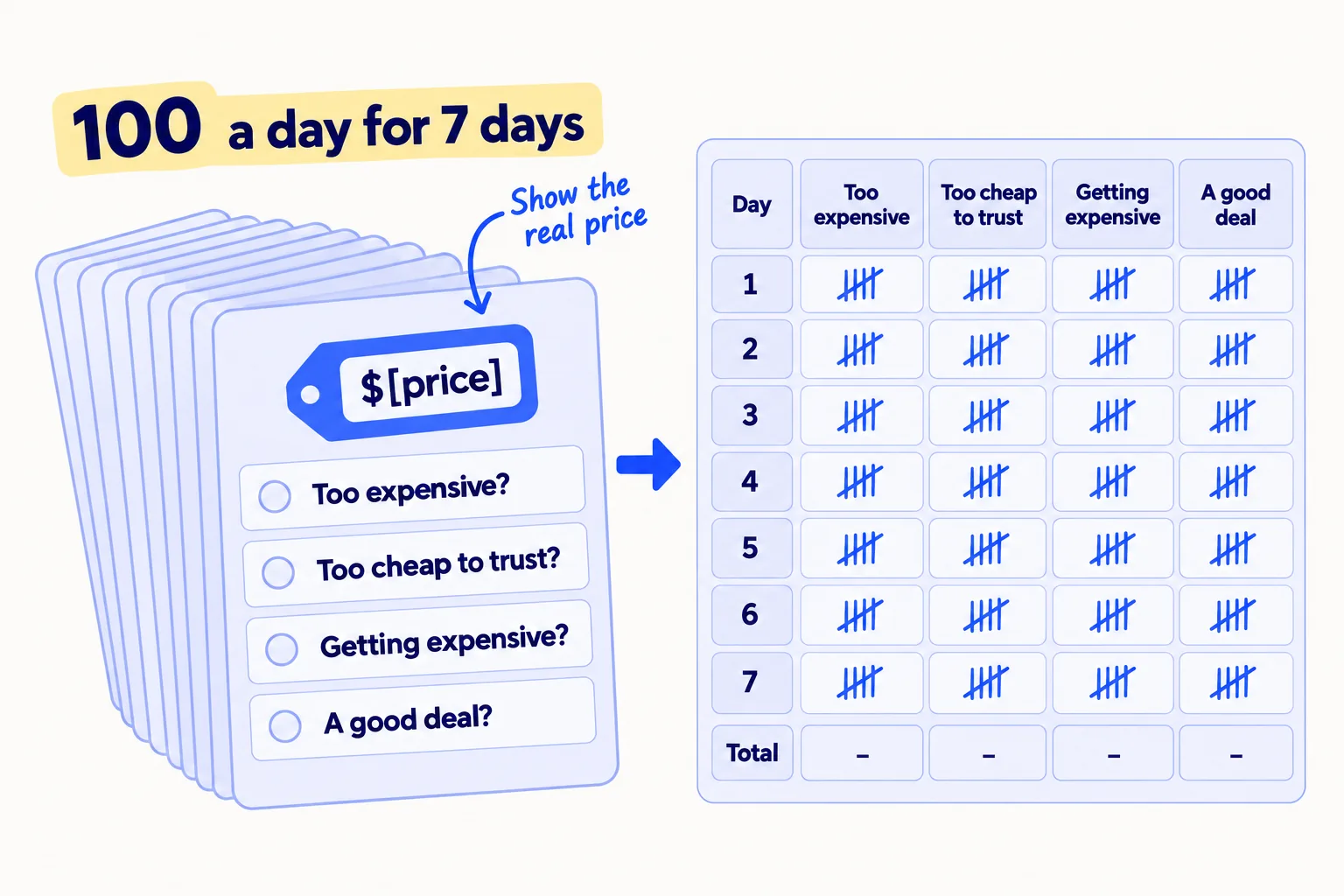
Who to ask. People who already posted about the problem your product fixes, on Instagramsoon, TikTok and Reddit. Members of online communitiessoon where your buyers ask for help. Your past buyers, and anyone they said has the same problem. With a past buyer, a short call teaches you more than the form. Friends count only as a last resort, because they are kind about price. 100 a day empties a list fast, so add 100 new names every day, the same way you found creators for your store.
What to ask. Put four questions in a free Google Form. They are the Van Westendorp price questions, a common pricing survey, and they find the range of prices buyers accept:
[Photo of the product. What it is, the size, and who it is for, in one line.]
At what price would this be so expensive that you would not buy it?
At what price would it be so cheap that you would doubt the quality?
At what price would it start to feel expensive, but you would still think about it?
At what price would it be a good deal?
It costs $[price]. Would you buy it at that price? (Yes / Maybe / No, and why)
Hi [first name], [one true line about something they posted].I make [what it is] for [who, the problem]. It costs $[price], or $[bundle price] for [the bundle]. Here it is: [link]I'm setting my price and would love an honest answer. Would you tell me what feels too much and what feels like a good deal? It's 4 quick questions: [form link]Thanks, [your name]
How 100 a day is possible. Paste 10 names at a time into ChatGPT or Claude, each with one thing they posted, plus the message above. Ask for one message per person. Read each draft, make the first line true, and send it yourself. That is about a minute a message. Log every one in your sheet: name, where, date, answered or not.
Follow each place's rules. On Reddit and in groups, read the rules on self-promotionsoon first, and ask in a post only where they allow it. If Instagram or TikTok shows you a warning about your messages, stop messaging there that day and send the rest by email or in communities. Keep every message one-to-one. The same text sent to hundreds of people is spam.
Follow upsoon once, 3 days later, with anyone who opened the link but did not answer.
- Tool: Instagram and TikTok messages, email, a free Google Form, ChatGPT or Claude to draft, and Google Sheets to log.
- Time: about 2 hours a day for 7 days: 100 minutes to send, 20 minutes to find new names.
- You will have: 700 asks and every answer in one sheet.
- It worked if: after 700 asks, at least 50 people have answered all four questions. Fewer than 20 means the first line is not about them, or you are asking the wrong people. Rewrite the first line and send the next 100.
- Common mistake: asking "Would you buy this?" with no price, or asking only friends. Both give you a yes that nobody pays. The other mistake is stopping at 30 asks because few replied.
See it done: Ferns & Rinse's price message
To: Priya, who posted about dry curls in hard water
Hi Priya, your post about curls going dry after you moved to a hard-water city sounded exactly like my sister.
We make a plant-based shampoo and conditioner for dry, curly hair. They cost $28 each, or $49 for both. Here they are: [link]
We're setting our prices and would love an honest answer. Would you tell us what feels too much and what feels like a good deal? It's 4 quick questions: [form link]
Thanks, Maya
Why it works: It shows the real price and the pair, asks about her, and asks for a range instead of a yes.
5. Put your price, bundle and free-shipping line on your store
After 700 asks, set your price, your bundle and your shipping line, and show all three in the first screen of your product page. Shoppers leave their cartsoon when the total surprises them at checkout: in Baymard's survey, about 4 in 10 US shoppers who left a checkout did so because of extra costs such as shipping.
![A product page with three things in the first screen: the price, a bundle that shows the saving in dollars, and a line 'Free shipping over $[X]', set just above the price of one product.](/academy/illustrations/how-to-price-a-product/step-5-put-your-price-bundle-and-free-shipping.webp)
Set the price from the answers. Count the answers to question 5 and questions 1 and 3:
- More than half say your price is "too expensive" (question 1 at or below your price): check step 3. If you sit above the top 5, fix the pagesoon first. If the page already says why, lower the price to the most common "getting expensive" answer, as long as step 2 still passes.
- Fewer than 1 in 5 say it "starts to feel expensive" (question 3 at or below your price): you are probably cheap for what it is. Raise the price to the middle of the question 3 answers, and check it on the next 700 asks.
- In between: keep your price.
Make the bigger order the easy choice. Create a fixed bundle with Shopify Bundles, Shopify's free app on every plan: go to Apps › Bundles and click "Create bundle". Show the saving in dollars. Then set a free-shipping line a little above the price of one product, so a one-product buyer adds the second. Check in your step 1 sheet that the bundle with free shipping still passes rule 2. Keep it to one bundle and one line for now. Other ways to lift average order valuesoon can wait until you have more orders.
Only show a "was" price that was real. Shopify shows a crossed-out price when you fill in Compare-at price. The FTC's pricing guides say a former price must be one you really offered, openly, for a reasonably long time. A made-up "was $40" is deceptive. Run sales rarelysoon, and do not send strangers a standing discount code yet: buyers learn to wait for it. A signup form can offer something other than a discountsoon.
- Tool: your Shopify admin and Shopify Bundles (free).
- Time: 1 hour.
- You will have: your price, one bundle and one free-shipping line, live in the first screen.
- It worked if: you show the page to 5 people who do not know you for 10 seconds, and at least 4 can say the total price with shipping for one item and for the bundle.
- Common mistake: a fake Compare-at price, or a 20%-off code for everyone. Both teach buyers that your real price is lower. Also: changing the price and the shipping line on the same day. Then you cannot tell which one worked.
See it done: Ferns & Rinse's shipping line
Before
Shipping: $5 on every order.
After
Free shipping on orders over $45. Both for $49 · save $7.
With free shipping, the pair leaves $22.73 of $49 (46%). The prices stay at $28 and $49. They test the new line for the next 20 orders.
Why it works: Free shipping starts just above one bottle, so a one-bottle buyer has a reason to add the conditioner, and the pair still leaves more than 40%.
6. Check your money left per order every Sunday and change one thing
Every Sunday, fill in one row: orders, what they left you, and what people said about your price. Then change at most one thing, and keep it until 20 more orders or 1,000 more visits.
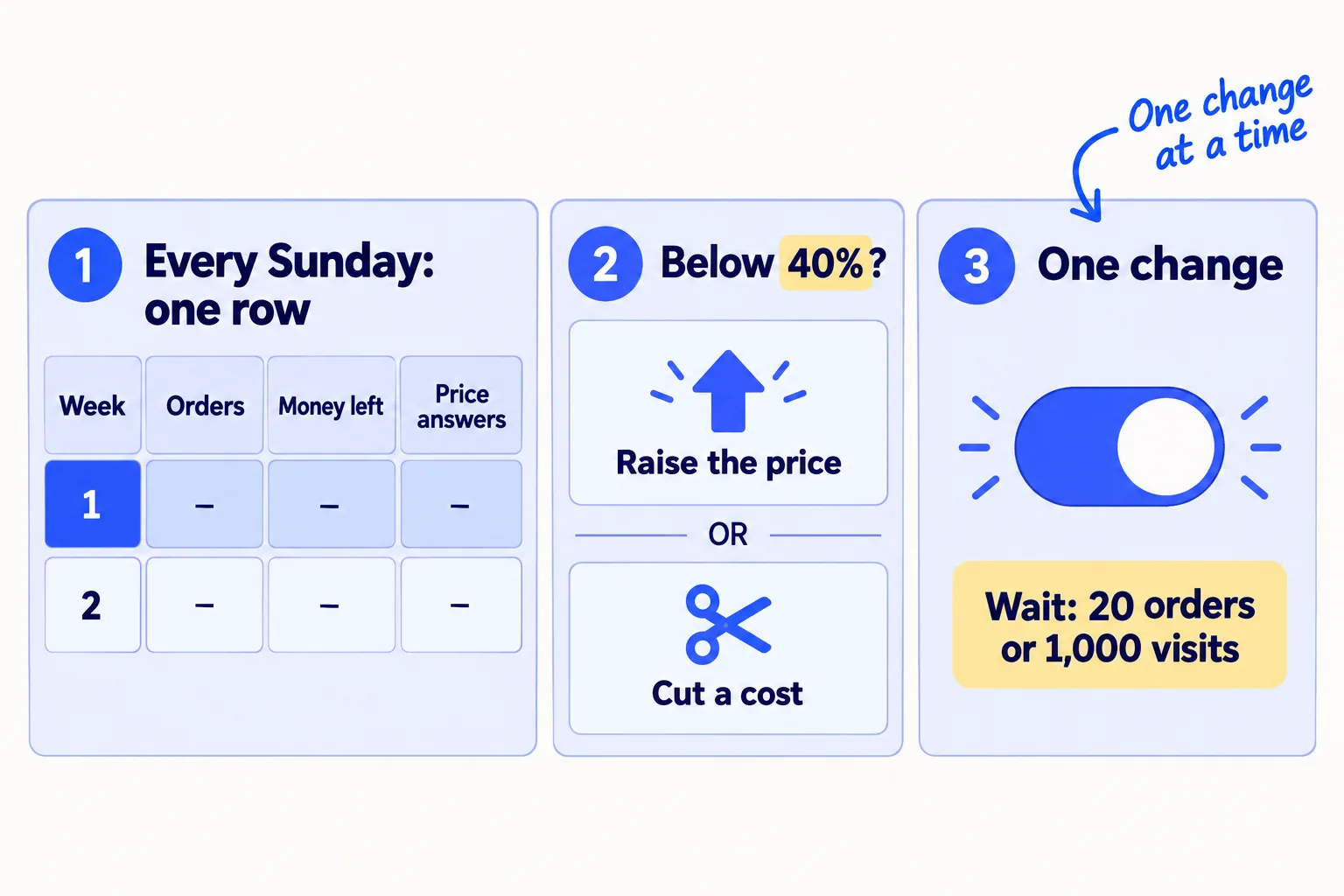
Take visits from Shopify's Analytics and orders from your order list. Tag the links you share with UTM parameterssoon and ask new buyers how they found you, so you can tell orders from strangers apart. Use the step 1 sheet for money left on each order.
Week | Visits | Orders | Orders from strangers | Bundles | Average money left per order | Money left share | Asks sent | Answers | "Too expensive" at your price | Change this week
Decide with these rules:
- Money left below 40%: raise the price, or cut the cost that grew (the label, the box, the samples). Do not fix it with ads: a bigger ad budgetsoon loses more money on every order.
- More than half of the answers say "too expensive", and fewer than 1 order per 100 visits from strangers (a conversion rate under 1%): the page or the price is the problem. Fix the first screen first; if that changes nothing after 1,000 visits, try the lower price from step 5. If almost nobody buys at any price, read why no one is buying before you cut the price. If people buy once and do not come back, work on repeat purchasessoon, not the price.
- Everything passes: change nothing. Spend the week getting more visitors and first sales, with the routine in your D2C marketing plan.
Keep each change for 20 more orders or 1,000 more visits, whichever comes first. Split tests that show two prices to different visitors need far more visits than a new store gets, so skip A/B testingsoon your price for now. When a place brings strangers who buy at your price, put more hours there. Once a month, look at the rows together in a marketing reviewsoon. Before you turn Meta adssoon back on, check the ROAS you need against your break-even ROAS from step 2. Ads that get clicks but no salessoon are often a price or page problem, not an ad problem.
- Tool: Google Sheets and Shopify Analytics.
- Time: 30 minutes each Sunday.
- You will have: one row a week and one written decision.
- It worked if: you can say the money left on an average order this week, and the reason for any change you made.
- Common mistake: changing the price, the bundle and the shipping line in the same week, or raising the price because one week was good. Later, when you have regular buyers, raise pricessoon with notice.
See it done: Ferns & Rinse's first two Sundays
The Sunday sheet, weeks 1 and 2
| Week | Visits | Orders | From strangers | Bundles | Money left share | Asks sent | Answers | "Too expensive" at $28 | Change |
|---|---|---|---|---|---|---|---|---|---|
| 1 | 105 | 2 | 1 | 1 | 49% | 700 | 61 | 9 of 61 | Free shipping over $45 |
| 2 | 120 | 3 | 2 | 3 | 46% | 0 | 12 | 2 of 12 | None; wait for 20 orders |
The decision: 11 of 73 people call $28 too expensive, and most call $49 for both a good deal, so the prices stay. Money left is above 40% with free shipping. They keep the new line until 20 orders.
Why it works: The founders keep the prices because the answers and the money left both pass, and change only the shipping line.
Where Scout7 helps
Scout7 speeds up two of the six steps: 3 and 4.
Step 3. Scout7's competitor set lists the brands that win the Google and AI answers you want, and by how much. Use it as the start of your 20 rows. It does not look up prices: you still open each store and write down today's price and shipping.
Step 4. Scout7's audience research reads public social conversations in your category and builds audience segments, with pain points and quotes in shoppers' own words. Use it to find the kind of people to ask and the words for each message's first line. It does not replace asking people what they would pay.
Your pricing checklist for the next 2 weeks
0 of 14 done
Work through this list with an AI assistant
It drafts the work and keeps track of what is done.
Frequently asked questions
- What is a good profit margin for a product?
For a D2C brand, aim for product and packaging at no more than 30% of the price, and at least 40% of each order left after shipping, fees and samples. Public beauty brands kept about 69% of sales after product costs in 2025. Food brands keep less. Use your own numbers to find your break-even ROASsoon.
- What is the formula for pricing a product?
Price = cost ÷ (1 − the share you want to keep). If one unit and its packaging cost $6 and you want to keep 70%, the price is at least $6 ÷ 0.30 = $20. Then check that at least 40% of the whole order is left after shipping and fees, and that buyers accept the price (steps 3 and 4).
- Should I price lower than my competitors to get my first sales?
Only if both rules in step 2 still pass. A low price leaves less money to pay for creators, samples and ads, lowers what each buyer is worth over time, and your first buyers expect it forever. Most new stores lose sales on trust, not price. Match the middle of your 20 competitors and spend the effort on reviewssoon and your product pagesoon.
- How do I price a product for wholesale and retail?
Shopssoon usually pay about half your retail price and double it on the shelf, which is called keystone pricing. So set the retail price first, then keep your product cost at 25% of it or less. Then half the wholesale price is still yours.
- Should I offer free shipping?
Offer it above a line, not on every order. Set the line a little above the price of one product, so buyers add a second item, and check the bigger order still leaves 40% after the label. About 4 in 10 US shoppers who leave a checkoutsoon do it over extra costs, so show the line on your product page.
Sources
- 1.Beauty Ecommerce Gross Margin 2026: 69% Median Across Public Brands — Eightx, 2026, checked 26 September 2026
- 2.Average Gross Margin by CPG Category: Beauty 70%, Food 40% — Eightx, 2026, checked 26 September 2026
- 3.The Average Credit Card Processing Fees for 2026 — Shopify, 2026, checked 26 September 2026
- 4.Shopify Bundles — Shopify Help Center, checked 26 September 2026
- 5.Setting sale prices for products — Shopify Help Center, checked 26 September 2026
- 6.16 CFR 233.1: Former price comparisons — Federal Trade Commission, via eCFR, checked 26 September 2026
- 7.How to set retail store prices — Faire, checked 26 September 2026
- 8.How to use the Van Westendorp Price Sensitivity Meter — SurveyMonkey, checked 26 September 2026
- 9.Cart abandonment rate statistics — Baymard Institute, updated 22 September 2025
- 10.2026 Postage Price Change — USPS, checked 26 September 2026
- 11.July 2026 USPS rate and rule changes — Pirate Ship, 2026, checked 26 September 2026
- 12.Ecommerce after the de minimis tariff exemption — Practical Ecommerce, checked 26 September 2026
- 13.Supreme Court strikes down IEEPA tariffs: what now? — WilmerHale, 20 February 2026
Next article to read
Related guides
- How to increase average order value on ShopifyD2CComing soon
- How to run a sale without training customers to waitD2CComing soon
- How much to spend on marketing as an ecommerce brandD2CSet your first ecommerce marketing budget from what one order leaves you: a fixed monthly amount from savings you can afford to lose, free product for small creators first, a daily log, a Sunday cost-per-order check, and a capped first ad test once three conditions are true.
- How to write a product description that sellsD2CComing soon
Guides that link here
- How to market a D2C brandD2C
- How much to spend on marketing as an ecommerce brandD2C
- How to get your first sale on EtsyD2C
- How to get people to try your product
- How to get your first sales on ShopifyD2C
- Why no one is buying your product, and how to fix it
- How to choose marketing channels for an ecommerce brandD2C
- How to do a competitor analysis
- How to validate a business idea without spending money
Cite this page
Dinesh Bypilla (2026). How to price a product. Scout7 Academy. https://scout7.ai/academy/marketing-plan/how-to-price-a-product
Written by Dinesh Bypilla, Agentic systems engineer at Scout7. Reviewed by Murali Sid. Last checked 26 September 2026.
Quote any part of this guide with a link back to this page. © 2026 Scout7.
Markdown version of this page: https://scout7.ai/academy/marketing-plan/how-to-price-a-product.md