



How to choose marketing channels for a B2B company
Choose marketing channels for your B2B company in 6 weeks: ask five buyers where they look, test two channels next to your outreach, and keep the one with the most conversations per hour.
ByDinesh BypillaReviewed byMurali SidLast checked 14 min read
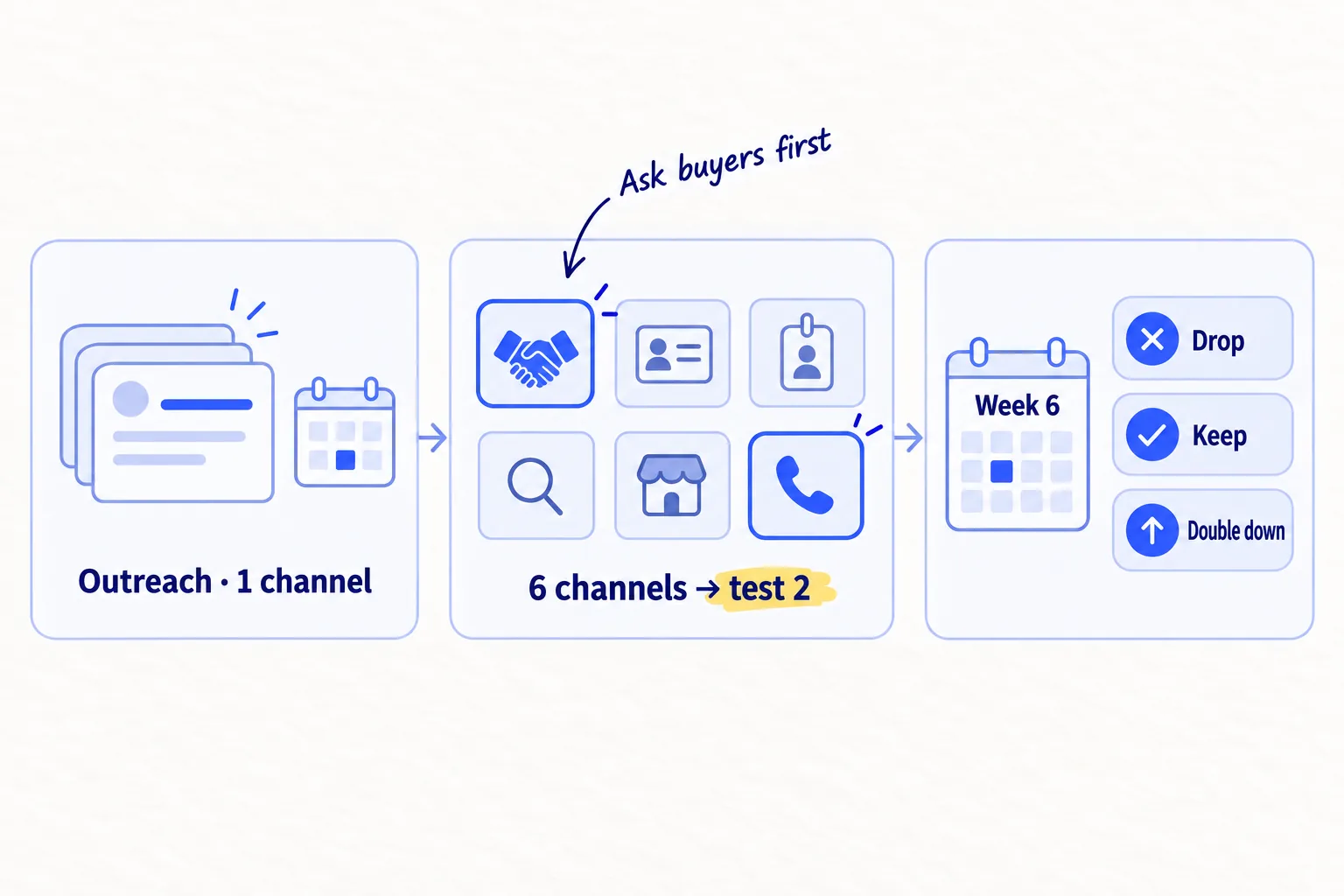
Here is how to choose marketing channels for a B2B company when you do all the selling and have a few spare hours a week. Most lists of B2B marketing channels rank a dozen options by the returns large companies get, so a small firm tries four at once and learns nothing. Ask your buyers where they look instead, test two channels for 6 weeks next to your outreach, and keep what brings conversations.
Do these three things
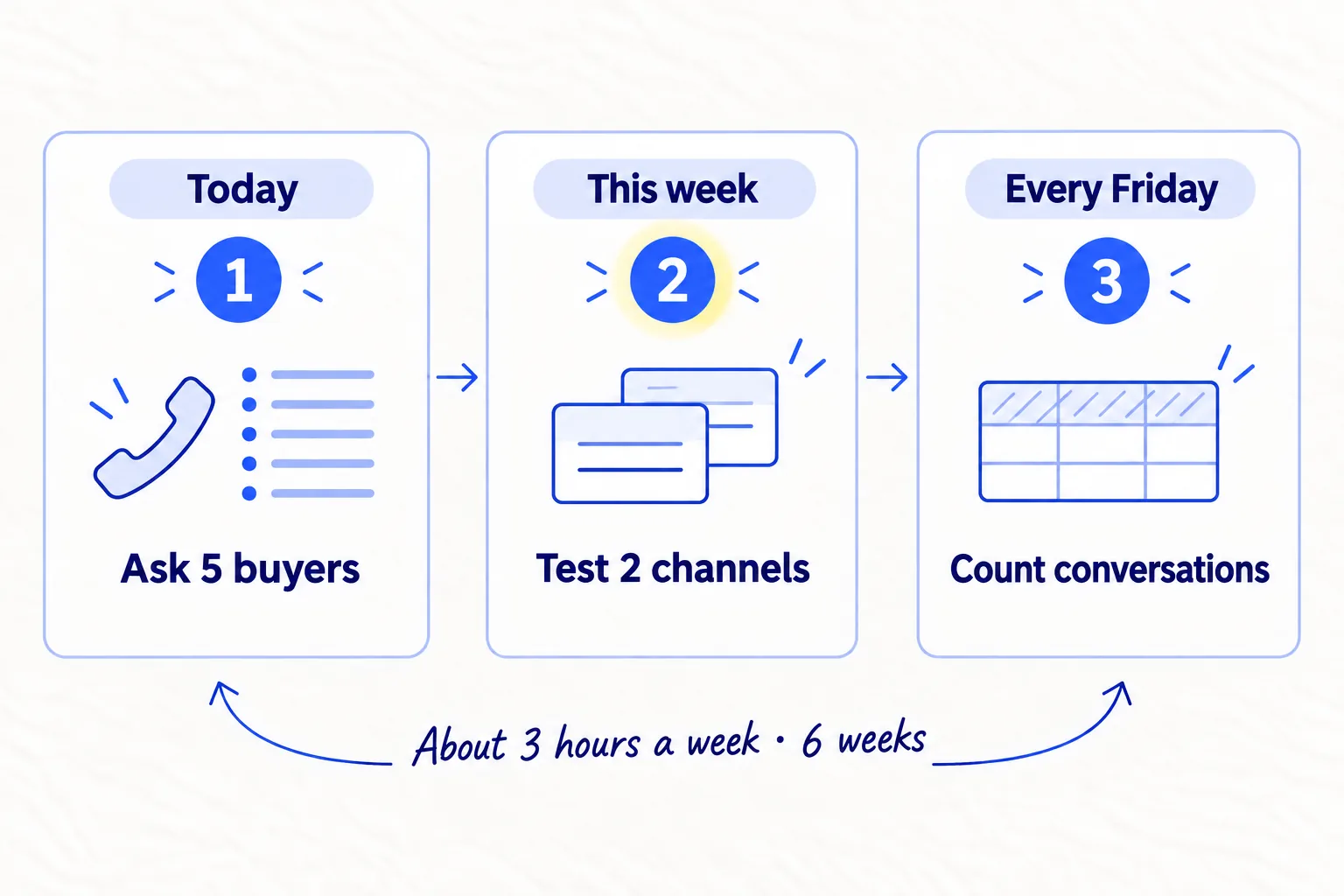
About 3 hours a week on top of your outreach, for 6 weeks. Judge conversations at week 6 and orders at week 12.
Show the three actions in fullHide the full list
- Today: ask five buyers how they found their last supplier, and write down every place they name.
- This week: pick two channels to test next to your outreach. Give each one a weekly amount, a cost and a stop line for 6 weeks.
- Every Friday: write down the hours and conversations each channel gave you. At week 6, drop any channel with none, and give its hours to the one with the most conversations per hour.
Get help doing these
ChatGPT or Claude reads this guide and works through it with you.
1. Ask five buyers how they found their last supplier
The best channel for your B2B company is the place your buyers went the last time they needed a supplier like you, so ask them. Ask your clients and the buyers you already talk to. Do not guess from a list of "top B2B channels".
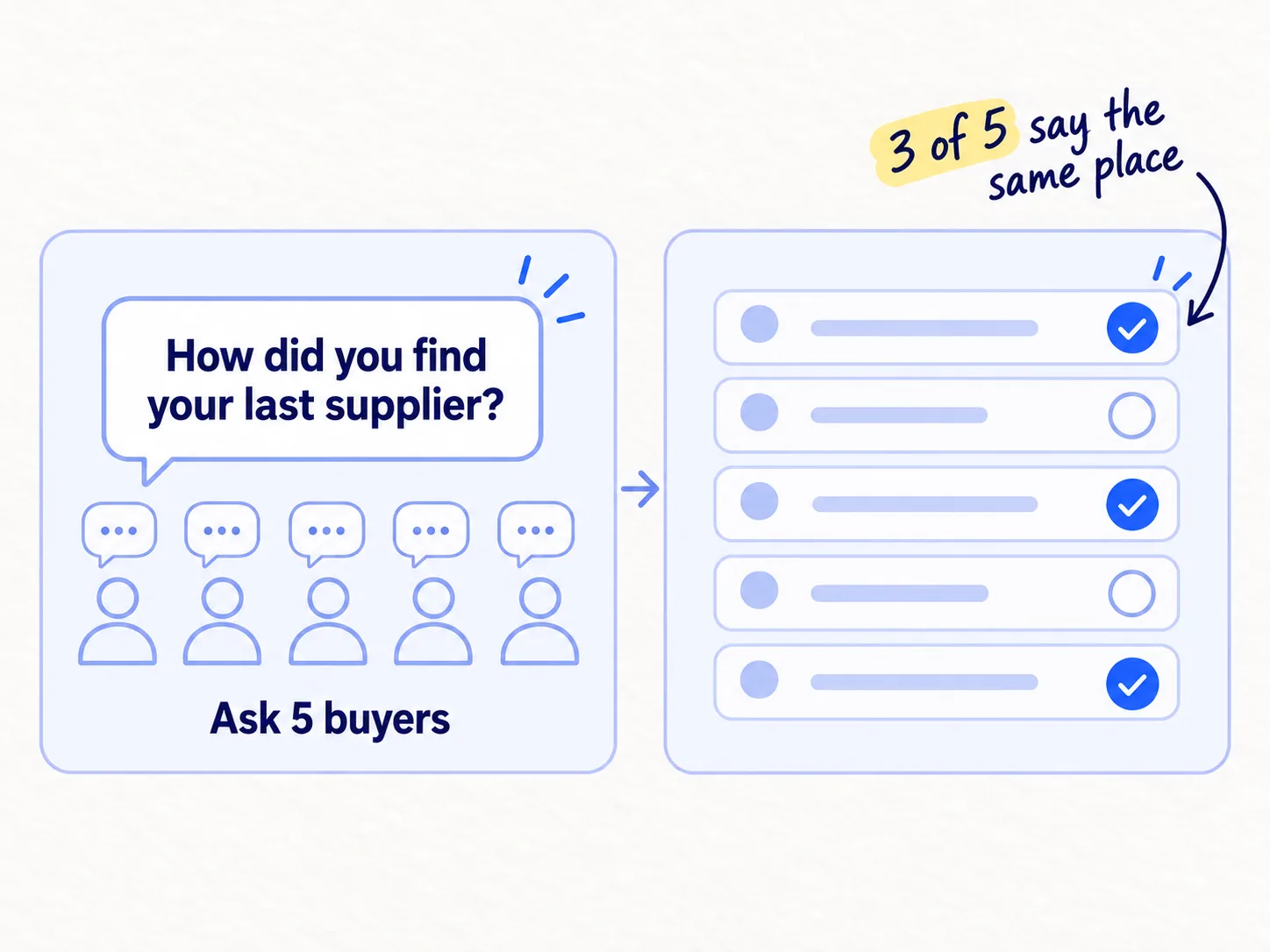
Ask your one or two clients, plus buyers from the conversations your outreach already brings, until you have five. If a call is already booked, ask these at the end. Write down their exact words.
The last time you needed a new [supplier / partner / tool] like us, how did you find one?
Where did you look first: someone you asked, Google or ChatGPT, LinkedIn, a trade show, a marketplace or catalogue, or a salesperson who contacted you?
Who else do you ask, or read, when you need to buy something like this?
- Tool: your phone and a Google Sheet with one row per buyer.
- Time: 10 minutes per buyer, or the last 5 minutes of a call you already have. One week for all five.
- You will have: five answers, in the buyers' own words, naming real places, people and events.
- It worked if: at least 3 of the 5 name the same kind of place. If all five name different places, ask five more buyers before you pick anything.
- Common mistake: asking "Would you look for us on LinkedIn?" Buyers say yes to be kind. Ask what they did last time, not what they might do.
For running these calls well, see How to do customer interviews.
2. Score the six B2B marketing channels and pick two to test
Keep your daily outreach and your introductions going, and pick two more channels to test by scoring six on three yes-or-no questions. Outreach stays, because it is the one channel you control every day. If you have not started it yet, begin with How to market your B2B business.
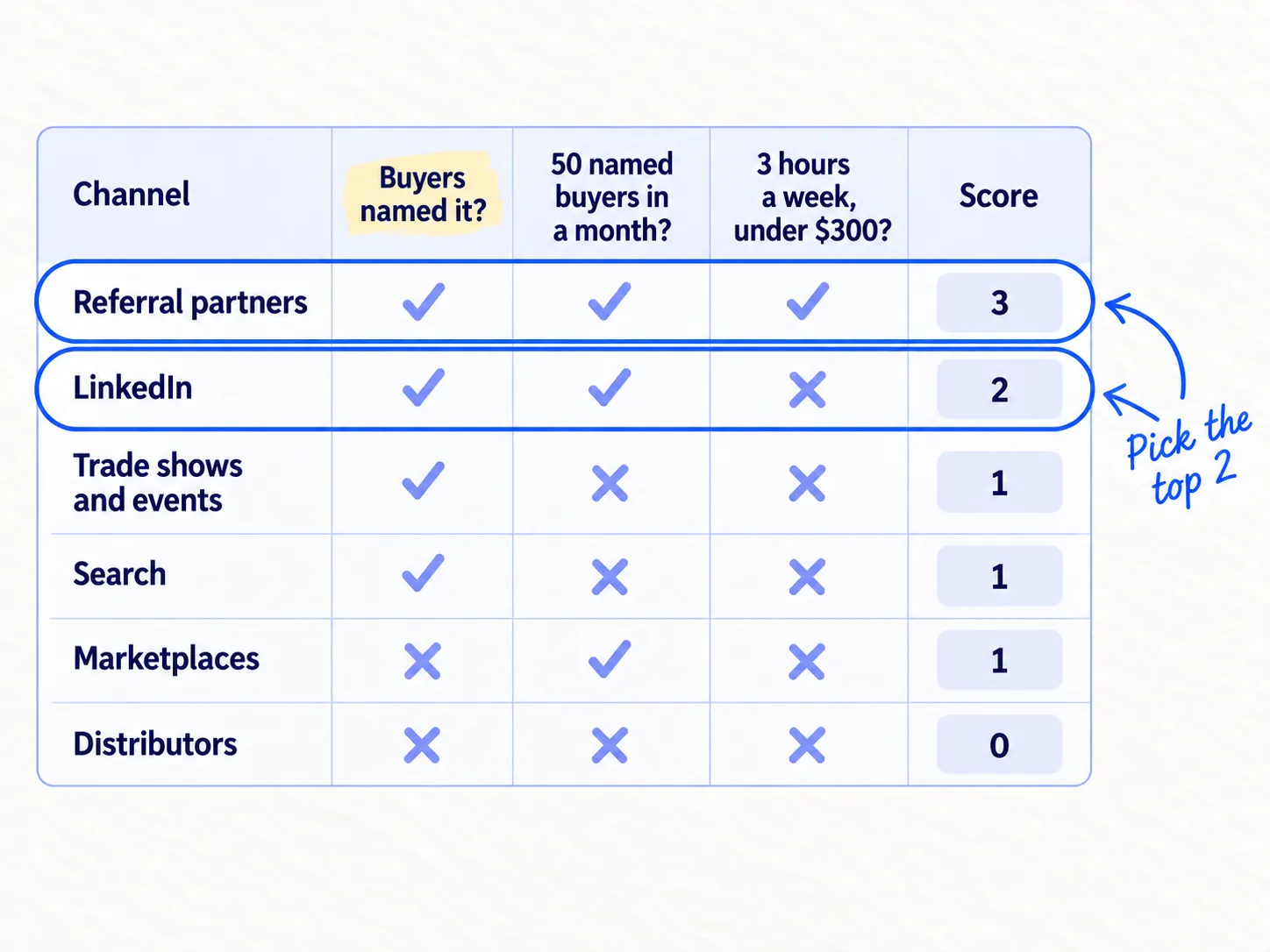
These are the six channels that fit a sales-led company at your size:
| Channel | What you do |
|---|---|
| Referral partners | Businesses that already serve your buyers send you introductions, and you send them yours. |
| You connect with named buyers from your own profile and message the ones who accept. | |
| Trade shows and events | You visit one show your buyers go to, with meetings booked before the day. |
| Search (Google and AI answers) | You write pages that answer what your buyers type into Google or ChatGPT. |
| Marketplaces | You fill in a free profile where buyers look for suppliers: Thomasnet, Clutch or an app store. |
| Distributors | A company that already sells to your buyers resells your product. |
Score each channel with one point for each yes:
- Did at least one of your five buyers name it in step 1?
- Can you find 50 named buyers there in a month? Names of people, not a crowd.
- Can you run it in 3 hours a week and under $300 over 6 weeks?
Pick the two channels with the highest score. A channel needs a yes to question 1 to be picked. If two channels tie, pick the one more buyers named.
-
If you make or wholesale a product: score trade shows, distributors and marketplaces first. Industrial buyers search for suppliers on Thomasnet, and shows are where your buyers and resellers meet.
-
If you sell a service, such as consulting or IT: look hard at referral partners. These are firms that serve the same clients as you: an accountant for a finance consultant, an office fit-out firm for an IT provider.
-
If you sell software through sales calls: check LinkedIn and search. In G2's March 2026 survey of 1,076 software buyers, 51% started their research with an AI chatbot more often than with Google.
-
Tool: Google Sheets.
-
Time: 30 minutes.
-
You will have: a score for all six channels, and two picked for testing.
-
It worked if: both picks have a yes to question 1 and a score of at least 2.
-
Common mistake: picking the channel you enjoy, or testing four at once. With 3 spare hours a week, four channels get 45 minutes each, and none of them gets a fair test.
See it done: Carvelian's channel scores
Carvelian Packaging is a made-up maker of custom printed boxes for small food and drink brands. One founder sells through calls, samples and quotes.
Six channels, three questions
| Channel | Buyers named it | 50 named buyers in a month | 3 hours a week, under $300 | Score |
|---|---|---|---|---|
| Referral partners (label and brand designers) | Yes | Yes | Yes | 3 |
| No | Yes | Yes | 2 | |
| A regional food and drink trade show, as a visitor | Yes | Yes | Yes | 3 |
| Search | No | No | Yes | 1 |
| Marketplaces | No | No | Yes | 1 |
| Distributors | No | No | Yes | 1 |
So the founder tests designer partners and one trade show visit, where the exhibitors are the small brands he sells to. His 10 outreach messages a day carry on.
Why it works: Both picks were named by buyers and reach 50 named buyers in a month. Search scored lowest, so it waits.
3. Run a 6-week test for each channel, with a stop line
Give each channel a fixed amount every week for 6 weeks, write down the first sign it works and when you will stop, then do exactly that. A test with no amount and no stop line runs on until you forget it.
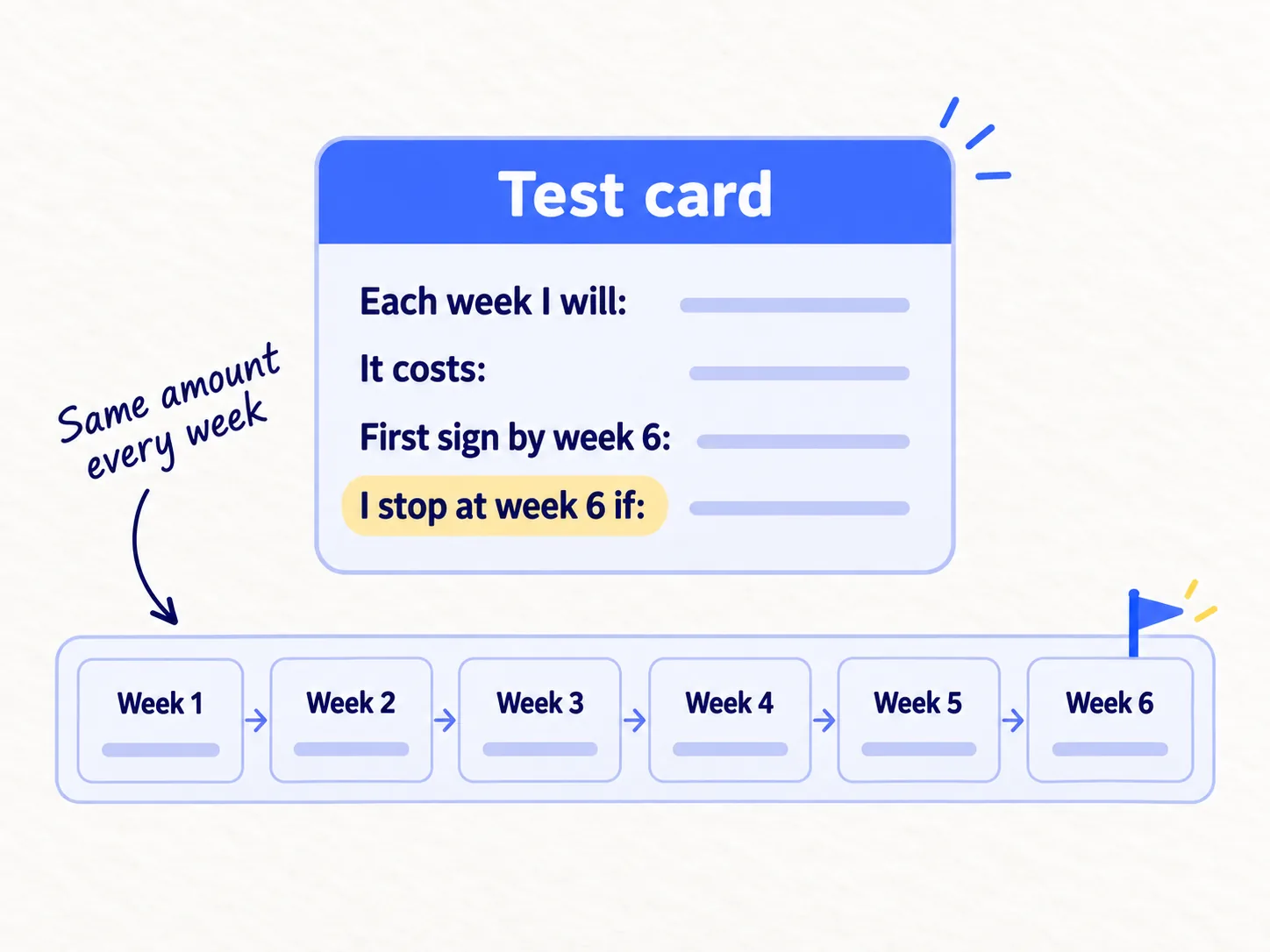
Use these amounts. A "conversation" is a call, a meeting, or a request for a sample or a quote from a named buyer.
| Channel | Each week | Cost | First sign by week 6 | Stop at week 6 if |
|---|---|---|---|---|
| Referral partners | List 10 firms that serve your buyers. Call or meet 2 a week and offer to swap introductions. | $0 | 1 introduction | 0 introductions |
| Send 20 connection requests to named buyers, and message each person who accepts. | $0 | 2 conversations | 0 conversations from 120 requests | |
| Trade show or event | Pick one show or business event in the next 6 weeks. Email 20 people from the exhibitor or speaker list and book meetings before the day. | Ticket and travel | 5 meetings booked | 0 sample or quote requests |
| Search | Type 5 buyer phrases into Google and ChatGPT. If small suppliers show up, write 1 page a week that answers one phrase. | $0 | Every page is on Google | Judge at week 12, not week 6 |
| Marketplaces | Fill in one free profile completely: what you sell, a starting price or minimum order, and 3 client results. | $0 | 1 enquiry | 0 enquiries |
| Distributors | Email 10 distributors that already carry products like yours, and offer a sample and your trade price. | Samples and postage | 1 call with a distributor | 0 replies from 10 |
For the channels that have a rule or a catch:
- Referral partners: lead with what you give. Offer to send them your clients who need their service. If a partner asks for a fee, agree a fixed amount per first order, paid after your client pays. Software firms often pay partners 10 to 20% of the first year's contract, according to Cello's August 2026 guide. See How to set up referral partnershipssoon.
- LinkedIn: a free account lets you add a note to only a few connection requests each month. Send the requests without a note, and write your message after they accept. See How to do LinkedIn outreachsoon.
- Trade shows: read the show's rules before you go. Many shows ban "suitcasing", which means promoting your business in the aisles or at other companies' stands when you have no stand. The 2027 code of conduct for IPPE, a large food industry show, says "Unauthorized solicitation by non-exhibitors is not allowed." So book meetings by email before the show, and meet in the café or a meeting area. The exhibitor list is also a lead list, even if you do not go. See How to get meetings from a trade showsoon and How to get clients from networking eventssoon.
- Search: it is the slowest channel, so judge it at week 12. Drop it then if Google Search Console shows 0 impressions for your buyers' phrases. If you serve clients in one area, set up a Google Business Profile, which is free. See How long does SEO take to worksoon, How to set up a Google Business Profilesoon and How to get your company recommended by ChatGPT as a suppliersoon.
- Marketplaces: the basic profiles on Thomasnet (industrial suppliers) and Clutch (service and IT firms) are free. Do not pay for a sponsored place during the test. Software sellers should look at the app stores of the tools their buyers already use. See How to get listed in integration marketplacessoon and How to get reviewed on Clutchsoon.
- Distributors: a distributor needs a margin, so work out your trade price before you email. See How to find distributors for your productsoon.
Channel: [the channel]Each week I will: [the amount, from the table]It costs: $[X] over 6 weeksFirst sign by week 6: [the number]I stop at week 6 if: [the number]Hours a week: [hours]
- Tool: Google Sheets for the cards, plus the tool each channel needs: your phone, LinkedIn, the show's website, Google Search Console, or the marketplace.
- Time: about 3 hours a week for both tests together.
- You will have: two test cards, and two tests running at a fixed amount every week.
- It worked if: each test hits its weekly amount 6 weeks in a row.
- Common mistake: doing a test "when there is time". A test done by half gives you no answer. The other mistake is pitching people in the aisles of a show you did not pay to exhibit at.
See it done: Carvelian's message to a designer
To: Lena, a freelance designer of labels for small food brands
Subject: introductions for your food clients
Hi Lena,
I saw the labels you designed for Pepperwick's gift set. They look great.
I make custom printed boxes for small food and drink brands, in short runs. Your clients often need a box once their labels are done, and my clients often ask me for a designer.
Could we swap introductions? I'll send you the next brand that asks me for a designer. Do you have 15 minutes for a call this week?
Dan, Carvelian Packaging, [phone]
Why it works: It offers her something first, and it names the moment her clients need a box.
4. Count hours and conversations for each channel every Friday
Every Friday, write down for each channel the hours you spent, the money, and the conversations it started. Then divide conversations by hours. That one number lets you compare a trade show with a LinkedIn test fairly.
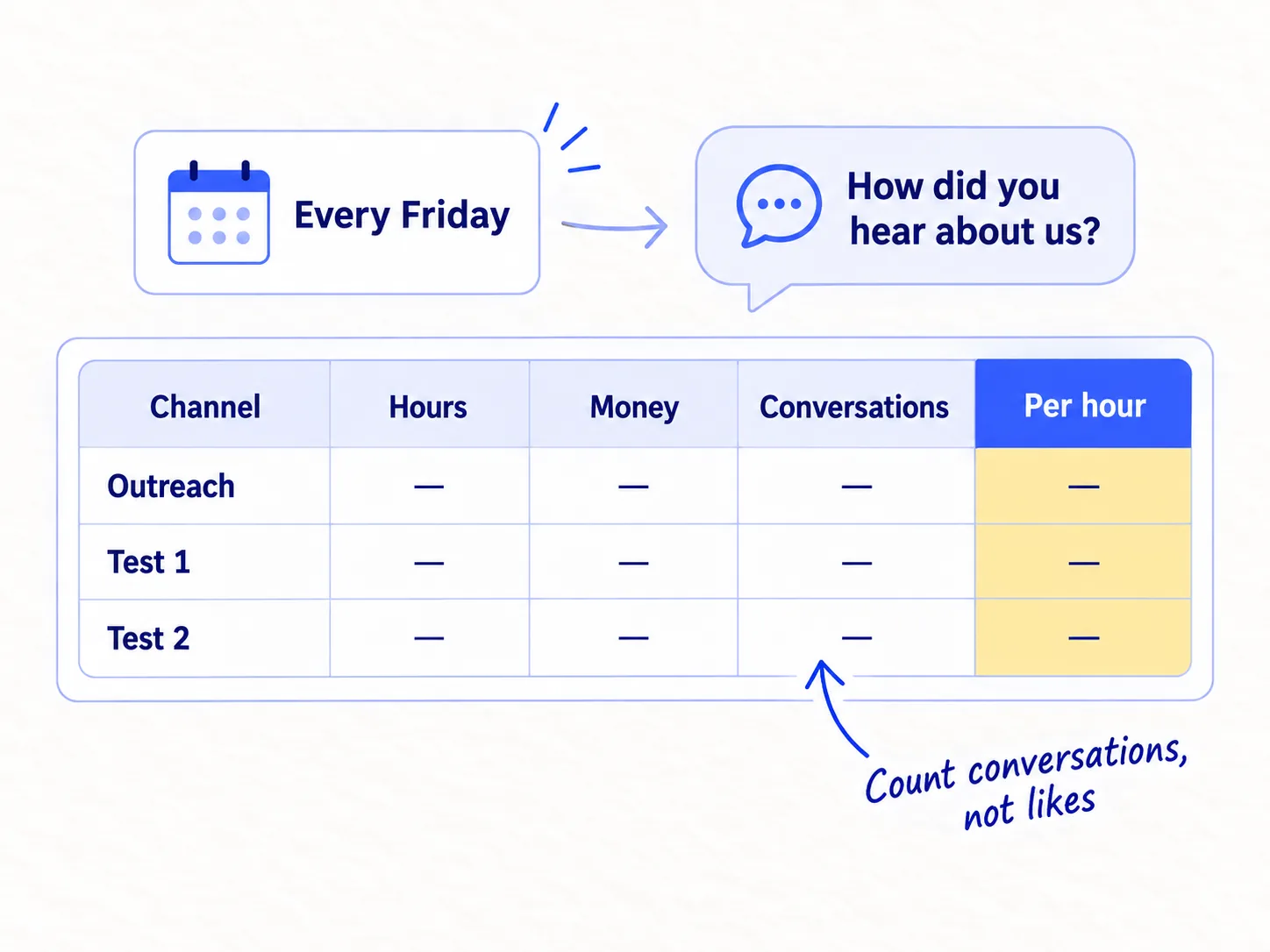
If you already keep the Friday sheet from How to market your B2B business, add these columns for each channel. Ask "How did you hear about us?" at the start of every first call, so each conversation lands in the right row.
Week | Channel | Hours | Money | Conversations | Samples or quotes | Orders | Conversations per hour
- Tool: Google Sheets.
- Time: 20 minutes each Friday.
- You will have: by week 6, six rows for each channel, with hours, money and conversations.
- It worked if: you can name the channel behind every conversation, and no channel has a blank hours cell.
- Common mistake: counting what you did (posts, requests sent, badge scans) as results. The other mistake is not logging hours, so the channel that eats your week looks free.
For a fuller way to trace each deal to its source, see How to track which channel brought each dealsoon.
5. At week 6, drop, keep or double down on each channel
At the end of week 6, give every channel one of three decisions, using its 6-week totals. Never decide on one week: with numbers this small, one good or bad week tells you nothing.
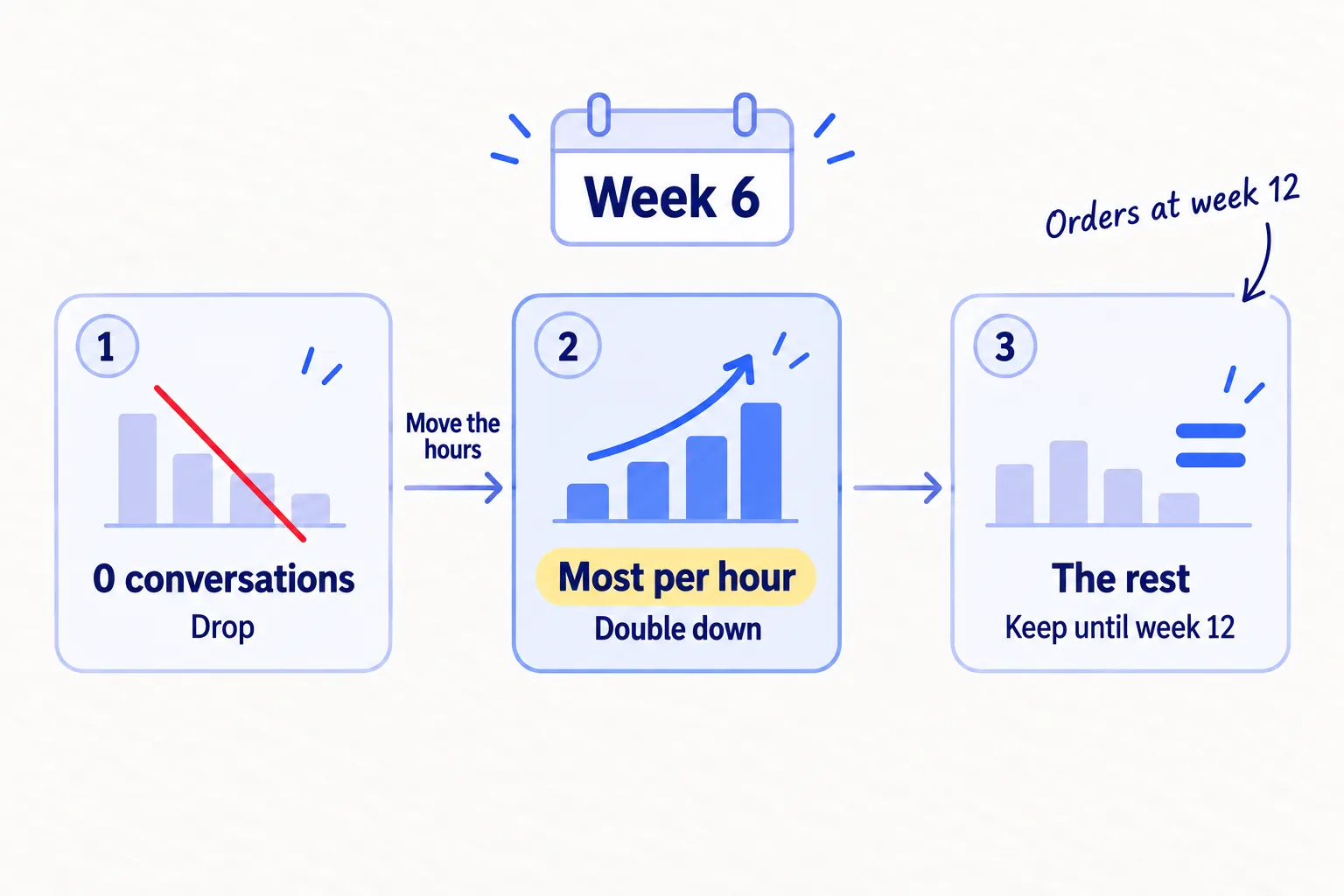
Use these rules:
- 0 conversations in 6 weeks: drop it. Search is the one exception: judge its pages at week 12.
- The most conversations per hour: double down. Give it the hours from any channel you dropped, for the next 6 weeks.
- Everything else: keep it at the same hours until week 12.
- At week 12: count orders by channel. An order beats a conversation, so a channel with fewer conversations and one order wins.
- Then start the next test from your step 2 score sheet in any hours you have freed. Run at most two tests at a time.
- Tool: Google Sheets.
- Time: 30 minutes at week 6, and 30 minutes at week 12.
- You will have: a written decision for every channel, and the hours each one gets for weeks 7 to 12.
- It worked if: every channel has a decision and a number of hours next to it.
- Common mistake: keeping a channel because you already paid for it, or because you like doing it. The sheet decides.
See it done: Carvelian at week 6
Weeks 1 to 6, by channel
| Channel | Hours | Money | Conversations | Samples or quotes | Conversations per hour |
|---|---|---|---|---|---|
| Outreach | 30 | $0 | 13 | 5 | 0.4 |
| Designer partners | 6 | $0 | 0 | 0 | 0 |
| Trade show visit | 12 | $240 | 7 | 3 | 0.6 |
The decision: the designer partners brought 0 conversations, so the founder drops that test. He moves its hour a week to shows: he emails the exhibitors of the next two regional shows and books meetings. Outreach stays at 10 a day. He counts orders at week 12.
Why it works: Each channel gets its decision from 6-week totals, not from how the weeks felt.
6. Pay for a channel only after the free version works
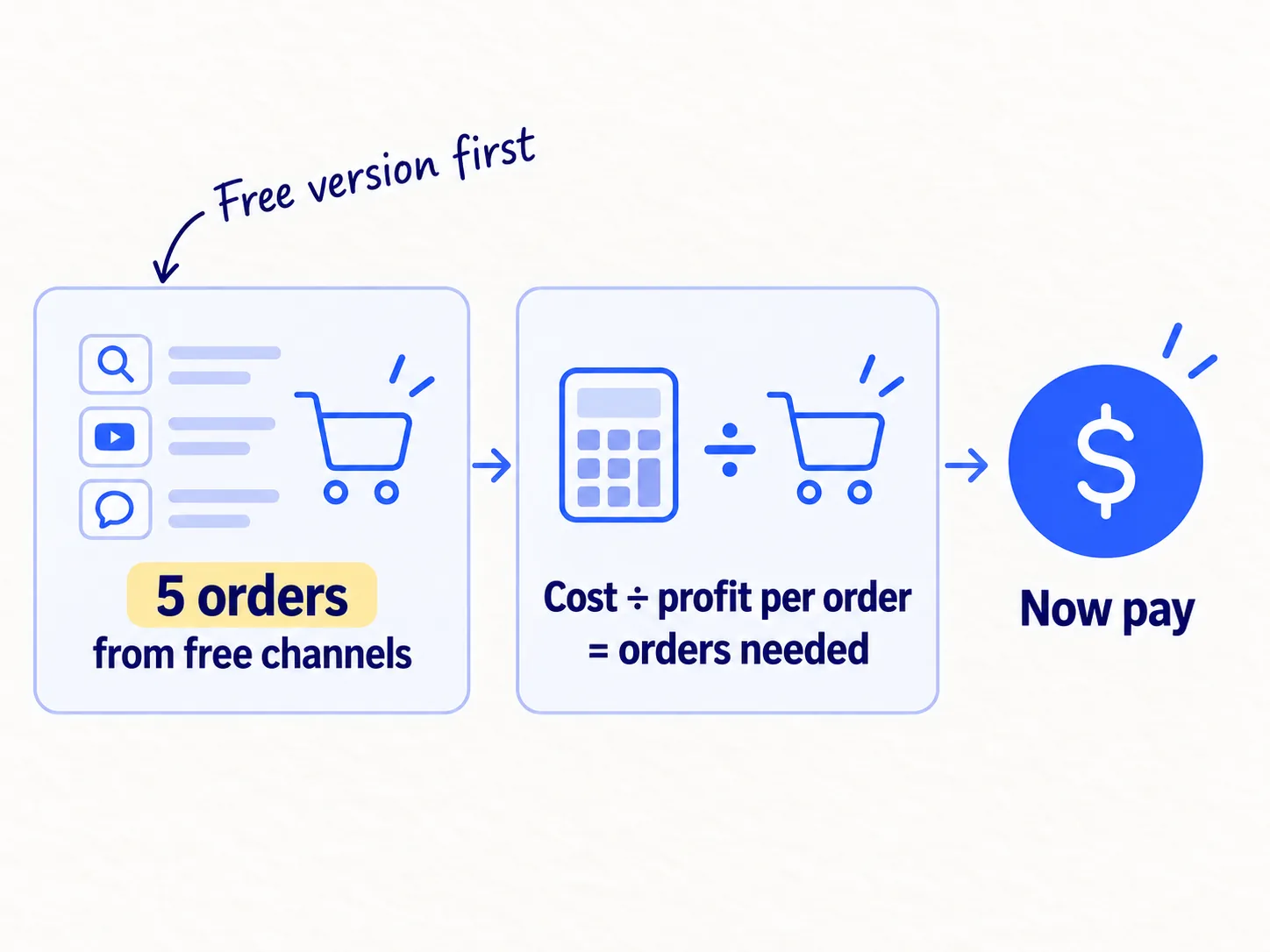
Spend money on a channel only when its free version has already brought conversations, and when the orders you can expect from it cost less than you pay. Every channel above has a free version, so test that first.
| Free version | Paid version | Price, checked 24 September 2026 |
|---|---|---|
| LinkedIn search and messages | Sales Navigator Core | $119.99 a month, or $1,079.88 a year; free trial |
| Posts from your own LinkedIn profile | LinkedIn ads | You set the budget |
| Visiting a show | A stand at the show | In the show's exhibitor pack |
| A free Thomasnet or Clutch profile | A sponsored or upgraded place | Clutch gives prices on request |
| Your own pages on Google | Google Ads | You set the budget |
Check two rules before you pay:
- At least 5 orders have come from your free channels, and you know which message gets replies. Before that, you pay to show strangers a message you have not tested.
- Work out the orders you need. Divide the cost by your profit on one order. If a stand costs $4,000 and you make $1,000 profit on an average order, you need 4 orders from that show. Pay only if the free version of the channel suggests you can get them: for example, a visit to that show brought at least 4 sample or quote requests.
- Tool: a calculator and your channel sheet.
- Time: 15 minutes for each paid option.
- You will have: a yes or no for each paid option, with the orders it needs written next to it.
- It worked if: everything you pay for has a payback number next to it, and its free version brought at least one conversation first.
- Common mistake: paying for a stand, ads or a sponsored listing first, "to get the word out".
To set how much to spend in total, see How much to spend on marketing as a B2B company. When LinkedIn passes both rules, see How to run LinkedIn ads for B2Bsoon.
Where Scout7 helps
Scout7 speeds up the search row of step 2, and gives you your buyers' words for the messages in step 3.
Step 2. Give Scout7's keyword intelligence the phrases your buyers used in step 1. For each one, it shows the monthly searches, how hard it is to rank, and who leads on Google and in AI answers. Scout7's competitor set shows which competitors win those answers, and by how much. If a few large sellers lead every answer, score search low and test it later.
Step 3. Scout7's audience research builds audience segments from public social conversations in your category, with pain points and quotes in buyers' own words. Use the quotes in your partner and LinkedIn messages. It does not replace the five calls in step 1.
Your B2B channel checklist for the next 6 weeks
0 of 11 done
Work through this list with an AI assistant
It drafts the work and keeps track of what is done.
Frequently asked questions
- What are the best marketing channels for a B2B company?
For a young sales-led company, the best channel is the place your buyers found their last supplier. Most small firms start with direct outreach and introductions from people they know. Then they add one or two of these: referral partners, LinkedIn, a trade show, search, a marketplace or a distributor. Ask five buyers, test two channels for 6 weeks, and keep the one with the most conversations per hour.
- How many marketing channels should a small B2B company use?
Your outreach plus two tests, at most. One person with about 3 spare hours a week cannot give four channels a fair test. At week 6, drop what brought nothing, and start the next channel from your score sheet in the hours you freed.
- Is LinkedIn good for B2B marketing?
It is good when your buyers have job titles you can search and use LinkedIn at work, as in software, IT and professional services. Test it for free: 20 connection requests a week to named buyers, and a message to each person who accepts. If 120 requests bring 0 conversations in 6 weeks, drop it. Pay for Sales Navigator or ads only after it brings conversations.
- Should I list my company on B2B marketplaces like Thomasnet or Clutch?
Yes, if your buyers said they look there, because the basic profiles are free. Thomasnet is for industrial suppliers, and Clutch is for service and IT firms. Fill in the profile completely and count enquiries for 6 weeks. Pay for a sponsored place only after the free profile brings at least one enquiry.
- How long should I test a marketing channel before I give up?
Six weeks at the same amount every week for conversations, and 12 weeks for orders. Search is slower, so judge its pages at week 12, not week 6. Never judge on one week. With small numbers, one good or bad week tells you nothing.
Sources
- 1.New G2 Research: Half of B2B Software Buyers Now Start Their Research With AI Chatbots — G2, via PR Newswire, 15 April 2026
- 2.IPPE Code of Conduct — IPPE, updated April 2026, checked 24 September 2026
- 3.Suitcasing Policy for GLTE 2026 — GLTE, checked 24 September 2026
- 4.Compare Pricing and Plans — LinkedIn Sales Navigator, checked 24 September 2026
- 5.Personalize invitations to connect — LinkedIn Help, checked 24 September 2026
- 6.Google Business Profile — Google, checked 24 September 2026
- 7.Claim Your Company — Thomasnet, checked 24 September 2026
- 8.What Free Features Does Clutch Offer? — Clutch Help Center, checked 24 September 2026
- 9.How Much Do Sponsorship and Featured Listings Cost? — Clutch Help Center, checked 24 September 2026
- 10.Referral Fees: A Comprehensive Guide — Cello, 7 August 2026
Next article to read
How much to spend on marketing as a B2B companyB2BOnce you pick your channels, this shows how much time and money to give each one.Read it nextRelated guides
- How to market your B2B businessB2BMarket your B2B business when you do all the selling: a 12-week routine for one founder, with who to contact, what to send, what to fix on your website, and what to count every Friday.
- How to do LinkedIn outreachComing soon
- How to get meetings from a trade showB2BComing soon
- How to create a B2B lead list for freeComing soon
Guides that link here
Cite this page
Dinesh Bypilla (2026). How to choose marketing channels for a B2B company. Scout7 Academy. https://scout7.ai/academy/marketing-plan/how-to-choose-marketing-channels-for-a-b2b-company
Written by Dinesh Bypilla, Agentic systems engineer at Scout7. Reviewed by Murali Sid. Last checked 24 September 2026.
Quote any part of this guide with a link back to this page. © 2026 Scout7.
Markdown version of this page: https://scout7.ai/academy/marketing-plan/how-to-choose-marketing-channels-for-a-b2b-company.md