



How to get your company recommended by ChatGPT as a supplier
Get your company recommended by ChatGPT as a supplier: ask it the 20 questions your buyers ask 3 times each and log who it names, put the same supplier facts on your site and every profile, then publish 1 page, send 100 mention requests, post twice on LinkedIn and give 20 answers every day, and recount the answers every Sunday.
ByDinesh BypillaReviewed byMurali SidLast checked 24 min read
![Three panels. First: a buyer asks an AI chat 'Who makes [what you supply] for [your buyer]?' and the answer names three other companies, not yours. Second: a 12-week calendar with work on every day, about 5 hours a day. Third: the same answer now names your company, with an arrow to 'Enquiry'.](/academy/illustrations/how-to-get-your-company-recommended-by-chatgpt-as-a-supplier/00-opening.webp)
Your buyers now ask ChatGPT which supplier to use before they contact anyone, and when you ask it the same thing, it names other companies and not yours. Here is how to get your company recommended by ChatGPT as a supplier: find out which pages it reads when it answers, put clear facts about what you supply on your own site and profiles, then get your name onto the pages it reads, every day. If you do nothing, the shortlist is made before anyone visits your website, and you are not on it.
Do these three things
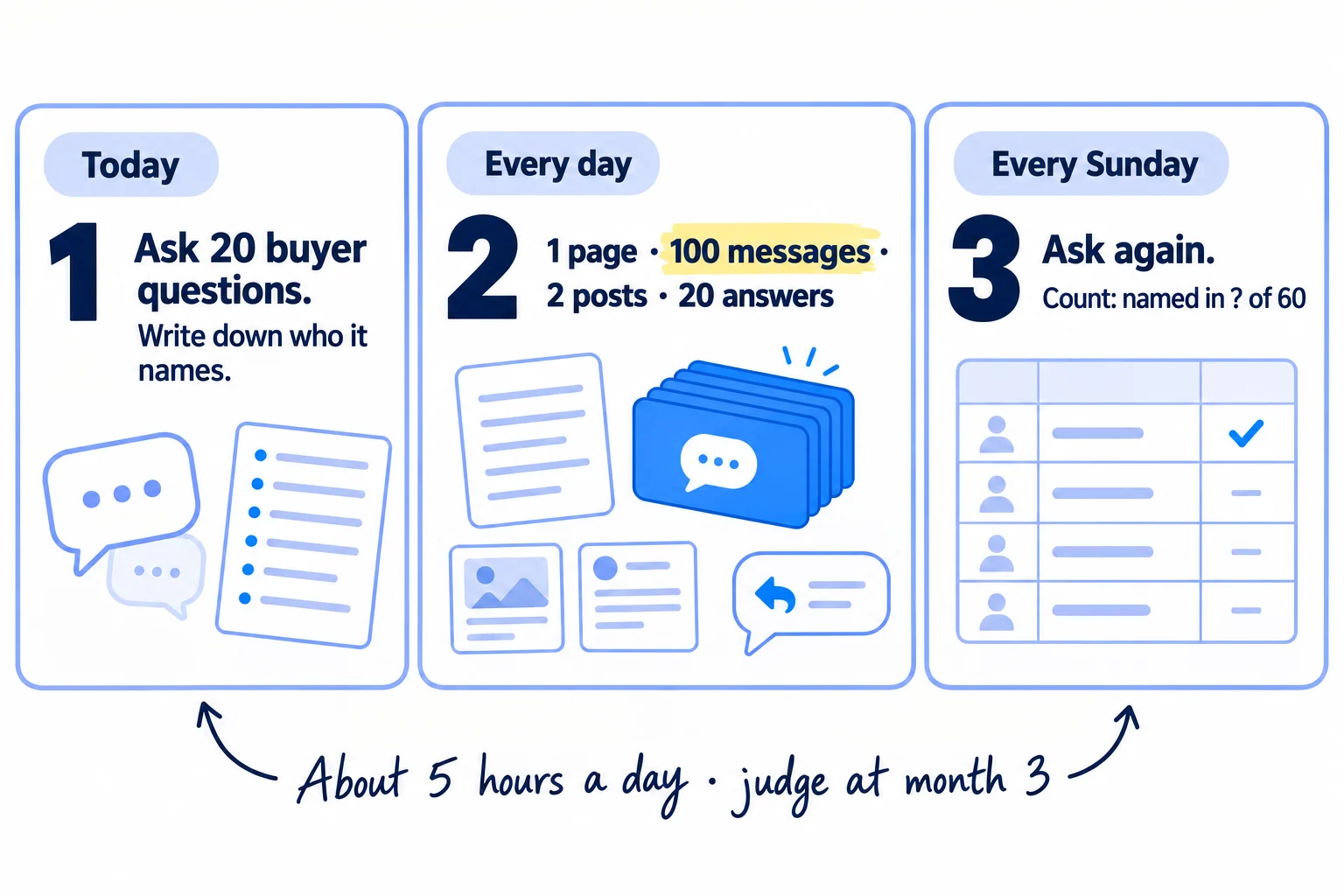
About 5 hours a day, every day, with AI drafting most of it. Judge it at month 3, after 84 pages and 8,400 messages, not after one check.
Show the three actions in fullHide the full list
- Today: ask ChatGPT 20 questions your buyers ask when they look for a supplier like you, 3 times each, and write down who it names and which pages it cites.
- Every day: publish 1 page that answers a buyer's question, send 100 personal messages asking the sites ChatGPT cites, your partners and your clients to mention you, post twice on LinkedIn and give 20 answers where buyers ask for help.
- Every Sunday: ask the same 20 questions again, count how many of the 60 answers name you, and count enquiries that say they found you through ChatGPT.
Get help doing these
ChatGPT or Claude reads this guide and works through it with you.
1. Ask ChatGPT the 20 questions your buyers ask, and write down who it names
Ask ChatGPT the questions a buyer types when they need a supplier like you, 3 times each, in a clean chat. Write down every company it names and every page it shows as a source. This is your starting point, and the list of sources is where you will spend most of your time.
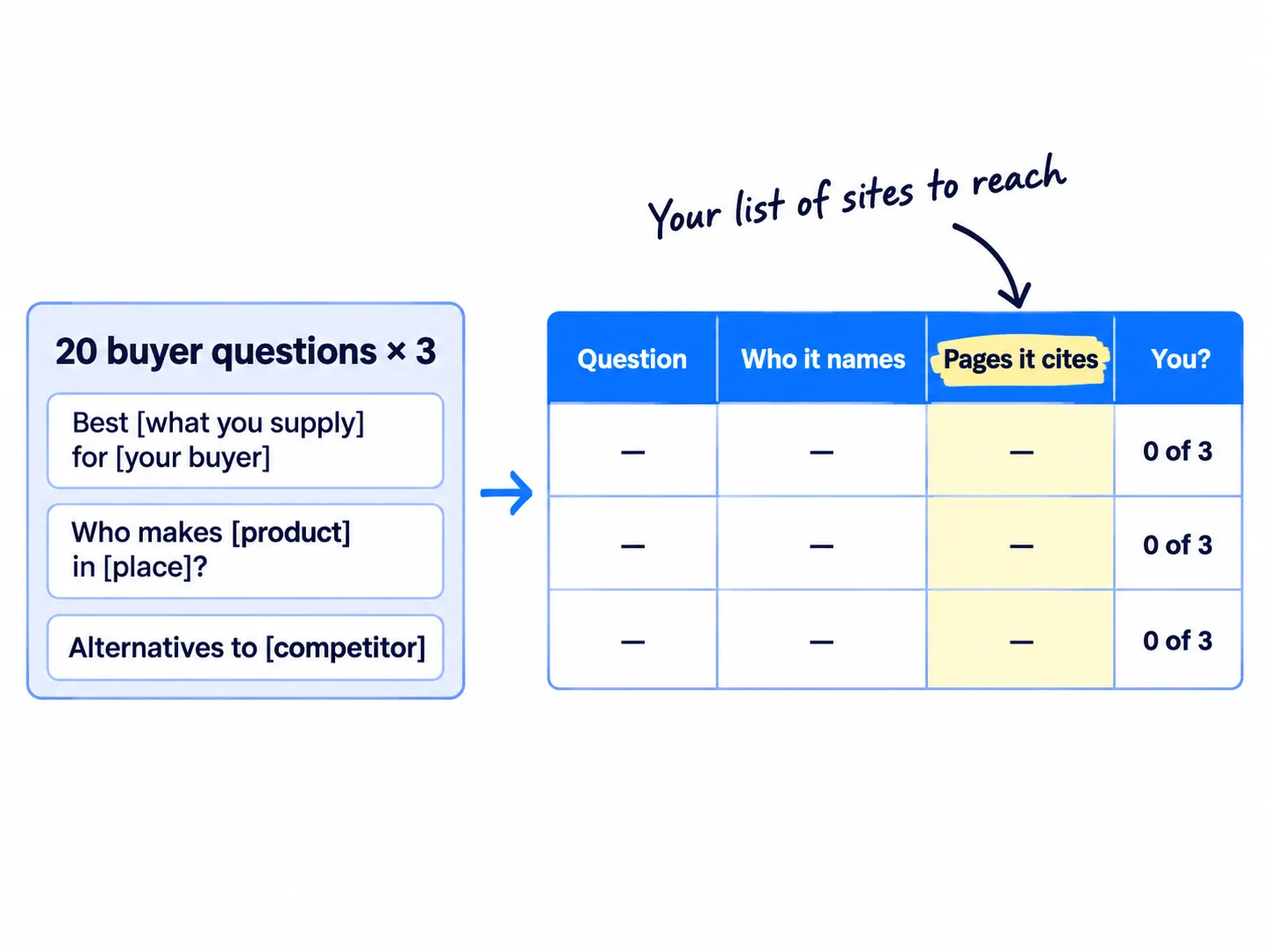
ChatGPT does not keep a list of suppliers. When a buyer asks, ChatGPT search turns the question into several shorter searches, sends them to outside search providers, reads the pages that come back, and names the companies those pages describe best. It may also use the buyer's rough location. So the pages it cites are the pages you need to be on.
Write 20 questions in your buyers' words. Use the words your clients used on their first call, and these shapes:
Best [what you supply] for [your kind of buyer]
Who makes [product or service] for [your kind of buyer]?
[What you supply] with a low minimum order
[What you supply] in [your region or country]
Alternatives to [a competitor your buyers know]
How do I choose a [what you supply] supplier?
[What you supply] that can deliver in [your lead time]
[What you supply] with [a certification or standard your buyers ask for]
Use each shape 2 or 3 times with different details, to reach 20. Add a place and a size where your buyers would ("for a café brand in Ohio", "for a 20-person firm"). Write down which of the 20 sound most like your best client's first question. Those are the 5 to watch most closely.
Then ask each question 3 times. Open ChatGPT, start a Temporary chat, and choose "Unpersonalized", so your own past chats and memories do not change the answer. Ask the question, then open "Sources" under the answer and copy every page it lists. Start a new Temporary chat for each run. Ask 3 times because the list changes almost every time: in a January 2026 study by SparkToro and Gumshoe, AI tools gave the same list of brands less than 1 time in 100. If an answer shows no sources, ask again and start with "Search the web:".
Give ChatGPT or Claude your 60 answers and ask it to fill the sheet: one row per answer, with the companies named and the pages cited. Check each row against the answer yourself. This list of names is also your real competitor list, because these are the companies your buyers hear about first.
- Tool: ChatGPT and a Google Sheet.
- Time: about 2 hours.
- You will have: 60 answers in a sheet, a count of how many name you, and a list of every page ChatGPT cited, with how often.
- It worked if: every row has the names and at least one cited page, and you have at least 20 different cited pages. If you have fewer, make the questions more specific to who you sell to.
- Common mistake: asking one question once, in your own logged-in chat with memory on, and deciding from that one answer. The next answer will be different.
See it done: 4 of Carvelian's 20 questions
Carvelian Packaging is a made-up maker of custom printed boxes for small food and drink brands. One founder sells through calls, samples and quotes.
Carvelian's first run, 3 answers per question
| Question | Who ChatGPT named | Pages it cited | Carvelian named |
|---|---|---|---|
| Best custom printed boxes for a small food brand | Two large online box printers, one packaging marketplace | A "best custom box printers" list on a packaging blog, one printer's own page | 0 of 3 |
| Who makes printed boxes in short runs for food brands? | The same two printers, one regional printer | A small-business forum thread, a trade magazine article | 0 of 3 |
| Printed gift boxes for a hot sauce brand, low minimum | One online printer, one marketplace | A food-startup blog post on packaging costs | 0 of 3 |
| How do I choose a packaging supplier for my snack brand? | No companies, a checklist | A food-startup blog post, a trade association guide | 0 of 3 |
Why it works: The founder now knows which kinds of pages ChatGPT reads for his buyers' questions, so he knows where his name needs to be.
2. Let ChatGPT and Bing read your website
Check that nothing blocks ChatGPT's search crawler, that your key facts are in the page itself, and that your site is in Bing as well as Google. ChatGPT cannot recommend what it cannot read.
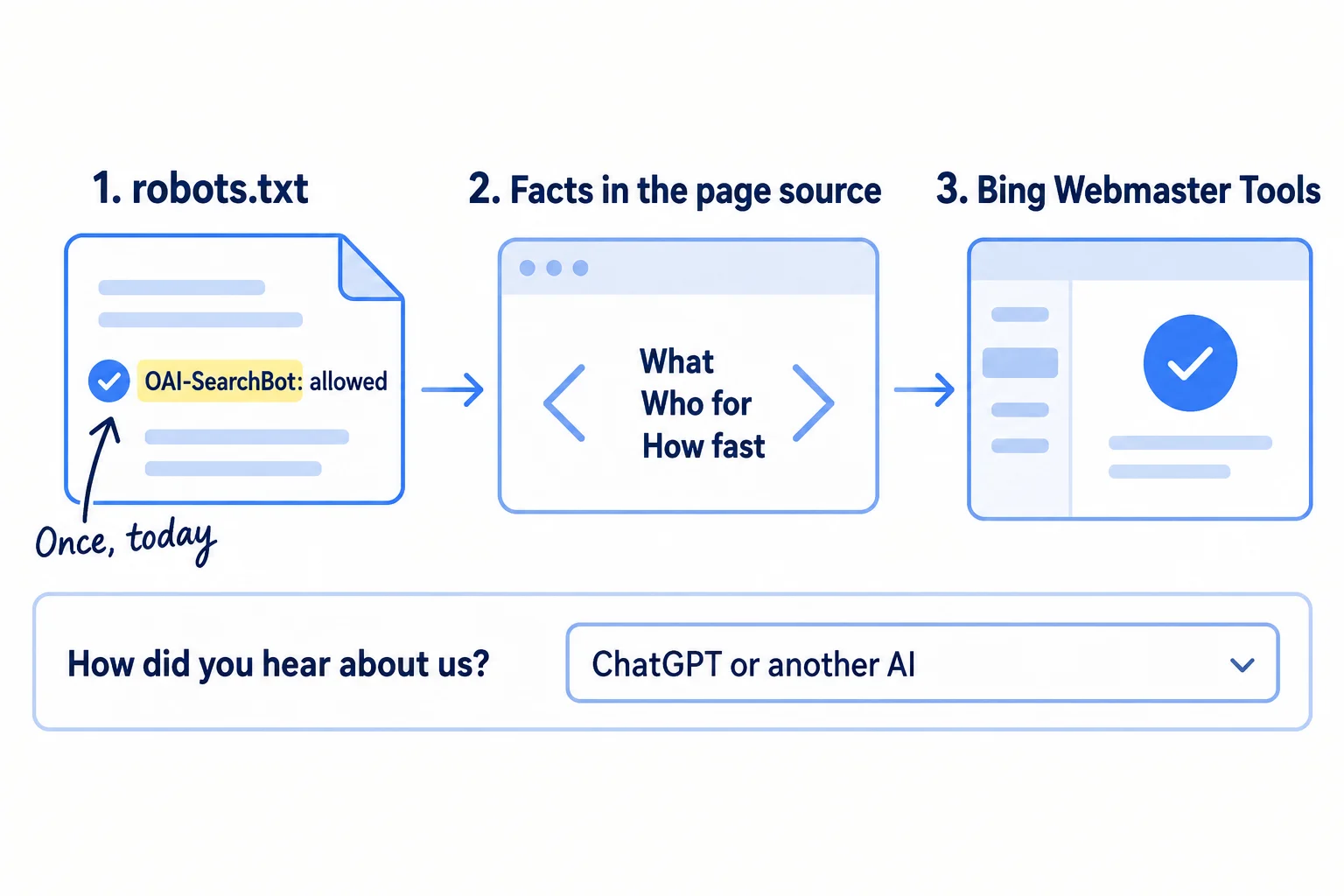
Do these five things once. Most take minutes, and they are on any technical SEO checklist.
- 1
Check your robots.txt
Open yoursite.com/robots.txt. If you see "User-agent: OAI-SearchBot" or "User-agent: *" followed by "Disallow: /", delete those lines. OpenAI says sites that block OAI-SearchBot "will not be shown in ChatGPT search answers". A change takes about 24 hours to reach ChatGPT.
- 2
Check Cloudflare, if your site uses it
Cloudflare changed its AI crawler settings in July and September 2026. Open your domain's Security settings, find the AI crawler setting, and check that search crawlers are allowed. Leave AI training unblocked too unless you have a reason: Cloudflare says blocking training also affects crawlers that do both jobs, such as Bingbot.
- 3
Check your facts are in the page source
Open your homepage, right-click and choose "View page source". Search for the words that say what you supply and for whom. If they are missing there but show on the page, your site builds them with JavaScript, and AI crawlers do not run it: Vercel's 2024 study found none of OpenAI's crawlers did. Ask whoever built the site to put that text in the page itself.
- 4
Add your site to Bing Webmaster Tools
OpenAI says ChatGPT search sends questions to outside search providers, so be in more than Google. Sign in to Bing Webmaster Tools, open My Sites, click "Import", sign in with your Google Search Console account and pick your site. It is verified at once, it is free, and its AI Performance report shows how often Bing's AI answers cite your pages.
- 5
Ask every enquiry where they heard about you
Add "How did you hear about us?" to your enquiry form, with "ChatGPT or another AI" as one answer. This is self-reported attribution, and it is the simplest way to know when an AI answer sent you a buyer.
Skip llms.txt and schema markup for now. OpenAI's pages on its crawlers and on ChatGPT search do not mention either one, and Google says its AI features need no special files or markup. Spend the time on steps 3 to 6.
- Tool: your site editor, Cloudflare if you use it, Bing Webmaster Tools and Google Search Console. All free.
- Time: about 45 minutes.
- You will have: a site ChatGPT's crawler may read, facts it can see without JavaScript, your site in Bing, and a form that records AI enquiries.
- It worked if: robots.txt has no block for OAI-SearchBot or for all crawlers, your "what we supply" words appear in the page source, and Bing Webmaster Tools shows your sitemap as submitted.
- Common mistake: switching on an "AI bots" block in a site builder or Cloudflare to stop AI training, and blocking search answers at the same time. More on this is in getting a new site found.
3. Write your supplier facts once and use them on your site and every profile
Write down, in plain words, what you supply, who it is for, your minimum order, how fast you deliver, where you deliver, and one piece of proof. Put the same words on one page of your site, at the top of your homepage, and on every profile buyers check. AI tools name the companies they can describe with confidence, and they cannot describe "quality solutions for every industry".
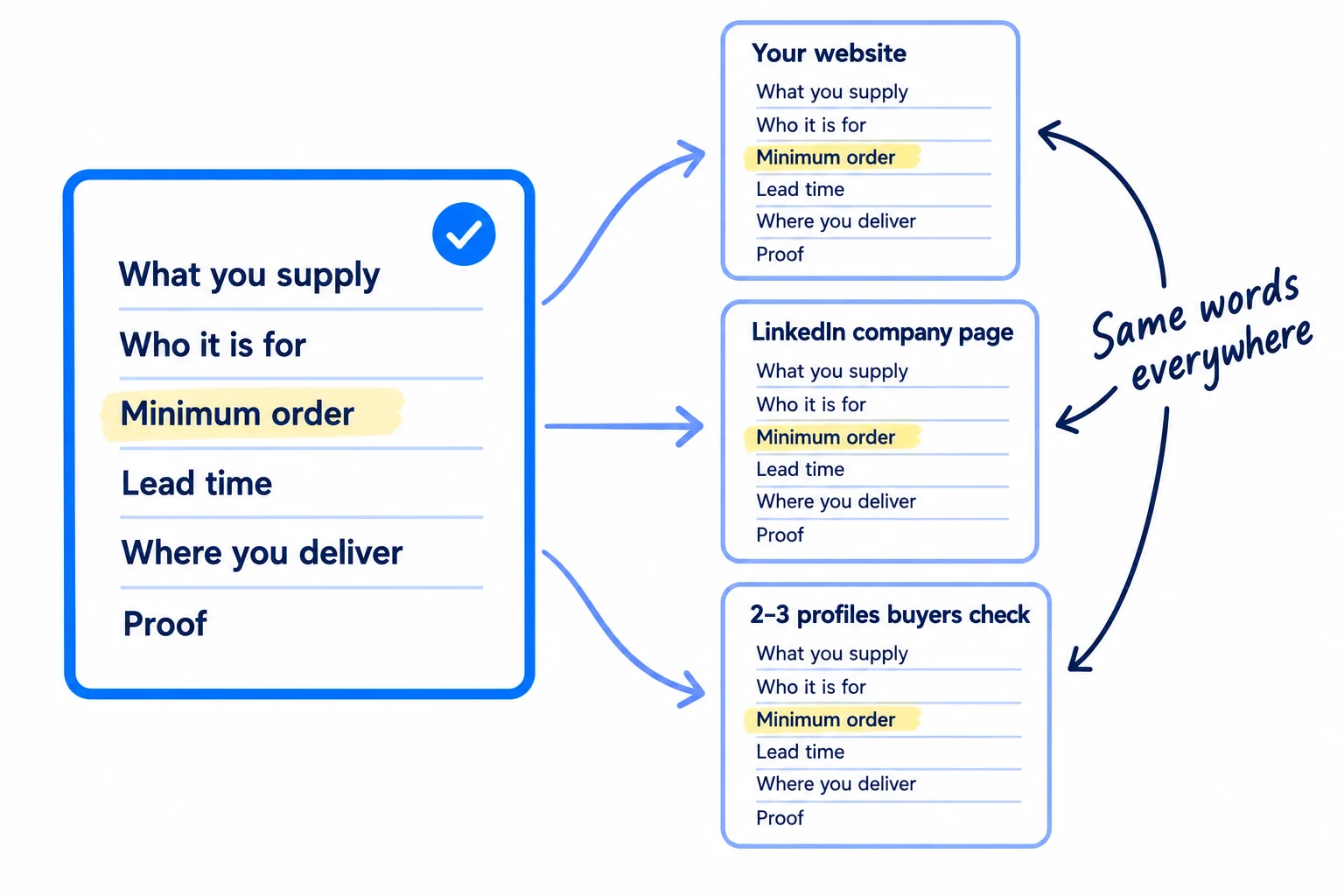
Buyers notice details, not brand names. In a Semrush survey of 622 US B2B professionals in spring 2026, a vendor caught their eye in an AI answer when it matched their use case (53%) or had a clear, detailed description (50%). Only 7% noticed a vendor because they knew the brand. Most (71%) then visited the vendor's website to check.
Fill in this block. Give ChatGPT or Claude your website and your last 3 quotes, and ask it to fill in a first draft. Then correct every line yourself. Each line must be true today.
What we supply: [product or service, in the words buyers use]
Who it is for: [kind of company, its size, the moment it needs you]
Minimum order or smallest project: [number, unit]
Lead time: [how long from order or approval to delivery]
Where we deliver or work: [countries, regions or "remote"]
Price guide: [a starting price, a range, or "quote in 1 working day"]
Certifications and standards: [only the ones you hold]
Proof: [one client result, with permission, or "[number] orders for [kind of company]"]
For the proof line, ask one client for a one-line testimonial you may quote. Then put the block in three places:
- One page on your site, called something like "[What you supply] for [who it is for]", with the block at the top, then more detail and photos. Link it from your homepage. Put the first two lines in your homepage headline area, so your value proposition and these facts say the same thing.
- Your LinkedIn company page. Use the same "what" and "who for" in the tagline and the same block in "About". Do the same on your own LinkedIn profile.
- The 2 or 3 profiles your buyers check. Pick by what you sell:
- Services (consulting, IT, design, agency work): make a free Basic profile on Clutch at clutch.co/get-listed. Clutch lists only companies that serve other businesses.
- Physical products made or distributed in North America: claim your free company profile on Thomasnet, at business.thomasnet.com, and add your company to any trade association member list you belong to.
- Software: set up your profile on G2. In G2's March 2026 survey of 1,076 software buyers, 45% said review-site citations were what made an AI answer most believable.
- Buyers visit you, or you serve one area: also set up a Google Business Profile with the same facts.
Use the exact same company name, address, phone number and description everywhere. If an old profile has a different address or a service you dropped, fix it today.
- Tool: a Google Doc for the block, your site editor, LinkedIn, and the free profiles above.
- Time: about 3 hours.
- You will have: one facts block, live on one page of your site, at the top of your homepage, on LinkedIn and on 2 or 3 profiles.
- It worked if: the same eight facts are on your site and every profile, with no number different, and a stranger shown your page for 30 seconds can say what you supply, who it is for, your minimum and how fast you deliver.
- Common mistake: a description that fits any company ("innovative solutions for every industry"), or a minimum order on one site and a different one on another. Pick one, and change it everywhere at once.
See it done: Carvelian's supplier facts
Carvelian Packaging, supplier facts
| Fact | Carvelian's line |
|---|---|
| What we supply | Custom printed boxes and gift-set boxes, in short runs |
| Who it is for | Small food and drink brands that have just got into shops or cafés |
| Minimum order | 250 boxes |
| Lead time | Ready 4 weeks after you approve the proof |
| Price guide | Quote in 1 working day from your size and quantity |
| Proof | Gift-set boxes for 2 food brands in their first shops |
Why it works: Every line answers a question a buyer types, with a number, so an AI answer can repeat it without guessing.
4. Publish one page a day that answers a buyer's supplier question
Every day, publish one page on your site that fully answers one question from your step 1 list, or one of the shorter searches ChatGPT turns it into. A page that answers the exact question with real numbers is a page an AI answer can quote.
![A stack of pages, one a day. The top page is titled '[Question your buyer asks]' and has four parts: the answer in the first two lines, a short list, a table, and an FAQ. A note says: real numbers, not 'contact us'.](/academy/illustrations/how-to-get-your-company-recommended-by-chatgpt-as-a-supplier/05-step-4.webp)
Pick the next question from your sheet. Start with the 5 you marked in step 1, then the rest, then new ones from your sales calls and keyword research. Good pages for suppliers:
- "[What you supply] for [use case]": one page per kind of buyer or job, such as "printed boxes for hot sauce gift sets".
- "How to choose a [what you supply] supplier": the checklist a buyer should use, honest about when you are not the right fit.
- "[What you supply] costs in [year]": real price ranges by quantity, from your own quotes.
- "[Competitor] alternatives": a fair comparison page for the names ChatGPT gave in step 1.
Put the answer in the first two lines. Then add a short list, a table with real numbers, and 3 to 5 questions at the end. In a May 2026 study of 40 software questions asked 10 times each, every page ChatGPT cited used a list, 68% had a comparison table and 56% had an FAQ. It was a small study of software only, but the shape is easy to copy.
AI makes one a day possible. Give ChatGPT or Claude the question, your facts block, and notes from your sales calls, and ask for a first draft. Then spend your hour on what only you know: a real photo, a price range from your quotes, a mistake you have seen buyers make. Google treats many pages made only to rank as spam, whether a person or AI wrote them. A page that answers one real question with your own numbers is not that. Writing a page that ranks goes deeper.
After you publish, open URL Inspection in Search Console and click "Request indexing", so it gets indexed sooner. The same pages help you show up in Google's AI Overviews.
- Tool: your site editor, ChatGPT or Claude to draft, and Google Search Console.
- Time: about 1 hour a page.
- You will have: 28 new pages in 4 weeks and 84 by month 3, each answering one buyer question.
- It worked if: URL Inspection shows "URL is on Google" within 1 to 2 weeks of publishing, and by month 3 Bing's AI Performance report shows at least one citation. Judge it like search, at month 3, not week 2.
- Common mistake: publishing 30 AI pages in one day, then nothing, or writing about your company ("our story", "our values") instead of the buyer's question.
5. Ask 100 people a day to mention you on the pages ChatGPT reads
Send 100 personal messages a day to the people who can put your company's name on the pages AI answers read: the writers of the pages ChatGPT cited, trade editors, businesses that serve the same buyers, and your clients. Ask each one for one specific thing.
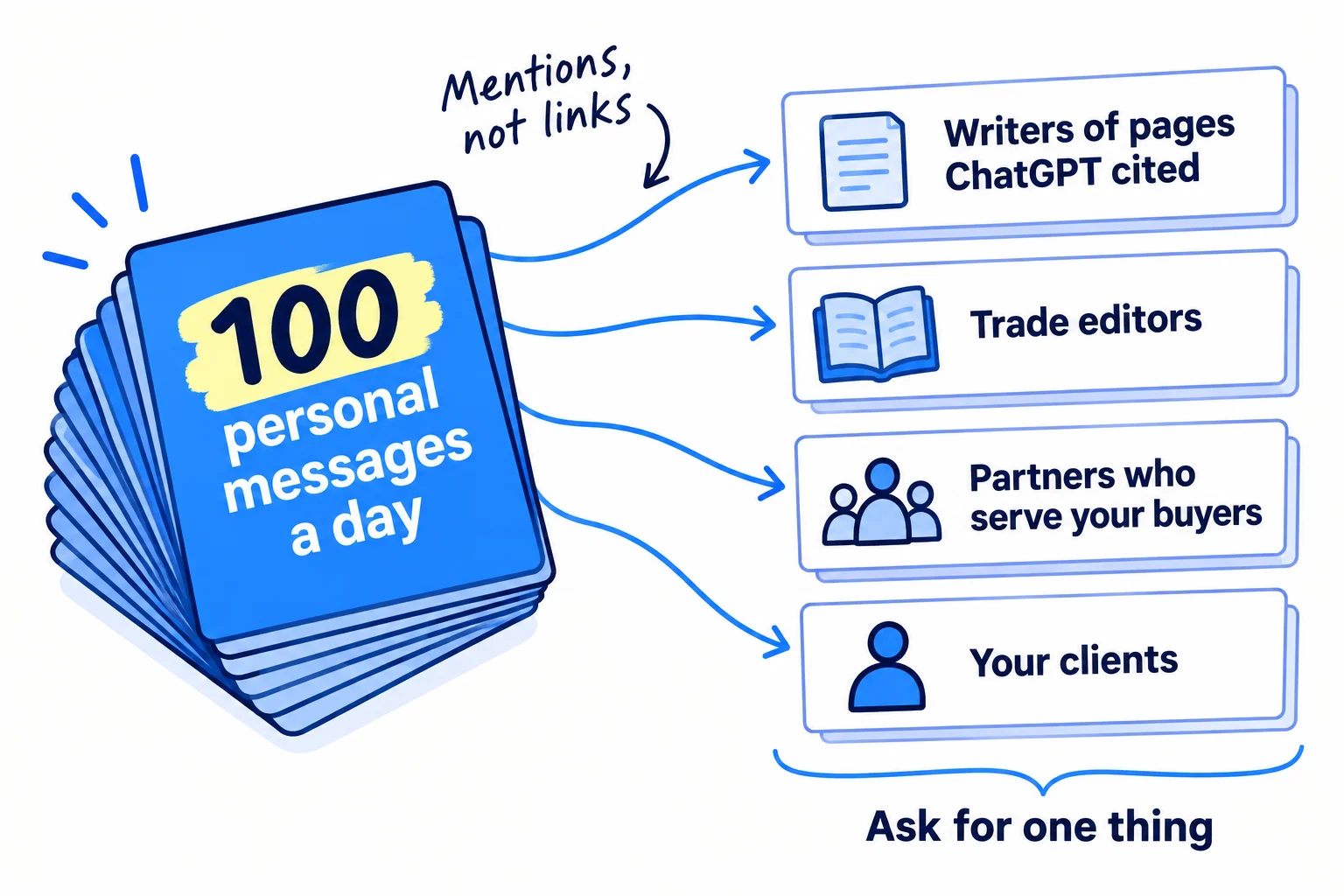
Other sites matter more than your own. In that May 2026 study, 88% of the pages ChatGPT cited when it recommended a tool were on someone else's site. And in Ahrefs' December 2025 study of 75,000 brands, the brands ChatGPT named most were the ones other websites and YouTube videos mentioned most. Links mattered much less. That is a pattern, not proof, but it points at the same work: more people writing your name next to what you supply.
Message four groups, in this order:
- The writers of the pages ChatGPT cited in step 1, and of similar pages Google shows for the same questions. Offer something that makes their page better: your real price range, a photo, a short expert quote. Getting onto "best of" lists covers this group in detail.
- Trade editors and writers for the magazines, newsletters and podcasts your buyers read. Offer one useful number or story from your work. Pitching journalists and getting booked on podcasts have the scripts.
- Businesses that serve the same buyers but do not compete with you: for a packaging maker, label designers, food photographers, co-packers. Ask to be named on their "suppliers we work with" page, and offer to name them on yours or promote each other. This is the start of a referral partnership.
- Your clients. Ask for a review on the profile from step 3, a line on their site ("boxes by …"), or a case study you write for them to approve.
100 a day empties a list fast, so add 100 new names a day. Take them from each Sunday's cited pages, from Google searches for your step 1 questions, and from the "about" and "partners" pages of companies that serve your buyers. A free lead list method works for the partner group.
These are cold emails, so the sending rules apply. Let AI draft. Paste 10 rows at a time into ChatGPT or Claude, each with one true thing about the person's page or business, plus the template below. Read each draft, make the first line true, then send it. That is about a minute a message. Send one at a time from your own email, or on LinkedIn to people you are connected to. If you email more than about 50 strangers a day, use a second domain and warm it up first. Every email needs SPF or DKIM set up on your domain. In the US, every message also needs your postal address and a way to say no. Follow up twice, 3 days apart, then stop.
Subject: [their page or publication]: [one useful thing you can add]Hi [first name],[One true line about their page, article or business.]I run [company]. We make [what you supply] for [who it is for], [one fact: minimum order, lead time or price range].[One specific ask: "Would you add us to your list of …", "Could I send you our real price ranges for your article on …", "Would you name us on your suppliers page? I'd name you on ours."][Your name], [company], [postal address]
Not for you? Reply "no" and I won't write again.
- Tool: your email and LinkedIn, ChatGPT or Claude to draft, and a Google Sheet to log who you asked, what you asked for and when to follow up.
- Time: about 1 hour 30 minutes for the messages and 45 minutes to find 100 new names. About 2 hours 15 minutes a day.
- You will have: 700 requests sent in week 1 and 8,400 by month 3, each logged.
- It worked if: at least 1 new mention goes live for every 200 messages. If you have 2 or fewer after 1,000 messages, rewrite the first line and the offer so they help the reader of that page, then send the next 100.
- Common mistake: asking only for a link, or paying for a place on a "best of" list. Ask to be named, with your facts, and never pay for a place that is not marked as paid.
See it done: Carvelian's message to a cited writer
To: Nora, who writes a blog for food-startup founders
Subject: Your packaging-costs post: real short-run prices
Hi Nora,
Your post on packaging costs for new snack brands came up when I asked ChatGPT how small brands should pick a box supplier. The checklist at the end is the clearest I've seen.
I run Carvelian Packaging. We make custom printed boxes for small food and drink brands, from 250 boxes, ready 4 weeks after the proof.
Could I send you our real price ranges for 250, 500 and 1,000 boxes for that post? If it helps, you could name us as one short-run option.
Dan, Carvelian Packaging, [postal address] Not for you? Reply "no" and I won't write again.
Why it works: It offers real numbers that make her article better, and asks for one small, clear change.
6. Post on LinkedIn twice a day and answer 20 buyer questions where they ask
Post twice a day on LinkedIn from your own profile, and answer 20 questions a day from buyers in 5 online places. AI answers quote LinkedIn posts and forum threads, so each useful post or answer is one more page that says what you supply.
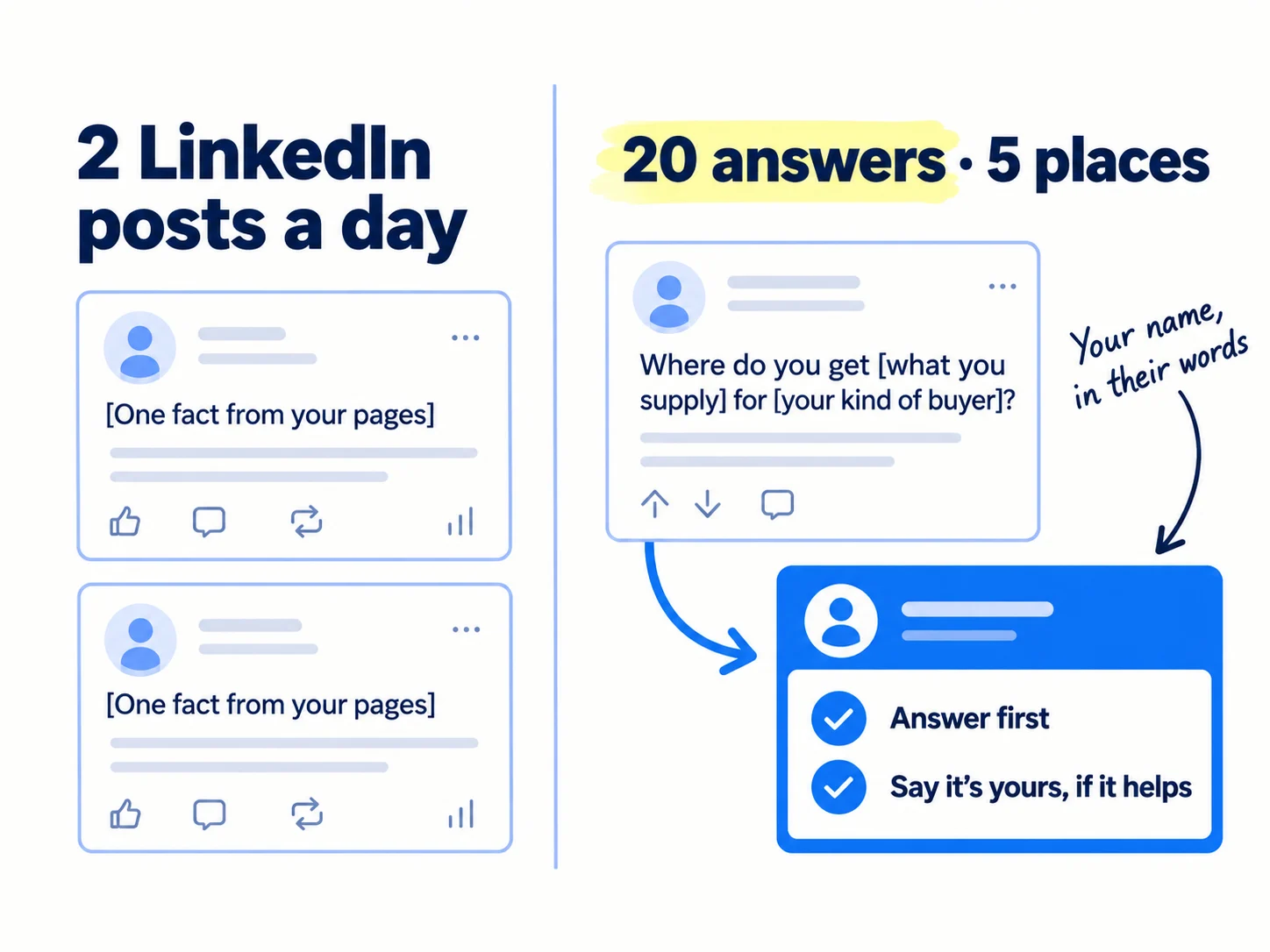
LinkedIn. In a March 2026 study by Profound, LinkedIn was the site AI tools cited most for work and business questions, and posts by people were cited more than company pages. So post from your own profile, twice a day. Each post is one fact, answer or mistake from your pages: a price range, a checklist, a question a buyer asked this week. Give ChatGPT or Claude yesterday's page and ask for 4 short posts in your voice; then add one true line from your own week. B2B post ideas has 50 more starting points.
Answers. Pick 5 places where your buyers ask for help: a subreddit, a LinkedIn or Facebook group, a trade forum, a Slack group. Read each place's rules on self-promotion first. Search each one for "supplier", "recommend", "who makes" and your product, sorted by new. Answer 20 a day across the 5 places, so no single place sees more than 4 from you. Answer the question fully; mention your company only if it truly fits, and say it is yours. Write the answer yourself: AI can find the threads and list the points, but many communities remove AI-written replies. Promoting on Reddit without getting banned has the rules that matter there.
If you can talk on camera, add video. In Ahrefs' study, YouTube mentions went with being named by ChatGPT more than any other signal. Turn one page a week into a short YouTube video that says your facts out loud.
- Tool: LinkedIn, the search box on each of your 5 places, and ChatGPT or Claude to draft posts.
- Time: about 30 minutes for 2 posts and 1 hour for 20 answers. About 1 hour 30 minutes a day.
- You will have: 14 posts and 140 answers a week under your own name, each saying what you supply in plain words.
- It worked if: after 4 weeks, at least 3 enquiries or calls say they saw you on LinkedIn or in a thread, and some of your posts or threads start to appear in the Sunday "pages it cites" column.
- Common mistake: posting only from the company page, or putting your link in every answer. Moderators remove those, and buyers stop reading.
See it done: Carvelian's answer in a forum
Asked in a forum for small food brand founders
“Where do you get printed boxes when you only need a few hundred? Big printers want 5,000.”
The reply
Ask for "short-run digital print". Most big printers quote offset print, which only pays above a few thousand boxes. For a few hundred, ask three things: the minimum order, the lead time after you approve the proof, and whether a printed sample is included. Get the box size right with a plain sample first, because a reprint costs more than the order. Disclosure: I run a short-run box printer, happy to share prices if useful.
Why it works: It answers the question fully without the product, then says openly that the founder makes boxes.
7. Ask the same 20 questions every Sunday and count enquiries from AI
Every Sunday, ask ChatGPT your 20 questions again, 3 times each, in the same way as step 1. Count how many of the 60 answers name you, and how many enquiries said they found you through ChatGPT. Do not track a "rank": the order changes almost every time.
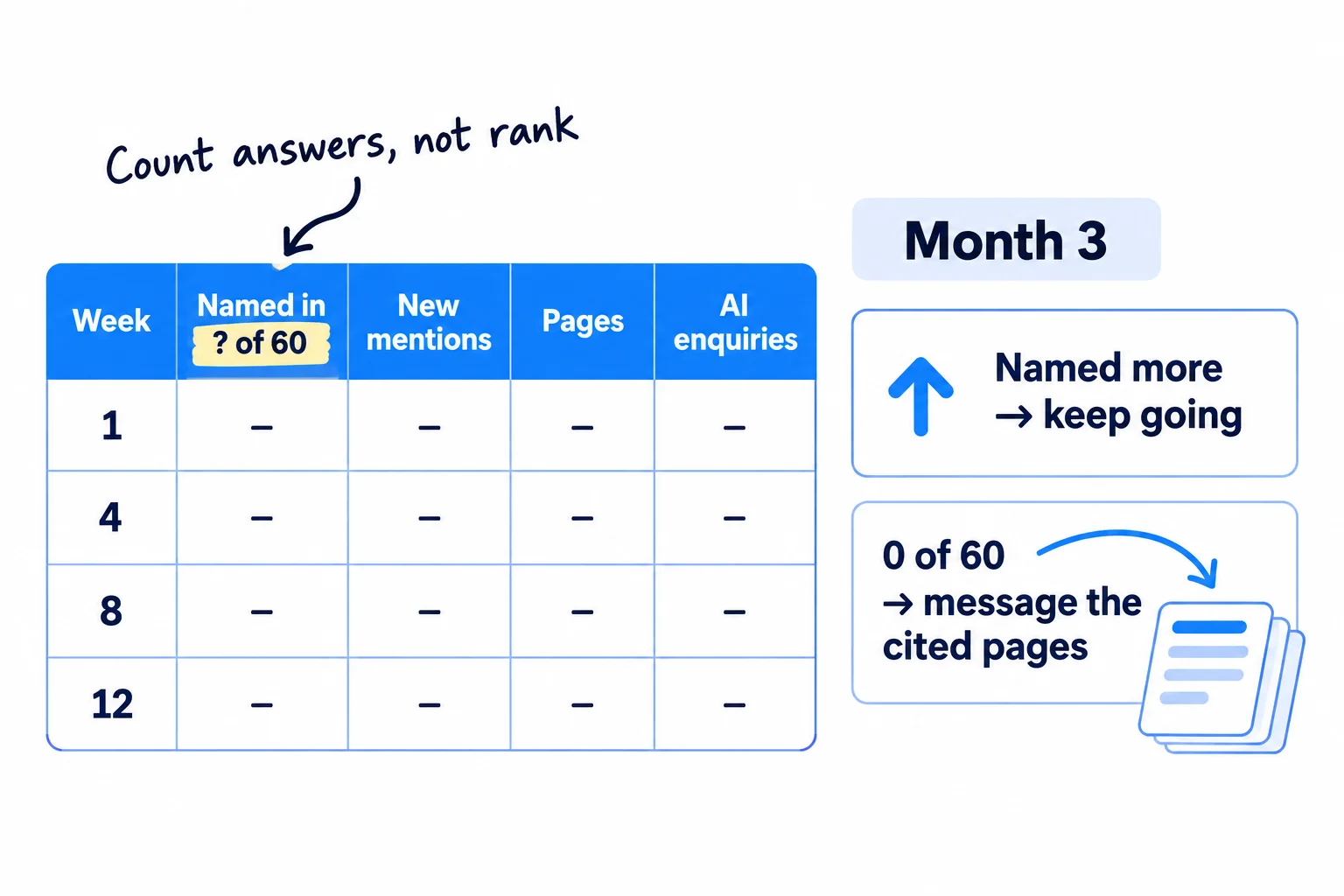
Each Sunday, fill in one row:
Week | Answers naming you (of 60) | Your 5 main questions (of 15) | New mentions live | Pages published | Messages sent | Enquiries: ChatGPT or other AI | Enquiries: other
New cited pages this week: [list them, then add them to the step 5 list]
Add two more numbers when you have them: citations in Bing Webmaster Tools' AI Performance report, and visits from chatgpt.com in your analytics. Tracking AI traffic and ChatGPT mentions shows where to find them, and tag the links you share with UTM parameters so you can tell them apart.
Fix wrong facts the same week. If an answer gets your minimum, location or services wrong, find the page it cites, ask that site to correct it, and check that your own page and profiles say the right thing. G2 found that 64% of software buyers see wrong AI recommendations often, so expect some.
Decide at month 3, after 84 pages and 8,400 messages:
-
If the answers name you more than in week 1, or AI enquiries have started: keep all of it, and add 5 new questions from your sales calls.
-
If ChatGPT names you in 0 of 60 answers: look at the pages it cites now. If your name is on none of them, move one hour a day from posts to more messages to those exact pages. If your name is on them but it still does not name you, check step 2 again and make your facts page more specific.
-
If AI brings visits but no enquiries: the problem is the page they land on. Turning B2B website visits into enquiries is next.
-
Tool: ChatGPT, Bing Webmaster Tools, your analytics, and your Google Sheet.
-
Time: about 1 hour 45 minutes each Sunday.
-
You will have: one row a week, and a clear answer on whether ChatGPT names you more and whether it brings enquiries.
-
It worked if: you can say how many of the 60 answers named you this week and where every enquiry came from. Bring the row to your monthly marketing review, next to your SEO numbers.
-
Common mistake: checking once, seeing nothing, and stopping in week 2, or paying for a tool that reports one "position" in ChatGPT. Count how often you are named across many answers.
See it done: Carvelian after 12 weeks
Carvelian's Sunday sheet, weeks 1 to 12
| Week | Answers naming Carvelian (of 60) | New mentions live (total) | Pages published (total) | Messages sent (total) | Enquiries from ChatGPT or other AI |
|---|---|---|---|---|---|
| 1 | 0 | 2 | 7 | 700 | 0 |
| 4 | 0 | 14 | 28 | 2,800 | 0 |
| 8 | 3 | 29 | 56 | 5,600 | 1 |
| 12 | 7 | 45 | 84 | 8,400 | 2 |
The decision: ChatGPT now names Carvelian in 7 of 60 answers, mostly for the short-run questions, and 2 buyers said they found it there. So the founder keeps all of it and adds 5 new questions from his sales calls.
Why it works: The founder judges by answers that name him and real enquiries, and keeps sending messages to the pages ChatGPT cites.
Where Scout7 helps
Scout7 speeds up steps 1, 2, 4, 6 and 7. Steps 3 and 5, your profiles and your messages, stay with you.
Steps 1 and 7. AI question coverage collects the questions real buyers ask AI assistants in your category and shows who answers them today on Google and in AI answers. Scout7's competitor set shows which competitors win the AI answers you want, and by how much. That gives you the 20 questions and a weekly view of who is named.
Step 2. The search and AI audit crawls your site and scores its AI answer presence, with a fix list by page. It checks your robots.txt, llms.txt and structured data. You apply the fixes on your own site.
Step 4. Content Co-Pilot drafts each day's page from the question: it asks you shaping questions with recommended answers, then writes the article with sources, an FAQ and structured data. You answer the questions and approve the draft. It can publish to a Scout7-hosted blog on your own domain.
Step 6. Scout7 writes LinkedIn image posts in your voice and schedules them. Join Conversations finds live threads about your category and drafts a reply for each. You read every thread and approve or rewrite every post and reply. Nothing goes live without your approval.
Your checklist for getting recommended by ChatGPT as a supplier
0 of 18 done
Work through this list with an AI assistant
It drafts the work and keeps track of what is done.
Frequently asked questions
- Can I pay ChatGPT to recommend my company?
No. OpenAI says ads in ChatGPT run on separate systems and "do not influence the answers ChatGPT gives you". Ads are labelled as sponsored and shown apart from the answer. Be wary of anyone selling a guaranteed spot in ChatGPT's answers. What you can do is what this guide covers: clear facts, pages that answer buyers, and your name on the sites ChatGPT reads.
- How do I register or list my company on ChatGPT?
OpenAI's help pages describe no form that adds a company to ChatGPT's answers. ChatGPT search looks for pages through outside search providers and names the companies those pages describe. So "getting listed" means being clearly described on your own site and on other sites. If you sell physical products to shoppers, that is a different job, covered in getting your products recommended.
- ChatGPT says wrong things about my company. How do I fix it?
Open "Sources" under the wrong answer and see which page it used. Fix that fact on your own site and profiles first, so they all agree. Then ask the site that is wrong to correct it, with a link to your page. If no source is shown, make your facts page answer that exact question. Ask the same question again the next Sunday.
- How long does it take for ChatGPT to recommend my company?
There is no fixed time. Changes to robots.txt reach ChatGPT in about 24 hours, but new pages and mentions have to be found first. Judge it like SEO: at month 3, after about 84 pages and 8,400 messages. Until then, count the mentions that go live each week. They come before ChatGPT names you.
- Do I need llms.txt or schema markup to be recommended?
Not to start. OpenAI's pages on ChatGPT search do not mention either one, and Google says its AI features need no new files or special markup. Both are quick to add later. Adding llms.txt and schema markup shows how, in under an hour. Your facts page and your mentions on other sites come first.
Sources
- 1.How AI tools shape the B2B buying process: A survey of 600+ US business professionals — Semrush, 8 July 2026
- 2.New G2 Research: Half of B2B Software Buyers Now Start Their Research With AI Chatbots — G2, via PR Newswire, 15 April 2026
- 3.Searching the web with ChatGPT — OpenAI Help Center, checked 1 October 2026
- 4.Overview of OpenAI crawlers — OpenAI, checked 1 October 2026
- 5.Temporary chat in ChatGPT — OpenAI Help Center, checked 1 October 2026
- 6.Ads in ChatGPT — OpenAI Help Center, checked 1 October 2026
- 7.AI Recommendations Change With Nearly Every Query: SparkToro — Search Engine Journal, 30 January 2026
- 8.New options to manage AI traffic — Cloudflare, 1 July 2026
- 9.The rise of the AI crawler — Vercel, 17 December 2024
- 10.Introducing AI Performance in Bing Webmaster Tools (public preview) — Microsoft Bing, 10 February 2026
- 11.Top Brand Visibility Factors in ChatGPT, AI Mode, and AI Overviews (75k Brands Studied) — Ahrefs, 12 December 2025
- 12.B2B SaaS AI Citation Study: How ChatGPT Recommends Software — DerivateX, 31 May 2026
- 13.LinkedIn is the most-cited domain for professional queries in AI search — Profound, 9 March 2026
- 14.How do I get my company listed on Clutch? — Clutch Help Center, checked 1 October 2026
- 15.Claim your company — Thomas, checked 1 October 2026
Next article to read
How to write a case studyWrite the proof AI tools can quote when buyers ask who to use.Read it nextRelated guides
- How to get your brand mentioned by ChatGPTGet your brand mentioned by ChatGPT: find the exact pages it reads when your buyers ask for a tool, agency or supplier, get your name onto them every day with pages, answers, messages and short videos, and count how often you are named every Sunday.
- How to get more leads from a B2B websiteB2BComing soon
- How to get reviewed on ClutchComing soon
- How to get on the "best of" lists AI tools citeGet on the "best of" lists ChatGPT, Perplexity and Google AI cite: ask them 20 "best [what you sell]" questions and copy every list they use, publish a listing kit an author can use in 5 minutes, pitch 100 list authors a day until every list has heard from you, and count the lists and AI answers that name you every Sunday.
Guides that link here
- How to write a case study
- How to add llms.txt and schema markup
- How to get on the "best of" lists AI tools cite
- How to get your brand mentioned by ChatGPT
- How to show up in Google AI Overviews
- How to track AI traffic and ChatGPT mentions
- How to get your first B2B clientsB2B
- How to launch a B2B productB2B
- How to choose marketing channels for a B2B companyB2B
- How to do a competitor analysis
- How to market your B2B businessB2B
- How to price a B2B product or serviceB2B
- How to find keywords for SEO
- How to get backlinks from news websites
- How to rank on Google Maps
- How to set up a Google Business Profile
- How to write competitor comparison and alternative pages
- Technical SEO checklist for a new website
- LinkedIn post ideas for B2B companiesB2B
Cite this page
Dinesh Bypilla (2026). How to get your company recommended by ChatGPT as a supplier. Scout7 Academy. https://scout7.ai/academy/ai-search/how-to-get-your-company-recommended-by-chatgpt-as-a-supplier
Written by Dinesh Bypilla, Agentic systems engineer at Scout7. Reviewed by Murali Sid. Last checked 1 October 2026.
Quote any part of this guide with a link back to this page. © 2026 Scout7.
Markdown version of this page: https://scout7.ai/academy/ai-search/how-to-get-your-company-recommended-by-chatgpt-as-a-supplier.md