



How to write a case study
Write a case study with one or two customers: ask every customer today with three ways to be named, hold a 25-minute recorded interview, let AI draft one page from the transcript, get written approval, then send it in 100 personal messages and 2 posts a day and count the calls it brings every Sunday.
ByDinesh BypillaReviewed byMurali SidLast checked 18 min read
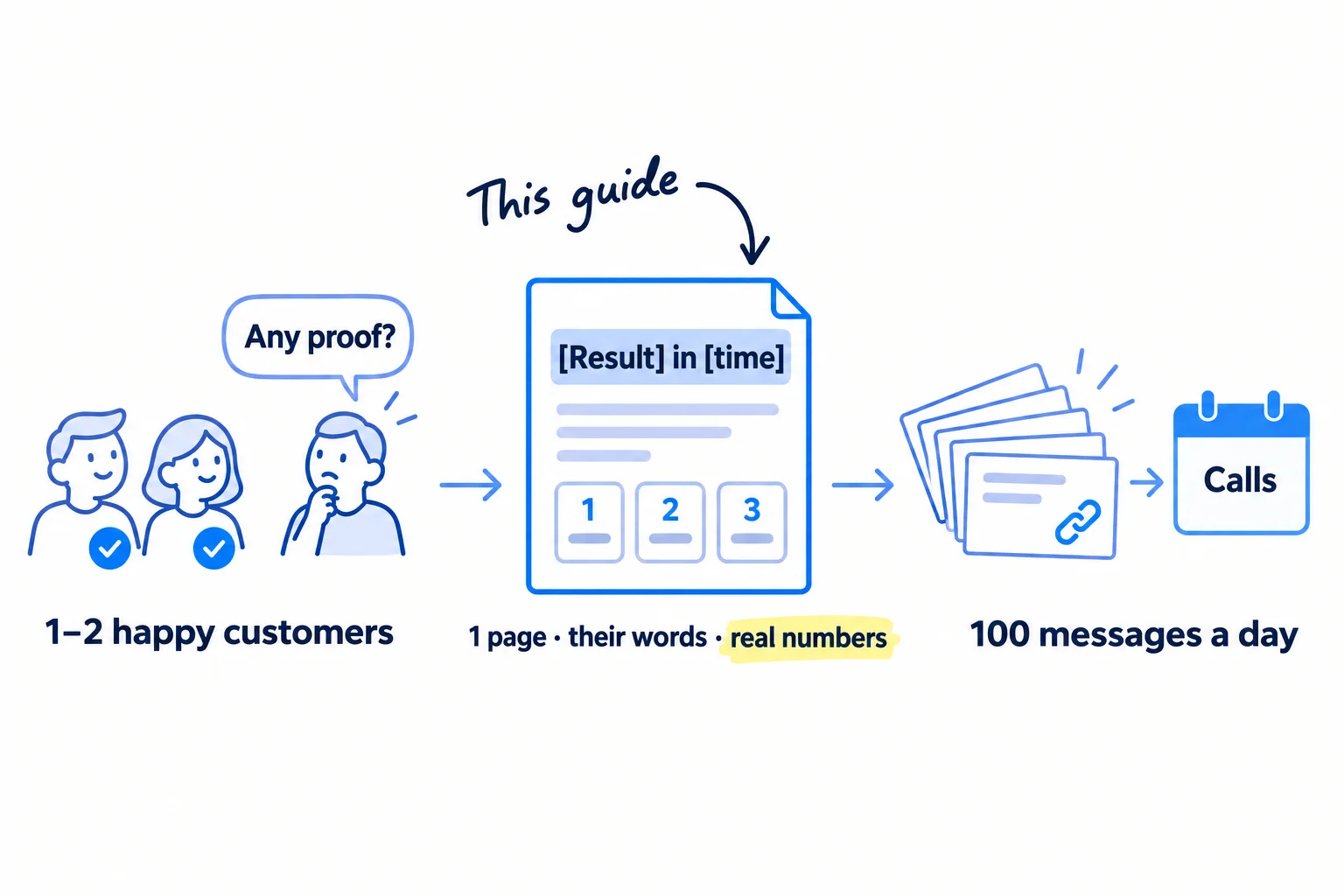
You have one or two happy customers, and a buyer has just asked you for proof. Here is how to write a case study for your business: a one-page story of one customer, with their numbers and their words, that you can send to the next buyer. Without one, a buyer who checks you out finds only what you say about yourself.
Do these three things
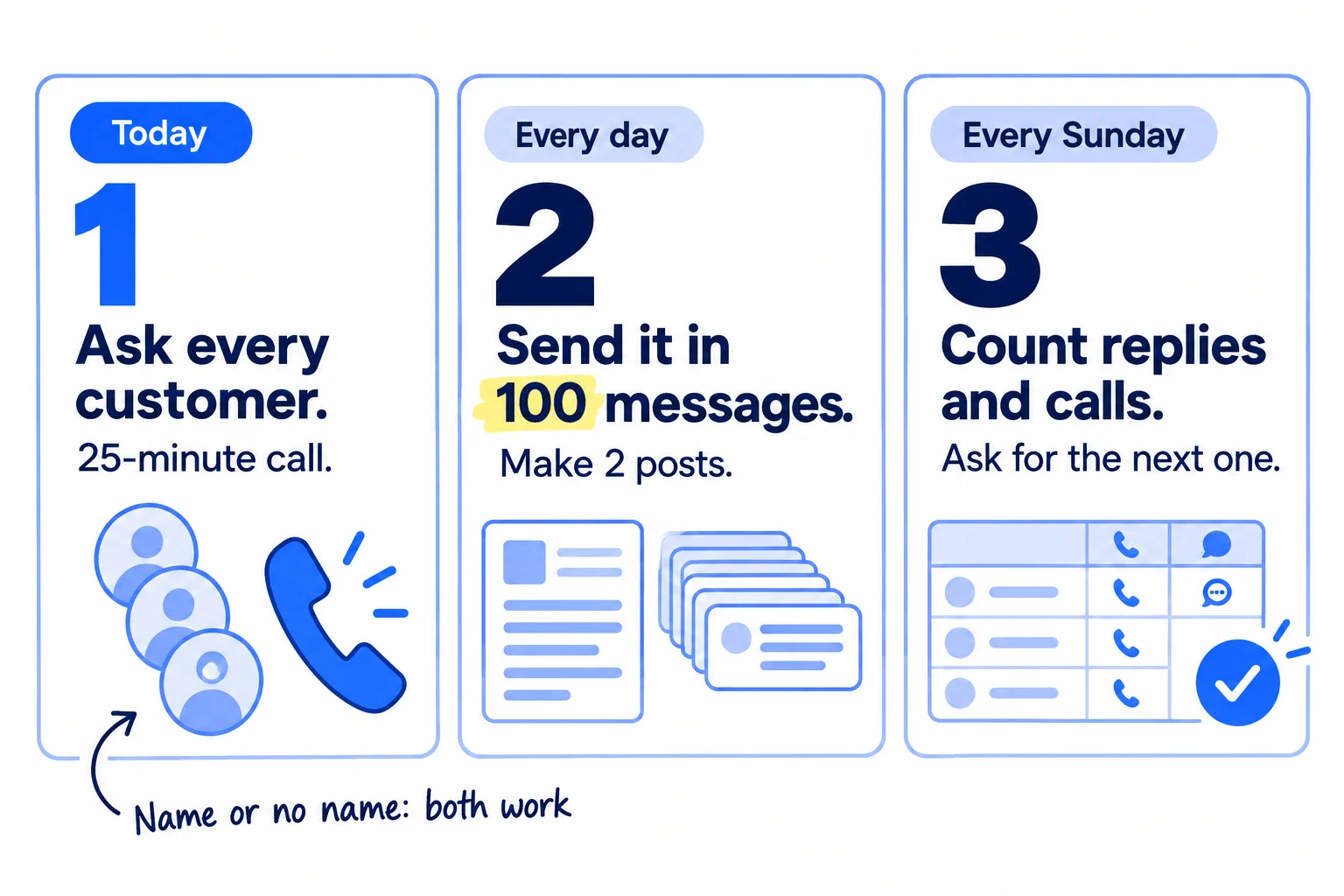
About 3 hours to write the first one, spread over a week while you wait for answers. Then 2 to 3 hours a day using it. Judge it after 1,400 messages.
Show the three actions in fullHide the full list
- Today: ask every customer, beta user and past client for a 25-minute call about their results. Offer to leave their name out, so "yes" is easy.
- Every day: once the customer has approved it, send the case study in 100 personal messages to buyers like them, and turn it into 2 posts.
- Every Sunday: count the replies and calls that mention it, and ask your newest customer for the next one.
Get help doing these
ChatGPT or Claude reads this guide and works through it with you.
1. Ask every customer for a case study today
Send a short ask to every customer who got a result, today: paying customers, beta users, past clients, even people you helped for free. Offer three ways to appear, so a "no name" is still a yes.
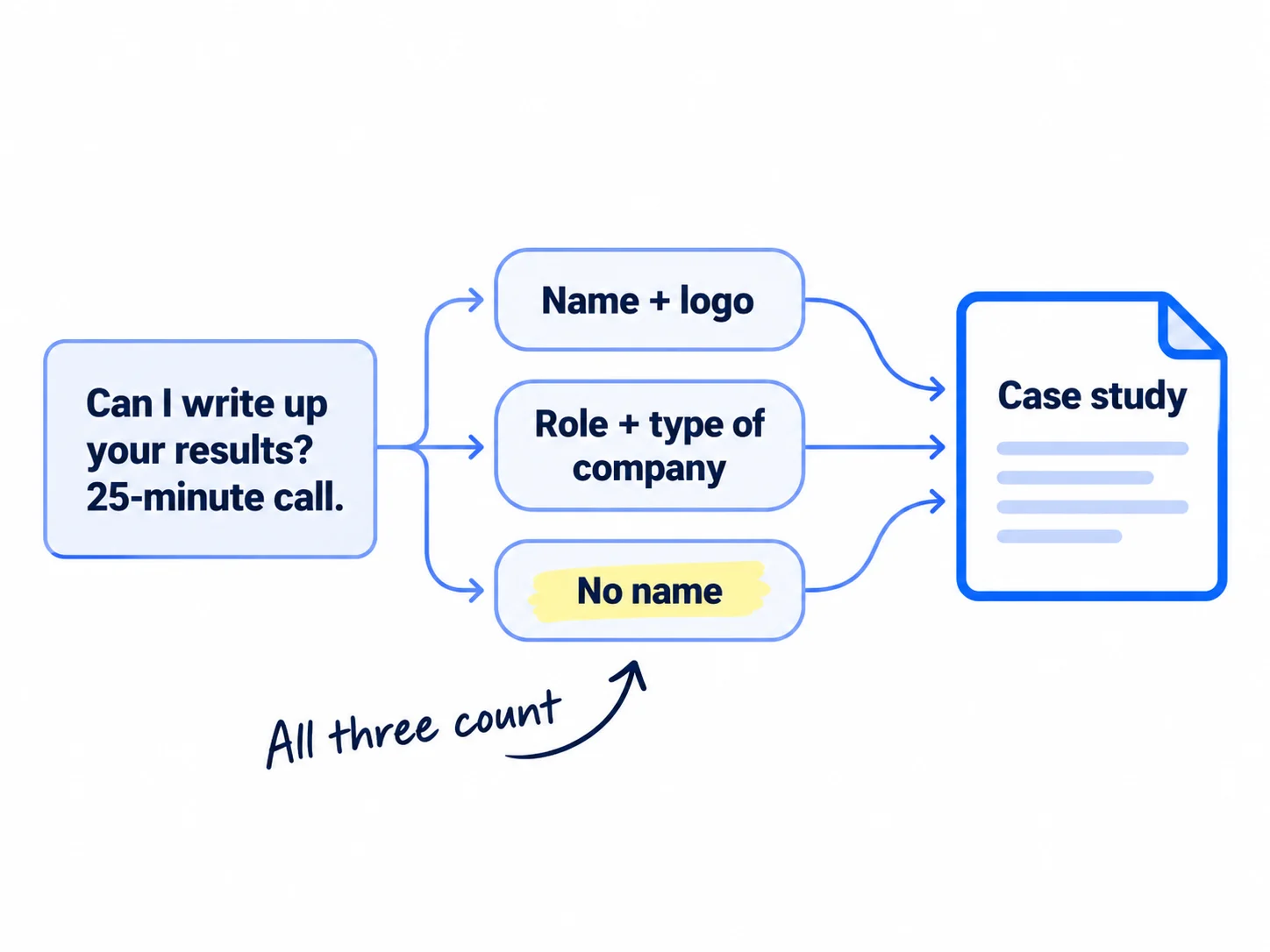
Most founders ask only their biggest customer, for their name and logo, and get a no. Ask everyone. With one or two customers, the whole list is a few names, so ask all of them now. Some will say no; you need one yes.
Who to ask first: the customer with the clearest before-and-after number, who looks most like the buyers you want next. A small company like your ideal customer beats a famous one that is nothing like them.
Give three choices in the ask:
- Name and logo: their company, their name and their photo.
- Role and type of company: "the founder of a 10-person accounting firm". No company name.
- No name: the same, with the numbers rounded.
Many companies cannot be named because of legal, PR or contract rules. A described, unnamed client with real numbers still shows a buyer that you solved a problem like theirs. Write your ask with ChatGPT or Claude if you like, but send each one yourself, by email or LinkedIn message, with one line about their result.
Subject: can I write up your results?Hi [first name],[One line about what changed for them, with a number if you have one.]I'd like to write a one-page case study about it, so other [kind of company] can see what worked. It takes one 25-minute call. I write it; you approve every word before anything goes live.You choose how you appear:
Your name and company
Your role and the type of company, no name
No name at all
Could we do the call this week or next? [Two time options.][Your name]
If you run an agency or sell B2B services: add one line to every new proposal or scope of work: "At the end of the first 3 months, we may write a short case study about the results. You approve the final text and choose whether you are named." It turns a hard ask later into a normal step now.
If you run a D2C store: ask the 5 customers who wrote you the warmest messages or reviews, and ask for a photo or a 20-second phone video too. A customer story with real photos does the job a case study does for a business buyer. It belongs on the product page, next to your user-generated content.
If you have no customers yet, you have three honest options: write up the results you got for your own business, write up work you did in a past job (say where it happened, and leave the employer's name out unless they agree), or run a small paid first project and write it up after. The full route is in getting agency clients without case studies. Never invent a client. Since 21 October 2024, the US Federal Trade Commission's rule bans fake or false testimonials, and courts can fine businesses that knowingly break it.
- Tool: your email or LinkedIn, and a Google Sheet with one row per customer: name, result, naming choice, answer.
- Time: 1 hour.
- You will have: every customer asked, and a sheet showing yes, no or no answer, with each one's naming choice.
- It worked if: at least 1 yes for every 5 people you asked. Follow up twice, 3 days apart, before you count a no.
- Common mistake: asking only for name and logo. The other mistake is waiting until you have "a big enough result". A small, true number from a customer like your buyer is enough.
See it done: Quillfox's case study ask
Quillfox is a made-up one-person agency. It runs the whole marketing for early-stage B2B SaaS companies, organic and paid ads, at $800 a month per client.
To: Marcus, founder of a 5-person SaaS company that sends appointment reminders for dental clinics
Subject: can I write up your results?
Hi Marcus,
Your trial signups from Google and LinkedIn went from 6 in June to 19 in September.
I'd like to write a one-page case study about it, so other small SaaS founders can see what worked. It takes one 25-minute call. I write it; you approve every word before anything goes live.
You choose how you appear:
- Your name and company
- Your role and the type of company, no name
- No name at all
Could we do the call Tuesday at 10 or Thursday at 3?
Jess
Why it works: It names the result first, keeps the ask to one short call, and lets him choose how he appears.
2. Pull the before-and-after numbers from your own records
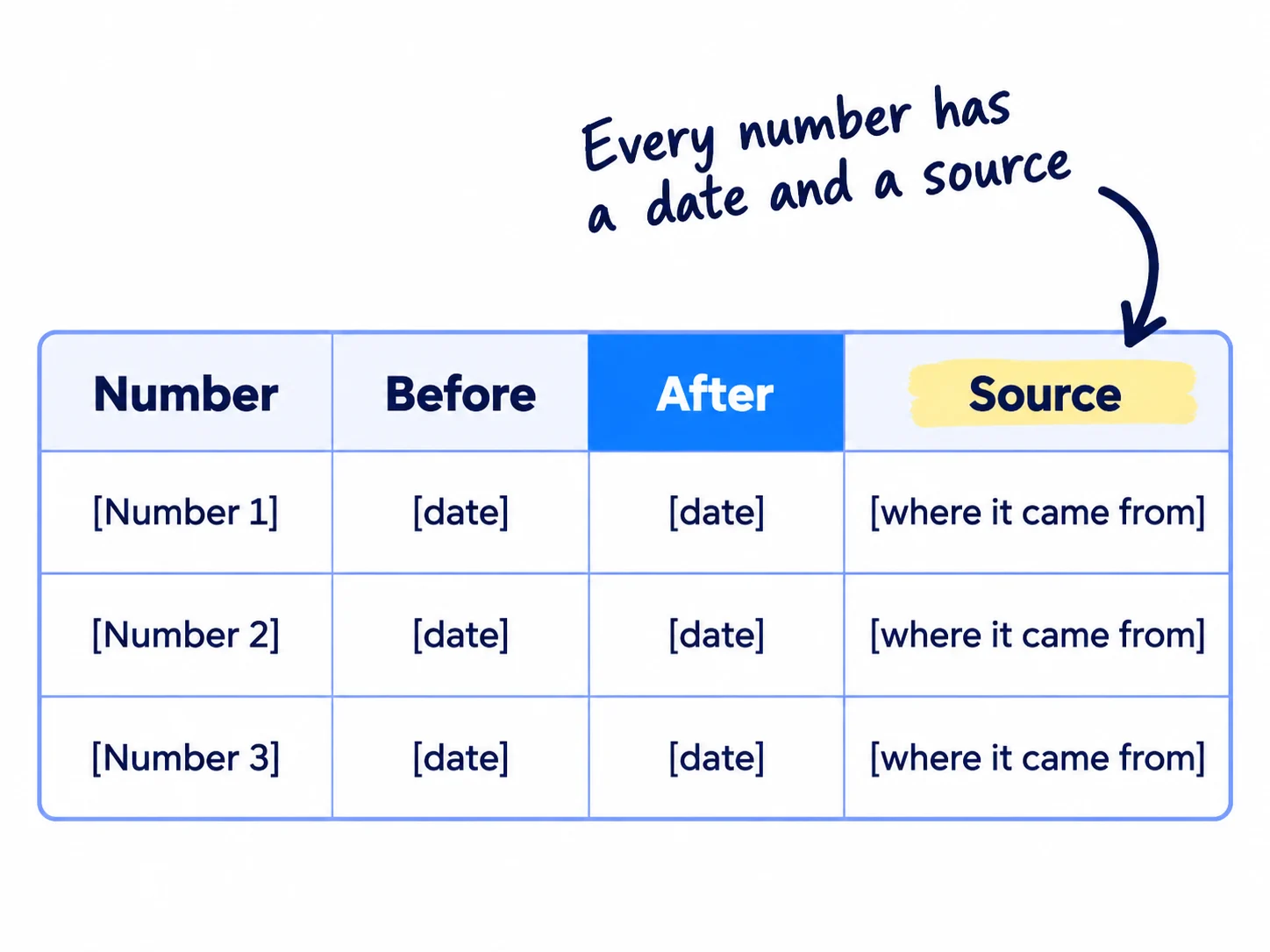
Before the call, write down 3 numbers that changed for this customer: what it was before, what it is now, and the dates. You hold most of them already, and having them ready keeps the call to 25 minutes.
Pick numbers your next buyer cares about: money, time, customers, signups, orders, enquiries. Leave out likes and impressions unless that is what the customer paid for. Use what you have:
- SaaS: their usage in your product, their activation date, the hours they say it saves, their plan and seats.
- B2B: the order or project dates, the cost, the time to deliver, errors or returns before and after, and enquiries won, from your invoices and emails.
- Agency: the client's Google Search Console, analytics and leads from Google from your monthly client reports.
- D2C: the customer's own words about the before and after, and what they ordered and reordered.
If you do not have a number, write the question down and ask for the customer's best estimate on the call. An honest "about 3 hours a week" is better than no number.
- Tool: your product's data, Search Console, your invoices, your sheet.
- Time: 45 minutes.
- You will have: 3 before-and-after numbers, each with dates and a source.
- It worked if: every number has a date and a place it came from, and you could show the customer where.
- Common mistake: a percent with no base. "Up 300%" from 1 to 4 looks like a trick. Write both numbers: "from 1 to 4 a month".
3. Interview the customer for 25 minutes with 8 questions
Hold a 25-minute video call, record it with their OK, and ask 8 questions about their before, their choice and their after. You want their words, not yours: the lines in their voice are what the next buyer believes.
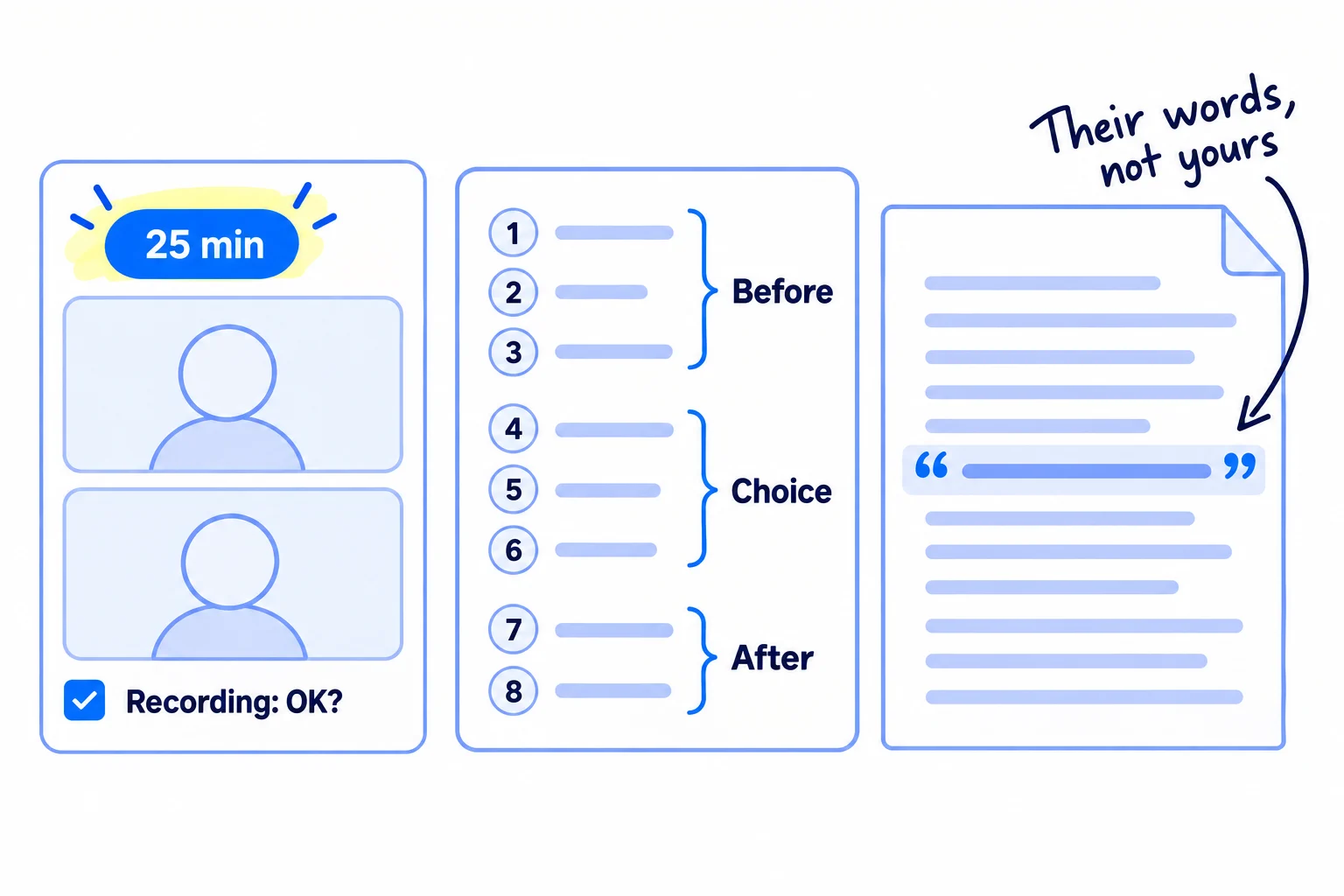
Start by asking, "Can I record this, so I quote you correctly?" Get the yes on the recording. Otter's free plan transcribes up to 30 minutes per conversation and 300 minutes a month, so a 25-minute call fits. Google Meet's own transcripts need a paid Google Workspace plan.
Ask these 8 questions. They are the same kind you ask in customer interviews: about real past events, not opinions.
Before
Walk me through what things looked like before we started. What was going wrong?
What did that cost you: time, money, customers?
What had you tried before, and why did it not work?
The choice
4. Why did you choose us? What almost stopped you?After
5. What changed, and when did you first notice it?
6. [Check your numbers:] I have [number] before and [number] now. Is that right?
7. What surprised you?
8. What would you tell someone in your position who is thinking about it?Close: Which of these can we say in public?
Let them talk. When they give a general answer, ask "Can you give me an example?" or "Roughly how many?" Do not pitch, and do not turn it into a demo. If they mention a problem with your product, write it down: it is feedback from a user worth acting on.
- Tool: Zoom or Google Meet, and Otter's free Basic plan for the transcript.
- Time: 25 minutes for the call, 10 minutes to fix names and numbers in the transcript.
- You will have: a recording and a transcript, with the customer's yes to the numbers.
- It worked if: you can underline at least 3 sentences in their words that you would put on the page, and they said yes to your numbers.
- Common mistake: leading questions like "Wasn't it great that…?" They give you your own words back, which no buyer believes.
4. Write a one-page case study with the result in the headline
Write one page of 500 to 800 words: a headline with the result and a number, 3 numbers at the top, then before, what you did and after, with 3 of their quotes. Let AI write the first draft from the transcript, then check every word.
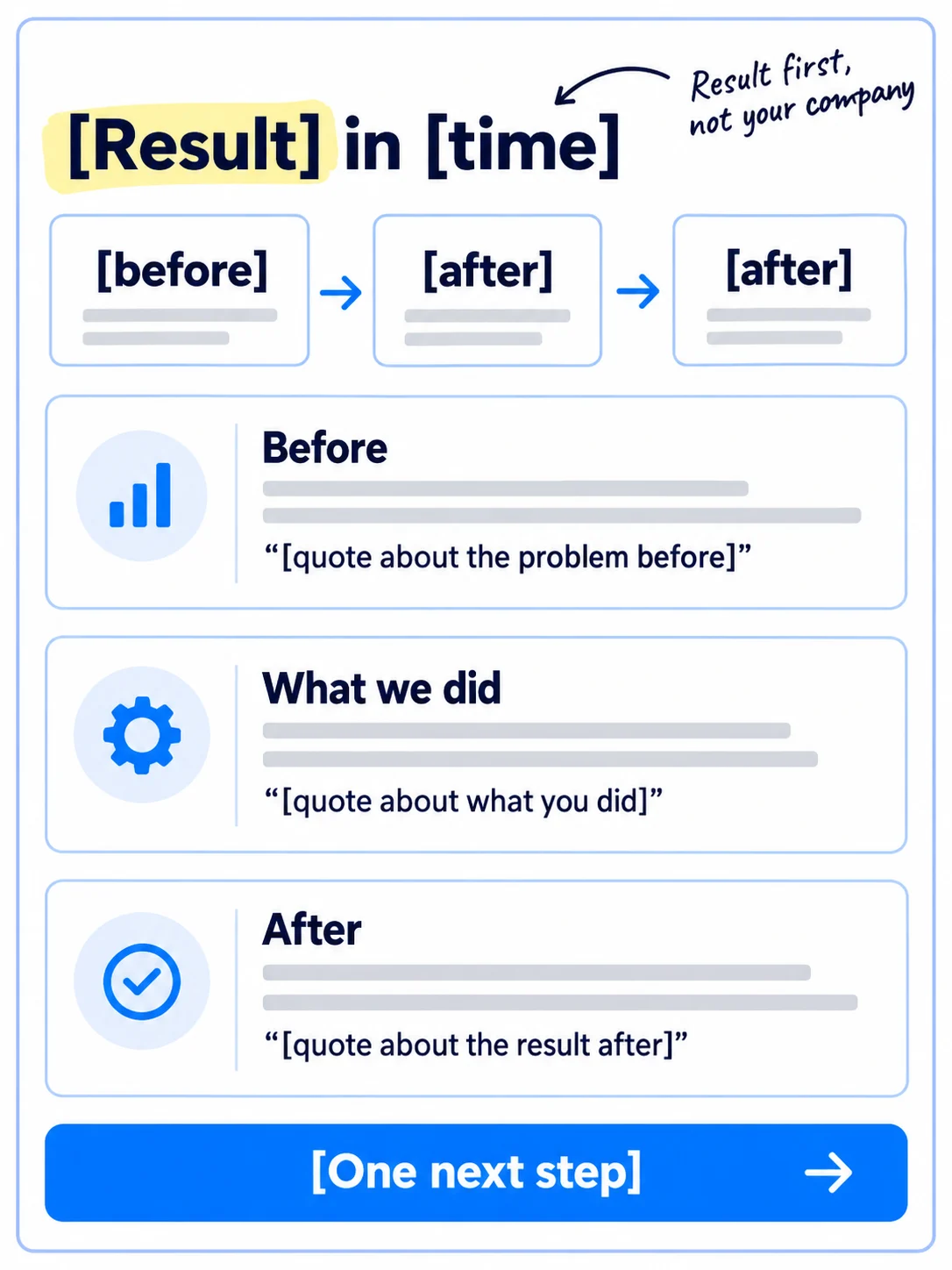
Give ChatGPT or Claude the transcript, your 3 numbers and the template below. Ask it to "write this case study using only facts and quotes from the transcript, in plain English, under 800 words, and mark anything it had to guess." Then you do the part AI cannot: check every number against step 2, check every quote against the recording, and cut any line the customer did not say. AI drafting takes about 5 minutes; your check takes about 45.
Headline: How [customer, or "a [size] [type of company]"] [got the result] in [time]At a glance: [Number 1 before → after] · [Number 2] · [Number 3]Who they are (2 sentences): [what they do, their size, where].Before (1 paragraph): [the problem in their words, what it cost, what they had tried].
"[Quote 1 about the problem]" — [name or role]What we did (3 to 5 short steps): [what you did, in order, with dates].After (1 paragraph): [what changed, with the 3 numbers and the dates].
"[Quote 2 about the result]" — [name or role]What they would tell you: "[Quote 3, from question 8]"[One next step:] [Book a 20-minute call / Start a free trial / See the product] if you are a [kind of company] with [the same problem].
Keep the customer as the main character. Your product or service shows up only in "What we did". Write the headline and the "At a glance" line so they make sense alone: buyers skim, and AI answers quote short, plain passages. Reuse the customer's words for the problem in your own value proposition, too. Google's own guidance asks whether a page shows first-hand experience and original information. A case study with real numbers is exactly that, which also makes it a page worth linking from your homepage.
- Tool: ChatGPT or Claude, and Google Docs.
- Time: about 1 hour.
- You will have: a one-page draft in a Google Doc.
- It worked if: a stranger who reads it for 30 seconds can say who the customer was, what changed and by how much, and every number matches step 2.
- Common mistake: starting with "About us" or a feature list. The other mistake is polishing their quotes into marketing words. Fix the grammar only.
See it done: Quillfox's case study headline
Before
Client success story: our full-service marketing partnership
After
How a 5-person SaaS for dental clinics went from 6 to 19 trial signups a month in 3 months
Why it works: The new headline names the result, the number and the time, and says who it was for without naming the client.
5. Send the draft for approval with a 7-day deadline
Send the draft as a Google Doc the customer can edit, with a date 7 days away. Ask them to approve the exact words and the naming choice in writing, and keep that email.
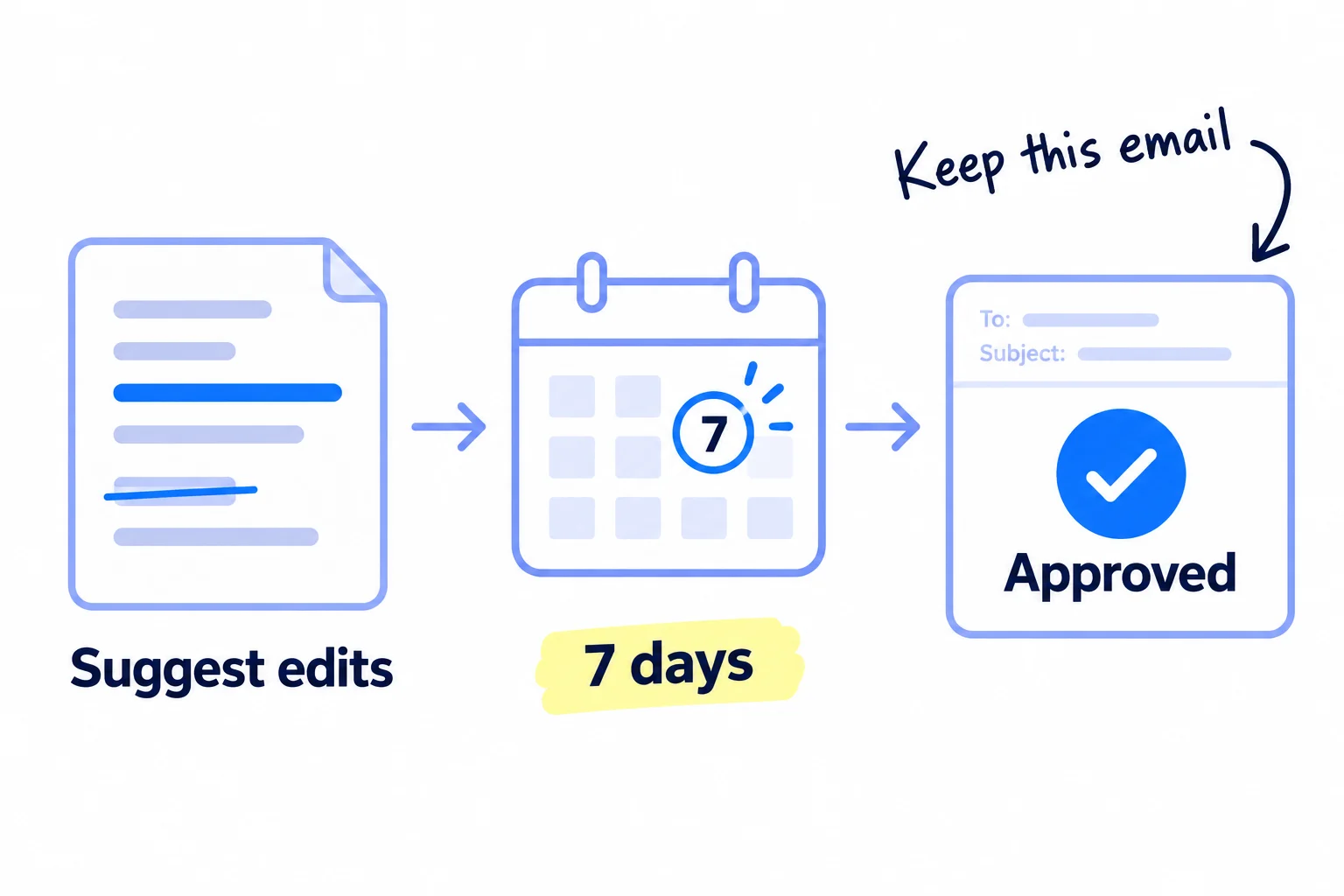
Share the Doc with "Editor" access and ask them to switch to Suggesting mode (Editing ▸ Suggesting, at the top right), so you see every change. If their legal or PR team must see it, as often happens with larger companies, ask your contact to read it first, then forward it. Follow up on day 3 and day 6.
Subject: your case study, for approval by [date]Hi [first name],Here is the case study: [Google Doc link]. Please change anything that is wrong right in the doc.You chose to appear as: [name and company / role and type of company / no name].Could you reply "Approved" by [date, 7 days away]? I will not publish anything until you do.Thank you for the time on the call.[Your name]
If they ask to remove a number, offer a range ("between 15 and 20 a month") or a percent with the base, before you agree to cut it. If they go quiet after two follow-ups, offer the "no name" version. Never publish a version they have not approved.
- Tool: Google Docs, in Suggesting mode, and your email.
- Time: 15 minutes, plus two follow-ups.
- You will have: a final text and an email that says "Approved", with the naming choice.
- It worked if: you have written approval within 7 days. If not after two follow-ups, send the "no name" version for approval instead.
- Common mistake: publishing because they said "looks fine" on a call. Get the written yes. The other mistake is giving them a discount for it and not saying so: the FTC says anything of value given for an endorsement should be disclosed when it would change how readers judge it.
6. Publish it on its own page and send it in 100 messages a day
Put the case study on its own page on your site, then put that link in front of buyers every day: in 100 personal messages, in every proposal, and in 2 posts a day for 2 weeks. A case study nobody sees wins nothing.
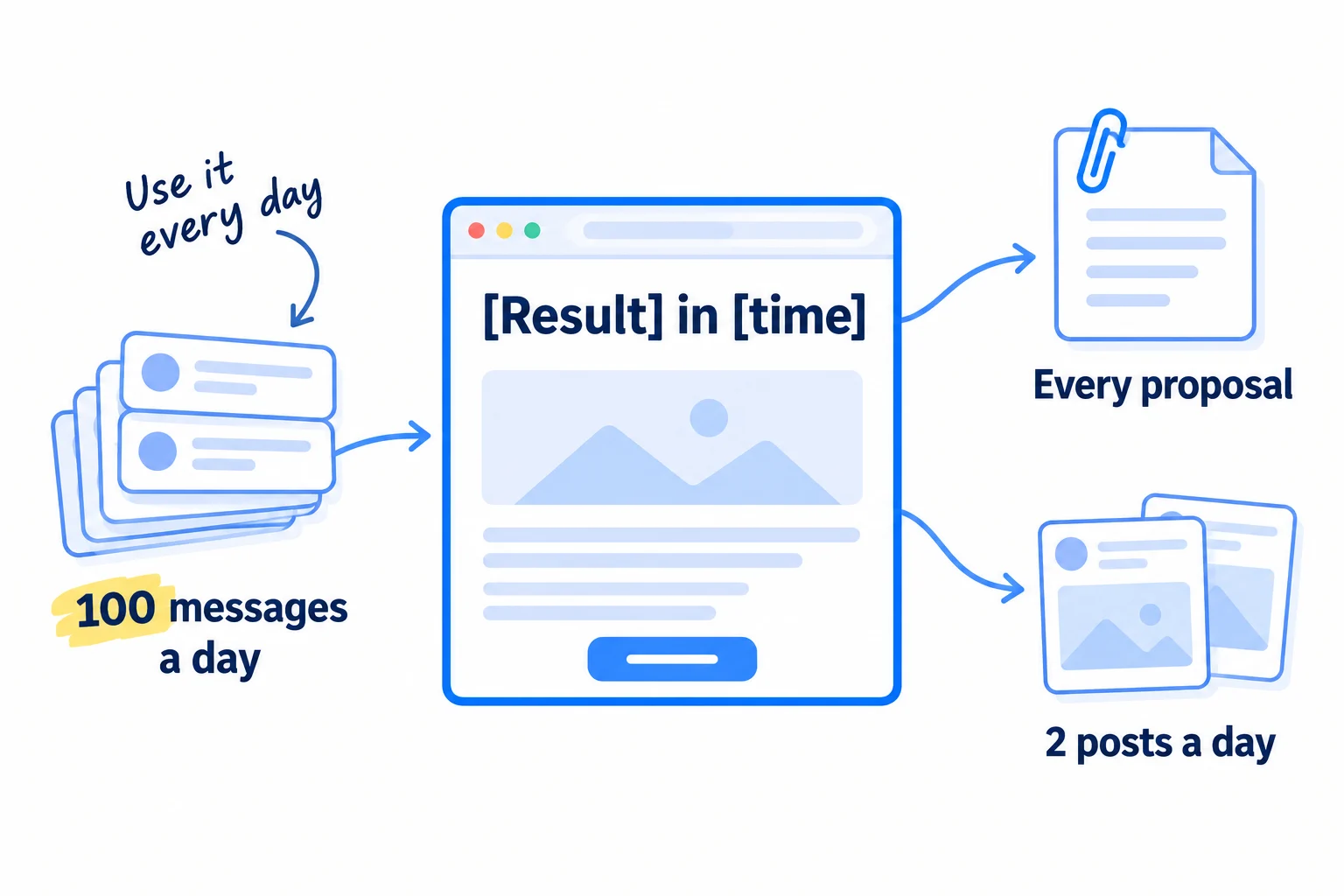
Publish it. Give it its own address, like yoursite.com/case-studies/[result]. Link it from your homepage, your pricing page or services page, and your LinkedIn profile. In Search Console, use URL Inspection and click "Request indexing", so it gets indexed sooner. In G2's March 2026 survey of 1,076 software buyers, 51% said they now start their research in an AI chatbot more often than in Google. Pages like this, with real numbers, are what those tools can read when buyers ask them which supplier to pick. Save a one-page PDF of it for your proposals and your sales deck.
Send it in 100 personal messages a day to buyers who look like this customer, from your lead list. AI drafts each message from the template; you add one true line about the person. That is about a minute a message. Send one at a time from your normal email, never in bulk. Gmail requires every sender to have SPF or DKIM set up and to keep spam reports below 0.3%. If you email more than about 50 strangers a day, set up and warm up a second domain first. On LinkedIn, message people you are already connected to: if you hit LinkedIn's invitation limit, you can be blocked from sending invitations for about a week, so send the rest by email instead of sending fewer. Send the case study to people already in talks with you, too: after every discovery call, send the one that matches their problem.
Subject: [the result], for a [kind of company] like yoursHi [first name],[One true line about them.]We just helped [customer, or "a [size] [type of company]"] go from [before] to [after] in [time]. The one-page story is here: [link]If [the same problem] is on your list too, would a 15-minute call next week be useful?[Your name]
[Your company, postal address]
Not for you? Reply "no" and I won't write again.
Post it 2 times a day for 2 weeks. One case study gives you at least 10 posts: each quote, each number, the before, the mistake you fixed, one step of what you did, and the whole story as a LinkedIn document post (Start a post ▸ the document icon; PDFs up to 100 MB). Spread them across your content calendar, add your other posts, and post as the founder on LinkedIn as well as on your company page. A 30-second short video of you telling the before and after is one more post.
If you run a D2C store: skip the 100 messages. Put the customer story under the product description it is about, use the photos in your posts, and add a line with the result most customers get if this one is better than usual. The FTC asks for that when a result is not typical.
- Tool: your website, Google Search Console, your email and LinkedIn, ChatGPT or Claude to draft.
- Time: 1 hour to publish, then about 2 hours a day for 100 messages and 30 minutes a day for 2 posts.
- You will have: a live page, and after 2 weeks, 1,400 messages and 28 posts that carry it.
- It worked if: after 1,400 messages, you get at least as many replies per 100 as your messages without it, and at least one buyer mentions it on a call. If replies drop, rewrite the first line around the result and send the next 100.
- Common mistake: putting it under "Resources" and never sending it. The other mistake is one mass email with the link to your whole list. That is spam, not volume.
See it done: Quillfox's message with the case study
To: Priya, founder of a 4-person SaaS that sends booking reminders for physiotherapy clinics
Subject: 19 trial signups a month, for a small SaaS like yours
Hi Priya,
I saw your post about trial signups going flat after your launch.
We just helped a 5-person SaaS for dental clinics go from 6 to 19 trial signups a month in 3 months, from Google and LinkedIn. The one-page story is here: [link]
If trial signups are on your list too, would a 15-minute call next week be useful?
Jess Quillfox, [postal address] Not for you? Reply "no" and I won't write again.
Why it works: It opens with something true about him, then shows a result from a company his size, in one line with the numbers.
7. Count what it brought every Sunday and ask for the next one
Every Sunday, write down how many messages carried the case study, how many replied, and how many calls or deals mentioned it. Then ask your newest customer for the next case study, so you always have one in progress.
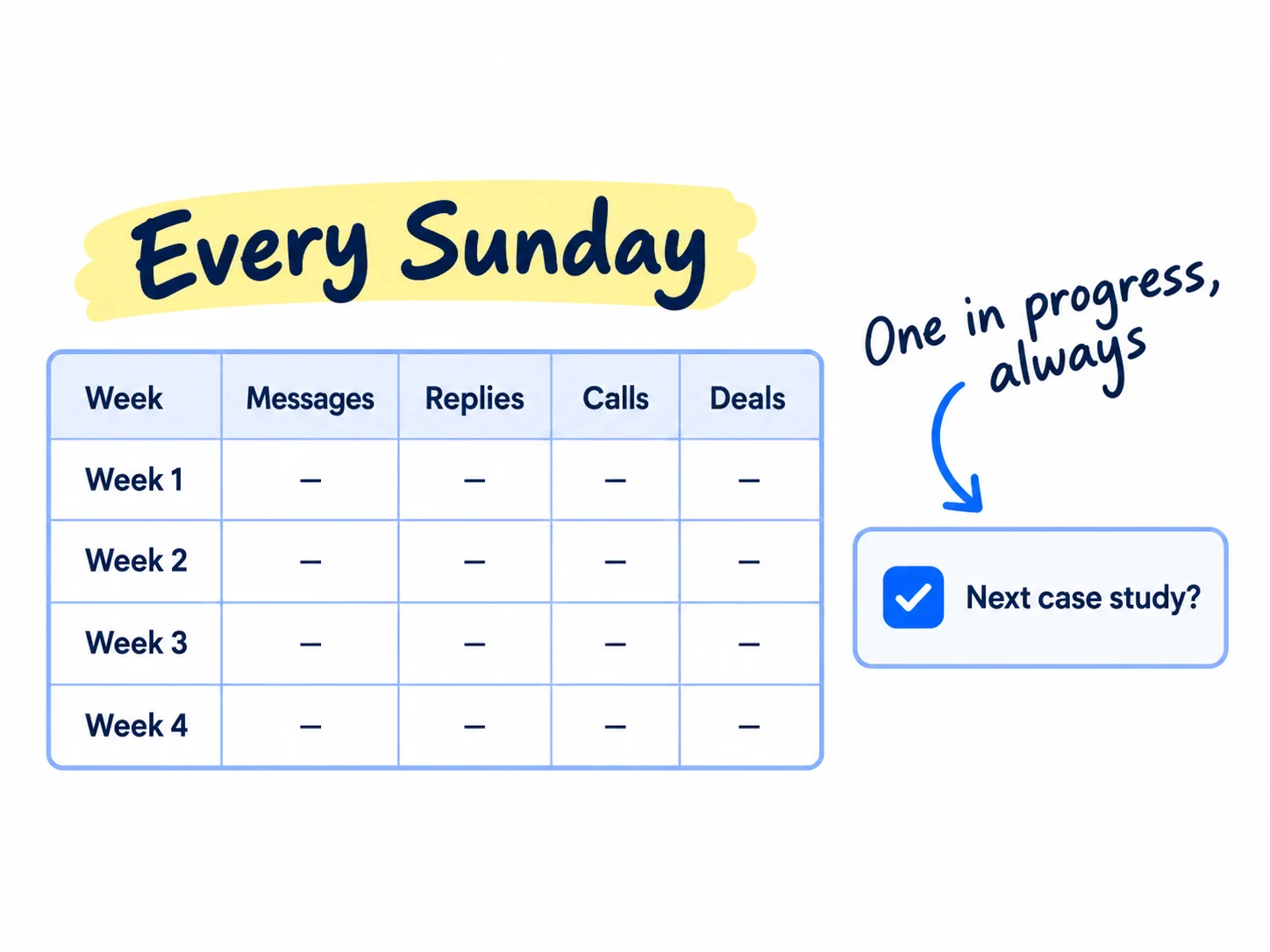
Ask every new buyer on the first call, "Did you read anything about us before this call?" That is self-reported attribution, and at this size it tells you more than any tool. Once the sheet gets slow, move it to a CRM. Tag the case study link with UTM parameters, so its visits show up by source.
Week | Messages with the case study | Replies | Calls that mention it | Deals | Case study page visits
Next case study: [customer] — asked / call booked / draft sent / approved
Ask each new customer for a case study once they have a result: about 30 days in for SaaS, often just after they pay at the end of the trial, and for D2C; after the first 3 months for agency and B2B work. Update each case study's numbers after 3 months, and look at all of them together in your monthly marketing review. A newer, bigger number is a new post and a new reason to message.
- Tool: Google Sheets.
- Time: 20 minutes every Sunday.
- You will have: one row a week, and one new case study in progress at all times.
- It worked if: you can say which calls and deals the case study helped with, and you have a second case study in progress by week 4.
- Common mistake: stopping at one. Buyers trust a story most when it matches them, so a second customer of another kind or size reaches people the first one cannot.
Where Scout7 helps
Scout7 speeds up step 6: turning the approved case study into posts.
Step 6. Image Studio takes an idea, such as one number or one quote from the case study, and makes an image post with a caption in your brand's voice. Video Studio builds a short portrait video about the case study: it writes the script and splits it into scenes, you direct each scene, and it adds captions, in your own recorded voice or a preset one. The Brand Calendar schedules them to LinkedIn, X, Instagram, Facebook, Threads and Reddit. You approve each post and video; nothing goes live without your approval. You still ask the customer, hold the interview, write the page and send the messages yourself.
Your case study checklist for the next 2 weeks
0 of 13 done
Work through this list with an AI assistant
It drafts the work and keeps track of what is done.
Frequently asked questions
- What if I have no customers yet?
Write up results you got for your own business, or work you did in a past job, saying where it happened and leaving the employer's name out unless they agree. Or run one small paid first project and write it up after. Never invent a client or a quote. Getting agency clients without case studies shows the full route.
- Can I publish a case study without the client's name?
Yes, with their written approval of the exact text. Describe them by size and type, such as "a 10-person accounting firm", use their role instead of their name, and round the numbers if they ask. Keep the real problem, what you did and the result. Buyers mainly want to see a problem like theirs solved.
- How long should a case study be?
One page: 500 to 800 words for the web page, with the result in the headline and 3 numbers at the top. Buyers skim, so the headline and the numbers must work alone. Keep the longer story for a sales call. Short testimonials of one or two lines are a different job.
- Should I give a customer a discount for a case study?
You can, but say so on the page. The FTC says that when something of value is given for an endorsement, and knowing about it would change how readers judge it, it should be disclosed. Most customers will say yes for less: a link to their site, their name in front of your audience, and a 25-minute call.
- Should I make a video case study instead?
Start with the written page. It is faster to get approved, easy to send in a message, and readable by Google and ChatGPT. If the customer is happy on camera, record a 30-second phone clip of them saying the result, and use it as a post and on the page.
Sources
- 1.Consumer Reviews and Testimonials Rule: Questions and Answers — Federal Trade Commission, checked 2 October 2026
- 2.FTC's Endorsement Guides: What People Are Asking — Federal Trade Commission, checked 2 October 2026
- 3.Creating helpful, reliable, people-first content — Google Search Central, updated 1 October 2026
- 4.New G2 Research: Half of B2B Software Buyers Now Start Their Research With AI Chatbots — G2, via PR Newswire, 15 April 2026
- 5.Otter.ai pricing — Otter.ai, checked 2 October 2026
- 6.Use transcripts with Google Meet — Google Meet Help, checked 2 October 2026
- 7.Suggest edits in Google Docs — Google Docs Editors Help, checked 2 October 2026
- 8.Email sender guidelines — Google Workspace Admin Help, checked 2 October 2026
- 9.Invitation limit reached — LinkedIn Help, checked 2 October 2026
- 10.Share documents in posts — LinkedIn Help, checked 2 October 2026
- 11.The ultimate guide to writing case studies that drive leads — Articulate Marketing, updated 2026
- 12.How do I write a case study when I can't name the client? — Pravin Kumar, 8 July 2026
- 13.How to write anonymous case studies — Proofmap, updated 4 July 2026
- 14.How to write a B2B SaaS case study that buyers actually trust — Tatarek, 2026
Next article to read
Related guides
- How to get agency clients without case studiesAgencyComing soon
- How to write a proposal that winsComing soon
- How to get your company recommended by ChatGPT as a supplierB2BGet your company recommended by ChatGPT as a supplier: ask it the 20 questions your buyers ask 3 times each and log who it names, put the same supplier facts on your site and every profile, then publish 1 page, send 100 mention requests, post twice on LinkedIn and give 20 answers every day, and recount the answers every Sunday.
- How to make a sales deckB2BComing soon
Guides that link here
- How to get clients for a consulting business without referralsB2B
- How to get your company recommended by ChatGPT as a supplierB2B
- LinkedIn post ideas for B2B companiesB2B
- How to add llms.txt and schema markup
- How to get on the "best of" lists AI tools cite
- How to get your brand mentioned by ChatGPT
- How to show up in Google AI Overviews
- How to get booked as a podcast guest
- How to make short-form videos for your business
- How to plan a content calendar
- How to repurpose content across platforms
- How to start a YouTube channel for business
- How to get beta users for your startupSaaS
- How to get people to try your product
- How to get your first 100 SaaS usersSaaS
- How to get your first B2B clientsB2B
- How to get your first client as a marketing agencyAgency
- Why no one is buying your product, and how to fix it
- How to announce a new business on social media
- How to launch a B2B productB2B
- How to submit your SaaS to directoriesSaaS
- How much to spend on marketing as a B2B companyB2B
- How to do customer interviews
- How to market your B2B businessB2B
- How to market your marketing agencyAgency
- How to price a B2B product or serviceB2B
- How to price digital marketing servicesAgency
- How to set a marketing budget for your agencyAgency
- How to write a value proposition
- How long does SEO take to work?
- How to get backlinks for a new website
- How to get backlinks from news websites
- How to get your website indexed on Google
- How to make an article rank higher on Google
- How to measure SEO success
- How to rank on Google Maps
- How to set up a Google Business Profile
- How to use Google Search Console
- How to write a blog post that ranks on Google
- How to write competitor comparison and alternative pages
- How to build in public on XSaaS
- How to get your first 1,000 followers
- How to grow on LinkedIn as a founder
- How to promote on Reddit without getting banned
- How to promote your business in Facebook groups
- How to write a LinkedIn profile that brings in clients
- Instagram post ideas for a marketing agencyAgency
Cite this page
Dinesh Bypilla (2026). How to write a case study. Scout7 Academy. https://scout7.ai/academy/content-marketing/how-to-write-a-case-study
Written by Dinesh Bypilla, Agentic systems engineer at Scout7. Reviewed by Murali Sid. Last checked 2 October 2026.
Quote any part of this guide with a link back to this page. © 2026 Scout7.
Markdown version of this page: https://scout7.ai/academy/content-marketing/how-to-write-a-case-study.md