



How to find online communities where your buyers talk
Find online communities where your buyers talk: write down 30 phrases they use, ask your customers where they go for help, search Google, Reddit, Facebook, LinkedIn, a community directory and ChatGPT for 50 places, keep the 10 where buyers ask at least 10 questions a month, answer 20 questions a day in your top 5, and count customers by place every Sunday.
ByDinesh BypillaReviewed byMurali SidLast checked 18 min read
You were told to "go where your customers hang out", so you joined a few founder groups, posted, and heard nothing. That happens because those rooms are full of other sellers. Here is how to find online communities where your buyers talk: search in their words, check each place for real buyer questions, keep the 10 that pass, and answer there every day so you find your first customers and your first visitors.
Do these three things
About 4 to 5 hours today, then about 1 hour 40 minutes a day. Judge each place after 560 answers, not after one quiet week.
Show the three actions in fullHide the full list
- Today: write down 30 phrases your buyers use for the problem, search them 6 ways to list 50 places where they ask for help, and keep the 10 with the most buyer questions in the last 30 days.
- Every day: answer 20 questions across your top 5 places in your own words with no link, following each place's rules on self-promotion, and copy each question into your sheet in the buyer's words.
- Every Sunday: count questions, replies and customers from each place by where they came from. After 560 answers, swap any place that brought nothing for one of your 5 spares.
Get help doing these
ChatGPT or Claude reads this guide and works through it with you.
1. Write down 30 phrases your buyers use for the problem
Make a list of 30 words and phrases a buyer would type when the problem hits them, not the words on your website. Every search in this guide uses this list, so it decides which communities you find.
Founders search for their own category, such as "SaaS", "packaging" or "skincare brand", and find rooms full of people who sell the same thing. In April 2026 one founder wrote that the Discord he built from friends had about 20 people, and only one of them fit his buyer. Buyers gather around their problem, their job, their trade, their hobby, the tools they already use and their town. So collect phrases in four groups:
- The problem, as they say it: "boxes crush in the post", "clients send bugs by email", "curls feel like straw".
- Their job, trade or hobby: "home baker", "web designer", "bookkeeper", "trail runner".
- The tools they already use: the software, marketplace or supplier they would mention.
- Who they compare you with: your competitors and the do-it-yourself way.
Take the words from your ideal customer profile, your notes from customer interviews, and the complaints you read when you did your competitor analysis. Then type the start of each problem phrase into Google and copy the suggestions it adds, the same way you find keywords. Ask ChatGPT or Claude for 20 more ways a buyer might say the problem, and keep only the ones a real buyer would type.
- Tool: a Google Sheet, Google, and ChatGPT or Claude. All free.
- Time: 30 minutes.
- You will have: 30 phrases in 4 groups, in one tab of your sheet.
- It worked if: at least 20 of the 30 phrases use no word from your own homepage.
- Common mistake: searching for your category word. It finds your competitors, not your buyers.
See it done: Carvelian's search words, before and after
Carvelian Packaging is a made-up maker of custom printed boxes for small food and drink brands. One founder sells through calls, samples and quotes.
Their words
custom printed packaging, packaging supplier, branded boxes
Their buyers' words
cookies crushed in the mail, boxes for 500 jars, cottage food labels, how much do custom boxes cost, packaging for farmers market
Why it works: The new phrases are what a small food maker types when the problem hits, so they lead to the groups where food makers ask for help.
2. Ask your buyers where they go when they need help
Ask every customer and every person who fits your buyer one question: where do they go online when they have a question about the problem? Places named by real buyers are the best places on your list.
No search tool knows about the private Slack your buyers use or the WhatsApp group their trade runs. They do. Today, send the question below to your customers and to 20 people you have already talked to who fit your buyer. From now on, ask it at the end of every customer interview, every chat and every discovery call, and add it to the questions on your signup, checkout or enquiry form.
Quick one: when you have a question about [the problem], where do you go online to ask? A group, a forum, a Slack or Discord, a newsletter, a person you follow? Names help me a lot.
Keep this as a one-off question to people you know or have spoken to. Your daily personal messages to new people stay about their problem, and the question fits at the end of the chat they lead to.
- Tool: email, LinkedIn messages or your phone, and your form.
- Time: 20 minutes today, then 30 seconds in every chat.
- You will have: a list of places named by real buyers, with how many people named each one.
- It worked if: within 2 weeks, at least 3 places have been named by 2 or more people.
- Common mistake: asking "Which social media do you use?". Everyone says "LinkedIn" or "Instagram". Ask where they go when they have a question.
3. Search 6 ways and list 50 places in one sheet
List 50 places where people who could buy from you ask questions, found 6 ways: Google, Reddit, Facebook, LinkedIn, a community directory and an AI assistant. Put every place in one sheet before you judge any of them.
Search each way with your 30 phrases. Add a row for every place that comes up: its name, its link, the platform, and how you found it.
- Google. Search
"[phrase]" forum, thensite:reddit.com "[phrase]"andsite:facebook.com/groups "[phrase]". Thesite:part shows results from one website only. Use the Forums filter under the search box, if you see one. Public Facebook groups are now the second most common site in Google's "Discussions and forums" box after Reddit, so they come up here. These are the threads buyers already find on the Google results page. - Reddit. Search a phrase, sort by New and set the time to Past month. GummySearch, the Reddit research tool many guides still name, closed in November 2025; Reddit's own search does the job. Then type your buyer's question and tap Ask. Reddit's AI search answers from real posts and lists the subreddits where people discuss it. The Reddit guide covers what to do once you are in.
- Facebook. Click Groups in the left menu and search your phrases. Open each group and check the dates of its last posts. The Facebook groups guide covers joining and the rules.
- LinkedIn. Type a phrase in the search bar and pick the "Groups" result, or tap the Groups filter on mobile. You join with Request to join, and an admin approves you. Private unlisted groups never show in search, so ask buyers about them in step 2. Groups are a small part of LinkedIn for founders; most of your LinkedIn time stays on your own posts and comments.
- A community directory, for Slack, Discord and forums. Slack has no public search across communities, and Discord's Discover tab only lists servers with at least 1,000 members. Small, focused servers never appear there. Search The Hive Index, a free directory of about 5,600 communities on 36 platforms, by your buyer's topic. Then search Google for
"[buyer's job]" slack communityand"[topic]" discord. - ChatGPT or Claude. Ask: "List the subreddits, Facebook groups, LinkedIn groups, Slack and Discord communities, forums and newsletters where [your buyer] asks for help with [the problem]. Give a link for each." Open every link yourself. Some will be dead or renamed.
Follow the side doors. When a page you find mentions another place, such as "we chat about this in our Discord" or a newsletter's member forum, add it too. Industry forums, trade association member boards, the community forum of a tool your buyers use, and Quora are all fair places.
If you run a SaaS: look where people who do your user's job ask for help, and in the community forums of the tools they already use. Founder groups only count if founders are your buyers. Answers here are part of how founders get their first 100 users. If your buyers are developers, add Hacker News, where you can later post a Show HN, and the communities around integration marketplaces your product plugs into.
If you run a B2B company: look for your buyer's trade: LinkedIn and Facebook groups for the trade, trade association forums, and Slack communities for the job title. The same people go to trade shows and networking events, so event groups count too. Communities add to your outreach to named buyers; they do not replace it.
If you run a D2C store: look where shoppers talk about the problem or the hobby your product serves, such as hobby subreddits, Facebook groups and fan Discords, not seller groups full of other Shopify stores. The people who lead these groups are often the small creators your buyers follow.
If you run an agency: look where your clients' owners ask for marketing help: local business-owner groups and owner groups in the industry you serve. Marketing groups are full of other marketers. Answers in your buyers' groups are one of the best ways to find clients online and to get your first client without case studies.
- Tool: Google, Reddit, Facebook, LinkedIn, The Hive Index, ChatGPT or Claude, and your sheet. All free.
- Time: about 2 hours.
- You will have: a sheet with 50 places, each with a link, its platform and how you found it.
- It worked if: the 50 places are spread over at least 3 platforms, and at least 10 came from your buyers' answers or your buyers' words.
- Common mistake: stopping at the biggest rooms on one platform. A small forum where 40 buyers ask questions every month beats a group of 200,000 sellers.
4. Check each place for buyers and keep 10
Spend a few minutes reading each place, score it on 3 checks, and keep the 10 best: 5 to answer in every day, and 5 spares. A place is worth your time only if buyers ask questions there now.
Open each place and read the last 20 posts. Score it on 3 checks against your ideal customer profile. These are our rules. The first is the same bar our Reddit and Facebook guides use:
| Check | A place passes if |
|---|---|
| Buyers ask questions there | It has at least 10 questions from the last 30 days that you could answer well. |
| The posts come from buyers | At least 10 of the last 20 posts come from people who could buy from you, not people selling to them. |
| It is alive | Questions get a reply within a day, from members or an admin. |
Start with the places your buyers named, then work down the rest. Most places fail in 2 minutes, because the last posts are weeks old or everyone in them is selling. If a group is private, read its About section and member count, join, and check it once you are in. On a free Slack workspace you can only see the last 90 days of messages, which is enough for these checks.
Keep 10. Put the 5 with the most buyer questions at the top. Those are where you answer every day. The next 5 are your spares. Keep at least 2 platforms among your top 5, so one removal or one quiet month does not stop you. If you cannot find 5 places that pass, check that the problem is real and that you are using your buyers' words.
Copy the rules. For each of the 10, write down where links are allowed, whether there is a weekly promotion thread or day, and whether posts need approval. Join as yourself, with a profile that says what you do, and answer any joining questions truthfully. The Reddit and Facebook groups guides cover what each platform allows.
Paid communities. Join a paid community only if at least 3 buyers named it in step 2, and a year of it costs less than one customer's first payment. This is our rule. Until then, free places come first.
- Tool: your sheet.
- Time: about 90 minutes: 2 minutes for most places, longer for the top 20.
- You will have: 10 places, each scored on the 3 checks, with its rules written down and your join request sent.
- It worked if: all of your top 5 pass all 3 checks, and they cover at least 2 platforms.
- Common mistake: choosing by member count. A huge group with no questions in a month brings nothing. The other mistake is keeping a group because it feels friendly when everyone in it is selling.
See it done: Carvelian's top 5
The 5 places to answer in, from 50 checked
| Place | Platform | Found by | Buyer questions in 30 days | Buyer posts in last 20 | Answered within a day? |
|---|---|---|---|---|---|
| A group for small bakery and cookie brands | A client named it | 46 | 17 | Yes | |
| A subreddit for small food business owners | Reddit's Ask | 31 | 14 | Yes | |
| A forum for small hot sauce makers | Forum | 18 | 19 | Yes | |
| A group for specialty food founders | A client named it | 14 | 11 | Yes | |
| A Slack community for food and drink founders | Slack | Directory | 12 | 13 | Yes |
Why it works: Every place is full of small food makers asking real questions, and the five are spread over five platforms.
5. Answer 20 questions a day in your top 5 places and save their words
Every day, answer 20 questions across your top 5 places, about 4 in each, in your own words and with no link. Copy every question you see into your sheet, word for word.
Get the questions to you. Set free alerts for 3 to 5 of your phrases: F5Bot emails you when a new Reddit or Hacker News post uses them. In Slack, open your profile picture, then Preferences, Notifications, and add your phrases under Channel keywords; it only works in channels you have joined. In Facebook, turn on notifications for your best 3 groups. Anywhere else, open the place each day and sort by newest.
Answer well. Answer the question in the first line. Give 2 or 3 steps that work without your product. Add one thing only you know: a number, something you tried, a mistake you made, a result from a real customer. Use ChatGPT or Claude to sort the day's questions and list the points to cover, then write the answer yourself. Communities remove answers that read like AI, and Reddit's rules ban AI-written content that pretends to be human. For your first 2 weeks, do not mention your business. After that, mention it only where it answers the question and the rules allow it, and say it is yours. The guides to Reddit and Facebook groups give the exact rules.
Spread the 20. About 4 answers in each of your 5 places keeps you inside most places' rules. 20 in one place in a day looks like spam. If a place has no good question today, answer in a spare. With AI finding and sorting the questions, each answer takes about 4 minutes.
Save their words. Paste every question into your sheet with the date and the place. After 4 weeks you have hundreds of real questions. They are your content calendar, the topics for pages that rank, and the words for your value proposition. Your best answers can also become posts: turn one answer into a post for your own channels. When a question mentions another group, forum or newsletter, add it to your list of 50.
Buyers listen to each other: in a January 2026 survey of 1,202 US business decision-makers, run by SurveyMonkey with Reddit, 73% trusted insights from peers above vendor websites. Answers in public places also last. Reddit is the site ChatGPT cites most, 16.8% of its citations in September 2026, so a good answer can keep your name in AI answers for months. If 1 hour 40 minutes a day feels impossible, find the time by cutting product work first.
- Tool: the 5 places, F5Bot (free), Slack's Channel keywords, Facebook notifications, ChatGPT or Claude, and your sheet.
- Time: about 1 hour 20 minutes for the answers and 20 minutes to log questions and alerts: about 1 hour 40 minutes a day.
- You will have: 140 answers and about 140 saved buyer questions every week.
- It worked if: after 280 answers (2 weeks), people reply to your answers or ask "what do you use?" in at least 3 of your 5 places.
- Common mistake: putting your link in every answer, or pasting the same answer in several places. Both get you removed. The other mistake is answering only in the place you like most.
See it done: Carvelian's answer, with no link
Asked in a Facebook group for small bakery and cookie brands
“Where do you get boxes printed when you only need 500? Every quote I get wants 5,000 minimum.”
The reply
Look for a digital printer, not a box factory. Digital print has no plates, so 250 to 500 boxes is normal and the price per box is higher but the total is far lower. Ask for a white box with a printed sticker or sleeve first, which is cheaper still. Before you order, ask for one sample box and drop it from table height with your heaviest order inside. From my years in a print shop: always ask what the price is at 500 and at 1,000, because the jump is often small.
Why it works: It answers the money question first, gives steps that work with any supplier, and adds one thing the founder knows from the print trade.
6. Count what each place brought every Sunday, and swap the ones that brought nothing
Every Sunday, fill in one row for each place: answers, replies, requests and customers. After 560 answers, 4 weeks at 20 a day, keep the places that brought conversations and swap the rest for spares.
Ask and tag. Add each of your 5 places to the "Where did you hear about us?" question on your form. This is self-reported attribution, and most visits from communities look like direct visits without it. Where a place allows links, tag them with UTM parameters, such as ?utm_source=[place]&utm_medium=community.
Week | Place | Answers | Replies to you | "What do you use?" requests | Visits (UTM) | Enquiries, signups or orders | Customers
New places found this week: [names] | Removed or warned: [where, and why]
Decide after 560 answers. Look at each place:
- It brought customers, enquiries, signups or orders: keep it, and move more of your 20 answers there.
- It brought replies but nothing else: keep it for 2 more weeks, and check that your answers solve what people asked.
- It brought visits but no enquiries, signups or orders: keep it, and fix the page people land on. For a store, fix the product page; for a SaaS, fix the signup page.
- It brought nothing, or removed you: swap it for your best spare, and check one new place from your list of 50.
Also re-run the 3 checks from step 4 on your top 5 once a month. Places go quiet. Judge by conversations and customers, never by members or likes. When someone from a place buys, ask them what made them try you, and put their words in your next answers. Once a month, put the places next to your other marketing channels in your marketing review.
- Tool: Google Sheets, your analytics and your form. A CRM can wait until the sheet gets slow.
- Time: 30 minutes each Sunday.
- You will have: one row per place each week, and after 560 answers a clear keep, wait or swap for each.
- It worked if: you can name the place each enquiry, signup or order from a community came from.
- Common mistake: dropping a place after one quiet week, or keeping a place for its size when it has brought nothing in 4 weeks.
See it done: Carvelian after 560 answers
Weeks 1 to 4, by place
| Place | Answers | Replies to you | Requests | Customers |
|---|---|---|---|---|
| Bakery and cookie brands group (Facebook) | 130 | 41 | 3 sample requests | 1 order, about $3,000 |
| Small food business subreddit | 110 | 22 | 1 enquiry | 0 |
| Hot sauce makers forum | 120 | 18 | 1 enquiry | 0 |
| Specialty food founders (LinkedIn) | 100 | 9 | 0 | 0 |
| Food and drink founders (Slack) | 100 | 0 | 0 | 0 |
The decision: keep the bakery group and the two places with enquiries, and give the bakery group 6 answers a day. Give the LinkedIn group 2 more weeks, because it brought replies. Swap the Slack community, which brought nothing, for the best spare.
Why it works: They keep the places that brought requests and an order, and swap the one that brought only friendly replies.
Where Scout7 helps
Scout7 speeds up steps 1, 3 and 5. Nothing is posted without your approval.
Step 1. Scout7's audience research reads public social conversations in your category and builds audience segments with pain points and quotes in buyers' own words. Those quotes are phrases for your list of 30.
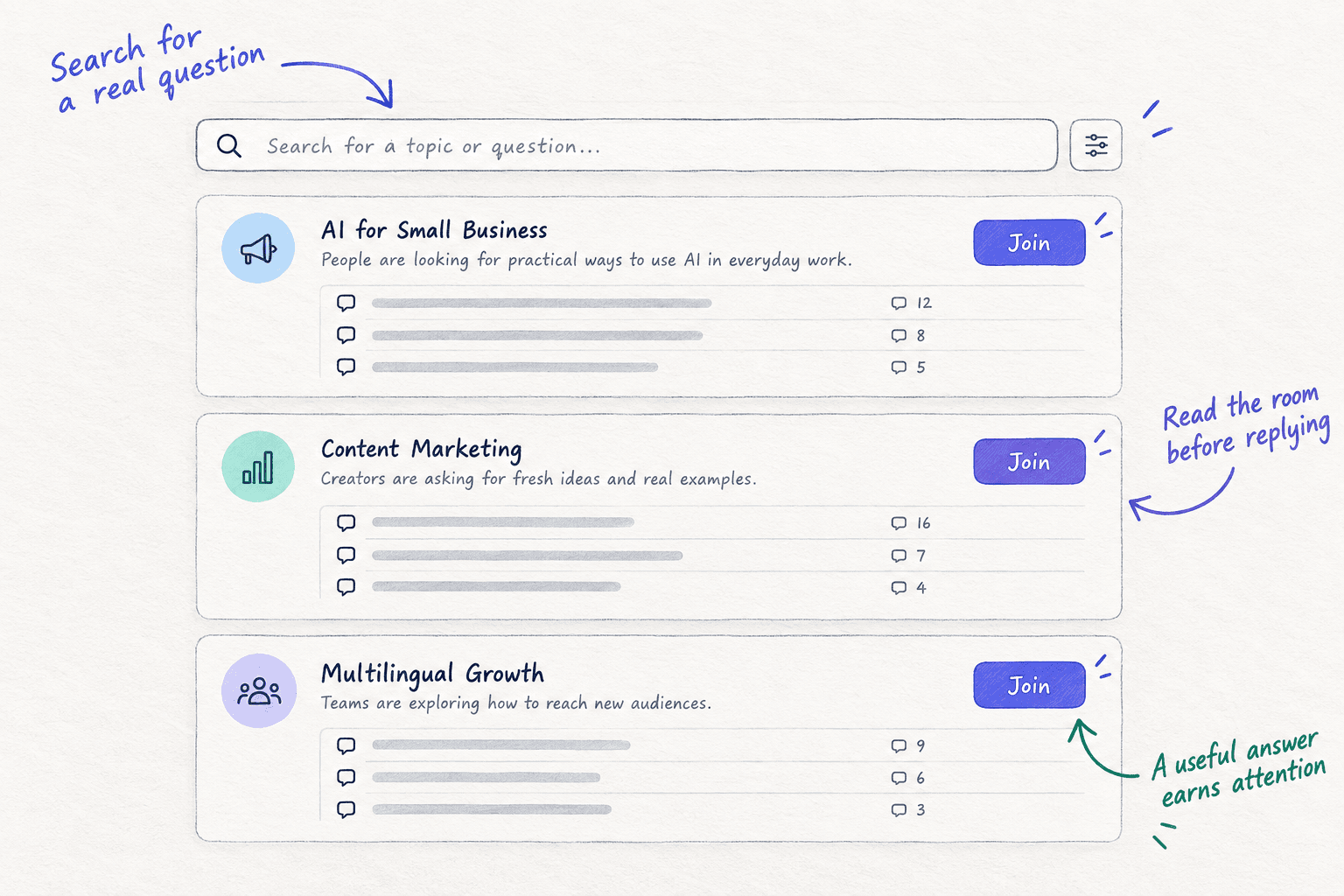
Step 3. Join Conversations searches social platforms for live discussions about your problem, from a direction you describe, and groups them by the kind of reply that fits. The places those discussions happen are candidates for your list. You still run the 3 checks from step 4.
Step 5. Join Conversations drafts a reply in your voice for a thread, with the context of what was said. You read the thread yourself and approve or rewrite the reply. On Reddit, use the draft as notes and write the answer in your own words.
Your community-finding checklist for the next 4 weeks
0 of 11 done
Work through this list with an AI assistant
It drafts the work and keeps track of what is done.
Frequently asked questions
- What if I can't find any online community where my buyers talk?
Check your words first: most founders search their own category. Then ask 20 buyers where they go for help. If you still cannot find 5 places with 10 buyer questions a month, your buyers do not ask online. Put the hours into personal messages and industry events instead.
- Should I start my own community instead of joining others?
Not yet. A new community needs members, and you are still looking for your first customers. Answer in places that already have your buyers. Once at least 20 people already talk to you about the problem you fix, read how to build a community around your brand.
- How many online communities should I join?
Answer in 5 at a time and keep 5 spares. That is enough for 20 answers a day, about 4 in each, which stays inside most places' rules. Joining 30 groups means each one sees you once a week, and nobody learns your name.
- Are paid communities worth it for finding customers?
Only when your buyers are there. Our rule: join a paid community only if at least 3 buyers named it, and a year costs less than one customer's first payment. Then run the same 3 checks as for a free place before you renew.
- Can I post the same answer in several communities?
No. Write each answer for the question in front of you. Reddit's spam policy names "mass-posting repetitive content for the purpose of exposure", and members notice copies. Reuse your notes and your points, not your words.
Sources
- 1.Analysis: Reddit Appears in 83.9% of Google's Discussions and Forums Results — Ahrefs, 27 August 2026
- 2.The most cited domains in ChatGPT — Ahrefs, 2 September 2026
- 3.Reddit's AI search — Reddit Help, updated 3 October 2026
- 4.Spam — Reddit Help, updated 2 October 2026
- 5.Manipulated Content and Misleading Behavior — Reddit Help, updated 1 October 2026
- 6.Discover Tab — Discord Support, updated 23 September 2026
- 7.Enabling Server Discovery — Discord Support, updated 28 September 2026
- 8.Find and join a LinkedIn group — LinkedIn Help, checked 4 October 2026
- 9.Set up keyword notifications — Slack Help Center, checked 4 October 2026
- 10.Pricing changes for the Pro plan and updates to the Free plan — Slack Help Center, checked 4 October 2026
- 11.site: search operator — Google Search Central, updated 10 December 2025
- 12.The Hive Index: find the best online communities — The Hive Index, updated 2 October 2026
- 13.F5Bot: Reddit, Hacker News and Lobsters keyword alerts — F5Bot, checked 4 October 2026
- 14.The Hidden B2B Journey (co-sponsored by Reddit) — SurveyMonkey and Reddit, fielded 23 December 2025 to 7 January 2026
- 15.GummySearch is closed for business — GummySearch, 30 November 2025
- 16.Comment on finding the right users through a Discord community — Hacker News, 18 April 2026
Next article to read
How to promote on Reddit without getting bannedStart with Reddit, where many buyers ask for advice and the rules are strict.Read it nextRelated guides
- How to create an ideal customer profileCreate an ideal customer profile when you have one or two customers: list everyone who paid, tried or talked to you, write 2 or 3 one-sentence guesses, test them with 100 messages a day, and keep the one that gets the most chats after 1,500 messages.
- How to promote your business in Facebook groupsPromote your business in Facebook groups without getting declined or removed: join as yourself with your role in your intro, copy the rules of 10 groups where your buyers ask for help, answer 20 questions a day with no link and add 2 helpful posts, name your business only where it answers the question and say it is yours, and count orders, signups and calls from groups every Sunday.
- How to build a community around your brandBuild a community around your brand when you have only a few customers: start once 20 people already talk to you, pick one free place your buyers use, add 10 starter posts before anyone joins, send 100 personal invites a day, welcome and answer every member every day, and count every Sunday who posts and who buys.
- How to get customers online for freeGet customers online for free: make one offer people can pay for or book, send 100 personal messages and answer 20 questions a day, post twice a day on one channel, add the free listings that fit, and count customers by source every Sunday.
Guides that link here
- How to choose marketing channels for a SaaS startupSaaS
- How to create an ideal customer profile
- How to get customers online for free
- How to get traffic to a new website for free
- How to promote on Reddit without getting banned
- How to promote your business in Facebook groups
- How to build a community around your brand
- How to get your brand mentioned by ChatGPT
- How to get your company recommended by ChatGPT as a supplierB2B
- How to get your products recommended by ChatGPTD2C
- How to show up in Google AI Overviews
- How to track AI traffic and ChatGPT mentions
- How to create a B2B lead list for free
- How to do LinkedIn outreach
- How to find a decision maker's email addressB2B
- How to build a free tool that brings in leadsSaaS
- How to get booked as a podcast guest
- How to make short-form videos for your business
- How to plan a content calendar
- How to repurpose content across platforms
- How to start a YouTube channel for business
- How to use AI for content creation
- How to fix a SaaS launch that got zero signupsSaaS
- How to get beta users for your startupSaaS
- How to get clients for a consulting business without referralsB2B
- How to get people to try your product
- How to get your first 100 SaaS usersSaaS
- How to get your first client as a marketing agencyAgency
- How to get your first sale on EtsyD2C
- How to get your first sales on ShopifyD2C
- Why no one is buying your product, and how to fix it
- How to announce a new business on social media
- How to build a waitlist before you launch
- How to launch a B2B productB2B
- How to launch a D2C brandD2C
- How to launch a product on AmazonD2C
- How to launch on Product HuntSaaS
- How to post a Show HN on Hacker NewsSaaS
- How to submit your SaaS to directoriesSaaS
- How much to spend on marketing as a SaaS startupSaaS
- How to choose marketing channels for an agencyAgency
- How to choose marketing channels for an ecommerce brandD2C
- How to do a competitor analysis
- How to do customer interviews
- How to fit marketing into your week as a solo founder
- How to market a SaaS productSaaS
- How to market your product as a technical founderSaaS
- How to price a productD2C
- How to validate a business idea without spending money
- How to write a value proposition
- How long does SEO take to work?
- How to do SEO for a Shopify storeD2C
- How to find keywords for SEO
- How to get backlinks for a new website
- How to get backlinks from news websites
- How to get your website indexed on Google
- How to make an article rank higher on Google
- How to write a blog post that ranks on Google
- How to build in public on XSaaS
- How to get your first 1,000 followers
- How to grow on LinkedIn as a founder
- How to promote your business on InstagramD2C
- Instagram post ideas for a marketing agencyAgency
- Instagram post ideas for D2C brandsD2C
- LinkedIn post ideas for B2B companiesB2B
- Social media post ideas for SaaS companiesSaaS
Cite this page
Dinesh Bypilla (2026). How to find online communities where your buyers talk. Scout7 Academy. https://scout7.ai/academy/social-media/how-to-find-online-communities-where-your-buyers-talk
Written by Dinesh Bypilla, Agentic systems engineer at Scout7. Reviewed by Murali Sid. Last checked 4 October 2026.
Quote any part of this guide with a link back to this page. © 2026 Scout7.
Markdown version of this page: https://scout7.ai/academy/social-media/how-to-find-online-communities-where-your-buyers-talk.md