



How to get backlinks from news websites
Get backlinks from news websites with no PR budget: write a source kit with 5 numbers only you have, answer 20 journalist requests a day on free services like HARO in your own words, send local and trade reporters a story from your own numbers once a month, and ask for every missing link every Sunday.
ByDinesh BypillaReviewed byMurali SidLast checked 23 min read
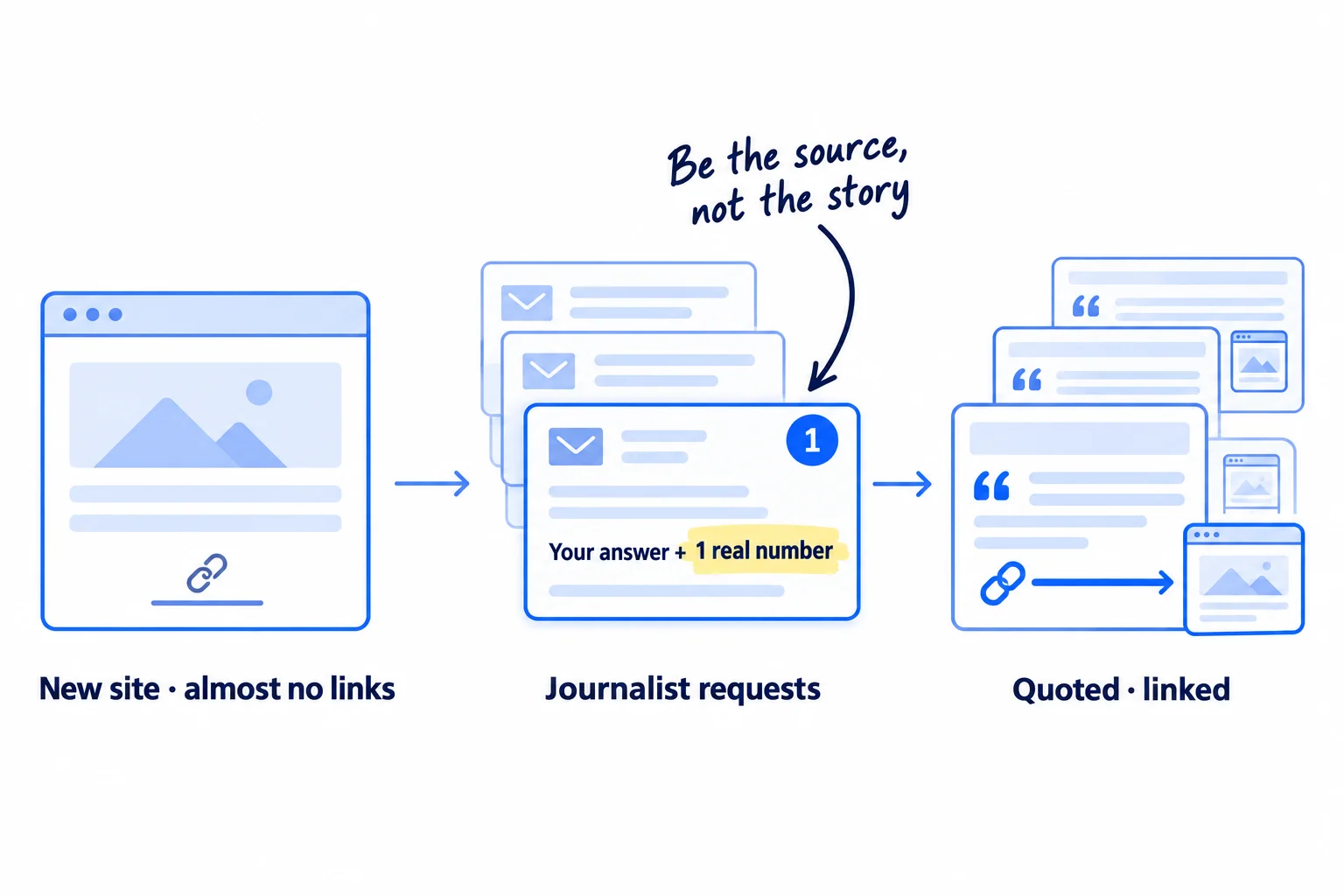
Your site is new, it has almost no backlinks, and everyone says one link from a news website is worth more than 100 small ones. Here is how to get backlinks from news websites with no PR budget: become the person journalists quote, by answering their requests every day, commenting on news the day it breaks, and sending local and trade reporters a small story built on your own numbers. If you wait for big news or pay for a press release, you get nothing, or links Google ignores.
Do these three things
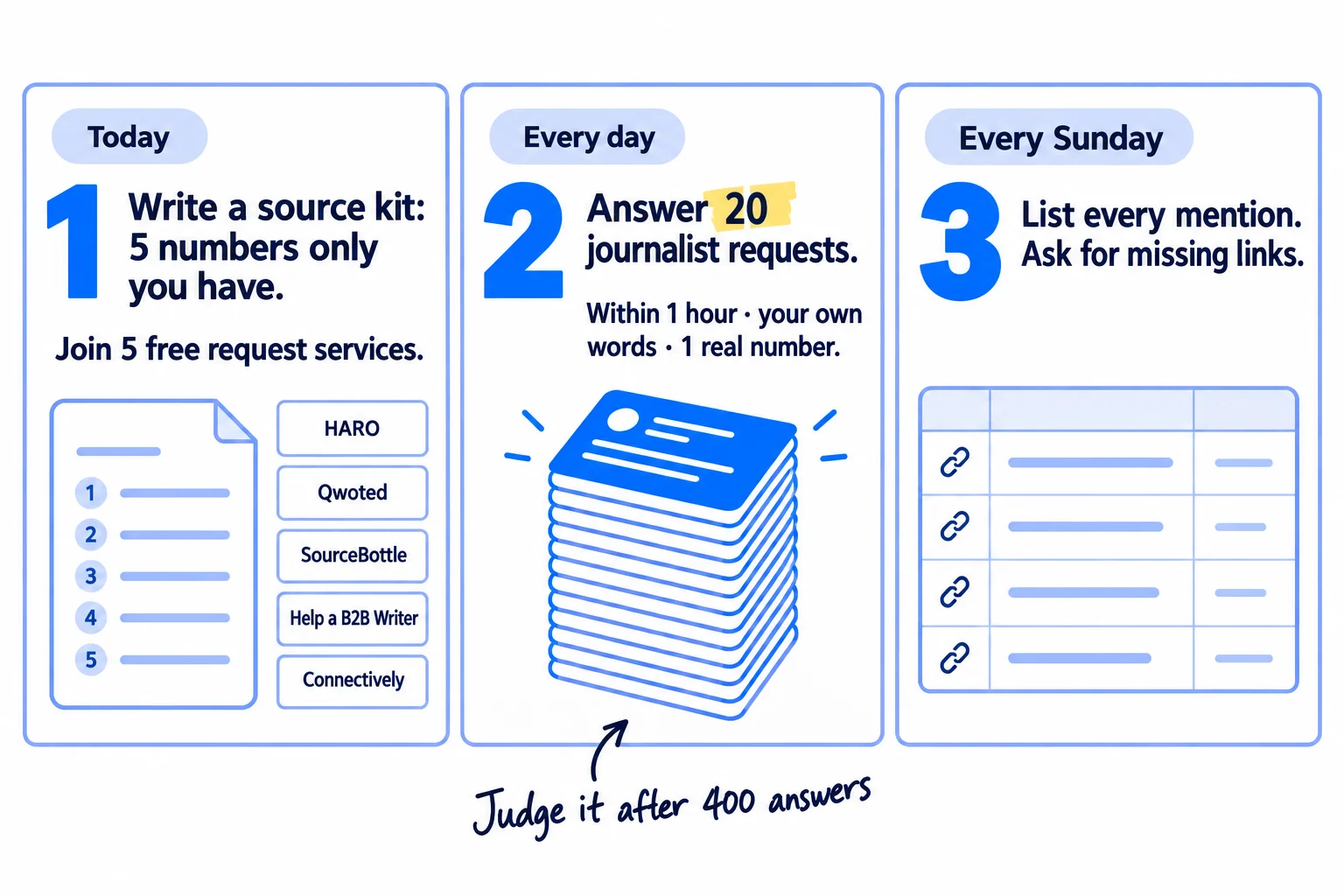
About 2 to 3 hours a day. Judge it after 400 answers, which is 20 days at 20 a day. Most answers are never used, and some mentions come without a link.
Show the three actions in fullHide the full list
- Today: write a one-page source kit with 5 numbers only you have, and sign up for 5 free journalist request services: HARO, Source of Sources, Featured, Help a B2B Writer and Qwoted.
- Every day: answer 20 journalist requests you truly know the answer to, within an hour, in your own words and with one real number. AI finds and sorts the requests; you write the answer.
- Every Sunday: list every article that mentioned you, ask for a backlink where one is missing, and count answers sent, mentions and links.
Get help doing these
ChatGPT or Claude reads this guide and works through it with you.
1. Write a source kit so journalists can quote you
A source kit is one page that tells a journalist who you are, what you know and how to credit you, so you can answer any request in 5 minutes. Journalists pick sources who clearly know the topic: in Muck Rack's 2026 survey of journalists, "clear relevance to their beat" and "original research or data" were among the things they value most in a pitch.
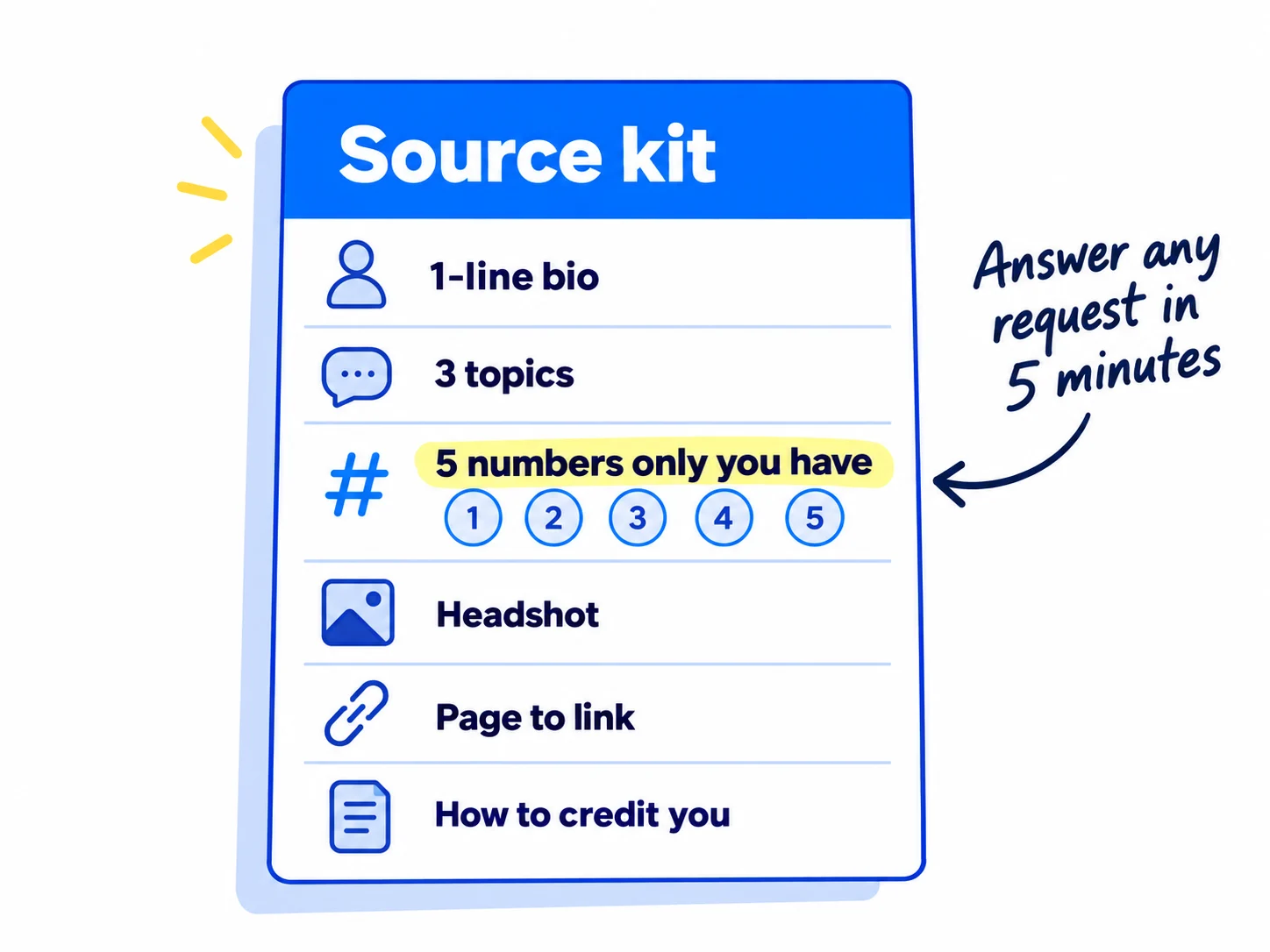
News links rarely come from pitching your product. They come from being useful to a journalist on a deadline. So the kit is about what you know, not what you sell.
Bio line: [Name], [title] at [Company], [one fact that proves you know this: years doing it, number of customers or jobs, a qualification].3 topics I can talk about with first-hand knowledge:
[topic your buyers ask you about]
[a problem you fix every week]
[a trend you see in your own numbers]
5 numbers only I have: [what your customers ask most, a price, a time, a count from your own work, a result]. Each with where it comes from.Headshot: [link to a clear, recent photo].
Page to link: [the most useful page on your site for a reader of the article, such as a guide or a data page, not only your home page].
Credit me as: [Name], [title] at [Company] ([yoursite.com]).
Phone or email for quick follow-up questions: [ ].
Ask ChatGPT or Claude to draft the bio line and topics from your website and your notes. Then add the numbers yourself. They are what a journalist cannot get from anyone else, so they make you worth quoting. Your customer interviews, the questions buyers ask in your daily messages and your own orders are the best places to find them. Pick topics your ideal customer cares about, so the coverage reaches people who might buy. Use the same bio line on your LinkedIn profile, because journalists check it before they quote you.
If your site has no links at all yet, spend one week on the easy first backlinks (profiles, directories, partners) next to this. News links take longer to arrive. Keep your daily routine for getting traffic to a new website going too: this work adds to it and does not replace it.
If you run an agency: your numbers can come from client work, added up, with no client named unless they agree. "Across [number] client accounts we ran this year, [finding]" is a number no one else has. A named client needs a case study and their written OK.
- Tool: Google Docs, and ChatGPT or Claude to draft the bio and topics. Free.
- Time: 1 hour.
- You will have: a one-page kit with a bio line, 3 topics, 5 numbers with their source, a headshot, the page to link and how to credit you.
- It worked if: someone who does not know you could quote you correctly from the kit alone, in 2 minutes.
- Common mistake: a kit about your product ("award-winning, all-natural"). Journalists do not quote adverts. They quote a person who knows something.
See it done: Ferns & Rinse's source kit
Ferns & Rinse is a made-up plant-based haircare brand with its own Shopify store. It sells one shampoo and one conditioner at $28 each, or both for $49.
Source kit
| Part | What they wrote |
|---|---|
| Bio line | Maya, co-founder of Ferns & Rinse, a plant-based haircare brand for dry, curly hair, started with her sister |
| 3 topics | Washing dry, curly hair; reading shampoo labels; starting a small beauty brand on Shopify |
| 5 numbers | $28 a bottle and what goes into that price; 2 months from store launch to today; the 3 questions every customer asks; how many label ingredients they cut and why; a count of ingredient lists they read (step 5) |
| Page to link | Their guide to reading a shampoo label |
| Credit | Maya, co-founder of Ferns & Rinse (fernsandrinse.example) |
Why it works: Every line is something a beauty or small-business writer could use, and none of it is an advert for the shampoo.
2. Sign up for free journalist request services like HARO
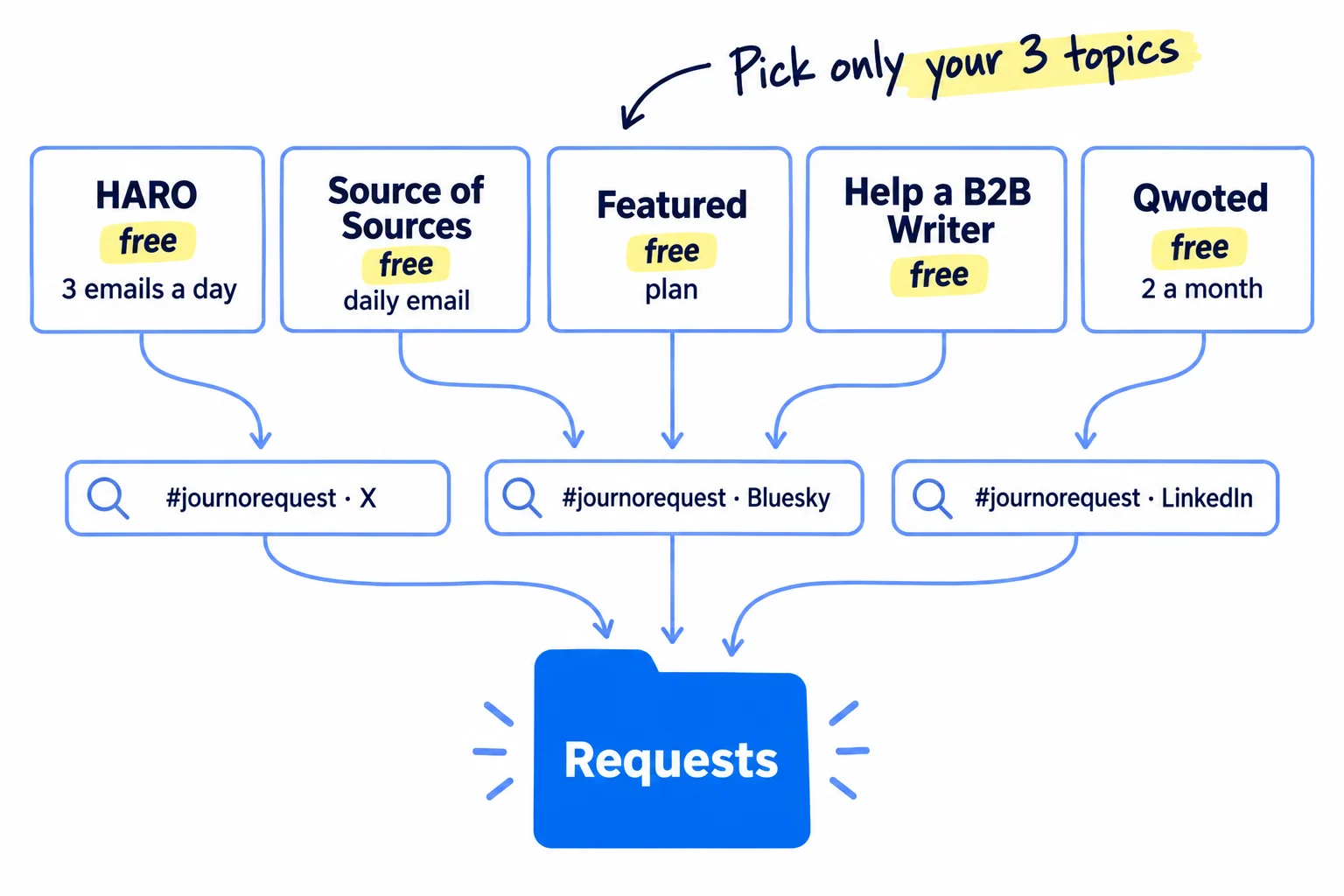
Journalist request services email you questions from reporters who need a source, and most are free. Sign up for these five today, pick only the topics in your kit, and send their emails to one folder so you can check them at set times.
| Service | What it costs today | What to know |
|---|---|---|
| HARO (Help a Reporter Out) | Free | Emails requests three times a day. It scores answers for AI writing, and it bans sources who send answers that do not fit the request. |
| Source of Sources | Free | A free daily email of requests, run by the man who first started HARO. |
| Featured | Free plan; Lite is $29 a month, paid yearly | The free plan has every feature, with a daily limit on its AI help. It also shows requests from HARO and LinkedIn. |
| Help a B2B Writer | Free | Requests from writers at business and trade sites. Best for B2B, SaaS and agencies. |
| Qwoted | Free plan: 2 answers a month, shown 2 hours late; Pro is $149 a month | Many requests come from large sites. Keep your 2 free answers for the requests that fit you best. |
When you sign up, choose only the categories that match your 3 topics. Add your topic words as keyword alerts where the service offers them. Then set an email filter that sends every request email to one folder called "Requests", so they do not bury your other work.
Some journalists post requests only on social media, with the tag #journorequest. Save three searches today: "#journorequest [your topic]" on X (sorted by Latest), on Bluesky and on LinkedIn. Posts there move fast, so check them at the same times as your folder.
Connectively, the name HARO used in 2023 and 2024, shut down on 9 December 2024. HARO came back on 22 April 2025 under Featured, free again. Advice that says "use Connectively" or "HARO is gone" is out of date.
If you run a D2C store: add the lifestyle, beauty, home or gift categories that match what you sell. About a quarter of all journalist requests are about home and lifestyle, so you will have more to answer than most. Coverage in these outlets also feeds the answers that recommend products in ChatGPT.
If you run a B2B company or SaaS: Help a B2B Writer and the business and technology categories on HARO and Featured bring the requests from the trade and business sites your buyers read.
- Tool: HARO, Source of Sources, Featured (free plan), Help a B2B Writer, Qwoted (free plan), and X, Bluesky and LinkedIn search. All free.
- Time: 45 minutes.
- You will have: accounts on 5 services with your topics chosen, one "Requests" folder and 3 saved searches.
- It worked if: by the next day, at least 30 requests have arrived in your folder.
- Common mistake: ticking every category. You then get 300 emails a day and answer none well. The other mistake is paying for a plan before you have sent 400 answers.
3. Answer 20 journalist requests a day in your own words
Answer 20 journalist requests a day where you truly know the answer, within an hour of seeing each one, with one real number in every answer. Each request gets many answers: on Featured, 42,392 requests drew about 1.4 million answers between June 2025 and July 2026, about 33 for each request. Being quick, on topic and specific is how you get picked.
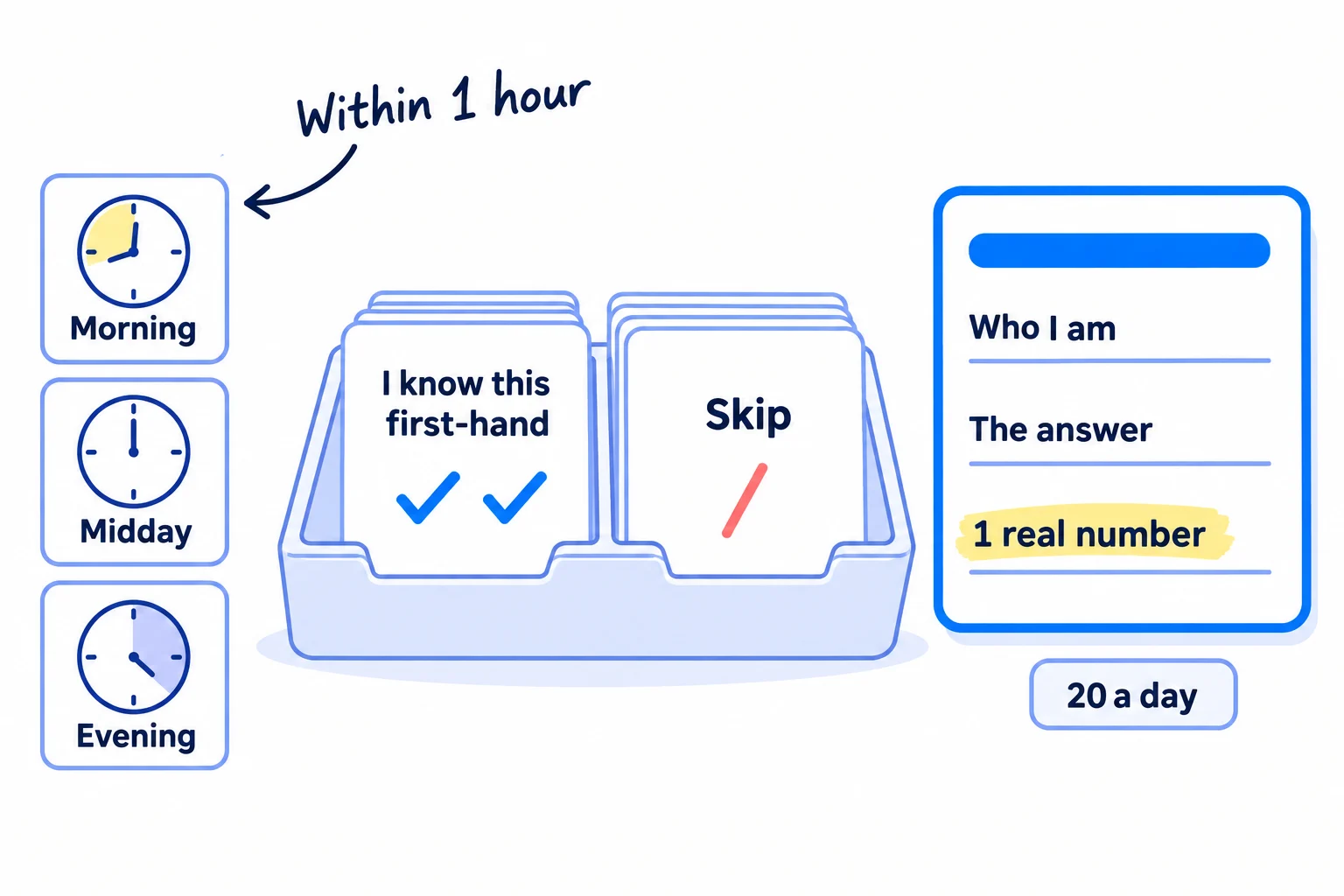
Check three times a day, at set times. Morning, midday and evening work because HARO sends three emails a day. Open your "Requests" folder and your 3 saved searches, and keep only requests where you have first-hand knowledge. Answer each within an hour of seeing it; BuzzStream's advice to sources puts speed first.
Let AI sort; write the answer yourself. Paste the day's requests and your source kit into ChatGPT or Claude, and ask it to list the ones your kit can answer, with the deadline of each. Once you have written an answer, ask it to check that you answered the exact question and kept to the word limit. Do not let it write the answer. In a 2026 study of Featured's data, fully AI-written answers were picked about 1 in 10 times and human ones about 1 in 3. More than a third of journalists on Featured choose to block AI-written answers, and HARO scores every answer for AI writing.
Subject: Re: [the request title, word for word] – [your credential in 5 words]Hi [journalist's name],[Answer their exact question in 1–2 sentences, with one number from your kit.][One example or reason only you know, in 1–2 sentences.][Optional: one more point, 1–2 sentences. Stop there.][Name], [title] at [Company] ([yoursite.com/page-to-link])
Headshot: [link]. I can answer follow-up questions today at [email or phone].
Keep each answer under 150 words, and write it so they can paste it into the article as a quote. Answer only the question asked. Do not add a pitch for your product, attachments or a "let's jump on a call".
How the 20 a day is possible. Sorting takes about 20 minutes with AI. Each answer takes about 5 minutes, because your kit already holds your bio, numbers and link. That is about 2 hours a day. If your topics bring fewer than 20 good requests a day, add more of your topic words to the saved searches and make up the number with same-day news comments (step 4). Never answer a request outside your field to hit the number: HARO bans sources for that, and journalists remember.
Know each service's limit. Qwoted's free plan gives you 2 answers a month, so use them on your 2 best fits. Featured's free plan limits its AI help each day. HARO has no answer limit, but off-topic answers get you banned. Featured also lists shows looking for guests; answer those the same way, and use the steps for getting booked on podcasts for the rest.
If you run a SaaS: requests about work tools, remote teams, productivity and small-business software fit best. Your usage numbers, added up and with no customer named, make strong answers: "Across [number] teams using our tool, [finding]." Check first that your terms and privacy policy allow it.
- Tool: your email, the 5 services, and ChatGPT or Claude to sort and check. Free.
- Time: about 2 hours a day, every day.
- You will have: 20 answers a day, 140 a week, each logged in a sheet with the date, outlet, request and topic.
- It worked if: after 400 answers (20 days at 20 a day), at least 10 have been used in an article. This is the guide's pass mark, not a promise. One agency's 2026 test got 143 mentions from more than 1,000 answers, about 1 in 7, but a new founder with no press yet should expect fewer. Below 5 used, rewrite your first lines and cut to the topics you know best before you send more.
- Common mistake: pasting AI-written answers, or answering hours late. Both put you at the bottom of a pile of 30.
See it done: Ferns & Rinse's answer to a request
To: A lifestyle writer who asked for haircare experts on HARO
Subject: Re: Experts wanted: how often should people with curly hair wash it? – Curly haircare brand founder
Hi Jess,
Most people with dry, curly hair do best washing 1 to 2 times a week, and using only conditioner on the days between. Washing every day can strip the oils that curls need to hold their shape.
Since we opened 2 months ago, 1 in 3 questions from our customers has been "why does my hair feel like straw after washing?" The answer is almost always too much washing with a strong shampoo, not a missing product.
Maya, co-founder of Ferns & Rinse (fernsandrinse.example/label-guide) Headshot: [link]. I can answer follow-up questions today at [email].
Why it works: The first line says why she can answer, the answer fits the exact question, and the number is one only her brand has.
4. Comment on news in your field the same day it breaks
When news breaks in your field, send a short comment with one new fact to the reporters covering it, within 2 hours. Reporters writing follow-up stories need a quote fast, so a quick comment with a fact they do not have is often used. This is how you get into the news without having news of your own.
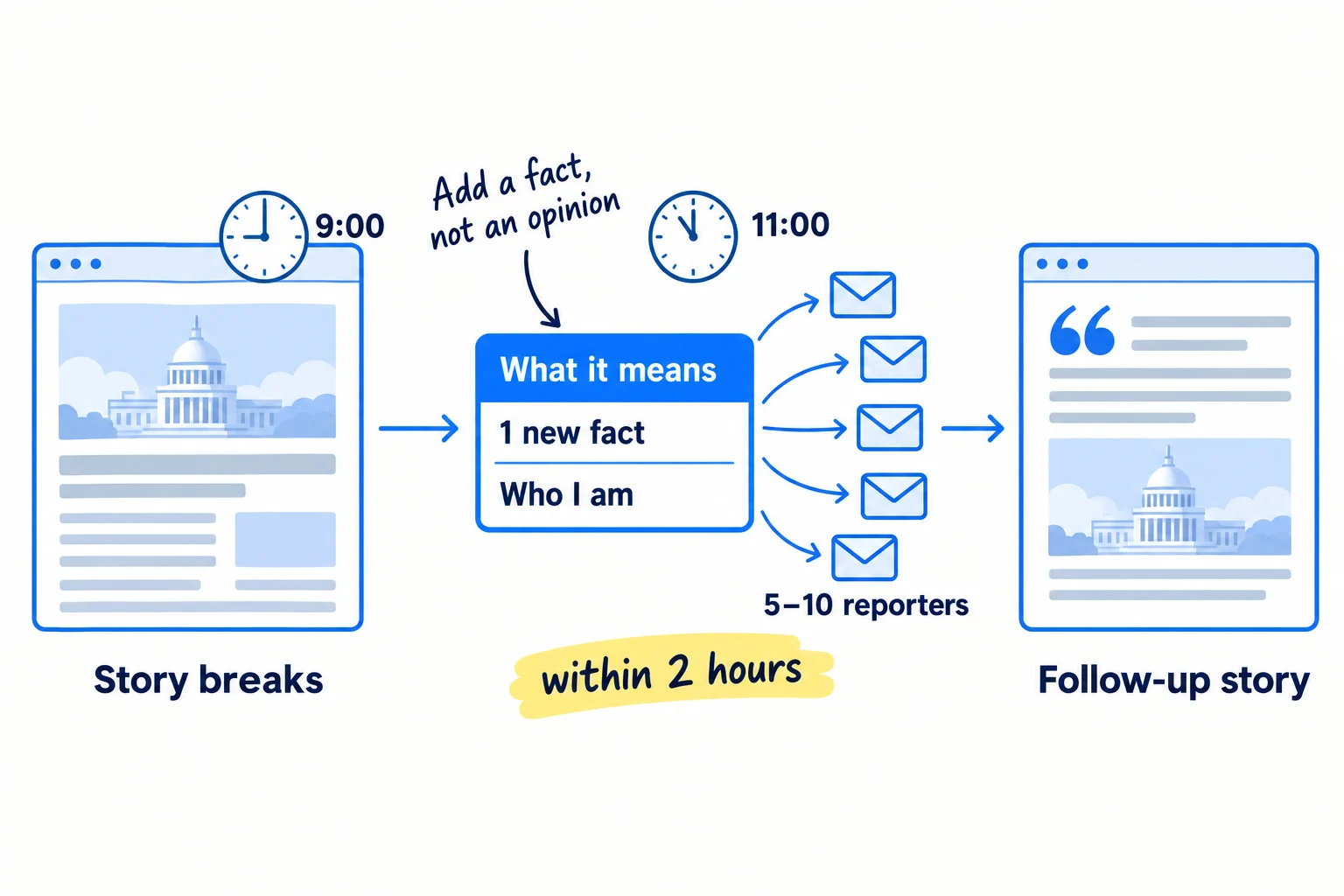
Set up the watch once. In Google Alerts, make one alert for each of your 3 topics, set to "As-it-happens". Then every morning, spend 15 minutes on Google News: search each topic, choose "Past 24 hours", and read the headlines. A new rule, a price change, a study, a product recall or a competitor's big move all count.
When a story fits, look at who wrote it and at who else covered it that day. Find the 5 to 10 reporters' emails in their author page or bio, or with the steps for finding someone's email address. Then send each one the comment as a personal message, with their name and their article in the first line.
Subject: Comment on [the news, in 5 words] – [your credential]Hi [name], I read your piece on [the news] this morning.[What it means for [the people affected], in one sentence.] [One fact or number from your own work that the story does not have yet.]Happy to be quoted as [Name], [title] at [Company] ([yoursite.com]). I'm free for a call until [time] today.
Post the same comment on LinkedIn or X too, with the topic in the first line. Reporters search there, and it shows people you have something to say. How to grow on LinkedIn as a founder and how to build in public on X show how to keep those accounts busy the rest of the week.
- Tool: Google Alerts and Google News, your email, and LinkedIn or X. Free.
- Time: 15 minutes a day to check; about 30 minutes more on days with a story.
- You will have: a same-day comment for every story in your 3 topics, each sent to 5 to 10 reporters.
- It worked if: at least 1 comment in 20 is quoted. Below that, add a harder fact to each comment, like a number or a date.
- Common mistake: an opinion with no fact, like "This is a big step for the industry." Every reporter already has ten of those. Send the number only you have.
5. Send local and trade news sites a story from your own numbers once a month
Once a month, turn a count of at least 100 things into a short story, put it on a page on your site, and send it to 100 reporters the same day, starting with local and trade news sites. Journalists say original data is one of the things they value most, and the page on your site is what they link to.
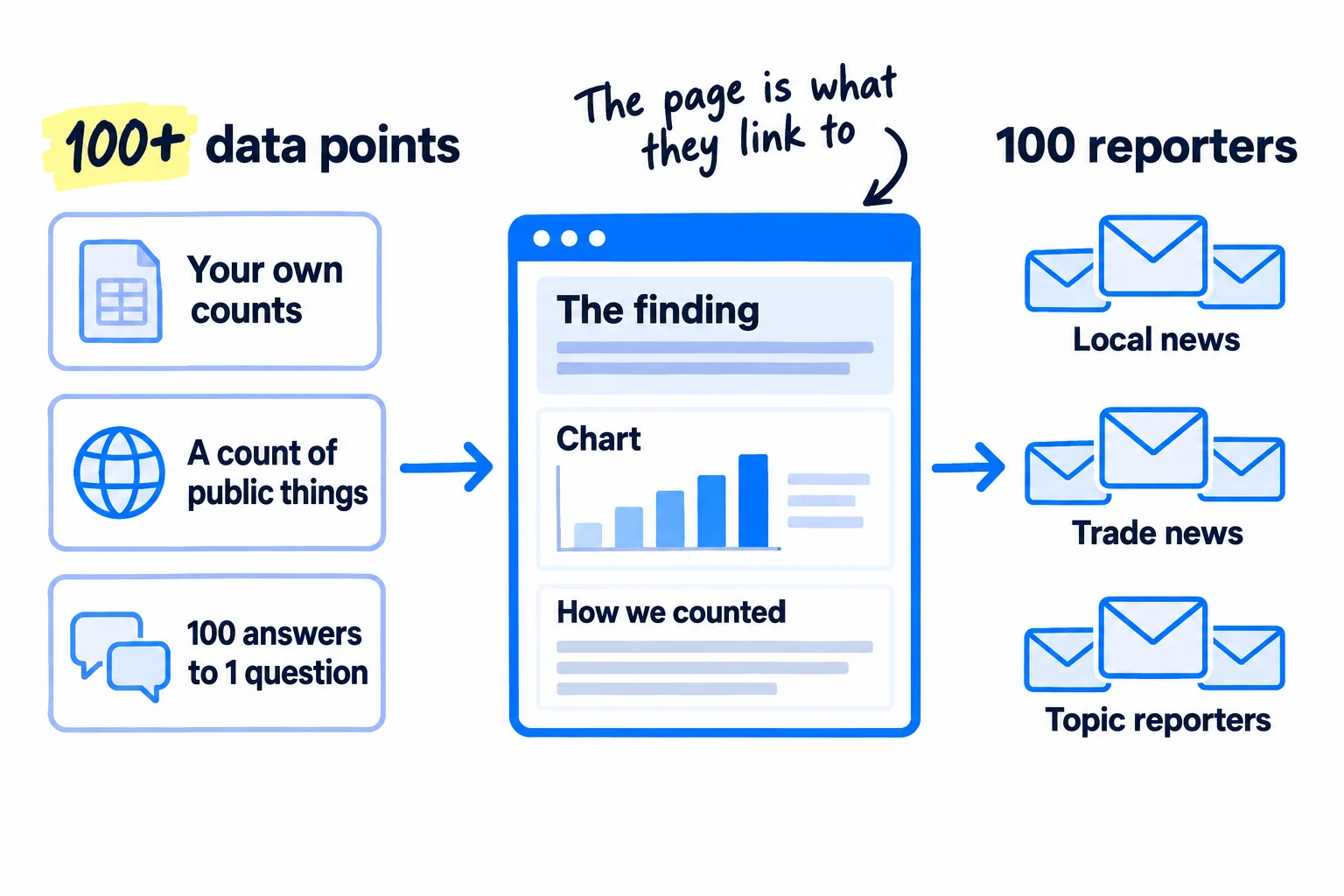
Pick one data source. Use the first one you can:
- Your own counts, if you have 50 or more of something: quotes sent, jobs done, support questions, signups, orders. Add them up; never name a customer without their OK.
- A count of public things: prices on 100 competitor pages (the same pages you read in a competitor analysis), the ingredient lists on the 50 best-selling products in your category, 200 job ads, 500 public reviews. AI helps you collect and count; you check every row by hand.
- 100 answers to one short question. Put one question in a free Google Form and ask it in your daily messages and in the communities where your buyers talk. Stop at 100 answers or more.
Fewer than 100 data points is not a story, and a journalist will spot it. If you know a company that sells to the same buyers, you can run it together and pool your counts. A small free tool, like a calculator, is another page reporters link to, once you have one.
Put it on one page on your site. The headline is the finding, as a plain fact with a number: "[Number] of [the 100 things you counted] [what you found]". Put the words people search for in it, found with a quick keyword check. Under it, give 3 findings with a simple chart, how you counted (what, when, how many), who you are, and how to reach you. A reporter who quotes your data links to this page, so it has to be the best place to read it, load fast and pass the technical SEO checklist. Write it like any page that ranks on Google, and ask Google to index it the day it goes live.
Build a list of 100 reporters who wrote about this topic in the last 3 months. Search Google News for the topic, choose "Past month", and write down each writer's name, outlet, article and email. Start with:
- Local news: your city paper's business desk, local TV news sites and your area's business journal. Muck Rack's 2026 survey found 78% of journalists call a pitch relevant when it affects their readers' community, so give them a local angle: "[City] founder finds…", or the numbers for your area.
- Trade news: the magazines and newsletters your buyers read for their work.
- Topic reporters: anyone who covered this exact topic recently, at any size of outlet, including writers of the "best of" lists that AI tools cite.
Send all 100 on the day the page goes live, one by one, each with the reporter's name and one line about their recent article. AI drafts the personal first line from their article; you check it and add anything true you know. The wording, follow-ups and timing are in how to pitch journalists. Follow up once, 3 days later, the same way as a cold email. Then turn the chart into posts for your own social accounts.
Subject: [The finding, as a number, in under 10 words]Hi [name], your [month] piece on [topic] made me count something.We looked at [what, how many, when] and found [the finding]. [One more surprising number.] [For local reporters: what it means for people in [city].]The full numbers, a chart and how we counted are here: [link to your page]. You're welcome to use the chart with a link back.[Name], [title] at [Company], [city]
Do not pay for a press release wire or a "featured in" package to get the links instead. Google's spam policy lists links with chosen words in "press releases distributed on other sites" and "exchanging money for links" as link spam, and paid links must be marked so they pass no ranking credit.
If you run a D2C store: a data story about your product type fits beauty, home and gift writers. Put the page on your store's blog, set up as in SEO for a Shopify store. For holiday gift guides, send samples with no strings attached. Google names "sending someone a product in exchange for them writing about it and including a link" as link spam, so never make a link a condition.
If you run a B2B company: your buyers' trade magazines are your main list. A count from your own quotes or jobs, such as average order size or lead times in your buyers' industry, is the kind of original data their editors ask for. Trade coverage also helps you get recommended by ChatGPT as a supplier.
If you run an agency: do this for your own agency first, in marketing trade news, then for clients as part of the SEO work you sell. Coverage you earn yourself is proof when you win clients without case studies.
- Tool: Google Sheets, Google Forms, Google News, your site, your email, and ChatGPT or Claude to help count and draft first lines. Free.
- Time: 1 day to build the data and the page, then about 3 to 4 hours on the day it goes live to send 100 pitches (about 2 minutes each with the AI-drafted first line).
- You will have: one data page on your site each month, and a list of 100 reporters with their recent article.
- It worked if: at least 3 pieces of coverage (a mention or a link) from every 100 pitches. Below that after 2 data stories, pick a finding that surprises more people, or a local angle.
- Common mistake: a "survey" of 12 friends, or a story that is really an advert for your product. Both get deleted.
See it done: Ferns & Rinse's data story headline
Before
Ferns & Rinse launches plant-based shampoo for curly hair
After
31 of the 50 best-selling shampoos contain sulfates, a count of their ingredient lists finds
They send it first to their hometown paper's business desk, with "Local sisters count…" in the first line.
Why it works: The new headline is a fact with a number that any beauty writer can use, and it does not mention their shampoo.
6. Check every mention every Sunday and ask for missing links
Every Sunday, find every article that mentioned you that week, write it down, check whether it links to you, and ask once for a link where it is missing. Many quotes are printed with no link, or with a link that tells Google not to count it. You can often fix the first with one short email.
Set up two free checks once. Make Google Alerts for your name, your company name and the headline of each data story, in quotes, set to "As-it-happens". Then open Google Search Console, go to Links, and look at "Top linking sites". Google says this report is only a sample and "doesn't specify if a link is marked as nofollow", so use it to spot new sites, not as a full count.
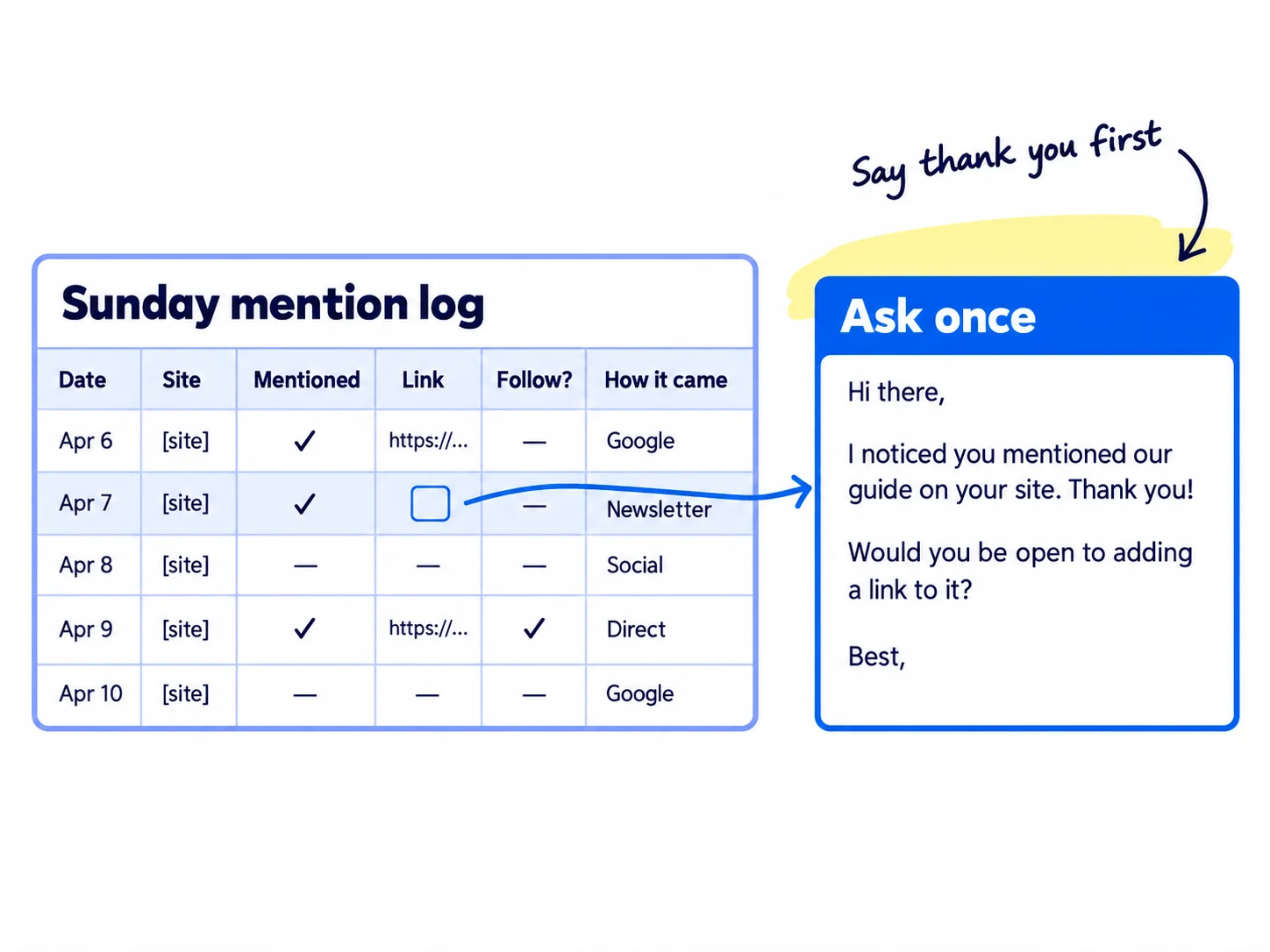
Every Sunday, fill in your mention log. Add every new article from your alerts, your answer log and your inbox. For each one, open the article, right-click the link to your site and choose Inspect. If you see rel="nofollow", rel="sponsored" or rel="ugc", Google will "generally not" follow it. Some news sites add nofollow to every outside link; that is their choice, so log it and move on. A mention still counts for something: in Muck Rack's May 2026 study of more than 25 million links cited by ChatGPT, Claude and Gemini, 84% came from earned media such as news coverage. That is how news helps you get mentioned by ChatGPT and in Google's AI Overviews, even without a link.
Date | Site | Article link | Mentioned? | Link to my site? | follow / nofollow / sponsored | Page linked | How it came (request / news comment / data story)
This week: answers sent __ | answers used __ | mentions __ | links __ | followed links __
Ask once for a missing link. If an article quotes you or uses your data but has no link, email the writer the same week. Thank them first, give the exact page, and make it one easy edit. Ask once only. Never ask them to change a nofollow link or the words in the link, the anchor text: that is their site's rule, and pushing it costs you the next story.
Subject: Thank you for including [me / our numbers] in [article title]Hi [name], thank you for quoting [me / our data] in your piece on [topic]. [One true line about the article.]If it helps your readers, the full [numbers / guide] are here: [exact page link]. Would you be able to add it where [the quote / the numbers] appear?Either way, happy to help with your next story on [topic].[Name]
Put your best coverage to work, too. Add an "As seen in" line to your home page with the outlets' names as plain text, which also helps a new store look trustworthy. Share each article on LinkedIn and your other accounts, and add "Where did you find us?" to your forms, a kind of self-reported attribution, so you can track which channel brought each customer. Each new link can help your pages over the following months; how long that takes is in how long SEO takes to work.
Judge the whole routine at 400 answers. Compare your log with these rules:
| After 400 answers, if… | Then |
|---|---|
| 10 or more were used, with at least 3 links | Keep going at 20 a day, and add one more data story a month |
| 10 or more were used, but almost none link | Put the page to link in every answer's sign-off, and move more of your time to trade sites and data stories |
| 5 to 9 were used | Rewrite your first lines around your strongest credential, and cut to your 2 best topics |
| Fewer than 5 were used | Stop and check 20 of your answers against the template: late, off-topic or AI-sounding answers are the usual cause |
If you run a SaaS or an agency: keep your mention log next to your SEO numbers, so you can see which new links came before your pages moved up.
- Tool: Google Alerts, Google Search Console, your browser's Inspect, and Google Sheets. Free.
- Time: 30 minutes every Sunday.
- You will have: a log of every mention and link, with follow or nofollow for each, and one email for every missing link.
- It worked if: every mention from the week is in the log, and every missing link has been asked for once.
- Common mistake: asking twice, or asking a journalist to change nofollow to follow. One polite ask, then let it go.
See it done: Ferns & Rinse asks for a missing link
To: The business reporter at the founders' hometown paper, who used their count with no link
Subject: Thank you for including our numbers in your piece on sulfate-free shampoo
Hi Tom, thank you for using our shampoo count in your piece last week. The photo of the market stalls was a lovely touch.
If it helps your readers, the full list of 50 shampoos and how we counted is here: fernsandrinse.example/sulfate-count. Would you be able to add it where the numbers appear?
Either way, happy to help with your next story on local makers.
Maya
Why it works: It thanks the writer first, gives the exact page, and asks for one small edit once.
Where Scout7 helps
Scout7 does part of step 5.
Step 5. Content Co-Pilot turns your data into the page reporters link to. It asks research-backed questions about the topic, then drafts the article with sections, sources, FAQs and structured data, and links it to your other articles. You bring the numbers, check every one, edit the draft and approve it; nothing is published without your approval. It can host the page on your own domain at /content, with the sitemap and robots.txt made for you.
Your news backlink checklist for the next 4 weeks
0 of 12 done
Work through this list with an AI assistant
It drafts the work and keeps track of what is done.
Frequently asked questions
- Is HARO free?
Yes. Since Featured bought it and brought it back on 22 April 2025, HARO is free for sources and journalists, paid for by sponsors in its emails. It sends requests three times a day. It scores answers for AI writing and bans sources who send answers that do not fit, so answer only what you know, in your own words, as in step 3.
- Are nofollow links from news sites worth anything?
They do not pass ranking credit the way a normal link does: Google says it will "generally not" follow them. They still bring readers, they can be found by Google in other ways, and news mentions are what AI answers cite most. Log them, share them, and put the outlet's name on your site. Then track your AI mentions to see the effect.
- Should I pay for a press release or a 'featured in' package to get news backlinks?
Not for links. Google's spam policy calls paid links that pass ranking credit, and links with chosen words in press releases sent to other sites, link spam. Spend the money's worth of time on 20 answers a day and a monthly data story instead. For real news, like a launch, see how to launch a B2B product.
- How long until a link from a news site helps my rankings?
Weeks to months. Google has to find the article, then your pages need time to move. Keep publishing and count your non-brand impressions every Sunday, as in how long SEO takes to work. If your pages are stuck at position 8 to 20, links plus an update to the page help most.
- Can I use ChatGPT to write my answers to journalists?
Use it to sort requests and check your answer, not to write it. In a 2026 study of Featured's data, fully AI-written answers were picked about 1 in 10 times, against about 1 in 3 for human ones. More than a third of journalists there block AI-written answers, and HARO scores every answer for it. See how to use AI for content for where AI helps most.
Sources
- 1.Spam policies for Google web search: Link spam — Google Search Central, updated 28 August 2026, checked 30 September 2026
- 2.Qualify your outbound links to Google — Google Search Central, updated 10 December 2025, checked 30 September 2026
- 3.Links report — Google Search Console Help, checked 30 September 2026
- 4.Help a Reporter Out (HARO) is back — HARO, April 2025, checked 30 September 2026
- 5.HARO Review 2026: Is Help a Reporter Out Worth Using Again? — MentionAgent, April 2026, checked 30 September 2026
- 6.Help a Reporter Out (HARO) is Back! (We Talked to the New Owner) — BuzzStream, 2025, checked 30 September 2026
- 7.Connectively has been discontinued — Cision, December 2024, checked 30 September 2026
- 8.Plans & Pricing — Featured, checked 30 September 2026
- 9.Qwoted Pricing: Free and Pro Plans for Experts — Qwoted, checked 30 September 2026
- 10.Source of Sources: free daily media queries — Source of Sources, checked 30 September 2026
- 11.How to Respond to HaB2BW Requests & Land Coverage — Help a B2B Writer, checked 30 September 2026
- 12.Journalist Requests: How to Find Them and Respond for Coverage — BuzzStream, 12 May 2025
- 13.The Data Behind 7 Top Journalist Request Platforms — BuzzStream, 25 July 2025
- 14.How journalists feel about citing AI-generated PR, according to data (Pangram Labs, via Stacker) — WSB-TV / Stacker, 28 September 2026
- 15.Muck Rack's 2026 State of Journalism Report — Muck Rack via GlobeNewswire, 19 March 2026
- 16.Data, experts and early access: What journalists want in 2026 (Cision State of the Media) — PR Daily, 13 May 2026
- 17.Generative Pulse: Earned Media Consistently Drives AI Citations, Holding at 84% — Muck Rack via GlobeNewswire, 7 May 2026
- 18.7 Best Journalist Query Platforms (Tested: 143 Brand Mentions from 1,000+ Pitches) — VisibilityStack, updated 28 September 2026
Next article to read
Related guides
- How to get backlinks for a new websiteGet backlinks for a new website with no budget or press contacts: take the 20 links you can get from your profiles, partners and directories today, list 100 sites that link to your competitors, publish one page worth linking to, send 100 personal pitches a day offering a guest article, a broken-link fix or a page for their list, and count new linking sites every Sunday.
- How to get your brand mentioned by ChatGPTGet your brand mentioned by ChatGPT: find the exact pages it reads when your buyers ask for a tool, agency or supplier, get your name onto them every day with pages, answers, messages and short videos, and count how often you are named every Sunday.
- How to get booked as a podcast guestGet booked as a podcast guest with no audience or PR budget: write a guest page with 3 episode ideas and a 2-minute video, find and pitch 100 shows a day that reach your buyers with one true line about a recent episode, follow up twice, ask every host for 2 introductions, and count bookings and leads every Sunday.
- How to get on the "best of" lists AI tools citeGet on the "best of" lists ChatGPT, Perplexity and Google AI cite: ask them 20 "best [what you sell]" questions and copy every list they use, publish a listing kit an author can use in 5 minutes, pitch 100 list authors a day until every list has heard from you, and count the lists and AI answers that name you every Sunday.
Guides that link here
- How to get backlinks for a new website
- How to get on the "best of" lists AI tools cite
- How to get your brand mentioned by ChatGPT
- How to get your products recommended by ChatGPTD2C
- How to do SEO for a Shopify storeD2C
- How to make an article rank higher on Google
- How to rank on Google Maps
- How to use Google Search Console
- Technical SEO checklist for a new website
Cite this page
Dinesh Bypilla (2026). How to get backlinks from news websites. Scout7 Academy. https://scout7.ai/academy/seo/how-to-get-backlinks-from-news-websites
Written by Dinesh Bypilla, Agentic systems engineer at Scout7. Reviewed by Murali Sid. Last checked 30 September 2026.
Quote any part of this guide with a link back to this page. © 2026 Scout7.
Markdown version of this page: https://scout7.ai/academy/seo/how-to-get-backlinks-from-news-websites.md