



How to get on the "best of" lists AI tools cite
Get on the "best of" lists ChatGPT, Perplexity and Google AI cite: ask them 20 "best [what you sell]" questions and copy every list they use, publish a listing kit an author can use in 5 minutes, pitch 100 list authors a day until every list has heard from you, and count the lists and AI answers that name you every Sunday.
ByDinesh BypillaReviewed byMurali SidLast checked 21 min read
![Three panels. Panel 1: an AI answer to 'Best [what you sell]?' that names five other businesses, with three small source cards under it labelled 'Best of lists', and the label 'Not named'. Panel 2: a sheet of lists, a stack of messages and an entry card, labelled 'Find the lists · pitch the authors'. Panel 3: a list page with a new row ticked, then the AI answer with one more name, labelled 'On the lists AI reads'. Handwritten note: 'AI copies the lists'.](/academy/illustrations/how-to-get-on-the-best-of-lists-ai-tools-cite/00-opening.webp)
When a buyer asks ChatGPT for the best tool, product or company in your field, the answer often comes from a few "best of" lists it read on the web, and if you are on none of them, you are left out of the answer. This guide shows how to get on the "best of" lists AI tools cite, so ChatGPT, Perplexity and Google's AI have a reason to recommend you. Three emails tell you nothing. With AI drafting, you can reach the author of every list that matters within a week or two.
Do these three things
![Do these three things. 1, today: ask ChatGPT, Perplexity and Google AI Mode 20 'best [what you sell]' questions and copy every list they cite into one sheet. 2, every day: send 100 personal pitches to list authors, each with a ready entry and free access; when fewer than 100 lists are left, pitch them all and find new ones. 3, every Sunday: ask the 20 questions again and count the lists and answers that name you. About 5 hours a day while you have lists to pitch.](/academy/illustrations/how-to-get-on-the-best-of-lists-ai-tools-cite/01-three-actions.webp)
About 5 hours a day while you have lists to pitch, then about 1 hour a day for new lists and follow-ups. Judge your pitches after 700 and the AI answers at month 3. Nobody can promise a mention.
Show the three actions in fullHide the full list
- Today: ask ChatGPT, Perplexity and Google AI Mode 20 "best [what you sell]" questions your buyers ask, and copy every list they cite into one sheet.
- Every day: send 100 personal pitches to the authors of those lists, each with a ready entry and free access. AI drafts each one; you add one true line about the list. When fewer than 100 lists are left, pitch them all and find new ones.
- Every Sunday: ask the 20 questions again and count the cited lists that include you and the answers that name you.
Get help doing these
ChatGPT or Claude reads this guide and works through it with you.
1. Write down 20 "best" questions your buyers ask ChatGPT
Write 20 questions a buyer would type into ChatGPT when looking for something like yours, each starting with "best", "top" or "[competitor] alternatives". These questions decide which lists you find, so make them narrow: who it is for, what size, what price, and where.
![A list card titled '20 questions' with three example rows: 'Best [what you sell] for [kind of buyer]', 'Best free [what you sell]', '[Competitor] alternatives'. A wide question 'Best [what you sell]' is crossed out with the note 'too wide'. Handwritten note: 'Narrow beats wide'.](/academy/illustrations/how-to-get-on-the-best-of-lists-ai-tools-cite/02-step-1.webp)
Start in Google. Type "best [what you sell]" and write down every suggestion that drops down. Do the same for "[competitor] alternatives" for each of your 3 to 5 competitors, and for "best [what you sell] for". These are phrases people really search for. Then add the words your customers used when they found you. If you have notes from customer interviews, copy their exact phrases.
Then give your list to ChatGPT or Claude and ask: "A buyer looking for [what you sell] for [kind of buyer] might ask an AI assistant these questions. Suggest 20 more ways they would ask it, using 'best', 'top' or 'alternatives'." Keep the ones a real buyer would type. Delete the rest.
Use this mix:
- 5 questions with the kind of buyer in them: "best [what you sell] for [kind of buyer]".
- 5 with a size, price or need: "best free…", "best… for small teams", "best… under $50".
- 5 "[competitor] alternatives" questions, at least one for each competitor.
- 5 broad ones: "best [what you sell] in 2026", "top [what you sell]".
If you run a B2B company: add your place and industry: "top [what you make or do] suppliers in [country]", "best [service] companies for [industry]". Many supplier lists are written by place. The rest of being recommended as a supplier is its own job.
If you run a D2C store: ask the way shoppers do: "best [product] for [need]", "best [product] under $[price]", "best [product] gifts for [person]". The last kind finds gift guides. Your product pages are their own job.
If you run an agency: ask the way your clients would: "best [service] agencies for [your niche]", "top [service] agencies in [city]".
- Tool: Google search, ChatGPT or Claude, and a Google Sheet. All free.
- Time: 30 minutes.
- You will have: 20 questions in the first tab of your sheet.
- It worked if: at least 10 of the 20 show up in Google's suggestions, or a customer says "yes, I'd type that".
- Common mistake: asking only "best [what you sell]". The biggest names win the broad questions. A new business fits on the narrow lists: the ones for one kind of buyer, one size or one price.
2. Ask ChatGPT, Perplexity and Google AI Mode each question and copy every list they cite
Ask each of your 20 questions in ChatGPT, Perplexity and Google AI Mode, open the sources each answer used, and copy every page that lists several businesses into one sheet. These are the "best of" lists the AI tools are reading for your buyers right now.
![Three chat windows labelled 'ChatGPT', 'Perplexity' and 'Google AI Mode', each answering '[Your question]' with source cards under the answer. Arrows carry the source cards into one sheet with the columns 'List', 'Cited by', 'Updated', 'You on it?'. Handwritten note: 'Copy every list'.](/academy/illustrations/how-to-get-on-the-best-of-lists-ai-tools-cite/03-step-2.webp)
This is where the work starts, because the lists matter more than most founders think. In a study published in December 2025, Ahrefs looked at 26,283 pages ChatGPT used to answer 750 questions about software, products and agencies. "Best X" lists were 43.8% of them, more than any other kind of page. More buyers now ask this way: in G2's March 2026 survey of 1,076 software buyers, 51% said they start their research in an AI chatbot.
Ask each question the same way in each tool:
- 1
ChatGPT
Open a new chat, so earlier chats do not shape the answer. Web search works on the free plan and without an account. Ask the question, then click "Sources" under the answer, when it shows, to see the pages it used.
- 2
Perplexity
Ask the question on the free plan. Every answer shows numbered sources; click each number to open the page.
- 3
Google AI Mode
Open AI Mode in Google search and ask the question. It is free. Open each linked page in the answer. Then do a normal Google search for the same question and look at the top 10 search results, because Google's AI Overviews use pages from Google's own search index.
Copy every page that names several businesses: "best…", "top…", "…alternatives", "…compared". Skip pages about one business. Put each list in your sheet once, with these columns:
List title | Address | Site | Question it answers | Cited by (ChatGPT / Perplexity / AI Mode / Google top 10) | Last updated | Are you on it? | Author | Contact | Pitched (date) | Follow-ups | Result | Live entry checked
Sort the sheet so you pitch the best lists first. Lists cited by 2 or more tools go to the top. Then lists updated in the last 12 months, because AI tools favour fresh lists: Ahrefs found 79% of the lists ChatGPT cited had been updated that year, and 26% in the past two months. Lists you are already on go to the bottom.
Some sources are not lists you pitch. Sort them out now:
- A review site's category page (G2, Capterra, Clutch). You get on these with a profile and reviews, not a pitch. Set up the directory profile once, then collect G2 reviews or Clutch reviews.
- A Reddit or forum thread. You cannot pitch a thread. Answer new threads like it, helpfully and without getting banned.
- A competitor's own "best of" page. Keep it in the sheet and pitch it last. Many of these name rival businesses too.
Then fill the sheet past what the AI tools showed. Lists that name 2 or more of your competitors but not you are the lists AI may cite next. Search Google for "best [what you sell]", intitle:best [what you sell] and "[competitor] alternatives", and add every list that names a competitor. Finally, set a Google Alert for "best [what you sell]": type it in the box, click "Show options", choose "As-it-happens", and click "Create Alert". Each new list arrives by email; add it to the sheet the same day.
- Tool: ChatGPT, Perplexity and Google AI Mode (all free), Google search, Google Alerts and your Google Sheet.
- Time: about 2 hours for the first 20 questions in three tools, then 30 minutes a day to add new lists.
- You will have: one sheet with every list the AI tools cite for your buyers, sorted, with the ones you are missing from at the top.
- It worked if: every question has its rows and the sheet holds at least 30 lists you are not on. Fewer than 30 means your questions are too narrow or too few: add 10 more from step 1.
- Common mistake: asking one question once in one tool and pitching the first three lists. The answers change between tools and between days. Twenty questions in three tools show you which lists keep coming back.
See it done: The top of Quillfox's lists sheet
Quillfox is a made-up one-person agency. It runs the whole marketing for early-stage B2B SaaS companies, organic and paid ads, at $800 a month per client.
Lists sheet, sorted
| List | Question it answers | Cited by | Last updated | On it? | Next |
|---|---|---|---|---|---|
| A marketing blog's "Best SaaS marketing agencies for startups" | best saas marketing agency for startups | ChatGPT, Perplexity, AI Mode | August 2026 | No | Pitch first |
| A founder newsletter's "Top B2B SaaS marketing agencies" | top b2b saas marketing agencies | ChatGPT, Google top 10 | June 2026 | No | Pitch |
| A review site's "SaaS marketing agencies" category | best saas marketing agency | Perplexity, AI Mode | Always live | No | Make a profile |
| A Reddit thread asking for a SaaS marketer | saas marketing agency recommendations | ChatGPT | May 2026 | No | Answer threads like it |
Why it works: The lists at the top are cited by more than one AI tool, were updated this year, and Quillfox is on none of them.
3. Make a listing kit a list author can use in 5 minutes
Put everything an author needs to add you on one page of your site: a 50-word entry, who you are best for, your price, three strengths with numbers, one honest limit, proof, three images and free access. Authors add the business that is easiest to write about, and the kit is what makes that you.
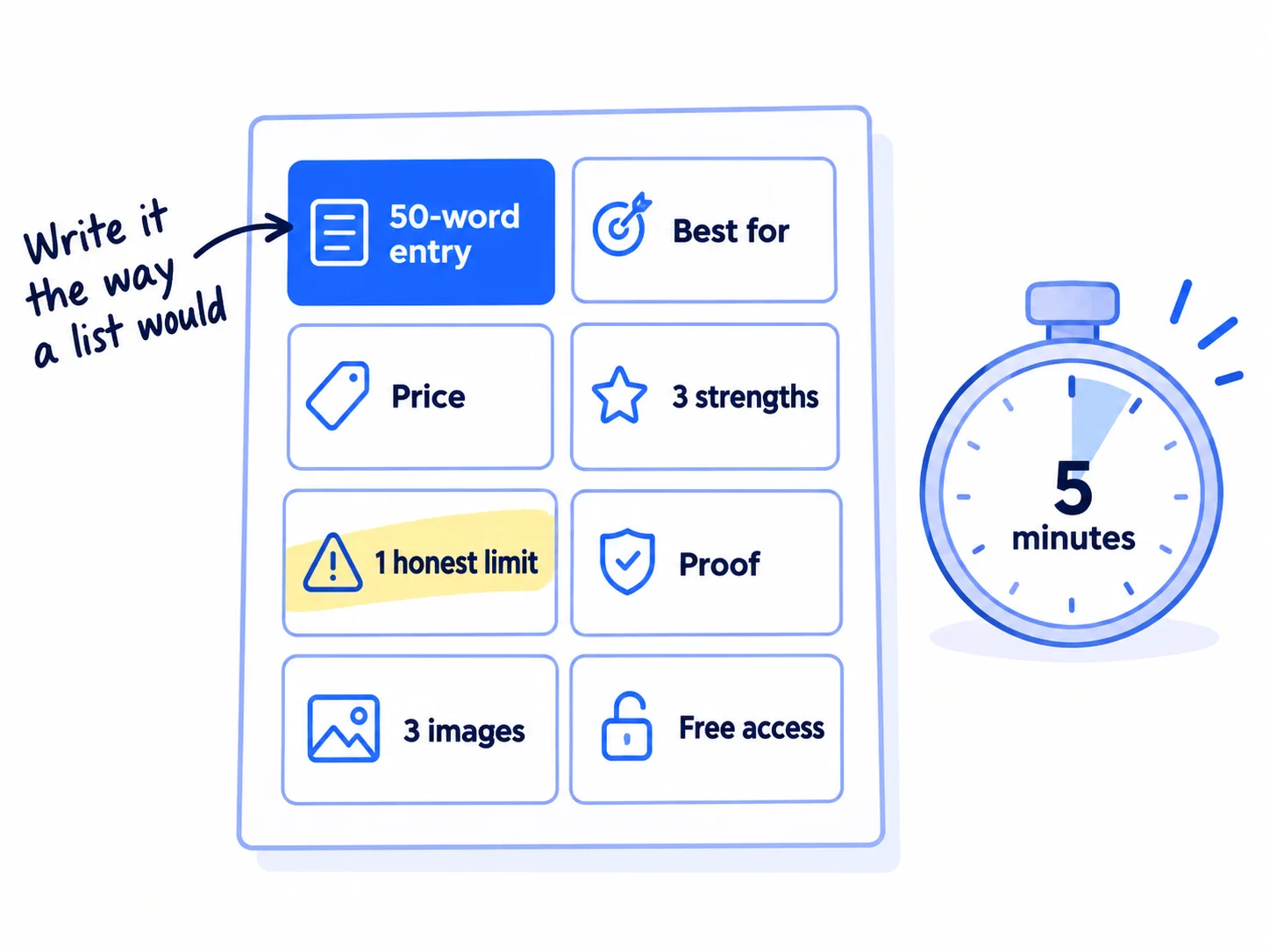
Write it in list voice: plain, fair and specific, like the other entries on the list. An author who has to rewrite sales copy into plain words may skip you. Add proof where you can, and one honest limit, such as "no free plan" or "only ships in the US". It makes the rest easier to believe.
Let AI draft it. Give ChatGPT or Claude your homepage text, your value proposition and your pricing, and ask for the kit below in a neutral voice with no adjectives like "best" or "leading". Then check every fact yourself. Put the same facts on your own site, so every page an AI tool reads says the same thing. Check that your site does not block ChatGPT's search crawler, OAI-SearchBot: OpenAI says sites that block it are not shown in ChatGPT search answers. Publish the kit at an address like yoursite.com/press, so every pitch can link to it. It is a normal web page and needs no special AI files.
Name: [business name] · Website: [address]One line: [what it is] for [kind of buyer], [the result, in under 15 words].Entry (about 50 words): [What it does, for whom, and what makes it different, in plain words. One number.]Best for: [the kind of buyer, size or need]
Not for: [the honest limit, such as "teams over 50 people" or "no free plan"]
Price: [from $X a month / free plan / "from $X per order"], checked [date]Three strengths, each with a number:
[strength, with a number]
[strength, with a number]
[strength, with a number]
Proof: [one customer quote with name and company, a real number, or a review score with its source]Images: [3 screenshots or product photos, 1200 pixels wide, and your logo, to download]Free access for writers: [a free account / a full demo / a sample sent free / a 20-minute call]Contact: [your name, email, and a reply time, such as "within a day"]
If you have no customers to quote yet, use what you have, the same way you would without case studies: a number from your own use, a short case study of free work, or the first testimonial you can collect.
If you run a D2C store: offer to send the product free, with no condition. Google's spam policies name "sending someone a product in exchange for them writing about it and including a link" as link spam, and in the US the FTC expects writers to tell readers when they got something free. Say: "There is no need to include us, and please say it was a free sample if you do." The same rule applies to creators.
If you run a SaaS: give writers a full account with no time limit, or a live demo, not a 14-day trial. A list author may test you weeks after your pitch.
- Tool: your website, a Google Doc, and ChatGPT or Claude to draft.
- Time: about 2 hours.
- You will have: one live kit page with your entry, facts, proof, images and an offer of free access.
- It worked if: you show the page to someone who does not know you, and they can write a fair 50-word entry about you from it in 5 minutes.
- Common mistake: an entry full of "leading", "powerful" and "all-in-one". It tells the author nothing they can write. The other mistake is a price on the kit that differs from your site. AI tools will repeat whichever one they read.
See it done: Quillfox's 50-word entry
Before
Quillfox is a results-driven, full-service growth partner that helps ambitious SaaS brands unlock their full potential with data-led, AI-powered marketing.
After
Quillfox is a one-person agency that runs the whole marketing job for early-stage B2B SaaS companies with 2 to 15 people: social, content, SEO and paid ads. Best for founders still doing the marketing themselves. Not for: companies that need a large team or a full in-house design studio.
Why it works: The new entry says who it is for, what it does and one limit, in the same plain voice as the rest of a list.
4. Pitch 100 list authors a day and follow up 3 times
Send 100 personal pitches a day to the people who write the lists in your sheet, starting at the top. Each pitch names their list, says which kind of reader it does not serve yet, and links your kit. When fewer than 100 lists are left that you have not pitched, pitch them all, then spend the rest of the time finding more.
![A tall stack of message cards labelled '100 pitches a day'. The front card reads 'Hi [name], your list [list title] has no option for [kind of buyer]. Here is a 50-word entry and free access.' Beside it, a small note card: 'Fewer than 100 lists left? Pitch them all, then find more.' Handwritten note: 'Name their list'.](/academy/illustrations/how-to-get-on-the-best-of-lists-ai-tools-cite/05-step-4.webp)
Find the author. The name is usually under the title or at the bottom. Open their author page or LinkedIn and find an email address; if there is none, use the site's contact page, or find the editor's email. Write to the person, not to "info@". Add each contact to your sheet.
Say why you fit. Read the list for two minutes. Look for the gap: a kind of buyer, a price or a size with no good option on the list. That gap is the first line of your pitch. A list that names only big businesses may have no option for small buyers. That is where a new business fits.
Let AI draft, then add the true line. Paste 10 rows from your sheet into ChatGPT or Claude at a time, each with the list title and the gap you found, plus the template below. Ask for one pitch per list. Read each draft, make the first line true about that list, and send it. That is about 2 minutes a pitch, so 100 pitches take about 3 and a half hours.
Subject: an option for [kind of buyer] on your [list title]Hi [first name],[One true line about their list: the date it was updated, a choice they made, a gap you noticed.]Your list doesn't have an option for [the gap: kind of buyer, price or size]. [Business name] is [one line from your kit].If it's useful, everything you'd need is here: [kit page link]. It has a 50-word entry, prices, screenshots and one honest limit. I can also give you [free access] so you can try it yourself.No need to reply if it's not a fit.[Your name]
[Business name, postal address]
Not for you? Reply "no" and I won't write again.
Send them safely. The rules are the same as for backlink pitches. Send one at a time from your normal work email. Gmail requires every sender to have SPF or DKIM set up and spam reports below 0.3%. If you email more than about 50 strangers a day, set up a second domain for pitches and warm it up first. In the US, the CAN-SPAM Act needs your postal address and a way to say no in every message. LinkedIn limits connection invitations each week, so message authors you are already connected to there, and send the rest by email.
Follow up. Follow up with everyone who has not replied, up to 3 times, 4 days apart, each time with one new line: a new customer, a new number, a feature they asked about. Lists are updated in their own time, so a "maybe later" is worth a note in your sheet and a follow-up when the list is updated. Stop the moment someone says no.
When lists run out. 100 a day goes through a sheet fast. When fewer than 100 lists are left, pitch every one, then use the rest of the time to find more, as in step 2: 10 new questions, an "alternatives" search for each competitor, lists that name your competitors, and lists in the topics next to yours that your buyers also read. Never pitch a list that has nothing to do with your buyers to keep the number up. Writers of the lists you are already on are worth a second pitch for their other lists.
If a list asks for money. Some lists, and agencies that sell "list placements", charge to add a business. Use this rule:
- Say no to any paid spot the page does not label. Google's spam policies count "exchanging money for links, or posts that contain links" as link spam, unless the link is marked
rel="sponsored"orrel="nofollow". In the US, the FTC says a paid connection that readers would not expect must be disclosed "clearly and conspicuously", and the business that pays is responsible for it too. - If you choose to pay, pay only where the entry says it is sponsored or paid, in words a reader sees, and the link to you is marked
rel="sponsored". Ask for both in writing before you pay. - An affiliate list is fine if the page tells readers it earns a commission. If you have an affiliate program, offer it.
- Never swap lists. "Add us and we will add you" is a link exchange, and Google's spam policies name "excessive link exchanges" as link spam.
If you run an agency: you can pitch these lists for your clients too, from the client's own email and with the client's approval. AI visibility work like this is a service you can sell.
- Tool: Gmail, ChatGPT or Claude to draft, and your Google Sheet to log every pitch and follow-up. No paid tool needed.
- Time: about 3 and a half hours for 100 pitches and 30 minutes for follow-ups, every day while you have lists to pitch.
- You will have: 700 pitches sent and logged by the end of week 1, or every list in your sheet pitched, whichever comes first.
- It worked if: after 700 pitches and their follow-ups, at least 3 lists in every 100 have added you or promised to. Below 1 in 100, rewrite the first line so it names the gap more clearly, and check the kit against step 3.
- Common mistake: "Please add us to your list" with nothing for the author's readers. The other mistake is paying for a spot the page does not label, or swapping lists. Both break Google's rules, and a paid spot readers cannot see is misleading.
See it done: Quillfox's pitch to a list author
To: Dana, who writes a marketing blog's list of SaaS marketing agencies
Subject: an option for 2–15 person SaaS teams on your agency list
Hi Dana,
I saw you updated "Best SaaS marketing agencies for startups" in August and added prices. That made it the most useful one I found.
Every agency on it works with funded teams of 30 or more. There's no option for a SaaS company of 2 to 15 people where the founder still does the marketing. Quillfox is a one-person agency that runs the whole marketing job for exactly those teams.
If it's useful, everything you'd need is here: quillfox.example/press. It has a 50-word entry, prices, examples and one honest limit. Happy to do a 20-minute call if you'd like to ask me anything.
No need to reply if it's not a fit.
Alex Quillfox, [postal address] Not for you? Reply "no" and I won't write again.
Why it works: It names the gap in her list, gives her a ready entry, and asks for nothing she has to pay or swap.
5. Check each new listing within a day and keep it correct
Open every new entry about you within a day of it going live, and send the author a fix for anything wrong. AI tools repeat what a list says, so an old price or the wrong "best for" line follows you into the answers.
![A list page with one entry highlighted. Four checks beside it, ticked: 'Name', 'Price', 'Link', 'Best for'. A short message card reads 'One fix: our price is now [price]. Thank you for adding us.' Handwritten note: 'Check within a day'.](/academy/illustrations/how-to-get-on-the-best-of-lists-ai-tools-cite/06-step-5.webp)
Check four things: your name is spelled right, the price is today's, the link works and goes to the right page, and the "best for" line matches your kit. If something is wrong, reply with one line and the correct fact. Thank the author either way. Then share the list once with the people who follow you, for example on LinkedIn, if it helps your buyers. If you share the link, tag it with UTM parameters so you can see the visits.
Every time your price, plan or product changes, email every author whose list includes you, with the new fact and the date. Keep this list in the "Live entry checked" column of your sheet.
- Tool: email and your Google Sheet.
- Time: about 10 minutes for each new listing.
- You will have: every live entry checked, with the date in your sheet.
- It worked if: every row marked "Live" has a check date within 24 hours of going live, and every fix you asked for is made or followed up.
- Common mistake: never reading the entry. One wrong price on a list that AI cites can be repeated in AI answers until someone fixes it.
6. Ask your 20 questions again every Sunday and count where you appear
Every Sunday, ask your 20 questions again in ChatGPT, Perplexity and Google AI Mode, in new chats, and count three things: how many cited lists there are, how many of them include you, and how many answers name you.
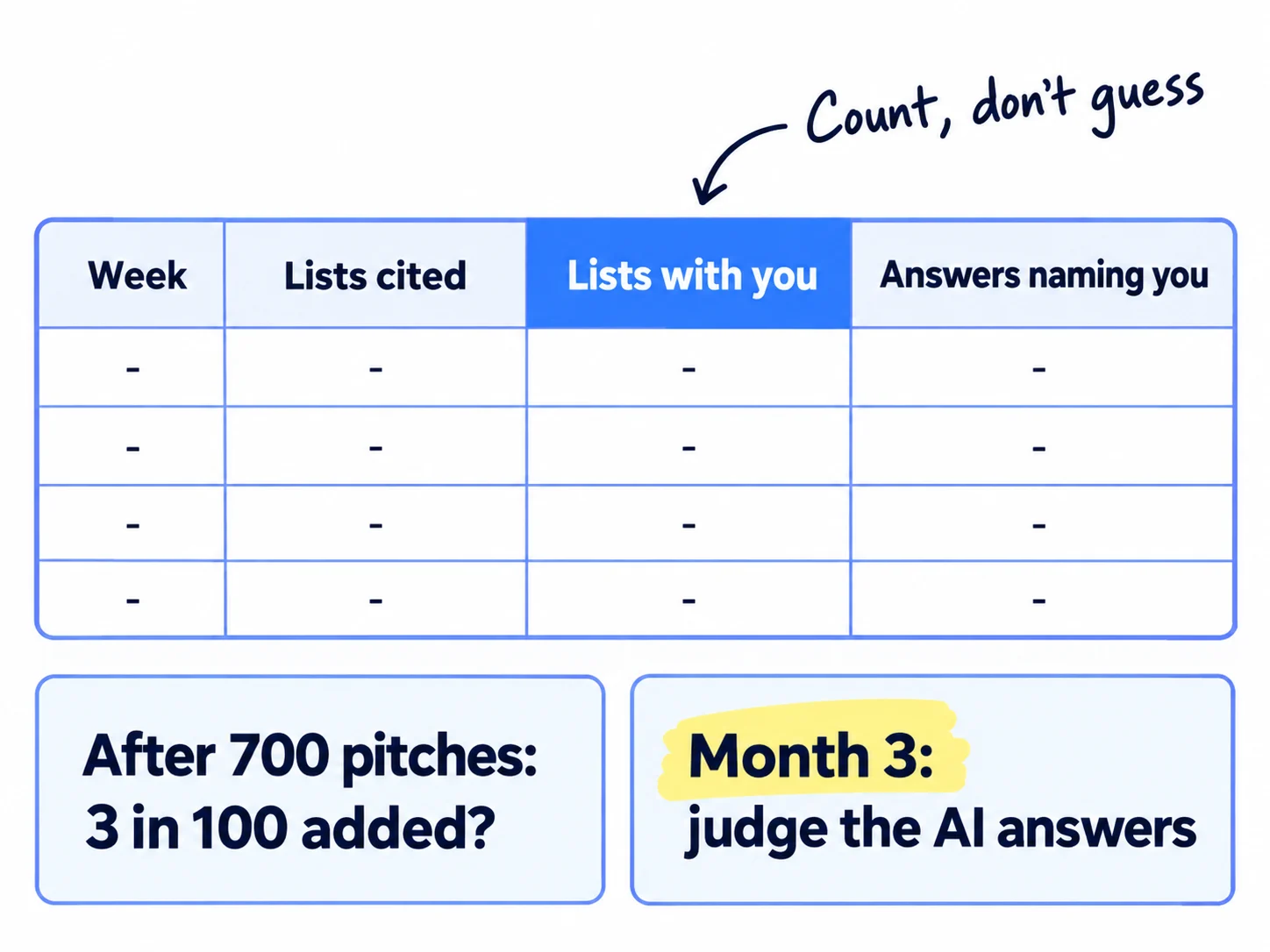
Fill in one row each Sunday:
Week | Pitches sent | Lists that added you (total) | Cited lists | Cited lists that include you | Answers naming you: ChatGPT / Perplexity / AI Mode (out of 20 each) | New lists found
Ask in new chats each time, because one answer can change from day to day. Count over all 20 questions, not one. To also count the visits these answers send you, track your AI traffic.
Make two decisions, at two different points:
- After 700 pitches: if fewer than 1 list in 100 has added you, change the pitch (step 4) or the kit (step 3) before you send more. Between 1 and 3, keep sending and change one part at a time. If 3 or more in 100 have, keep going.
- At month 3: judge the AI answers. Lists are updated in their own time, and the AI tools have to read the new version before your name can appear. Until month 3, count lists, not answers.
Being on a list is not the same as being recommended. In June 2026, Lily Ray looked at 100 "best [category] software" questions in Google's AI Overviews. When Google cited a business's own "best of" list, it left that business out of the recommendation 69% of the time, and recommended businesses that many other sites mention. So if you are on 10 or more cited lists by month 3 and the answers still do not name you, get mentioned in more places: reviews, Reddit answers, YouTube videos and news sites. A May 2026 Ahrefs study of 75,000 brands found that mentions across the web and on YouTube track AI visibility far more closely than backlinks do. Those mentions are the rest of getting your brand mentioned by ChatGPT.
- Tool: ChatGPT, Perplexity, Google AI Mode and your Google Sheet.
- Time: about 1 hour each Sunday.
- You will have: one row a week showing lists, entries and answers, and a clear next move.
- It worked if: the number of cited lists that include you goes up week by week while you are pitching.
- Common mistake: judging after one week, or reading one answer from one tool as the truth. The other mistake is stopping once you are on a few lists. New lists appear every month, and the Google Alert from step 2 finds them.
Once a month, take these numbers into your monthly marketing review.
Where Scout7 helps
Scout7 speeds up steps 1, 2 and 6, the research and the Sunday count.
Steps 1 and 2. Scout7's AI question coverage collects the questions real buyers ask AI assistants in your category and shows who answers them today on Google and in AI answers. Its competitor set reports which competitors are winning the search and AI answers you want. Together they give you the questions for step 1 and show where to look for the lists in step 2. You still open the sources, judge each list and build the sheet.
Step 6. The same report, run each Sunday, shows whether the AI answers for your questions have changed.
You still find each author and send every pitch yourself.
Your checklist for getting on the lists AI cites
0 of 12 done
Work through this list with an AI assistant
It drafts the work and keeps track of what is done.
Frequently asked questions
- Should I pay to get on a “best of” list?
Only if the page labels your entry as paid where readers see it and your link is marked rel="sponsored". Google counts unmarked paid links as link spam, and the FTC expects paid connections to be disclosed clearly. Say no to anyone selling unlabelled spots or list swaps, and start with the lists that do not charge.
- Should I write my own “best [category]” list and put myself first?
Not as your way into AI answers. In February 2026, sites with dozens of these lost 29% to 49% of their Google visibility, and in June 2026 Google's AI Overviews left the publishing business out of the answer 69% of the time. Write fair comparison and alternatives pages instead, and earn places on other people's lists.
- How long until ChatGPT names me after I get on lists?
Nobody can promise it will. Lists are updated in their own time, and AI tools must read the new version before your name can appear. Count lists that include you every Sunday, and judge the answers at month 3. If you are on 10 or more cited lists by then and still not named, add mentions elsewhere: reviews, Reddit answers and YouTube.
- What if there are only a few lists in my niche?
Pitch all of them, then widen: 10 more questions by buyer, price and place, an "alternatives" search for each competitor, and lists in the topics next to yours that your buyers also read. If there are still few, write fair alternatives pages on your own site and get mentioned by ChatGPT in other ways.
- Do G2, Capterra and Clutch count as “best of” lists?
Their category pages work like lists, and AI tools cite them. You do not pitch them: you get on them with a complete profile and real reviews. G2's 2026 survey of software buyers named review-site citations as a main trust signal in AI recommendations. Set them up once, using the guides on G2 reviews and Clutch.
Sources
- 1.Do Self-Promotional “Best” Lists Boost ChatGPT Visibility? Study of 26,283 Source URLs — Ahrefs, 4 December 2025
- 2.Why Calling Yourself the ‘Best’ Could Be Helping Your Competitors Win in AI Search — Lily Ray, 17 June 2026
- 3.Is Google Finally Cracking Down on Self-Promotional Listicles? — Lily Ray, 3 February 2026
- 4.Ahrefs study: YouTube mentions and brand mentions track AI visibility — The Next Web, 27 May 2026
- 5.New G2 Research: Half of B2B Software Buyers Now Start Their Research With AI Chatbots — G2, via PR Newswire, 15 April 2026
- 6.Spam policies for Google web search: link spam — Google Search Central, updated 28 August 2026
- 7.Qualify your outbound links to Google — Google Search Central, updated 10 December 2025
- 8.FTC's Endorsement Guides: What People Are Asking — US Federal Trade Commission, checked 1 October 2026
- 9.Searching the web with ChatGPT — OpenAI Help Center, checked 1 October 2026
- 10.Overview of OpenAI crawlers — OpenAI, checked 1 October 2026
- 11.How does Perplexity work? — Perplexity Help Center, checked 1 October 2026
- 12.Get AI-powered responses with AI Mode in Google Search — Google Search Help, checked 1 October 2026
- 13.Create an alert — Google Search Help, checked 1 October 2026
- 14.Email sender guidelines — Google Workspace Admin Help, checked 1 October 2026
- 15.CAN-SPAM Act: A Compliance Guide for Business — US Federal Trade Commission, checked 1 October 2026
- 16.We're invisible in the listicles — here's what we tried today — Indie Hackers, 4 May 2026
Next article to read
How to track AI traffic and ChatGPT mentionsOnce you are on the lists, check whether AI tools now name you.Read it nextRelated guides
- How to get your brand mentioned by ChatGPTGet your brand mentioned by ChatGPT: find the exact pages it reads when your buyers ask for a tool, agency or supplier, get your name onto them every day with pages, answers, messages and short videos, and count how often you are named every Sunday.
- How to write competitor comparison and alternative pagesWrite competitor comparison and alternative pages that buyers trust: list 30 pages from your rivals' Google suggestions, copy their prices from their own sites with dates, publish 1 page a day with the verdict first and 6 fair-comparison checks, and update prices every Sunday.
- How to get G2 reviewsSaaSComing soon
- How to get reviewed on ClutchComing soon
Guides that link here
- How to do a competitor analysis
- How to submit your SaaS to directoriesSaaS
- How to get backlinks from news websites
- How to write competitor comparison and alternative pages
- How to get your brand mentioned by ChatGPT
- How to show up in Google AI Overviews
- How to get your products recommended by ChatGPTD2C
- How to get your company recommended by ChatGPT as a supplierB2B
- How to add llms.txt and schema markup
- How to track AI traffic and ChatGPT mentions
- How to build a free tool that brings in leadsSaaS
- How to get backlinks for a new website
- How to rank on Google Maps
Cite this page
Dinesh Bypilla (2026). How to get on the "best of" lists AI tools cite. Scout7 Academy. https://scout7.ai/academy/ai-search/how-to-get-on-the-best-of-lists-ai-tools-cite
Written by Dinesh Bypilla, Agentic systems engineer at Scout7. Reviewed by Murali Sid. Last checked 1 October 2026.
Quote any part of this guide with a link back to this page. © 2026 Scout7.
Markdown version of this page: https://scout7.ai/academy/ai-search/how-to-get-on-the-best-of-lists-ai-tools-cite.md