



How to get booked as a podcast guest
Get booked as a podcast guest with no audience or PR budget: write a guest page with 3 episode ideas and a 2-minute video, find and pitch 100 shows a day that reach your buyers with one true line about a recent episode, follow up twice, ask every host for 2 introductions, and count bookings and leads every Sunday.
ByDinesh BypillaReviewed byMurali SidLast checked 21 min read
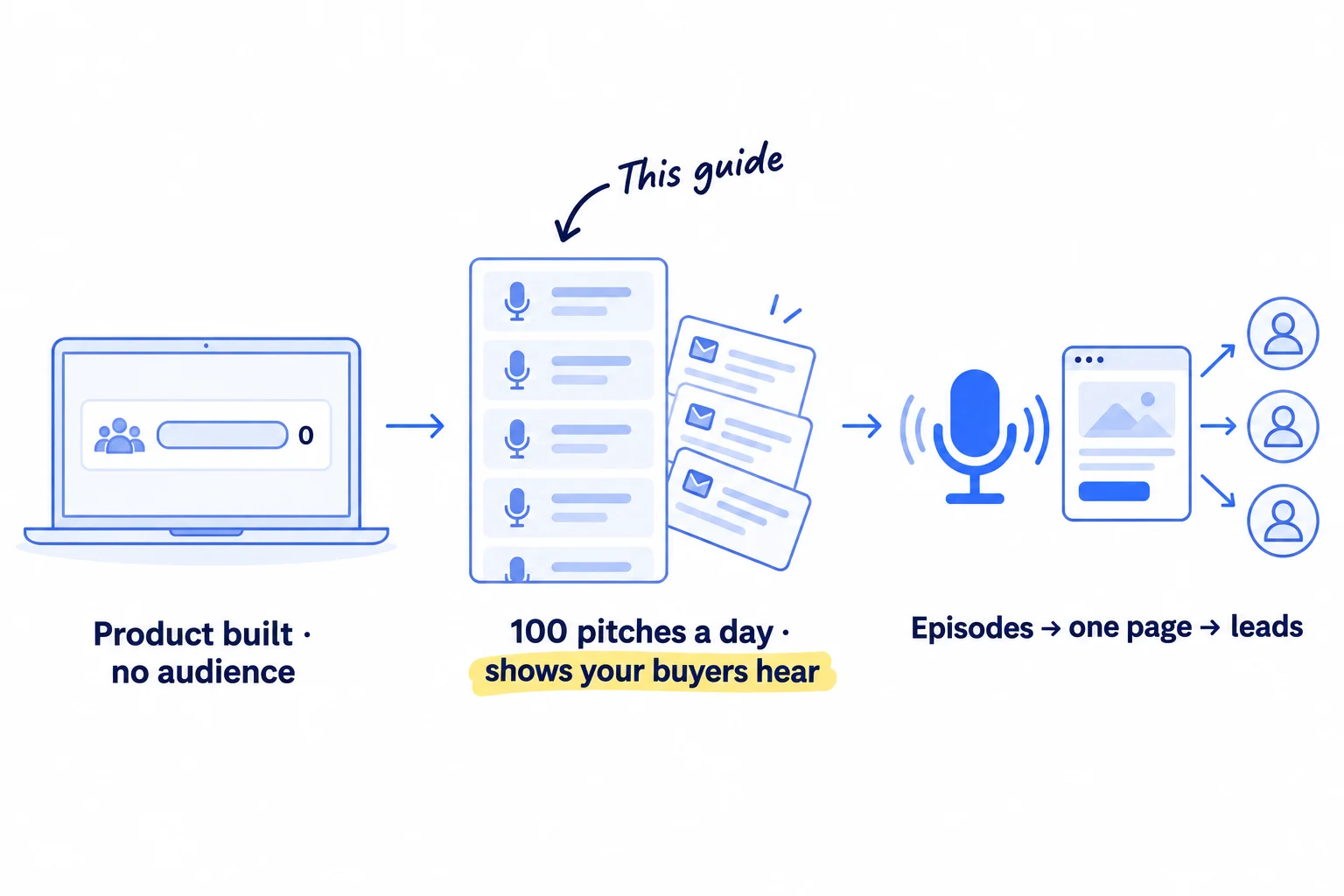
You built something good, but nobody has heard of you, and you have no audience of your own to tell. Here is how to get booked as a podcast guest when you are unknown: find the shows your buyers already listen to, pitch 100 of them a day with one true line about each, and give every listener one place to go. Most founders pitch 10 big shows, hear nothing, and decide podcasts are only for famous people.
Do these three things
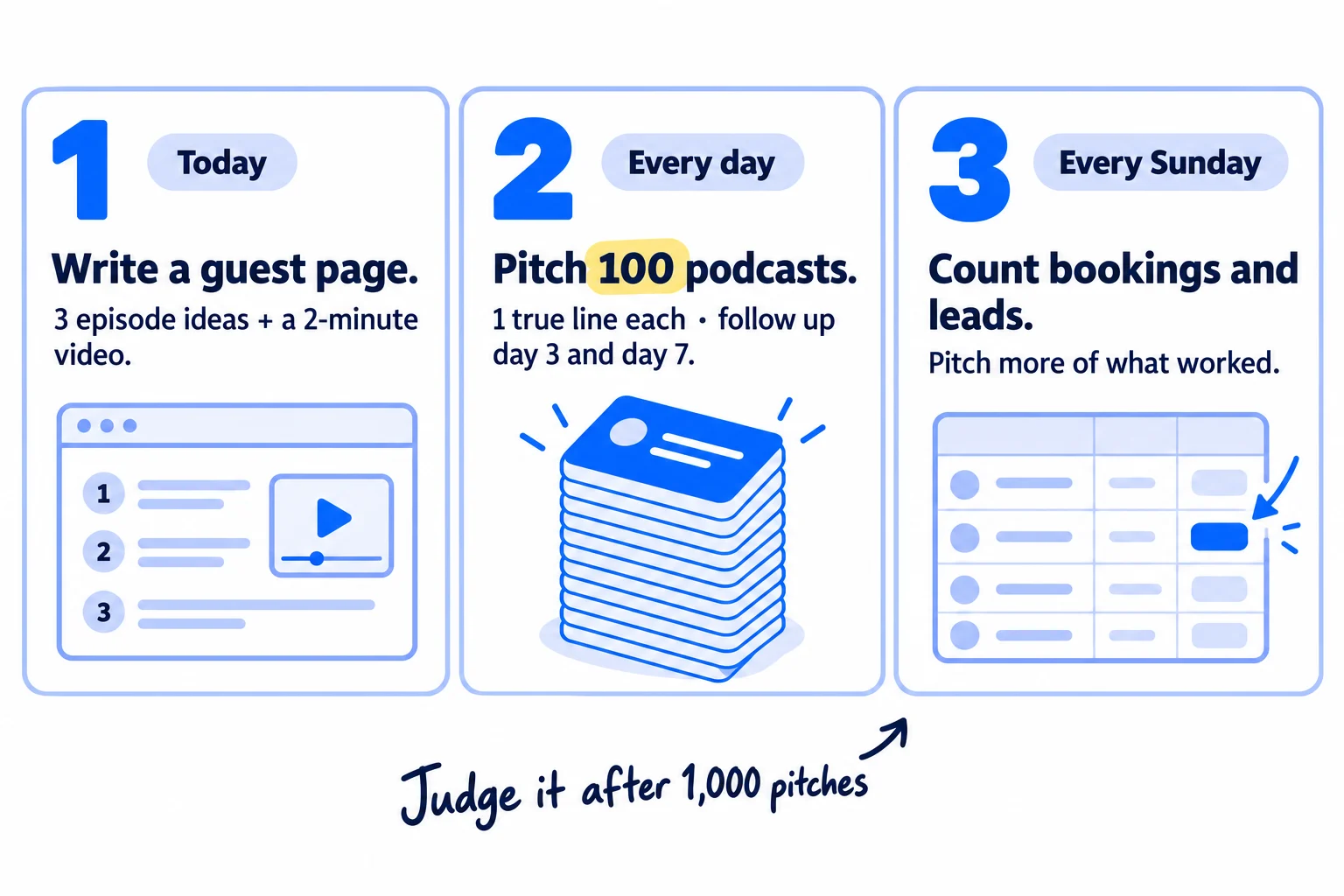
About 5 hours a day on finding and pitching shows, plus 1 to 3 hours for recordings and posts once bookings start, every day for 4 weeks. Judge the pitch after 1,000 pitches, and the leads after 10 episodes are out.
Show the three actions in fullHide the full list
- Today: write a guest page on your site with 3 episode ideas about your buyers' problem and a 2-minute video of you talking, so a host can say yes in one minute.
- Every day: pitch 100 podcasts whose listeners are your buyers, each with one true line about a recent episode, and follow up on day 3 and day 7. AI drafts each pitch from the episode's transcript; you check the line and send it.
- Every Sunday: count pitches, bookings, episodes out and leads who say they heard you on a podcast, and pitch more of the kind of show that brought them.
Get help doing these
ChatGPT or Claude reads this guide and works through it with you.
1. Write a guest page with 3 episode ideas a host can say yes to
A guest page is one page on your own site that tells a host who you are, what you would talk about and how to book you. Every pitch links to it, so a host can say yes without writing back to ask.
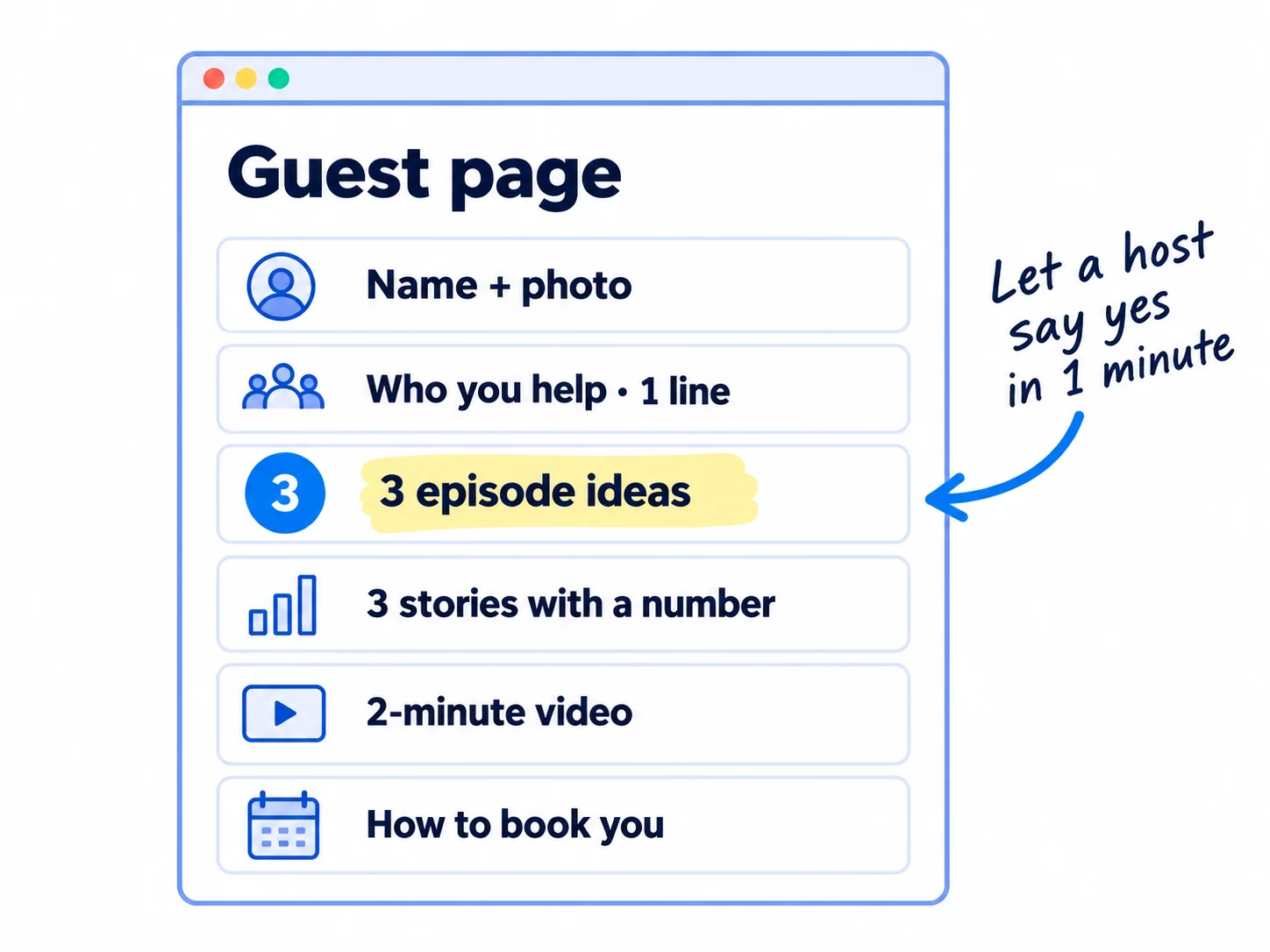
The episode ideas matter most. Each one is about a problem the show's listeners have, not about your company. "How I started my agency" is your story. "How a 3-person SaaS gets its first 100 users without ads" is the listener's problem, and it is the kind of idea a host can say yes to. Take the ideas from what your buyers told you in customer interviews, in their words, and from your value proposition.
Put on the page, in this order:
[Your name], [your role] at [your company]. [Photo]I help [kind of buyer] [get the result], from [one fact that proves it: years doing it, jobs done, customers served].Episode ideas:
[The listener's problem, as a title] — [one line on what they will learn]
[Title] — [one line]
[Title] — [one line]
Stories I can tell: [3 short stories, each with one real number]Questions you could ask me: [5 questions][A 2-minute video of you talking about idea 1]Book me: [email] · [a booking link with times in your time zone]
Let AI do the first draft. Give ChatGPT or Claude your notes from buyer chats and ask for 10 episode titles about the listener's problem. Pick 3. Then record the video on your phone, in one take, looking at the camera. Hosts want to hear how you talk before they book you, and video is now normal: in Edison Research's Infinite Dial 2026, 57% of Americans 12 and older had both listened to and watched a podcast.
Put the page at a short address, such as yoursite.com/guest. If you have no website yet, a simple site with this one page is enough to start.
- Tool: your site editor, your phone camera, and ChatGPT or Claude. All free to start.
- Time: 2 hours.
- You will have: a live guest page at a short address, with 3 episode ideas and a video.
- It worked if: you show the 3 titles to 3 people who fit your buyer, and each one picks a title they would listen to. A stranger can tell in 1 minute what you would talk about.
- Common mistake: ideas about your product or your founder story. Hosts want their listeners to learn something they can use. The other mistake is waiting for a perfect video. A clear phone video today beats a studio video next month.
See it done: Quillfox's first episode idea
Quillfox is a made-up one-person agency. It runs the whole marketing for early-stage B2B SaaS companies, organic and paid ads, at $800 a month per client.
Before
From freelancer to agency: my story
After
How a 3-person SaaS gets its first 100 users without ads
Why it works: The new title is the listener's problem, so the host can see why their audience would care.
2. Find 100 podcasts a day that take guests and reach your buyers
To find podcasts to be a guest on, add 100 new shows to your list every day, and keep only the ones that pass four checks. A show that is dead, never has guests, or reaches the wrong people is a wasted pitch, however good the pitch is.
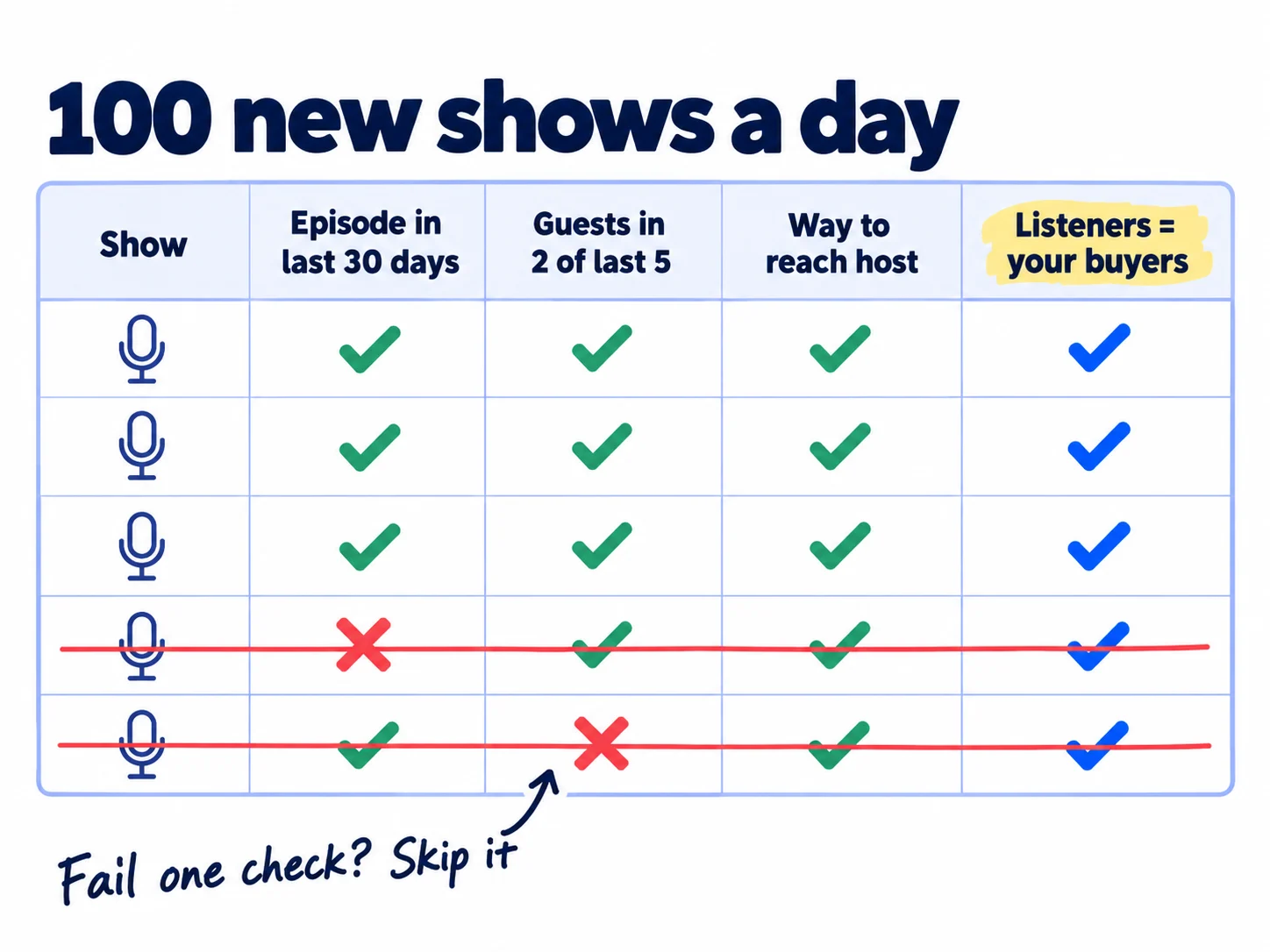
The four checks. A show goes on your list only if all four are true:
- It has an episode from the last 30 days.
- At least 2 of its last 5 episodes have a guest from outside the show.
- You can reach the host: a guest form, an email on its website, the email icon on its Listen Notes page, or the host on LinkedIn.
- Its listeners are your buyers. The show's description and its last 5 guests are people like your buyers, or people who sell to them.
Listen Notes counts about 3.8 million podcasts, old and new, so check the date first. Shows that fit badly also book badly: in Podseeker's 2026 data, pitches to shows that fit poorly booked 0.6 times per 100, and pitches to shows that fit well booked 6.2 times per 100.
Where to find 100 a day. Work through these sources in order, and move to the next when one runs dry:
- Ask your buyers. In every buyer chat and sales call, ask: "Which podcasts do you listen to for work?" Then search the online communities where they talk for "podcast". These are your best shows.
- Search for people like you. Listen Notes, a free podcast search engine, finds episodes by a person's name. Search the names of 10 people who sell to your buyers: competitors, consultants, authors. Every show that interviewed them takes guests like you.
- Search for your buyers' job and problem. Search Listen Notes, Apple Podcasts and YouTube for "[your buyer's job] podcast" and for the problem in their words. On each good show's Listen Notes page, open "Find similar podcasts".
- Shows asking for guests. Sign up free at PodcastGuests.com. It sends 2 emails a week with 10 shows looking for guests. Apply to every one that passes the checks.
- Guest forms on Google. Search
"be a guest" podcast [your buyer's job]to find shows with a guest form on their site.
Let AI do the checking. Paste a show's episode list into ChatGPT or Claude and ask: "When was the last episode? Which of the last 5 have an outside guest?" Then open the latest episode yourself and check who it is for. Log every show in one sheet with its link, how to reach the host, and the date you checked it, the same way you would build a lead list. If a show has no form or email, find the host's email the way you would find any buyer's.
If you run out of shows that pass the checks, never pitch one that fails. Keep the 100 by moving to the next source, adding the shows your buyers' buyers listen to, and adding the introductions hosts give you in step 5.
If you run a SaaS: pitch the shows for your users' job, such as web design, finance or sales shows. "SaaS founder" podcasts reach other founders, not your users, unless your users are founders.
If you run a B2B company: your buyers' trade podcasts come first. Many trade magazines and industry groups run a show; search their names in Listen Notes.
If you run a D2C store: pitch shows your shoppers listen to about the problem your product solves, such as health, parenting or home shows. Founder and ecommerce shows reach other store owners, which only helps if you also sell to stores.
If you run an agency: pitch the shows your clients listen to, as part of how you market your agency. If your clients are founders, founder shows are your buyers' shows. Each episode also works as proof when you have no case studies.
- Tool: Listen Notes (search is free), PodcastGuests.com (free), Google Sheets.
- Time: about 1 hour 30 minutes a day, under a minute a show. Most of it overlaps with step 3, because you read the latest episode for both.
- You will have: 100 new shows a day, 700 a week, each passing all four checks.
- It worked if: every row passes all four checks, and the list never has fewer than 100 shows you have not pitched yet.
- Common mistake: pitching only the 10 biggest shows in your field. Podseeker finds that smaller shows that fit well often book faster than large ones, and they still put you in front of the right people.
3. Pitch yourself to 100 podcasts a day and follow up twice
Send 100 personal pitches every day, each with one true line about a recent episode and one episode idea that fits that show. Follow up twice, on day 3 and day 7, then stop.
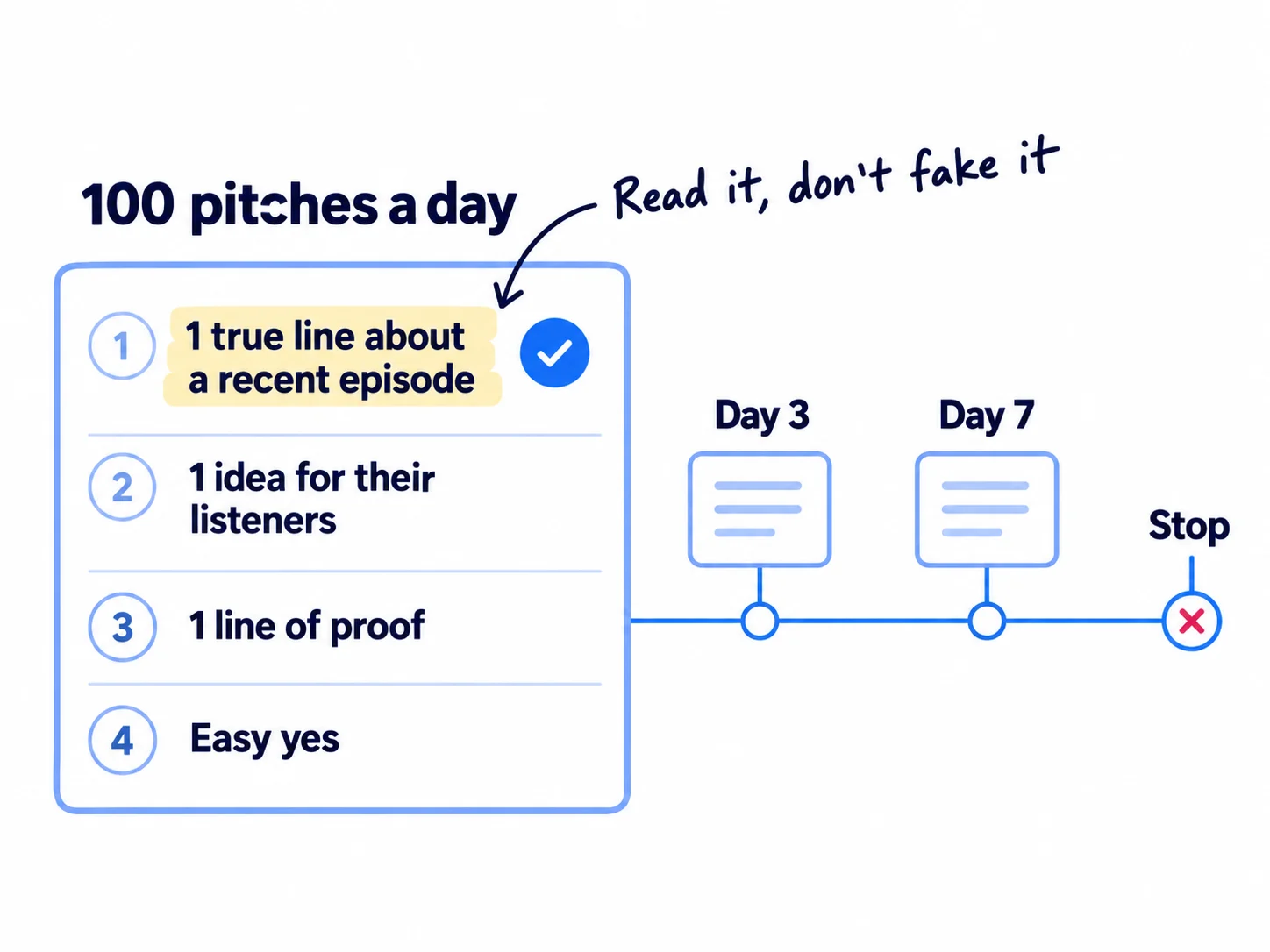
100 a day sounds like a lot. It is the point. In Podseeker's measured 2026 data, about 13 of every 100 pitches got a reply and about 3 turned into a booking. At 10 pitches a day, that is one booking every few days and nothing to learn from. At 100 a day, you have several bookings by the end of week 1. The median time from pitch to booking was 3.7 days, but 1 in 10 took 8 weeks or more, so keep going while you wait.
The true line is what makes 100 possible, and AI makes the true line fast. Many episodes have a transcript: in Apple Podcasts, tap Transcript in the full-screen player; on YouTube, click "Show transcript" in the video description. Paste the latest episode's transcript into ChatGPT or Claude with your guest page and the template below. Ask for a pitch with one specific moment from the episode. Then check the moment is really there, fix anything that is not true, and send. That is about 2 minutes a pitch. Never write "I'm a longtime listener" unless you are.
Subject: Episode idea: [your episode title]Hi [host's first name],[One true line about a recent episode: what a guest said, and why it stuck with you.]I'd like to come on and talk about [episode idea]. Your listeners are [who they are], and I can show them [what they will learn], with [one real number or story].I'm [your name], [one line of proof]. More about me, and a 2-minute video, here: [your guest page]If it fits, I'm free [2 or 3 times in your time zone], or any time that suits you.[Your name]
[Your company, postal address]
Not for you? Reply "no" and I won't write again.
Keep it to 100 to 150 words. If the show has a guest form, use the form and follow its rules instead of emailing.
Send each pitch one at a time, from your work email, not from a bulk-sending tool. Gmail requires every sender to have SPF or DKIM, two settings that prove your email comes from you, and to keep spam reports below 0.3%. If you email more than about 50 strangers a day, set up a second domain and warm it up first. Until it is warm, send the rest of the 100 through guest forms and to hosts you can message on LinkedIn. In the US, the CAN-SPAM Act makes no exception for business email, so add your postal address and a way to say no, and stop the day someone says no.
Follow up twice, then stop. On day 3, follow up in the same thread with one new line, such as a second episode idea. On day 7, send one short last note. In Podseeker's 2026 data, about 15 of every 100 bookings came only after a follow-up. The second follow-up brings only about 3 replies per 100, so a third adds little. Mark the show "try again in 3 months" in your sheet.
- Tool: Gmail, ChatGPT or Claude to draft, Apple Podcasts or YouTube for transcripts, and your Google Sheet to log each pitch, reply and follow-up date.
- Time: about 3 hours 30 minutes a day, about 2 minutes a pitch.
- You will have: 700 pitches a week, each logged with its follow-up dates.
- It worked if: you get at least 10 replies and 2 bookings per 100 pitches. If you have under 1 booking per 100 after 1,000 pitches, rewrite your episode ideas (step 1) and your first line, then send the next 100.
- Common mistake: the same pitch with only the name changed. Without a true line about their show, it reads like every other pitch in the host's inbox. The other mistake is pitching your product. Pitch what the listeners will learn; your product comes up on its own.
The craft of the first line is the same as in a cold email or a pitch to a journalist: it is about them, and it is true. If replies stay low, fix the first line before you change anything else.
See it done: Quillfox's pitch to a SaaS growth show
To: Dana, host of a weekly show for early SaaS founders
Subject: Episode idea: the first 100 users, without ads
Hi Dana,
In last week's episode, your guest said she "wasted $4,000 on ads before she had 10 users." I hear that from almost every founder I work with.
I'd like to come on and talk about how a 3-person SaaS gets its first 100 users without ads. Your listeners are founders doing their own marketing, and I can walk them through the 4-week routine I run for my clients, with the numbers.
I'm Rowan, and I run Quillfox, a one-person agency for early B2B SaaS companies. More about me, and a 2-minute video: quillfox.example/guest
If it fits, I'm free Tuesday or Thursday at 10 am Eastern, or any time that suits you.
Rowan Quillfox, [postal address] Not for you? Reply "no" and I won't write again.
Why it works: The first line proves the host's episode was heard, and the idea is for the show's listeners, not about the agency.
4. Prepare for every recording in 30 minutes and give listeners one place to go
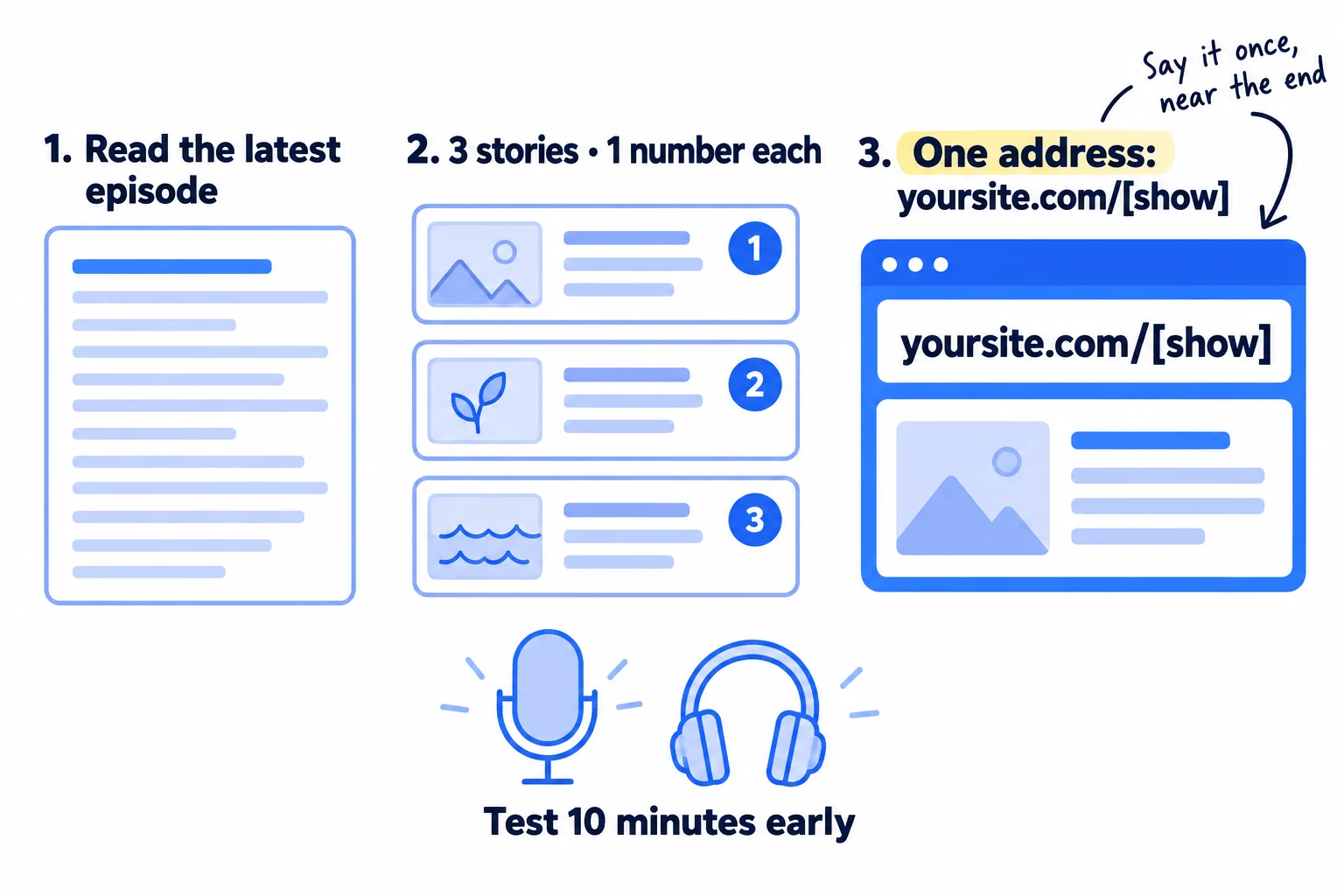
Say yes to every show that passes the four checks, and prepare for each one in 30 minutes: read the latest episode, write 3 stories, and decide the one place you will send listeners.
Book recordings 1 to 4 weeks out, and take up to 2 a day. Block the times now so they fit into your week. That is a lot of recording time, and it is the point: each one is an hour in front of buyers who already trust the host. Before each one:
- Read the latest episode's transcript and note how the host asks questions and how long answers run.
- Write 3 stories, each with one real number: a customer's problem, what you did, what changed. A short case study is a good source. Stories with numbers are easy to remember and easy to cut into clips.
- Pick one next step for listeners: a free checklist, template or tool on a page with an address you can say out loud, such as yoursite.com/[show name]. People cannot click a link in their ears, and UTM tags do not work out loud, so a page per show tells you which show sent each visitor. Make the free thing a real lead magnet your buyers want, and add a landing page form so you can build your email list.
- Add "Where did you hear about us?" to your signup, enquiry or checkout form, if it is not there yet. This is self-reported attribution, and it is the only way to see leads who heard you but never typed your page address.
- Test your setup 10 minutes early: wired headphones so the host's voice does not echo, a quiet room, the camera at eye level, and the host's recording link opened once.
On air, answer the question asked, tell your stories, and say your page address once, near the end, when the host asks where people can find you. After the recording, thank the host, and ask when the episode goes out and whether you may share clips from it.
If you run a D2C store: offer to send the host your product a week before the recording, with no strings attached, as you would to small creators. Give each show its own discount code, so you can count orders from each one.
If you run a B2B company: on the listener page, put the free checklist first and a link to book a 20-minute call second.
- Tool: your laptop, wired headphones, your phone or laptop camera, and your site for the listener page.
- Time: 30 minutes before, the recording (usually 30 to 60 minutes), and 10 minutes after.
- You will have: each recording done, with your page address said once and a publish date from the host.
- It worked if: you said the address once, every show has its own page or code, and the host asks you back or offers an introduction.
- Common mistake: selling your product on air. Listeners tune out, and the host is less likely to ask you back or introduce you. Teach the listeners something they can use today; that is what makes them visit your page.
5. Share every episode the day it goes live and ask the host for 2 introductions
The day an episode goes live, add it to an "As heard on" list on your guest page, post it on every channel you use, and write to the host. The list is social proof for the next host you pitch. Hosts want guests who bring the episode new listeners.
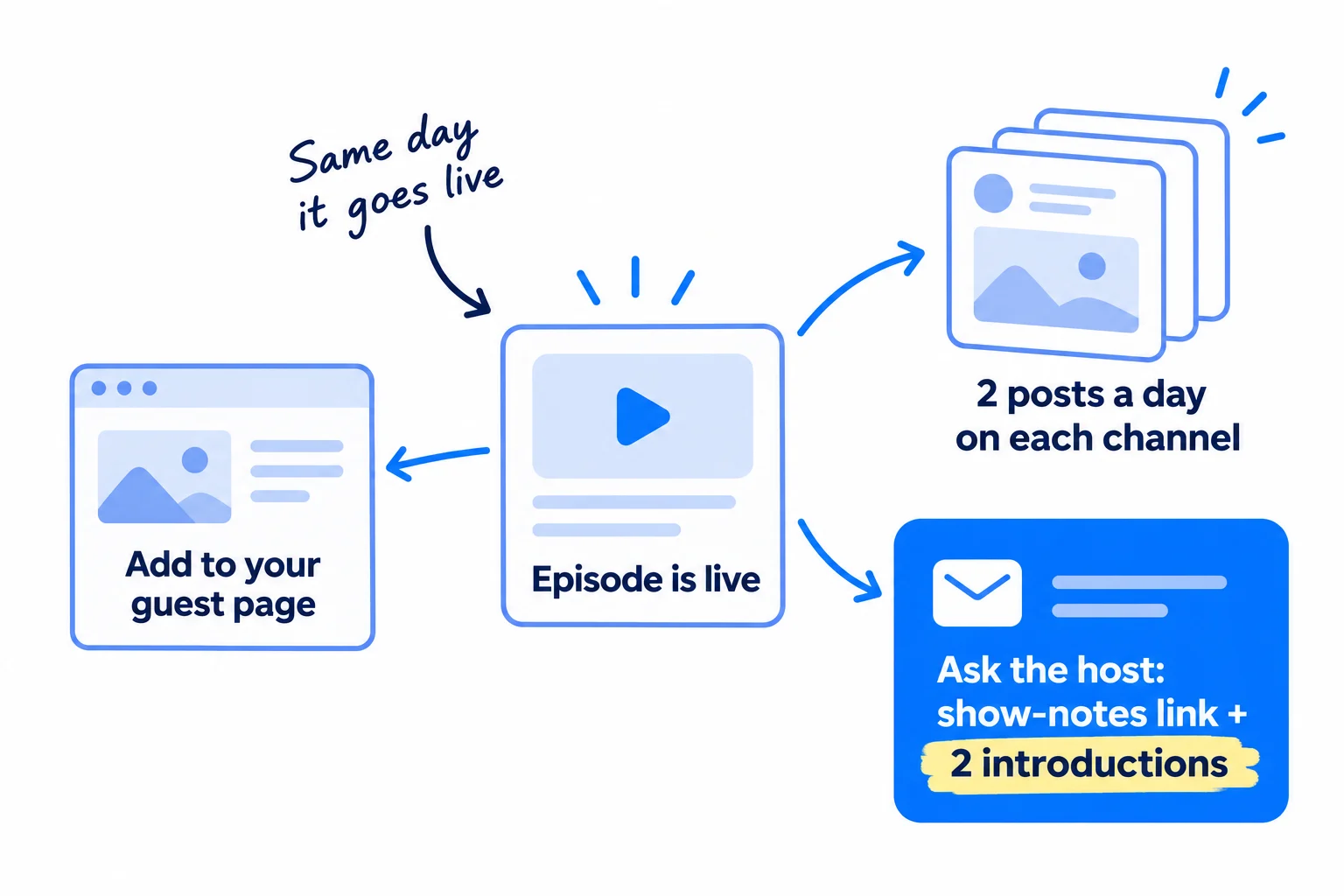
Post about it. Keep 2 posts a day on each channel you use, every day, made from your episodes: the main lesson, a story with its number, a short 9:16 clip. AI drafts the posts from the transcript; you pick the moments and add one line in your own words. Put each episode's posts in your content calendar. Cut clips only with the host's OK, from the video file they send or the published episode. How to make a week of posts from one episode is in repurpose content across platforms and short-form videos. Start where your buyers are: for most B2B, SaaS and agency founders that is LinkedIn.
Ask the host for two things, in one short message: a link to your listener page in the show notes, which is also a backlink to your site, and introductions to 2 other hosts whose listeners are like theirs. Pitch each introduced host within 24 hours, and say who sent you in the first line.
Episodes on YouTube have one more use. Ahrefs found YouTube is the website Google's AI Overviews cite most, and brands that are mentioned more on YouTube also show up more in AI answers. Every video episode that says your name and what you do is one more place AI tools can read about you. That is part of how you get mentioned by ChatGPT.
Hi [host's first name],Thank you for having me. The episode is out, and I've shared it on [channels] today.Two small asks, only if they're easy:
Could you add a link to [your listener page] in the show notes?
Who are 2 other hosts whose listeners are like yours? I'd be glad of an introduction, and I'll send them the same idea list.
[Your name]
- Tool: LinkedIn and the other channels you already use, ChatGPT or Claude to draft posts, and the host's video file for clips.
- Time: 30 minutes on the day each episode goes live, plus about 1 hour a day for the 2 posts on each channel.
- You will have: every episode on your guest page and in your posts within 2 days of going live, and a list of introductions.
- It worked if: every episode is in at least 2 posts on each channel, and at least 1 host in 3 gives you an introduction.
- Common mistake: one post on the day, then nothing. Keep posting from each episode for weeks: the lessons in it do not go out of date.
See it done: Quillfox's message after an episode went live
To: Dana, host of a weekly show for early SaaS founders
Subject: Thank you, and two small asks
Hi Dana,
Thank you for having me. The episode is out, and I've shared it on LinkedIn and X today, with the clip about the $4,000 ad mistake.
Two small asks, only if they're easy:
- Could you add quillfox.example/dana to the show notes? It has the 4-week routine as a free sheet.
- Who are 2 other hosts whose listeners are like yours? I'd be glad of an introduction, and I'll send them the same idea list.
Rowan
Why it works: It thanks the host, shows the episode was shared, and makes both asks small and easy to say yes to.
6. Count pitches, bookings and leads every Sunday
Every Sunday, fill in one row of your sheet, and see which kind of show brings leads. Then give more of next week's 100 a day to that kind of show.
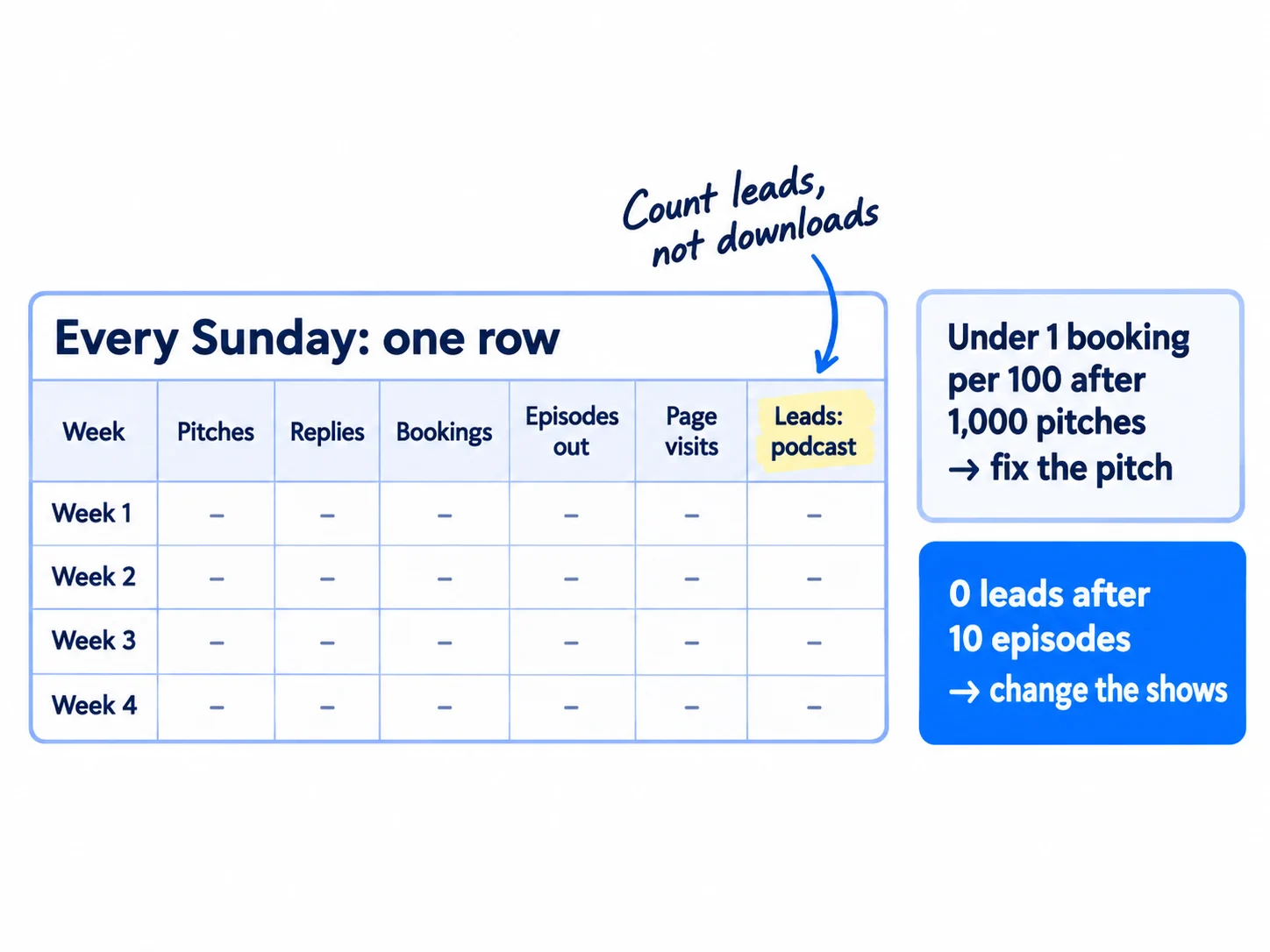
Week | Pitches | Replies | Bookings | Recorded | Episodes out | Listener page visits | Leads who said "podcast" | New customers
Best source this week: buyers asked | people like you | job and problem search | guest emails | guest forms | introductions
Use two judging points, because episodes come out weeks after you pitch:
- The pitch, after 1,000 pitches (10 days at 100 a day). Under 1 booking per 100: rewrite your episode ideas and first line. Many replies but few bookings: the ideas do not fit the shows. Few replies: fix the first line and check the shows pass the four checks.
- The leads, after 10 episodes are out. 0 visits to your listener pages and 0 leads who said "podcast": the listeners are not your buyers, so move your 100 a day to a different source in step 2, usually buyers' own shows and trade shows. Any leads: give more of the 100 to that kind of show, and start pitching bigger shows of the same kind, with your published episodes as proof. Once podcasts bring customers, work out what each customer cost you, counting your hours.
Leave the last word to the people who buy. Ask every new lead and customer where they heard about you, and write it down. Once a month, step back for a marketing review and see how podcasts compare with your other marketing channels.
- Tool: Google Sheets.
- Time: 20 minutes each Sunday.
- You will have: one row a week, and a clear answer on which kind of show brings leads.
- It worked if: every lead in the sheet has a source, and you can name the kind of show that brought the most.
- Common mistake: counting downloads, views or followers. A small show your buyers listen to beats a big show they do not.
See it done: Quillfox after 4 weeks
The Sunday sheet, weeks 1 to 4
| Week | Pitches | Replies | Bookings | Recorded | Episodes out | Page visits | Leads: podcast | New clients |
|---|---|---|---|---|---|---|---|---|
| 1 | 700 | 70 | 12 | 0 | 0 | 0 | 0 | 0 |
| 2 | 700 | 84 | 15 | 8 | 0 | 0 | 0 | 0 |
| 3 | 700 | 91 | 17 | 13 | 3 | 41 | 1 | 0 |
| 4 | 700 | 95 | 18 | 14 | 7 | 96 | 3 | 1 |
The decision: about 2 bookings per 100 pitches, so the pitch works. All 4 leads came from SaaS growth shows found by searching for people like Rowan, and 0 from general business shows. So next week, most of the 100 a day go to SaaS growth shows, and general business shows stop.
Why it works: They judge the pitch by bookings and the shows by leads, not by how big the shows are.
Where Scout7 helps
Scout7 speeds up two of the six steps: 1 and 5.
Step 1. Give Scout7's Content Co-Pilot your topic, and it researches it and returns distinct angles you can shape in conversation. Use them as episode ideas. You choose the 3 that fit your buyers.
Step 5. Image Studio makes image posts with captions in your brand's voice, one for each lesson from an episode, and schedules them to LinkedIn, X, Instagram, Facebook, Threads and Reddit in one calendar. Content Co-Pilot can also turn an episode's topic into a full article, with sources and FAQs. You approve every post and article; nothing goes live without your approval.
Your podcast guest checklist for the next 4 weeks
0 of 13 done
Work through this list with an AI assistant
It drafts the work and keeps track of what is done.
Frequently asked questions
- Do podcast guests get paid, or should I pay to be on a podcast?
Most guests are not paid, and you should not pay for an earned guest spot. Some shows charge guests, from under $100 to thousands. Treat that as an ad: check the listeners are your buyers, and ask how the show will tell listeners it was paid. The FTC says a paid connection should be disclosed clearly. Put the same money into your own hours first.
- Is PodMatch worth paying for?
Not at the start. PodMatch is a paid site that matches guests with hosts, and it can bring bookings. The free sources in step 2 let you choose every show yourself and check that its listeners are your buyers. Try a paid site once you have 10 episodes out and know which kind of show brings leads.
- Do I need an audience or a famous name to get booked?
No. Small shows book unknown guests every week, because they need a guest every week. What they need from you is an idea their listeners will use, a true line that shows you heard the show, and a short video so they know you can talk. Start with small shows that fit your buyers, then use those episodes as proof for bigger ones.
- Should I start my own podcast instead?
Not first. Your own show starts with no listeners; a guest spot puts you in front of a host's listeners from day one. Be a guest on 10 to 20 shows first. Then you will know what your buyers want to hear, and the hosts you met can be your first guests. A YouTube channel or a webinar is a similar choice.
- How long after recording does the episode come out?
It depends on the show. Some publish in a week, others plan a month or two ahead. Ask the host at the end of the recording, and write the date in your sheet. That is why this guide judges the pitch after 1,000 pitches, but judges the leads only after 10 episodes are out.
Sources
- 1.Podcast Outreach Benchmarks 2026: Booking & Reply Rates — Podseeker, updated 11 September 2026
- 2.How to Follow Up on a Podcast Pitch: Timing, Templates, and Data — Podseeker, updated 30 August 2026
- 3.Podcast Pitch Examples — Podseeker, checked 2 October 2026
- 4.How to Create a Client One-Sheet for Podcast Booking — Podseeker, 10 September 2026
- 5.Do Podcast Guests Get Paid? Who Pays Whom in 2026 — Podseeker, updated 29 August 2026
- 6.The Infinite Dial 2026 — Edison Research and SSRS, 12 March 2026
- 7.Podcast Stats: How many podcasts are there? — Listen Notes, checked 2 October 2026
- 8.Podcast PR guide: how to find podcasts and reach out to be a guest — Listen Notes Help Center, updated 29 June 2026
- 9.PodcastGuests.com — PodcastGuests.com, checked 2 October 2026
- 10.Technical updates for hosting providers — Apple Podcasts for Creators, 22 August 2022
- 11.View episode transcripts in Apple Podcasts on iPhone and iPad — Apple Support, checked 2 October 2026
- 12.View video transcripts — YouTube Help, checked 2 October 2026
- 13.The 50 Most-Cited Websites in Google AI Overviews (September 2026) — Ahrefs, September 2026
- 14.Top Brand Visibility Factors in ChatGPT, AI Mode, and AI Overviews (75k Brands Studied) — Ahrefs, 12 December 2025
- 15.Email sender guidelines — Google Workspace Admin Help, checked 2 October 2026
- 16.CAN-SPAM Act: A Compliance Guide for Business — Federal Trade Commission, checked 2 October 2026
- 17.FTC's Endorsement Guides: What People Are Asking — Federal Trade Commission, checked 2 October 2026
- 18.You Probably Didn't Get Ghosted: The Truth About Podcast Pitch Follow-Up — Kathleen Gage, 6 June 2026
Next article to read
How to grow on LinkedIn as a founderShare each episode on LinkedIn, so buyers who missed it still hear it.Read it nextRelated guides
- How to get backlinks for a new websiteGet backlinks for a new website with no budget or press contacts: take the 20 links you can get from your profiles, partners and directories today, list 100 sites that link to your competitors, publish one page worth linking to, send 100 personal pitches a day offering a guest article, a broken-link fix or a page for their list, and count new linking sites every Sunday.
- How to pitch journalistsComing soon
- How to host a webinarComing soon
- How to repurpose content across platformsRepurpose content across platforms without copy-pasting: list 30 questions your buyers ask, answer one a day in a 10-minute video or one-page article, turn it into 2 posts for each of your 2 or 3 channels with one 9:16 video, upload clean files and reply within an hour, and remake your 3 best pieces every Sunday.
Guides that link here
- How to get backlinks for a new website
- How to get backlinks from news websites
- How to get your brand mentioned by ChatGPT
- How to get your company recommended by ChatGPT as a supplierB2B
- How to make short-form videos for your business
- How to plan a content calendar
- How to repurpose content across platforms
- How to start a YouTube channel for business
- How to choose marketing channels for an agencyAgency
Cite this page
Dinesh Bypilla (2026). How to get booked as a podcast guest. Scout7 Academy. https://scout7.ai/academy/content-marketing/how-to-get-booked-as-a-podcast-guest
Written by Dinesh Bypilla, Agentic systems engineer at Scout7. Reviewed by Murali Sid. Last checked 2 October 2026.
Quote any part of this guide with a link back to this page. © 2026 Scout7.
Markdown version of this page: https://scout7.ai/academy/content-marketing/how-to-get-booked-as-a-podcast-guest.md