



How to get backlinks for a new website
Get backlinks for a new website with no budget or press contacts: take the 20 links you can get from your profiles, partners and directories today, list 100 sites that link to your competitors, publish one page worth linking to, send 100 personal pitches a day offering a guest article, a broken-link fix or a page for their list, and count new linking sites every Sunday.
ByDinesh BypillaReviewed byMurali SidLast checked 20 min read
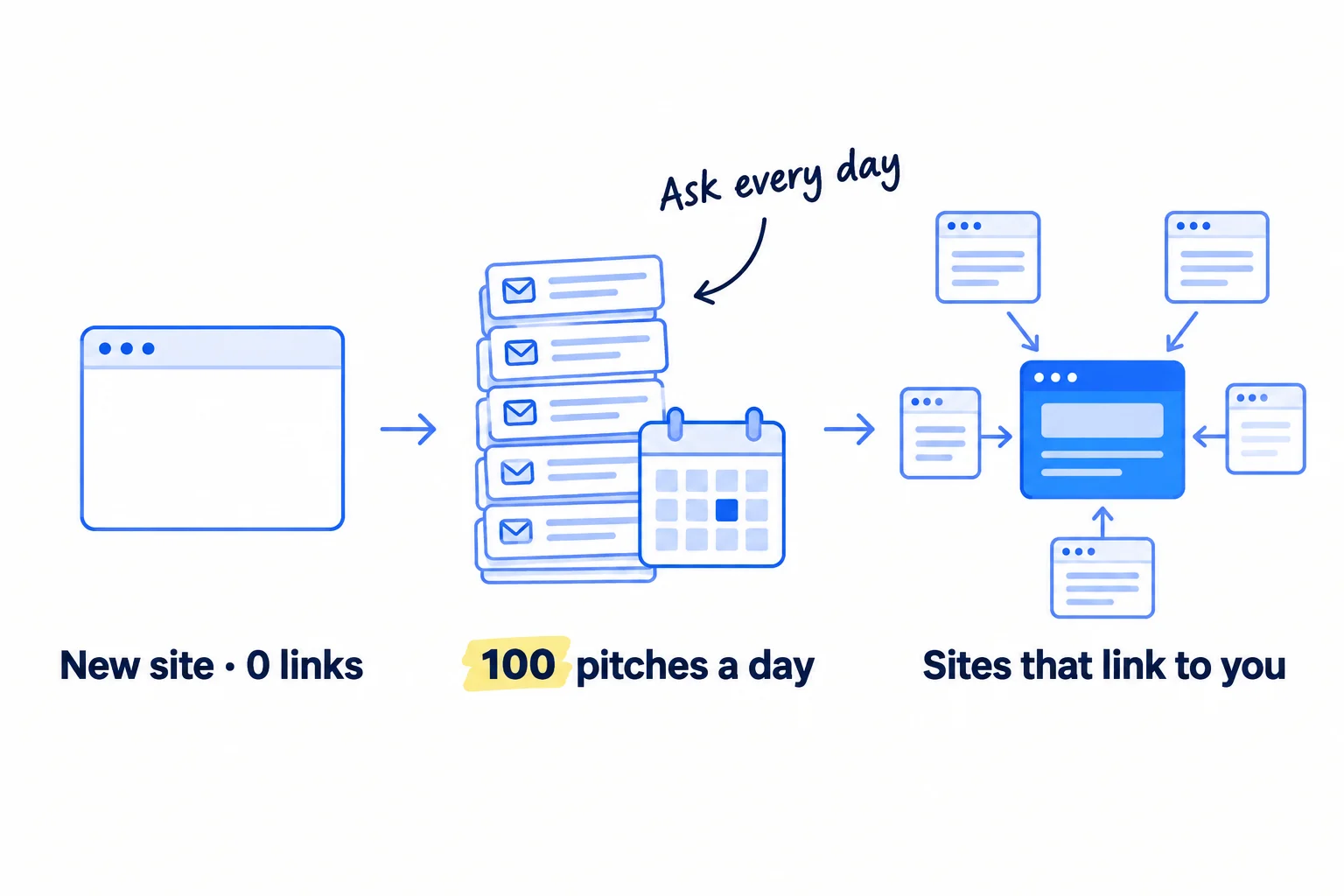
Your new website is live, you have written a few pages, and Google still sends almost nobody to your site, because no other site links to you yet. Here is how to get backlinks for a new website without a budget or press contacts: take the links you can get today, then ask 100 relevant sites a day for a link, each time offering something their readers want. Most founders send 10 emails, get no links and decide backlinks are only for big brands. Ten emails can't tell you anything. 2,800 pitches will show you which kind of ask works for your site.
Do these three things
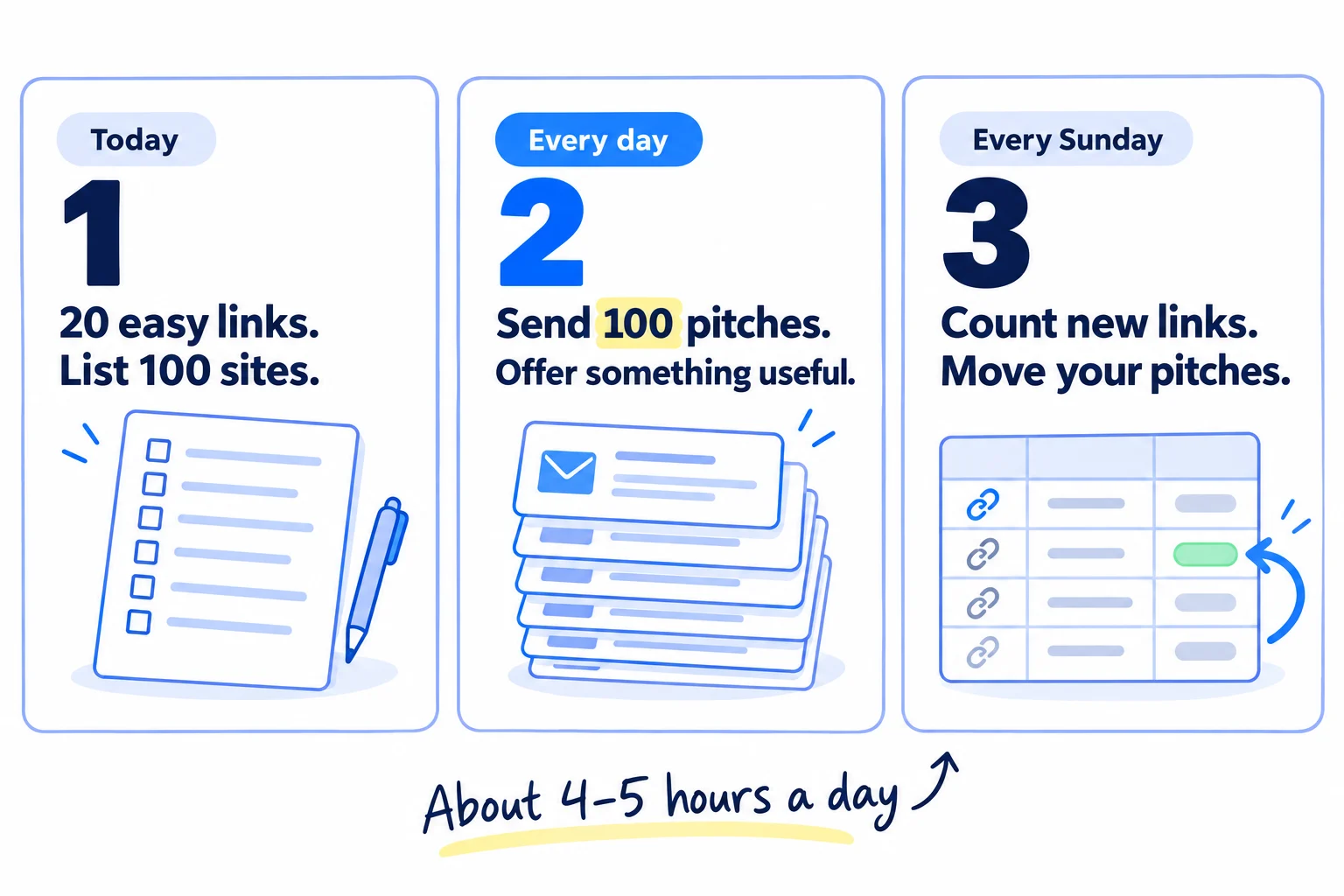
About 4 to 5 hours a day, next to your messages to buyers. Judge it after 2,800 pitches, not after a week. Nobody can promise a ranking.
Show the three actions in fullHide the full list
- Today: get your first 20 backlinks from places you already belong to: your profiles, partners, suppliers, the tools you use and the directories your buyers read. Then list 100 sites that link to your competitors, using Ahrefs' free backlink checker.
- Every day: send 100 personal pitches to sites on your list, each offering something their readers want: a guest article, a fix for a broken link, or a useful page for their list. AI drafts each one; you add one true line about the site. Add 100 new sites to the list.
- Every Sunday: count the new sites that linked to you and the links you got per 100 pitches of each kind, next to your search numbers. Put more of next week's pitches into the kind that won the most.
Get help doing these
ChatGPT or Claude reads this guide and works through it with you.
1. Get your first 20 backlinks from places you already belong to
The fastest backlinks for a new website come from places where you already have an account or a relationship: your own profiles, the people you work with, and the directories your buyers use. You do not need to convince a stranger for any of these, so do all of them today.
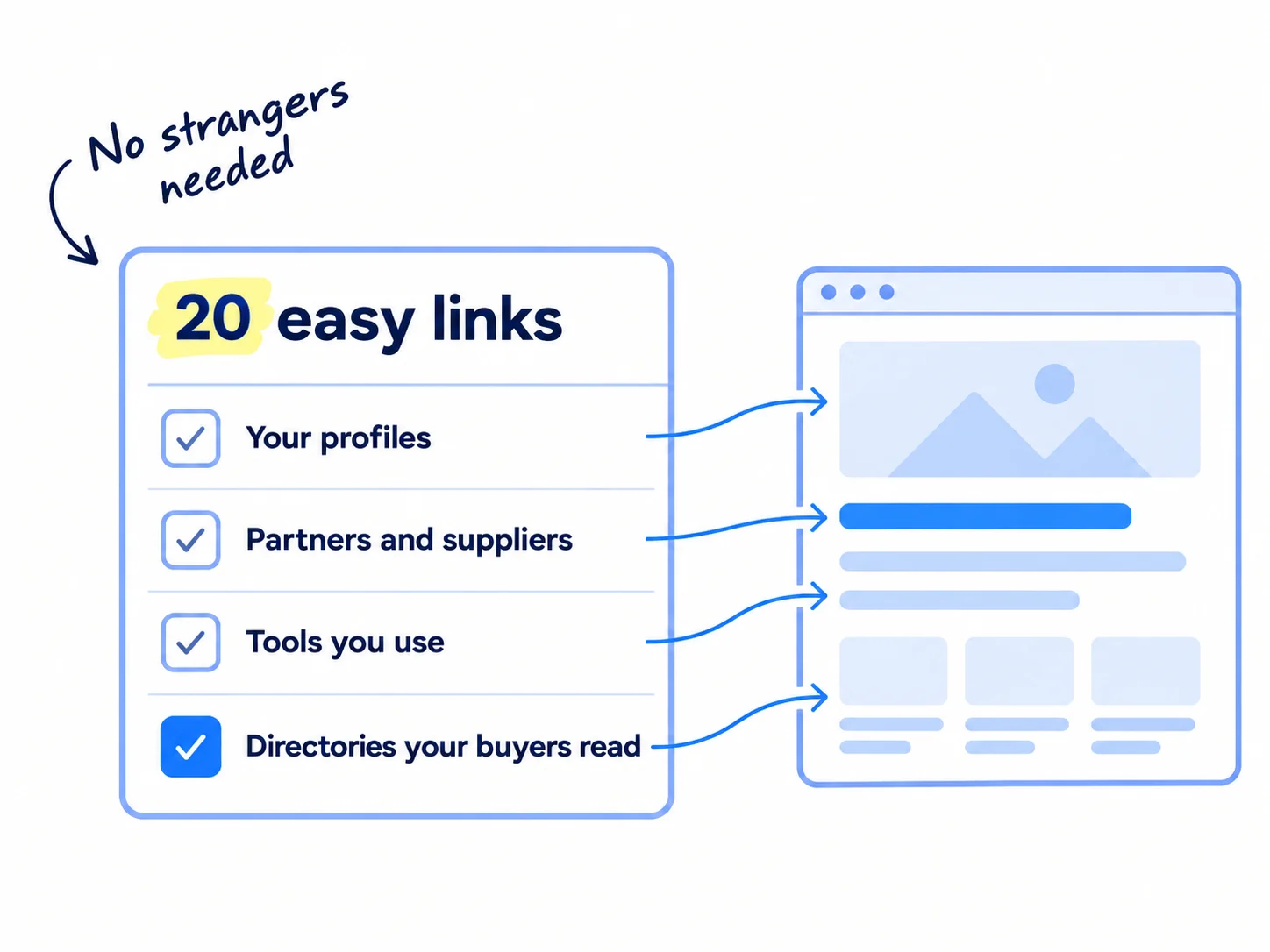
Open a sheet with the columns Place, Kind, Asked, Live, Link address. Work down this list and add a row for each place:
- Your own profiles. Put your website address on your LinkedIn company page and your own LinkedIn profile, X, YouTube, Instagram, GitHub and Crunchbase. Most of these links are marked nofollow, a tag that tells Google not to pass credit through them. They still help Google find your site and help people and AI tools like ChatGPT connect your name to your site.
- People you already work with. Write to every partner, supplier, reseller and client you have. Ask if they list the companies they work with on their site, and if yours can be on it. Only ask where the work together is real. Google's spam policies call "partner pages exclusively for the sake of cross-linking" link spam.
- The tools you pay for. Many software companies publish short customer stories. Offer one: two lines on what you use their tool for and what it changed. If they publish it, it usually names and links your site. Offer the story; do not ask for a link as payment.
- Directories your buyers read. Submit to the ones that show up on the first page of Google for your category. How to pick them and what to paste is in how to submit your SaaS to directories. Skip any directory that charges you or asks you to link back.
- Launch sites. If you have not launched yet, a Product Hunt launch or a Show HN post gets your site named and linked on the day.
Use ChatGPT or Claude to write each short ask. Give it the name of the partner, what you did together, and ask for a three-line email. Read it, fix anything that is not true, and send it.
Subject: listing us on your partners page?Hi [first name],We've been [working together on / supplying / using] [the real thing you do together] since [month]. I saw your [partners / suppliers / customers] page lists the companies you work with.Could you add [your company] there, with a link to [your website address]? Happy to send a one-line description and a logo.If it helps, I can do the same for you on [our partners page / a short case study].Thanks,
[Your name]
If you run a SaaS: list your product in the app marketplace of every tool it connects to. Each listing is a page about you on a site your buyers already use. How to do it is in how to get listed in integration marketplaces.
If you run a B2B company: add your trade association's member list, your local chamber of commerce and your suppliers' "where to buy" or "who we work with" pages. Offer each client a short case study that names both of you, for both sites. If you serve one area, set up your Google Business Profile too.
If you run an agency: "designed by" or "built by" links in the footers of your clients' sites do not count for much. Google lists "widely distributed links in the footers or templates of various sites" as link spam. Ask each client for a case study you both publish instead, and get your agency on Clutch.
- Tool: a Google Sheet, your email, and ChatGPT or Claude to draft the asks.
- Time: about 3 hours today.
- You will have: 20 rows in the sheet, each asked or submitted, and your address on every profile you own.
- It worked if: within 2 weeks, at least 10 of the 20 show your site with a working link. Open each page and click the link to check.
- Common mistake: paying a service to submit you to hundreds of sites at once. Google calls "using automated programs or services to create links to your site" link spam. Twenty places you chose beat 500 you did not.
2. List 100 sites that link to your competitors
The best list of sites that might link to you is the list of sites that already link to your competitors. They write about your topic, and they have linked to a business like yours before. Build a list of 100 today, and add 100 more every day, so you never run out of sites to pitch.
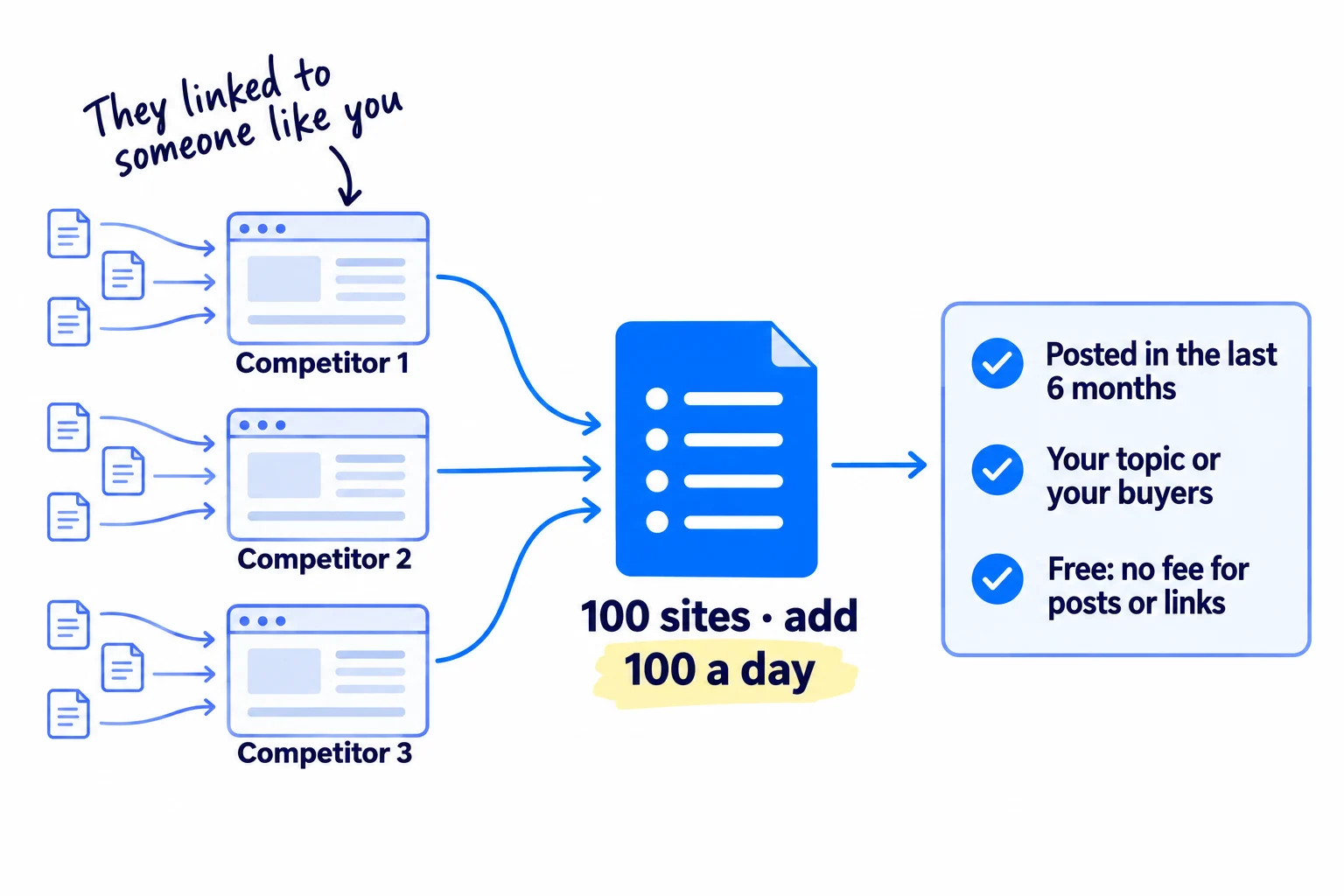
Write down 5 to 10 competitors: the businesses that show up when you search for what you sell, and the ones your buyers name. Put each competitor's website into Ahrefs' free backlink checker. It shows the top 100 backlinks for any site for free. Copy each linking page into your sheet, with the columns Site, Page, What it is, Kind of pitch, Contact, Sent, Follow-ups, Reply, Link live.
Then fill the list up to 100 a day with four Google searches. Swap in your own topic and competitor:
"[your topic]" "write for us"finds blogs that take guest articles."[your topic]" resourcesand"[your topic]" "useful links"find resource pages that list helpful sites."best [your category] tools"and"[competitor] alternatives"find lists where your business could be added. These are also the best-of lists AI tools cite, and they show which alternatives pages rank for your competitors."[your topic]" podcastfinds shows that interview people like you. How to pitch them is in how to get booked as a podcast guest.
Before a site goes on the list, check three things:
- It posted something in the last 6 months. Dead blogs do not answer.
- Its readers could be your buyers, or it writes about your topic. A link from a site about something else helps nobody.
- It is free. Skip any site that asks for a fee to publish a guest post or add a link. Google counts "exchanging money for links, or posts that contain links" as link spam.
Keep the list full at 100 new sites a day. That is about 3,000 sites a month. When the competitor lists and searches run dry, widen to the topics and places your buyers read next to yours: their industry, their job, and the tools they already use. Never widen to sites that have nothing to do with your buyers. Ask ChatGPT or Claude: "List 50 topics that [your buyer] reads about besides [your topic]", then run the four searches on each one.
- Tool: Ahrefs' free backlink checker, Google search and a Google Sheet. All free.
- Time: about 2 hours today, then about 1 hour a day to add 100 sites.
- You will have: a sheet with 100 checked sites today, each with the page, the kind of pitch and a contact, and 100 new rows every day after that.
- It worked if: every row passes the three checks and has a named person or a contact form, not just a general "info@" address.
- Common mistake: keeping sites because of a high "domain rating" or "domain authority" score and skipping small blogs. Those scores come from other companies, not Google. A small blog your buyers read is worth more than a big site about something else.
See it done: The top of Quillfox's list
Quillfox is a made-up one-person agency. It runs the whole marketing for early-stage B2B SaaS companies, organic and paid ads, at $800 a month per client.
| Site | What it is | Kind of pitch | Keep? |
|---|---|---|---|
| A SaaS founders' newsletter | Takes guest articles, last one 3 weeks ago | Guest article | Keep |
| A marketing podcast for startups | Interviews founders and marketers | Podcast | Keep |
| A blog's "SaaS marketing resources" page | Lists 40 guides; 3 links are broken | Broken link | Keep |
| A guest post site for "all topics" | Charges a fee per post | None | Skip |
| A travel blog with a "write for us" page | Readers are not SaaS founders | None | Skip |
Why it works: Every site that stays writes for SaaS founders, is free, and has a clear kind of pitch next to it.
3. Publish one page other websites want to link to
Sites link to pages that help their readers more than your homepage does: a free tool, a template, a checklist, or numbers nobody else has. Make one such page before you send your resource-page and broken-link pitches, because those pitches need something to point at. Start the guest-article pitches while you build it. Links help the pages you already have, so if fewer than 10 pages on your site answer a question your buyers search for, keep publishing one page a day next to your pitches.
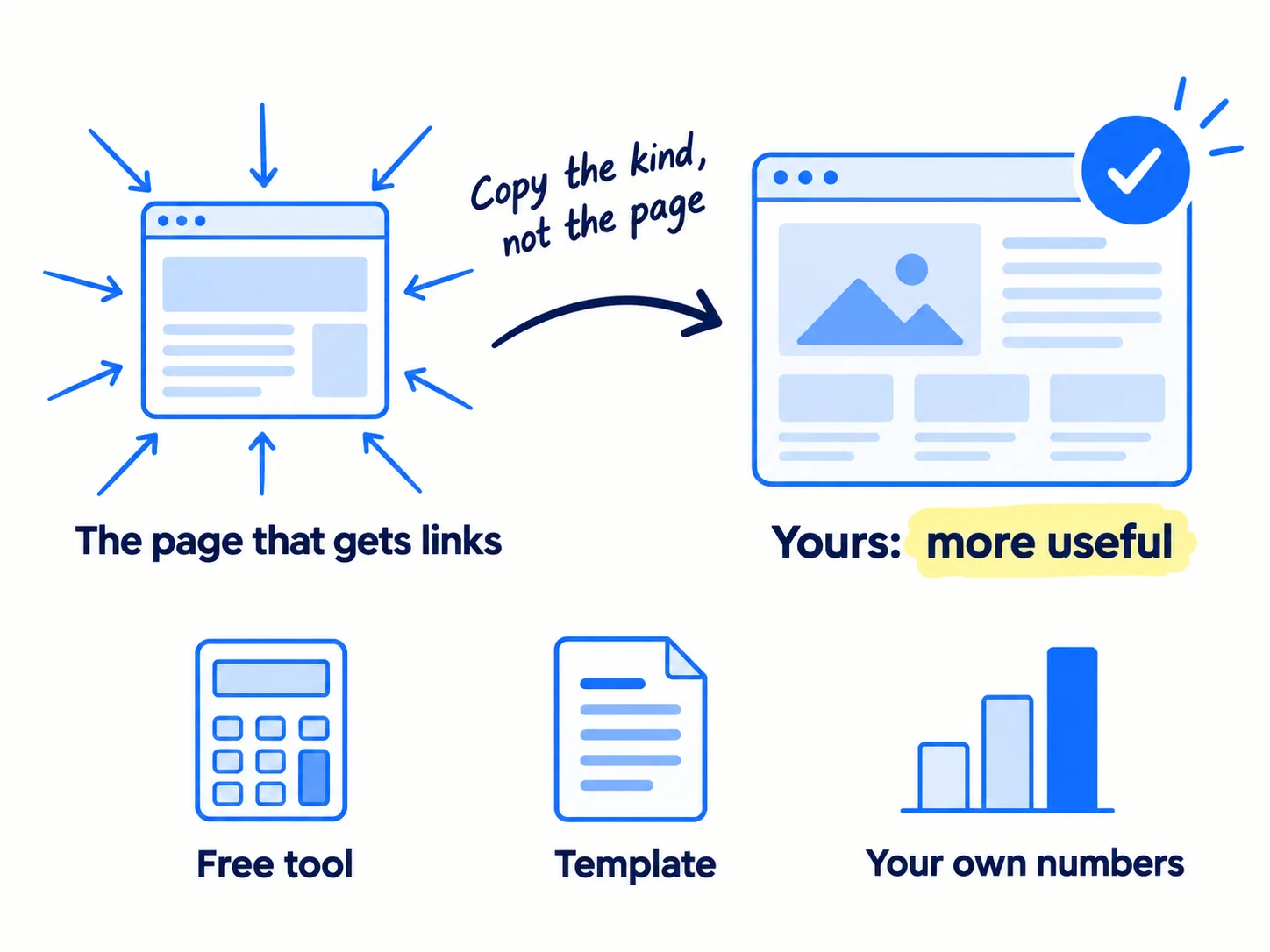
Find out what already earns links in your space. In your step 2 sheet, look at which competitor pages the links point to. The page that shows up most often is the kind of page your topic links to. Make your own version, better than theirs: newer, more complete, or easier to use. Put your own experience or numbers in it, because an AI Overview cannot copy that.
| If you run | Make this kind of page first |
|---|---|
| a SaaS | a free tool that does one small job your product does, such as a checker or a calculator |
| a B2B company | a price guide or a checklist with the real numbers from your quotes, such as "what [your service] costs in 2026" |
| a D2C store | a guide your buyers search for before they buy, with facts only you have, such as what is in your product and why |
| an agency | a free template your clients' buyers ask for, such as a content calendar or a report template |
Let AI do the first draft. ChatGPT or Claude can write the text of a guide or the code for a simple calculator page. You check every number and add what only you know. Answer the question on the first screen, and link to 2 or 3 of your other pages, as in writing a blog post that ranks.
- Tool: your site editor, and ChatGPT or Claude to draft.
- Time: 1 to 2 days, next to your first pitches.
- You will have: one page live on your site that a writer could link to as "a free [thing] for [your buyer]".
- It worked if: you can say in one sentence why a writer would link to your page instead of the one you copied, and the page is on Google after you request indexing in Search Console.
- Common mistake: a general post, such as "10 tips for [your topic]". AI answers already cover those, so writers have no reason to link to yours.
See it done: The page Quillfox made
Before
Our thoughts on SaaS content marketing
After
Free content calendar template for SaaS founders with no marketer
Why it works: The new title names a free thing SaaS founders need, and resource pages list free templates.
4. Send 100 backlink pitches a day and follow up up to 3 times
Send 100 personal emails a day to the sites on your list. Each one offers something the site's readers want. Asking for a link without giving anything gets ignored. Offering a finished fix or a useful article often gets a yes.
![A tall stack of message cards labelled '100 pitches a day'. The front card reads 'Hi [name], I read [your page]. [One useful thing for your readers].' Five tags beside it: 'Guest article', 'Broken link', 'Resource list', 'Mention', 'Podcast'. Handwritten note: 'Give first, then ask'.](/academy/illustrations/how-to-get-backlinks-for-a-new-website/05-step-4.webp)
Match the pitch to the site. Your sheet already says which kind each site gets:
| Kind of pitch | When to use it | The line that changes |
|---|---|---|
| Guest article | The site takes guest articles | Three article ideas, each one a question their readers ask |
| Broken link | A page links to something that no longer works. Find it with the free Check My Links extension for Chrome | Which link is broken, where it is, and your page that could replace it |
| Resource list | A page lists helpful tools, guides or templates | Your step 3 page, and the one sentence on why it fits their list |
| Mention | A page names you but does not link. Set up a free Google Alert for your company name to find them | Thanks, and the address to link to |
| Podcast | A show interviews people like you | Two topics you can talk about, with one story each |
Let AI draft the pitches. Paste 10 rows from your sheet into ChatGPT or Claude at a time, each with the page and one thing you read on it, and the template below. Ask for one email per site. Read each draft, make the first line true and about that site, and check any broken link yourself. That is about 2 minutes a pitch, so 100 pitches take about 3 and a half hours. Hunter's 2026 report on 31 million emails found that cold emails asking for links get about 13 replies per 100 on average, and that emails to small, hand-picked lists got more than twice the replies of big blasts.
Subject: [their page title, or "your [topic] resources page"]Hi [first name],I read [their page]. [One true line about it: what you found useful or what you noticed.][The line for this kind of pitch, from the table: three article ideas / "The link to [thing] in the section [where] no longer works. My page [your page] covers the same thing and is up to date." / "I made [your step 3 page], a free [thing] for [their readers]. It might fit your list." / "Thanks for mentioning [your company]. Could you link it to [address]?" / two topics and a story each]If it's not a fit, no problem at all.[Your name]
[Your company, one line on what it does]
[Postal address] · Reply "no thanks" and I won't write again.
Follow up with everyone who has not replied, up to 3 times, 4 days apart, each time with one new line, such as a fourth article idea. Stop the moment someone says no. A yes to a guest article goes to step 5.
Send every email one at a time, from your own address. Do not use a bulk-sending tool. Gmail requires every sender to have SPF or DKIM, two settings that prove an email really comes from your domain, and wants spam reports below 0.3%. Ask your email host to confirm both are on. If you email more than about 50 strangers a day, set up a second domain for pitches and warm it up first, so your main email stays safe. While it warms up, send the rest of the 100 through the sites' contact forms and as messages to editors on LinkedIn and X, instead of sending fewer. In the US, the CAN-SPAM Act covers business email too: include your postal address and a way to say no, and honour a "no" within 10 business days. The UK and EU have their own rules, so check them before you write to sites there.
If you run a D2C store: do not send free products in return for a link. Google's spam policies name "sending someone a product in exchange for them writing about it and including a link" as link spam. You can send products to reviewers and creators with no strings attached, and ask them to mark any link to you as sponsored. Pitch holiday gift guides and product round-ups instead. SEO for a Shopify store covers the rest.
If you run an agency: do this for your own site first, then sell it. Never buy links for a client's site. It breaks Google's rules and the client pays for it. Once it works for you, you can sell it as an SEO service to your web design clients.
Pitches to journalists and news sites work differently, with requests from reporters and fast replies. That is its own job: how to get backlinks from news websites.
- Tool: your email (or a second domain), Check My Links, Google Alerts, and ChatGPT or Claude to draft. All free.
- Time: about 3 and a half hours a day for 100 pitches, plus 30 minutes for follow-ups.
- You will have: 100 pitches sent every day, each logged in the sheet with its kind and date.
- It worked if: after the first 700 pitches, at least 5 in 100 get a reply and at least 1 in 100 turns into a new site linking to you. Below that, rewrite the first two lines of the pitch before you send more.
- Common mistake: a pitch that is about you: "I'd love a backlink to boost my site." Say what their readers get. The other mistake is sending the same email to everyone. One true line about the site is what gets the reply.
See it done: Quillfox's guest article pitch
To: Priya, editor of a newsletter for SaaS founders
Subject: 3 article ideas for your founders' newsletter
Hi Priya,
I read your issue on pricing pages last week. The part about testing the price before the page was the most useful thing I've read on it this year.
I run marketing for early-stage B2B SaaS companies where the founder still does it all. Three ideas your readers might want:
- What to post on LinkedIn when you have no customers to talk about yet
- A content calendar for a founder with 5 hours a week
- How to tell in 30 days if a blog is worth keeping
If it's not a fit, no problem at all.
Jess Quillfox, marketing for early-stage SaaS [Postal address] · Reply "no thanks" and I won't write again.
Why it works: The first line proves they read the newsletter, and every idea is a question its readers already ask.
5. Write every guest post you are offered within 7 days
When a site says yes to a guest article, send the finished article within 7 days. Editors forget fast, and a quick, good article often gets you a second one.
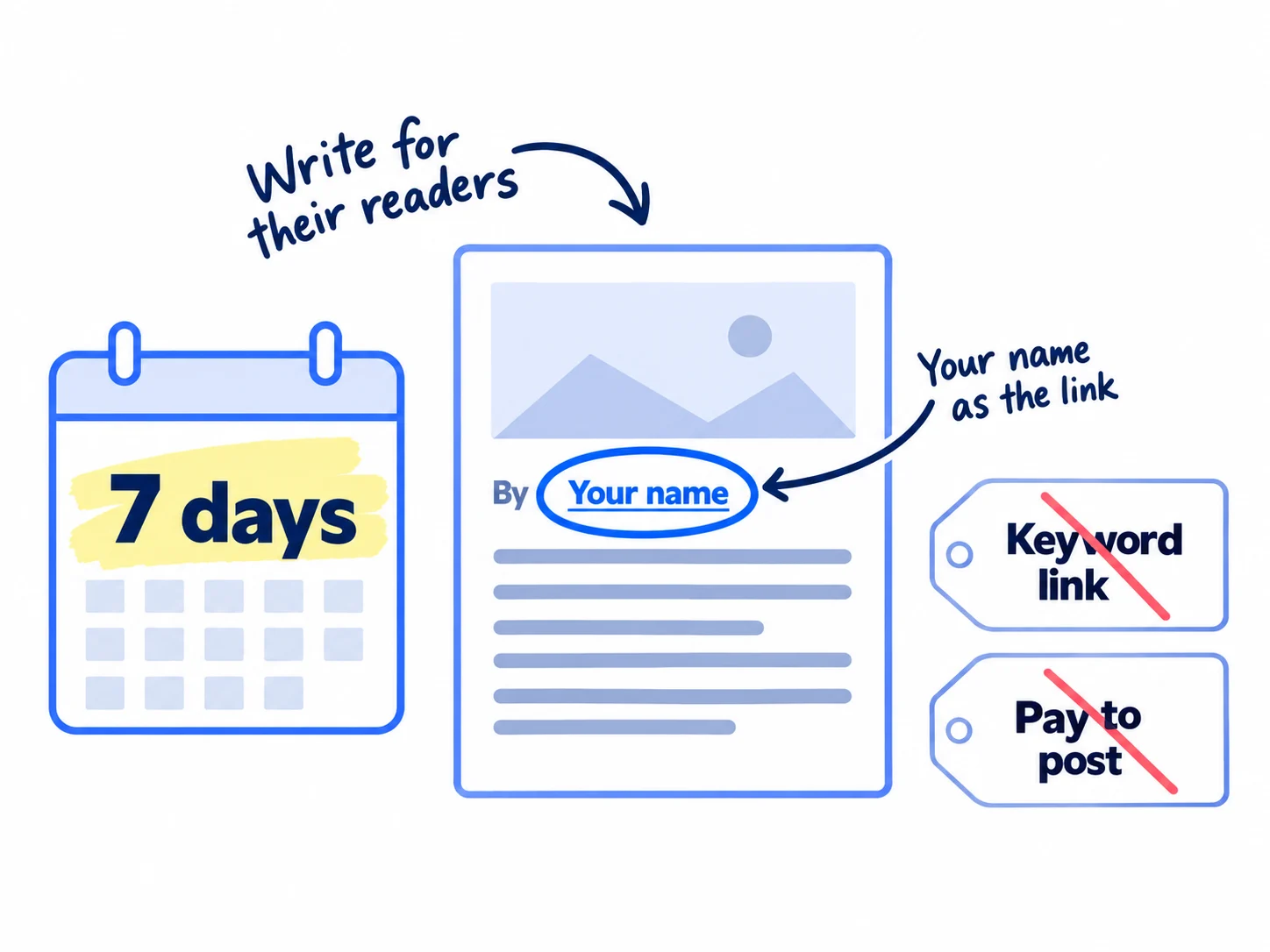
Ask the editor three questions before you write: how long, whether they allow a link in the body or only in the author line, and when they want it. Then write for their readers, not for your site. Give ChatGPT or Claude the title, the editor's rules and your notes, and ask for a first draft. Then put in your own experience: a real mistake, a number from your work, a step you do differently. That is the part the editor wants, and it is how you use AI for writing without sounding like everyone else.
Follow Google's rules on the link, or it can count against you:
- Link with your company name or the name of your page, not with the words you want to rank for. Google's spam policies name "links with optimized anchor text in articles, guest posts, or press releases" as link spam.
- One link to you is enough, in the author line or where it truly helps the reader.
- Never pay to be published. If the editor asks for a fee after all, say no thanks.
- Accept a nofollow link. The site still sends readers, and your name is still on the page.
When it goes live, open the page, click your link, and write the address in the sheet. Share it on your own channels and thank the editor with one more idea.
- Tool: ChatGPT or Claude to draft, Google Docs to send it.
- Time: about 2 hours an article: 20 minutes for the AI draft, 1 hour 40 minutes to add your own experience and edit.
- You will have: each accepted article sent within 7 days, and each live link in the sheet.
- It worked if: every article you send is published, and at least 1 in 3 editors asks for another or says yes to your next idea.
- Common mistake: sending a pasted AI article with nothing of your own in it. Editors can tell, and they stop replying.
6. Count your new backlinks every Sunday and move your pitches
Every Sunday, count how many new sites linked to you that week, and which kind of pitch won them. Put more of next week's pitches into the kind that wins the most links per 100.
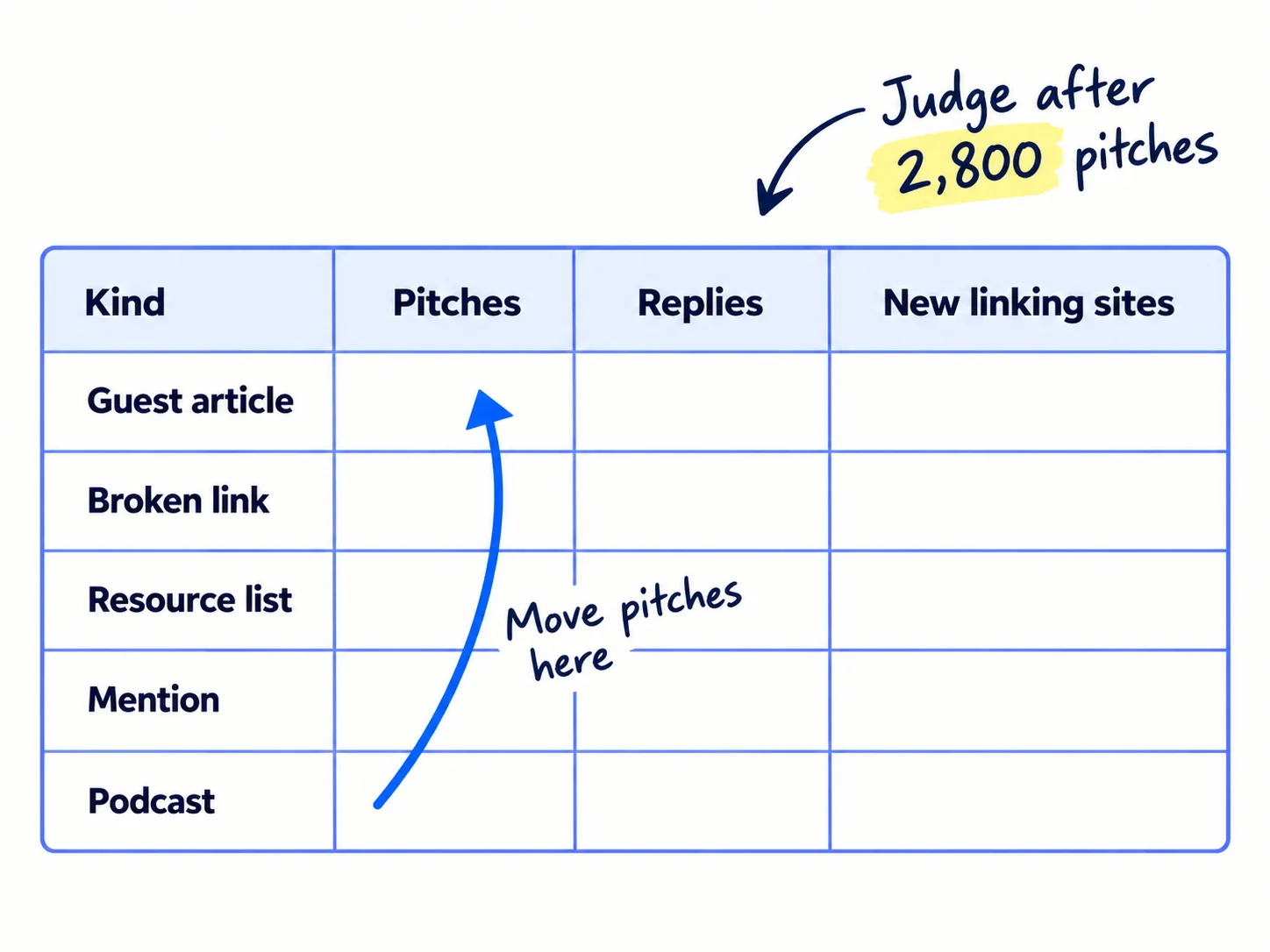
Fill one row for each kind of pitch from your sheet: pitches sent, replies, and new sites linking to you. The sheet is your real count, because you logged each link when it went live. Then open the Search Console Links report and look at "Top linking sites" under External links. It shows the sites Google has found so far. It is a sample, not every link, and it can take weeks to catch up, so a missing site there does not mean the link failed. If Search Console shows many of your own pages are not on Google, fix that first with the technical SEO checklist.
Also count mentions of your name, with or without a link. A May 2026 Ahrefs study of 75,000 brands found that mentions of a brand across the web and on YouTube track far more closely with showing up in AI answers than backlinks do. Ask ChatGPT your buyer's question once a month and write down who it names.
Week | Kind of pitch | Pitches sent | Replies | New sites linking | Mentions without a link | Guest articles due
Total pitches so far: [number] | New linking sites so far: [number] | Linking sites in Search Console: [number]
Use these decision rules:
-
After 700 pitches (1 week): fewer than 5 replies per 100 means the first two lines are the problem. Rewrite them and test the new version on the next 700.
-
After 2,800 pitches (4 weeks): stop any kind of pitch with 0 new links, and give its share to the kind with the most new links per 100. Keep at least two kinds running.
-
Every month: check your search results with the month-3 check in how long SEO takes. New links help most on pages that already sit on page 2, so update those pages too.
-
Tool: your Google Sheet and Google Search Console.
-
Time: 30 minutes every Sunday.
-
You will have: one row per kind of pitch each week, and a clear keep or stop for each kind after 2,800 pitches.
-
It worked if: you can say which kind of pitch wins the most links per 100, and next week's 700 pitches follow that.
-
Common mistake: judging by a "domain rating" score going up or down. It moves slowly and it is not Google's. Count linking sites, replies, and the visits and signups your pages get from search, with a "Where did you find us?" question on your form.
Your backlink checklist for a new website
0 of 11 done
Work through this list with an AI assistant
It drafts the work and keeps track of what is done.
Frequently asked questions
- How many backlinks does a new website need?
There is no fixed number. Search your main keyword and put the top 5 results into Ahrefs' free backlink checker. If they have links from 10 to 30 sites, you need a similar number of relevant sites, which is a few weeks of pitching at 100 a day. If they have hundreds, pick easier keywords first. Count linking sites, not links.
- Is it OK to buy backlinks?
No. Google's spam policies count "exchanging money for links, or posts that contain links" as link spam, and that includes paid guest posts and link packages. A paid link is only allowed if it is marked sponsored or nofollow, which means it passes no ranking credit. If you want paid help, pay for writing or outreach time, and read how to hire an agency without getting burned.
- Do nofollow links and links from Reddit help?
They help, but not as ranking credit. Google says links marked nofollow, sponsored or ugc are "generally not followed". They still bring visitors, get your name in front of buyers, and count as mentions. On Reddit and forums, answer the question first and link only where the rules allow; "forum comments with optimized links" are spam, and the rules for posting on Reddit without getting banned apply.
- Do I need to disavow toxic backlinks?
Almost never. Google says "most sites will not need to use this tool", and that you should only use it if you have many spammy links that caused, or will likely cause, a manual action. A new site with a few odd links has nothing to do. Using the tool by mistake "can potentially harm your site's performance".
- Do backlinks help you show up in ChatGPT and AI answers?
Somewhat, but mentions matter more. A May 2026 Ahrefs study of 75,000 brands found that mentions of a brand across the web and on YouTube track far more closely with AI visibility than backlinks. So every guest article, podcast and list that names you counts, even without a link. How to go further is in how to get your brand mentioned by ChatGPT.
Sources
- 1.Spam policies for Google web search: link spam — Google Search Central, updated 28 August 2026
- 2.Qualify your outbound links to Google — Google Search Central, updated 10 December 2025
- 3.Link best practices for Google — Google Search Central, updated 10 December 2025
- 4.SEO Starter Guide — Google Search Central, updated 10 December 2025
- 5.Links report — Search Console Help, checked 30 September 2026
- 6.Disavow links to your site — Search Console Help, checked 30 September 2026
- 7.Google September 2026 Spam Update Is Rolling Out — Search Engine Roundtable, 24 September 2026
- 8.Email sender guidelines — Google Workspace Admin Help, checked 30 September 2026
- 9.CAN-SPAM Act: A Compliance Guide for Business — Federal Trade Commission, checked 30 September 2026
- 10.The State of Cold Email 2026 — Hunter, 2026, checked 30 September 2026
- 11.YouTube mentions are the top signal for AI brand visibility (Ahrefs study of 75,000 brands) — The Next Web, 27 May 2026
- 12.Free Backlink Checker — Ahrefs, checked 30 September 2026
- 13.Check My Links — Chrome Web Store, updated 25 September 2026
- 14.Create an alert — Google Search Help, checked 30 September 2026
- 15.How to Get Backlinks in 2026: 10 Tactics That Actually Work — Semrush, 22 April 2026
- 16.Honest question: we blog weekly, 0 technical errors, follow every SEO checklist, still stuck at DA 12 — Indie Hackers, 8 March 2026
- 17.Ask HN: How do new blogs break the backlink–indexing loop? — Hacker News, February 2026
Next article to read
How to get backlinks from news websitesOnce you have a few easy links, this shows how to earn stronger ones from the press.Read it nextRelated guides
- How to make an article rank higher on GoogleMake an article rank higher on Google: list the articles Search Console already shows at position 8 to 20, update 1 a day in about an hour with a title that answers the search, what the top 3 results miss, proof only you have and 3 internal links, and compare each one's numbers 4 weeks later every Sunday.
- How to submit your SaaS to directoriesSaaSSubmit your SaaS to directories in one week: write one listing kit, pick the 50 directories your buyers see on Google (starting with G2, Capterra, AlternativeTo and SaaSHub), submit 10 a day with a tracked link on each, ask every active user for a review, and count signups from each directory every Sunday.
- How to get booked as a podcast guestGet booked as a podcast guest with no audience or PR budget: write a guest page with 3 episode ideas and a 2-minute video, find and pitch 100 shows a day that reach your buyers with one true line about a recent episode, follow up twice, ask every host for 2 introductions, and count bookings and leads every Sunday.
- How to build a free tool that brings in leadsSaaSBuild a free tool that brings in leads for your SaaS: pick one job your product already does that people search for and ChatGPT cannot do in one reply, put it on your own site with no signup, send 100 people a day their own result, and count uses, emails and signups every Sunday.
Guides that link here
- How to submit your SaaS to directoriesSaaS
- How to make an article rank higher on Google
- How to get backlinks from news websites
- How to get your website indexed on Google
- How to build a free tool that brings in leadsSaaS
- How to get booked as a podcast guest
- How to add llms.txt and schema markup
- How to get on the "best of" lists AI tools cite
- How to get your products recommended by ChatGPTD2C
- How to write a case study
- How to get traffic to a new website for free
- How long does SEO take to work?
- How to do SEO for a Shopify storeD2C
- How to find keywords for SEO
- How to rank on Google Maps
- How to use Google Search Console
- How to write a blog post that ranks on Google
- How to write competitor comparison and alternative pages
- Technical SEO checklist for a new website
Cite this page
Dinesh Bypilla (2026). How to get backlinks for a new website. Scout7 Academy. https://scout7.ai/academy/seo/how-to-get-backlinks-for-a-new-website
Written by Dinesh Bypilla, Agentic systems engineer at Scout7. Reviewed by Murali Sid. Last checked 30 September 2026.
Quote any part of this guide with a link back to this page. © 2026 Scout7.
Markdown version of this page: https://scout7.ai/academy/seo/how-to-get-backlinks-for-a-new-website.md